Categories
31 Days to More Effective Compliance Programs

31 Days to a More Effective Compliance Program: Day 26 – CCO Authority and Independence

Welcome to a special podcast series on the Compliance Podcast Network, 31 Days to a More Effective Compliance Program. Over these 31 days of the series in January 2025, Tom Fox will post a key part of a best practices compliance program daily. By the end of January, you will have enough information to create, design, or enhance a compliance program. Each podcast will be short, at 6–8 minutes, and will include three key takeaways you can implement at little or no cost to help update your compliance program. I hope you will join us each day in January for this exploration of best practices in compliance.

On Day 26, we ponder the evolving stature and authority of the CCO within organizations, as highlighted by recent guidelines and regulations. The 2020 FCPA Resource Guide emphasizes the importance of the CCO’s direct reporting line to the board and senior management status. The DOJ’s updated Corporate Enforcement Policy has further enhanced the prestige and role of the CCO, introducing key factors like the quality, experience, authority, independence, compensation, and reporting structure of the CCO. The episode also touches on the significance of the Delaware Court of Chancery’s decision in the McDonald’s case, which formalized the oversight duties of corporate officers, positioning the CCO as the second-most important role in an organization. Key takeaways include demonstrating real authority for the CCO, evaluating their professional qualifications, and assessing their actual status within your company.

Key highlights:

  • Key Inquiries Around the CCO and Compliance Function
  • Importance of CCO Certification and Court Decisions
  • Critical Takeaways for Compliance Professionals

Resources:

Click here to receive a 20% discount on The Compliance Handbook, 5th edition, for listeners to this podcast.

Categories
31 Days to More Effective Compliance Programs

31 Days to a More Effective Compliance Program: Day 25 – Responding to Investigative Findings

Welcome to a special podcast series on the Compliance Podcast Network, 31 Days to a More Effective Compliance Program. Over these 31 days of the series in January 2025, Tom Fox will post a key part of a best practices compliance program daily. By the end of January, you will have enough information to create, design, or enhance a compliance program. Each podcast will be short, at 6–8 minutes, and will include three key takeaways you can implement at little or no cost to help update your compliance program. I hope you will join us each day in January for this exploration of best practices in compliance.

On Day 25, we consider the critical importance of addressing investigative findings within a corporate compliance framework. When a whistleblower report, DOJ subpoena, or SEC notice brings compliance violations to light, it commands the board’s and senior management’s attention. The initial outrage and ethical proclamations that follow are often a prelude to the need for a serious reality check regarding costs and time outlays for remediation. The key is maintaining transparency and solid communication between those investigating and those responsible for remediation, ensuring compliance gaps are effectively identified and addressed. Today’s takeaways emphasize using the heightened attention for compliance improvement, recognizing the interplay between investigation and remediation, and being ready to answer the ‘where else’ question effectively. Join us tomorrow as we explore the authority and independence of Chief Compliance Officers.

Key highlights:

  • The Impact of Investigations on Compliance
  • Communicating Costs and Risks
  • Ensuring Effective Communication

Resources:

Click here to receive a 20% discount on The Compliance Handbook, 5th edition, for listeners to this podcast.

Categories
10 For 10

10 For 10: Top Compliance Stories for the Week Ending January 25, 2025

Welcome to 10 For 10, the podcast that brings you the week’s Top 10 compliance stories in one podcast each week. Tom Fox, the Voice of Compliance, brings to you, the compliance professional, the compliance stories you need to be aware of to end your busy week. Sit back, and in 10 minutes hear about the stories every compliance professional should be aware of from the prior week. Every Saturday, 10 For 10 highlights the most important news, insights, and analysis for the compliance professional, all curated by the Voice of Compliance, Tom Fox. Get your weekly filling of compliance stories with 10 for 10, a podcast produced by the Compliance Podcast Network.

  • Great risk for Germany to invest in China. (FT)
  • Vietnam dismantles AML ring. (Aljazeera)
  • Administration ramps up attacks on DEI . (NYT)
  • Ukraine chief psychiatrist arrested on corruption charges. (BBC)
  • Ex-Everton player and China coach jailed for bribery. (ESPN)
  • KPMG under FRC investigation yet again. (Bloomberg)
  • Tariff whiplash coming. (Bloomberg)
  • WFH not ‘real work’. (BBC)
  • More conflict mineral allegations against Apple from DRC. (FT)
  • Trash compliance-it’s a thing. (Gothamist)

For more information on the Ethico Toolkit for Middle Managers, available at no charge, click here.

You can check out the Daily Compliance News for four curated compliance and ethics-related stories each day here.

Connect with Tom 

Instagram

Facebook

YouTube

Twitter

LinkedIn

Categories
Creativity and Compliance

Creativity and Compliance – Creative Approaches to Corporate Compliance with Tyson Avery

Where does creativity fit into compliance? In more places than you think. Problem-solving, accountability, communication, and connection – they all take creativity. Join Tom Fox and Ronnie Feldman on Creativity and Compliance, part of the award-winning Compliance Podcast Network.

Ronnie’s company, Learnings, and Entertainment, utilizes the entertainment devices people use to consume information in their everyday, non-work lives and apply it to important topics around compliance and ethics. It is not only about being funny. It is about changing the tone of your compliance communications and messaging to make your compliance program, policies, and resources more accessible. In this episode of Creativity and Compliance, host Tom Fox and Ronnie Feldman are joined by Tyson Avery, the former Chief Ethics Compliance Officer at Starbucks and current Deputy General Counsel and Compliance Officer for Lucid Motors.

They discuss innovative strategies to make ethics and compliance engaging within organizations. Tyson shares insights into how he has leveraged creative methods to make serious compliance topics more relatable and accessible, emphasizing the importance of aligning corporate values with effective compliance programs.

One of the standout moments in the episode is Tyson’s recounting of the ‘Wally Awards,’ a unique initiative aimed at normalizing misconduct reporting and fostering a culture of transparency and trust. Through creative anonymization and employee engagement, the Wally Awards highlighted significant misconduct cases without compromising confidentiality, thereby encouraging ethical behavior across the company. The episode underscores the need for continuous, relatable, and engaging communications to embed compliance into the organizational culture.

Key highlights:

  • The Importance of Creativity in Compliance
  • Making Ethics Relatable
  • The Wally Awards: A Creative Compliance Initiative
  • Building Engagement and Trust
  • Advice for Implementing Creative Compliance

Resources:

Ronnie

Tom

Instagram

Facebook

YouTube

Twitter

LinkedIn

For more information on the Ethico ROI Calculator and a free White Paper on the ROI of Compliance, click here.

Categories
Blog

Lessons on Conducting Internal Investigations from Brazil

It is always gratifying when a reader calls you out for your podcasts and postings. It is even more so when your work inspires them to join in the conversation with a pod or post of their own. I was, therefore, very intrigued by Priscila Copi, who recently wrote on LinkedIn, “Inspired by an episode of Thomas Fox’s podcast and my own experience, I share best practices in internal investigations and the importance of well-structured protocols to strengthen organizational integrity.” In her piece, Internal Investigations Financial Market, she related that effective internal investigations are not just a cornerstone of a robust compliance program but a testament to an organization’s commitment to transparency, integrity, and ethical behavior. Today, I write about her thoughts on the key components of an investigative protocol, the importance of maintaining consistency across global operations, and some lessons we in the United States can draw from Brazilian regulatory frameworks and enforcement cases.

The Importance of Confidentiality, Transparency, and Impartiality

Copi reminds us that at the heart of every internal investigation lies a delicate balance: ensuring confidentiality for all parties involved while maintaining transparency and impartiality. This balancing act is vital for building trust within your organization and with regulators. Confidentiality ensures whistleblowers and witnesses feel safe to come forward without fearing retaliation. Transparency guarantees stakeholders, including employees and regulators, trust the investigation process. Impartiality ensures that the findings of the investigation will withstand scrutiny both internally and externally. These principles are not just ethical imperatives but essential for mitigating legal risks and protecting corporate reputation.

The Components of an Effective Investigative Protocol

It is no secret that well-structured investigative protocol is the backbone of a credible compliance program. Copi is kind enough to cite my five-step process that should form the foundation of any investigation:

  • Opening and Categorizing the Case

The process begins by identifying and categorizing the alleged violation. This step involves notifying relevant stakeholders, including senior management and the investigative team. Categorization determines the course of the investigation, helping allocate resources and ensuring alignment with regulatory requirements.

  • Planning the Investigation

In this phase, the investigative team develops a comprehensive plan, which may involve reviewing documents, quarantining data, and identifying individuals for interviews. Each step must adhere to strict evidentiary standards to ensure findings are admissible and defensible if challenged.

  • Executing the Investigative Plan

Execution should follow a logical sequence. For instance, document reviews should precede interviews, ensuring that interviewers are well-informed and can ask meaningful questions. This phase also requires meticulous documentation to create a clear audit trail.

  • Monitoring the Investigation

Monitoring ensures that the investigation stays on track and addresses all relevant questions. Preliminary findings should be reviewed to identify gaps or areas needing further clarification. Proper storage of evidence is critical to maintaining its integrity.

  • Closing the Case

The investigation concludes with the communication of findings to relevant stakeholders and the preparation of a final report. This report should include detailed documentation of all steps taken, ensuring consistency and materiality, especially if the findings are presented to regulators or used in litigation.

(Ed. Note: This original formulation came from a speech by Jacki Trevino and Jay Martin.)

Why Uniform Protocols Matter 

Copi reminds multinational American organizations that maintaining uniformity in investigative protocols is critical. A documented and standardized approach minimizes the risk of inconsistent findings, which can undermine the credibility of your compliance program. However, uniformity must be balanced with local adaptation. For instance, what works at headquarters may not be workable or appropriate for subsidiaries in jurisdictions with different cultural or legal norms. In such cases, close collaboration with local legal teams and alignment with headquarters is essential to maintain consistency and compliance with local laws.

Lessons from Brazil’s Regulatory Framework 

After setting the stage, Copi offers real guidance to North American compliance professionals by reviewing Brazilian anti-corruption law, key enforcement actions, and company responses. Brazil offers a compelling case study on the importance of robust investigative protocols, given its strong regulatory frameworks like the Anti-Corruption Law and sector-specific regulations enforced by entities such as the Central Bank of Brazil (Bacen), the Securities and Exchange Commission (CVM), and the Superintendence of Private Insurance (SUSEP).

1. Brazilian Anti-Corruption Law

This landmark legislation, the Clean Companies Act, emphasizes the importance of corporate integrity programs, which must include whistleblowing channels, investigative protocols, and employee training. Companies that show robust compliance measures may see reduced penalties in enforcement actions. Odebrecht entered into a leniency agreement under this law, which involved repaying embezzled funds and implementing stringent compliance measures. The case highlights how transparency and cooperation can mitigate reputational and financial damage.

2. Bacen’s Circular

The Central Bank’s regulations focus on preventing money laundering and terrorist financing. Financial institutions must implement detailed investigative protocols and ensure comprehensive documentation to identify and report suspicious activities.

Bacen’s intrusive inspections exemplify how regulators scrutinize compliance. Recent cases involving credit market fraud, misuse of foreign exchange transactions, and FinTech-related fraud underscore the importance of a robust investigative framework.

3. CVM and SUSEP Regulations

The CVM’s Instruction 607/2019 and SUSEP’s CNSP Resolution 382/2020 emphasize transparency, good governance, and whistleblower protections. Recent enforcement actions against XP Investimentos and ModalMais demonstrate the CVM’s commitment to holding companies accountable for infractions, such as front-running and inadequate disclosures.

Practical Takeaways for Compliance Professionals

What lessons can the American compliance professional draw from Copi’s experience and overview?

1. Invest in Investigative Training

Investigative protocols are only as effective as the people implementing them. Regular training for compliance teams, internal auditors, and other stakeholders ensures they understand their roles and responsibilities.

2. Leverage Technology

Technology can streamline investigations by automating document review and data analysis tasks. Advanced analytics can also identify patterns that may indicate misconduct.

3. Build a Culture of Integrity

An effective investigative process starts with a strong corporate culture. Encourage employees to speak up by fostering trust in whistleblowing channels and demonstrating that reports are taken seriously.

4. Document Document Document

Always remember, even in the international context, it never happens if it is not documented in a regulator’s eyes. This translates to detailed documentation that ensures consistency and serves as critical evidence in enforcement actions or litigation.

5. Adapt to Local Contexts

Tailor investigative protocols to align with local legal and cultural norms while maintaining overall consistency with global standards.

The Role of Leadership in Investigations

Leadership buy-in is essential for the success of any investigative process. Senior executives must set the tone from the top, demonstrating a commitment to transparency and accountability. This commitment ensures that investigations are adequately resourced and findings are acted upon regardless of the individuals or departments involved.

Internal investigations are more than just a compliance requirement; they reflect an organization’s ethical backbone. By adhering to best practices and learning from regulatory frameworks like those in Brazil, companies can ensure that their investigative processes address misconduct and foster a culture of trust and integrity.

Copi reminds us that a strong investigative protocol is not just about compliance but about building a sustainable and ethical business. By embedding these principles into your compliance program, you can confidently navigate the complexities of internal investigations, ensuring regulatory compliance and organizational resilience.


Categories
Business Integrity Innovations

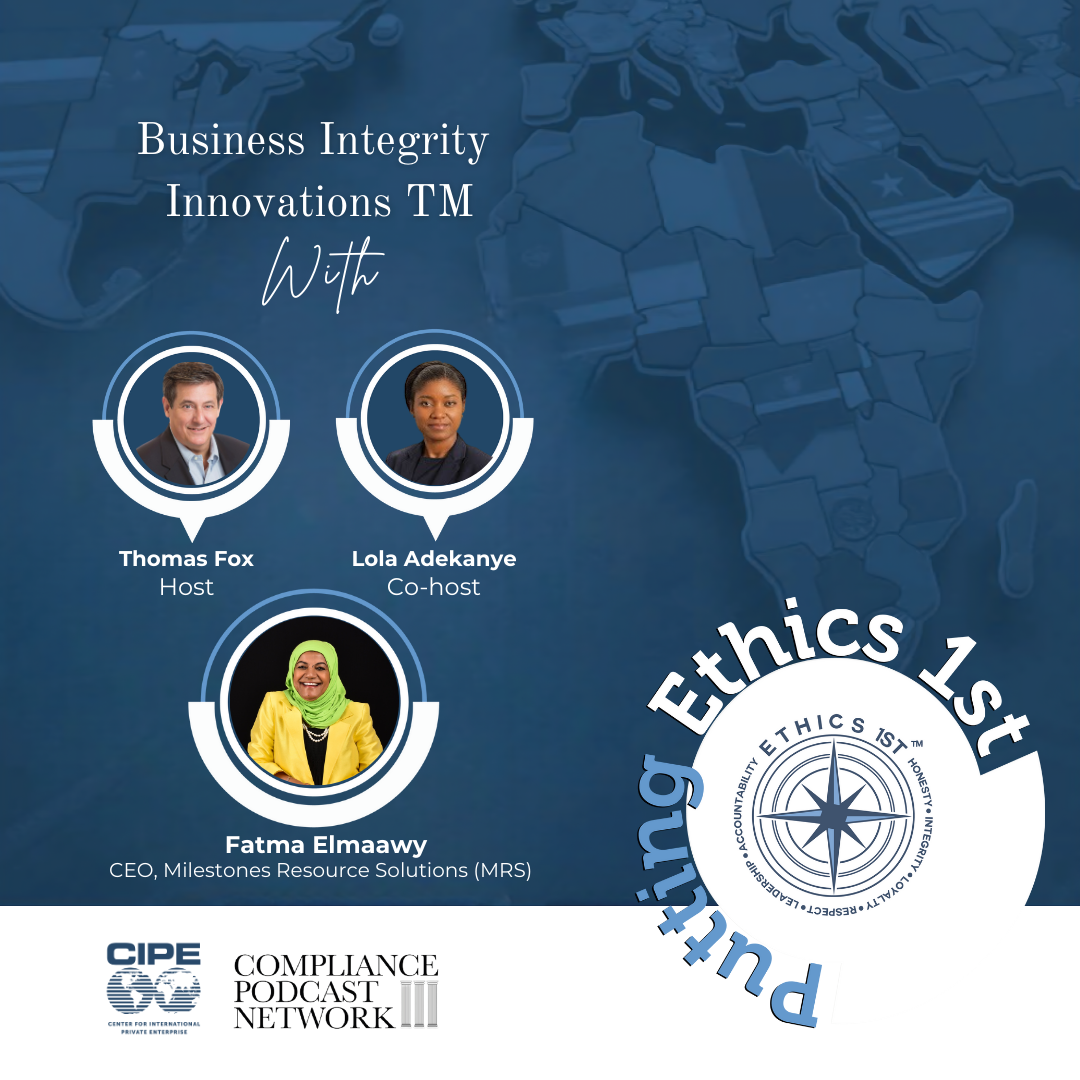
Business Integrity Innovations: Empowering SME’s Through Business Ethics with Fatma Elmaawy

Business Integrity Innovations is brought to you by the Center for International Private Enterprise (CIPE) and the Compliance Podcast Network (CPN). This podcast is inspired by Ethics 1st, a multi-stakeholder initiative led by CIPE that creates pathways for accountable and sustainable investment in Africa. Companies can use Ethics 1st to standardize their business practices, develop sound corporate governance systems, and demonstrate their commitment to compliance and business ethics.

In this episode of Business Integrity Innovations, host Tom Fox and co-host Lola Adekanye sit down with Fatma Elmaawy, founder of Milestones Resource Solutions, to explore her diverse professional background and journey into business ethics and compliance training. Fatma shares her experiences from working in various sectors, including airlines, to founding her own training company that initially focused on sales and customer service but eventually specialized in business ethics. She highlights the challenges SMEs face in environments where corruption is rampant and discusses practical solutions, such as mindset engineering and the three R’s approach (Response, Report, Review), to help businesses operate with integrity.

Fatma also touches on the importance of training the trainers to create a ripple effect of ethical practices within organizations and explains how pivotal leadership is in setting the tone for business integrity. The conversation further delves into the success stories of companies that have transformed their compliance cultures and shares strategies for leaders to embed ethical practices effectively.

Key highlights:

  • Fatma Elmaawy’s Professional Journey
  • Challenges and Realities of Business Ethics
  • Success Stories and Impact
  • Training the Trainers and Leadership
  • Practical Solutions and Collective Action

Resources:

Milestones Resources Solution

Categories
Blog

AI, Process Management, and Compliance

Integrating artificial intelligence (AI) and advanced analytics with robust process management principles can unlock new levels of efficiency and innovation. Mars Wrigley, the global confectionery leader, offers an instructive case study. In an article in the Harvard Business Review entitled, How to Marry Process Management and AI Thomas H. Davenport and Thomas C. Redman wrote that through its strategic deployment of AI to digitize its supply chain and manage operations, Mars Wrigley demonstrates how a systematic approach to process management can achieve significant improvements in operational performance, customer satisfaction, and sustainability.

Mars Wrigley’s success story holds valuable lessons for compliance professionals about aligning technology, data, and governance to enhance compliance frameworks and drive value across organizations.

Digitization and AI: The New Frontier for Process Management

Mars Wrigley began its journey by building a digital twin of its production line and feeding real-time operational data into machine-learning models. The results were striking. The company received predictive insights that reduced overfilling, minimized waste, and optimized supply chain processes. They partnered with vendors like Aera Technology for data visualization and preventive maintenance and with Kinaxis to balance supply and demand, automate invoices, and increase truck utilization by 15%.

This underscores a critical point from a compliance standpoint: Technology can only enhance compliance when processes are well-defined, integrated, and aligned with organizational goals. Compliance officers must recognize the potential of AI to streamline compliance monitoring, enhance risk detection, and reduce manual inefficiencies.

For example, consider AI tools that monitor high-risk transactions or flag anomalies in employee expense reports. When implemented in a robust compliance framework, these tools improve detection rates and allow compliance teams to focus on strategic initiatives rather than routine checks.

The Role of Process Management in Compliance

Process management is about understanding how tasks fit together to create a specific outcome and then optimizing those sequences. Put another way, it is about operationalizing compliance. Whether addressing department-level activities or end-to-end processes, process management principles can yield transformative results when applied to compliance. What are some of the ways process management can do so?

In areas as basic as error reduction, well-managed processes minimize compliance failures by reducing error rates and increasing consistency. A traditional compliance department area is cross-functional coordination with other corporate departments. Effective compliance requires breaking down silos, whether between legal, finance, HR, or operations, and aligning departments toward common objectives.

This approach can also positively impact corporate culture by increasing stakeholder buy-in and employee engagement. Process management often conflicts with hierarchical management structures. In compliance, this tension may manifest when reconciling DOJ mandates with operational priorities in your organization. Persuading stakeholders to prioritize compliance demands strong leadership and effective change management.

AI and Process Management: A Compliance Blueprint

AI supports specific subprocesses within larger workflows, but true transformation occurs when organizations integrate these capabilities across end-to-end processes. For compliance professionals, this is a roadmap for embedding AI into compliance programs.

Step 1: Establish Ownership

Every effective compliance initiative begins with clear accountability. A defined ownership structure underpinned Mars Wrigley’s digital twin success. Compliance programs require similar clarity. Appointing a “compliance process owner” ensures cross-functional alignment, while department-level compliance champions can coordinate implementation.

Step 2: Map and Redesign Processes

Mapping current compliance processes is essential for identifying inefficiencies. Process mining tools, which analyze enterprise system logs to identify bottlenecks, can uncover hidden risks. For instance, tracking the due diligence lifecycle in third-party onboarding can reveal inefficiencies, such as delays in background checks or missed follow-ups.

Redesign efforts should prioritize risk-prone areas, leveraging AI tools to streamline activities like transaction monitoring, policy distribution, and whistleblower case tracking.

Step 3: Define Metrics and Set Targets

Compliance performance must be measurable. Metrics such as incident resolution times, training completion rates, and risk assessment quality should guide process improvements. AI enables real-time metrics monitoring, providing insights that compliance officers can act on immediately. Mars Wrigley’s use of analytics to improve truck utilization offers a parallel for compliance: by tracking resource allocation, compliance teams can reduce unnecessary costs while ensuring optimal coverage of risk areas.

Step 4: Leverage Technology and Data

AI tools such as robotic process automation (RPA) and natural language processing (NLP) are increasingly used in compliance programs to automate routine tasks. RPA can streamline repetitive activities like generating regulatory reports. NLP can analyze large volumes of text, such as contracts or policies, to identify risks or inconsistencies.

Compliance professionals must also advocate for standardized data practices. As Mars Wrigley’s case illustrates, data silos impede process efficiency. In compliance, inconsistent data can obscure risks, making standardized data governance a cornerstone of effective compliance.

Step 5: Foster a Culture of Continuous Improvement

AI and process management are not “set it-and-forget it” solutions. As Mars Wrigley demonstrated, continuous monitoring and iterative improvements are critical for sustaining gains. This means regularly reviewing and updating AI tools for compliance professionals to address emerging risks and regulatory changes.

Lessons for Compliance Professionals

Mars Wrigley’s journey highlights several key takeaways for compliance leaders:

  1. Invest in AI Thoughtfully. Technology is not a silver bullet. Its effectiveness depends on how well it integrates with and supports compliance processes.
  2. Adopt a Holistic View of Compliance. Compliance risks rarely confine themselves to one department. Breaking down silos through cross-functional process management improves visibility and reduces risk.
  3. Prioritize Data Governance. High-quality, standardized data is essential for both AI and compliance. Without it, even the best tools cannot deliver meaningful insights.
  4. Embrace Change Management. As with Mars Wrigley’s digital transformation, compliance process improvements require buy-in from leadership and employees.

The Compliance Call to Action

Compliance has been reactive for too long, focusing on addressing failures rather than preventing them. Integrating AI into process management offers an opportunity to shift that paradigm. By combining the best of technology and process management, compliance programs can reduce risk and enhance business value.

Mars Wrigley’s success story reminds us that the tools and strategies to transform compliance are available—but the onus is on compliance professionals to lead the charge. Whether through smarter risk management, better stakeholder engagement, or innovative technology adoption, the path forward is clear: process management and AI are not just operational tools; they are the future of compliance.

Now is the time to act. By adopting process management principles and leveraging AI, compliance leaders can build programs that are not only effective but also resilient, sustainable, and aligned with organizational goals. The question is no longer whether compliance should embrace these tools but how quickly they can integrate them into their processes.

By learning from companies like Mars Wrigley, compliance professionals can reimagine their programs, aligning them with the business’s needs while staying ahead of regulatory requirements.

Categories
31 Days to More Effective Compliance Programs

31 Days to a More Effective Compliance Program: Day 22 – Levels of Due Diligence

Welcome to a special podcast series on the Compliance Podcast Network, 31 Days to a More Effective Compliance Program. Over these 31 days of the series in January 2025, Tom Fox will post a key part of a best practices compliance program daily. By the end of January, you will have enough information to create, design, or enhance a compliance program. Each podcast will be short, at 6-8 minutes, and will include three key takeaways you can implement at little or no cost to help update your compliance program. I hope you will join us each day in January for this exploration of best practices in compliance.

On Day 22, we consider the levels of due diligence you should use when investigating third parties. Tom outlines the three due diligence levels necessary to manage corruption risk effectively. With insights from Candice Tal, founder and CEO of Infortal, Tom breaks down each level in detail, from initial screenings in level one to comprehensive, on-the-ground investigations in level three. He emphasizes the need for tailored approaches based on the risks associated with different business transactions and the importance of thorough documentation throughout the process.

Key highlights:

  • What are the levels of Due Diligence?
  • When is each level appropriate?
  • Key Takeaways

Resources:

Click here to receive a 20% discount on The Compliance Handbook, 5th edition, for listeners to this podcast.

Categories
Great Women in Compliance

Great Women in Compliance – The Future of the Profession

It’s a new year and a new administration.  Listen to two experts talk about what their crystal balls reveal about the profession’s future and how #Ethics and #Compliance professionals should prepare for what may lie ahead.

🎧 Listen to the full episode here.

In this #GWIC roundtable podcast, @Lisa Fine and @Ellen Hunt talk with our guests about:

  • What characteristics make ethics and compliance professionals and their programs succeed?
  • The potential impact of technology and #AI.
  • How we might bridge the divide between the U.S. and the EU regarding #DEI and ESG.
  • The most insightful results of @ECI’s Global Business Ethics Survey and @Navex’s benchmarking surveys.

Thanks, as always, to our sponsor, #Corporate Compliance Insights, and our wonderful #GWIC community. You can join the Great Women in Compliance community on LinkedIn here.

Categories
Blog

Top Compliance Leadership Skills for the Wild Wild West that is Coming – Part 3, Humor

This week, the world changed when Donald Trump was inaugurated as the 47th President of the US. Indeed, the only thing I can guarantee with complete certainty is change. I was therefore intrigued by Melissa Swift’s recent MIT Sloan Business Review article, “Three Nonnegotiable Leadership Skills for 2025.” In this week of change, I cannot think of a more prescient article for the compliance professional.

I adapted Swift’s three critical leadership skills for the compliance professional: fairness, curiosity, and a sense of humor. In this concluding blog post of this three-part series, I will explore how compliance leaders can develop and leverage these skills to strengthen their programs and inspire their teams throughout the tumultuous next four years using humor.

Your Saving Grace: Sense of Humor

As Ronnie Feldman continually reminds us, do not be “Debbie Downer,” or as I would say, do not be Dr. No from the Land of No. In some ways, Ronnie focuses on attitude, while I tend to focus a bit more on the message. However, you might look at it. Between audits, policy rollouts, regulatory updates, and managing the risk employees inevitably want to take, a sense of humor is a powerful tool for staying grounded and maintaining perspective.

It is important to note that you need the right kind of humor for compliance leadership. This does not mean you should become the office comedian. Instead, humor in compliance leadership is about finding light in challenging situations and encouraging your team to do the same. For example, after navigating a tough audit and telling your team, “Well, we survived—and I didn’t even need to bribe anyone with donuts this time!” That simple quip can diffuse tension and signal that it’s okay to exhale.

The humor in your attitude and what you can bring to your customer base. Humor can reduce stress. Compliance work often operates under tight deadlines, high stakes, and relentless scrutiny. This pressure can weigh heavily on teams, leading to burnout and diminishing productivity. A leader who uses humor to lighten the mood helps to ease stress, making the workplace feel less like a pressure cooker and more like a place of collaboration and problem-solving.

Humor can help to build relationships, as compliance leaders often face the challenge of appearing approachable while maintaining authority. Humor humanizes leaders, making them more relatable and easier to connect with. When you can laugh at yourself or acknowledge the absurdities of compliance work with a smile, your team feels more comfortable sharing ideas, asking questions, and raising concerns.

Humor can make you a better compliance officer. When people are less stressed, their creativity and problem-solving abilities improve. Humor reduces the brain’s fight-or-flight response, allowing for more thoughtful and innovative approaches to challenges. A leader who fosters an environment where it’s okay to laugh at setbacks or unexpected hurdles creates a culture where solutions flow more freely. For example, if a compliance initiative hits a snag, a leader who can frame it with humor, “Okay, so maybe this isn’t Plan A…or Plan B…but I have high hopes for Plan C!” encourages the team to stay flexible and keep brainstorming.

The Right Kind of Humor for Compliance Leadership 

Humor in compliance leadership is not about cracking jokes or becoming the office comedian. Instead, it is about using levity strategically to foster positivity and resilience. Some key principles are as follows:

  1. Diffuse Tension, Don’t Deflect Responsibility. A well-timed, self-deprecating comment can make you more relatable, but humor should never be used to deflect accountability. For example, if a compliance policy rollout faces delays, saying, “Looks like my time management skills could use some compliance training of their own!” shows humility without shirking responsibility.
  2. Celebrate Compliance Wins Playfully. Recognizing team achievements doesn’t have to be dry or overly formal. Use humor to make celebrations memorable. Consider giving out light-hearted awards like “Most Persistent Policy Enforcer” or decorating the office with “Mission Accomplished” banners after a successful audit. These small gestures show appreciation while keeping the mood light.
  3. Maintain Perspective. Compliance is serious work, but that does not mean you must take every situation or yourself too seriously. Laughing at the absurdities of navigating complex regulations or managing a mountain of policies reminds your team that, while the work is important, it’s okay to have a sense of humor about the challenges.

Applying Humor to Compliance Challenges in 2025

Humor is not simply a feel-good tool. It can be strategically applied to some of the most pressing challenges compliance professionals face in 2025.

  • Building Ethical Cultures Amid Workforce Discontent

With employee engagement at a low and workplace polarization on the rise, leaders must model fairness and transparency to rebuild trust. Humor can complement these efforts by making leaders more relatable and approachable. For example, during a town hall on compliance updates, opening with a light joke about the complexity of the latest regulations, “I think the word paid the lawyers who wrote this!” can put employees at ease and make the session more engaging.

  • Navigating Emerging Risks

As AI, ESG, and privacy dominate the compliance agenda, staying ahead of these risks requires proactive engagement and innovation. Humor can make daunting challenges feel more manageable. For example, when introducing training on AI ethics, a leader might quip, “Don’t worry, our goal is to make sure the robots are working for us, not the other way around!” This approach encourages curiosity and open-mindedness.

  • Managing Regulatory Fatigue

As regulations grow more complex, compliance fatigue becomes a real risk for teams. Or, as the Trump Administration whipsaws the business communities with new mandates morning, noon, and night, business and compliance leaders who inject humor into routine tasks, like creating a fun, interactive quiz for compliance training or adding light-hearted captions to a policy presentation, can make the work feel less monotonous. A leader who acknowledges the challenges with humor, such as “Regulatory updates: the gift that keeps on giving!” helps your compliance team feel seen and supported, even as they tackle challenging workloads.

How to Integrate Humor Into Your Leadership Style

If you’re ready to harness the power of humor in your compliance leadership, here are some practical tips:

  1. Know Your Audience. Tailor your humor to your team’s preferences and sensitivities. Avoid sarcasm or jokes that could be misinterpreted.
  2. Start Small. During meetings, test the waters with light-hearted comments or anecdotes. Observe how your team responds and adjust accordingly.
  3. Encourage Teamwide Levity. Create a culture where humor is welcomed. For example, designate a “fun committee” to plan occasional light-hearted activities, like a compliance trivia game or themed office decorations.
  4. Keep It Contextual. Use humor to enhance, not detract from, the seriousness of compliance work. Acknowledge the gravity of issues like regulatory violations while using humor to build resilience.

The Bottom Line: Humor as a Leadership Strength

In 2025, compliance leaders will face mounting challenges, from increasing regulatory complexity to employee disengagement to a more focused enforcement presence in some verticals. A sense of humor can be your secret weapon for gracefully and effectively navigating these difficulties.

By reducing stress, building connections, and fostering creative problem-solving, humor enhances your leadership and the overall resilience of your compliance team. Remember, humor doesn’t diminish the importance of your work; it underscores your ability to lead with empathy, perspective, and authenticity.

In the high-stakes world of compliance, laughter truly is a saving grace. So, the next time you find yourself knee-deep in regulatory updates or preparing for a strict audit, don’t forget to take a moment to smile, laugh, and remind your team that even in the most serious work, a little levity goes a long way.