Dive into the world of compliance and high-stakes investigations!
In this episode of #GWIC, Hemma Lomax talks with Jamie Hoxie Solano, Partner at Dynamis LLP and former federal prosecutor, about how compliance and legal teams can lead with precision when incidents become investigations—especially where cyber risk and digital assets raise the stakes and the speed.
We cover:
What prosecutors look for when assessing credibility and cooperation
The “first 72 hours” of an internal investigation: triage, scope, evidence, and governance
Why cyber and digital assets matter in changing the evidence trail and the decision timeline
How to protect privilege while still moving fast
Practical guidance for cross-functional leadership under pressure
Jamie’s Bio
Jamie Hoxie Solano is a Partner at Dynamis LLP and a former federal prosecutor. She represents individuals and companies in high-stakes matters spanning government and internal investigations, white-collar and regulatory defense, and cybercrime and digital asset disputes.
Before returning to private practice, Jamie served as an Assistant U.S. Attorney in both the Northern District of Texas and the District of New Jersey, working in units including cybercrime and national security, and serving (among other leadership roles) as the Digital Asset Coordinator for the District of New Jersey.
She is also an adjunct professor at Seton Hall Law School, where she teaches Persuasion and Advocacy.
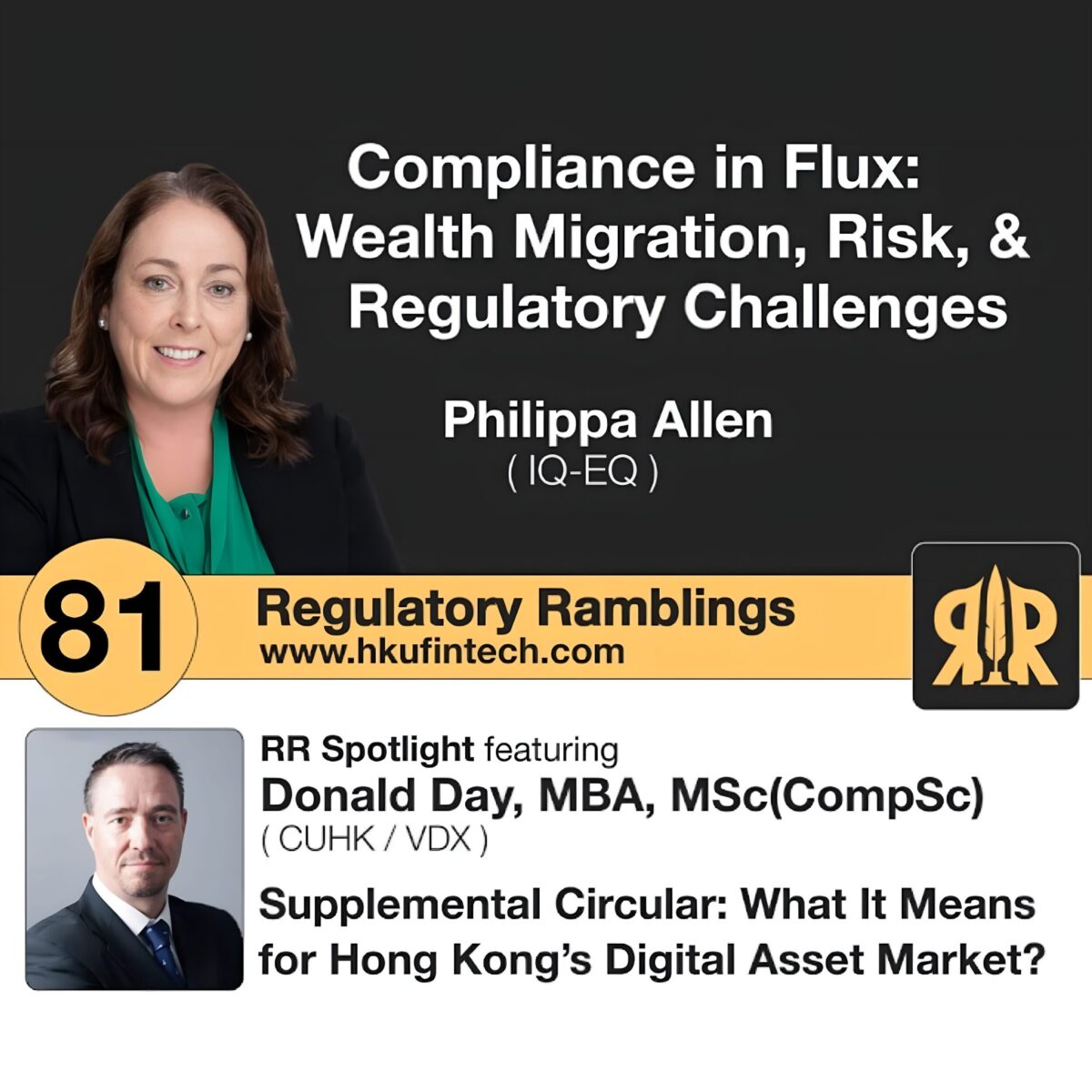
Today’s podcast begins with a brief discussion in our spotlight segment featuring a returning guest, Donald Day of VDX, on the Securities and Futures Commission (SFC) and the Hong Kong Monetary Authority’s (HKMA) newly issued supplemental circular, which updates the framework for intermediaries’ virtual asset activities.
Following that, we chat with Philippa Allen of IQ-EQ about the compliance implications of a large number of high-net-worth mainland Chinese individuals parking their funds – and, all too often, themselves and their families – in Singapore in recent times, especially since the pandemic.
Biography:
Donald Day is the Chief Operating Officer of VDX, a fintech startup in Hong Kong committed to building a digital asset ecosystem for institutional investors. He was previously the SFC’s in-house crypto expert at the SFC, Hong Kong’s capital markets regulator, where he helped shape the licensing regime for virtual asset trading platforms and designed and led the supervision of virtual asset fund managers and trading platforms.
Donald is a veteran of Deutsche Bank and Accenture. He was a co-founder, partner, and CTO at Bletchley Park Asset Management, an institutional-grade crypto hedge fund where he led systematic portfolio management.
Having served many roles at brokerage houses and hedge funds, including as COO of Qantex, a pan-Asian OTC derivatives brokerage, as a Delta-1 trader at Segantii, a multi-strategy hedge fund, and as a quantitative strategist and trader at Deutsche Bank. He began his career in Accenture’s capital markets practice, where he helped design and build world-class trading systems for some of the largest equity and derivatives exchanges.
Donald holds an MBA from the London Business School and a master’s degree in computer science from LMU University Munich.
Philippa Allen is the managing director of Regulatory Compliance, Asia at IQ-EQ. A compliance veteran, she has over 30 years of extensive experience in business and regulation across Asia.
She founded ComplianceAsia Consulting in early 2003. ComplianceAsia has been a part of IQ-EQ since August 2023. Previously, Philippa served as the head of compliance for the Asia-Pacific region at Dresdner Bank, based in Hong Kong, and at GT Asset Management (now part of LGT Asset Management). She was one of the drafters of the original Fund Manager Code of Conduct for Hong Kong’s SFC, and is involved in numerous submissions to regulators and lobbying efforts with financial industry bodies.
She graduated from the University of Western Australia with a Bachelor of Jurisprudence and Bachelor of Laws (LLB) degree. Upon graduation, she commenced practice as a barrister and solicitor for Freehill Hollingdale and Page, in Perth, Western Australia.
Philippa is also a frequent speaker at financial industry conferences and technical panels, and a member of various industry representative bodies, including the Asia Securities Industry & Financial Markets Association, the Hong Kong Venture Capital Association, AIMA, SFAA, and SVCA.
Discussion:
Our initial spotlight segment begins with reference to a recent LinkedIn Post authored by Don, entitled Hong Kong Raises the Bar in Digital Finance. He praised the SFC and HKMA’s recent circular update on the territory’s framework for intermediaries engaged in virtual asset activities.
Key changes include permitting licensed firms to offer staking services, as well as “use off-platform execution channels, and facilitate subscriptions/redemptions in virtual assets, giving institutions and investors greater flexibility. At the same time, retail clients remain protected through knowledge tests, suitability checks, and strict custody standards,” Don said, stressing that protection of retail customers was a key goal.
Emphasizing his optimism for the territory’s prospects to Regulatory Ramblings host Ajay Shamdasani, Don noted that such updates “show how Hong Kong is balancing innovation with trust, reinforcing its role as a leading global hub for regulated digital assets and institutional adoption.”
Don pointed out that Appendices A and B of the circular provide the updated licensing and compliance terms.
“These refinements balance market development with safeguards, further cementing Hong Kong’s role as a global hub for regulated digital assets,” he said.
Don concludes his remarks by stating that the right balance has been struck between market development and adequate guardrails, while also providing room for growth and innovation in Hong Kong’s digital assets market and promoting its position as a well-regulated global hub.
Following that, we speak with Philippa, who shares a bit about her personal and professional background, telling us about her roots in Australia, what drew her to the legal profession, and ultimately, to careers in compliance, consulting, and entrepreneurship.
We then delve into the rapid increase in wealth within post-pandemic Singapore – particularly from the arrival of wealthy mainland Chinese high-net-worth individuals (HNWIs) – and what that has meant for greater regulatory scrutiny in the Lion City’s private banking, wealth management, and family office sectors. Against this backdrop, Philippa shares her impressions of Singapore’s evolving regulatory landscape, the importance of robust compliance, and how firms can proactively adapt their strategies to navigate heightened expectations, while also maintaining client trust and operational excellence.
The discussion then turns to how HNWIs from mainland China often have ties to the government. Philippa remarks on when individuals should be presumed to be politically exposed persons (PEPs), what risks being a PEP entails, and when a former PEP is no longer considered to be such. As she stresses, the label and designation should not be applied expansively.
The conversation concludes with Philippa commenting on the efficacy of the UK’s Financial Conduct Authority’s (FCA’s) recently opened APAC office in Australia.
Regulatory Ramblings podcasts is brought to you by The University of Hong Kong – Reg/Tech Lab, HKU-SCF Fintech Academy, Asia Global Institute, and HKU-edX Professional Certificate in Fintech, with support from the HKU Faculty of Law.
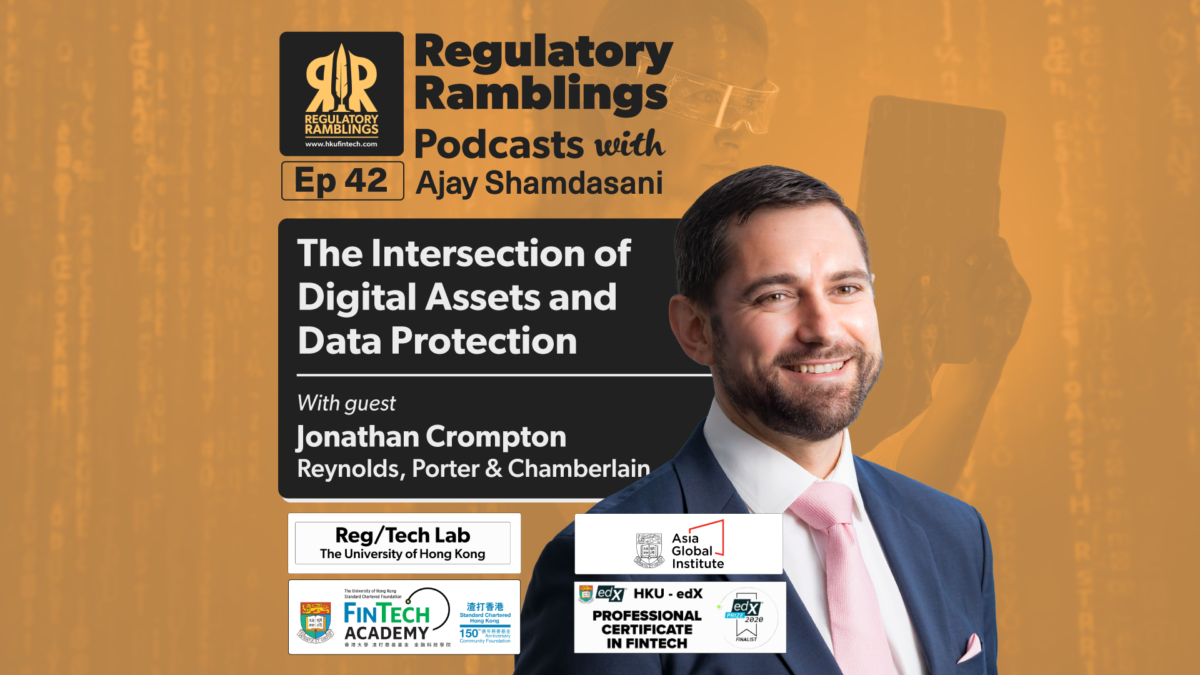
Jonathan Crompton is a partner at the law firm Reynolds, Porter & Chamberlain (RPC), based in Hong Kong. There, he helps companies and individuals navigate complex cross-border disputes and investigations involving their Asian operations. He specializes in commercial matters (particularly for the retail industry), financial services, technology-related disputes, and cyber incidents.
As the lead for RPC’s ‘ReSecure’ cyber incident response service in Asia, he advises local and multinational clients on cyber-attacks, data privacy, and law enforcement investigations. He also helps clients worldwide recover money transferred to Hong Kong bank accounts as a result of cyber and other frauds.
Jonathan advises on all forms of disputes, including litigation before national courts and arbitral tribunals operating under various rules (in particular, the HKIAC, ICC, and UNCITRAL) and on investigations by regulators (notably financial services regulators such as the Securities and Futures Commission). His clients include senior individuals, asset managers, and leading multinational corporations and brands. As a result of RPC’s predominantly ‘conflict-free’ model for financial services disputes, Jonathan represents senior individuals and companies in claims brought by or against leading banks where other firms are often unable to act.
He is also a founding member of the Hong Kong chapter of the Crypto Fraud and Asset Recovery (CFAAR) network, the first global association for such professionals. The London chapter was launched in London in 2021, and the Hong Kong chapter was formed in August 2022.
In this episode of Regulatory Ramblings, Jonathan chats with host Ajay Shamdasani about his background, upbringing, and how he ended up in the legal profession. The bulk of the conversation, however, is devoted to data protection and digital assets, specifically the February raid of the offices of WorldCoin by the Hong Kong Office of the Privacy Commissioner (PCPD). They discuss the PCPD’s expression of concern about WorldCoin’s collection and storage of iris scans in exchange for its WorldCoin token (WLD).
As Jonathan points out, the case was a clear example of the increasing intersection of personal data protection principles and digital assets. The conversation also covers his recent LinkedIn post in which he stated that Privacy Commissioner Ada Chung’s action was further proof that she was flexing her existing powers—even before the amendments to the territory’s Personal Data (Privacy) Ordinance are expected to be enacted within the next year.
They also discuss the shape Jonathan envisages those amendments taking, the recent cases he has seen in his practice involving virtual assets, digital contracts, and cybersecurity, and related emerging methodologies, trends, and themes.
Podcast Discussion:
3:01 Journey from Military Roots to Legal Frontiers
11:00 Perspectives on Legal Specialization in the Virtual Asset Sphere
20:52 Understanding Cryptocurrency Fraud and Legal Challenges in Recovery
29:16 Assessing the Efficacy of Asset Tracing Rules in Cryptocurrency Fraud Cases
38:12 Money Mules, Cybercrime, and the Evolution of Financial Fraud
42:48 Complexities of Cybercrime and Deepfake Deception in Financial Fraud
45:29 Insights into Crypto Regulation and Risk Management from CFAAR
59:34 Intersection of Personal Data and Digital Assets: Insights from WorldCoin and NFTs
1:05:52 Personal Data Privacy: Insights into Legislative Amendments and Regulatory Enforcement in Hong Kong
1:17:01 Adapting Legal Careers to Emerging Technologies, Change and Uncertainty
Innovation comes in many areas and compliance professionals need to not only be ready for it but embrace it. One of those areas is telehealth and telemedicine. My guest in this episode is Chris Lehman, CEO at Safeguard Cyber who visits with me to discuss the challenges and importance of managing risk in digital compliance.
The conversation focuses on the shift in communication channels from email to platforms like Slack and social media, highlighting the human factor as the biggest risk in compliance strategies. Lehman emphasizes the need for companies to prioritize compliance and good corporate governance in these new communication channels. To manage risk, companies should treat digital compliance as a risk management process, gaining visibility into employee communication tools, establishing policies, training employees, and utilizing technology.
We also highlight the tension between compliance teams and line of business teams, emphasizing the need for compliance teams to be enablers and strategic partners. The conversation references recent SEC enforcement actions and the importance of taking action to enforce compliance. Overall, digital compliance and governance are crucial in the modern business landscape, and utilizing technologies like monitoring tools and natural language understanding can help businesses stay secure and compliant in the digital age.
Highlights Include:
· Safeguard Cyber: Securing Digital Communications
In this episode of the FCPA Compliance Report, I am joined by Keith Williamson and Henry Chambers, Managing Directors at Alvarez and Marsal. We look at the firm’s Threatscape Report. Highlights of this podcast include:
A. Threat 1-ABC Threats
Why do you see a potential increase in anti-corruption investigations?
In addition to the US under the FCPA, do you see other countries are actively assisting US authorities in ABC investigations?
The new DOJ Monaco Doctrine reinstate the Yates Memo and the DOJ focus on individuals. What does this mean for ABC investigations?
What are some of the key challenges in handling investigations in China?
How does this increase in ABC enforcement impact M&A?
B. Threat 2-Fraud and Digital Asset Fraud Threats
What are digit assets and digit asset fraud?
The US has not yet released many regulations regarding cryptocurrency. What is the role of other countries in such regulation, if any?
Why is the Ukraine war the first ‘digital asset war’?
How have the worldwide sanctions against Russia impacted the growth and use of digit assets?
What are the key controls and screen tools for digital assets that you advocate a company employ?
C. Threat 3-Data Privacy and Data Protection
What is the Personal Information Protection Law and how does it relate to the Chinese State Secrets and Data Security Laws?
How can a non-Chinese company get data out of China?
What are some of the key components of compliance program for this new law?
How does this new law impact investigations in China?
In this episode, Director of Registered Investment Company Services, Allison Fraser and Director of Broker-Dealer Services & Private Funds, John Gentile discuss the latest on digital assets and cryptocurrency. Are they considered securities, what does the SEC’s risk alert mean for digital assets, and how should investment managers be thinking about cryptocurrency trading and compliance?
About Our Guest Speakers:
Allison Fraser provides compliance consulting services to investment advisers, registered investment companies and private investment funds, including conducting annual compliance program reviews and testing, developing risk assessments and preparing for SEC examinations. She also assists clients with drafting policies and procedures and preparing regulatory filings. On behalf of, the Compliance Services division of CSS, Allison served as the Chief Compliance Officer for a family of alternative funds registered under the Investment Company Act of 1940. Prior to joining CSS, Allison served as a Senior Vice President of Compliance at Northern Trust Investments, Inc. (“NTI”), the asset management subsidiary of The Northern Trust Company. In this capacity, she managed and administered the compliance due diligence program for NTI’s Multi-Manager Solutions and Outsourced Chief Investment Officer businesses. Allison also was the Chief Compliance Officer of two registered funds of hedge funds advised by NTI as well as a member of the funds’ Pricing and Disclosure Committees. Before joining NTI, Allison served as the Compliance Director for General Motors Asset Management, where she assisted with the administration of the compliance program for this registered investment adviser.
John Gentile is responsible for overseeing various types of broker-dealer and investment adviser consulting engagements, including conducting SEC/FINRA internal control reviews, anti-money laundering testing, written supervisory policy and procedures testing, and other consultation services. John is a frequent speaker at industry conferences on various compliance topics, including “Effective Supervision,” “Large Firm Testing,” FINRA Supervisory Control Rules” and “Anti Money Laundering Requirements for Broker Dealers under the PATRIOT Act.” In 1987 John joined the SEC as a Securities Compliance Examiner, becoming a Branch Chief in 1991. He became Assistant Regional Director in 1993, supervising a team of 20 broker-dealer managers and examiners. He also planned and conducted financial, operational, and sales practice examinations of the largest broker dealers and was among those responsible for a review of hedge funds’ impact on broker dealer internal controls. Before joining the SEC, John was a Financial Damage Analyst with PaineWebber Inc. Most recently from 2000-2007 John was an Executive Consultant, Broker-Dealer Services, at National Regulatory Services. John has an MBA from Fordham University and a BS in Finance from Central Connecticut State University. From 1995 to 2002, John was also a member of the Securities Industry Continuing Education East Coast Content Committee.