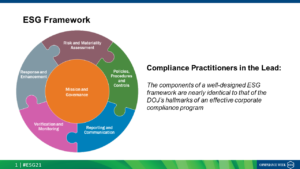
This week I will be considering the role compliance and a Chief Compliance Officer (CCO) should play in a corporate Environmental, Sustainable and Governance (ESG) program. Over this series, I will explore how the StoneTurn Group, LLP (StoneTurn) ESG Framework provides a structure through which any compliance professional can create an organization necessary for an ESG program. Today we take up ESG policies and procedures.
There are numerous reasons to put some serious work into your ESG policies and procedures. They are certainly a first line of defense when stakeholders coming knocking. Having ESG policies and procedures that outline responsibilities for compliance within the company, detail proper internal controls, auditing practices, and documentation policies are critical for public companies under ESG regulatory scrutiny. The Securities and Exchange Commission (SEC) and other regulators will take a strong view against a company that does not have well thought out and articulated ESG policies and procedures; all of which are systematically reviewed and updated. Moreover, having policies written out and signed by employees provides what some consider the most vital layer of communication and acts as an internal control. Together with a signed acknowledgement, these documents can serve as evidentiary support if a future issue arises. In other words, the “Document, Document, and Document” mantra applies just as strongly to this area of anti-corruption compliance.
Additionally, a company’s ESG policies provide a basic set of guidelines for employees and others to follow. ESG policies should give general prescriptions and should be supplemented by more specific procedures. By establishing what is and what is not acceptable behavior, a company helps mitigate the risks posed by employees who might not always make the right ESG choices.
Bryan J. Sillaman and Alexandra Poe, Hughes Hubbard & Reed LLP, in an article entitled Five Steps to Establishing a Corporate ESG Policy for the Present Moment, suggested that an organization should focus their ESG policies and procedures that are “applicable generally with respect to your industry and then with greater specificity to the conditions, operations and geographic footprint of your particular company.” In the area of Environmental, that could mean your organization’s “contribution to climate change, including energy use (such as its carbon footprint and use of clean energy), waste management, pollution, resource conservation, impact to habitats and environmental remediation.” From there you could consider if your organization has opportunities to promote positive change, in reducing “energy loads, expanding organic food production, or adopting technologies that repair environmental damage.” Moreover, with the passage of the Germany Supply Chain Act and other legislation such as the UK Anti-Slavery Act, both regulators and investors “want to see companies consider their own operations and impacts arising from your supply chain.”
In the prong of Sustainability, what are your policies and procedures around conduct that affects your organization’s relationship with human communities, from employees to customers and local communities where the company operates? Obviously, social justice is a key component, but it quickly expands out to working conditions, whether a state will provide basic social and healthcare services and employ health and safety. From there it can include such disparate topics as “childcare, education, equal opportunity, pay equity, financial inclusion, job creation and social justice. Companies that make products that have the potential to harm people, like guns, toxic materials, alcohol and other addictive substances, have special considerations in this regard.” But all companies must justify having physical operations in geographic locations which will not protect employees from mass shootings or even pandemic related threats such as Covid-19 to the Delta Variant.
In the area of Governance, compliance continues to play a key role. Here consider your organization’s policies and procedures “relating to regulatory compliance and the conduct of
officers and directors and the expectations of integrity set at the top of the organization.” The concerns are as varied as ranging from “accurate and transparent financial reporting, to executive compensation practices, diversity and inclusion, and avoidance of conflicts of interest, sexual harassment and corrupt practices.” Governance policies and procedures should also evaluate the “composition of a board of directors or executive teams, to assess whether representatives to those bodies are well suited to address concerns of all stakeholders and potential ESG risks.”
Cowen Inc. incorporated all of these concepts into its corporate ESG Statement. In the area of Environmental, Cowen states:
Cowen recognizes that the world faces environmental challenges and is committed to promoting a healthy environment. As an organization that engages in the global financial markets, we believe that our business can and should do things to promote a positive influence in matters that improve the world.
In the area of Sustainability, Cowen states:
At Cowen, we pride ourselves in the long-standing culture of respect and empathy for our employees and the community at-large.
We employ a fair pay practice which ensures that Cowen’s pay practice is competitive with the market for the same or similar jobs, qualifications and experience.
We believe that diversity and inclusion strategies are the catalyst for success and innovation in the workplace. We believe that differing opinions and lived experiences are valuable and serve to support our business overall.
Wellness, both physical and financial, is the cornerstone of our employee benefit programs. Our… programs, such as emergency back-up elder/child care, subsidized health club membership and flexible work arrangements, help employees balance work, life and family matters more effectively.
We also work to create partnerships with vendors that share a commitment to sustainability. Vendors engaged in providing products and services to Cowen are expected to act in a manner that is consistent with our Code of Business Conduct and Ethics. During vendor evaluations, Cowen takes the appropriate steps to ensure ethical business practices, labor and human rights, vendor diversification and inclusion, environmental stewardship, management systems and governance are considered.
We intend to further improve our social impact across our organization and within the greater community.
In the area of Governance, Cowen states:
Strong governance, ethical business practices and prudent risk management are critical ingredients to Cowen’s achievement of its goal for long-term value creation for shareholders and driving sustainability.
Corporate governance guidelines assist the Board in the exercise of its responsibilities and to promote the effective functioning of the Board and its committees. The Board’s goal is to oversee and direct management in building long-term value for the Company’s stockholders. In addition, the Board’s goal is to assure the strength, integrity and vitality of the Company for its customers, clients, employees and the communities in which it operates.
Cowen’s Code of Business Conduct and Ethics, which applies to all officers, employees and members of the Board, serves as the foundation for high standards of integrity and ethics, the deterrence of wrongdoing and the promotion of compliance with applicable regulations.
The Board and executive management are ultimately responsible for the review and oversight of risk at Cowen. They are supported by a risk management framework which includes committees, departments and systems which monitor, manage and report on market, liquidity and operational risk.
As we expand our ESG initiative, we will seek ways to further optimize our governance process.
Clearly a compliance function has a large role in filling out the policies and procedures to implement these statements.
Tag: ESG
Mythbusting ESG & FAQs Part 2

Mythbusting ESG & FAQs Part 2
In this second episode of a special two-part series on ESG, CSS’s Regulatory Content Manager, Greg Hotaling and ESG Specialist, Marye Cherry demystify the complicated world of ESG including the latest regulatory developments, the complexity of ESG data, and what ESG actually means for investment managers.
About Our Guest Speakers:

Marye Cherry is the EU Regulatory Counsel and Head of ESG at Compliance Solutions Strategies (CSS). With more than 10 years of legal and compliance experience, Marye specializes in transparency and regulatory reporting issues in the financial services industry, including sensitive industries and ESG. At CSS, Marye focuses on European financial regulations that affect fund managers’ operations worldwide and helps translate those requirements into automated reporting solutions.
Greg Hotaling is a Regulatory Content Manager at CSS, addressing global regulatory matters relevant to the financial industry. Since its inception, Greg has led the regulatory research and content team for CSS’s global Investment Monitoring platform that facilitates compliance with shareholder disclosure and position limit rules around the world

Tom Fox is pleased to welcome Stephen Martin, Partner at StoneTurn, to this week’s episode of the ESG Report. Stephen, an expert in ESG CSR, helps clients proactively improve their ESG programs so they can be better corporate citizens. He and Tom discuss the ESG framework he developed with his team, why mission and governance matter, and the exciting future of ESG.
Mission and Governance at the Core
Stephen believes that compliance professionals have the right skillset to help organizations understand their wider responsibility. It’s more than just making money, he emphasizes; it’s about making a positive impact on the communities you serve. Compliance officers can help companies make strategic moves to accomplish this goal. Stephen tells Tom that mission and governance are critical. Your mission – what your company is designed to do – would inform how you build out your ESG program and who you select to oversee it. Governance means that you assign the right people and resources to accomplish your objectives. “Until you define your mission and appropriately resource it,” Stephen points out, “you’re never really going to be effective in moving forward on an ESG program front.”
5 Elements of ESG Framework
Tom asks Stephen to outline the elements of the ESG framework he developed with his team. Stephen responds that the elements are:
- Risk and materiality assessment – what risks and material impact does your ESG initiative pose to the company and stakeholders?
- Policies, procedures, and controls – set these to streamline your processes to accomplish your goals.
- Reporting and communication – to educate internal and external stakeholders on why this is important and what your mission is and how you’re going to execute on it.
- Verification and monitoring – ensuring the data you put out is accurate and that you’re delivering on your mission.
- Response and enhancement – making refinements over time to improve the program.

The Future of ESG
Stephen has seen compliance evolve into the robust infrastructure it is today. Tom asks him what he envisions as the future of ESG. “We’re very much at the early stages of ESG and CSR,” Stephen replies, “but I’m very excited because this is going to be a game-changer on having corporations do more than just make money… You want to have strong economics, you want to have capitalism-driving things. But I think you really can be an organization that cares about the broader areas than just money; and more importantly, the companies that do it the right way, that really embrace this, can really maximize the performance of the entity in all ways.”
Resources
Stephen Martin on LinkedIn | Email
StoneTurn.com
Mythbusting ESG & FAQs Part 1

Mythbusting ESG & FAQs Part 1
In this episode of a special two-part series on ESG, CSS’s Regulatory Content Manager, Greg Hotaling and ESG Specialist, Marye Cherry demystify the complicated world of ESG including the latest regulatory developments, the complexity of ESG data, and what ESG actually means for investment managers.
About Our Guest Speakers:

Marye Cherry is the EU Regulatory Counsel and Head of ESG at Compliance Solutions Strategies (CSS). With more than 10 years of legal and compliance experience, Marye specializes in transparency and regulatory reporting issues in the financial services industry, including sensitive industries and ESG. At CSS, Marye focuses on European financial regulations that affect fund managers’ operations worldwide and helps translate those requirements into automated reporting solutions.
Greg Hotaling is a Regulatory Content Manager at CSS, addressing global regulatory matters relevant to the financial industry. Since its inception, Greg has led the regulatory research and content team for CSS’s global Investment Monitoring platform that facilitates compliance with shareholder disclosure and position limit rules around the world

SFDR Level 2 RTS Delays and Latest Developments
In this episode, CSS’s Head of ESG, Marye Cherry discusses the latest updates on ESG, including the delay to the SFDR Level 2 RTS and the impact that will have on financial firms.
About Our Guest Speakers:

Marye Cherry is the EU Regulatory Counsel and Head of ESG at Compliance Solutions Strategies (CSS). With more than 10 years of legal and compliance experience, Marye specializes in transparency and regulatory reporting issues in the financial services industry, including sensitive industries and ESG. At CSS, Marye focuses on European financial regulations that affect fund managers’ operations worldwide and helps translate those requirements into automated reporting solutions.
Natalie Silverman serves as CSS’s Chief Marketing Officer. A leading FinTech specialist, Natalie has over 18 years of go-to-market and strategic expertise in financial services, SaaS, media and news. Most recently she has helped to build innovation labs across startups and enterprises.
The Mood of Compliance

The Mood of Compliance
In this episode, CSS’s Executive Director, Jackie Hallihan and Senior Consultant, Adam DiPaolo discuss observations on the mood of compliance, with predictions of heavy regulatory activity, and key areas of focus including enforcement, ESG, cryptocurrency, whistleblowers and cybersecurity.
About Our Guest Speakers:
Jackie Hallihan is the Co-Executive Director of CSS’s Compliance Services team and has over 25 years’ regulatory and risk management experience. She was the founder of National Regulatory Services (NRS) which started the compliance resource business and served as its President for over 20 years. She also founded the National Society of Compliance Professionals (NSCP), a non-profit organization for compliance officers, staff and lawyers serving the compliance industry. It now boasts over 2000 memberships. Jackie has been a leading speaker to compliance professionals, including in-house training programs and various other industry association conferences, and has received numerous industry awards. Jackie also serves as Director, Clerk of the New England Broker Dealer Investment Adviser Association (NEBDIAA), a non-profit organization, incorporated in 1997. The purpose of NEBDIAA is to provide a forum for the professional exchange of information among investment advisers, broker dealers, and persons who provide services to investment advisers and broker dealers, and to direct communication among its members which will improve their ability to serve the needs of their respective clients. The forum will help NEBDIAA’s members meet the increased regulatory demands placed on investment advisers, broker dealers, and persons who provide services to investment advisers and broker-dealers.
In this episode of The ESG report, Tom Fox is talking about why Compliance Professionals should be leading the way when it comes to ESG initiatives – they’re uniquely suited to do it! From the importance of governance and transparency to the increasing value shareholders and investors are placing on it, to new tools and strategies for reporting and communicating returns and concerns, ESG should be top of mind.
Exxon Gets Called Out Carbon Neutrality
Governance doesn’t often get as much attention as the Environmental and Sustainability part of ESG – but its impact shouldn’t be overlooked. Just ask Exxon Mobile, who says several board members were soundly defeated by a shareholder nominated slate, citing the importance of carbon neutrality. Exxon forgot a fundamental law of capitalism – shareholders are the owner of the company – not the managers. As the Bank of America determined through a poll of executives and leaders, governance can be seen as transparency, and that is how shareholders are made aware of and can make changes to the actions of companies.
A Change in the Air
Exxon was already seen as a leader of the opposition when it comes to action on climate change, but if the corporate culture is willing to listen, it could mean a massive change to organizational priorities and actions. The shareholders who voted against the board members did so at the cost of short-term financial gain in the interest of a longer-term play – not something you usually see!
ESG and the Biden Administration
SEC Chair Gary Gensler has made it clear that ESG reporting is going to be a priority for the Biden administration, and the commission announced the creation of a Climate and ESG task force in the Division of Enforcement. This means that there are going to be more tools and resources available for identifying ESG misconduct. Institutional investors are equally committed, identifying ESG as a key metric. A strategy recommended for communicating ESG initiatives is a quarterly earnings call.
This process includes:
- Laying the groundwork
- Adapting the earnings call schedule
- Reporting on and explaining the return on the ESG investment
- Developing cross-functional collaborations
- Treating the earnings call as theater.
Being thorough and above all, engaging about ESG goals and progress towards them will “…ensure that the ESG story is told in a way that animates and informs everyone present,” say the authors of the recommendation.
Why Compliance Is Critical to the ESG Effort.
The elements of ESG are directly within the wheelhouse of compliance. Compliance sets up frameworks and allows you to measure against them – exactly what you need in ESG initiatives. The DOJ laid out how to think through your compliance program – risk assessment, manage the risk and monitor the risk management strategy, so you can improve it as you see gaps and problems. This framework works extraordinarily well for ESG as well – assess the materiality, map the materiality, and put systems in place so you can monitor it. Environmental programs, diversity and inclusion initiatives, and transparency – these are all areas where compliance professionals can lead the way, and make huge, beneficial impacts on an organization.
The SEC and ESG with Karen Woody

Tom Fox welcomes Karen Woody, Assistant Professor of Law at Washington and Lee University and “uber SEC watcher”, to this week’s episode of the ESG Report. They have an engaging discussion about how the SEC views its role in advancing ESG, and how ESG can impact potential investment opportunities.
Pushing ESG Forward
The SEC is driving the conversation on ESG disclosures, Karen tells Tom. Their new reporting guidelines on climate risk will be out soon, and they believe there should be more robust reporting in other ESG areas as well. Corporate America should not be surprised, Karen says, as “there’s a very clear link between climate risk and even investor risk and financial risk…” Better reporting will ensure that investors have a better understanding of their investment risk.
ESG Overlap
The Exxon shareholder revolt is a great example of how environmental and governance issues can overlap. This case, Karen remarks, “says a lot about governance and activists and the power you can have with what was a very small sliver of control.” Another area of overlap is between social and governance, especially regarding compensation. “It’s an interesting time to be watching this field because it hits on every aspect of life in some ways,” Karen comments. Investors are increasingly looking at ESG as a material factor in deciding where they want to invest.
Part of the Total Mix
More investors see ESG as part of the total mix when deciding if an investment is sound. Karen believes that the SEC will move towards more robust ESG reporting standards, but these will be qualitative rather than quantitative. They’re also becoming more strict about enforcement, she tells Tom. Tom asks her to contrast the difference in approach toward ESG between the Trump and Biden administrations. She responds that the ESG is more of a priority under Biden and explains how the SEC is helping to further that agenda.
Resources
Karen Woody on LinkedIn | Twitter | Washington and Lee University of Law

Laura Tulchin is ESG Solutions Lead at Exiger. Her role involves ensuring that the company’s products and services provide comprehensive coverage of ESG risk. She tells Tom Fox that more and more companies are focusing on ESG as part of their mainstream risk management programs. She joins Tom in this episode of the ESG Report to talk about doing ESG right by managing risk and value generation.
Getting ESG Right
“Where we get ESG right, we have the potential to have decades of positive impact on the world around us,” Laura tells Tom. ESG is having a moment now, she says, so now is the time to take the steps necessary to move the industry forward. Getting that right will have a lasting impact. She and Tom discuss global and local advancements in ESG regulations. US regulators are getting serious about ESG, Laura says. She talks about the SEC Enforcement Task Force as well as the ESG Disclosure and Simplification Act. This demonstrates that regulators want companies to back up their ESG claims with real data.
The Need for Standardization
There are multiple ESG reporting mechanisms existing today, Laura tells Tom. This causes fragmentation and is costly and ineffective. Also, she argues, it “allows companies to choose the reporting standard that might make them look the best from an ESG perspective.” For this reason, five of the leading standards setters have agreed to work together on a comprehensive standardized ESG reporting system. She acknowledges that no one system will perfectly cover every ESG situation, but standardization is an important first step. Tom asks why she thinks companies are pushing back against standardization. They’re mostly worried about the legal ramifications, she responds. “ESG is so impactful,” she remarks, “that if we don’t have a single benchmark it makes it really difficult for consumers, for investors, for risk managers, for compliance people to really understand ESG risks as well as the potential for ESG value generation.” Ultimately, ESG risk needs to be balanced with ESG performance to measure net impact, Laura says. That’s where the industry is going.
The G in ESG
Tom asks Laura to share her thoughts on the recent Exxon case. Should there be more focus on the G in ESG? “Good governance should ultimately lead to strong environmental practices and strong social engagement,” Laura agrees. The Exxon case demonstrates that going forward, companies need to engage shareholders and stakeholders, even though their views on ESG issues may be different. These changes are here to stay, she argues. Forward-thinking companies will try to understand ESG net impact and craft programs that respond to these types of actions.
Resources
Laura Tulchin on LinkedIn
Exiger on Website | LinkedIn

Lawrence Heim, the editor of PracticalESG.com, has been working in environmental sustainability for over 30 years, moving from one area of the industry to another and developing a deep knowledge of the space. PracticalESG.com is designed to help professionals approach program development, program implementation and disclosure, as well as understanding the basics from a practical point of view. He and Tom discuss how legal work led to a passion for ESG, and the HBR paper that changed his whole way of thinking. (Green and Competitive) It was in the late 80’s and early 90’s that meaningful linkages between environmental management and business value started to be made, and that is where today’s guest found his stride in the industry.
A Risk Management Focus
Tom asked how Lawrence’s experience has helped him create a risk management focus on ESG. Lawrence explains how he didn’t know a thing about what risk management really was. Even today, he is of the opinion that most people don’t really understand what risk is. It’s critical that ESG professionals discuss and work alongside traditional risk management folks, or different terms, definitions, and benchmarks are going to be in play, which is really ESG shooting itself in the foot in terms of credibility.
Changes over the Pandemic
Tom points out that the pandemic has really focused attention on supply chains and procurement, and the importance of responsible sourcing. Lawrence explains how this has been an evolution over time, starting in the garment and textile sectors, and how public as well as corporate awareness started to shift the needle. The Rana Plaza incident, and the rulings around conflict minerals have really advanced the conversation. They also discuss what changes have happened internally in organizations over the pandemic – particularly the impact on how companies are treating employees.
Too Much Information
Getting started in ESG can be overwhelming because there is a huge amount of information, much of it conflicting. Lawrence recommends that people just begin reading and learning, but remaining skeptical, and being on the lookout for contradictory information. Learning which sources you can trust, and which have the best reputation takes time, but if you start broad, and remain skeptical, you will start to gain a full understanding.
Long Term ESG Strategy
Lawrence gives his thoughts and predictions about what the coming years will mean for ESG – he posits that ESG is going to become fully integrated in organizations, rather than a standalone issue. He further posits that if companies aren’t considering water use and availability now, they should be.
Resources
Lawrence Heim: LinkedIn | PracticalESG.Com | Lheim@Ccorp.com
Green and Competitive – HBR Article
Killing Sustainability