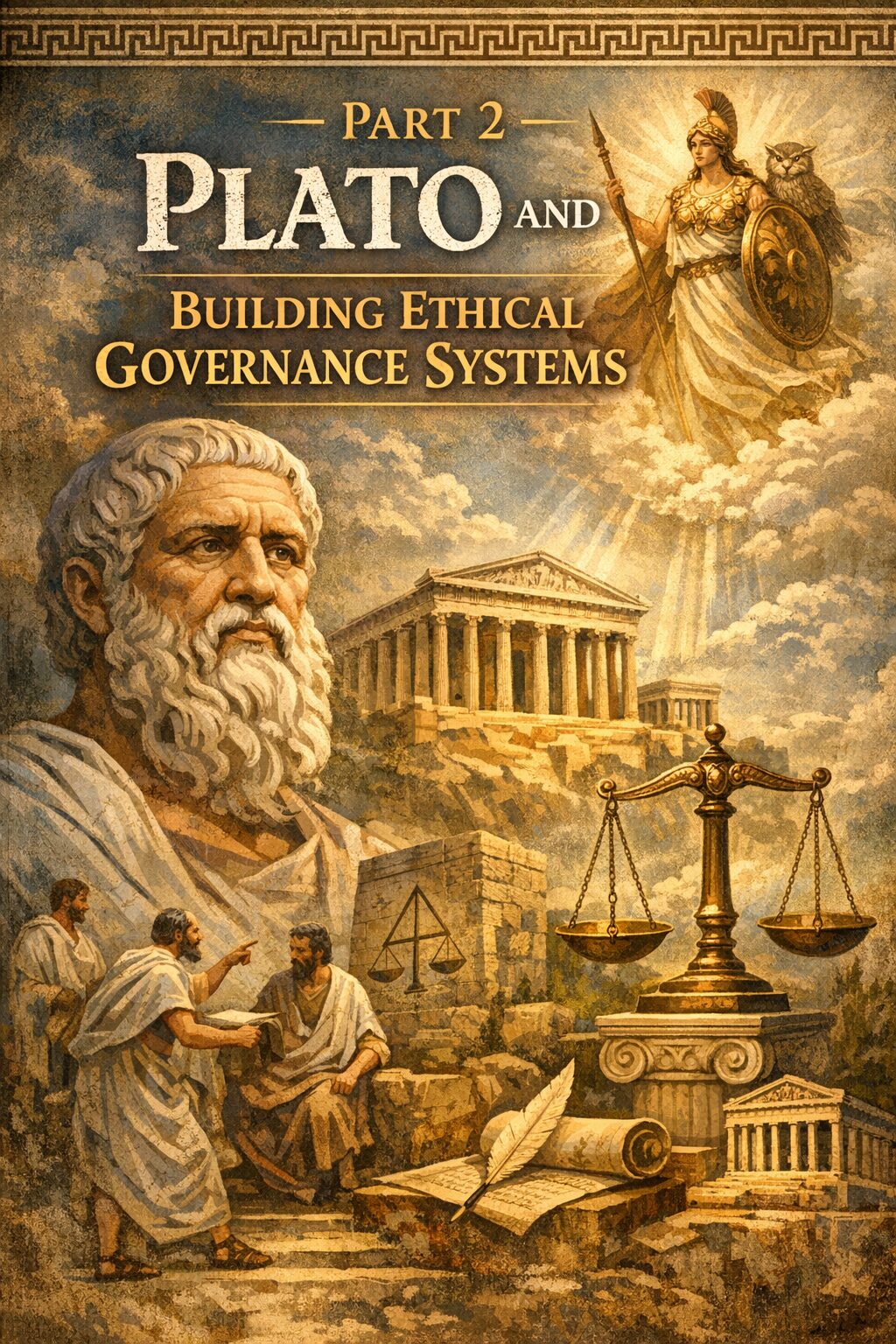
In Part 2, we continue our exploration of the origins of the modern corporate compliance organization, tracing them back to the ancient Greek philosophers, including Plato. Socrates teaches the compliance professional how to ask the right questions. But questions alone do not protect an organization. They must be translated into governance, structure, and systems that endure. That is where Plato becomes indispensable to the modern compliance conversation.
Plato’s great concern was not whether people could articulate values, but whether societies could be structured to sustain them. His work, particularly The Republic, focuses on justice, leadership, and the design of institutions that align individual behavior with the collective good. For corporate compliance professionals, this is familiar terrain. The DOJ Evaluation of Corporate Compliance Programs (ECCP) is fundamentally a governance document. It asks whether companies have built systems that make ethical behavior the default rather than the exception.
If Socrates is the conscience of the compliance function, Plato is its architect. Think Joe Murphy and his weekly compliance newsletter, Compliance & Ethics: Ideas and Answers.
From Ethical Inquiry to Institutional Design
Plato understood a core truth: that good intentions fail without structure. In the Allegory of the Cave, Plato describes people mistaking shadows for reality because the system around them reinforces illusion. In corporate compliance, the same dynamic occurs when incentives, reporting lines, and performance metrics reward behavior that quietly contradicts stated values.
The ECCP repeatedly asks whether a company’s compliance program is “well designed.” That phrase is not accidental. Prosecutors examine reporting structures, escalation pathways, authority, and resources because ethics without governance is aspirational theater. Plato would recognize this immediately. Justice, in his view, emerges when each part of a system performs its proper role in harmony with the whole.
Daily compliance operations live or die by this design. A hotline without investigation authority, training without consequence management, or policies without ownership all create shadows on the wall. Plato teaches that governance must align form and function.
Justice as Consistency, Not Sentiment
Plato’s conception of justice is not emotional. It is structural. Justice exists when rules are applied consistently, and roles are respected. That lesson maps directly onto compliance enforcement and discipline. The ECCP places heavy emphasis on consistent discipline across the organization, including senior management, and asks the following question: Have disciplinary actions and incentives been fairly and consistently applied across the organization? Does the compliance function monitor its investigations and resulting discipline to ensure consistency? Are there similar instances of misconduct that were treated disparately, and if so, why? What metrics does the company apply to ensure consistency of disciplinary measures across all geographies, operating units, and levels of the organization?
This is Organizational Justice. Regulators know that selective enforcement erodes credibility faster than almost any policy failure. Employees watch how decisions are made. They see who is protected and who is expendable. In daily operations, this requires compliance professionals to insist on fairness even when outcomes are uncomfortable. Investigations must follow evidence, not hierarchy. Remediation must address systemic failures, not just individual misconduct. Plato reminds us that justice perceived as arbitrary is, by another name, injustice.
Governance Structures Are Ethical Decisions
Plato believed that leadership structure determined ethical outcomes. His concept of philosopher-kings was not an elitist fantasy. It was an argument that power should rest with those who possess both knowledge and virtue. Modern compliance programs face a parallel challenge. Who owns compliance? To whom does it report? Does compliance have direct access to the board? Can it act independently of revenue pressure? These are not administrative questions. They are ethical ones.
The ECCP explicitly evaluates whether compliance has sufficient autonomy, stature, and authority. Does a corporate compliance function have (1) sufficient qualifications, seniority, and stature (both actual and perceived) within the organization; (2) sufficient resources, namely, staff to undertake the requisite auditing, documentation, and analysis effectively; and (3) sufficient autonomy from management, such as direct access to the board of directors or the board’s audit committee.
A compliance program buried several layers below decision-makers may exist on paper, but it cannot function effectively. Plato would argue that such a structure inevitably leads to injustice, regardless of intent. In practice, this means compliance leaders must engage in governance conversations, not just operational tasks. Reporting lines, committee charters, and escalation protocols shape behavior long before a policy is breached.
Education, Culture, and Ethical Formation
Plato placed enormous emphasis on education as the foundation of a just society. He understood that laws and punishments alone do not produce ethical citizens. Formation matters. The ECCP reflects this insight by focusing on training effectiveness, communication, and culture. The key is effectiveness. In training, the DOJ asks the following question: Has the training been offered in a format and language appropriate for the audience? Are the company’s training and communications tailored to the particular needs, interests, and values of relevant employees? Is the training provided online or in-person (or both), and what is the company’s rationale for its choice? This means prosecutors will ask whether training is tailored, interactive, and aligned with real-world risk. Checkbox training produces compliance in name only.
Daily compliance work must therefore treat education as formation rather than instruction. Training should reinforce ethical reasoning, not just rules. Communications should explain why standards exist, not merely what they prohibit. Plato teaches that culture is cultivated deliberately, not imposed.
The Cave and Ethical Blindness in Organizations
Perhaps Plato’s most powerful contribution to compliance thinking is the Allegory of the Cave. It explains how intelligent people can remain blind to obvious risk when systems reinforce false narratives.
In corporate settings, ethical blindness often arises from success. When revenue grows and deals close, warning signs are rationalized. Compliance concerns become shadows, dismissed as theoretical or pessimistic. The ECCP’s focus on continuous improvement and periodic testing is a direct response to this risk. Compliance professionals must act as those who have seen the light and returned to the cave, even when their message is unwelcome. Plato warns that truth-tellers are rarely celebrated. Yet without them, organizations mistake comfort for compliance.
5 Key Takeaways for the Compliance Professional
1. Ethical inquiry must be translated into governance.
Asking the right questions is essential, but compliance programs fail when inquiry does not result in structural change. Plato teaches that ethics must be embedded in systems, reporting lines, and decision-making authority. The ECCP reinforces this by evaluating program design, autonomy, and oversight. Compliance professionals must ensure that insights from risk assessments and investigations lead to governance adjustments. Without that translation, ethical awareness fades, and misconduct reemerges under familiar pressures.
2. Justice in compliance is consistency, not discretion.
Plato’s concept of justice demands consistent application of rules regardless of status or performance. The ECCP mirrors this expectation by scrutinizing discipline across seniority levels. Daily compliance operations must reinforce fairness through objective investigations, documented decisions, and transparent remediation. Selective enforcement undermines trust, weakens culture, and signals that ethics are negotiable. Justice must be structural, not situational.
3. Reporting lines and authority are ethical decisions.
Where compliance sits in the organization determines whether it can function effectively. Plato understood that leadership structure shapes outcomes. The ECCP evaluates compliance independence because authority enables ethical action. Compliance professionals must engage in governance discussions to ensure direct access to decision-makers and the board. Without structural authority, even well-intentioned programs become symbolic.
4. Training is ethical formation, not information delivery.
Plato emphasized education as the foundation of justice. Compliance training should shape ethical reasoning, not merely convey rules. The ECCP expects tailored, risk-based training connected to real-world scenarios. Daily operations should reinforce values through ongoing communication and leadership modeling. Culture forms through repetition and example, not annual courses.
5. Ethical blindness thrives in poorly designed systems.
The Allegory of the Cave explains how organizations normalize risk when systems reward illusion. Compliance professionals must challenge comfortable narratives and continuously test assumptions. The ECCP’s focus on monitoring and improvement reflects this need. Plato reminds us that ethical failure often begins with structural blindness, not bad intent.
From Plato to Aristotle: From Structure to Execution
Plato gives compliance professionals the blueprint. He shows how governance structures, justice systems, and educational frameworks translate ethical ideals into organizational reality. But even the best-designed systems fail if they are not used daily.
That is where Aristotle enters the conversation. Aristotle shifts the focus from ideal structures to practical execution, from governance to habit, judgment, and decision-making at the operational level. If Plato teaches us how to design ethical systems, Aristotle teaches us how people actually behave within them. That transition mirrors the next stage in compliance maturity, where structure meets reality and ethics become a matter of daily choice.
Join us tomorrow in Part 3 to find out how.