Categories
31 Days to More Effective Compliance Programs

31 Days to a More Effective Compliance Program: Day 24 – Internal Reporting and Triage

Welcome to 31 Days to a More Effective Compliance Program. Over this 31-day series in January 2026, Tom Fox will post a key component of a best-practice compliance program each day. By the end of January, you will have enough information to create, design, or enhance a compliance program. Each podcast will be short, at 6-8 minutes, with three key takeaways that you can implement at little or no cost to help update your compliance program. I hope you will join each day in January for this exploration of best practices in compliance. In today’s Day 24 episode, we look into the critical process of internal reporting and triaging of FCPA claims.

Key highlights:

  • Guidelines for Effective Compliance Programs
  • Jonathan Marks’ Five-Step Process for Early Assessment
  • Key Takeaways

Resources:

Listeners to this podcast can receive a 20% discount on The Compliance Handbook, 6th edition, by clicking here.

Categories
31 Days to More Effective Compliance Programs

31 Days to a More Effective Compliance Program: Day 23 – Investigative Protocols

Welcome to 31 Days to a More Effective Compliance Program. Over this 31-day series in January 2026, Tom Fox will post a key component of a best-practice compliance program each day. By the end of January, you will have enough information to create, design, or enhance a compliance program. Each podcast will be short, at 6-8 minutes, with three key takeaways that you can implement at little or no cost to help update your compliance program. I hope you will join each day in January for this exploration of best practices in compliance. In today’s Day 23 episode, we delve into the essential steps for conducting a thorough and effective internal investigation following an internal report.

Key highlights:

  • Key Questions for Internal Investigations
  • Detailed Procedures for Handling Complaints
  • Steps in the Investigative Process
  • Importance of Consistency in Investigations

Resources:

Listeners to this podcast can receive a 20% discount on The Compliance Handbook, 6th edition, by clicking here.

Categories
Compliance Tip of the Day

Compliance Tip of the Day – Your Investigative Team

Welcome to “Compliance Tip of the Day,” the podcast where we bring you daily insights and practical advice on navigating the ever-evolving landscape of compliance and regulatory requirements. Whether you’re a seasoned compliance professional or just starting your journey, our aim is to provide you with bite-sized, actionable tips to help you stay on top of your compliance game. Join us as we explore the latest industry trends, share best practices, and demystify complex compliance issues to keep your organization on the right side of the law. Tune in daily for your dose of compliance wisdom, and let’s make compliance a little less daunting, one tip at a time.

This week we continue our consideration of issues relating to your internal investigations. Today we consider who should be on your investigative team.

For more on this topic, check out The Compliance Handbook, a Guide to Operationalizing your Compliance Program, 6th edition which was recently released by LexisNexis. It is available here.

Categories
Compliance Tip of the Day

Compliance Tip of the Day – Preparing for an Investigation

Welcome to “Compliance Tip of the Day,” the podcast that brings you daily insights and practical advice for navigating the ever-evolving landscape of compliance and regulatory requirements. Whether you’re a seasoned compliance professional or just starting your journey, we aim to provide you with bite-sized, actionable tips to help you stay on top of your compliance game. Join us as we explore the latest industry trends, share best practices, and demystify complex compliance issues to keep your organization on the right side of the law. Tune in daily for your dose of compliance wisdom, and let’s make compliance a little less daunting, one tip at a time.

We continue our consideration of issues relating to your internal investigations. Today, we will discuss how to prepare for an investigation.

For more on this topic, check out The Compliance Handbook: A Guide to Operationalizing your Compliance Program, 6th edition, which LexisNexis recently released. It is available here.

Categories
Compliance Tip of the Day

Compliance Tip of the Day – Your Investigative Protocol

Welcome to “Compliance Tip of the Day,” the podcast that brings you daily insights and practical advice for navigating the ever-evolving landscape of compliance and regulatory requirements. Whether you’re a seasoned compliance professional or just starting your journey, we aim to provide you with bite-sized, actionable tips to help you stay on top of your compliance game. Join us as we explore the latest industry trends, share best practices, and demystify complex compliance issues to keep your organization on the right side of the law. Tune in daily for your dose of compliance wisdom, and let’s make compliance a little less daunting, one tip at a time.

This week, we will consider issues relating to your internal investigations. Today, we begin by considering your investigative protocol.

For more on this topic, check out The Compliance Handbook: A Guide to Operationalizing your Compliance Program, 6th edition, which LexisNexis recently released. It is available here.

Categories
Blog

The Michigan Man, Part 1 – From Winning Program to Institutional Crisis

There are moments when an organization confronts a crisis so severe that it overwhelms every narrative it once controlled. The University of Michigan now finds itself in precisely that moment. What began as a continuation of compliance issues stemming from the sign-stealing scandal has rapidly escalated into something far more serious, far more painful, and far more destabilizing. This is no longer a story about NCAA rules or institutional embarrassment. It is a story about human failure, organizational breakdown, and the real-world consequences of ignoring warning signs.

As compliance professionals, our instinct is to move quickly to frameworks, root causes, and lessons learned. That work will come later in this series. But first, it is essential to set out the facts as they are currently known and to acknowledge the human cost embedded in every paragraph of this story. This story is far beyond compliance and ethics, but it is a true human tragedy. But it will also show how such a human tragedy could have been prevented if the basic tenets of organizational compliance and ethics had been followed.

All resources cited in this four-part series are listed at the end of this blog post. Finally, this writing is personal, as I am a UM graduate.

The Rise of Sherrone Moore

Sherrone Moore’s ascent within the University of Michigan football program appeared, at least on the surface, to be a model of internal succession. Moore joined Jim Harbaugh’s staff in 2018 and rose steadily through the ranks, ultimately serving as offensive coordinator during Michigan’s 2023 national championship season. When Harbaugh departed for the NFL, Moore was promoted to head coach, a decision widely praised as ensuring continuity and stability.

Moore was not simply a coach. He was a symbol. His emotional post-game interview after a victory over Penn State, while Harbaugh was suspended, became an iconic moment for Michigan fans. He embodied loyalty, perseverance, and what many referred to as the “Michigan Man” ethos. ESPN

Yet even at the time of his promotion, Moore’s record was not unblemished. He had already been implicated in the Connor Stalions sign-stealing investigation and had received NCAA suspensions for deleting text messages during that inquiry. Those issues were treated by the university and much of the fan base as technical compliance matters rather than as indicators of deeper governance or integrity risks. Slate

That framing now appears deeply flawed.

The Inappropriate Relationship Investigation

According to reporting by The AthleticESPNSlate, and The Wall Street Journal, the University of Michigan received an anonymous tip earlier in 2025 alleging an inappropriate relationship between Moore and a female football staffer. The university retained Jenner & Block, an outside counsel, to conduct an investigation. Initially, both Moore and the staffer denied any relationship, and investigators reported that insufficient evidence existed to substantiate the claim.

That changed dramatically in December 2025. Prosecutors allege that the staffer disclosed corroborating evidence confirming a multi-year intimate relationship after she ended it earlier that week. At that point, the university determined that Moore had violated institutional policy and terminated him for cause, avoiding a reported $14 million buyout. The Athletic

This was not merely an employment decision. It was the spark that ignited a cascading crisis.

The Criminal Charges

Within hours of his dismissal, Moore’s personal situation escalated into a criminal matter. Prosecutors allege that Moore went to the staffer’s residence without permission, entered through an unlocked door, and engaged in a confrontation during which he picked up scissors and butter knives and threatened to harm himself. According to court statements, Moore allegedly made repeated statements such as “I am going to kill myself” and “My blood is on your hands. The Athletic

Moore was subsequently charged with felony third-degree home invasion and misdemeanor charges of stalking and breaking. He was taken into custody, evaluated at a hospital, and later released on bond with GPS monitoring and a requirement that he continue mental health treatment. A probable cause hearing is scheduled for January 2026.

At this point, it bears stating plainly: these are allegations, and Moore has pleaded not guilty. The legal process will determine criminal responsibility. However, from an organizational perspective, the damage has already been done.

The Expanding Institutional Investigation

What began as an inquiry into Moore’s conduct has now broadened into a comprehensive review of the University of Michigan athletic department. University leadership has confirmed that Jenner & Block’s mandate has expanded to examine how the athletic department handled the Moore matter and other recent scandals, including the sign-stealing investigation and prior misconduct by football staffers. ESPN

Interim President Domenico Grasso has publicly called for anyone with relevant information to come forward, emphasizing that “all of the facts here must be known.” Athletic Director Warde Manuel remains in his position for now, but multiple reports note that his leadership and oversight are under intense scrutiny.

This expansion matters. It signals that the university itself recognizes that Moore’s actions cannot be isolated from the environment in which they occurred.

Beyond Compliance: The Human Tragedy

It would be a profound mistake to reduce this story to a checklist of policy violations.

At the center of this crisis are people whose lives have been irreversibly altered. Moore is a married father of three whose career has collapsed in public view. His family faces humiliation, uncertainty, and emotional trauma that will not disappear with headlines. Prosecutors describe the staffer at the center of the allegations as someone who felt terrorized and unsafe, a position no employee should ever occupy. University of Michigan players have lost their head coach midseason, forcing them to process personal loyalty, public scandal, and institutional chaos simultaneously. There is also the culture of an entire university athletic department, which not only allowed such behavior but also tolerated and even celebrated it by promoting Moore to Head Coach.

The broader Michigan community, alumni, students, and fans are also stakeholders in this tragedy. For an institution that has long traded on its image of integrity and moral leadership, the reputational damage cuts deeply. Being a ‘Michigan Man’ was meant to stand for something—something positive, that you did things in the right way, and you personally held yourself to a higher standard. As The Wall Street Journal observed, this is no longer a college football story. It is “agony in Ann Arbor. I certainly echo that feeling personally.

A Pattern, Not an Anomaly

The most troubling aspect of the facts as currently known is how familiar they feel. The Moore scandal follows a series of incidents involving Michigan athletics over recent years, including the Stalions’ sign-stealing operation, multiple staff arrests, internal HR complaints, and even a federal indictment of a former assistant coach for accessing student-athletes’ private data. WSJ

The issue may not be any single actor but rather an entrenched culture that has historically insulated powerful figures from accountability. Slate: When organizations repeatedly frame misconduct as isolated events, they fail to confront systemic risk.

Why This Matters for Compliance Professionals

For compliance professionals, this case is already instructive even before we reach lessons learned. It demonstrates how compliance failures often emerge not as sudden collapses but as accumulations of ignored signals. It shows how reputational capital built over decades can evaporate in a matter of days. Most importantly, it reminds us that behind every policy failure are human beings who bear the consequences.

While there will be others who say ‘I told you so’ or want to bring the vaunted Michigan Man down a peg or two, the lessons from this scandal and human tragedy are no less important for your team, your school, and your university.

In the next installment of this series, I will turn directly to Sherrone Moore’s individual compliance and ethics violations, including his conduct during the sign-stealing investigation and his alleged misrepresentations to investigators. That analysis is necessary. But it should never obscure the reality that this story is about far more than rules. Compliance exists to protect people, institutions, and trust. When it fails, the cost is measured not only in fines or sanctions but also in lives disrupted and communities shaken.

Resources:

The Terrible Mess at Michigan Football, by Jason Gay, writing in the Wall Street Journal.

Ex-Michigan coach Sherrone Moore charged with home invasion, stalking, breaking—Austin Meek and Sam Jane writing in The Athletic.

Fire Everybody—Alex Kirshner, writing in Slate.

Source: Michigan begins a review of the athletic department, by Dan Wetzel and Pete Thamel, writing for ESPN.

Categories
Adventures in Compliance

Adventures in Compliance: The Novels – The Valley of Fear, Sherlock Holmes’ Investigative Techniques for Today’s Challenges

In this new season of Adventures in Compliance, host Tom Fox takes a deep dive into the Sherlock Holmes novels. Over this season, Tom will take a deep dive into each novel over a four-part series. The four novels we will consider from the ethics and compliance perspective are A Study in Scarlet, The Sign of Four, The Hound of the Baskervilles, and The Valley of Fear. For the month of August, we conclude this Season with a deep dive into the least well-known of the Sherlock Holmes novels, The Valley of Fear.

In Part 2, Timothy and Fiona return to continue our exploration of The Valley of Fear, where we delve into five key investigative lessons from Sherlock Holmes. Discover how Holmes’ methods of questioning initial facts, emphasizing collaborative efforts, maintaining patience, keeping a big-picture perspective, and communicating findings effectively can be applied to modern corporate and personal challenges. Learn to approach information gathering with meticulous scrutiny and uncover bigger truths hidden in the details.

Key highlights:

  • Sherlock Holmes’ Relevance Today
  • Lesson 1: Question Everything
  • Lesson 2: Investigative Cooperation
  • Lesson 3: Patience and Persistence
  • Lesson 4: Big Picture Perspective
  • Lesson 5: Effective Communication

Resources:

The New Annotated Sherlock Holmes

Sherlock Holmes FAQ by Dave Thompson

Connect with Tom Fox

Instagram

Facebook

YouTube

Twitter

LinkedIn

Categories
Blog

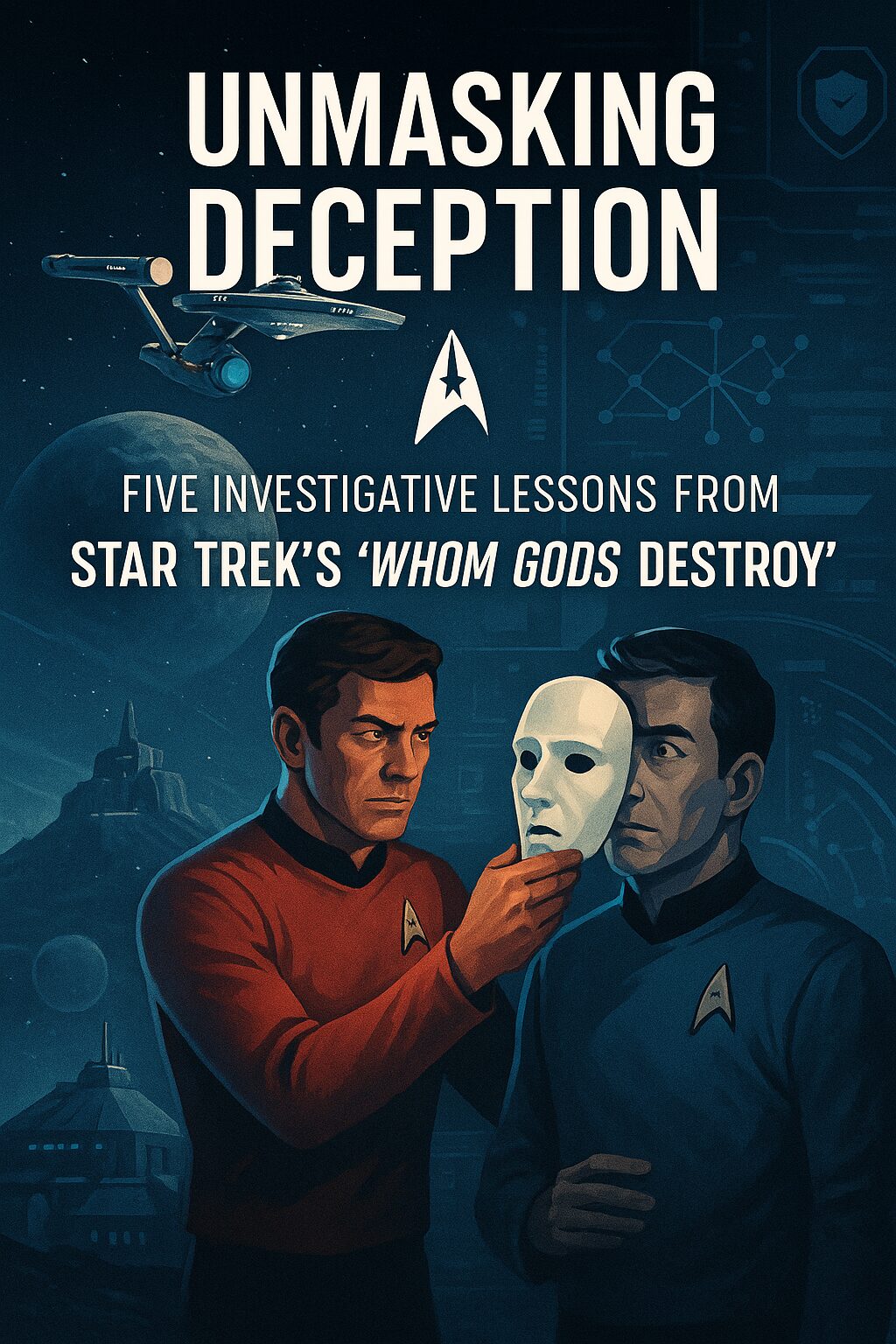
Unmasking Deception: Five Investigative Lessons from Star Trek’s “Whom Gods Destroy”

Today, let’s take a journey to one of Star Trek: The Original Series’ most intense psychological dramas: “Whom Gods Destroy.” On its surface, this episode is a tale of madness, manipulation, and peril. But for the vigilant compliance professional, it’s a trove of investigative lessons on dealing with deception, managing risk, and safeguarding your organization in an unpredictable world.

In “Whom Gods Destroy,” Captain Kirk and Mr. Spock arrive at the maximum-security facility on Elba II to deliver a new medicine. They quickly fall prey to the cunning Garth of Izar, a former starship fleet captain now criminally insane. Garth seizes control of the asylum using his shapeshifting ability and manipulates everyone around him with a series of deceptions, impersonations, and psychological games. For Kirk and Spock, survival means uncovering the truth in a maze of misdirection.

Let’s beam down to Elba II, a remote asylum for the galaxy’s most dangerous criminally insane, to examine what this wild ride can teach us about effective corporate investigations.

1. Never Accept Surface Appearances—Verify, Then Trust

Illustrated By: Kirk and Spock are greeted by what appears to be the asylum’s director, Governor Cory. He acts normally and reassures them that all is well. Only later do they discover that Garth, using his ability to alter his appearance, is impersonating Cory and is, in fact, in control of the facility.

Compliance Lesson. In investigations, never accept things at face value. Documents can be forged, credentials fabricated, and even trusted individuals may act under duress or with hidden motives. Just as Garth’s impersonation deceived Kirk, compliance investigators must independently verify facts, corroborate stories, and challenge what seems obvious. Assume nothing—always test the evidence.

What should you do now? Establish robust protocols for evidence verification. Don’t simply trust, but verify, using multiple sources, forensic tools, and independent witness interviews. Always be alert to the possibility that someone may be playing a role.

2. Psychological Manipulation: Beware the Power of Charisma

Illustrated By: Garth, in his guise as both himself and others, uses his charisma and manipulation to sow confusion and loyalty among the other inmates. He persuades them to join his rebellion through promises, threats, and appeals to their egos.

Compliance Lesson. In many investigations, the most dangerous individuals are those who wield psychological influence. Charismatic leaders, managers, or employees can persuade others to cover up wrongdoing, falsify records, or sabotage investigative efforts. Investigators must be wary of undue influence and remember that even the most likable or persuasive people may have something to hide.

What should you do now?  Train your investigative team to recognize and resist psychological manipulation. Always seek independent corroboration and never let charm or status cloud your objectivity.

3. The Importance of Access Controls and Segregation of Duties

Illustrated By: Garth gains control over the asylum’s security systems, disabling communications and trapping Kirk and Spock. By centralizing control, he can manipulate everyone in the facility and thwart any rescue attempt.

Compliance Lesson: A key safeguard against fraud and misconduct is the principle of segregation of duties and strict access controls. If one individual or a small group can manipulate systems without oversight, your organization is vulnerable to abuse. Garth’s control of Elba II mirrors what can happen in a business when there are weak internal controls: a single rogue actor can wreak havoc before anyone notices.

What should you do now? Regularly review and test your access controls and segregation of duties. Ensure that no single person has unchecked power and regularly audit system logs to detect unusual activity. Prevent the “Garth scenario” by building multiple layers of oversight.

4. Recognize Red Flags and Act on Them Swiftly

Illustrated By: Despite several warning signs, unusual behavior from the “director,” cryptic comments from the staff, and security lapses, Kirk and Spock hesitate before taking decisive action. Only after the deception becomes undeniable do they shift into crisis mode.

Compliance Lesson. Every investigation reveals red flags. The question is: will your team recognize them early and act decisively? All too often, subtle signals, changes in behavior, delayed responses, or gaps in documentation are ignored until the situation escalates. In “Whom Gods Destroy,” the cost of delay is nearly fatal.

What should you do now? Create a culture where red flags are escalated and investigated immediately. Encourage open reporting and ensure investigators are empowered to follow up on their instincts. Quick action can prevent a minor issue from becoming a crisis.

5. Collaboration Is the Key to Outwitting Deception

Illustrated By: Ultimately, Kirk and Spock overcome Garth’s deceptions through close teamwork, communication, and the use of a prearranged security code that only the honest Kirk would know. Spock’s skepticism and methodical approach are essential to cutting through the confusion and revealing the truth.

Compliance Lesson. Investigations should never be a solo endeavor. Collaboration, clear communication, and checks and balances are essential to unmasking sophisticated schemes. Like Spock and Kirk, compliance teams must establish protocols—such as “safe words,” confirmation codes, or independent review processes—to prevent impersonation, collusion, or false confessions.

What should you do now? Build cross-functional investigative teams with diverse skill sets. Foster a culture of transparency, and ensure all findings are independently reviewed and validated. Teamwork and process discipline are your best defenses against deception.

Final ComplianceLog Reflections

“Whom Gods Destroy” may be set in a galaxy far away, but its lessons are as relevant to the compliance investigator as they are to any starship captain. In a world where deception can take many forms, such as charisma, forged documents, technological manipulation, or even trusted colleagues, your best defense is disciplined skepticism, rigorous process, and a commitment to the truth above all else.

In corporate investigations, the price of being deceived is high, but the rewards of vigilance, skepticism, and teamwork are higher. So, as you face your own “Elba II,” remember the lessons of Kirk and Spock: Trust the process, trust your team, and always keep your eyes open for the masks that others might wear.

Resources:

⁠⁠Excruciatingly Detailed Plot Summary by Eric W. Weisstein⁠⁠

⁠⁠MissionLogPodcast.com⁠⁠

⁠⁠Memory Alpha

Categories
Blog

Sherlock Holmes and Compliance: Investigative Insights from “The Valley of Fear”

Here’s a detailed, insightful article in the style of Tom Fox for a corporate compliance audience, highlighting investigative lessons from the Sherlock Holmes novel, “The Valley of Fear.”

For compliance professionals, investigations are the bedrock of effective compliance programs. Whether it’s tracking down evidence of bribery, uncovering fraud schemes, or rooting out systemic misconduct, the investigative methods you deploy can significantly impact your organization’s integrity, reputation, and bottom line.

“The Valley of Fear” offers a wealth of investigative wisdom. Its narrative of deception, undercover operations, secret societies, and surprising plot twists provides vivid lessons highly relevant to today’s corporate compliance landscape. Let’s unpack five key investigative lessons, each illustrated with memorable scenes from this timeless detective classic.

Lesson 1: Do Not Take Facts at Face Value

Illustrated By: Detailed Analysis of the Crime Scene. Upon arrival at Birlstone Manor, Holmes carefully examines the room where Douglas’s body was discovered, noting inconsistencies like the placement of furniture, window access, and unusual blood patterns.

The central narrative of “The Valley of Fear” revolves around the apparent murder of John Douglas at his Manor House in Birlstone. Initially, the crime scene appears straightforward: Douglas has seemingly been shot at close range, and the crime scene implicates an intruder. Yet Holmes immediately suspects deeper layers beneath the obvious evidence. His meticulous examination of the scene, blood patterns, room layout, and oddities like misplaced items reveals inconsistencies that others missed.

For compliance professionals, the lesson is clear: avoid jumping to conclusions based solely on initial evidence. It is tempting and human to embrace straightforward narratives quickly. But like Holmes, investigators must resist that impulse, digging deeper, questioning assumptions, and rigorously testing evidence for hidden contradictions or overlooked facts. By refusing to accept surface-level interpretations, compliance teams protect organizations from premature and potentially misguided conclusions.

Compliance Takeaway: Always scrutinize initial evidence meticulously and objectively. Never accept evidence without question or assume that initial appearances represent complete facts.

Lesson 2: Investigative Cooperation is Essential

Illustrated By: Collaboration between Holmes and MacDonald. Holmes and Inspector MacDonald openly discuss theories, evidence, and ideas, working cooperatively rather than competitively. Holmes shares insights freely, establishing mutual trust and respect that propel the investigation forward. 

Throughout the novel, Holmes collaborates closely with Scotland Yard’s Inspector MacDonald, who initially struggles to make sense of the complex scenario. Rather than competing, Holmes works cooperatively with MacDonald, openly sharing insights, theories, and information. Their mutual respect, dialogue, and professional cooperation ultimately contribute to solving the intricate puzzle.

Corporate compliance investigations similarly require effective internal and external cooperation. Compliance departments must partner seamlessly with Legal, HR, Audit, and IT functions, as well as outside counsel or forensic experts when necessary. Effective cooperation and collaboration across departments ensure thoroughness and objectivity, minimize blind spots, and enhance investigative outcomes. Holmes demonstrates that strong investigative results rely on teamwork rather than isolation or internal competition.

Compliance Takeaway: Foster collaborative relationships across organizational functions, aligning investigative efforts with Legal, HR, IT, and other stakeholders to produce effective outcomes.

Lesson 3: Patience and Persistence Yield Results

Illustrated By: Patient Uncovering of Douglas’s Background. Holmes painstakingly reconstructs Douglas’s past life in America, gradually identifying him as a Pinkerton detective who infiltrated the Scowrers. This meticulous work takes time, patience, and sustained investigative discipline.

Holmes painstakingly pieces together the clues surrounding John Douglas, ultimately revealing Douglas’s true identity as Birdy Edwards, a former Pinkerton detective who infiltrated a dangerous criminal organization, the Scowrers, in the United States. This revelation is not instantaneous; Holmes’ success comes from persistence, incremental discovery, and careful analysis of evidence collected over time.

In corporate compliance investigations, patience and persistence are equally critical. Compliance officers must frequently manage complex, multi-faceted investigations spanning weeks, months, or even years. Instant resolutions are rare; critical information often emerges slowly and incrementally. Holmes’s deliberate and patient approach to unraveling Douglas’s identity highlights the importance of tenacity, emphasizing that thoroughness and sustained attention invariably produce the clearest investigative outcomes.

Compliance Takeaway: Recognize and embrace that thorough investigative efforts are often incremental, requiring sustained attention and patience to understand complex compliance issues fully.

Lesson 4: Maintain a Big-Picture Perspective

Illustrated By: Contextual Awareness of Moriarty’s Influence. Holmes keeps Moriarty’s potential involvement clearly in mind throughout, maintaining awareness that individual incidents might connect to larger criminal patterns.

In the novel, Holmes repeatedly emphasizes that the apparent Birlstone murder is merely one small part of a larger, sinister picture orchestrated by the infamous Professor Moriarty. Though Moriarty never physically appears, his influence permeates the narrative, connecting seemingly unrelated events and adding deeper context to the investigation. Holmes maintains a sharp awareness of this broader context throughout, ensuring he does not lose sight of underlying motivations and interconnected plots.

This lesson resonates powerfully for compliance professionals. Frequently, investigations initially perceived as isolated incidents reveal systemic compliance or ethical weaknesses within an organization. Investigators must always remain cognizant of the broader organizational, cultural, or regulatory contexts influencing misconduct. By keeping this “big picture” perspective, compliance teams ensure investigations are holistic, not narrowly focused, enabling effective systemic remediation rather than piecemeal solutions.

Compliance Takeaway: Maintain holistic awareness in compliance investigations, ensuring isolated incidents are analyzed within broader organizational, regulatory, or ethical contexts to uncover deeper systemic issues.

Lesson 5: Effective Communication is Crucial 

Illustrated By: Contextual Awareness of Moriarty’s Influence. Holmes keeps Moriarty’s potential involvement clearly in mind throughout, maintaining awareness that individual incidents might connect to larger criminal patterns.

At key points throughout the novel, Holmes carefully explains his deductions, processes, and conclusions to Inspector MacDonald, Dr. Watson, and other key players. His ability to clearly articulate reasoning and insights, especially when conclusions appear counterintuitive or complex, is essential to maintaining credibility, building consensus, and driving effective outcomes.

Corporate compliance investigators must also master clear, effective communication. It’s insufficient merely to uncover misconduct; the true skill lies in effectively communicating findings to stakeholders, management, regulators, and even potentially implicated employees. Holmes shows us that investigative brilliance must be matched by communicative clarity. In corporate settings, investigative reports must clearly explain methodology, facts, assumptions, and conclusions, ensuring decisions based on investigations are informed, justified, and actionable.

Compliance Takeaway: Maintain holistic awareness in compliance investigations, ensuring isolated incidents are analyzed within broader organizational, regulatory, or ethical contexts to uncover deeper systemic issues.

Sherlock Holmes as Compliance Inspiration

Sherlock Holmes remains an enduring inspiration to corporate compliance professionals precisely because effective investigations are foundational to compliance success. Holmes’s methods, including detailed scrutiny of evidence, a collaborative approach, patient and persistent inquiry, a holistic perspective, and clear communication, are not merely fictional flourishes; they represent essential best practices.

“The Valley of Fear” offers compliance officers vivid, relatable insights, underscoring that successful investigations require disciplined methodology, sustained inquiry, careful analysis, cross-functional cooperation, and effective stakeholder communication. As Sherlock Holmes memorably states, “It is, of course, a trifle, but there is nothing so important as trifles.” For compliance professionals today, Holmes’s wisdom is more relevant than ever, reminding us that attention to detail, disciplined process, and communicative clarity are never trivial.

By embracing Holmes’s investigative rigor and lessons from this classic novel, compliance professionals equip themselves and their organizations to meet today’s complex challenges effectively. After all, just like Holmes himself, the compliance investigator’s role is fundamentally about uncovering truth; patiently, methodically, and tirelessly ensuring organizational integrity and ethical clarity amidst a complex corporate landscape.


Categories
Trekking Through Compliance

Trekking Through Compliance: Episode 63 – Untangling the Unknown: Investigative Excellence from ‘The Tholian Web’”

If you ask any veteran compliance professional what separates the ordinary from the extraordinary, the answer is almost always the same: the ability to investigate under pressure. In a world of shifting facts, unseen dangers, and cross-functional confusion, true investigative skill is what keeps organizations ethical, transparent, and resilient. Few stories illustrate this as vividly as “The Tholian Web,” an iconic episode from Star Trek: The Original Series.

Lesson 1: Investigate With a Cool Head—Leadership Under Duress

Illustrated By: After Kirk’s sudden disappearance, Spock assumes command. Crew anxiety spikes, tempers flare, and Dr. McCoy challenges Spock’s decisions..

Compliance Lesson: In crises, whether a whistleblower allegation, data breach, or fraud discovery, panic is a natural response. The best investigators, like Spock, recognize that emotional decision-making clouds judgment. They follow procedure, remain analytical, and never let pressure override the investigative process.

Lesson 2: Document Everything—The Importance of the Record

Illustrated By: Early in the investigation, Spock reviews and references Captain Kirk’s standing orders and last log entries. He later records his log, explicitly noting the crew’s condition, the timeline, and his rationale for each major decision.

Compliance Lesson: Thorough documentation is the lifeblood of effective investigations. Records create an objective narrative, protect the organization, and provide transparency for auditors, regulators, or stakeholders. If Spock had not documented his actions, later review, internal or external, would have been impossible.

Lesson 3: Test Hypotheses—Don’t Jump to Conclusions

Illustrated By: McCoy believes the interdimensional “space sickness” is a kind of infection, while Spock hypothesizes it is a function of spatial instability. Rather than making snap judgments, both test their theories with scientific rigor, running medical scans, experiments, and simulations until they converge on the facts.

Compliance Lesson: Good investigators approach every matter as a hypothesis to be tested and not a foregone conclusion. By seeking corroborating (or conflicting) evidence, compliance professionals ensure they arrive at the truth, not just a convenient story.

Lesson 4: Manage External Interference—Defend the Integrity of the Investigation

Illustrated By: The Tholians appear and begin imposing their agenda, demanding that the Enterprise leave the area. Under threat, Spock must weigh the crew’s safety against the risk of abandoning the investigation and Kirk. He stands firm, communicating clearly with the Tholians but refusing to let external pressure dictate internal process.

Compliance Lesson: Legal, business, or even cultural pressures can tempt organizations to curtail, rush, or steer investigations for expediency or self-protection. The role of compliance is to defend the integrity of the process, ensuring objectivity, completeness, and independence even when it’s inconvenient.

Lesson 5: Foster Teamwork and Resilience—No One Investigates Alone

Illustrated By: Tension between Spock and McCoy is palpable, but when faced with Kirk’s absence and the ship’s peril, they collaborate—combining scientific and medical expertise, pooling resources, and supporting one another.

Compliance Lesson: The most effective compliance investigations harness the diverse skills and perspectives of a multidisciplinary team. Unity, support, and open communication are force multipliers in a web of uncertainty.

Final ComplianceLog Reflections

The Tholian Web” is more than a science fiction adventure. It is a case study in investigative excellence under extraordinary pressure. The crew’s ability to stick to the process, document facts, test hypotheses, defend their mission against outside interference, and come together as a team mirrors the best practices in modern compliance investigations.

Resources:

⁠⁠Excruciatingly Detailed Plot Summary by Eric W. Weisstein⁠⁠

⁠⁠MissionLogPodcast.com⁠⁠

⁠⁠Memory Alpha