Categories
Blog

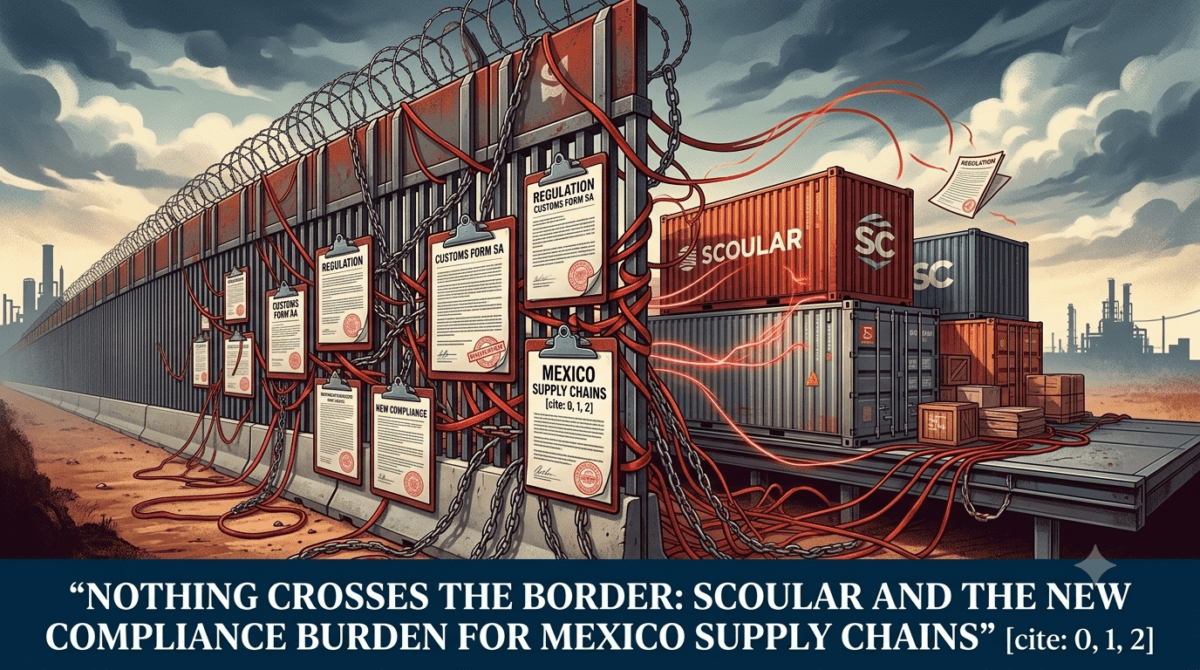
Nothing Crosses the Border: Scoular and the New Compliance Burden for Mexico Supply Chains

“Nothing crosses into or out of Mexico without the approval and payment to Mexican drug cartels. American businesses that engage in any cross-border trade bear a significant amount of responsibility to do so without benefitting those cartels and without threatening our national security,” said U.S. Attorney Justin R. Simmons for the Western District of Texas. “The bribery scheme in which the Scoular Company engaged demonstrates the dangerous corporate corruption we in the Western District of Texas are committed to fighting on behalf of the American people.”

This is not a quote from The Onion, but it is an extraordinary statement from a United States Attorney. It is not confined to companies that knowingly pay cartels. It is not limited to businesses operating in cartel-controlled industries. It speaks broadly to American companies engaged in cross-border trade with Mexico.

The statement appeared in the Department of Justice’s Press Release announcing that The Scoular Company would pay more than $10 million to resolve an FCPA investigation involving payments to Mexican officials. According to the DOJ, customs brokers paid approximately $2,000 per train to allow shipments of corn and other products to cross the border despite inspections identifying dirt, soil, and other impurities. The payments were invoiced back to Scoular as “reinspection fees.” The enforcement message extends far beyond Scoular. Every U.S. company importing goods from Mexico should take notice.

Cartels and the UFLPA

One of the few laws that demands such an approach is the Uyghur Forced Labor Prevention Act (UFLPA), which targets goods made, whole or in part, by forced labor in the Xinjiang region of China or made by forced labor in other parts of China by Uighurs or other minorities. It is designed to operate as a de facto trade ban on goods from China’s Jing Jang region. US businesses will face a heavy burden to overcome the presumption of forced labor. It is perhaps the most significant US law addressing forced labor, and it has the most tangible repercussions companies can face. Under the UFLPA, the key is your documentation for US Customs and Border Protection. Travis Miller has noted that this means if you are “asking companies to look back into where the actual sand came from that got turned into the silica, that got turned into the semiconductor, that got turned into the circuit board, that got turned into the device that finds its way into your laptop. There’s just never been anything like it.”

The UFLPA and its guidance weave together existing business processes. The UFLPA emerged from the America Supply Chain Executive Order in the US/China trade war, which focused on semiconductors, critical raw materials, and elements that are the subject of the extractives. To comply with it, you could not actually start unless you already had a product compliance program in place. This means that if you do not know the bill of materials, do not have an approved vendor list, or do not know where your components are manufactured, you cannot prove compliance. This may well be the approach the Trump Administration takes under FTOs in Mexico and other locations in Central and Latin America.

Is Every Cross-Border Company Benefiting a Cartel?

In my podcast discussion with Matt Ellis, Latin America Practice Lead at Miller & Chevalier, Ellis challenged the literal breadth of the government’s statement. He noted that companies move legitimate goods between the United States and Mexico every hour without knowingly benefiting drug cartels. It would be inaccurate to conclude that every cross-border transaction involves a cartel payment.

Nevertheless, Ellis called the statement striking. He raised the question every CCO should now be considering: Is the DOJ establishing a new compliance standard for companies doing business across the U.S.-Mexico border? The statement does not create a new statute, regulation, or formal presumption of liability. Yet prosecutorial statements communicate enforcement expectations. Here, the expectation appears to be that American businesses must understand not only who their immediate third parties are, but also whether their supply chain activities could provide economic benefits to organized crime.

That puts pressure on importers in three ways. First, companies may face greater scrutiny over customs brokers, logistics providers, trucking companies, warehouses, security providers, labor organizations, and other parties supporting Mexican operations. Second, companies may be expected to investigate the downstream destination of payments, even when there is no obvious cartel connection. Third, the government may examine whether compliance programs integrate anti-corruption controls with sanctions, anti-money laundering, trade compliance, supply chain security, and organized-crime risk.

The question will no longer be limited to whether the company intended to pay a bribe. Prosecutors may also ask whether the company reasonably understood the environment in which its money and goods were moving.

Traditional Third-Party Due Diligence May Not Be Enough

Ellis made one of the most important observations of our discussion: standard third-party screening may not identify cartel connections. Conventional anti-corruption due diligence focuses heavily on government-facing intermediaries. Companies screen owners and principals, search adverse media, identify politically exposed persons, review government relationships, obtain certifications, and include anti-corruption language in contracts. Those measures remain necessary. They may not be sufficient for organized-crime risk.

Cartel affiliations are rarely disclosed in a corporate registry. A logistics provider may appear legitimate while making payment for protection. A trucking company may operate in a region controlled by a criminal organization. A supplier may use subcontractors with undisclosed local connections. A customer, warehouse, labor group, or security provider may be vulnerable to criminal infiltration.

This means companies should broaden the universe of third parties subject to risk-based review. For Mexican supply chains, that universe may include:

  • Suppliers
  • Customers
  • Customs brokers
  • Freight forwarders
  • Trucking companies
  • Warehouses
  • Security companies
  • Local consultants
  • Port and terminal service providers
  • Labor contractors
  • Union representatives
  • Subcontractors
  • Last-mile transportation providers

The legal requirement to use a licensed customs broker should not reduce scrutiny. As Ellis noted, mandatory licensing can sometimes create a false sense of security. A government license does not replace a company’s responsibility to understand how the broker operates.

Contextual Due Diligence Becomes Essential

If database screening cannot reliably identify cartel connections, companies need a contextual approach. This begins by examining where the third party will operate and what criminal activity is associated with that region. Relevant questions include:

  • Is the location known for cartel activity?
  • Are particular highways or transportation corridors subject to roadblocks or protection payments?
  • Is the region associated with fentanyl production, human trafficking, fuel theft, cargo theft, or smuggling?
  • Are unusual labor or union arrangements present?
  • Does the vendor use subcontractors that have not been disclosed?
  • Are payment requests made in cash or to unrelated accounts?
  • Is the third party reluctant to explain its security or transportation arrangements?
  • Does the third party promise an unrealistic customs clearance rate?
  • Are employees instructed not to ask questions about local payments?

Companies must also listen to their employees on the ground. Local personnel may understand risks that do not appear in formal databases. They know the regional rumors, transportation practices, local power structures, and third parties that other companies avoid.

This presents another compliance challenge. Local employees may fear retaliation if they report suspected cartel connections. A company’s speak-up system must provide credible confidentiality, escalation, and protection measures. A hotline is not enough if employees believe that raising a concern will endanger them or their families.

The New Standard Is Demonstrable Reasonableness

Companies cannot guarantee that no peso in a complex Mexican supply chain will ever reach a cartel-affiliated person. Prosecutors should not expect the impossible. They can expect companies to identify their risks, conduct reasonable diligence, monitor high-risk transactions, respond to warning signs, preserve relevant communications, and improve controls when new information emerges.

That is the pressure created by the Scoular resolution. Companies must be able to demonstrate that they made a serious, documented, and risk-based effort to prevent their operations from benefiting criminal organizations. The compliance burden is moving from a narrow inquiry into government-facing intermediaries toward a broader examination of the entire supply chain ecosystem.

Actions for CCOs

CCOs should consider five immediate steps:

  1. Expand Mexico-related risk assessments beyond traditional FCPA intermediaries.
  2. Map the complete supply chain, including subcontractors and transportation routes.
  3. Test customs-broker invoices and recurring border-related payments.
  4. Incorporate regional cartel intelligence and local employee knowledge into due diligence.
  5. Brief the board on the convergence of corruption, sanctions, organized crime, and national security risk.

The Scoular resolution does not establish that every company importing goods from Mexico is paying a cartel. It does put every such company on notice that the DOJ may ask what it did to make sure it was not. That is a significant change in compliance expectations. But look to your response to the UFLPA and see if you can find guidance from that compliance issue. Regardless, companies need to respond accordingly.

Categories
Compliance Tip of the Day

Compliance Tip of the Day – Compliance, Ethics and Your Supply Chain

Welcome to “Compliance Tip of the Day,” the podcast where we bring you daily insights and practical advice on navigating the ever-evolving landscape of compliance and regulatory requirements. Whether you’re a seasoned compliance professional or just starting your journey, we aim to provide bite-sized, actionable tips to help you stay on top of your compliance game. Join us as we explore the latest industry trends, share best practices, and demystify complex compliance issues to keep your organization on the right side of the law. Tune in daily for your dose of compliance wisdom, and let’s make compliance a little less daunting, one tip at a time.

Today, we will consider how compliance can improve your supply chain.

For more information on the Ethico Toolkit for Middle Managers, available at no charge, click here.

Categories
Daily Compliance News

Daily Compliance News: November 27, 2024-the VW Leaves Xingjing Edition

Welcome to the Daily Compliance News. Each day, Tom Fox, the Voice of Compliance brings to you compliance related stories to start your day. Sit back, enjoy a cup of morning coffee and listen in to the Daily Compliance News. All, from the Compliance Podcast Network. Each day we consider four stories from the business world, compliance, ethics, risk management, leadership or general interest for the compliance professional.

  • Larry Thompson looks back. (Press Release)
  • VW to exit Jingjing region of China. (NYT)
  • Hong Kong becoming financial crime hub.  (WSJ)
  • China Defense Minister under investigation for corruption. (FT)

For more information on the Ethico Toolkit for Middle Managers, available at no charge by clicking here.

Check out the full 3-book series, The Compliance Kids on Amazon.com.

Categories
Daily Compliance News

Daily Compliance News: November 25, 2024 – The All WSJ Edition

Welcome to the Daily Compliance News. Each day, Tom Fox, the Voice of Compliance, brings you compliance-related stories to start your day. Sit back, enjoy a cup of morning coffee, and listen in to the Daily Compliance News—all from the Compliance Podcast Network. Each day, we consider four stories from the business world: compliance, ethics, risk management, leadership, or general interest for the compliance professional.

  • A reordering of world trade is coming; is compliance ready? (WSJ)
  • SEC racks up $8bn in penalties under Gensler. (WSJ)
  • 30 Chinese companies have been added to the blacklist.  (WSJ)
  • US sanctions GazpromBank and other Russian entities. (WSJ)

For more information on the Ethico Toolkit for Middle Managers, available at no charge, click here.

Check out the full 3-book series, The Compliance Kids, on Amazon.com.

Categories
Daily Compliance News

Daily Compliance News: September 25, 2024 – The $11bn Forfeiture Edition

Welcome to the Daily Compliance News. Each day, Tom Fox, the Voice of Compliance, brings you compliance-related stories to start your day. Sit back, enjoy a cup of morning coffee, and listen to the Daily Compliance News. All from the Compliance Podcast Network.

Each day, we consider four stories from the business world: compliance, ethics, risk management, leadership, or general interest for the compliance professional.

In today’s edition of Daily Compliance News:

  • Carolyn Ellison is sentenced to 2 years in prison and forfeits $11 billion. (NYT)
  • Wagner Group used HSBC and JPMorgan for payments. (FT)
  • China probes PVH. (Reuters)
  • Wells Fargo must face a Caremark claim. (Reuters)

Categories
10 For 10

10 For 10: Top Compliance Stories For The Week Ending June 15, 2024

Welcome to 10 For 10, the podcast that brings you the week’s top 10 compliance stories in one podcast each week.

Tom Fox, the Voice of Compliance, brings to you, the compliance professional, the compliance stories you need to be aware of to end your busy week.

Sit back, and in 10 minutes, hear about the stories every compliance professional should be aware of from the prior week.

Every Saturday, 10 For 10 highlights the most important news, insights, and analysis for compliance professionals, all curated by the Voice of Compliance, Tom Fox.

Get your weekly filling of compliance stories with 10 for 10, a podcast produced by the Compliance Podcast Network.

  • FTX administrator looking again at Sullivan and Cromwell. (Law.com)
  • Tyson Foods CFO was suspended for drunk driving. (Bloomberg)
  • 5 takeaways from the Menendez trial. (CNN)
  • The FAA says greater oversight is needed over Boeing. (NYT)
  • More Chinese companies have been added to the sanction list for using forced labor. (WSJ)
  • TerraForm settles with the SEC for $4.5bn. (FT)
  • What happens when the Rule of Law dies out? (FT)
  • U.A.W. Monitor Investigates Accusations Against Union Leader (NYT)
  • Beny Steinmetz profile.  (OCCPR)
  • TD Bank is under scrutiny for alleged AML violations. (Bloomberg)

For more information on the Ethico ROI Calculator and a free White Paper on the ROI of Compliance, click here.

You can check out the Daily Compliance News for four curated compliance and ethics related stories each day, here.

Connect with Tom:

Instagram

Facebook

YouTube

Twitter

LinkedIn

Categories
2 Gurus Talk Compliance

2 Gurus Talk Compliance: Episode 28 — CZ v. SBF Edition

What happens when two top compliance commentators get together? They talk about compliance, of course. Join Tom Fox and Kristy Grant-Hart in 2 Gurus Talk Compliance as they discuss the latest compliance issues in this week’s episode!

In this episode, Tom and Kristy take on a wide variety of compliance related topics.

One of the key issues they look at are reports suggesting China is strategically relocating forced labor from the Uyghur region to different parts of the country in an attempt to bypass US laws prohibiting goods sourced from areas associated with forced labor.

This could trigger wider limitations on goods originating from China, stressing the necessity for intensive audits and transparency in business operations. This issue has sparked bipartisan concern, hinting at potential upcoming legal actions.

Tom stresses the need for companies to react effectively to reduce risks, possibly through on-the-ground audits and increased accountability in business operations in China. Kristy underscores the need for thorough audits and proactive measures in response to the risks associated with forced labor in China. She raises the possibility of legal consequences for companies found to be misleading about their involvement with forced labor. Both perspectives serve to underline the gravity and complexity of this issue.

Highlights Include:

  • An ex-McKinsey partner says he was scapegoated. (Reuters)
  • CFTC names its first AI Chief. (WSJ)
  • CZ gets 4 months. (WSJ)
  • FCPA violator Ericsson bemoans ‘over-regulation’.  (FT)
  • Corporate investigations are under scrutiny.   (FT)
  • China Moving Forced Laborers Amid U.S. Crackdown, Biden Official Says (WSJ)
  • Robinhood Crypto gets Wells notice from US SEC (Reuters)
  • Report Spotlights Privacy Access Requests (Radical Compliance)
  • Why Employee Bonuses Do Not Work (and What to Do Instead) (Inc.)
  • A Florida man runs to the police for help after committing a crime and ends up behind bars. (Aol.)

Resources:

Kristy Grant-Hart on LinkedIn

Spark Consulting

Tom

Instagram

Facebook

YouTube

Twitter

LinkedIn

Categories
Daily Compliance News

Daily Compliance News: April 8, 2024 – The Eclipse Edition

Welcome to the Daily Compliance News. Each day, Tom Fox, the Voice of Compliance, brings you compliance-related stories to start your day. Sit back, enjoy morning coffee, and listen to the Daily Compliance News. All from the Compliance Podcast Network. Each day, we consider four stories from the business world: compliance, ethics, risk management, leadership, or general interest for the compliance professional.

  • EY is still under fire for Wirecard imbroglio.  (FT)
  • The former Cognizant executive’s trial moved yet again. (Law360)
  • Huawei’s trial moved yet again. (WSJ)
  • US to crack down on the UFLPA loophole. (WSJ)

Click here: https://pages.ethico.com/cpn for more information on the Ethico ROI Calculator and a free White Paper on the ROI of Compliance.

Connect with the Compliance Podcast Network at:

LinkedIn: https://www.linkedin.com/company/compliance-podcast-network/
Facebook: https://www.facebook.com/compliancepodcastnetwork/
YouTube: https://www.youtube.com/@CompliancePodcastNetwork
Twitter: https://twitter.com/tfoxlaw
Instagram: https://www.instagram.com/voiceofcompliance/
Website: https://compliancepodcastnetwork.net/

Categories
Daily Compliance News

Daily Compliance News: March 7, 2024 – The Forced Labor Slow Porsche Edition

Welcome to the Daily Compliance News. Each day, Tom Fox, the Voice of Compliance, brings you compliance-related stories to start your day. Sit back, enjoy a cup of morning coffee and listen to the Daily Compliance News. All from the Compliance Podcast Network. Each day, we consider four stories from the business world: compliance, ethics, risk management, leadership, or general interest for the compliance professional.

In today’s edition of Daily Compliance News:

  • Forced labor and Porsches.  (WSJ)
  • Bribery acquittal in London. (FT)
  • The SEC approves weakened climate reporting rules. (NYT)
  • The Hotel California criminal trial was dismissed. (Bloomberg)

For more information on the Ethico ROI Calculator and a free White Paper on the ROI of Compliance, click here.

Categories
Compliance Tip of the Day

Compliance Tip of the Day: Compliance and Human Rights

Welcome to “Compliance Tip of the Day,” the podcast where we bring you daily insights and practical advice on navigating the ever-evolving landscape of compliance and regulatory requirements.

Whether you’re a seasoned compliance professional or just starting your journey, our aim is to provide you with bite-sized, actionable tips to help you stay on top of your compliance game.

Join us as we explore the latest industry trends, share best practices, and demystify complex compliance issues to keep your organization on the right side of the law. Tune in daily for your dose of compliance wisdom, and let’s make compliance a little less daunting, one tip at a time.

In this episode, we begin to consider the role of compliance in a corporate human rights strategy.

For more information on Ethico and a free White Paper on top compliance issues in 2024, click here.