Categories
Compliance Tip of the Day

Compliance Tip of the Day: The Clash of Cultures

Welcome to “Compliance Tip of the Day,” the podcast where we bring you daily insights and practical advice on navigating the ever-evolving landscape of compliance and regulatory requirements.

Whether you’re a seasoned compliance professional or just starting your journey, our aim is to provide you with bite-sized, actionable tips to help you stay on top of your compliance game.

Join us as we explore the latest industry trends, share best practices, and demystify complex compliance issues to keep your organization on the right side of the law.

Tune in daily for your dose of compliance wisdom, and let’s make compliance a little less daunting, one tip at a time.

In this episode, we consider the role of compliance in the clash of cultures in a company, particularly through a merger.


For more information on the Ethico ROI Calculator and a free White Paper on the ROI of Compliance, click here.

To check out The Compliance Handbook, 5th edition, click here.

Categories
Blog

Navigating Culture in Mergers and Acquisitions: A Strategic Approach

Mergers and Acquisitions (M&A) are often perceived as primarily financial transactions. However, the real success of these endeavors usually hinges on a less tangible but equally crucial factor: organizational culture. In the landscape of M&A, the traditional focus on financial synergies and operational efficiencies can overshadow the importance of cultural alignment. Culture, often viewed as a soft asset, is a pivotal element that can make or break the integration process. The webinar emphasized that assessing culture is not just a feel-good exercise but a critical step in ensuring the long-term success of the merger.

Why Cultural Fit Matters

One of the key takeaways from the webinar was the concept of cultural fit. While financial metrics are crucial, they don’t capture the essence of how well two organizations can work together. ETHOS, a company’s underlying character and values, plays an important role. A good cultural fit can foster synergy beyond financials, enhancing cooperation and reducing friction during integration.

On the flip side, a poor cultural fit can lead to misunderstandings, conflicts, and even the eventual failure of the merger. The importance of this alignment cannot be overstated, as it directly impacts employee morale, retention, and overall productivity. All of this means that any acquiring entity needs to understand the company and its culture at the point of closing and merger.

The Role of Leadership

Leadership plays a crucial role in navigating cultural integration. Effective leaders recognize the importance of culture and actively work to align their teams toward common goals. They are instrumental in setting the tone for the newly formed organization and ensuring cultural integration is as smooth as possible.

The Culture Audit™: A Strategic Tool

To effectively assess and integrate cultures, the webinar introduced The Culture Audit™. This tool evaluates various dimensions of organizational culture, including ethics, trust, safety, stress, and accountability. By systematically assessing these areas, companies can gain actionable insights into potential cultural mismatches and areas for improvement.

Pre-Acquisition Assessment

The Culture Audit™ is a pre-acquisition assessment tool that treats culture as an asset that can be measured and evaluated. This assessment provides a comprehensive view of the target company’s cultural landscape, enabling acquirers to make informed decisions about the merger.

Integrating Findings into the Valuation

Incorporating cultural findings into the overall valuation and assessment process allows companies to create a more holistic view of the acquisition. This approach highlights potential risks and uncovers opportunities for creating additional value through cultural alignment.

Actionable Insights for Integration

The insights derived from a culture audit can guide the integration planning process. Companies can develop tailored strategies to facilitate a smoother transition by understanding the cultural dynamics. This involves:

  1. Culture Assessment: Conducting a thorough culture audit to identify strengths and areas for improvement.
  2. Culture Strategy: Developing a strategic plan to address cultural gaps and align values.
  3. Implementation: Executing the cultural integration strategy with clear objectives and milestones.
  4. Monitoring: Continuously assess the integration process and make necessary adjustments.
  5. Improvement: Using data-driven insights to refine and enhance the cultural integration strategy.

DOJ M&A Safe Harbor

An added benefit of a thorough cultural assessment is the potential to leverage the DOJ M&A Safe Harbor. Using the culture audit, companies have up to six months to disclose issues and twelve months to remediate and integrate, providing a clear timeline and framework for addressing cultural challenges.

The Safe Harbor policy continues the DOJ’s push for voluntary corporate self-disclosure. Monaco outlined efforts by the DOJ to increase the benefits to companies that voluntarily disclose corporate misconduct rather than those companies that decide not to disclose misconduct. The key for the acquirer company to obtain the “carrot” DOJ is dangling and poses questions as to the “stick” the DOJ might wield if a self-disclosure does not achieve safe harbor or, more broadly, if an acquirer fails to identify misconduct in the acquisition process, either pre or post-closing. This new Mergers & Acquisitions Safe Harbor Policy demonstrates that the DOJ’s interest is to avoid discouraging companies with ethical, solid cultures and compliance programs from acquiring companies with ineffective compliance programs and toxic cultures.  On the contrary, the DOJ seeks to incentivize an acquiring company to uncover and remediate timely misconduct uncovered during the M&A process.

Conclusion

In the realm of M&A, culture should never be an afterthought. By prioritizing cultural assessments and leveraging tools like The Culture Audit™, companies can enhance their integration strategies, reduce risks, and ultimately drive the long-term success of their mergers and acquisitions. For those interested in exploring this further, Sam Silverstein and his team offer consultations and a behind-the-scenes look at how The Culture Audit™ can be implemented effectively. Embrace the power of culture in M&A to unlock new synergies and achieve sustainable growth.

Categories
Blog

Transforming Culture: Part 1 – From Merger to Culture Toxicity

Boeing is not the first company to find itself amid a massive scandal. You can think of Siemens’ bribery and corruption scandal, the VW emissions-testing scandal, the Wells Fargo fraudulent accounts scandal, or any other myriad of corporate scandals where culture failed and created a toxic culture. The question for any organization in such a situation is how to transform its culture. Currently running on the Culture Crafters podcast on the Compliance Podcast Network is a 5–part of podcast series with myself and Sam Silverstein, the most trusted voice in America on accountability.

Over this companion, 5-part blog post series, we look at how a company in the depths of such a toxic culture can begin to make a culture comeback by planning and taking concrete steps to turn around and rebuild its culture. In this concluding Part 5, we explore the dynamism of culture, assessing culture through The Culture Audit™ (the sponsor of this blog post series), putting together a plan to remediate your culture and implementing that plan, and conclude with why ongoing monitoring and continuous improvement are so critical for a true culture transformation. In Part 1, we consider the steps that led Boeing to the current state of its corporate culture.

Boeing’s cultural miasma led to the 737 MAX crisis, which has tarnished the company’s reputation and raised doubts about its future in the commercial airline industry. Yet the company’s slide into cultural toxicity began long before the 737 MAX disasters. From these pre-pandemic disasters, the company now finds itself in one of the worst places in recent memory for a company’s reputation.

The slide began with the merger with McDonnell Douglas back in 1996. This led to a shift in leadership, which transformed the company’s culture by prioritizing stock performance over quality. This emphasizes the importance of cultural due diligence in mergers and acquisitions, with the need to evaluate existing cultures, plan post-merger integration, and uphold a robust culture within the acquiring firm. The significance of workplace culture was highlighted as a pivotal factor influencing stakeholders, from employees to customers, impacting talent retention, productivity, and overall profitability.

The culture that permeates an organization’s operations plays a pivotal role in determining its outcomes. A toxic culture characterized by shortsightedness, a profit-over-quality mentality, and a lack of ethical standards can have catastrophic consequences for the organization as a whole. Such cultures often prioritize immediate gains at the expense of long-term sustainability, leading to compromised quality, ethical dilemmas, and damaged stakeholder relationships.

The merger with McDonnell Douglas in 1997 marked a turning point for Boeing. A shift towards a culture focused on stock performance and short-term gains took precedence over a culture of engineering excellence. This shift strayed from Boeing’s legacy of quality and engineering excellence, resulting in significant setbacks like the 737 MAX crisis. The Boeing situation underscores the importance of upholding a culture that values integrity, quality, and long-term success to avoid such catastrophic outcomes.

 Mergers and acquisitions are complex processes that extend beyond financial considerations to encompass cultural integration. The compatibility of organizational cultures is a critical factor that can significantly impact the success or failure of such strategic decisions. To mitigate risks and facilitate a smooth transition, assessing cultural alignment, creating a clear roadmap for integration, and ensuring a strong, cohesive culture in the new entity are essential steps that leaders must prioritize during mergers and acquisitions.

In the context of mergers and acquisitions, culture synergy is critical, and indeed, the Boeing-McDonnell Douglas merger is a cautionary tale. The takeover of Boeing by McDonnell Douglas’s leadership brought about a cultural shift that veered away from Boeing’s core values, leading to subsequent challenges. Organizations embarking on such endeavors must pay close attention to cultural compatibility and actively work towards fostering a unified culture built on shared values and objectives. All of this underscores the critical role of culture in shaping the success of strategic business decisions like mergers and acquisitions.

The bottom line is that the best cultures are always the ones where senior leadership at the top always asks, how can we improve this culture?” This emphasizes the need for organizations to continually prioritize ongoing efforts to enhance their workplace culture. Action follows belief. This underscores the notion that an organization’s outcomes are rooted in its beliefs and values. Companies like Boeing can drive positive actions and results by fostering a culture that prioritizes quality and safety.

When you create a fantastic workplace culture, it goes home with your people. It impacts their spouses. It affects other businesses in the community. This serves as a poignant reminder of the far-reaching influence of workplace culture on individuals and broader societal interactions.

With this unique narrative, Boeing demonstrates the profound impact of leadership on culture and the overall organizational environment. Yet this sets the stage for exploring strategies to transform toxic cultures into thriving, ethical ones for CEOs and organizational leaders seeking actionable insights. I hope you will join us for the rest of the blog posts this week, in which we show how a company can transform its culture.

Categories
Blog

New DOJ M&A Safe Harbor Policy

We continue our review of DOJ initiatives from 2023 and what they may portend for the compliance professional in 2024 and beyond. In October 2023, Deputy Attorney General Lisa Monaco announced a new policy regarding M&A. It is a Mergers & Acquisitions Safe Harbor policy that encourages companies to self-disclose criminal misconduct discovered by an acquiring company during the acquisition of a target company. Under the policy, the acquiring party will receive a presumption of criminal declination if it promptly and voluntarily discloses criminal misconduct, cooperates with any ensuing investigation, and engages in appropriate remediation, restitution and disgorgement.

The Safe Harbor policy is a clear continuation of the DOJ’s push for corporate voluntary self-disclosure. Monaco outlined efforts by DOJ to increase the benefits to companies that voluntary disclose corporate misconduct rather than those companies that decide not to disclose misconduct. The key for the acquirer company to  obtain the “carrot” DOJ is dangling and poses questions as to the “stick” the DOJ might wield if a self-disclosure does not achieve safe harbor, or more broadly, if an acquirer fails to identify criminal misconduct in the acquisition process, either pre or post-closing. This new Mergers & Acquisitions Safe Harbor Policy clearly demonstrates the DOJ’s interest is to avoid discouraging companies with strong compliance programs from acquiring companies with ineffective compliance programs and/or a history of misconduct.  To the contrary, DOJ is seeking to incentivize an acquiring company to timely disclose misconduct uncovered during the M&A process.

The Key Policy Takeaways are as follows:

  • The acquiring company must disclose criminal misconduct within six months of the transaction closing date.
  • The acquiring company has one year from the closing date to fully remediate the misconduct, including remediation, restitution and disgorgement, where appropriate.
  • Both deadlines are subject to reasonableness and may be extended by prosecutors due to deal complexity and other factors.
  • Misconduct that threatens national security or involves ongoing imminent harm must be immediately disclosed.
  • Misconduct disclosed under the policy will not factor into present or future recidivist analysis for the acquiring company.
  • The acquiring company’s eligibility for a criminal declination will not be impacted by the presence of aggravating factors at the acquired company.
  • The target company can also qualify for self-disclosure benefits, potentially including a declination, if there are no aggravating factors at the target company.
  • The policy does not impact civil merger enforcement.
  • The policy does not apply to misconduct that is otherwise required to be disclosed, already public or otherwise known to the DOJ.

Under this new Mergers & Acquisitions Safe Harbor, which applies across the Department of Justice, companies that promptly and voluntarily disclose criminal misconduct with the Safe Harbor period, and then cooperate with the resulting investigation, engage in timely and appropriate remediation and pay applicable restitution and disgorgement, will receive a presumption of a declination. Once again, the key deadlines are as follows:

  • Companies must disclose misconduct discovered (whether pre-or post-acquisition) at the acquired entity within six (6) months from the date of closing.
  • Companies will then have one year from the date of closing to fully remediate the misconduct.

The 6 month and one-year deadlines are subject to modification depending on the specific circumstances and complexity of the transaction.  The acquired company can also qualify under the Mergers & Acquisition Safe Harbor Policy for voluntary self-disclosure benefits.  Interestingly, DOJ clarified that any misconduct disclosed under the Safe Harbor Policy will not implicate or be counted in any future potential recidivist analysis.

As with most new DOJ policy initiatives, these concepts have been around for some time. As far back as 2008, the DOJ in Opinion Release 08-02 laid out safe harbor concepts in mergers and acquisitions. This Opinion Release was followed by the FCPA Resource Guide, 1st edition, released in 2012 which brought these concepts forward. However, many defense counsel decried the lack of certainty in both of these initiatives. Now under this new Mergers & Acquisition Safe Harbor Policy, the benefits are laid out in black and white.

The DOJ has made clear that under this new Mergers & Acquisition Safe Harbor Policy organizations that do not perform effective due diligence or self-disclose misconduct at an acquired entity will be subject to full successor liability. DOJ’s objective is clear — they do not want to penalize companies with strong compliance programs from acquiring companies with weak compliance programs when they conduct proper due diligence and discover and self-disclose misconduct. With this new policy, the DOJ is encouraging companies to conduct robust pre-acquisition due diligence and post-acquisition integration. Compliance must have a prominent seat at the deal table if an acquiring company wishes to effectively de-risk a transaction.

Categories
31 Days to More Effective Compliance Programs

31 Days to a More Effective Compliance Program: Day 1 – What 2023 Brought to Compliance

2023 was a very significant year for every compliance practitioner and compliance program. While there was a paucity of corporate enforcement actions under the Foreign Corrupt Practices Act (FCPA), there were significant announcements from the Department of Justice (DOJ) that directly impacted compliance professionals and compliance programs.

The first came in January, and it was an update to the Evaluation of Corporate Compliance Programs (2023 ECCP). Next, we heard speeches about the increased focus on clawbacks and other areas of consequence management. In October, Deputy Attorney General (DAG) Lisa Monaco introduced a new Mergers & Acquisitions Safe Harbor Policy in October. Finally, in late November, Acting Principal Deputy Assistant Attorney General Nicole M. Argentieri Delivered remarks at the 39th International Conference on the Foreign Corrupt Practices Act (FCPA) on the use of data analytics in a compliance program and DOJ expectations going forward.

The 2023 ECCP brought forward several new initiatives laid out in the 2020 Update to the Evaluation of Corporate Compliance Programs, including additions and deletions.

In October 2023, Deputy Attorney General Lisa Monaco announced a new policy regarding M&A. It is a Mergers & Acquisitions Safe Harbor policy that encourages companies to self-disclose criminal misconduct discovered by an acquiring company during the acquisition of a target company.

In November, Nicole Argentieri, Acting Assistant Attorney General for the Criminal Division, speaking at the ACI National FCPA, reported that the DOJ is stepping up its own use of data analytics to identify instances of corporate misconduct and will boost its cooperation with overseas law enforcement to bring more anti-corruption cases as well. The DOJ and SEC are increasingly focusing on data analytics for corporate compliance, signaling higher expectations for larger companies. Both agencies have successfully utilized data analytics in various areas, such as securities and healthcare fraud, and are actively improving their own capabilities in this field. She made several important points for all compliance professionals, which will be significant going forward into 2024 and beyond.

Three key takeaways:

1. 2023 was a key year for the DOJ’s evolution in its views on compliance programs.

2. Clawbacks, incentives, and consequence management have become more important.

3. The new DOJ safe harbor initiative for M&A raises many questions.

Categories
Blog

What 2023 Brought to Compliance

2023 was a very significant year for every compliance practitioner and compliance program. While there was a paucity of corporate enforcement actions under the Foreign Corrupt Practices Act (FCPA), there were significant announcements from the Department of Justice (DOJ) which directly impact compliance professionals and compliance programs.

The first came in January and it was update to the Evaluation of Corporate Compliance Programs (2023 ECCP). Next we heard speeches about the increased focus on clawbacks and other areas of consequence management. In October, Deputy Attorney General (DAG) Lisa Monaco introduced a new Mergers & Acquisition Safe Harbor Policy in October. Finally, in late November Acting Principal Deputy Assistant Attorney General Nicole M. Argentieri Delivered remarksat the 39th International Conference on the Foreign Corrupt Practices Act (FCPA) on the use of data analytics in a compliance program and DOJ expectations going forward.

The 2023 ECCP brought forward several new initiatives laid out in the 2020 Update to the Evaluation of Corporate Compliance Programs, include additions and deletions. It also incorporated many of the concepts from the 2022 Monaco Memo. We begin with a review of the new incentives, both financial and non-financial; consequence management; messaging apps and provide a summary for the compliance professional.

In March there were two days of speeches from the DOJ which added to the compliance complexity for 2023 and beyond.  The speeches were made by Deputy Attorney General (DAG) Lisa Monaco (2023 Monaco Speech) and Assistant Attorney General Kenneth A. Polite, Jr. (Polite Speech) and they previewed a number of initiatives by the DOJ which every compliance professional needs to study in some detail. These new initiatives included: (1) The Criminal Division’s Pilot Program Regarding Compensation Incentives and Clawbacks; (2) Evaluation of Corporate Compliance Programs; and (3) Revised Memorandum on Selection of Monitors in Criminal Division Matters.

In October 2023, Deputy Attorney General Lisa Monaco announced a new policy regarding M&A. It is a Mergers & Acquisitions Safe Harbor policy that encourages companies to self-disclose criminal misconduct discovered by an acquiring company during the acquisition of a target company. Under the policy, the acquiring party will receive a presumption of criminal declination if it promptly and voluntarily discloses criminal misconduct, cooperates with any ensuing investigation, and engages in appropriate remediation, restitution and disgorgement.

The Safe Harbor policy is a clear continuation of the DOJ’s push for corporate voluntary self-disclosure. Monaco outlined efforts by DOJ to increase the benefits to companies that voluntary disclose corporate misconduct rather than those companies that decide not to disclose misconduct. The key for the acquirer company to  obtain the “carrot” DOJ is dangling and poses questions as to the “stick” the DOJ might wield if a self-disclosure does not achieve safe harbor, or more broadly, if an acquirer fails to identify criminal misconduct in the acquisition process, either pre or post-closing. This new Mergers & Acquisitions Safe Harbor Policy clearly demonstrates the DOJ’s interest is to avoid discouraging companies with strong compliance programs from acquiring companies with ineffective compliance programs and/or a history of misconduct. To the contrary, DOJ is seeking to incentivize an acquiring company to timely disclose misconduct uncovered during the M&A process.

In November, Nicole Argentieri, Acting Assistant Attorney General for the Criminal Division, speaking at the ACI National FCPA reported that the DOJ is stepping up its own use of data analytics to identify instances of corporate misconduct, and will boost its cooperation with overseas law enforcement to bring more anti-corruption cases as well. The DOJ and the Securities and Exchange Commission (SEC) are increasingly focusing on data analytics for corporate compliance, signaling higher expectations for larger companies. Both agencies have successfully utilized data analytics in various areas, such as securities and healthcare fraud, and are actively improving their own capabilities in this field. She made several important points for all compliance professionals which will be significant going forward into 2024 and beyond.

Categories
Great Women in Compliance

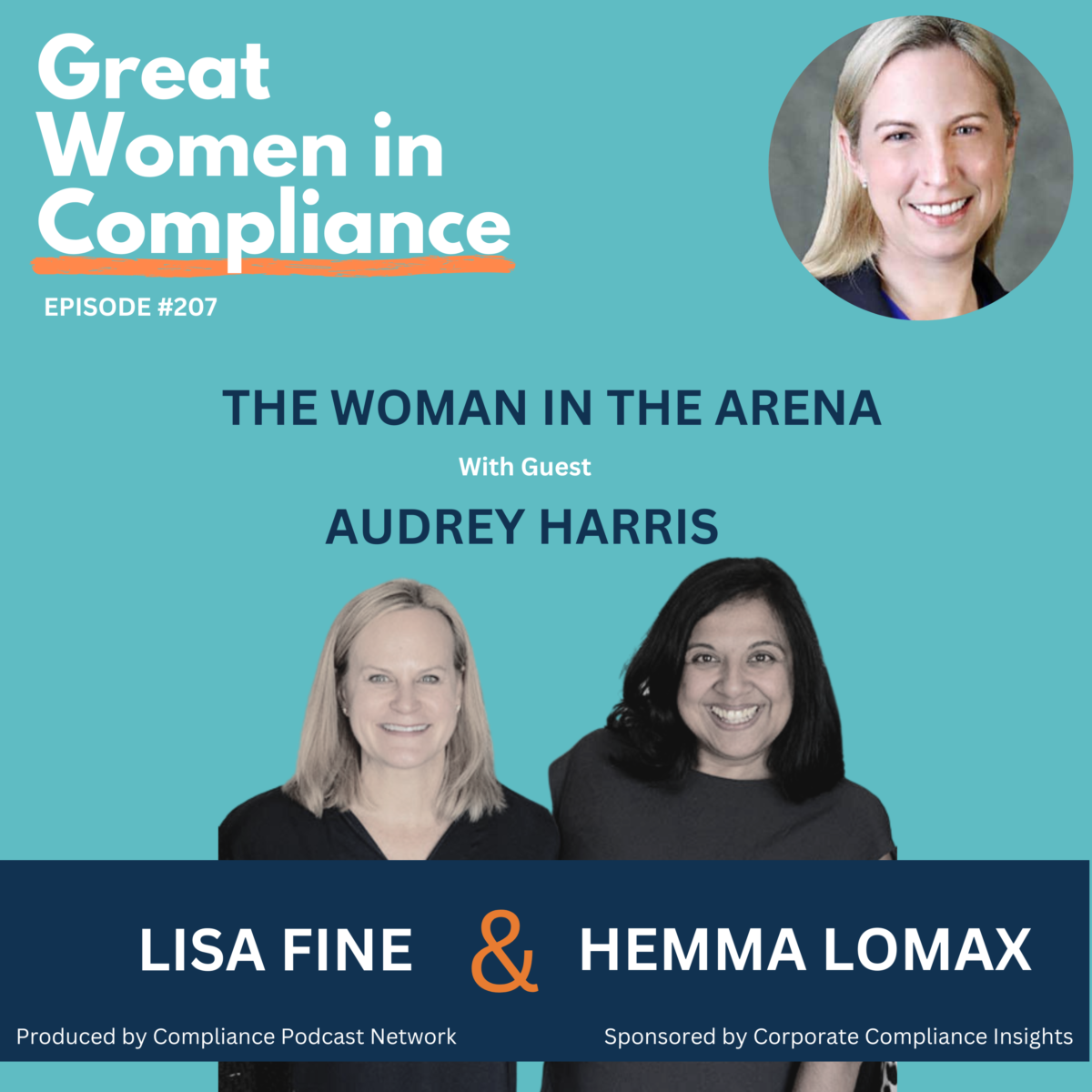
Great Women in Compliance: Audrey Harris – The Woman in the Arena

Audrey Harris, this week’s guest, shared a quote with us that is very meaningful to her. It is from Theodore Roosevelt, about “The Man in the Arena. Since this is #GWIC, we have expanded this to the women in the arena. That is the woman who is actually in the arena, not the critic or the person who waits to offer suggestions or say what can be done better after the hard calls are made and who strives to do the work and…spends herself on a worthy cause; who at the best knows, in the end, the triumph of high achievement, and who at the worst, if she fails, at least fails while daring greatly, so that her place shall never be with those cold and timid souls who neither knows victory nor defeat.”

Audrey Harris is the woman in the arena. She is Managing Director, of  Global Anticorruption, Compliance, Ethics & Non–Financial Risk at Affiliated Monitors, Inc., was formerly at two world-class law firms, and has also been a Chief Compliance Officer. She has made hard decisions in real-time and now helps organizations do the same.

In this episode, Lisa and Audrey talk more about what the woman in the arena does and why Ethics and Compliance Officers are truly the people in the arena. Audrey will also provide insight on the most recent US Department of Justice statement, whether it really is the “Monaco Memo 3.0,” and her views about what is significant in the memo and the guidance it provides.

 The arena for GWIC next week is US Thanksgiving, so we are off but will see you with a great episode on November 29.

The Great Women in Compliance Podcast is on the Compliance Podcast Network with a selection of other Compliance-related offerings. GWIC is also sponsored by Corporate Compliance Insights, where we have a page where you can hear every episode. If you are enjoying this episode, please rate it and/or provide a review.

Corporate Compliance Insights is a much-appreciated sponsor and supporter of GWIC, including affiliate organization CCI Press publishing the related book; “Sending the Elevator Back Down, What We’ve Learned from Great Women in Compliance” (CCI Press, 2020). If you enjoyed the book, the GWIC team would be very grateful if you would consider rating it on Goodreads and Amazon and leaving a short review.  Don’t forget to send the elevator back down by passing on your copy to someone who you think might enjoy reading it when you’re done, or if you can’t bear parting with your copy, consider it as a holiday or appreciation gift for someone in Compliance who deserves a treat.

If you enjoyed the book, the GWIC team would be very grateful if you would consider rating it on Goodreads and Amazon and leaving a short review.  Don’t forget to send the elevator back down by passing on your copy to someone who you think might enjoy reading it when you’re done, or if you can’t bear parting with your copy, consider it as a holiday or appreciation gift for someone in Compliance who deserves a treat.

Categories
Blog

DAG Monaco on Cooperation and Compliance Incentives for M&A

Early in October at the 2023 SCCE Compliance and Ethics Institute, Deputy Attorney General Lisa Monaco delivered a long-anticipated speech expanding and formalizing the Department of Justice’s (DOJ’s) new Safe Harbor for mergers and acquisitions in the Foreign Corrupt Practice Act (FCPA) context. The latest M&A Safe Harbor expanded on an old and frankly cumbersome Opinion Release from 2008 and some old FCPA enforcement actions from the last decade to create a clear, concise, and most welcomed announcement.

The Halliburton Opinion Release (08-02) gave some very tight deadlines for engaging in due diligence post-acquisition and reporting to the DOJ. The deadlines were 90 days to identify and report high-risk agents, 120 days to identify and report medium-risk agents, and 180 days to identify and report low-risk agents. For those scoring at home, that is three, six, and nine months, which for most corporations is the blink of an eye.

Moreover, while the 2012 FCPA Resource Guide did provide some guidance on what may constitute a safe harbor, the word “may” was a sticking point for corporate management when deciding whether and how to proceed with a potential merger or acquisition. There is a big difference between a theoretical outcome and one that is concrete and presumptively available. Finally, a series of FCPA enforcement actions involved mergers and acquisitions. It was unclear when remediation of any issues must be completed, from 18 months to “as soon as is practicable.”

This new DOJ policy is then aimed at encouraging cooperation and compliance in the corporate world, particularly during acquisitions. This policy allows companies to avoid charges for compliance violations discovered during the acquisition process as long as specific deadlines are met. Compliance officers are crucial in this process, conducting due diligence before and after the acquisition.

Monaco stated, “We are announcing a Department-wide Safe Harbor Policy for voluntary self-disclosures in the mergers and acquisition process context. In the future, acquiring companies that promptly and voluntarily disclose criminal misconduct within the Safe Harbor period, cooperate with the ensuing investigation, and engage in requisite, timely, and appropriate remediation, restitution, and disgorgement will receive the presumption of declination.”

Under this new policy, acquiring companies will not be held accountable for aggravating factors at the acquisition target. This means that the acquiring company will not be responsible if there are compliance issues at the target company. However, there are concerns about how this policy will be executed and its potential impact on different enforcement actions.

A key element is the clear and concise timelines articulated by DAG Monaco. She stated, “To ensure consistency, I am instructing this Safe Harbor policy to be applied Department-wide. Each part of the Department will tailor its application of this policy to fit its specific enforcement regime and consider how it will be implemented.

To ensure predictability, we are setting clear timelines. As a baseline matter, to qualify for the Safe Harbor, companies must disclose misconduct discovered at the acquired entity within six months from the date of closing. That applies whether the misconduct was found pre- or post-acquisition.”

After that, “Companies will have a baseline of one year from the closing date to fully remediate the misconduct. These baselines are subject to a reasonableness analysis because we recognize deals differ and not every transaction is the same. So, depending on the specific facts, circumstances, and complexity of a particular transaction, Department prosecutors could extend those deadlines.”

One essential tradeoff in this policy is the balance between encouraging cooperation and holding companies accountable for their actions. On one hand, the policy incentivizes companies to disclose compliance violations and cooperate with the Justice Department voluntarily. This can lead to more effective enforcement and greater transparency in the corporate world. On the other hand, there is a risk that some companies may take advantage of this policy and try to cover up compliance violations.

Compliance officers also face challenges in this new policy. If they are not involved in pre-acquisition due diligence, it could be a red flag for their career security. There is a concern that unscrupulous management teams may try to close a deal without proper due diligence and then blame the compliance officer if issues arise later on. Compliance officers must proactively ensure their involvement in the acquisition process to protect themselves and their companies.

The enforcement of this policy, particularly in antitrust cases, is also a subject of curiosity and anticipation. It is unclear how the policy will apply to corporate misconduct beyond bribery and corruption or anti-competitive actions. There are questions about whether the default position of the DOJ antitrust division will be a declination or if they will still bring charges against companies involved in antitrust violations.

While this new policy is a step forward for compliance, there are still concerns about its effectiveness and potential abuse. The Justice Department is trying to balance providing incentives for cooperation and holding companies accountable for their actions. However, there is a need for further clarity and guidance on how this policy will be executed in practice.

Overall, the new policy on corporate compliance during acquisitions is an essential development in the corporate world. It highlights the importance of considering compliance issues when making decisions about acquisitions and encourages companies to take proactive steps to address compliance violations. Compliance officers play a crucial role in this process and must be vigilant in ensuring their involvement to protect themselves and their companies. The execution of this policy and its impact on different enforcement actions will be closely watched in the coming months.

Categories
2 Gurus Talk Compliance

2 Gurus Talk Compliance – Episode 15 – The I Don’t Like it Edition

What happens when two top compliance commentators get together? They talk compliance, of course. Join Tom Fox and Kristy Grant-Hart in 2 Gurus Talk Compliance as they discuss the latest compliance issues in this week’s episode! In this episode, Tom and Kristy take on a wide variety of topics, including a visit to Florida Women.

The landscape of corporate compliance is ever-evolving, with recent developments posing new challenges and opportunities for businesses. Compliance is a dynamic process that requires constant monitoring and retrospective reviews to identify potential risks and changes. He also emphasizes the importance of involving compliance officers early in the due diligence process of mergers and acquisitions and acknowledges the complexities of managing conflicts of interest in networking and hiring. Tom and Kristy advocate for a proactive approach to compliance, highlighting the importance of regulatory resources such as the New York State Department of Financial Services’ cybersecurity rules. She also stresses the need for clarity and certainty in compliance practices, particularly in areas like mergers and acquisitions and conflicts of interest. Join Tom Fox and Kristy Grant-Hart as they delve deeper into these issues in the latest episode of the 2 Gurus Talk Compliance podcast.

 Highlights Include:

  1. Albemarle FCPA enforcement action. (FCPA Blog)
  2. DAG Monaco on more credit for self-disclosure, this time in M&A. (Radical Compliance)
  3. NYDFS Comments on proposed cyber disclosure amendments. (Compliance and Enforcement Blog)
  4. Michael Lewis and SBF. (The Dig)
  5. Identifying compliance blind spots. (CCI)
  6. Lawmakers Press NBA, Players Union on Forced Labor (WSJ)
  7. Can you tell the difference between acceptable networking and wrongful hiring practices? (FCPA Blog)
  8. Crypto Sector Seeks Lawyers, Compliance Officers After Reputational Hits (WSJ)
  9. Stop Obsessing About Work All the Time (WSJ)
  10. Two women stole bags of food from Florida Taco Bell during armed robbery, deputies say (Fox 25 Orlando)

Resources 

Kristy Grant-Hart on LinkedIn

Spark Consulting

Tom

Threads

Instagram

Facebook

YouTube

Twitter

LinkedIn

Categories
Compliance Into the Weeds

Compliance into the Weeds: New M&A Safe Harbor

The award-winning Compliance into the Weeds is the only weekly podcast that takes a deep dive into a compliance-related topic, literally going into the weeds to explore a subject more fully. Are you looking for some hard-hitting insights on sanctions compliance? Look no further than Compliance into the Weeds! In this episode, Tom and Matt consider the recent speech by DAG Lisa Monaco, creating a Safe Harbor for M&A under the FCPA and beyond.

The Justice Department has recently unveiled a new policy aimed at fostering cooperation and compliance within the corporate sector, especially during acquisitions. This policy, which offers companies the chance to avoid charges for compliance violations discovered during the acquisition process, has sparked a lively discussion among compliance experts. Matt views this policy with a mix of curiosity and uncertainty. He acknowledges its potential benefits but also raises concerns about its practical execution, particularly in relation to antitrust enforcement and the treatment of companies new to acquisitions.

The application of the policy across various DOJ divisions and its interactions with other enforcement organizations intrigue Tom. He also questions whether acquiring companies will still receive a “free pass” if the acquired company engages in antitrust behavior. To delve deeper into these perspectives and explore the potential implications of this new policy, join Tom Fox and Matt Kelly in the latest episode of the Compliance into the Weeds podcast.

Key Highlights:

  • Cooperation and Compliance Incentives for M&A
  • Exemption of Acquisition Target’s Aggravating Factors
  • DOJ’s Emphasis on Pre-Acquisition Compliance Involvement
  • Enforcement Policy’s Impact and Curiosity

 Resources:

Matt in Radical Compliance

Tom 

Threads

Instagram

Facebook

YouTube

Twitter

LinkedIn