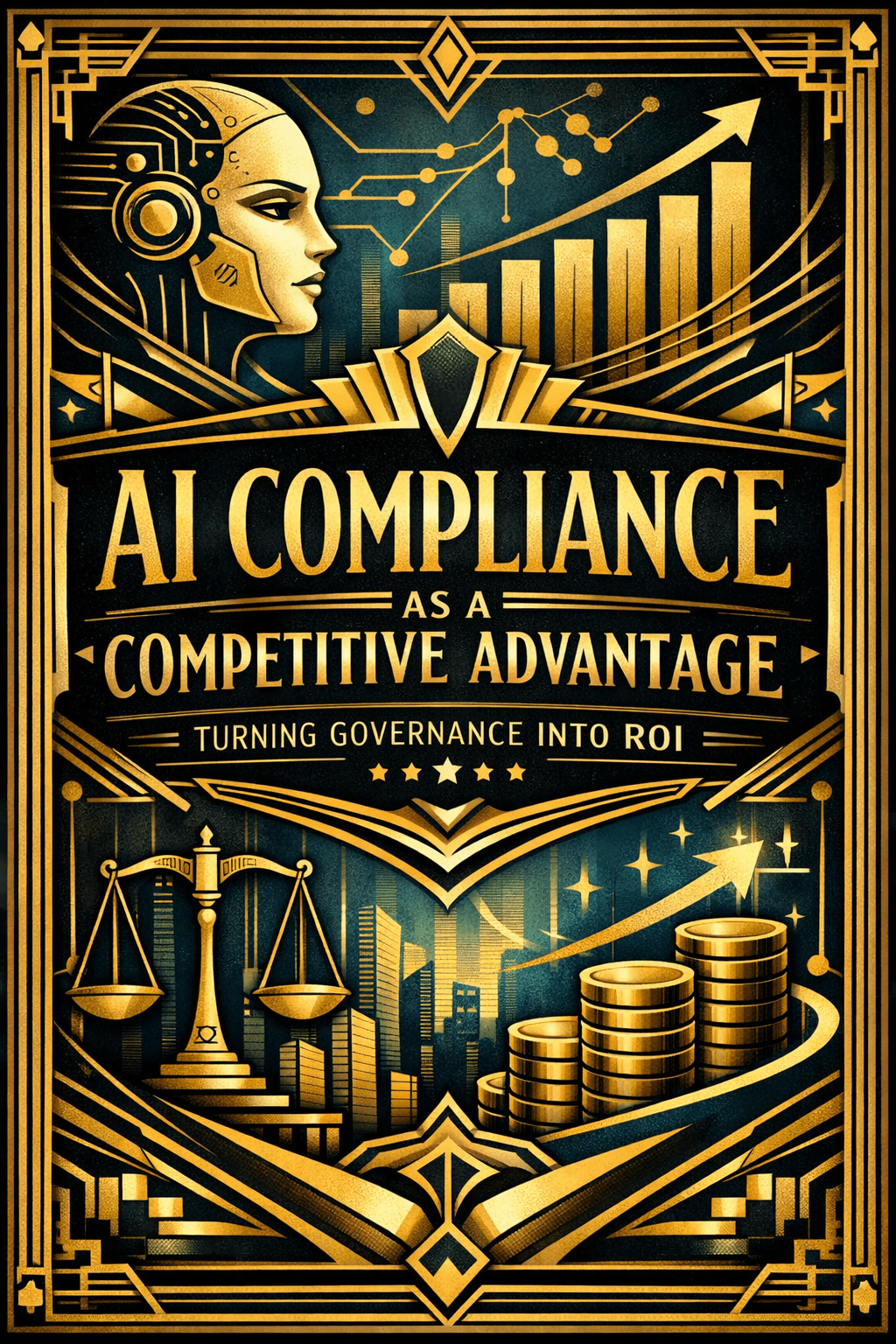
In too many organizations, “AI compliance” is treated like a speed bump. Something to route around, manage after launch, or outsource to a vendor deck and a policy that nobody reads. That mindset is not only outdated but also expensive. In 2026, mature AI governance is becoming a commercial differentiator because customers, regulators, employees, and business partners increasingly ask the same question: Can you prove your system is trustworthy?
The most underappreciated truth is that AI risk is not “an AI team problem.” It is a business-process problem, expressed through data, decisions, third parties, and change control. The Department of Justice Evaluation of Corporate Compliance Programs (ECCP) has never been about perfect paperwork; it has been about whether a program is designed, implemented, resourced, tested, and improved. If you can translate that posture into AI, you can convert “compliance cost” into “credibility capital.”
A cautionary backdrop shows why. The EEOC’s 2023 settlement with iTutorGroup serves as a cautionary tale: automated hiring screening that disadvantages older workers can lead to legal exposure, remediation costs, and reputational damage. The details matter less than the pattern; when algorithmic decisions are not governed, the business eventually pays the bill. The compliance professional should see the pivot clearly; governance is the mechanism that lets you move fast without becoming reckless.
From a build-from-scratch, low-to-medium maturity posture, the win is not sophistication. The win is repeatability. If you build an AI governance framework aligned to NIST AI RMF (govern, map, measure, manage), structured through ISO/IEC 42001’s management-system discipline, and cognizant of EU AI Act risk tiering, you get something the business loves: a predictable path from idea to deployment. Today, I will explore five ways mature AI compliance can become a competitive advantage, each with a practical view of how a compliance-focused GenAI assistant can support business processes.
1) Sales and Customer Trust
Trust is a sales feature now, even when marketing refuses to call it that. Customers increasingly ask about data use, model behavior, security controls, and human oversight, and they are doing it in procurement questionnaires and contract negotiations. A mature governance framework lets you answer quickly, consistently, and with evidence, thereby shortening sales cycles and reducing late-stage deal friction. A compliance GenAI can support this by drafting standardized responses from approved trust artifacts such as policies, model cards, DPIAs, and audit summaries; flagging gaps, and routing exceptions to Legal and Compliance before the business overpromises.
For compliance professionals, this lesson is even more stark, as the ‘customers’ of a corporate compliance program are your employees. Some key KPIs you can track are average time to complete AI security and compliance questionnaires; percentage of deals requiring AI-related contractual concessions; number of customer-facing AI disclosures issued with approved templates; and percentage of AI systems with current model documentation and ownership attestations.
2) Regulatory Credibility
Regulators are not impressed by ambition; controls persuade them. NIST AI RMF provides a common language to demonstrate that you mapped use cases, measured risks, and managed them over time, while ISO/IEC 42001 imposes discipline on accountability, documentation, and continual improvement. The EU AI Act’s risk-based approach adds an organizing principle: classify systems, apply controls proportionate to risk, and prove that you did it. A compliance GenAI can help by maintaining a living inventory, prompting owners to complete quarterly attestations, drafting control narratives aligned with the frameworks, and assembling regulator-ready “evidence packs” that demonstrate governance in operation rather than on paper.
For compliance professionals, this lesson is about your gap analysis. You have not aligned your current internal controls with GenAI, governance, or other controls. You should do so. Some key KPIs you can track are percentage of AI systems risk-tiered and documented; time to produce an evidence pack for a high-impact system; number of material control exceptions and time-to-remediation; and frequency of risk reviews for high-impact systems.
3) Faster Product Approvals and Safer Deployment
Speed comes from clarity, not from cutting corners. When decision rights, review thresholds, and required artifacts are defined up front, product teams stop guessing what Compliance will require at the end. That is the management-system advantage: ISO/IEC 42001 treats AI governance like a repeatable operational process with gates, owners, and records, rather than a series of one-off debates. A compliance GenAI can support the workflow by pre-screening new use-case intake forms, recommending the correct risk tier under EU AI Act concepts, suggesting required testing (bias, privacy, safety), and generating the first draft of a launch checklist that the product team can execute.
For compliance professionals, this lesson is that you must run compliance at the speed of your business operations. Some key KPIs you can track are: cycle time from AI intake to approval; percent of launches that pass on first review; number of post-launch “surprise” issues tied to missing pre-launch controls; and percentage of models with human-in-the-loop controls when required.
4) Talent, Recruiting, and Internal Confidence
Top performers do not want to work in a company that treats AI like a toy and compliance like a nuisance. Mature governance creates psychological safety inside the organization: employees know what is permitted, what is prohibited, and how to raise concerns. It also improves recruiting because candidates, especially in technical roles, ask about responsible AI practices, data governance, and ethical guardrails. A compliance GenAI can support internal confidence by serving as the first-line “policy concierge,” answering questions with approved guidance, directing employees to the correct procedures, and logging common questions so Compliance can improve training and communications.
For compliance professionals, this fits squarely within the DOJ mandate for compliance to lead efforts in institutional justice and fairness. Some key KPIs you can track include training completion and comprehension metrics for AI use; the number of AI-related helpline inquiries and their resolution times; employee survey results on comfort raising AI concerns; and the percentage of AI use cases with documented business-owner accountability.
5) Lower Cost of Incidents and More Resilient Operations
AI incidents are rarely just “bad outputs.” They are process failures: poor data lineage, uncontrolled model changes, vendor opacity, missing logs, weak access controls, or no escalation path when harm appears. NIST AI RMF’s “measure” and “manage” functions emphasize monitoring, drift detection, incident response, and continuous improvement, which is precisely how you reduce the frequency and severity of failures. A compliance GenAI can support incident resilience by guiding teams through an AI incident response playbook, helping triage severity, ensuring evidence is preserved (audit logs, prompts, outputs, approvals), and generating lessons-learned reports that connect root cause to control enhancements.
For compliance professionals, this lesson is even more stark, as the ‘customers’ of a corporate compliance program are your employees. Some key KPIs you can track include the number of AI incidents by severity tier; mean time to detect and mean time to remediate; the percentage of high-impact models with drift-monitoring and alert thresholds; and the percentage of third-party AI providers subject to change-control notification requirements.
What “Mature Governance” Looks Like When You Are Building From Scratch
Do not start with a 60-page policy. Start with a few non-negotiables that scale:
- Inventory and classification: Create a single inventory of GenAI assistants, ML models, and automated decision systems. Classify them by impact using EU AI Act concepts (high-impact versus low-impact) and your own business context.
- Accountability and decision rights: Assign an owner for each system and require periodic attestations for the highest-risk categories.
- Standard artifacts: Use lightweight model documentation, data lineage notes, and disclosure templates. If it is not documented, it does not exist for governance.
- Human oversight and logging: Define when human-in-the-loop is mandatory and ensure logs capture who approved what, when, and why.
- Third-party AI controls: Contract for transparency, audit support, change notification, and security requirements. Vendor opacity is not a strategy.
This is where ECCP thinking helps. The question is not whether you have a policy. The question is whether the policy is operationalized, tested, and improved. That is the bridge from compliance to competitive advantage.
If you want AI compliance to be a competitive advantage, treat it like a management system that produces evidence, not like a policy library that produces comfort. When governance becomes repeatable, the business can move faster, regulators become more confident, and customers see the difference. That is not a cost center. That is credibility you can take to the bank.