Categories
Blog

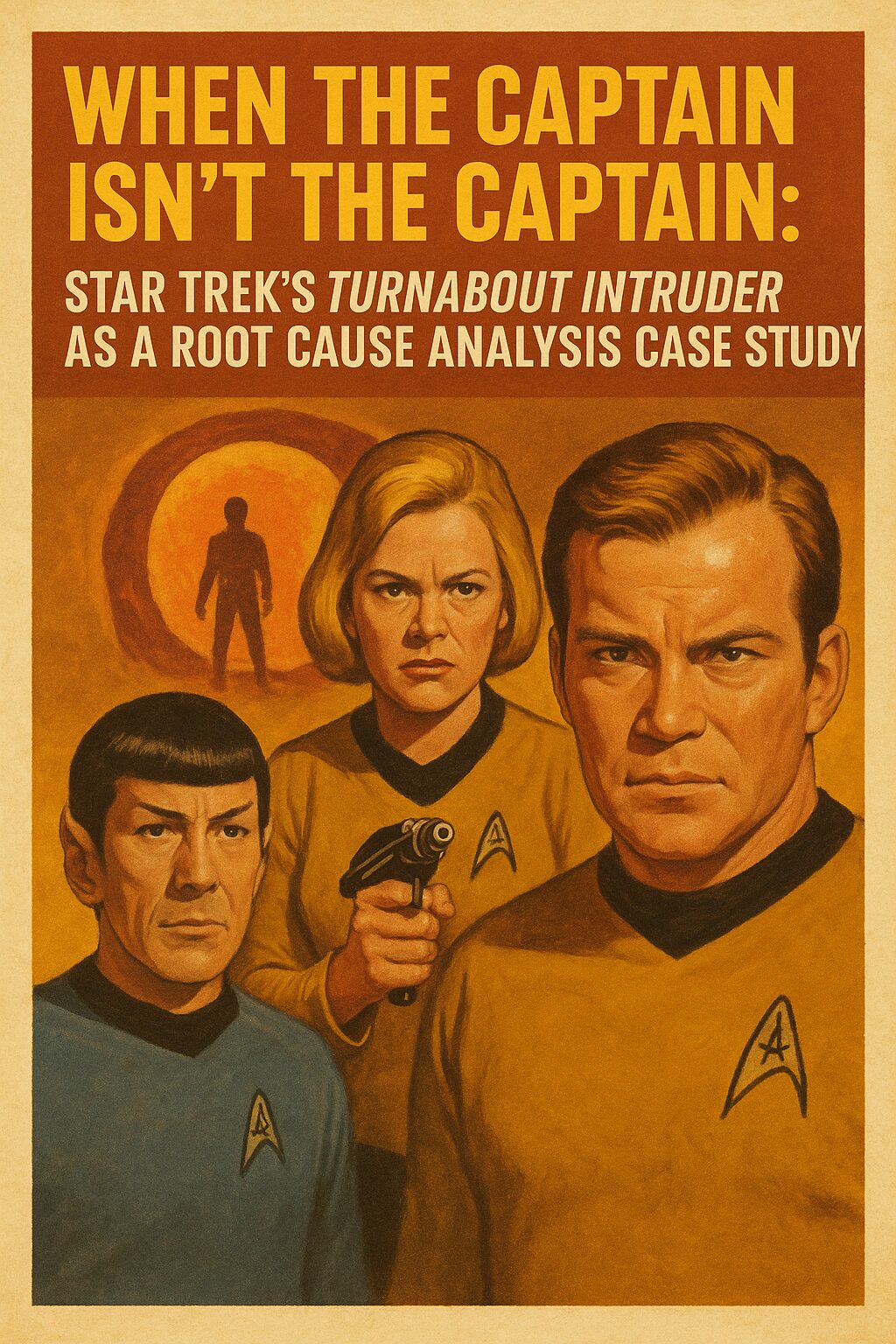
When the Captain Isn’t the Captain: Star Trek’s Turnabout Intruder as a Root Cause Analysis Case Study

One of the Department of Justice’s most consistent themes in its 2024 Update to the Evaluation of Corporate Compliance Programs (ECCP) is the need for companies to conduct effective root cause analysis following misconduct or control failures. It’s not enough to identify what went wrong; you must understand why it happened and implement measures to prevent it from happening again.

That principle is front and center in the Star Trek: The Original Series finale, Turnabout Intruder. In this episode, Captain Kirk is on an archaeological survey mission when he encounters Dr. Janice Lester, an old acquaintance from Starfleet Academy. Through a mysterious alien device, Lester transfers her consciousness into Kirk’s body, trapping his mind in her own body. What follows is a tense series of events in which “Kirk” behaves increasingly erratically, prompting suspicion among the crew.

For compliance professionals, the episode is a surprisingly apt case study in the perils of failing to dig past the surface when something seems off. Just as the crew needed to piece together the real cause of their captain’s strange behavior, compliance teams must be adept at peeling back layers to discover the true root cause of problems.

Here are five key root cause analysis lessons from Turnabout Intruder.

Lesson 1: Unusual Behavior Should Trigger an Investigation

Illustrated by: Shortly after the mind swap, “Kirk” begins making uncharacteristic decisions, belittling subordinates, ignoring Starfleet protocols, and punishing dissent in ways that are entirely out of character for the captain.

Compliance Lesson:

Behavior that deviates from established patterns should be a red flag. In corporate compliance, abrupt changes, whether in employee conduct, financial reporting patterns, or transaction activity, often indicate deeper issues.

Too often, organizations rationalize away early warning signs: “He’s under stress” or “That’s just her style.” But effective root cause analysis begins with the willingness to ask, Why is this happening now? Early detection is often the difference between a manageable problem and a full-blown crisis. Develop and maintain behavioral baselines for key personnel and functions. If something deviates sharply, investigate promptly rather than waiting for more evidence to emerge.

Lesson 2: Multiple Data Points Build a Stronger Case

Illustrated by: Several crew members—Spock, McCoy, Scotty—each notice something odd about “Kirk.” At first, their observations are anecdotal and separate. Only when they share information do they begin to see a pattern that suggests something is seriously wrong.

Compliance Lesson.  Root cause analysis is stronger when it integrates multiple perspectives and sources of data. If you rely on a single source, one audit, one complaint, you risk drawing incomplete or biased conclusions.

In the episode, no single crew member had enough to prove that Kirk wasn’t himself. But when their observations were combined, the collective evidence pointed toward an anomaly that needed urgent action. Create processes that encourage information sharing across departments. Compliance, audit, HR, and operations should have mechanisms to cross-reference findings because the root cause may only emerge when different pieces are put together.

Lesson 3: Be Alert to Hidden Motives

Illustrated by: In Kirk’s body, Lester uses her new authority to sideline suspected opponents, reassigning or threatening crew who question her behavior. Her motive isn’t mission success; it’s consolidating her stolen command.

Compliance Lesson. The apparent cause of a problem may mask deeper personal or organizational motives. Misconduct often occurs because someone is pursuing goals that conflict with corporate policy, whether financial gain, personal vendettas, or reputational enhancement.

If your analysis stops at “This person violated policy,” you miss the opportunity to uncover why they were willing to risk consequences. In many cases, systemic issues, misaligned incentives, toxic culture, and weak oversight are the true drivers. In every investigation, ask “What’s in it for them?” Understanding incentives, pressures, and personal agendas can reveal root causes that process analysis alone won’t uncover.

Lesson 4: Authority Structures Can Delay Recognition of the Problem

Illustrated by: Even when evidence mounts, the crew is reluctant to challenge “Kirk” because of the chain of command. Starfleet discipline dictates deference to the captain, making it harder to act on suspicions.

Compliance Lesson. In organizations, hierarchy can be a barrier to identifying root causes. Employees may hesitate to report misconduct by senior leaders, or they may assume questionable directives are “above their pay grade” to question.

This dynamic often allows problems to persist far longer than they should. A compliance program must be designed to bypass those bottlenecks, giving employees safe, confidential, and credible ways to report concerns, even about top executives. Ensure that escalation procedures allow for independent review of senior management conduct. Whistleblower protections, ombuds functions, and anonymous hotlines can help surface issues that otherwise stay buried.

Lesson 5: Validate Assumptions Before Acting

Illustrated by: Spock eventually confronts “Kirk” and demands an explanation. Through logical analysis and a mind meld, he confirms the body-swap truth. Only then can the crew take decisive action to restore the captain to his rightful body.

Compliance Lesson. One of the biggest pitfalls in root cause analysis is acting on unverified assumptions. If you jump to conclusions too early, you may “fix” the wrong problem—or make it worse. Spock’s mind meld was the ultimate verification step. In compliance, your “mind meld” might be corroborating whistleblower claims with independent documentation, or testing an internal control in multiple scenarios before concluding it’s defective.

Build verification into your root cause analysis process. Don’t settle for the first plausible explanation; pressure-test your conclusions before implementing remediation.

Connecting Star Trek to DOJ Expectations

The DOJ’s ECCP explicitly asks:

  • “What is the root cause of the misconduct?”
  • “Were prior opportunities to detect the misconduct missed?”
  • “What systemic failures contributed to the issue?”

Turnabout Intruder illustrates the importance of addressing these questions. If the crew had stopped at “the captain is acting oddly” and focused on damage control, they might never have uncovered the deeper truth of Lester’s body swap. Similarly, in corporate investigations, stopping at the surface level (“employee violated policy”) without probing the environment that allowed it to happen fails both the DOJ’s expectations and your prevention mandate.

Final ComplianceLog Reflections

In Turnabout Intruder, the crew’s slow realization of the true problem nearly cost them their captain and perhaps the Enterprise itself. In the compliance arena, a slow or shallow root cause analysis can allow misconduct to persist, control weaknesses to remain unaddressed, and systemic issues to metastasize.

Effective compliance leadership means not just spotting what’s wrong, but relentlessly pursuing why it went wrong. That’s how you fix the problem in a way that prevents recurrence.

Like Spock confronting “Kirk,” we must be willing to gather evidence methodically, test our conclusions, and take decisive action once the truth is clear. Root cause analysis isn’t about blame—it’s about ensuring your organization emerges stronger, more transparent, and more resilient than before.

Because in the end, just like the Enterprise, your mission depends on having the right people in the right roles, operating with integrity, and that’s a result only a thorough, well-executed root cause analysis can guarantee.

 Resources:

⁠⁠Excruciatingly Detailed Plot Summary by Eric W. Weisstein⁠⁠

⁠⁠MissionLogPodcast.com⁠⁠

⁠⁠Memory Alpha

Categories
Trekking Through Compliance

Trekking Through Compliance: Episode 35 – Root Cause Lessons from Star Trek’s “The Doomsday Machine”

Compliance professionals are forever tasked with pinpointing the root causes behind organizational failures, missteps, or breaches. This deep dive is critical, not only for remediating issues but also for ensuring they don’t recur. In this compliance exploration, let’s boldly go where few compliance bloggers have gone before, into the riveting episode “The Doomsday Machine.”

Here are five lessons, each anchored directly in the narrative of this classic Star Trek episode, emphasizing how thorough root cause analyses can strengthen your compliance function and safeguard your organization.

Lesson 1: Identify the Problem to Solve the Correct Issue

Illustrated By: Commodore Decker incorrectly identifies the root cause. He believes the Doomsday Machine is a conventional threat rather than an unfeeling, mechanical entity beyond traditional warfare.

Compliance Lesson. In compliance terms, this parallels the imperative first step in any root cause analysis: defining the correct problem. Misidentifying the fundamental issue can lead to misguided corrective actions that fail to prevent recurrence.

Lesson 2: Gather Complete Data Before Making Decisions

Illustrated by: Commodore Decker’s hasty decisions are predicated upon incomplete and inadequate data.

Compliance Lesson. Drawing premature conclusions from incomplete data gathering can lead to inadequate analyses, resulting in ineffective solutions and the recurrence of issues.

Lesson 3: Recognize and Address Human Factors

Illustrated By: The human element, including stress, fatigue, and emotional response, significantly impacts decision-making.

Compliance Lesson. In your root cause analyses, it is essential to consider human factors rigorously.

Lesson 4: Establish and Follow Clear Protocols

Illustrated By: Captain Kirk, once back in command, establishes a disciplined approach to address the crisis.

Compliance Lesson. Root cause analyses similarly benefit immensely from disciplined adherence to clearly established investigative protocols.

Lesson 5: Develop Sustainable Preventive Solutions, Not Temporary Fixes

Illustrated By: The Enterprise crew devises an effective solution by leveraging detailed knowledge of the Doomsday Machine’s design and vulnerabilities.

Compliance Lesson. In compliance with this, root cause analyses aim to create permanent, preventive solutions. Short-term patches that treat symptoms rather than underlying causes merely set organizations up for future compliance breakdowns.

Final ComplianceLog Reflections

As corporate compliance professionals, our role parallels that of Starfleet officers, tasked with safeguarding our organizations against compliance risks that can threaten their very existence. The Star Trek episode “The Doomsday Machine” highlights the crucial importance of effective root cause analysis, which involves accurately identifying issues, collecting comprehensive data, understanding human factors, adhering to disciplined investigative procedures, and implementing sustainable solutions.

Resources:

Excruciatingly Detailed Plot Summary by Eric W. Weisstein
MissionLogPodcast.com

Memory Alpha

Categories
Blog

Unseen Threats and Deduction: Compliance Lessons from The Adventure of the Lion’s Mane

Sherlock Holmes, the master of deduction, seldom worked without Dr. Watson. Yet in The Adventure of the Lion’s Mane, Holmes takes center stage in a quiet coastal town, solving a case that presents no apparent suspects, no human culprit, and a mystery rooted in the natural world. For corporate compliance professionals, this unusual story offers rich lessons about vigilance, adaptability, and the importance of robust investigative techniques. The story is unusual for several reasons, including Holmes’s first-person narrative. Also, the case involves an antagonist from the natural world instead of the human world.

Equally interesting are the lessons the story can teach the 21st-century compliance professional. Today, I will examine five key compliance lessons from Holmes’s encounter with the lion’s mane jellyfish. For additional information on the story and commentary, check out the podcast Compliance Lessons from The Lion’s Mane on the Compliance Podcast Network.

Unraveling Unseen Threats: The Importance of Root Cause Analysis

In this story, the victim collapses after screaming the cryptic words “The lion’s mane!” while bearing strange, whip-like marks on his body. At first, suspicion falls on human suspects, but Holmes’s methodical approach reveals the true cause: a Cyanea capillata jellyfish, an elusive and deadly natural threat. The case highlights a critical point for compliance professionals: risks may not always appear obvious, and solutions often require digging beneath the surface.

In the compliance world, it is often tempting to stop at the first explanation for misconduct, such as blaming individual employees or focusing on the visible symptoms of an issue. However, failing to identify the root cause leaves your organization vulnerable to repeated compliance failures. Whether dealing with third-party bribery risks, internal fraud, or systemic policy gaps, the Department of Justice has made clear in the 2024 Update to the Evaluation of Corporate Compliance Programs, that a root cause analysis is a cornerstone of effective compliance programs, re-emphasizing the need for both performing a root cause analysis and equally importantly using it to remediate your compliance program. It stated, “A hallmark of a compliance program that works effectively in practice is the extent to which a company can conduct a thoughtful root cause analysis of misconduct and timely and appropriately remediate to address the root causes.”

It stated what additional steps the company has taken “that demonstrate recognition of the seriousness of the misconduct, acceptance of responsibility for it, and implementing measures to reduce the risk of repetition of such misconduct, including measures to identify future risk.” The following questions were then posed:

Root Cause Analysis—What is the company’s root cause analysis of the misconduct at issue? Were any systemic issues identified? Who in the company was involved in making the analysis?

Prior Weaknesses—What controls failed? If policies or procedures should have prohibited the misconduct, were they effectively implemented, and have functions that had ownership of these policies and procedures been held accountable?

Adaptability in Unfamiliar Environments

Holmes’s seaside investigation takes him far from his usual London setting. Without the bustle of Baker Street or Watson’s steady presence, Holmes must rely entirely on his deductive skills and adaptability. This scenario mirrors the modern compliance officer’s challenge of addressing new and unfamiliar risks.

For example, your organization may expand into a new market or pivot its business model, exposing it to unfamiliar regulatory requirements or operational risks. In these situations, compliance professionals must act as business partners, guiding the organization through uncharted waters while ensuring compliance remains a priority.

You should begin with the question of who should perform the remediation; should it be an investigator or an investigative team that was part of the root cause analysis? Jonathan Marks believes the key is both “independence and objectivity.” An investigator or investigative team may be a subject matter expert and “therefore more qualified to get that particular recourse.” Yet, to perform the remediation, the key is to integrate the information developed from the root cause analysis into the solution.

Accounting for External Risks

The lion’s mane jellyfish, a force of nature, represents the kind of external risk that organizations often overlook. External risks, whether from geopolitical shifts, third-party misconduct, or environmental factors, can devastate even the most robust compliance programs if not properly managed.

Consider the recent focus on supply chain risks. An organization may have strong internal controls, but a third-party supplier engaging in unethical practices can still expose it to liability. Therefore, due diligence and ongoing monitoring are essential to an effective compliance program. Some of the key actions you can take include the following:.

Conduct comprehensive third-party due diligence before onboarding suppliers, agents, or contractors; regularly review external risks as part of your enterprise risk management (ERM) program; and implement tools and technologies to monitor external developments in real-time, such as sanctions lists or geopolitical instability.

The Power of Patience and Observation 

Holmes’s resolution hinges on his meticulous observation of minor details, marks on the victim’s body, the jellyfish’s natural habitat, and the timeline of events. He doesn’t rush to conclusions or allow others’ assumptions to sway him. Instead, he systematically gathers evidence and applies his knowledge to reach the correct conclusion. This approach underscores the importance of methodical, data-driven investigations for compliance professionals. Whether handling an internal whistleblower complaint or responding to a regulatory inquiry, rushing the process can lead to missed details or flawed conclusions.

You may also have deficiencies in internal controls. Failing to remediate gaps in internal controls “allows additional errors or misconduct to occur and thus could damage the company’s credibility with regulators” by allowing the same or similar conduct to reoccur. Finally, with both the 2024 ECCP and FCPA Corporate Enforcement Policy, the DOJ has added its voice to prior SEC statements that regulators “will focus on what steps the company took upon learning of the misconduct, whether the company immediately stopped the misconduct, and what new and more effective internal controls or procedures the company has adopted or plans to adopt to prevent a recurrence.”

Communication as a Compliance Superpower

One of Holmes’s strengths lies in his ability to explain complex phenomena in a way others can understand. In this story, he demystifies the jellyfish’s deadly nature for the local community, helping them grasp their danger and take appropriate precautions. Communication is equally critical. Whether presenting findings to the board, conducting employee training, or preparing reports for regulators, you must convey complex information clearly and compellingly. The best compliance programs are not just comprehensive; they are understood and embraced by everyone in the organization.

For compliance professionals, there are several actions you can take. First, tailor your communication style to your audience, whether it’s frontline employees, senior leadership, or regulators. Next, use data visualization, case studies, and real-world examples to make your message relatable and memorable. Finally, foster a culture of transparency, ensuring employees feel empowered to ask questions and report concerns without fear of retaliation.

Final Thoughts 

The Adventure of the Lion’s Mane is a tale of hidden threats, careful investigation, and the power of critical thinking—qualities that resonate deeply with the compliance profession. Holmes’s success lies in adapting to unfamiliar circumstances, uncovering an unseen danger, and effectively communicating his findings. Compliance officers need these skills to navigate the complex and ever-changing corporate risk landscape.

As you reflect on Holmes’s seaside investigation, consider how his methods can inspire your compliance practices. Are you conducting root-cause analyses with the same rigor? Have you adapted your program to account for external risks? And most importantly, are you equipping your organization with the tools and knowledge to prevent compliance failures before they occur?

By channeling Sherlock Holmes’s spirit of deduction and vigilance, you can strengthen your compliance program and ensure it is prepared to face even the most unexpected challenges. When the next hidden risk emerges, you will be ready to solve the mystery with precision and confidence, just like Sherlock Holmes.

Categories
Everything Compliance

Everything Compliance: Episode 143, The North to South Episode

Welcome to the only roundtable podcast in compliance as we celebrate our second century of shows.

In this episode, we have the quartet of Matt Kelly, Jonathan Marks, and Karen Moore; with host Tom Fox wearing a double hat as a commentator as well. We take up Root Cause Analysis, DEI questions in the Boeing monitorship, failures at TD Bank and a possible Caremark claim.

1. Matt Kelly takes a look into the commercial strategies which led to the compliance failures at TD Banks.  He rants about the Boston’s National Women’s Soccer League team (now deleted) advertising campaign announcing the new team with the tagline ‘too many balls’.

2. Jonathan Marks explains the differences in a Root Cause Analysis and investigations. He shouts out the WNBA and the person who solved the Golden Owl puzzle.

3. Karen Moore takes a deep dive into the district court’s request for more information on the impact of DEI on the Boeing monitorship. She rants about non-civility in the Supermarkets of America’s Parking Lots.

4. Tom Fox takes a look at the potential Caremark claim against TD Bank for both Directors and Officers failures in their duties. He shouts out to GOP dominated Texas Legislature for subpoenaing Robert Roberson for an appearance before the House, one day before his scheduled execution and the Texas Supreme Court for staying his execution until he could appear.

The members of the Everything Compliance are:

The host and producer, rantor (and sometime panelist) of Everything Compliance is Tom Fox the Voice of Compliance. He can be reached at tfox@tfoxlaw.com. Everything Compliance is a part of the award-winning Compliance Podcast Network.

Additional Resources:

1.     Jonathan Marks on Root Cause Analysis on LinkedIn.

2.     Matt Kelly on TD Bank’s Enforcement Action on Radical Compliance.

3.     Tom Fox on the potential Caremark claims in the TD Bank case on the Compliance Podcast Network blog.