

Categories
Blog

The Warner Bros. Bidding War: Part 3 – The CCO Playbook for Transactions Under Pressure

The Warner Bros. Bidding War: Part 3 – The CCO Playbook for Transactions Under Pressure

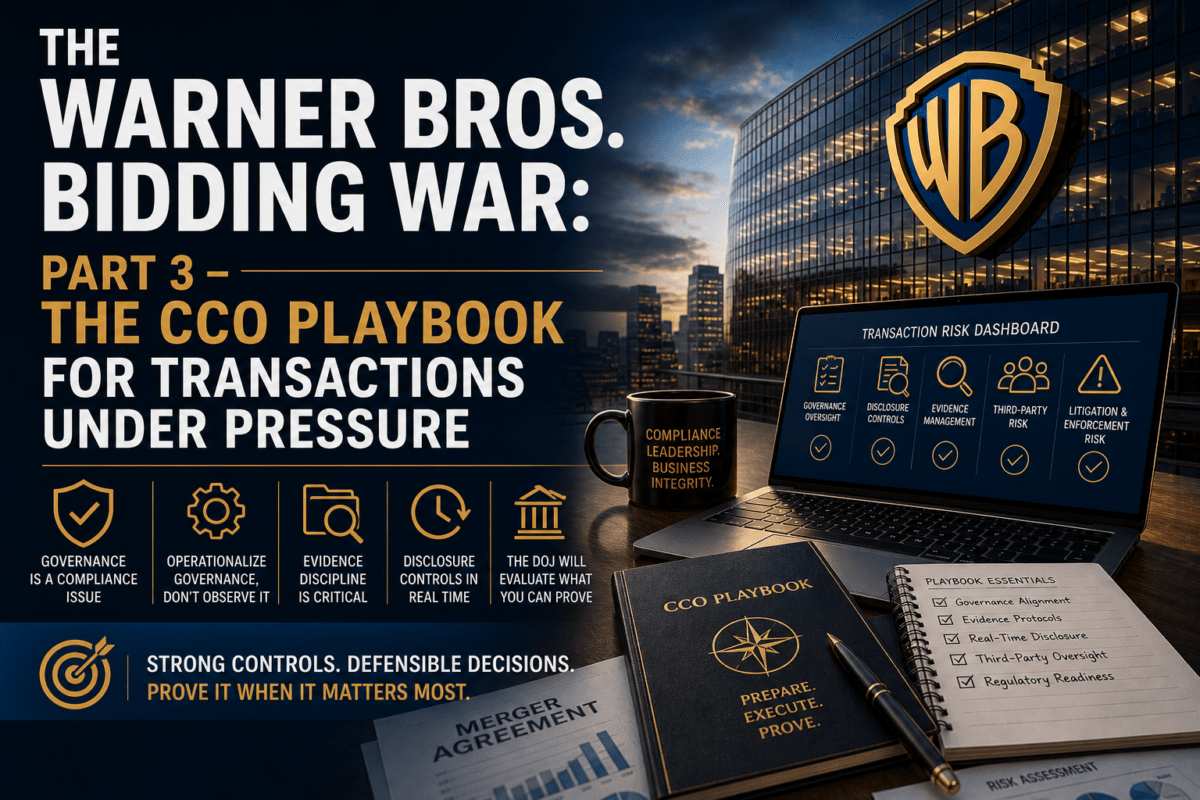
The Warner Bros. (WBD) bidding war is not simply a Board story. It is a compliance operating model test. When a superior proposal emerges, the Chief Compliance Officer (CCO) must move from program design to execution discipline. Today, we conclude our short review of the Warner Bros./Netflix/Paramount dance and sale by considering lessons for the compliance professional.

In Part 1, we focused on the deal mechanics that led Warner Bros. Discovery to move from an agreed transaction with Netflix to a superior proposal from Paramount Skydance. In Part 2, the focus shifted to Board governance and fiduciary duty. This final post, Post 3, answers the operational question. What must the Chief Compliance Officer do when the process accelerates and governance must be proven in real time?

The answer is grounded in the DOJ’s Evaluation of Corporate Compliance Programs (ECCP). The core question remains constant. Is the program working in practice? A live transaction provides the answer.

Move Compliance Into the Transaction Control Room

Too many compliance functions treat M&A as a legal and financial activity. That approach fails when the transaction becomes contested. Once a superior proposal is identified, the compliance function must:

  • Participate in transaction governance meetings
  • Map control risks across disclosure, communications, and decision-making
  • Establish escalation pathways for new information

This is consistent with the expectations embedded in the DOJ’s Corporate Enforcement Policy, which rewards companies that demonstrate real-time awareness, escalation, and action. A compliance function that is not present during the decision-making process cannot later demonstrate that controls were effective.

Build and Execute an Evidence Protocol

The most significant compliance failure point in transactions is not misconduct. It is the absence of a reliable evidentiary record. In the WBD process, multiple streams of information were created simultaneously:

  • Board materials
  • Banker communications
  • Draft proposals and revisions
  • Internal analyses and emails

The CCO must ensure that the company has an evidence-based protocol that includes:

  • Centralized collection of transaction-related materials
  • Defined custodians for document integrity
  • Time-stamped records of key decisions and communications

Under the DOJ’s framework, this directly ties to the question of whether the company can demonstrate effectiveness through data and documentation. If the company cannot reconstruct its decision-making process, it cannot defend it.

Treat Disclosure Controls as a Real-Time Compliance System

Post 2 emphasized that disclosure is a governance issue. For the CCO, it is a control system. The compliance function should validate that:

  • The disclosure committee is activated and functioning continuously
  • There is a clear trigger matrix for Form 8-K filings and proxy updates
  • All external communications are coordinated and controlled

This is not theoretical. In a contested transaction, the volume and speed of information create a risk of selective disclosure, inconsistent messaging, or delayed filings. The CCO must ensure that disclosure controls meet the same standard as financial controls. They must be tested, documented, and operational.

Control Third-Party and Advisor Risk

Transactions introduce intense third-party engagement. Investment banks, legal advisors, consultants, and communications firms all operate at speed. In the WBD scenario, third-party actions included:

  • Structuring revised proposals
  • Communicating deal terms
  • Interacting with market participants

The CCO must ensure:

  • Clear protocols for third-party communications
  • Defined boundaries on who can speak on behalf of the company
  • Documentation of all material third-party interactions

This aligns with long-standing expectations under the Foreign Corrupt Practices Act (FCPA) and the broader third-party risk principles embedded in compliance programs. Even in a domestic transaction, third-party risk remains a control issue.

Align Governance With Internal Controls Frameworks

The events described in Parts 1 and 2 map directly onto internal control frameworks such as the COSO Internal Controls Framework. For the CCO, this means:

  • Control Environment: Tone at the top regarding disciplined decision-making
  • Risk Assessment: Identification of disclosure, litigation, and regulatory risks
  • Control Activities: Implementation of approval processes and documentation protocols
  • Information and Communication: Real-time disclosure and coordination
  • Monitoring: Ongoing review of transaction-related controls

This mapping is not academic. It is how the company demonstrates that governance is structured, repeatable, and effective.

Prepare for Day Two Risk

The transaction does not end with signing or closing. It creates a new risk profile. The CCO must plan for:

  • Integration of compliance programs across entities
  • Review of legacy decisions made during the transaction process
  • Preservation of records for litigation or regulatory review

This is where the DOJ’s focus on continuous improvement becomes critical. The company must show that it learns from the transaction and strengthens its program.

Connecting the Lessons Across the Series

Part 1 showed that deal terms, including termination fees and superior proposal mechanics, can change outcomes. Part 2 demonstrated that the Board must govern those changes through documented, disciplined processes. In Part 3, we demonstrated the connections between the two. The compliance function is the mechanism that allows the company to prove that governance worked. Without compliance execution, governance is an assertion. With compliance execution, governance becomes evidence.

Practical Action Steps for CCOs

  1. Embed compliance into the transaction governance structure at the outset of any deal.
  2. Implement an evidence protocol that captures all material transaction activity in real time.
  3. Test disclosure controls under accelerated conditions, including mock 8-K scenarios.
  4. Define and enforce third-party communication protocols.
  5. Map transaction governance to COSO and DOJ ECCP requirements before a contested situation arises.

Questions for the CCO

  1. If a regulator requested the full decision record tomorrow, could the company produce it?
  2. Are disclosure controls capable of operating continuously under transaction pressure?
  3. Is there a single source of truth for transaction-related documentation?
  4. Are third-party interactions fully documented and controlled?
  5. Has the compliance program been stress-tested in a high-speed governance scenario?

Final Thoughts

The Warner Bros. Discovery bidding war is not unique. What is unique is how clearly it illustrates the modern role of the Chief Compliance Officer. Compliance is no longer limited to preventing misconduct. It is responsible for enabling the company to act, decide, and disclose with integrity under pressure and then prove it. That is the standard set by the DOJ. That is the expectation of Boards. And that is the future of the compliance profession.
 

Categories
Blog

The Warner Bros. Bidding War: Part 2 – Board Governance Under Pressure

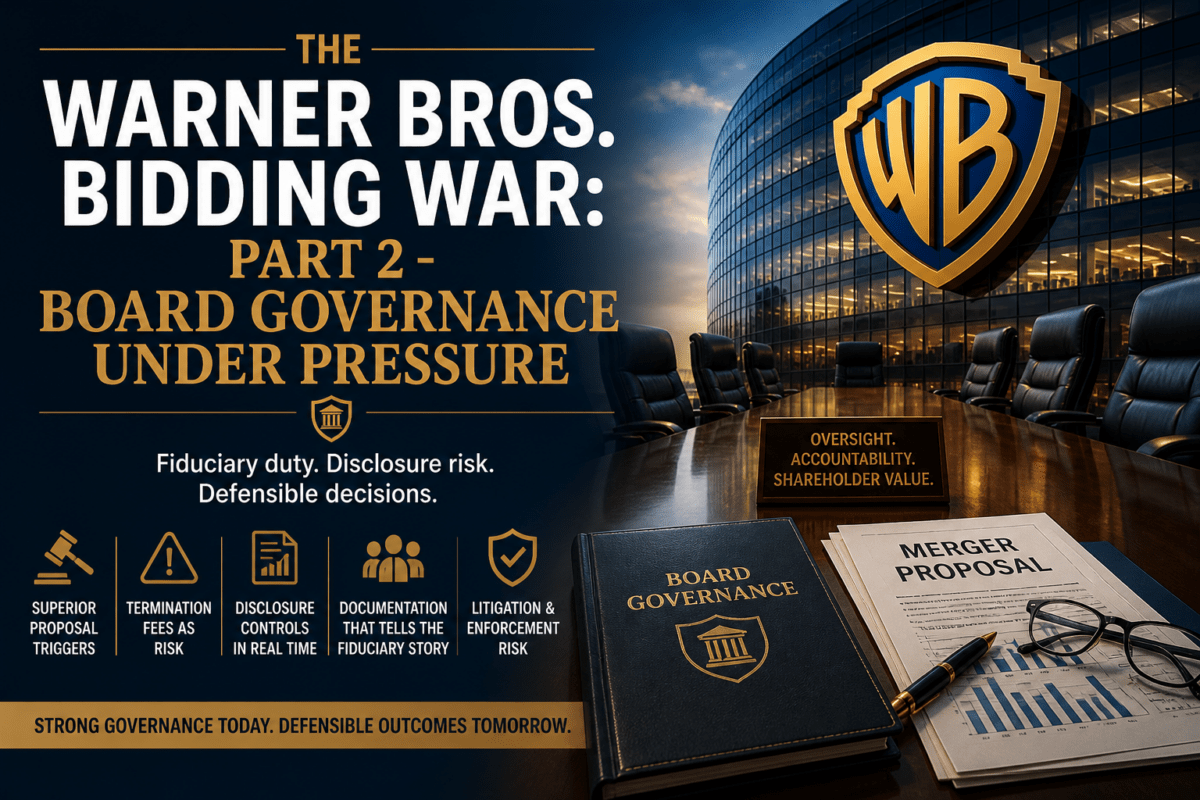
When a superior proposal emerges, the Board is no longer evaluating strategy. It is proving governance. The Warner Bros. transaction shows how fiduciary duty, disclosure discipline, and control execution must function in real time. We are exploring Warner Bros./Netflix/Paramount’s bidding and purchase processes for lessons for the compliance professional. In Part 1, we focused on what happened. This post focuses on how the Board must respond when events accelerate.

The process moved from a negotiated transaction with Netflix to a contested situation with a rival bidder, Paramount. At that moment, the Board’s role shifted from approving a deal to managing an auction under fiduciary duty. This is the precise moment contemplated by Delaware fiduciary law and the Board oversight obligations often framed through the lens of Caremark duties. The question is no longer whether the Board can approve a transaction. The question becomes whether the Board can demonstrate that it acted on an informed basis, in good faith, and in the best interests of shareholders. That is not a conclusion. It is a record.

Waiver Discipline and the Fiduciary Record

In a live bidding environment, the Board will be asked to consider waiving contractual provisions, including standstill agreements, exclusivity clauses, and information-sharing restrictions. The governance risk is not the waiver itself. The governance risk is undocumented decision-making. A Board must ensure that every waiver is:

  • Reduced to writing with a defined scope and duration
  • Reviewed by counsel with a clear statement of fiduciary rationale
  • Reflected in contemporaneous Board minutes that explain why the waiver was necessary

Under the DOJ’s Evaluation of Corporate Compliance Programs (ECCP) framework, the question is whether the company can demonstrate that its processes work in practice. A waiver without documentation is indistinguishable from a control failure.

Termination Fees as Board-Level Risk

The WBD transaction turned the $2.8 billion termination fee into a live issue. When Paramount agreed to fund the fee, the Board had to evaluate more than price. It had to evaluate:

  • Who ultimately bears the economic and legal risk
  • Whether the funding mechanism introduces new contingencies
  • How the arrangement should be disclosed to shareholders

Termination fees are often treated as deal protections. In a contested process, they serve as mechanisms for risk allocation. That places them squarely within Board oversight. A Board that does not interrogate the assumptions behind a termination fee, including third-party assumptions, is not exercising informed judgment.

Real-Time Disclosure Controls

Disclosure obligations in a transaction are not periodic. They are continuous. Once a superior proposal is identified, the company must:

  • Update proxy materials where required
  • Ensure that all material information is disclosed without selective leakage
  • Align communications across legal, investor relations, and management

The governance challenge is that information moves faster than process. Emails, banker discussions, draft proposals, and internal analyses all become part of the evidentiary record. Boards must ask whether the company has a real-time disclosure protocol. This includes:

  • A defined disclosure committee process
  • A single point of accountability for filings such as Form 8-K
  • Controls over who can communicate with external stakeholders

This is where governance intersects directly with compliance. Disclosure failures are not merely technical. They can trigger enforcement exposure.

The 8-K and Proxy Playbook

In a fast-moving transaction, the company does not have the luxury of drafting disclosures from scratch. A Board should expect management to have a predefined playbook that includes the following:

  • Trigger thresholds for filing obligations
  • Pre-approved disclosure templates for common scenarios
  • A documented approval chain involving legal, finance, and executive leadership

The absence of such a playbook creates a delay. Delay creates inconsistency. Inconsistency creates risk. From a COSO internal control perspective, this is a failure in control activities and information and communication. From a DOJ perspective, it is evidence that the program is not operationalized.

Regulatory Readiness and Remedy Planning

Both competing transactions carried regulatory risk. The difference was how that risk was allocated and mitigated. A Board must understand the following:

  • The regulatory approval pathways
  • The likelihood of a challenge
  • The remedies available if regulators object

More importantly, the Board must ensure that management has pre-developed the following:

  • Divestiture scenarios
  • Behavioral remedies
  • Escrow or holdback mechanisms tied to regulatory outcomes

This is not theoretical planning. It is part of the decision to determine which proposal is superior. A Board that does not understand regulatory risk is not fully evaluating the transaction’s value.

Post-Termination Control and Evidence Custody

When WBD terminated the agreement with Netflix, the transaction did not end. It transitioned into a new phase of risk. The company must:

  • Ensure proper handling of confidential information shared during the termination process
  • Preserve all records relevant to the decision-making process
  • Maintain audit trails for potential litigation or regulatory review

This is where evidence discipline becomes critical. The record must be complete, organized, and defensible. In the absence of such controls, the company risks being unable to demonstrate how decisions were made.

Why This Matters for Boards

The WBD process illustrates that governance is tested when conditions change rapidly. A Board cannot build governance in the middle of a transaction. It must already exist. The DOJ and SEC will not evaluate the Board based on the outcome. They will evaluate the Board based on the effectiveness of its processes, documentation, and controls. This is the essence of modern corporate governance. It is not about whether the Board chose Netflix or Paramount. It is about whether the Board can prove how and why it made that choice.

Practical Takeaways for Boards

  1. Ensure that superior proposal mechanics are understood at the Board level before a transaction is signed.
  2. Treat termination fees and regulatory protections as governance issues requiring full Board engagement.
  3. Demand real-time disclosure controls with clear ownership and escalation protocols.
  4. Require a pre-built 8-K and proxy playbook to manage disclosure risk under time pressure.
  5. Mandate regulatory scenario planning as part of transaction evaluation.

Questions for the Board

  1. Can the Board demonstrate, through contemporaneous documentation, how it evaluated a superior proposal?
  2. Does the company have a real-time disclosure control framework that supports rapid filings and updates?
  3. Are termination fee structures and third-party funding arrangements fully understood and documented?
  4. Has the Board reviewed regulatory risk scenarios and approved a default remedy strategy?
  5. Who is accountable for evidence preservation and record integrity during and after the transaction?

Please join us tomorrow; in our final post, we’ll focus on the Chief Compliance Officer. The question will be direct. What must a CCO do, in operational terms, to ensure that the company can execute governance under pressure and prove it after the fact?