Categories
Blog

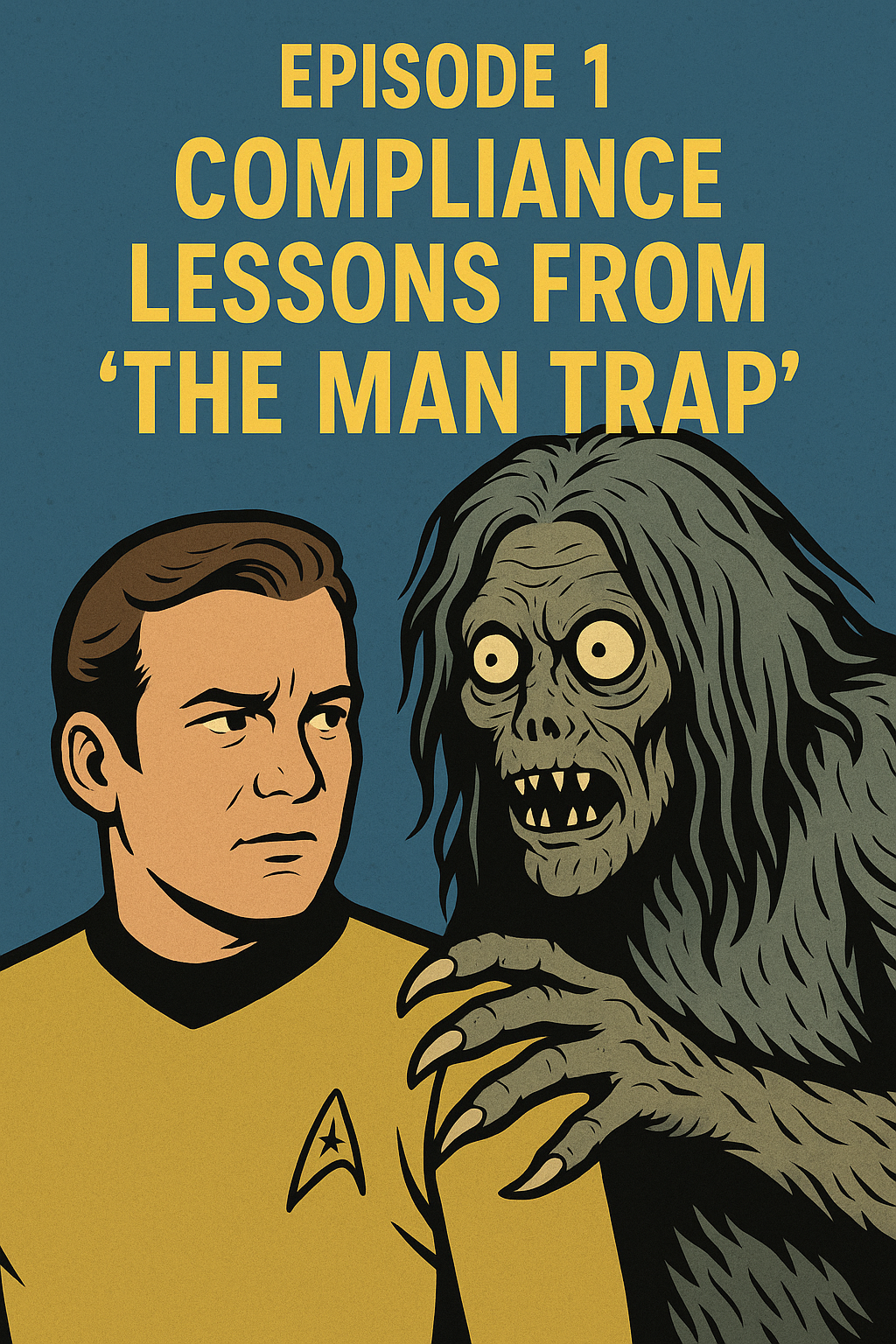
The Man Trap: Salt Vampires, Soft Controls, and the Price of Inaction

Today we consider the episode The Man Trap which aired on June 3, 1969, Star Date 5298.5. We begin by beaming down to Planet M113 with Captain Kirk and crew to uncover the compliance and leadership lessons buried in the salt-thirsty narrative of The Man Trap. This first aired Star Trek episode is not simply science fiction, rather it is a parable for today’s compliance professional. When a creature with the ability to shape-shift into anyone it wants hides among the crew, deception, emotional blind spots, and ethical hesitation threaten the integrity of the mission and the lives aboard the Enterprise.

Story

In this episode, a landing party from the Enterprise beams down to perform an annual checkup of scientist Bob Crater and his wife Nancy, who have lived on the planet M113 for 5 years. Dr. Crater and Nancy appear to be in good health, but Dr. Crater goes out of his way to request an additional salt supply from the Enterprise’s stores. A crewman wanders off and dies under mysterious circumstances. Further tests show that his body is completely devoid of salt.

Scanning the planet’s surface reveals only a single life form, so Spock and Kirk realize that Nancy must have beamed aboard the Enterprise and started searching for her. They question Dr. Crater and learn that Nancy is dead and that her form has been taken over by the planet’s last remaining indigenous creature, which can assume any form and requires salt to live.

Kirk and Spock then beam Dr. Crater aboard the Enterprise, who prevents Kirk from killing the creature (which he still sees as Nancy Crater), and then stands idly by as she begins to drain the salt from Kirk’s body. At this juncture, Spock rushes in and demonstrates to McCoy that the woman attacking Kirk could not be Nancy by striking her repeatedly and forcefully. Nancy does not flinch, sending Spock flying across the room with a single counterblow. When the creature attacks Kirk again, its proper alien form is revealed, and Bones kills it with a phaser, even after it reverts to Nancy’s form.

Key Highlights:

1. Compliance and Leadership Lessons – The Cost of Denial
Key Scene- Dr. Crater’s refusal to acknowledge the danger posed by the creature impersonating his wife Nancy.
Leadership is about difficult truths, not convenient fantasies. Dr. Crater’s emotional attachment blinds him to reality, echoing the risks faced when leaders ignore clear signs of compliance breakdowns. Just as he stalls Kirk and enables the creature’s deception, real-world executives who refuse to confront corruption or misconduct endanger the entire ship.

2. Character Dynamics – Trust, Bias, and Team Decision-Making
Key Scene- The landing party’s conflicting views of Nancy—each member sees her differently.
This episode reminds us how biases cloud judgment. The creature manipulates the crew’s perceptions, much like a charismatic fraudster might mislead auditors or compliance officers. Effective compliance teams must cultivate objectivity and challenge assumptions, especially when red flags appear under familiar disguises.

3. Ethical Decision-Making and Vigilance – When Loyalty Becomes Liability
Key Scene- McCoy’s inability to act until it’s almost too late.
McCoy’s emotional paralysis shows the danger of misplaced loyalty in corporate settings. Compliance professionals must prioritize facts over feelings. Only when Spock physically assaults the creature and reveals its true nature does McCoy accept the need for lethal action. It’s a painful but powerful lesson in balancing empathy with professional duty.

4. Storytelling and Visual Branding – Make the Message Memorable
Key Scene- The unforgettable reveal of the creature’s true alien form.
The creature’s transformation is a visual metaphor for uncovering the truth beneath appearances. For compliance programs, this underscores the importance of storytelling, compelling visuals, and emotional engagement. Dry policies don’t stick—memorable messages do. Think of the salt vampire’s final scene as a compliance training module with bite.

5. Balancing Security and Compassion – Don’t Let the Monster in the Room Stay Hidden
Key Scene- The crew’s initial desire to give Nancy space, contrasted with the need for containment.
Compassion is vital, but so is security. The crew’s hesitation to confront “Nancy” creates a vulnerability that costs lives. In corporate compliance, this translates to having the courage to investigate suspicions swiftly and without prejudice. The longer you let a problem impersonate a solution, the greater the risk to your organization

Final ComplianceLog Reflections

As we wrap up this episode, we are reminded that illusions, whether born of nostalgia, bias, or fear; can be deadly in space and in the boardroom. “The Man Trap” teaches us that truth must be pursued with vigilance, that leaders must act decisively in the face of risk, and that compliance is not simply about rules, it is also about readiness.

Resources

Excruciatingly Detailed Plot Summary by Eric W. Weisstein

MissionLogPodcast.com

Memory Alpha

Categories
The Ethics Experts

Episode 216 – Guido Palazzo

In this episode of The Ethics Experts, Gio welcomes Guido Palazzo.

Guido Palazzo is a professor of business ethics at the University of Lausanne in Switzerland and a sought-after adviser on ethics and compliance. His work has been published in leading management journals such as the Academy of Management Review and the Academy of Management Journal.

Guido, along with Ulrich Hoffrage, authored the book “The Dark Pattern: The Hidden Dynamics of Corporate Scandals.” The book is set to release on June 3rd, 2025. In the book, Guido and Ulrich reveal why good people in organizations do bad things and how entire organizations can fall off a moral cliff.

Connect with Guido on LinkedIn

Learn more about the book and order here

Categories
Corruption, Crime and Compliance

DOJ’s New Corporate Enforcement Program

Is your company ready to bet its future on whether it can outpace a whistleblower to the DOJ’s door? In this episode, Michael Volkov takes a deep dive into the Department of Justice’s newly announced strategy to reshape corporate enforcement. With promises of greater clarity, reduced penalties, and fewer monitors, the DOJ wants companies to see voluntary disclosure as a smart and safe move – not a leap of faith. But behind the incentives lies a sharper edge: whistleblowers, shortened timelines, and a more assertive DOJ ready to move fast. Whether you’re in-house counsel, a compliance officer, or just trying to stay ahead of enforcement trends, this is a must-listen breakdown of what’s changed, why it matters, and what companies need to do now to avoid being caught off guard.

You’ll hear him discuss:

  • How companies that voluntarily disclose, cooperate, and remediate can now qualify for a declination, even with aggravating circumstances
  • Why the DOJ is promising greater transparency and fairness in enforcement to reduce fear and uncertainty around self-reporting
  • What changes have been made to limit when corporate monitors are imposed, and how DOJ will control their cost and scope
  • How the whistleblower program has been significantly expanded to include sanctions, tariffs, trade violations, and federal program fraud
  • What benefits may still be available for companies that report after DOJ has begun an investigation, including reduced fines and no monitorship
  • Why DOJ is pushing prosecutors to shorten the length of corporate investigations and avoid drawn-out resolutions
  • What’s at stake if a whistleblower reports first, and how companies could lose access to key benefits by waiting too long

Resources

Michael Volkov on LinkedIn |Twitter

The Volkov Law Group

Categories
Career Can D0

The Coffee Code Strategy with Marc Reede

What if your big career break isn’t hiding in a job board or behind a perfect résumé—but sitting across from you at a coffee shop? In this special episode of Career Can Do, we switch things up as Chris Sandland steps in for Mary Ann Faremouth to host a lively and insightful conversation with Marc Reede—lecture agent to the stars and author of The Coffee Code. Marc’s mission is clear: help college seniors and recent grads stop spinning their wheels and start making real connections that lead to opportunities.

Forget stuffy interviews and formal networking events. Marc breaks down how a simple coffee chat—yes, really—can open doors you didn’t even know existed. He shares how reaching out for advice, not a job, often leads to something far more powerful: relationships. And when it comes to building your career, relationships are everything.

Chris and Marc also unpack the idea of personal branding—not in a buzzwordy kind of way, but in a “what’s your story and how do you tell it?” kind of way. Marc brings it home with a moving story about his daughter, a towel from Venus Williams, and a lesson that turns into the heartbeat of The Coffee Code: touch one person, share your gift, and watch what happens.

This episode is packed with the kind of advice you wish someone had told you years ago, whether you’re 22 or 42. Marc reminds us that professors are more connected than we think, that LinkedIn isn’t just for job seekers, and that the power of “being nice” never goes out of style.

If you’ve ever felt stuck, overlooked, or unsure of your next step, this one’s for you. It’s not about being the loudest person in the room—it’s about being the most memorable. And sometimes, all it takes is a coffee.

Resources

Marc Reede on Web | The Coffee Code Book | LinkedIn | Email:marcreede@yahoo.com

Mary Ann Faremouth on the Web | X (Twitter)

Categories
Adventures in Compliance

Adventures in Compliance: The Novels – The Sign of Four, Introduction and Compliance Lessons Learned

In this new season of Adventures in Compliance, host Tom Fox takes a deep dive into the Sherlock Holmes novels. Throughout this season, Tom will explore each novel in a four-part series. The four novels we will consider from the ethics and compliance perspective are A Study in Scarlet, The Sign of Four, The Hound of the Baskervilles, and The Valley of Fear. 

For our second offering this season, we begin with The Sign of Four. In this Part 1 of our four-part exploration, we dive into the synopsis of the story and extract five key compliance lessons: (1) Methodical investigation and attention to detail, (2) The importance of clear and open communication, (3) Understanding human behavior, (4) Vigilance against complacency, and (5) Integrity and ethical fortitude. These lessons underline the timeless relevance of Sherlock Holmes’ methods for modern compliance professionals. Tune in for an engaging blend of classic literature and practical compliance insights. 

Highlights include:

  • Deep Dive into ‘The Sign of Four’
  • Key Compliance Lessons from ‘The Sign of Four’
  • Methodical Investigation and Attention to Detail
  • Clear and Open Communication
  • Understanding Human Behavior
  • Vigilance Against Complacency
  • Integrity and Ethical Fortitude

Resources:

The New Annotated Sherlock Holmes

Sherlock Holmes FAQ by Dave Thompson

Connect with Tom Fox

Instagram

Facebook

YouTube

Twitter

LinkedIn

Categories
FCPA Compliance Report

FCPA Compliance Report – The Role of Culture and Data in Fraud Risk Management: A Conversation with Vincent Walden

Welcome to the award-winning FCPA Compliance Report, the longest-running podcast in compliance. This is a very special episode. Today, Tom Fox cross-posts an episode from the BCG Podcast. In it, host Hanjo Siebert visits with konaAI CEO Vince Walden. They discuss the critical role of data and culture in achieving effective compliance, exploring the importance of interdepartmental collaboration, the evolving compliance landscape, and real-world examples of fraud detection. Walden emphasizes that while strategy is important, a strong organizational culture is essential for successful execution. He explains how data serves as a transparency agent and outlines the need for a collective approach to managing fraud risk. Listen in to gain insights into the challenges and best practices in modern compliance.

Key highlights:

  • The Importance of Transaction Monitoring
  • Challenges in Fraud Risk Management
  • Collaborative Approaches to Compliance
  • konaAI Role in Modern Compliance
  • Real-World Fraud Cases and Lessons Learned
  • The Impact of Business Culture on Fraud Prevention
  • Fostering a Culture of Transparency

Resources:

Vince Walden on LinkedIn

konaAI

Original Podcast Recording

Tom Fox

Instagram

Facebook

YouTube

Twitter

LinkedIn

For more information on the use of AI in Compliance programs, see my new book, Upping Your Game. You can purchase a copy of the book on Amazon.com.

Categories
Daily Compliance News

Daily Compliance News: June 2, 2025, The Unintended Consequence Edition

Welcome to the Daily Compliance News. Each day, Tom Fox, the Voice of Compliance, brings you compliance-related stories to start your day. Sit back, enjoy a cup of morning coffee, and listen in to the Daily Compliance News. All from the Compliance Podcast Network. Each day, we consider four stories from the business world: compliance, ethics, risk management, leadership, and general interest, all of which are relevant to the compliance professional.

Top stories include:

  • The judge may limit Google’s use of AI in antitrust cases. (WSJ)
  • Rise of claims against AI washing. (Reuters)
  • Boeing is worried about the impact of tariffs. (FT)
  • Goldman’s letter sways Leissner’s sentencing judge. (Bloomberg)
Categories
Trekking Through Compliance

Trekking Through Compliance – Episode 1 – Compliance Lessons from The Man Trap

In this episode of Trekking Through Compliance, we examine “The Man Trap,” which aired on September 8, 1966, at Star Date 1515.1.

In this episode, a landing party from the Enterprise beams down to perform an annual checkup of scientist Bob Crater and his wife, Nancy, who have lived on the planet M113 for 5 years. Dr. Crater and Nancy appear to be in good health, but Dr. Crater goes out of his way to request an additional salt supply from the Enterprise’s stores. A crewman wanders off and dies under mysterious circumstances. Further tests show that his body is completely devoid of salt.

Scanning the planet’s surface reveals only a single life form, so Spock and Kirk realize that Nancy must have beamed aboard the Enterprise and start searching for her. They question Dr. Crater and learn that Nancy is dead and that her form has been taken over by the planet’s last remaining indigenous creature, which can assume any form and requires salt to live.

Kirk and Spock then beam Dr. Crater aboard the Enterprise, who prevents Kirk from killing the creature (whom he still sees as Nancy Crater) and then stands idly by as she begins to drain the salt from Kirk’s body. At this juncture, Spock rushes in and demonstrates to McCoy that the woman attacking Kirk could not be Nancy by striking her repeatedly and forcefully. Nancy does not flinch, sending Spock flying across the room with a single counterblow. When the creature attacks Kirk again, its proper alien form is revealed, and Bones kills it with a phaser, even after it reverts to Nancy’s form.

Key highlights:

1. Compliance and Leadership Lessons—The Cost of Denial

🖖 Illustrated by Dr. Crater’s refusal to acknowledge the danger posed by the creature impersonating his wife, Nancy.

Leadership is about facing difficult truths, not indulging in convenient fantasies. Dr. Crater’s emotional attachment blinds him to reality, echoing the risks faced when leaders ignore clear signs of compliance breakdowns. Just as he stalls Kirk and enables the creature’s deception, real-world executives who refuse to confront corruption or misconduct put the entire organization at risk.

2. Character Dynamics—Trust, Bias, and Team Decision-Making

🖖 Illustrated by the landing party’s conflicting views of Nancy, each member sees her in a different light.

This episode reminds us how biases cloud judgment. The creature manipulates the crew’s perceptions, much like a charismatic con artist might deceive auditors or compliance officers. Effective compliance teams must cultivate objectivity and challenge assumptions, especially when red flags appear under familiar disguises.

3. Ethical Decision-Making and Vigilance—When Loyalty Becomes Liability

🖖 Illustrated by McCoy’s inability to act until it’s almost too late.

McCoy’s emotional paralysis shows the danger of misplaced loyalty in corporate settings. Compliance professionals must prioritize facts over feelings. Only when Spock physically assaults the creature and reveals its true nature does McCoy accept the need for lethal action. It’s a painful but powerful lesson in balancing empathy with professional duty.

4. Storytelling and Visual Branding—Make the Message Memorable

🖖 Illustrated by the unforgettable reveal of the creature’s true alien form.

The creature’s transformation is a visual metaphor for uncovering the truth beneath appearances. For compliance programs, this underscores the importance of storytelling, compelling visuals, and emotional engagement. Dry policies don’t stick—memorable messages do. Think of the salt vampire’s final scene as a compliance training module with a bite.

5. Balancing Security and Compassion—Don’t Let the Monster in the Room Stay Hidden

🖖 Illustrated by the crew’s initial desire to give Nancy space, contrasted with the need for containment.

Compassion is vital—but so is security. The crew’s hesitation to confront “Nancy” creates a vulnerability that costs lives. In corporate compliance, this translates to having the courage to investigate suspicions swiftly and without prejudice. The longer you let a problem impersonate a solution, the greater the risk to your organization.

Resources:

Excruciatingly Detailed Plot Summary by Eric W. Weisstein for The Man Trap

MissionLogPodcast.com-The Man Trap

Memory Alpha

Categories
Compliance Tip of the Day

Compliance Tip of the Day – Assessing Internal Controls in International Operations

Welcome to “Compliance Tip of the Day,” the podcast that brings you daily insights and practical advice on navigating the ever-evolving landscape of compliance and regulatory requirements. Whether you’re a seasoned compliance professional or just starting your journey, our goal is to provide you with bite-sized, actionable tips to help you stay ahead in your compliance efforts. Join us as we explore the latest industry trends, share best practices, and demystify complex compliance issues to keep your organization on the right side of the law. Tune in daily for your dose of compliance wisdom, and let’s make compliance a little less daunting, one tip at a time.

How should you assess your internal controls in your international operations?

For more information on this topic, refer to The Compliance Handbook: A Guide to Operationalizing Your Compliance Program, 6th edition, recently released by LexisNexis. It is available here.

Categories
Blog

The Future of Compliance: From Risk Management to Strategic Business Partner

Recently, I had the opportunity to visit with John Byrne, the CEO at Corlytics. You can listen to the podcast here. One of the areas we discussed is that the compliance landscape is experiencing a fundamental shift, moving compliance professionals from traditional gatekeeping roles to strategic leadership positions within their organizations. Historically viewed as mere regulatory enforcers, compliance teams are increasingly recognized as essential partners in managing strategic risks. Recent global disruptions, such as unexpected tariffs and political upheavals that impact anti-corruption enforcement, as well as unprecedented events like the COVID-19 pandemic, underscore the inadequacies of traditional, static compliance frameworks.

These events emphasize a crucial truth: compliance must become agile, proactive, and deeply integrated into core business strategies to effectively anticipate and respond to rapidly evolving risks. The compliance function of tomorrow is not simply reactive; it actively shapes organizational resilience and strategic decision-making. By harnessing advanced technologies like artificial intelligence, compliance professionals can significantly enhance their capacity to identify and manage emerging risks rapidly.

In this transformed role, compliance becomes not just a defensive measure but a strategic asset positioned to enable innovation, accelerate growth, and protect organizational integrity. Embracing this vision is essential if compliance teams are to fully realize their potential as indispensable strategic leaders, securing their organizations against unforeseen challenges and positioning them for sustained success.

Lesson 1: Recognizing Compliance as Strategic Risk Management

Compliance is evolving from a purely regulatory-driven necessity into a dynamic strategic asset. At its core, compliance is a risk management process that involves identifying, assessing, managing, and mitigating risks to ensure organizational stability and effectiveness. Traditionally, this process has been laborious, reactive, and often separated from core business functions. Now, aided by technology such as artificial intelligence (AI), compliance professionals can leverage dynamic traceability and advanced analytics to accelerate risk identification and assessment dramatically.

In this rapidly evolving environment, compliance must take an active leadership role. Rather than passively reacting to regulatory requirements, compliance professionals need to proactively anticipate and manage emerging threats, positioning themselves as forward-thinking strategic advisors who protect and enable business growth.

Lesson 2: No More Black Swans—Every Risk Must Be Anticipated

Historically, compliance teams spent significant resources preparing for rare, highly impactful “black swan” events. However, recent history teaches that events previously considered extraordinary, such as pandemics, economic disruptions, or sudden political shifts, are becoming increasingly commonplace. There are no actual black swan events anymore; instead, there are just unexpected events.

Compliance professionals must recalibrate their mindset and methods, accordingly building agile systems capable of rapid adaptation. Compliance frameworks must be resilient, flexible, and proactive enough to manage uncertainties and unexpected scenarios effectively, even those we have not imagined yet. Rather than planning for specific black swans, compliance teams need adaptive frameworks and advanced scenario-planning capabilities to navigate an uncertain future.

Lesson 3: Embedding Compliance Directly into Core Business Operations

One of the most promising evolutions in compliance is its integration directly into the heart of business operations. Traditionally, compliance and operational functions operated in isolation, often misunderstanding or miscommunicating with one another. Compliance would issue requirements, leaving operational teams struggling to interpret and effectively implement directives.

Future-oriented compliance departments must break down these walls. The ideal structure aligns compliance closely with operational teams, creating shared understanding and cooperation. For instance, onboarding a large corporate client at a tier-one bank typically takes 40 days. Embedding compliance directly into the onboarding process and leveraging real-time compliance monitoring and collaboration could dramatically shorten this timeframe, delivering tangible value to customers and the firm.

Lesson 4: Creating a Learning Compliance Organization

A strategic compliance function doesn’t merely enforce rules; it continuously learns and adapts. It asks key questions: How can we improve outcomes? How can compliance processes create greater value for the business and its clients?

To become genuinely strategic, compliance departments must embrace a culture of continuous improvement. They should leverage advanced technologies, foster cross-functional teamwork, and cultivate an open and collaborative learning culture that continually seeks improvement in processes and outcomes. By shifting towards this learning organization model, compliance can better support business growth, enhance customer satisfaction, and foster a competitive advantage.

Lesson 5: Leveraging ‘What If’ Scenario Planning to Enable Business Innovation

A dynamic compliance function can actively support and accelerate business innovation through sophisticated “what if” scenario analysis. Instead of merely assessing past risks, compliance teams equipped with advanced analytical tools can proactively evaluate risks associated with potential future business decisions.

This capability enables compliance professionals to quickly analyze the implications of entering new markets, launching innovative products, or changing business strategies. Imagine compliance contributing proactively during product development, swiftly identifying regulatory or operational roadblocks. This proactive, strategic role not only prevents future compliance issues but also dramatically accelerates innovation, reduces client pain points, and fosters faster, more confident business decisions.

Compliance as a Critical Strategic Partner

The compliance profession stands at a crossroads, with immense potential to redefine itself as a strategic asset essential to organizations. Compliance professionals possess a unique skill set that enables them to lead dynamic risk management efforts—identifying risks, rapidly deploying mitigation strategies, and facilitating proactive decision-making. By leveraging technologies like AI and cultivating deep integration with operational functions, compliance departments can reposition themselves from gatekeepers to strategic business enablers.

The future of compliance lies in proactive leadership, continuous learning, and deep integration within the organization’s strategic fabric. This evolution not only enhances compliance outcomes but also transforms compliance into a mighty, positive contributor to organizational growth, innovation, and success.