Categories
Blog

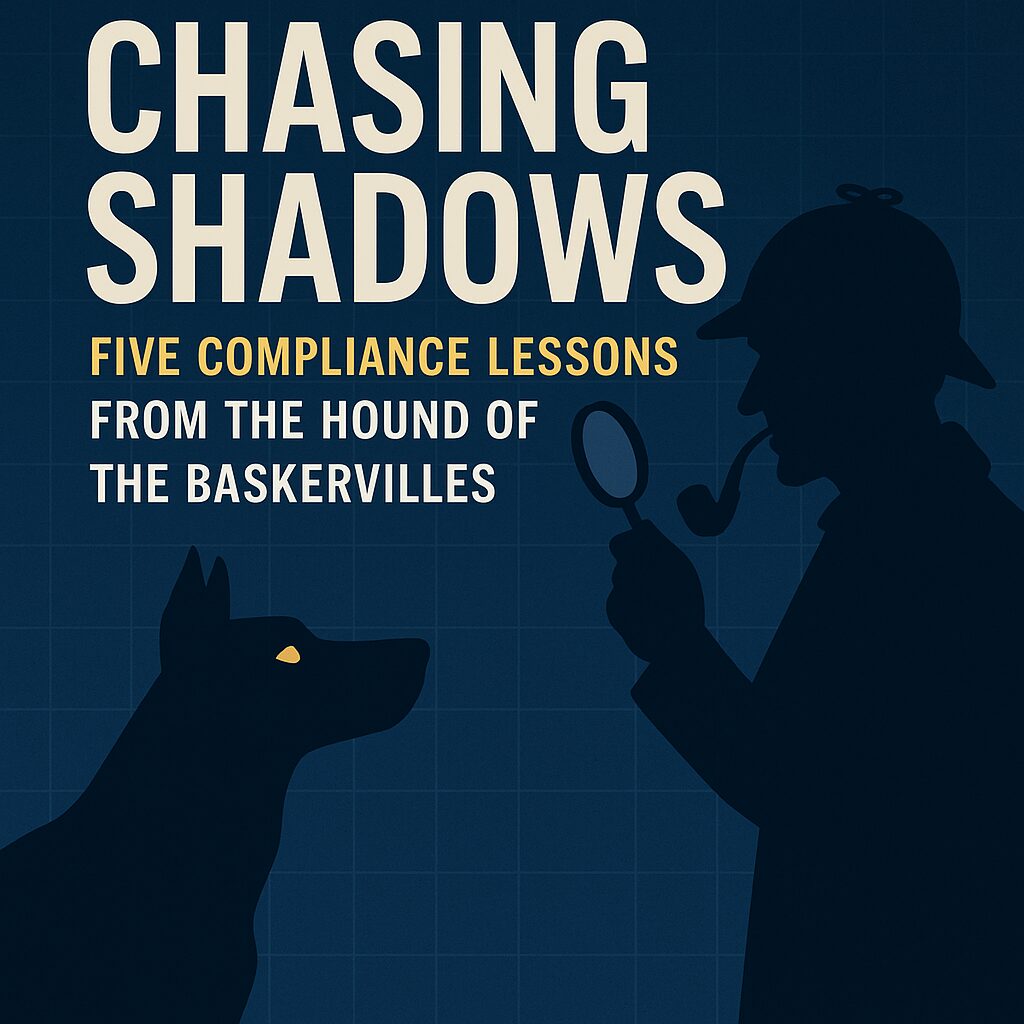
Chasing Shadows: Five Compliance Lessons from the Hound of the Baskervilles

The Hound of the Baskervilles,” penned by Sir Arthur Conan Doyle, is not only the most famous Sherlock Holmes story and a riveting detective tale but also presents timeless lessons in compliance applicable to corporate governance and risk management. Through its intricate plot and detailed character portrayals, the novel underscores several critical principles that every compliance professional should heed.

The story itself blends mystery, suspense, and supernatural elements. Sherlock Holmes and Dr. Watson investigate Sir Charles Baskerville’s mysterious death on the eerie Devonshire moors, connected to a legendary demonic hound curse. Holmes sends Watson with his heir, Sir Henry Baskerville, to the estate, where suspicious servants, an escaped convict, and peculiar neighbors—the Stapletons—heighten tensions. Watson’s observations reveal Jack Stapleton’s instability and jealousy over Sir Henry’s attention to Beryl Stapleton. Secretly investigating, Holmes identifies Stapleton as a Baskerville relative plotting Sir Henry’s death to claim the inheritance. Stapleton’s deception includes staging supernatural events to exploit local superstition. In the climax, Stapleton releases a phosphorus-painted hound to kill Sir Henry, but Holmes and Watson intervene, killing the beast. Stapleton flees, presumed dead in the Grimpen Mire. Holmes’s rational deductions triumph, dismissing supernatural fears and reinforcing logic and reason. Watson’s meticulous work is instrumental, showcasing his courage and skill. The novel concludes by affirming reason over superstition, demonstrating the dangers of irrational fear.

Here are five key compliance lessons derived from specific events within this classic tale.

Lesson 1: Avoiding Complacency in Risk Assessment

The initial approach to the mystery of Sir Charles Baskerville’s death illustrates a critical lesson in risk assessment: the importance of maintaining vigilance. Dr. Mortimer initially attributes the death to supernatural causes, influenced by local legends of a family curse. Sherlock Holmes immediately challenges this complacency, emphasizing the need for rational investigation over reliance on myths or unexamined assumptions. Holmes insists on examining evidence logically rather than accepting straightforward, sensational explanations.

Compliance professionals must similarly avoid complacency. It is easy for an organization to rely on historical assumptions or superficial risk assessments. However, genuine vigilance requires continuous questioning and reevaluation of all potential threats. By regularly revisiting risk assessments and remaining skeptical of conventional wisdom, compliance teams can better anticipate, mitigate, and respond to potential compliance failures before they escalate into significant issues.

Lesson 2: Effective Use of Data and Evidence

Throughout “The Hound of the Baskervilles,” Holmes’s meticulous use of evidence exemplifies the necessity of thorough documentation and analysis in achieving effective compliance outcomes. One key example is Holmes’s careful examination of Sir Henry Baskerville’s stolen boots. Holmes correctly deduces that the shoes were stolen to provide the hound with Sir Henry’s scent. This attention to minute detail and systematic analysis underscores the importance of robust documentation and record-keeping.

Compliance professionals should similarly prioritize precise data collection, rigorous documentation, and evidence-based decision-making. Proper documentation provides transparency, facilitates effective audits, and ensures clarity when addressing compliance issues or regulatory inquiries. By fostering a culture where data-driven decision-making is standard practice, organizations can strengthen their compliance programs and more effectively prevent violations.

Lesson 3: Maintaining Independence and Objectivity

A pivotal moment in the novel occurs when Holmes secretly arrives on the moor, independent of Watson’s investigation. Holmes understands the importance of maintaining independence to gather unbiased information. By conducting a parallel investigation that is free from local biases and personal relationships, Holmes preserves objectivity and ultimately identifies the true culprit, Jack Stapleton.

For compliance professionals, maintaining independence and objectivity is equally vital. Conflicts of interest can obscure judgment and compromise investigations. Compliance officers must be empowered to act independently, free from undue influence, to ensure the integrity of their findings and recommendations. Establishing clear reporting structures and supporting unbiased investigative procedures can significantly enhance an organization’s overall compliance effectiveness.

Lesson 4: Transparent Communication and Reporting

Transparency is repeatedly highlighted as essential throughout Conan Doyle’s narrative. Watson’s regular and detailed correspondence with Holmes exemplifies clear, transparent reporting. Watson meticulously records his observations, suspicions, and interactions, ensuring Holmes remains informed of developments in real time. This ongoing communication proves instrumental in Holmes’s eventual successful intervention.

In the realm of corporate compliance, transparent communication and reporting are equally critical. Employees must feel encouraged and supported in reporting suspicious activities or compliance concerns without fear of retaliation or retribution. Implementing precise and accessible reporting mechanisms, while ensuring open lines of communication, fosters a culture that is compliant-friendly. This transparency enables compliance teams to detect and address issues promptly, thereby reducing organizational exposure to risk and promoting an ethical business environment.

Lesson 5: Importance of Culture and Ethics

The actions and eventual downfall of Jack Stapleton underscore a profound lesson in compliance regarding organizational culture and ethics. Stapleton manipulates local fears and exploits the legend of the supernatural hound to facilitate his criminal plans. His unethical behavior, driven by greed and a disregard for human life, ultimately led to his ruin.

Organizations must prioritize building and maintaining a strong ethical culture. Leadership should exemplify ethical behavior, clearly communicate expectations, and swiftly address unethical actions. Regular training and communication regarding ethical standards reinforce an organization’s values and expectations. By cultivating a robust ethical culture, organizations not only reduce the likelihood of compliance violations but also enhance their reputation and long-term sustainability.

The Hound of the Baskervilles” offers rich insights for compliance professionals. Avoiding complacency, emphasizing evidence-based decision-making, maintaining independence, ensuring transparent communication, and fostering a robust ethical culture are foundational principles that are vividly highlighted throughout Conan Doyle’s timeless narrative. These lessons, illustrated through specific events and character decisions within the story, remain deeply relevant in guiding modern corporate compliance practices.

Categories
Daily Compliance News

Daily Compliance News: July 15, 2025, The Fighting Workplace Bullying Edition

Welcome to the Daily Compliance News. Each day, Tom Fox, the Voice of Compliance, brings you compliance-related stories to start your day. Sit back, enjoy a cup of morning coffee, and listen in to the Daily Compliance News. All, from the Compliance Podcast Network. Each day, we consider four stories from the business world, including compliance, ethics, risk management, leadership, or general interest, relevant to the compliance professional.

Top compliance stories:

  • When was the last time you checked your fuel switches? (Reuters)
  • FCA to take on workplace bullying. (FT)
  • Of tariff fraud and tipsters. (WSJ)
  • Ramaphosa opens corruption investigation. (NYT)

You can donate to flood relief for victims of the Kerr County flooding by going to the Hill Country Flood Relief here.

Categories
Career Can D0

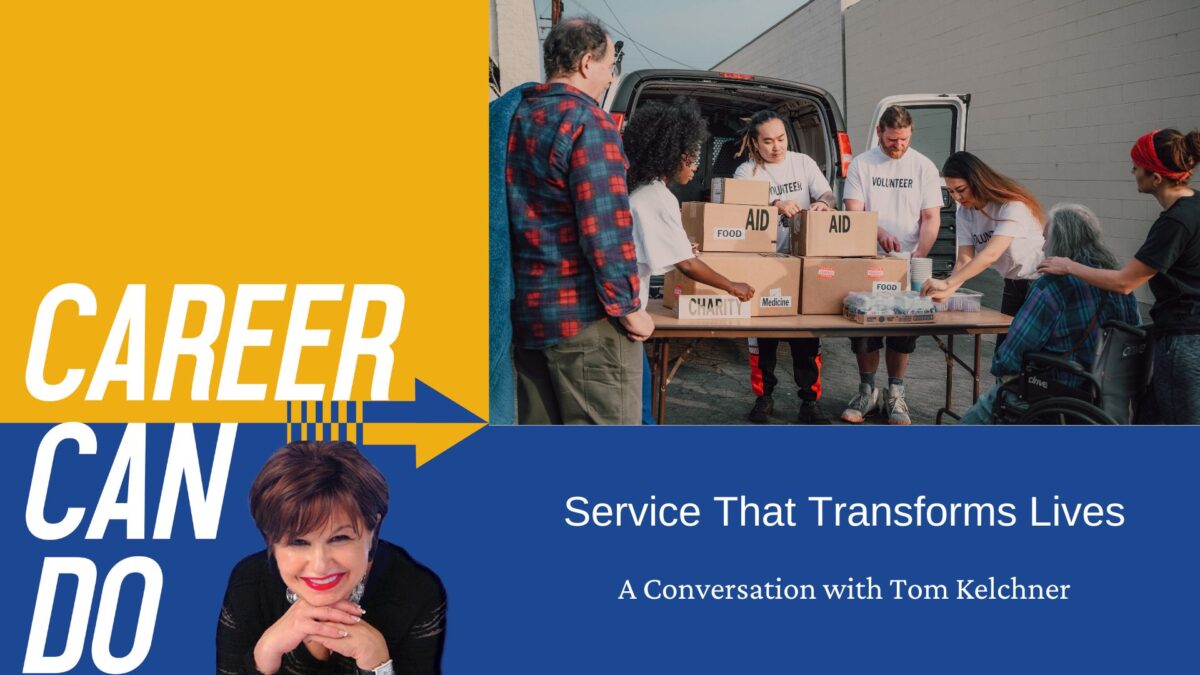
Service That Transforms Lives with Tom Kelchner

What if making the world a better place was more than just a dream – and became your purpose? Dr. Tom Kelchner joins Mary Ann Faremouth on this episode of Career Can Do to share how a lifelong commitment to service led him from classrooms to community leadership, and now, to his newest role as District Governor for Rotary District 5890.

After 33 years in public education, Tom found a new mission through Rotary – one that aligned perfectly with his passion for helping others. “Why do I serve? Because it’s needed,” he says. For Tom, service isn’t a side project. It’s a way of life.

Rotary’s reach is massive, with 1.4 million members worldwide and initiatives that span from eradicating polio to addressing food insecurity and mental health. But the power of Rotary, Tom explains, is also local. Whether it’s mentoring students, helping veterans, or improving access to clean water, the impact is real and personal.

Tom also highlights Rotary’s work with youth through programs like Interact and youth exchange, showing how service can start early and last a lifetime. Under his leadership, he hopes to grow membership, amplify support for veterans and trafficking awareness, and make Rotary more visible to the wider community.

This episode is a powerful reminder that service isn’t just noble – it’s necessary. And joining an organization like Rotary might just be the start of something much bigger than yourself.

Resources: Tom Kelchner on Rotary District 5890 | LinkedIn

Mary Ann Faremouth on the Web | X (Twitter)

Categories
Compliance Tip of the Day

Compliance Tip of the Day – COSO Governance Framework: Part 2, Oversight

Welcome to “Compliance Tip of the Day,” the podcast that brings you daily insights and practical advice on navigating the ever-evolving landscape of compliance and regulatory requirements. Whether you’re a seasoned compliance professional or just starting your journey, our goal is to provide you with concise, actionable tips to help you stay ahead in your compliance efforts. Join us as we explore the latest industry trends, share best practices, and demystify complex compliance issues to keep your organization on the right side of the law. Tune in daily for your dose of compliance wisdom, and let’s make compliance a little less daunting, one tip at a time.

We continue our multi-part review of the new COSO Governance Framework (CGF). Today, we examine Component 2: Oversight.

For more information on this topic, refer to The Compliance Handbook: A Guide to Operationalizing Your Compliance Program, 6th edition, recently released by LexisNexis. It is available here.

Categories
Trekking Through Compliance

Trekking Through Compliance: Episode 44 – Furry Lessons: The Case for Humor in Compliance Training, from The Trouble with Tribbles

If you ask any Star Trek fan to name a classic episode that brings a smile to their face, you’re likely to hear a chorus of “The Trouble with Tribbles! ” The episode, famous for its furry creatures and lighthearted spirit, stands out not just as a fan favorite but as a masterclass in the effective use of humor to deliver meaningful lessons, something all compliance professionals can learn from when it comes to training and engagement.

Why does this matter for compliance? Too often, compliance training is seen as dry, mandatory, and, for even the most well-intentioned teams, something to be “gotten through” rather than truly absorbed. Here are five key training lessons, each tied to a classic scene, that show why humor belongs in your compliance toolbox.

Lesson 1: Humor Lowers Defenses—Use It to Open the Door to Learning

Illustrated By: The first appearance of Tribbles in the Enterprise rec room, as Lieutenant Uhura and crew are charmed by the adorable creatures, leading to laughter and playful banter. Humor, at its core, is a universal icebreaker. In this scene, the crew’s initial reaction to the Tribbles—coos, smiles, and gentle teasing—sets the tone for a more relaxed and open environment. No one is bracing for a lecture; they’re engaged, curious, and, most importantly, willing to participate.

Compliance Lesson: Start your training with humor, an anecdote, a funny compliance video, or a self-deprecating story about compliance “gone wrong.” This isn’t about making light of serious subjects but about lowering barriers and inviting employees to engage. When people laugh, they are not defensive; they are receptive. Set the tone early, and the message will go farther.

Lesson 2: Humor Makes the Message Memorable—Embed It in Your Key Points

Illustrated By: Kirk’s deadpan reaction as he opens a storage compartment, only to be buried under an avalanche of Tribbles. Few moments in compliance (or television history) are as iconic as Captain Kirk being engulfed by a cascade of Tribbles. Why does this stick in our collective memory? Because it’s funny, unexpected, and visually memorable.

Compliance Lesson: Tie humor directly to your key training points. Whether it’s a short skit, a humorous meme, or a role-play gone slightly sideways, link your core compliance lesson to a moment of levity. Employees are more likely to remember “that time the manager dressed up as a ‘compliance villain’” than another slide about policy violations. Humor etches learning into memory.

Lesson 3: Humor Builds Camaraderie—Make Compliance a Team Effort

Illustrated By: The barroom brawl between the Enterprise crew and Klingons, sparked by good-natured ribbing and escalating into comic chaos. This classic scene is not just slapstick; rather, it is a reminder that shared laughter unites a team. The brawl, though farcical, reveals camaraderie and loyalty among the crew.

Compliance Lesson: Use humor to create shared experiences during training; try team quizzes, compliance-themed games, or humorous competitions. When employees laugh together, they build bonds, and those bonds foster a culture where compliance is everyone’s responsibility. Humor turns compliance from an individual burden into a collective mission.

Lesson 4: Humor Allows for Safe Failure—Encourage Experimentation and Questions

Illustrated By: Scotty sheepishly admitting to Captain Kirk that he started the fight with the Klingons, not to defend the Captain’s honor, but the Enterprise’s. When Kirk questions his crew after the barroom incident, Scotty’s honest (and hilarious) confession, delivered with perfect comic timing, creates a safe space for truth. The crew knows they can speak candidly, even about mistakes.

Compliance Lesson: Use humor to create an environment where mistakes are learning opportunities, not sources of shame. Incorporate funny compliance “fails” into your sessions and invite employees to share their own stories, anonymously or otherwise. When the cost of failure is laughter (not punishment), people are more willing to ask questions, admit confusion, and truly learn.

Lesson 5: Humor Reveals Hidden Risks—Spotting Problems Before They Multiply

Illustrated By: Dr. McCoy’s revelation that Tribbles are born pregnant, and their exponential population growth threatens the Enterprise’s operations. The Tribbles’ explosive reproduction is played for laughs, but it serves as a brilliant metaphor for how small issues, if left unchecked, can spiral into major crises. The crew’s laughter quickly gives way to action as the true scope of the problem emerges.

Compliance Lesson: Inject humor into hypothetical scenarios that illustrate how minor compliance lapses can escalate—think of the “snowball effect” as the “Tribble effect.” By making risk tangible (and a little bit funny), you highlight the importance of vigilance and early intervention. Employees will be more likely to remember the “Tribbles in the grain” than an abstract risk chart.

Final ComplianceLog Reflections

Too often, compliance training is a solemn, check-the-box affair. But “The Trouble with Tribbles” reminds us that humor is not the enemy of seriousness; it is an ally. Humor can make difficult topics more approachable, encourage open conversation, and ultimately drive better learning outcomes.

Captain Kirk didn’t solve the Tribble crisis with a stern lecture; he solved it by staying nimble, engaging his crew, and responding with creativity—qualities every compliance professional should embrace. When training is infused with laughter, employees lean in. When they lean in, they learn.

So, the next time you design a compliance training session, ask yourself: Where can I find the “Tribbles”? Where can I use humor to open minds, break down silos, and make the message stick? You’ll find that laughter, much like Tribbles, spreads quickly, multiplies engagement, and leaves your organization stronger (and perhaps a little furrier) than before.

Resources:

Excruciatingly Detailed Plot Summary by Eric W. Weisstein

MissionLogPodcast.com

Memory Alpha

Categories
Word of the Week

Word of the Week with Kenneth O’Neal – Exploring ‘Interest’ and Meaningful Conversations

Each week, Kenneth O’Neal discusses a word that describes a principle or value of the Qualities of Success. We suggest that you incorporate the Word of the Week into your thoughts, deeds, and actions. You might currently possess the quality and desire to develop it to a higher level. You could replace a bad habit with a good habit. Write an action step and use it daily to develop the quality in your life. In this episode, Kenneth discusses the word – Interest.

In this episode, Rick and Kenneth delve into the concept of ‘interest’ as both a noun and a verb, exploring its various meanings and applications. The conversation navigates topics such as effective communication and the importance of maintaining open dialogues on significant matters, including religion and politics, despite potential disagreements. A poignant story about a trip to Rwanda highlights the depth of human connection and service, illustrating that true giving often means carrying the hearts and stories of others with us. Join us for a thought-provoking discussion that encourages curiosity, empathy, and continuous conversation.

Key highlights:

  • Word of the Week: Interest
  • Deep Dive into Effective Communication
  • The Importance of Conversations
  • A Personal Story from Rwanda

Resources:

KRONEAL Consulting

Categories
Blog

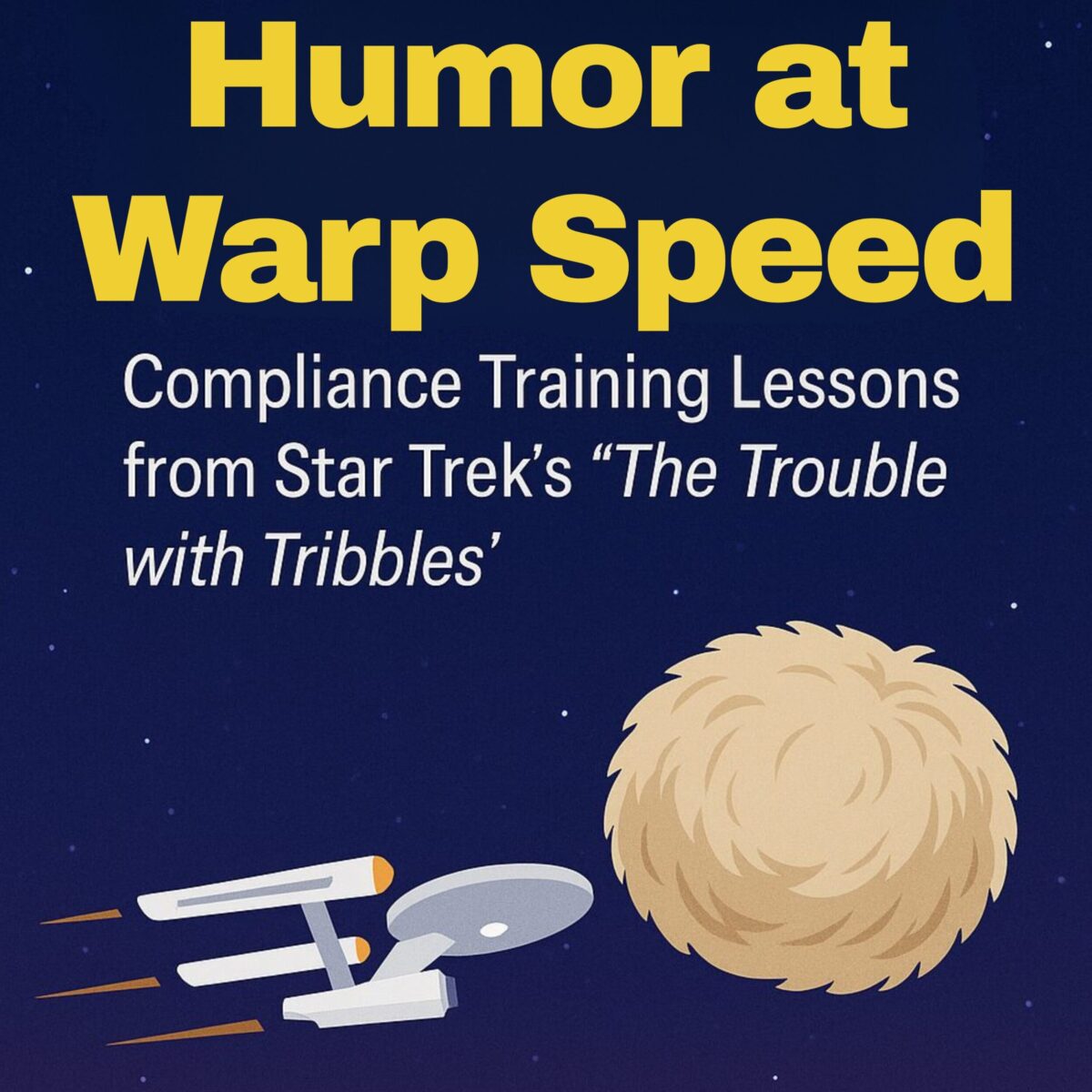
Humor at Warp Speed: Compliance Education Lessons from Star Trek’s “The Trouble with Tribbles”

If you ask any Star Trek fan to name a classic episode that brings a smile to their face, you’re likely to hear a chorus of “The Trouble with Tribbles! ” The episode, famous for its furry creatures and lighthearted spirit, stands out not just as a fan favorite but as a masterclass in the effective use of humor to deliver meaningful lessons, something all compliance professionals can learn from when it comes to training and engagement.

Why does this matter for compliance? Too often, compliance training is seen as dry, mandatory, and, for the most well-intentioned teams, something to be “gotten through” rather than truly absorbed. Yet, as Captain Kirk and his crew discovered, laughter can disarm resistance, break down barriers, and make even the most serious topics stick. Let’s beam in for a closer look at how humor, when used with intent, can supercharge your compliance training program.

In “The Trouble with Tribbles,” the crew of the USS Enterprise encounters a seemingly innocuous species of cuddly, purring creatures called Tribbles. What starts as a minor amusement soon escalates into chaos, with Tribbles multiplying at an exponential rate, getting into grain stores, and ultimately foiling a Klingon sabotage plot. Throughout, the tone remains light, even as the stakes rise, delivering a pitch-perfect balance between humor and operational seriousness.

What can compliance professionals learn from this blend? Here are five key training lessons, each tied to a classic scene, that show why humor belongs in your compliance toolbox.

Lesson 1: Humor Lowers Defenses—Use It to Open the Door to Learning

Illustrated By: The first appearance of Tribbles in the Enterprise rec room, as Lieutenant Uhura and crew are charmed by the adorable creatures, leading to laughter and playful banter. Humor, at its core, is a universal icebreaker. In this scene, the crew’s initial reaction to the Tribbles—coos, smiles, and gentle teasing—sets the tone for a more relaxed and open environment. No one is bracing for a lecture; they’re engaged, curious, and, most importantly, willing to participate.

Compliance Lesson: Start your training with humor, an anecdote, a funny compliance video, or a self-deprecating story about compliance “gone wrong.” This isn’t about making light of serious subjects but about lowering barriers and inviting employees to engage. When people laugh, they are not defensive; they are receptive. Set the tone early, and the message will go farther.

Lesson 2: Humor Makes the Message Memorable—Embed It in Your Key Points

Illustrated By: Kirk’s deadpan reaction as he opens a storage compartment, only to be buried under an avalanche of Tribbles. Few moments in compliance (or television history) are as iconic as Captain Kirk being engulfed by a cascade of Tribbles. Why does this stick in our collective memory? Because it’s funny, unexpected, and visually memorable.

Compliance Lesson: Tie humor directly to your key training points. Whether it’s a short skit, a humorous meme, or a role-play gone slightly sideways, link your core compliance lesson to a moment of levity. Employees are more likely to remember “that time the manager dressed up as a ‘compliance villain’” than another slide about policy violations. Humor etches learning into memory.

Lesson 3: Humor Builds Camaraderie—Make Compliance a Team Effort

Illustrated By: The barroom brawl between the Enterprise crew and Klingons, sparked by good-natured ribbing and escalating into comic chaos. This classic scene is not just slapstick; rather, it is a reminder that shared laughter unites a team. The brawl, though farcical, reveals camaraderie and loyalty among the crew.

Compliance Lesson: Use humor to create shared experiences during training; try team quizzes, compliance-themed games, or humorous competitions. When employees laugh together, they build bonds, and those bonds foster a culture where compliance is everyone’s responsibility. Humor turns compliance from an individual burden into a collective mission.

Lesson 4: Humor Allows for Safe Failure—Encourage Experimentation and Questions

Illustrated By: Scotty sheepishly admitting to Captain Kirk that he started the fight with the Klingons, not to defend the Captain’s honor, but the Enterprise’s. When Kirk questions his crew after the barroom incident, Scotty’s honest (and hilarious) confession, delivered with perfect comic timing, creates a safe space for truth. The crew knows they can speak candidly, even about mistakes.

Compliance Lesson: Use humor to create an environment where mistakes are learning opportunities, not sources of shame. Incorporate funny compliance “fails” into your sessions and invite employees to share their own stories, anonymously or otherwise. When the cost of failure is laughter (not punishment), people are more willing to ask questions, admit confusion, and truly learn.

Lesson 5: Humor Reveals Hidden Risks—Spotting Problems Before They Multiply

Illustrated By: Dr. McCoy’s revelation that Tribbles are born pregnant, and their exponential population growth threatens the Enterprise’s operations. The Tribbles’ explosive reproduction is played for laughs, but it serves as a brilliant metaphor for how small issues, if left unchecked, can spiral into major crises. The crew’s laughter quickly gives way to action as the true scope of the problem emerges.

Compliance Lesson: Inject humor into hypothetical scenarios that illustrate how minor compliance lapses can escalate—think of the “snowball effect” as the “Tribble effect.” By making risk tangible (and a little bit funny), you highlight the importance of vigilance and early intervention. Employees will be more likely to remember the “Tribbles in the grain” than an abstract risk chart.

Final ComplianceLog Reflections

Too often, compliance training is a solemn, check-the-box affair. But “The Trouble with Tribbles” reminds us that humor is not the enemy of seriousness; it is an ally. Humor can make difficult topics more approachable, encourage open conversation, and ultimately drive better learning outcomes.

Captain Kirk didn’t solve the Tribble crisis with a stern lecture; he solved it by staying nimble, engaging his crew, and responding with creativity—qualities every compliance professional should embrace. When training is infused with laughter, employees lean in. When they lean in, they learn.

So, the next time you design a compliance training session, ask yourself: Where can I find the “Tribbles”? Where can I use humor to open minds, break down silos, and make the message stick? You’ll find that laughter, much like Tribbles, spreads quickly, multiplies engagement, and leaves your organization stronger (and perhaps a little furrier) than before.

Resources:

Excruciatingly Detailed Plot Summary by Eric W. Weisstein

MissionLogPodcast.com

Memory Alpha

Categories
Innovation in Compliance

Innovation in Compliance – Allison Lagosh on Proactive Compliance Planning for Regulatory Changes

Innovation is present in many areas, and compliance professionals must not only be prepared for it but also actively embrace it. Join Tom Fox, the Voice of Compliance, as he visits with top innovative minds, thinkers, and creators in the award-winning Innovation in Compliance podcast. In this episode, host Tom Fox visits with Allison Lagosh, Head of Compliance at Saifr.ai, to discuss the current and future landscape of regulatory compliance.

With over two decades of experience in asset management, compliance, and regulatory affairs, Lagosh anticipates a pivotal shift towards AI and cryptocurrency regulations. She predicts a lighter enforcement landscape but stresses the importance of a conservative, informed approach to compliance, encouraging firms to future-proof their programs by staying abreast of regulatory changes and engaging in cross-team collaboration. Her insights, shared on platforms like the “Innovation in Compliance” podcast, highlight the necessity of strong leadership support and continuous learning to effectively navigate the dynamic regulatory environment, particularly in the realm of emerging technologies.

Key highlights:

  • Regulatory Futurism: AI and Crypto Compliance
  • “Colorado’s Groundbreaking AI Safety Legislation”
  • Proactive Compliance Planning for Regulatory Changes
  • Navigating Compliance Uncertainties with AI Integration
  • Regulatory Insights on Safer.AI Website

Resources:

Allison Lagosh on LinkedIn

Saifr.ai

Tom Fox

Instagram

Facebook

YouTube

Twitter

LinkedIn

Check out my latest book, Upping Your Game—How Compliance and Risk Management Move to 2023 and Beyond, available from Amazon.com.

Innovation in Compliance was recently honored as the number 4 podcast in Risk Management by 1,000,000 Podcasts.

Categories
Red Flags Rising

Red Flags Rising: S01 E19 – Stack Sweeps, Successor Liability, and “Knowledge” – Emerging Signals from Recent Enforcement Actions

Mike & Brent coin a new phrase in the context of white-collar corporate enforcement, “stack sweep,” to describe the potential enforcement risks–up and down the technology stack–that recent U.S. export controls settlements, policy statements, and guidance portend in focusing on broad end-use or end-user “catch-all” provisions that turn on “knowledge” defined to include “an awareness of a high probability.” Specifically, they discuss how two recent cases are short on facts but long on lessons (or, as Brent says, appear at first glance to be “dogs”) (01:07), discuss the Alpha & Omega Semiconductor (AOS) settlement announced July 2, 2025 (03:19), how reliance on the advice of counsel is as useful as the extent of facts disclosed to counsel (06:09), discuss the Unicat Catalyst Technologies settlement announced by the Bureau of Industry & Security (BIS) on June 24, 2025 and parallel settlements announced by the Department of the Treasury’s Office of Foreign Assets Control (OFAC) and the Department of Justice’s (DOJ’s) National Security Division (NSD) on June 16, 2025 (08:34), the lessons for pre-acquisition due diligence (11:03) including the importance to buyers of testing whether a target’s trade compliance program incorporates risks driving by the full definition of knowledge to include “high probability” awareness (for example, by specifically addressing risks under the catch-all provisions) (15:33), convergence across DOJ, Treasury, and Commerce regarding expectations for corporate compliance programs (17:50), and then Mike & Brent coin the phrase “stack sweep” to describe what would be the equivalent in corporate export controls enforcement to prior “industry sweeps” in corporate FCPA enforcement, in that catch-all, knowledge-driven end-use and end-user enforcement “sweeps” within the tech industry would be “sweeps” up and down the relevant technology stack (20:01). They then conclude with Brent’s back-by-popular-demand segment, “Managing Up” (25:52).

Resources:

The July 2, 2025, BIS settlement with Alpha & Omega Semiconductor

The June 24, 2025, BIS settlement with Unicat Catalyst Technologies

The June 16, 2025, OFAC settlement with Unicat Catalyst Technologies

The June 16, 2025, DOJ NSD press release with the relevant declination letter (buyer), non-prosecution agreement (target), and criminal guilty plea (former CEO)

For everything you ever wanted to know about the “high probability” standard

Brent LinkedIn

Mike LinkedIn

Categories
SBR - Authors' Podcast

SBR-Authors Podcast: The Resilience of the Human Spirit: Ana Hebra Flaster’s Immigrant Story and the Essence of Liberty

Welcome to the SBR-Authors Podcast! In this podcast series, host Tom Fox visits with authors in the compliance arena and beyond. In this episode, Tom Fox interviews author Ana Hebra Flaster about her book ‘Property of the Revolution‘ and her journey as an immigrant from Cuba to the United States

Flaster shares her experiences from childhood, the impact of her sudden move from Cuba, and how it shaped her perspective on liberty and resilience. She details her family’s struggles and triumphs, providing a personal window into the broader Cuban exodus. The conversation also touches on her writing process, the role of storytelling in preserving her family’s legacy, and the importance of immigrants to American culture and innovation. Flaster emphasizes the value of freedom, the trauma of displacement, and the enduring strength of the immigrant spirit. Ultimately, she discusses her ongoing efforts to raise awareness about Cuban history and current events through her writing.

Key highlights:

  • Ana Hebra Flaster ‘s Childhood and Immigration Story
  • The Concept of Liberty
  • Storytelling and Family Resilience
  • Writing Process and Challenges
  • Role of PR and Final Thoughts

Resources:

Ana Hebra Flaster at PR by the Book

Property of the Revolution: From a Cuban Barrio to a New Hampshire Mill Town—A Memoir on Amazon & Bookshop.org

Ana Hebra Flaster Website

PR by the Book Website

Follow Ana Hebra Flaster on:

Facebook

LinkedIn

Instagram

X/Twitter

Tom Fox

Instagram

Facebook

YouTube

Twitter

LinkedIn