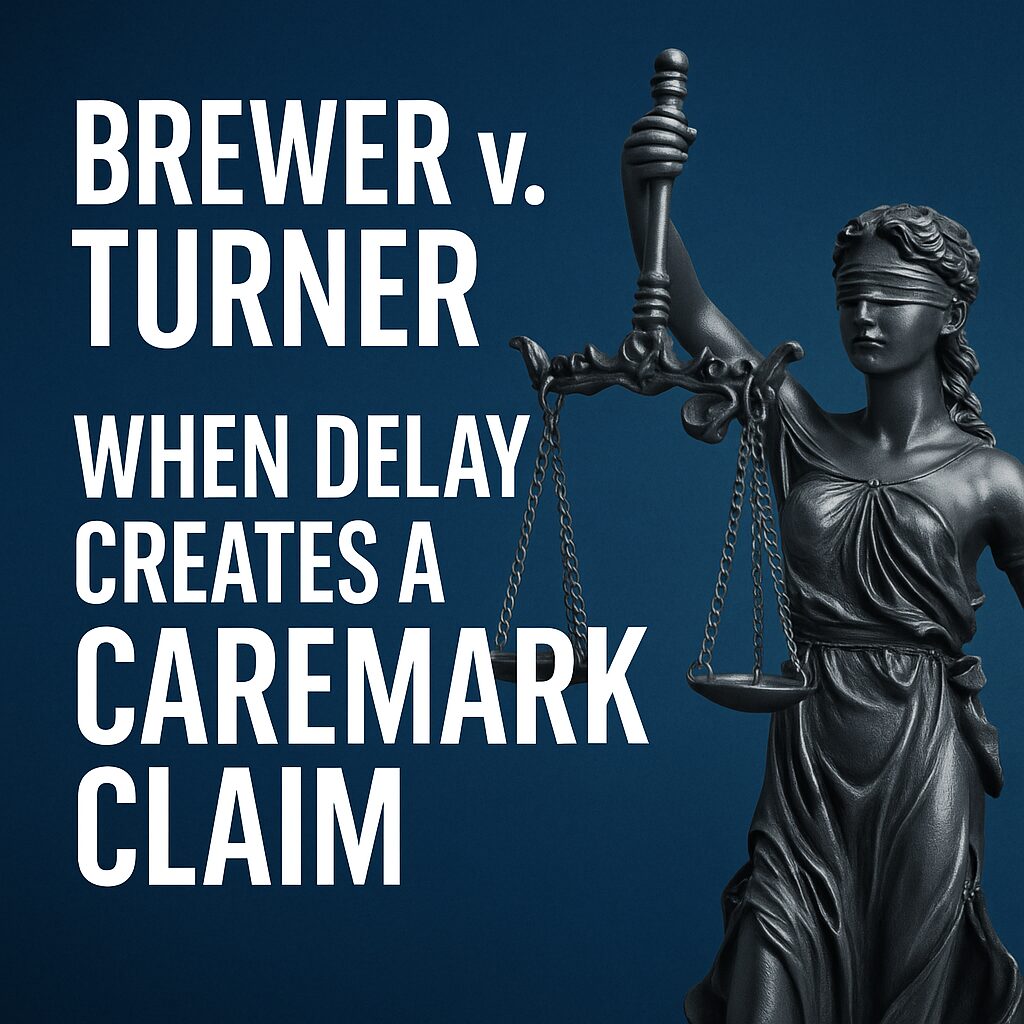
In corporate governance, timing is everything. A board’s oversight failure does not always come from what it does not see; often, it comes from how long it waits to act once the warning lights flash red. This cautionary tale originates from the shareholder action in the case of Brewer v. Turner, a Delaware Court of Chancery decision that permitted a Caremark claim against the directors of Regions Financial Corporation to proceed. The opinion marks another milestone in the court’s expanding interpretation of fiduciary “bad faith.” It offers an unmistakable message to compliance professionals: delay can be fatal, and now it can also lead to exposure.
A New Chapter in Caremark
In the article in the Harvard Law School Forum on Corporate Governance, titled Caremark Claim Survives Board’s Delay in Ending Illegal Practices, lawyers from Fried Frank considered the case. At issue was the board’s handling of a whistleblower complaint from its former Deputy General Counsel, Jeffrey A. Lee, who alleged that Regions’ overdraft-fee practices violated CFPB regulations. Eighteen months after receiving his detailed complaint, the bank finally ended those practices. By then, the Consumer Financial Protection Bureau had investigated and levied $191 million in penalties and restitution.
The court concluded that the board’s delay could itself amount to bad faith. Hiring outside counsel and forming committees did not shield the directors from liability. As Chancellor Kathaleen McCormick wrote, “Everyone knows that delay can be intentional and a tactic to avoid the consequences of acting appropriately.” For compliance officers, this ruling signals that boards can no longer hide behind process if the substance and speed of oversight fall short of expectations.
Today, examine the lessons compliance leaders should take from the case.
1. Red Flags Require Immediate, Documented Response
Historically, Delaware courts were reluctant to treat whistleblower complaints as “red flags.” They often viewed such claims as speculative unless corroborated by concrete evidence of wrongdoing. But in Regions, the whistleblower’s position mattered: he was a lawyer responsible for assessing legal risk. His complaint was detailed, specific, and sent to the Audit Committee, a combination that the court found impossible to ignore. That shift widens the compliance risk perimeter. A whistleblower who possesses subject-matter authority, particularly someone in compliance, legal, risk, or audit, can now trigger a board-level duty to act.
For the CCO:
Implement a rapid-response framework for any internal report that raises concerns about legal or regulatory violations. Require escalation to the board or relevant committee within days, not weeks. Then document every step: receipt, investigation, deliberation, and resolution. When courts review the record, speed and transparency become your strongest defenses.
2. Delay Can Be the New Bad Faith
Perhaps the most groundbreaking element of this case is the court’s recognition that delay itself can constitute bad faith. The board did not ignore the red flag; it simply took 18 months to address the illegal conduct while seeking to offset the lost revenue. That conscious hesitation, prioritizing profits over compliance, transformed a mere oversight lapse into a potential breach of fiduciary duty. This is a paradigm shift. Previously, a board’s response, no matter how sluggish or ineffective, was often enough to defeat Caremark liability. No longer. The court has now drawn a line between discretionary pacing and strategic stalling.
For the CCO:
Build timelines into remediation plans. When an investigation confirms illegality, establish a clear corrective-action schedule, present it to the board, and insist on documented follow-through. If management requests “time to replace lost revenue,” remind them and the board that regulatory risk compounds with every day of delay.
3. Law Firm Engagement Is Not Absolution
The region’s board tried to defend its actions by noting that it had hired a law firm to review the overdraft program. But the court found that “merely hiring an attorney” does not immunize directors from bad faith findings. What mattered was not the hiring, but what the board did with the firm’s advice, and the minutes didn’t say.
For compliance professionals, this point should feel familiar. Retaining outside counsel is prudent, but outsourcing judgment is perilous. A board that commissions a report yet fails to discuss or implement its recommendations appears, in the eyes of Delaware law, to be checking boxes rather than managing risk.
For the CCO:
Whenever outside counsel is engaged, insist on:
- The written scope of work aligned with the suspected violation.
- Formal delivery of findings to the full board or its committee.
- Recorded deliberations on next steps.
- Follow-up updates tracking implementation of counsel’s recommendations.
Compliance is not a spectator sport. Documenting action, not merely delegation, demonstrates good faith.
4. Central Compliance Risks Deserve Central Oversight
The court emphasized that overdraft-fee compliance was a “central risk” for a retail bank and thus a board-level responsibility. This reasoning expands the range of risks boards must personally monitor, rather than delegate entirely to management. Each industry has its equivalents: drug safety in the pharmaceutical industry, anti-bribery in global operations, and data security in the tech sector. When violations occur within these core domains, the argument that “management had it under control” will no longer be a sufficient defense for directors.
For the CCO:
Regularly update your board on the organization’s central compliance risks. Tie each risk to explicit board-level monitoring responsibilities. Provide metrics, internal audit findings, incident counts, and regulatory inquiries that show oversight in action. In the post-Brewer v. Turner environment, silence equals exposure.
5. Meeting Minutes Are Compliance Evidence
A striking aspect of the case was the court’s observation that the board minutes were “largely redacted” and recorded only cursory discussions. This absence of detail undermined the directors’ defense that they had acted responsibly. The court essentially inferred neglect from the lack of written proof. Compliance officers should view board minutes as the audit trail of integrity. If your minutes merely note that “the issue was discussed,” you may have built a weak defense for a strong case.
For the CCO:
Work with your corporate secretary to ensure that minutes:
- Record substantive deliberation, not boilerplate.
- Reference specific documents reviewed, such as legal opinions or risk assessments.
- Capture decisions, follow-ups, and accountability for each item.
When regulators or plaintiffs seek evidence of good-faith oversight, well-crafted minutes speak louder than affidavits.
Broader Compliance Takeaways
The Brewer decision reflects a judiciary that is increasingly willing to look beyond formality and assess intent. In the compliance world, this mirrors what the DOJ’s 2024 Evaluation of Corporate Compliance Programs emphasized: that outcomes matter, but so do the timeliness and sincerity of response. A compliance program that detects misconduct yet allows it to persist for months or years cannot claim to be effective.
The ruling also underscores why Caremark risk is a personal matter. Because these claims rest on findings of bad faith, neither the DGCL Section 102(b)(7) exculpation clauses nor most D&O insurance policies will shield directors or officers from liability. The best protection remains proactive compliance, not post-hoc coverage. Finally, note the procedural context: new DGCL amendments restrict shareholder access to corporate books and records, potentially reducing frivolous oversight suits. Yet for legitimate claims supported by detailed facts, as in Brewer, the bar has been lowered. Courts are signaling that they will continue to allow well-pled Caremark cases to proceed when evidence shows a conscious disregard.
What It Means for the Chief Compliance Officer
For the CCO, Brewer v. Turner is both a warning and a roadmap. It is a warning that oversight delay equals liability. You can no longer rely on the board’s procedural comfort—hiring counsel, forming committees, or debating endlessly—to prove good faith. Results and responsiveness now define the legal standard.
But it is also a roadmap for strengthening your partnership with the board. You can help directors stay ahead of Caremark exposure by:
- Defining red flags. Work with Audit and Risk Committees to set escalation thresholds for legal-risk incidents.
- Accelerating action. Create escalation SLAs with responses within 24 hours for high-severity issues.
- Documenting diligence. Ensure every board discussion about misconduct is supported by complete, unredacted minutes.
- Tracking remediation. Maintain a dashboard showing when each issue was raised, investigated, and resolved.
- Aligning incentives. Reinforce that executive bonuses and promotions depend on compliance performance, not just profitability.
At its heart, Caremark is not about punishing hindsight; rather, it is about enforcing foresight. The compliance professional’s role is to make foresight possible by ensuring that red flags are identified quickly, decisions are properly documented, and illegal conduct is corrected before it metastasizes into corporate trauma.
Final Thoughts
The Brewer case stands as a modern parable of fiduciary patience gone wrong. A board that meant to deliberate found itself accused of delay; a company that tried to plan found itself punished for profit-driven hesitation. For compliance leaders, the moral is clear: you cannot strategize your way out of illegality. When a red flag rises, the clock starts, and every tick is a test of integrity. The essence of compliance is not preventing failure. It is ensuring you act decisively when failure appears. In the wake of Brewer, that truth has never been more legally or morally binding.