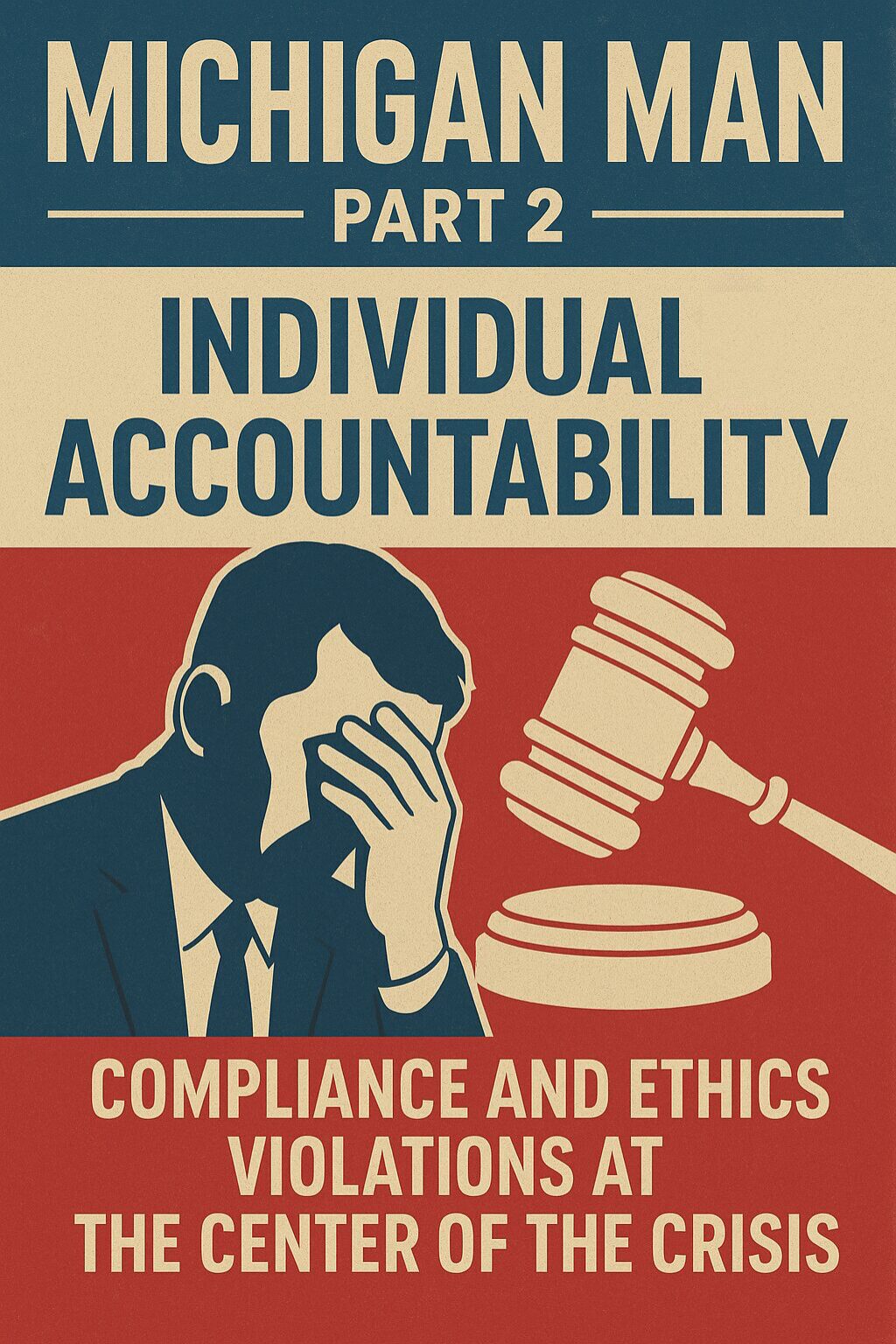
Part 1 of this series established that the Sherrone Moore story is both a human tragedy and an institutional crisis. In Part 2, we turn to a more difficult but necessary task. Compliance professionals must ask a direct question: What did Moore do that violated compliance and ethics expectations, and why do those actions matter beyond college football?
The answer is uncomfortable because it involves more than a single lapse in judgment. The facts as currently known describe a pattern of conduct that strikes at the heart of any credible compliance program: dishonesty during investigations, misuse of power, disregard for institutional policy, and an apparent belief that personal status insulated him from consequences.
Compliance Is About Truth-Telling
At the core of every compliance program is a simple, non-negotiable principle: tell the truth when the organization asks questions. That principle applies whether the inquiry involves financial controls, harassment allegations, or NCAA violations. Once an individual lies during an investigation, the issue ceases to be a narrow policy breach and becomes an integrity failure. As a friend of mine told me once, “As one of my partners said when a managing partner was having an affair, ‘if he’ll do that to his wife, imagine what he’ll do to his partners.’” Sherrone Moore crossed this line well before his dismissal as head coach.
During the Connor Stalions sign-stealing investigation, Moore deleted text messages exchanged with Stalions and later provided what the NCAA described as an implausible explanation for doing so. That conduct resulted in NCAA suspensions and remains part of the formal record of compliance violations tied to Moore personally. ESPN
From a compliance perspective, this matters far more than sign stealing itself. Deleting records during an investigation undermines document retention obligations, impedes fact-finding, and signals a willingness to prioritize personal or programmatic interests over institutional integrity. In the corporate world, the parallel would be deleting emails during a regulatory inquiry. No compliance officer would treat that as a minor infraction.
Repeated Dishonesty During Investigations
The more recent investigation into Moore’s relationship with a female staffer raises even more serious concerns. According to reporting, the University of Michigan launched an inquiry after receiving an anonymous tip alleging an inappropriate relationship. Both Moore and the staffer denied any ties, and the investigation initially stalled for lack of corroborating evidence. ESPN
That denial later proved false when the staffer disclosed corroborating evidence confirming a multi-year intimate relationship. At that moment, the issue shifted decisively from a policy violation to an ethics failure.
From a compliance standpoint, the problem is not merely the relationship itself. It is the active misrepresentation to investigators, i.e., intent. Lying to internal or external investigators destroys trust in the investigative process and forces organizations to rely on incomplete or inaccurate information when making risk decisions. It also exposes the institution to claims that it ignored or mishandled misconduct, even when the real issue was a senior leader’s deception.
Abuse of Power and Conflicts of Interest
Most university and corporate codes of conduct prohibit intimate relationships between supervisors and subordinates or require disclosure and mitigation when they do. These rules are not moral judgments. They are risk controls designed to prevent coercion, favoritism, retaliation, and exploitation.
Moore’s alleged multi-year relationship with a staffer squarely implicates these risks. As head coach and, previously, as an assistant coach, Moore held a position of significant authority within the athletic department. Even if the relationship was initially consensual, the power imbalance is unavoidable. Compliance professionals recognize that consent in such circumstances is inherently complicated and that organizations bear responsibility for preventing these situations from arising.
Failure to disclose the relationship deprived the university of the opportunity to implement safeguards, reassign reporting lines, or otherwise manage the conflict. That omission constitutes a clear ethics violation independent of any later criminal allegations.
Escalation Beyond Policy Violations
The most disturbing allegations arise from events following Moore’s termination. Prosecutors allege that after the relationship ended and Moore was fired, he went to the staffer’s residence without permission, engaged in repeated unwanted communications, and threatened self-harm while inside her home. NYT
While the criminal justice system will determine legal responsibility, compliance professionals must recognize how quickly misconduct can escalate when earlier controls fail. What began as an undisclosed relationship allegedly progressed into stalking behavior and an incident that law enforcement deemed serious enough to warrant felony charges.
This escalation underscores a core compliance truth: that early intervention matters. When organizations fail to address misconduct promptly and transparently, risks compound. Personal crises become workplace crises. Workplace crises become institutional crises.
Retaliation and Intimidation Risks
Another compliance dimension cannot be ignored. Prosecutors allege that Moore made statements to the staffer suggesting that she had “ruined his life” and that his blood would be “on her hands. From a compliance lens, such statements raise red flags around intimidation and retaliation. NYT
Whistleblower and reporting systems depend on employees feeling safe to come forward. Any conduct that could reasonably be perceived as threatening or coercive undermines that system. Whether intentional or not, such behavior chills reporting and exposes organizations to significant liability.
The Myth of the Star Performer Exception
One of the most consistent themes in compliance failures across industries is the star performer exception. High performers convince themselves, and sometimes their organizations, that rules are flexible when success is at stake. Moore’s trajectory fits this pattern uncomfortably well.
Despite prior compliance issues, including NCAA suspensions, Moore was elevated to head coach of one of college football’s most prominent programs. Each unresolved issue reinforced the perception that consequences were manageable and survivable. That perception is toxic to any ethical culture. Compliance professionals know that prior misconduct is one of the strongest predictors of future misconduct. Moore’s history should have triggered heightened scrutiny, not diminished concern.
Why Individual Accountability Matters
It is tempting to view Moore as a tragic figure overtaken by personal failure. That view is human and compassionate, but it cannot obscure the reality of compliance. Moore made choices. He chose to delete records. He decided to misrepresent facts to investigators. He chose not to disclose a prohibited relationship. He allegedly took actions that led to criminal charges.
Individual accountability is essential because without it, compliance programs lose credibility. Employees notice when leaders are treated differently. Regulators notice when organizations minimize misconduct by senior figures. Over time, the erosion of accountability becomes cultural.
Compliance Takeaways
For compliance professionals, the Moore case reinforces several hard truths:
- Dishonesty during investigations is a red-line violation.
- Conflicts of interest must be disclosed and managed, not hidden.
- Power imbalances amplify ethical risk.
- Past misconduct predicts future risk.
- Star performers do not deserve special rules.
In Part 3 of this series, I will turn from individual accountability to institutional failure. The University of Michigan did not create Moore’s choices, but it did create the environment in which those choices were insufficiently challenged. Understanding that failure is essential for any organization that believes its compliance program is robust.
Resources:
The Terrible Mess at Michigan Football, by Jason Gay, writing in the Wall Street Journal.
Ex-Michigan coach Sherrone Moore charged with home invasion, stalking, breaking—Austin Meek and Sam Jane writing in The Athletic.
Fire Everybody—Alex Kirshner, writing in Slate.
Source: Michigan begins a review of the athletic department, by Dan Wetzel and Pete Thamel, writing for ESPN.