I recently wrote a series on the direct link between ancient Greek Philosophers and modern corporate compliance programs and compliance professionals. It was so much fun and so well-received that I decided to follow up with a similar series on notable Roman Philosophers. This week, we will continue our exploration of the philosophical underpinnings of modern corporate compliance programs and compliance professionals by looking at five philosophers from Rome, both from the Roman Republic and the Roman Empire.
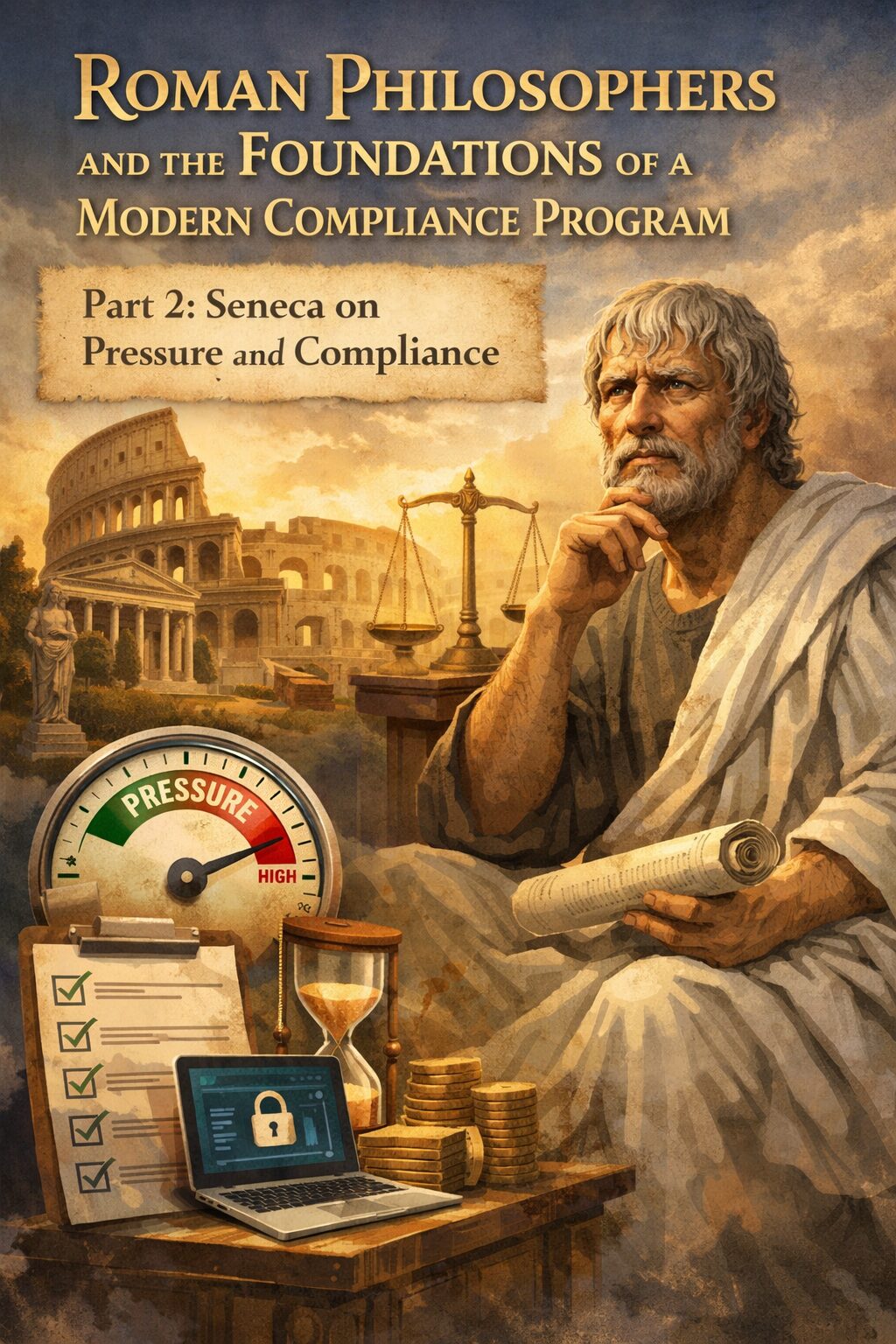
Yesterday, we considered Cicero and the duty, law, and the moral limits of business; today, we will look at Seneca and power, pressure, and ethical decision-making under stress; upcoming blog posts include Marcus Aurelius and ethical leadership and tone at the top; Varro and corporate governance; and Lucretius to explore rationality, fear, and risk perception. Today, we continue with Seneca on pressure and when compliance matters the most.
I. Seneca in Context: Ethics from Inside Power
Lucius Annaeus Seneca did not write philosophy from a safe distance. He lived at the center of Roman power, wealth, and danger. As tutor and later advisor to Emperor Nero, Seneca understood how quickly ethical intentions could be compromised by fear, ambition, loyalty, and survival. He also understood how people justify those compromises to themselves.
Seneca’s writings, particularly Letters from a Stoic and On Anger, are not abstract moral treatises. They are practical examinations of how human beings behave when placed under stress. He was deeply concerned with emotional excess, not because emotions were immoral, but because unchecked emotion distorts judgment. Anger, fear, greed, and the desire for approval all lead otherwise rational people to make decisions they later defend as necessary.
For Seneca, ethical failure was rarely sudden. It was incremental. People crossed lines not because they intended to be corrupt, but because they convinced themselves that circumstances demanded flexibility. This insight makes Seneca indispensable to the modern compliance professional, whose greatest challenge is not policy design, but behavior under pressure.
II. The Compliance Problem Seneca Illuminates: Rationalization Under Stress
Most compliance programs are designed around rules, controls, and reporting structures. Far fewer are designed with human psychology in mind. Seneca would argue that this is a critical oversight. Modern compliance failures often occur in high-pressure environments: aggressive sales targets, looming deadlines, competitive markets, political instability, or financial distress. In these moments, individuals do not typically reject ethical norms outright. Instead, they rationalize deviations as temporary, necessary, or harmless.
Common rationalizations include:
- “This is how business is done here.”
- “We will fix it later.”
- “No one is really harmed.”
- “Leadership expects results.”
- (and my personal favorite) “We’ve always done it this way.”
Seneca warned that these internal narratives are more dangerous than ignorance. Once people justify unethical conduct to themselves, external controls become less effective. A policy cannot compete with a story someone tells themselves to preserve status, income, or safety. The DOJ, particularly in its various iterations of the Evaluation of Corporate Compliance Programs (ECCP), has increasingly focused on this dynamic. In recent enforcement actions, regulators have emphasized root-cause analysis, asking not only what rule was broken but also why individuals felt compelled to break it. Pressure, incentives, and cultural signals consistently appear as contributing factors.
Seneca teaches that compliance programs must anticipate rationalization. It is not enough to say “do not do this.” Organizations must understand when and why people will convince themselves that doing it is acceptable.
III. Modern Corporate Application: Seneca, DOJ Expectations and Behavioral Compliance
The ECCP explicitly asks whether a company’s risk assessment and controls account for “the types of misconduct most likely to occur” and whether the company has “addressed the root causes of misconduct.” These questions align directly with Seneca’s insights. Consider major enforcement actions involving systemic bribery, fraud, or manipulation of controls. In cases such as the Wells Fargo fraudulent accounts scandal or the Volkswagen emissions testing scandal, both of which involved employees operating under intense performance pressure. While not all wrongdoing can be excused by culture, regulators repeatedly noted environments where employees felt trapped between expectations and ethics.
A Seneca-informed compliance program would focus on several practical measures.
First, risk assessments should explicitly identify pressure points. Compliance should map where incentives, deadlines, or market conditions increase the likelihood of rationalization. This includes sales functions, third-party relationships, emerging markets, and crises.
Second, training should move beyond rules into scenario-based discussions. Seneca believed self-awareness was an ethical discipline. Modern compliance training should confront common rationalizations directly, helping employees recognize them before they take hold. DOJ guidance increasingly favors practical, tailored training over generic training.
Third, escalation pathways must be realistic under stress. A hotline that exists only on paper will not be used when fear of retaliation or failure dominates. Seneca understood that fear silences conscience. Effective compliance programs must demonstrate that speaking up under pressure is protected, valued, and acted upon.
Fourth, leadership messaging matters most during crises. Seneca warned that leaders set moral boundaries through behavior, not speeches. The DOJ has emphasized that how management responds to misconduct is a key indicator of program effectiveness. When leaders excuse results achieved through questionable means, rationalization spreads quickly.
Finally, compliance must be present before the crisis, not introduced afterward. Seneca would view reactive compliance as inherently weak. Ethical resilience must be built in advance, when judgment is clear, and stakes are lower.
Key Takeaways for Compliance Professionals
1. Behavioral Risk. Compliance professionals should view Seneca as a guide to behavioral risk, not philosophical pessimism. Seneca focuses on how real people behave under pressure rather than on abstract ethical ideals. He recognizes that stress, fear, ambition, and loyalty distort judgment long before formal rules are broken. For compliance professionals, Seneca provides a framework for understanding why misconduct occurs even in organizations with well-designed programs.
2. Pressure Points. Compliance should identify and manage pressure points where rationalization thrives. High-performance targets, crises, and competitive markets create environments where ethical shortcuts are easily justified. Seneca teaches that rationalization flourishes when people feel trapped between expectations and consequences. Compliance programs must proactively map and mitigate these pressure points rather than react after misconduct occurs.
3. Training Design. Compliance should design training that addresses how people actually make decisions under stress. Traditional rule-based training assumes calm, rational decision-making, which rarely occurs in real-world situations. Seneca reminds us that ethical failure often occurs in moments of emotional intensity rather than in deliberation. Effective compliance training should use scenarios and realistic dilemmas that reflect pressure, ambiguity, and competing incentives.
Compliance should ensure escalation mechanisms work when fear and incentives collide. A hotline or reporting channel is ineffective if employees do not trust it during high-risk moments. Seneca understood that fear silences conscience and discourages disclosure. Compliance programs must test whether escalation pathways function when the personal cost of speaking up feels high.
4. Leadership Engagement. Compliance should engage leadership on how their responses to pressure shape ethical behavior. Leaders signal ethical boundaries most clearly when responding to setbacks, failures, or missed targets. Seneca warned that inconsistent or emotionally driven leadership responses accelerate ethical decay. Compliance professionals must ensure leaders understand that their reactions under pressure become cultural instruction.
- Compliance should focus on prevention through awareness, not punishment after failure. Seneca emphasized self-awareness as the first defense against moral error. Compliance messaging that only appears after misconduct reinforces fear rather than learning. Ongoing communication about pressure, rationalization, and ethical expectations strengthens resilience before problems arise.
- Finally, Seneca instructs us that ethical systems fail not because people abandon values, but because they convince themselves that those values can wait. A compliance program that ignores pressure is a program designed to fail when it matters most. Rationalization is the quiet mechanism through which ethical erosion occurs. Seneca shows that delay, exception-making, and “temporary” compromises accumulate into systemic failure. Compliance programs that do not confront rationalization directly leave themselves exposed at their most vulnerable moments.
Conclusion
Seneca exposes the internal dynamics that cause compliance programs to fail under pressure. He shows us how fear, ambition, and rationalization erode ethical judgment, even when rules are clear and controls are in place. But Seneca largely examines the problem from the inside out, focusing on how individuals respond to external forces. That analysis leads directly to the next question in the compliance lifecycle: what responsibility does the individual retain when pressure is real, and authority is unequal? This is where Seneca gives way to Epictetus.
Join us tomorrow as we explore Varro and corporate governance for your compliance regime.