McDevitt took a different but highly effective approach in this case study. Rather than centering the story on a single historical corporate scandal, she crafted an immersive fictional scenario grounded in real-life attacks, expert interviews, and public guidance. Compliance Week made clear that, while the company and its characters are imagined, the legal, operational, and compliance issues are very real. That makes this piece especially valuable for compliance professionals because it is less a postmortem of one company and more a practical field manual for the next crisis.
McDevitt’s story begins where many cyber incidents begin: with a person, not a machine.
A longtime employee, Betsy, receives an “urgent” email that appears to be from her boss. She clicks a malicious link, lands on a phony, internal-looking site, realizes too late that something is wrong, and then makes the mistake that turns a bad moment into a corporate crisis: she does not report it. Her silence gives the attacker time. Within days, the company, Vulnerable Electric (VE), a private utility serving 1.4 million customers with about 600 employees and $250 million in annual revenue, is facing a full-blown ransomware attack.
That is the first lesson, and McDevitt drives it home with precision. Ransomware is often described as a technology problem, but the first failure is frequently human, organizational, and cultural. Betsy clicked. But more importantly, she hesitated, feared blame, and kept quiet. As McDevitt explains through the expert commentary, her biggest mistake was not simply opening the link. It was actively deciding not to report the incident to the proper internal authority.
For compliance officers, that point should sound very familiar. Whether the issue is corruption, harassment, sanctions, safety, or cyber, organizations do not fail only because something bad happens. They fail because people do not feel safe reporting it quickly.
McDevitt also lays out why this issue matters so much now. She notes that ransomware payments in 2020 reached roughly $350 million, a more than 300 percent increase from the prior year, and that proactive prevention is no longer optional. She further situates the case study in the context of critical infrastructure, noting that entities such as utilities are subject to heightened scrutiny and are encouraged to align with the NIST cybersecurity framework. In other words, ransomware is not just an IT nuisance. It is an enterprise risk, a regulatory risk, and in some sectors a national security risk.
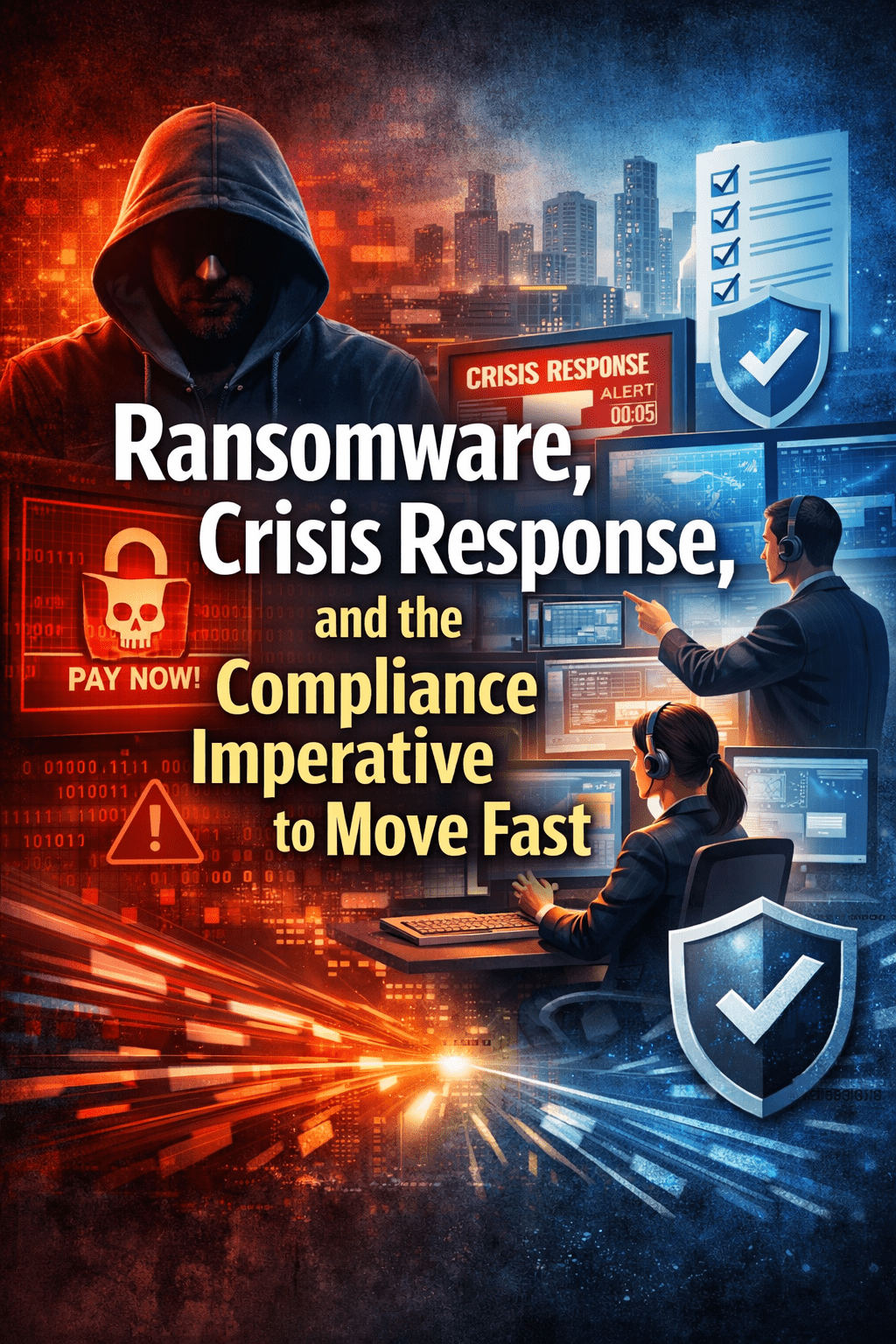
Once the attack is recognized, McDevitt shows the company doing something right: it moves into a structured response. The CEO activates the full cyber incident response team, or CIRT, and the war room includes not only technical leaders and legal counsel, but also the chief compliance officer, the head of communications, external incident response professionals, and other essential decision-makers. This is exactly what a mature response should look like. Cyber incidents do not fall under a single function. They are enterprise events.
I particularly appreciated how McDevitt uses the case study to underline the role of compliance. The CCO is not there as decoration. The article makes clear that if employee data has been exfiltrated, the incident constitutes a personal data disclosure with potentially local, state, and international notification consequences, and that compliance and legal personnel should be in the room from the start. That is a crucial point for corporate compliance professionals. Cyber risk management is not separate from compliance. It is now one of compliance’s core operating terrains.
McDevitt also captures the psychology of the first 36 hours. Anthony Ferrante says those hours are extremely stressful for a CEO, who is simultaneously thinking about operations, data, reputation, and people. That observation matters because it explains why preparation before an attack is so important. You do not want your executives inventing a process under duress. McDevitt reports that VE had already created an incident playbook with roles, escalation steps, and a five-part response framework: facts, business impact, root cause, corrective actions, and lessons learned. That is the kind of disciplined structure compliance leaders should insist upon.
Another strength of McDevitt’s reporting is her treatment of communications. Too many organizations still believe communications should be brought in late, after the lawyers and technologists finish their work. McDevitt, through multiple expert voices, makes the opposite case. Communications should have a seat at the table, not at the back wall. The reason is straightforward: stakeholders will forgive many things, but they will not forgive caginess. VE’s communications lead rightly argues that employees and customers should hear from the company first, not from the media or the attacker.
This point becomes even sharper when McDevitt contrasts VE’s approach with the real-life story of “Melvin,” an employee at another firm that remained offline for 10 days with no formal communication and did not disclose the sensitive data breach to employees in a timely or transparent way. That section may be the most important communications lesson in the entire piece. Employees are not bystanders. They are among the primary victims of a data breach, and they know when something is wrong. Silence destroys trust.
Then comes the hard question at the center of nearly every ransomware story: Do you pay?
McDevitt wisely resists easy moralizing. She notes the FBI’s official position is not to pay, because payment fuels the criminal business model and does not guarantee restoration. Yet she also reports the practical view of experienced practitioners: payment is not illegal per se, and companies often face a grim choice among bad options. The anonymous chief compliance officer quoted in the case study says it best: there are no good options, only the least bad option.
McDevitt’s two parallel paths, pay and do not pay, are particularly useful because they show that neither choice is clean. In Path A, VE pays $5 million, gets imperfect decryption support, recovers faster, but then faces scrutiny over whether it should have consulted OFAC before payment and whether it may have paid a sanctioned party. In Path B, VE does not pay, endures a longer recovery, suffers a data breach, and still faces reputational and legal fallout. McDevitt’s point is not that one route is right and one is wrong. Her point is that ransomware decision-making is governance under pressure.
That is why the postmortem matters so much. McDevitt closes the case study by emphasizing that the long-term impacts fall into three risk buckets: reputational, legal, and regulatory. She then turns to practical lessons: train the workforce, strengthen spam filters, run tabletop exercises, isolate infected devices immediately, secure backups offline, contact law enforcement quickly, do not rush engagement with the attacker, and communicate with each stakeholder group in a timely and tailored way. She also adds smart recommendations on canary files, forensic retainers, access reviews, logging, threat intelligence monitoring, and industry information sharing.
Finally, McDevitt ends on a note that compliance professionals should not miss. Betsy is not scapegoated. She is thanked for telling the truth and invited to participate in a phishing-resilience campaign for other employees. That is not sentimentality. That is culture. If your response to human error is humiliation, people will hide problems. If your response is accountability plus learning, people will surface them.
That may be the most important compliance lesson of all. Ransomware is a cyber crisis, but surviving it depends on culture, governance, and trust just as much as on technology.
I hope you have enjoyed reading about Aly’s case studies for CW. I am a columnist for Compliance Week.