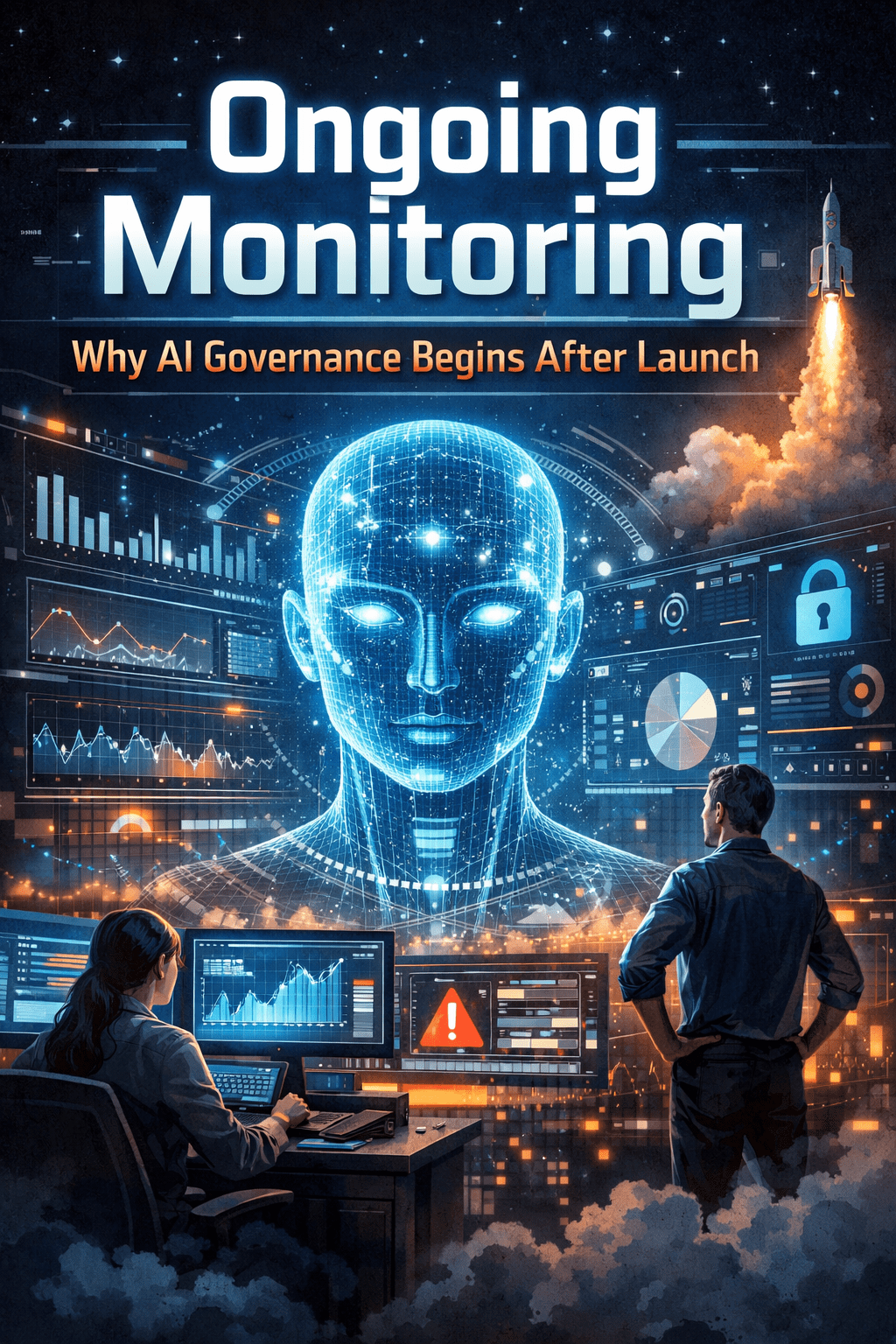
In this blog post, we turn to the fourth major governance challenge in AI: ongoing monitoring. This is one of the most persistent weaknesses in AI governance. Organizations may build an intake process. They may create an approval committee. They may conduct risk reviews, privacy assessments, and validation testing before launch. All of that is important. But it is not enough.
AI risk does not freeze at the moment of approval. It changes over time. Use cases evolve. Employees adapt tools in unexpected ways. Vendors modify models. Controls weaken in practice. Regulatory expectations shift. What looked reasonable at launch may become inadequate six weeks later.
That is why ongoing monitoring is not an optional enhancement to AI governance. It is a core governance requirement. For boards and CCOs, the central question is not simply whether the company approved AI responsibly. It is whether the company has the discipline to govern it continuously once it is in the wild.
Approval Is Not Governance
One of the great temptations in AI governance is to confuse approval with control. A business unit proposes a use case, a committee reviews it, guardrails are listed, and the tool goes live. At that point, many organizations behave as though the governance work is largely complete. It is not.
Approval is a moment. Governance is a process. The problem is that companies often put their best people, clearest thinking, and highest scrutiny into the approval stage, then shift immediately into operational mode without building the same discipline around post-launch oversight. That leaves management blind to how the system actually performs under real-world conditions.
The Department of Justice’s Evaluation of Corporate Compliance Programs (ECCP) is especially instructive here. The ECCP does not ask merely whether a company has policies on paper. It asks whether the program works in practice, whether controls are tested, whether issues are investigated, and whether lessons learned are incorporated back into the compliance framework. AI governance should be viewed through the same lens. The question is not whether a control was described at launch. The question is whether that control continues to function and whether management would know if it stopped.
Why AI Risks Change After Launch
Post-deployment risk in AI does not arise because management failed to care on Implementation Day. It arises because AI systems operate in dynamic environments. A model may begin to drift as conditions change. A tool approved for one limited purpose may gradually be used for broader or higher-risk decisions. Employees may find workarounds that bypass the intended controls. Human reviewers may begin by scrutinizing outputs closely but, over time, may become overconfident, overloaded, or simply too reliant on the system. Vendors may update underlying functionality without the company fully appreciating the consequences. New regulations or regulatory interpretations may alter the risk landscape. Inputs may change. Outputs may become less reliable. Bias may surface in ways not identified in initial testing.
In other words, AI governance risk is not static. It is operational. That is why boards and CCOs must resist the notion that initial approval is the hardest part. In many respects, ongoing monitoring is harder because it requires sustained attention, clear metrics, escalation discipline, and the willingness to revisit prior assumptions.
The Governance Question
After implementation, the governance question changes. It is no longer simply, “Was this use case approved?” It becomes, “Is the use case still operating as expected, within risk tolerance, and under effective control?” That sounds simple, but it requires a much more mature oversight model than many companies currently have. It requires management to define what should be monitored, how frequently, by whom, and what changes or anomalies trigger escalation. It requires a reporting structure that does not simply celebrate adoption or efficiency gains, but surfaces incidents, deviations, near misses, and control fatigue.
For the board, the challenge is to insist on post-launch visibility. Board reporting on AI should not end with inventories and implementation updates. It should include information about ongoing performance, exception trends, complaints, incidents, validation results, vendor changes, policy breaches, and remediation efforts. A board that hears only that AI adoption is accelerating may not hear that AI governance is working.
For the CCO, the challenge is even more immediate. Compliance must ask whether the organization is gathering evidence that controls continue to function in practice. If it is not, then the governance program is still immature, no matter how polished its approval process may appear.
Monitoring What Matters
It all begins by identifying the right things to monitor. This cannot be a generic exercise. Monitoring should be tied to the specific use case, its risk classification, and its control environment. But there are some recurring categories that boards and CCOs should expect to see.
- Performance should be monitored. Is the tool still delivering outputs that are accurate, reliable, and appropriate for the intended purpose? Have error rates changed? Are there signs of drift or degraded quality?
- Control effectiveness should be monitored. Are human review requirements actually being followed? Are approval restrictions, access controls, or usage limitations still operating as designed? Is there evidence that employees are bypassing or weakening controls?
- Incidents and complaints should be monitored. Has the tool produced problematic results? Have customers, employees, or managers raised concerns? Have there been internal reports about bias, inaccuracy, misuse, or confidentiality risks?
- Changes in scope should be monitored. Is the tool still being used for the original purpose, or has it drifted into new contexts? Scope creep is one of the oldest compliance problems in business, and AI is no exception.
- External change should be monitored. Has a vendor updated the model? Have relevant laws, guidance, or industry expectations changed? Has a new regulatory concern emerged that requires reevaluation?
This is where the NIST AI Risk Management Framework is especially useful. NIST emphasizes that organizations must govern, measure, and manage AI risk over time, not simply identify it once. ISO/IEC 42001 reaches the same conclusion from a management systems perspective by requiring continual improvement, internal review, and adaptive controls. Both frameworks point to the same truth: effective AI governance is iterative, not episodic.
The CCO’s Role in Governance
For compliance professionals, ongoing monitoring is where the AI governance conversation becomes most familiar. This is where the CCO brings real institutional value. Compliance understands that controls weaken over time. Training decays. Workarounds emerge. Policies lose operational traction. Reporting channels capture issues others do not see. Root cause analysis matters. Corrective action must be tracked to closure. These are not new lessons. They are the daily work of compliance. AI gives them a new domain.
The CCO should insist that AI use cases have documented post-launch monitoring plans. These should identify the responsible owner, the metrics to be reviewed, the review frequency, the escalation triggers, and the process for documenting findings and remediation. High-risk use cases should not be left to passive observation. They should be actively governed.
The CCO should also ensure that AI monitoring is connected to the broader compliance ecosystem. Employee concerns raised through speak-up channels may reveal issues with the model. Internal investigations may expose misuse. Third-party due diligence may uncover changes to vendors. Training gaps may explain repeated incidents. AI governance should not be isolated from these functions. It should be integrated with them.
This is also where the CCO can most effectively help the board. Rather than presenting AI as a series of isolated technical matters, the CCO can frame post-launch governance in familiar compliance terms: monitoring, testing, escalation, remediation, and lessons learned.
Board Practice: Ask for More Than Adoption Metrics
One of the most important disciplines boards can develop is to stop mistaking usage information for governance information.
Management may report that AI adoption is growing, that productivity gains are material, or that pilot programs are expanding. Those data points may be relevant, but they are not a form of governance assurance. A board should want to know whether controls are operating, whether incidents are increasing, whether certain business units generate more exceptions, whether human review remains meaningful, and whether management has paused or modified any use cases based on real-world experience.
This is where board oversight becomes genuinely valuable. When the board asks for evidence of ongoing monitoring, it changes management behavior. It signals that AI success will not be measured solely by speed or efficiency, but also by discipline and resilience.
Boards should also ensure that high-risk use cases receive enhanced visibility. Not every AI tool merits the same level of board attention. But where AI affects regulated interactions, employment decisions, sensitive data, financial reporting, significant customer outcomes, or reputationally sensitive functions, ongoing board-level reporting should be expected.
Escalation and Remediation Must Be Built In
Monitoring matters only if it leads to action. There must be clear escalation and remediation protocols. When a material issue emerges, who gets notified? Can the use case be paused? Who determines whether the problem is technical, operational, legal, or cultural? How are facts gathered? How are corrective actions assigned? When is the board informed? How is the lesson fed back into policy, training, vendor management, or approval standards?
These processes should not be improvised. They should be documented. The organization should know in advance which incidents require escalation, which temporary controls may be imposed, and how remediation is tracked.
This is another place where the ECCP provides a useful governance model. DOJ expects companies not only to identify misconduct but also to investigate it, understand its root causes, and implement improvements that reduce the risk of recurrence. AI governance should work the same way. If a model fails or a control weakens, management should not merely fix the immediate problem. It should ask what the failure reveals about the program itself.
Documentation Is the Proof
As with every other element of effective governance, documentation is what turns intention into evidence. Post-launch AI governance should generate records that demonstrate monitoring occurred, issues were surfaced, escalations were handled, and remediation was completed. That may include performance reviews, validation updates, incident logs, committee minutes, complaint summaries, control testing records, vendor change notices, and corrective action trackers.
Without such documentation, management may believe it is effectively monitoring AI, but it will struggle to prove it to internal audit, regulators, or the board. More importantly, it will struggle to learn from experience in a disciplined way. A company that documents ongoing monitoring creates institutional memory. It can compare use cases, detect patterns, and refine its oversight model over time. That is how governance matures.
AI Governance Starts After Launch
The hardest truth in AI governance may be this: launching the tool is often the easiest part. The real challenge begins afterward. That is when optimism meets operational reality. That is when human reviewers become tired. That is when vendors update products. That is when regulators begin asking harder questions. That is when small problems become visible, or invisible, depending on whether the company has built a monitoring system capable of finding them.
For boards and CCOs, this is where governance earns its name. If the organization can monitor, escalate, remediate, and improve, then AI oversight has substance. If it cannot, then the company has not really governed AI at all. It has only been approved.
In the next and final blog post in this series, I will turn to the fifth governance challenge: culture, speak-up, and human judgment, because in many organizations, the first people to see an AI problem will not be the board, the CCO, or the governance committee. It will be the employee closest to the work.