Categories
The Hill Country Podcast

The Hill Country Podcast: Schreiner University’s Jane Ragsdale Memorial Polo Celebration: Honoring Legacy and Funding the Equestrian Team

Welcome to the award-winning The Hill Country Podcast. The Texas Hill Country is one of the most beautiful places on earth. In this podcast, Hill Country resident Tom Fox visits with the people and organizations that make this one of the most unique areas of Texas. In this episode, host Tom Fox speaks with Sage Walter about the upcoming Jane Ragsdale Memorial Polo Celebration, which will be held at Camp Stewart in Hunt, Texas, on Saturday, April 18, 2026.

The event honors longtime Schreiner Board member Jane Ragsdale, who was lost in the July 4 flood, and raises funds to build an endowment for Schreiner’s equestrian team led by head coach Ashley Brune, whose riders compete through IHSA against larger universities and have recently attended a national qualifier. Sage outlines event logistics and programming, including sponsor/VIP tents, general admission options, halftime equestrian demonstrations, hat contest, divot stomping, polo basics, parking details, and “rain or shine” execution. VIP and sponsorships are sold out, with general admission still available, and attendees are advised on smart-casual polo attire.

Highlights include:

  • Meet the Equestrian Team
  • Remembering Jane Ragsdale
  • Tickets, Weather, and Attire

Resources:

Schreiner University

Jane Ragsdale Memorial Polo Celebration 

Other Hill Country Focused Podcasts

Hill Country Authors Podcast

Hill Country Artists Podcast

Texas Hill Country Podcast Network

Cover Art

Nancy Huffman

Categories
Blog

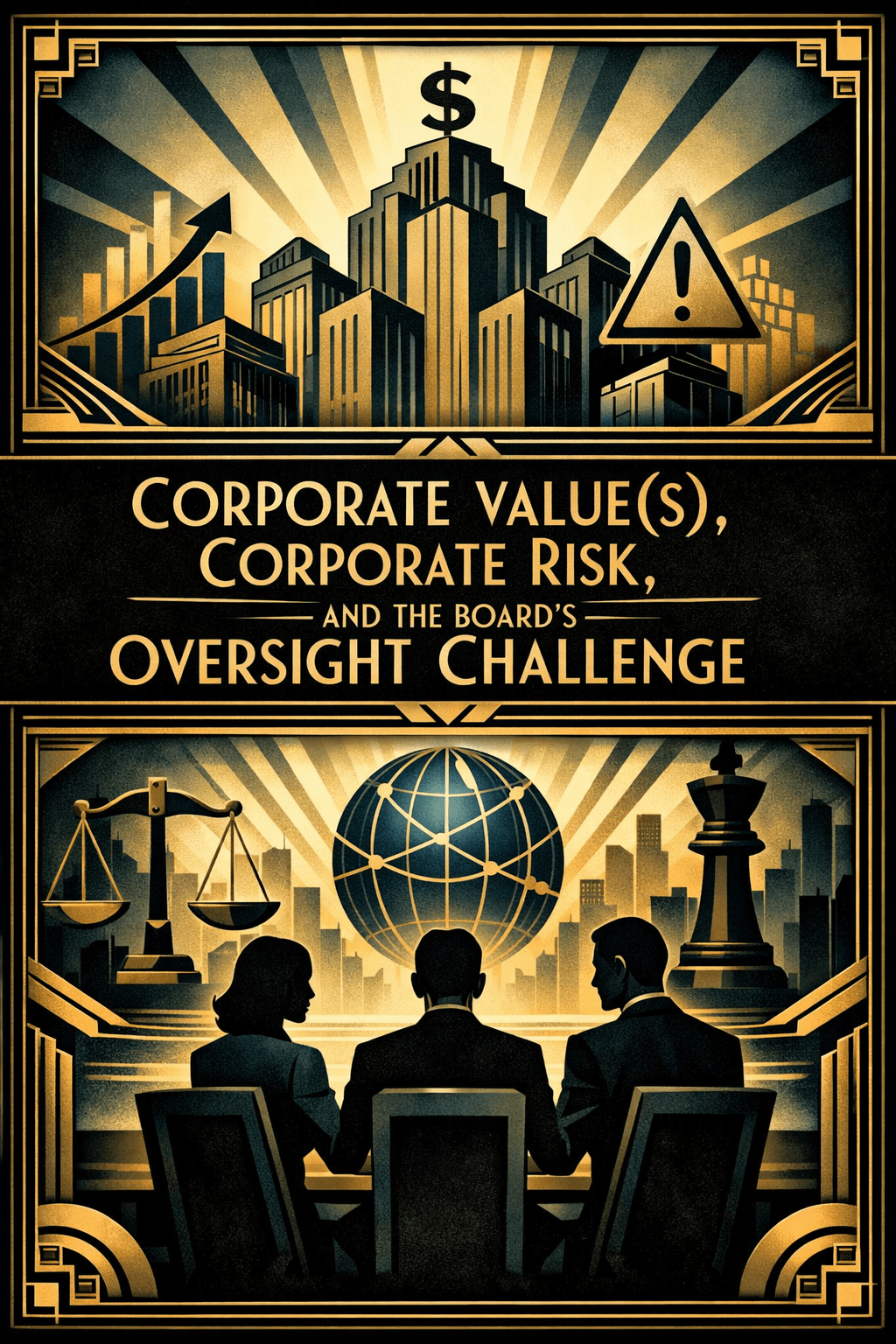
Corporate Value(s), Corporate Risk, and the Board’s Oversight Challenge

There was a time when many executives could treat corporate values as a branding exercise, a recruiting line, or a paragraph on the company website. That time is over. Today, corporate values are operational. They shape customer loyalty, employee engagement, regulatory attention, shareholder expectations, and public trust. Most importantly for boards and compliance professionals, they shape risk.

That is the central lesson of Corporate Value(s) by Jill Fisch and Jeff Schwartz. Their insight is both practical and profound: managers should select the corporate values that maximize long-term economic value, and to do that, they need reliable information about what stakeholders actually care about. The paper does not argue that corporations should become moral philosophers. It argues for something more useful for the compliance function. Corporate values are part of the long-term value equation, and management ignores them at its peril.

Why This Matters to Compliance

For a corporate compliance audience, this is not an abstract governance debate. It is a board oversight issue. It is a cultural issue. It is an internal controls issue. And it is a warning that values misalignment can become a business crisis long before it shows up in a formal investigation or on a quarterly earnings call.

The paper is particularly strong in rejecting two simplistic views. First, it rejects the notion that companies can operate as if values do not matter. Second, it rejects the idea that companies should chase social legitimacy untethered from business reality. Instead, the authors land where sophisticated boards and chief compliance officers should land: values matter because they affect value, and management needs disciplined ways to understand that connection.

Culture as a Control

That is where compliance comes in. Too often, companies treat culture as a soft concept and values as a public relations topic. Yet every experienced compliance professional knows that culture is a control. It influences decision-making when policy manuals are silent, when incentives are misaligned, and when leaders face pressure. Corporate values, when operationalized correctly, help define that culture. They tell employees, managers, and third parties what the company stands for when the choice is not easy, the answer is not obvious, and money is on the line.

The paper notes that values-based concerns now influence a broad range of business decisions, from product design and sourcing to employment policies and public positioning. It also emphasizes that employees, customers, governments, and shareholders all communicate their values and preferences in different ways, and that management must stay attuned to those preferences, as misalignment can carry real economic consequences. That is precisely the language of risk management.

A Governance Issue for the Board

For boards, this means values cannot be siloed in human resources, investor relations, or communications. Values belong in governance. Boards need to ask not only what the company says its values are, but how those values are translated into operations, incentives, escalation, and response. If culture is a control, then values are part of the control environment.

This is also why corporate values should be viewed as a business risk issue. A values mismatch can trigger employee walkouts, consumer backlash, shareholder agitation, government retaliation, or a reputational spiral amplified through social media. The paper offers multiple examples showing how value-related decisions can carry material economic consequences. For the modern board, that means values are no longer a side conversation. They are part of enterprise risk management.

The paper offers another insight that compliance professionals should take seriously. Management often lacks perfect information about stakeholder values, and shareholders face structural impediments in communicating their views clearly. The authors argue that shareholder input can help management better understand public sentiment, reputational risk, and the tradeoffs between values and value. Whether one agrees with every detail of their governance analysis, the broader compliance lesson is straightforward: management needs listening mechanisms before a crisis hits.

Compliance as an Information System

That point should resonate deeply with compliance professionals. A mature compliance program is, at its core, an information system. It is supposed to tell management what it needs to know before misconduct metastasizes. The same is true for values-based risk. If the only time leadership learns that employees, customers, or investors believe the company is out of step is when a boycott begins, or a viral post explodes, the company’s information channels have already failed.

What Boards Should Do

  1. Boards should insist that management identify the company’s most material values-sensitive risk areas. These will vary by industry. For one company, it may be product safety. For another, environmental performance. For another, labor standards, DEI, or political engagement. The important point is that these issues should be mapped as risk categories, not simply discussed as messaging challenges.
  2. Boards should ask whether the company has credible mechanisms to hear from stakeholders before controversy becomes a crisis. The paper emphasizes that employees and customers often have clearer channels to express their values and preferences than shareholders do. A compliance-minded board should ask: Are we learning from all of them? Are we capturing concerns through speak-up systems, culture assessments, employee town halls, customer trends, market testing, and investor engagement? Or are we waiting for a public backlash to tell us what we should already know?
  3. Boards should evaluate whether management is treating corporate culture as a control. This means looking beyond tone at the top to the systems beneath it: incentives, middle-management behavior, escalation pathways, decision rights, and accountability. Values that live only in a code of conduct are decorative. Values that influence promotions, discipline, product choices, third-party oversight, and crisis response become operational.
  4. Boards should ensure that compliance has a seat at the table when values-laden business decisions are made. The compliance function should not decide corporate values. That is not its role. But it should help management test assumptions, identify blind spots, assess stakeholder reactions, and determine whether a proposed course is consistent with the company’s culture and risk appetite. In that sense, compliance serves as both translator and challenger.
  5. Boards should resist the temptation to turn every values issue into a political debate. The paper wisely cautions against viewing corporations as moral leaders first and economic institutions second. That is a sound warning. But there is an equal and opposite danger in pretending that values are irrelevant to business. They are not. The board’s job is not to moralize. It is to govern. And governance today requires management to understand how stakeholder values affect long-term value.

Steps for Chief Compliance Officers

For chief compliance officers, there are some clear, practical steps to take.

Begin by incorporating values-sensitive issues into risk assessment and culture reviews. Build a process to identify where stakeholder expectations may materially affect the company’s operations, reputation, and control environment. Make sure that speak-up and escalation systems can capture values-based concerns, not only legal violations. Work with management to develop an early-warning capability around stakeholder sentiment. Bring boards concrete reporting on culture trends, employee concerns, reputational flashpoints, and areas where the company may be drifting away from its stated values. Finally, pressure-test whether the company’s incentives, communications, and business decisions align with the culture it claims to have.

The Bottom Line

The bottom line is this: corporate values are not soft. They are not ornamental. They are not outside the compliance function’s field of vision. They are part of how companies create value, lose trust, and invite risk. The real challenge for boards and CCOs is not to choose values in the abstract. It is to build the governance and information systems that help management understand stakeholder values before a crisis hits. That is not politics. That is good governance.


Categories
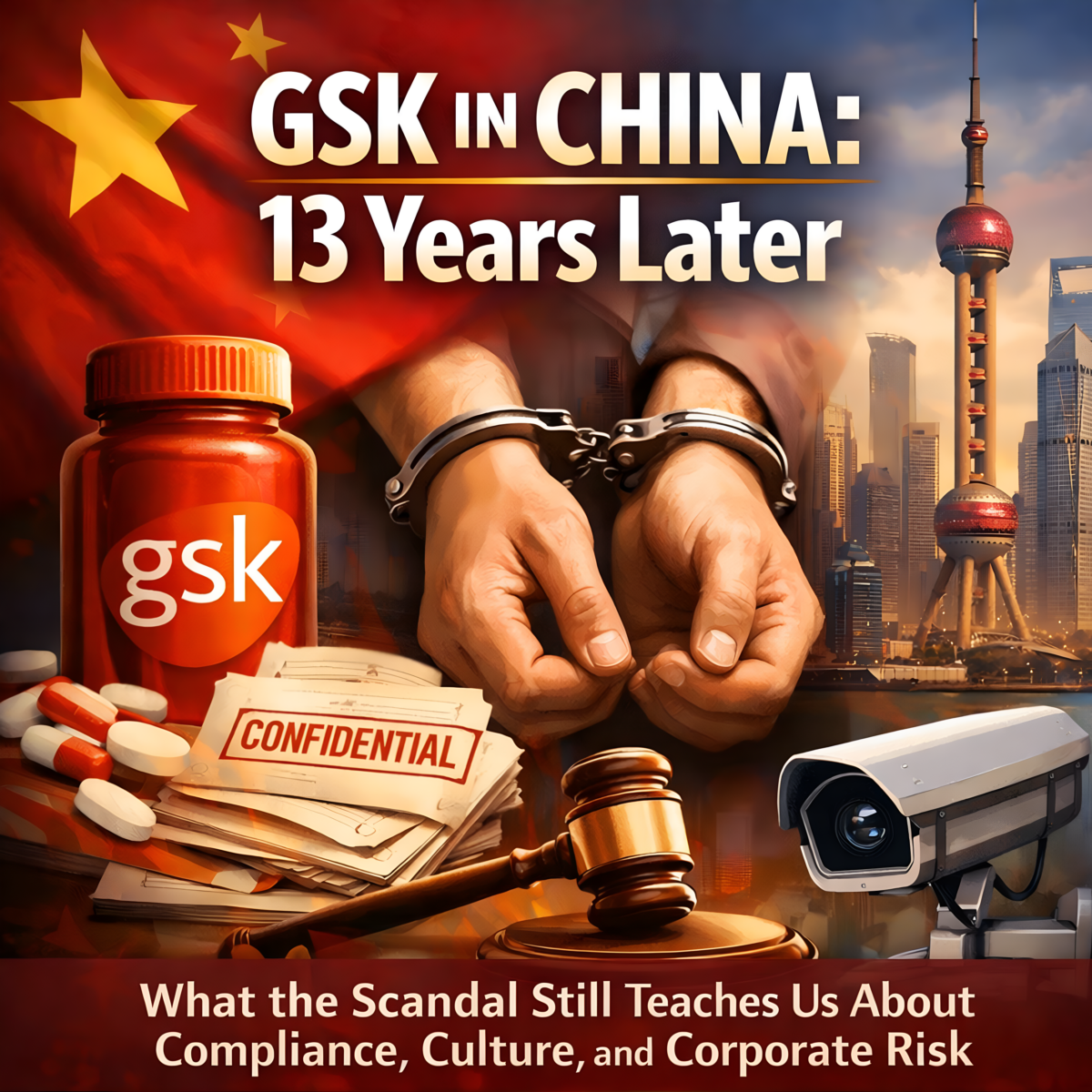
GSK in China: 13 Years Later

GSK In China: 13 Years Later – The Verdicts

Thirteen years after the GSK China scandal exploded onto the global stage, its lessons remain as urgent as ever for compliance professionals and business leaders. In this podcast series, we revisit the case not simply as corporate history, but as a living cautionary tale about culture, incentives, third parties, investigations, and governance. Each episode explores what went wrong, why it went wrong, and how those failures still echo in today’s compliance and ethics landscape. Join me as we unpack the scandal and draw practical lessons for building stronger, more resilient organizations.

This episode analyzes the GSK China scandal and its compliance implications, beginning with the 2014 Shanghai trial of private investigators Peter Humphrey and Yu Yingzeng, convicted under a vague 2009 privacy law for illegally purchasing sensitive personal data (IDs, travel, and phone records) using hidden cameras and data brokers, resulting in prison terms and fines. Their arrest overlapped with a GSK-commissioned probe into a sex tape involving China chief Mark Reilly, as China separately convicted GSK in a secret Hunan trial, imposing a record 3 billion RMB (~$491M) fine tied to bribes routed through travel agencies via inflated conference budgets and kickbacks to doctors. Executives gave televised confessions yet received suspended sentences, reflecting a strategy of corporate submission and public exposure over incarceration. The market reaction was muted, but GSK responded by ending payments to doctors and replacing volume-based sales commissions with qualitative metrics, creating a modern compliance blueprint while highlighting ongoing UK Bribery Act and FCPA exposure. Our hosts are Timothy and Fiona.

Key highlights:

  • Investigators on Trial
  • GSK Secret Verdict
  • Executives Sentenced
  • Judicial Strategy Explained
  • Global Compliance Blueprint

Resources:

GSK in China: A Game Changer for Compliance on Amazon.com

GSK in China: Anti-Bribery Enforcement Goes Global on Amazon.com

Tom Fox

Instagram

Facebook

YouTube

Twitter

LinkedIn

Ed. Note: the voices of the hosts, Timothy and Fiona, were created by Notebook LM based upon text written by Tom Fox

Categories
Daily Compliance News

Daily Compliance News: April 16, 2026, The Bribery is Legal in Illinois Edition

Welcome to the Daily Compliance News. Each day, Tom Fox, the Voice of Compliance, brings you compliance-related stories to start your day. Sit back, enjoy a cup of morning coffee, and listen in to the Daily Compliance News. All, from the Compliance Podcast Network. Each day, we consider four stories from the business world, compliance, ethics, risk management, leadership, or general interest for the compliance professional.

Top stories include:

For more information on the use of AI in Compliance programs, my new book, Upping Your Game, is available. You can purchase a copy of the book on Amazon.com.

To learn about the intersection of Sherlock Holmes and the modern compliance professional, check out my latest book, The Game is Afoot-What Sherlock Holmes Teaches About Risk, Ethics and Investigations on Amazon.com.

Categories
Hill Country Authors

Hill Country Authors: Teddy Jones on Borger’s Boomtown Corruption and the Origins of Far from Uncertain

Welcome to a new season of the award-winning Hill Country Authors Podcast, sponsored by Stoney Creek Publishing. In this podcast, Hill Country resident Tom Fox visits with authors who live in and write about the Texas Hill Country.  Host Tom Fox welcomes back Teddy Jones to talk about her new book,  Far from Uncertain: One Woman’s Life of Crime and Other Righteous Deeds.

Teddy’s book is inspired by a woman found near death in a ditch in Jones’s prior book, A Family of Good Women. She explains Borger’s 1926 oil boom, which led to lawlessness (gambling, illegal liquor, prostitution), entrenched corruption, and the governor’s declaration of martial law after the district attorney was killed, with Texas Rangers and the military restoring order; Borger then faced the Dust Bowl and the Depression. Teddy describes using a dual timeline to connect historical events to contemporary relevance without being heavy-handed, developing complex characters through observation informed by her nursing background, and weaving research (including local theses and books) into the narrative. She previews her next novel, Rise to the Occasion, set in the fictional town of Jackson Pond, Texas, and shares her website and social media accounts.


Key highlights:

  • Origin of Frankie
  • Borger Boomtown Chaos
  • Martial Law and Aftermath
  • Dual Timeline Structure
  • Building Real Characters

Resources:

Teddy Jones on Stoney Creek Publishing

Far from Uncertain: OneWoman’s Life of Crime and Other Righteous Deeds

Stoney Creek Publishing

Social Media

Instagram

Facebook

Podcast Cover Art

Nancy Huffman Fine Art

Tom Fox

Instagram

Facebook

YouTube

Twitter

LinkedIn

Categories
Kerr250 Podcast

The Kerr250 Podcast: Library of America Books Celebrating the American Revolution

Kerr250 is a community-focused podcast dedicated to celebrating America’s 250th birthday through the people, businesses, traditions, and events of Kerr County. As our nation marks this historic anniversary on July 4, 2026, Kerr250 will highlight local celebrations and community efforts that bring this milestone to life. Each episode will feature conversations with local leaders, business owners, organizers, volunteers, and proud citizens who are helping make Kerr County a vibrant part of this national moment. The podcast will explore how history, patriotism, service, and community pride come together in one county that believes America’s strength has always come from its people. Kerr250 is where Kerr County honors the past, celebrates the present, and helps inspire the future. In honor of the upcoming 250th anniversary of the US, in this episode, we look at 4 top books from the Library of America on contemporaneous writings on the American Revolution.

Highlights include:

Thomas Jefferson: Writings

George Washington: Writings

The American Revolution: Writings from the Pamphlet Debate

The American Revolution: Writings from the War of Independence

Resources:

Kerr250 Website

Texas Hill Country Podcast Network

Categories
AI Today in 5

AI Today in 5: April 16, 2026, The AI Attack Chains Edition

Welcome to AI Today in 5, the newest addition to the Compliance Podcast Network. Each day, Tom Fox will bring you 5 stories about AI to start your day. Sit back, enjoy a cup of morning coffee, and listen in to the AI Today In 5. All, from the Compliance Podcast Network. Each day, we consider five stories from the business world, compliance, ethics, risk management, leadership, or general interest about AI.

Top AI stories include:

  1. Building real-world healthcare with AI. (Crunchbase News)
  2. AI and regulatory intelligence. (FinTechGlobal)
  3. Space Force touts AI. (Cyberscoop)
  4. AI attack chains. (PYMNTS)
  5. For lawyers: your chatbots will be used against you. (Reuters)

For more information on the use of AI in Compliance programs, my new book, Upping Your Game, is available. You can purchase a copy of the book on Amazon.com.

To learn about the intersection of Sherlock Holmes and the modern compliance professional, check out my latest book, The Game is Afoot-What Sherlock Holmes Teaches About Risk, Ethics and Investigations on Amazon.com.