Categories
Trekking Through Compliance

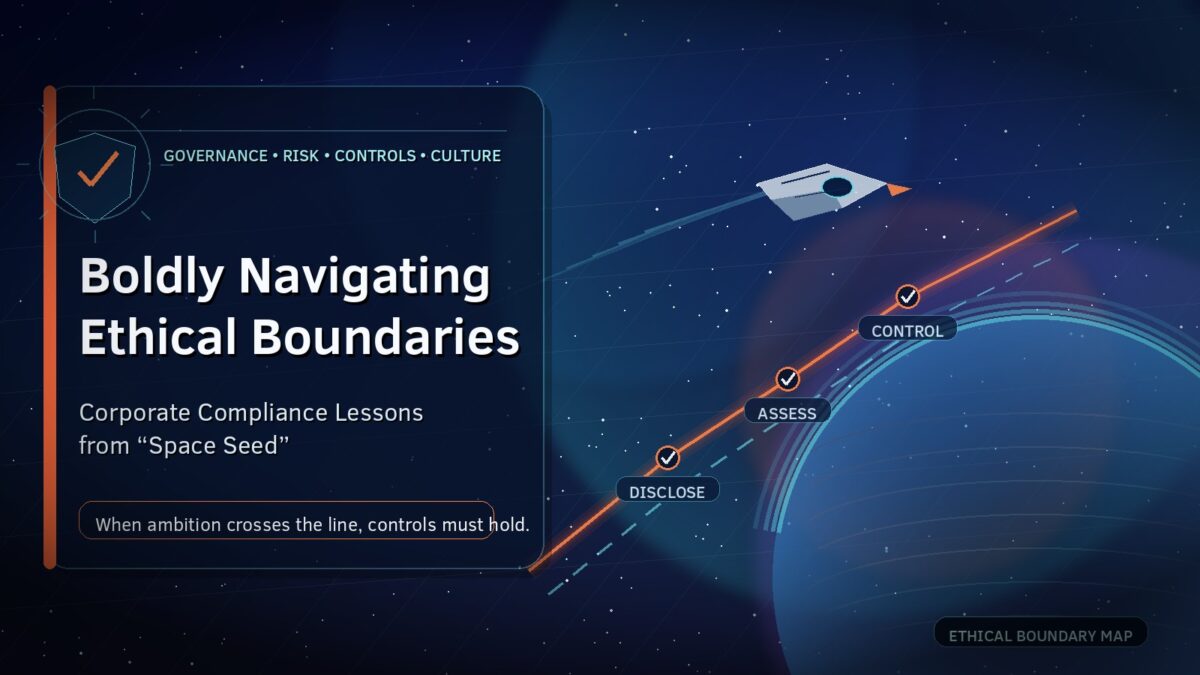
Trekking Through Compliance – Episode 22 – Ethical Lessons from Space Seed

In the legendary Star Trek episode “Space Seed,” Captain Kirk and the crew of the USS Enterprise encounter a drifting vessel, the SS Botany Bay, which houses cryogenically frozen survivors from Earth’s Eugenics Wars. Among these survivors is Khan Noonien Singh, a charismatic and genetically superior figure with ambitious plans to dominate those around him. “Space Seed” is not merely compelling science fiction but also an illuminating parable about ethics, leadership, and compliance within organizations. Let’s examine four key ethical lessons from this iconic episode and explore how they apply to the context of corporate compliance.

Lesson 1: Beware Charisma Without Ethics

Illustrated By: Khan awakens from centuries of cryogenic sleep. Charismatic, brilliant, and imposing, he quickly gains the trust and admiration of historian Lieutenant Marla McGivers. However, Khan’s charm conceals his ruthless ambition, ultimately leading McGivers to compromise her principles.

Compliance Lesson: Compliance officers must instill a culture that evaluates leaders and decision-makers on their ethical conduct and actions rather than superficial charisma or immediate performance.

Lesson 2: Transparency and Trust Are Pillars of Integrity

Illustrated by Khan, upon awakening, he refuses to disclose his past or intentions fully. This lack of transparency breeds mistrust among Kirk’s crew despite Khan’s superficially appealing characteristics. The withholding of critical information ultimately undermines his position, signaling to the crew the presence of hidden motives.

Compliance Lesson: Transparency and trust are foundational to a robust compliance culture.

Lesson 3: Ethical Leadership Requires Courageous Accountability

Illustrated By: Captain Kirk ultimately confronts Khan directly, taking decisive and courageous action to protect the crew and uphold the integrity of the Enterprise. Kirk’s willingness to confront difficult situations head-on demonstrates courageous leadership grounded in strong ethical principles.

Compliance Lesson: Ethical leadership entails proactive accountability, particularly when confronting challenging or uncomfortable issues.

Lesson 4: History Teaches Valuable Compliance Lessons

Illustrated By: Lieutenant McGivers is initially enamored with Khan due to her fascination with historical figures of power and dominance. However, her romanticized view of history blinds her to the true nature and consequences of Khan’s leadership style, resulting in serious ethical lapses.

Compliance Lesson: Organizations must actively engage with past compliance failures, both internal and external, to glean critical insights that prevent the repetition of ethical breaches.

Final ComplianceLog Reflections

“Space Seed” vividly illustrates how charisma divorced from ethics, opacity over transparency, leadership without courageous accountability, and ignorance of historical lessons can lead to organizational harm. For compliance professionals, these lessons serve as potent reminders of the importance of ethical vigilance and proactive leadership in safeguarding corporate integrity.

In an ever-evolving corporate landscape fraught with risks and opportunities, maintaining ethical standards is not merely advisable—it is imperative. Let us boldly apply these Star Trek-inspired ethical lessons, ensuring our organizations prosper not just through profit but through principled and trustworthy conduct. Remember, as Captain Kirk demonstrated, ethical vigilance is not just logical; it is essential for sustainable success.

Resources:

Excruciatingly Detailed Plot Summary by Eric W. Weisstein

MissionLogPodcast.com

Memory Alpha

Timothy is an AI generated voice.

Categories
Daily Compliance News

Daily Compliance News: June 22, 2026, The Corruption as Campaign Issue Edition

Welcome to the Daily Compliance News. Each day, Tom Fox, the Voice of Compliance, brings you compliance-related stories to start your day. Sit back, enjoy a cup of morning coffee, and listen in to the Daily Compliance News. All, from the Compliance Podcast Network. Each day, we consider four stories from the business world, compliance, ethics, risk management, leadership, or general interest for the compliance professional.

Top stories include:

  • Trump’s corruption is a midterm campaign issue. (Bloomberg)
  • Wife of Spanish PM to stand corruption trial. (NYT)
  • Albanians protest corruption around the Kushner luxury resort. (NYT)
  • Corruption charges hit Puerto Rico’s governor. (Miami Herald)

To learn about the intersection of Sherlock Holmes and the modern compliance professional, check out Tom’s latest book, The Game is Afoot-What Sherlock Holmes Teaches About Risk, Ethics and Investigations on Amazon.com.

Categories
AI Today in 5

AI Today in 5: June 22, 2026, The Flamethrower to AI Music Edition

Welcome to AI Today in 5, the newest addition to the Compliance Podcast Network. Each day, Tom Fox will bring you 5 stories about AI to start your day. Sit back, enjoy a cup of morning coffee, and listen in to AI Today In 5. All, from the Compliance Podcast Network. Each day, we consider five stories from the business world, compliance, ethics, risk management, leadership, or general interest about AI.

Top AI stories include:

  1. AI and wealth management. (Bloomberg)
  2. SZA set a flamethrower to AI music. (TheWrap)
  3. AI helped design a cancer drug for dogs. (Let’s Data Science)
  4. Data centers in space. (CNBC)
  5. AI as a force multiplier in healthcare. (WSJ)

For more information on the use of AI in compliance programs, Tom Fox’s new book, Upping Your Game, is available. You can purchase a copy of the book on ⁠Amazon.com⁠.

To learn about the intersection of Sherlock Holmes and the modern compliance professional, check out Tom’s latest book, The Game is Afoot-What Sherlock Holmes Teaches About Risk, Ethics and Investigations on ⁠Amazon.com⁠.

Categories
FCPA Compliance Report

FCPA Compliance Report – Managing Compliance and National Security Risks When Doing Business in the DRC, Part 1

In this episode, Tom Fox welcomes David Simon, Partner at Foley & Lardner, and Jack Korba Of Counsel at Foley & Lardner, and Olivier Bustin a Partner at Pinsent Masons about doing business in and with the Democratic Republic of the Congo (DRC). This is the first part of a two-part series on this topic. The guests present a detailed manner to evaluate  and manage going into a high-risk country or region.

The three argue that while governance and logistics risks remain, improved infrastructure and heightened strategic importance of the DRC’s critical minerals (including cobalt, coltan, lithium, manganese, and rare earths) make risks more manageable and the market more relevant, with noted U.S. government continuity across administrations. They discuss opportunities beyond mining, including power, logistics, banking/insurance, tech, entertainment, and education, while emphasizing infrastructure and bankability constraints. Korba outlines national security, sanctions/export controls, and supply chain “adjacency” risks, and the need for sector-specific analysis. The panel highlights “choke points” from concentrated power and weak institutions, and Bustin explains why local content/ownership rules and patronage dynamics require diligence beyond nominal ownership. They conclude with applying a risk-based compliance approach, devoting enhanced resources to higher-risk projects and counterparties.

Key Highlights

  • Why DRC Now
  • Beyond Mining Opportunities
  • National Security Risks
  • Choke Points Explained
  • Local Ownership Diligence
  • Risk Based Compliance

Resources

David Simon

Jack Korba

Olivier Bustin

Foley & Lardner

Pinsent Masons

The Democratic Republic of the Congo as a Near-Term Strategic Opportunity for U.S. Companies Part 1

Part 2

Part 3


Tom Fox

Instagram

Facebook

YouTube

Twitter

LinkedIn

To learn about the intersection of Sherlock Holmes and the modern compliance professional, check out my latest book, The Game is Afoot-What Sherlock Holmes Teaches About Risk, Ethics and Investigations on Amazon.com

Categories
Blog

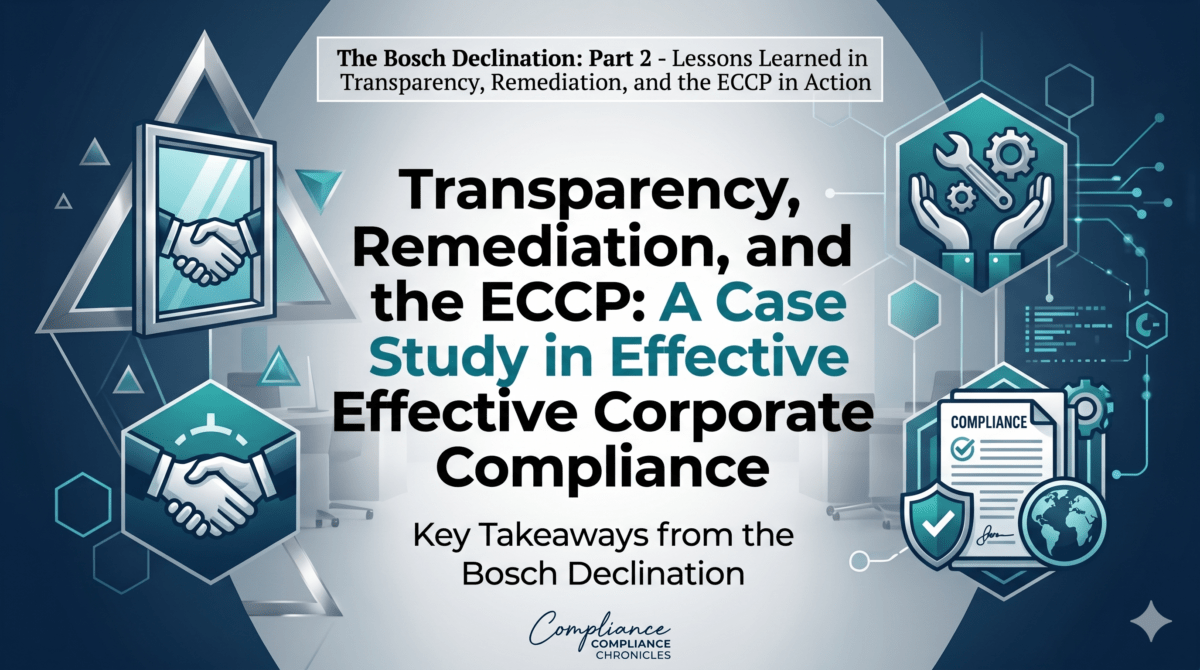
The Bosch Declination: Part 2 – Lessons Learned in Transparency, Remediation, and the ECCP in Action

Every Chief Compliance Officer should study the Bosch declination because it answers a practical question: what does the DOJ reward when a company discovers serious national security compliance failures? It is also a useful case study for CCOs beyond export controls. It is a broader lesson in how enforcement authorities evaluate program effectiveness, internal controls, and corporate response after misconduct is identified.

The answer is not perfection. The answer is transparency, cooperation, remediation, resources, accountability, and governance. Bosch received a declination from the National Security Division under the DOJ’s Department-wide Corporate Enforcement and Voluntary Self-Disclosure Policy (CEP) after self-disclosing export control issues, cooperating with the investigation, remediating, and resolving parallel civil exposure with BIS.

Lessons Learned

1. Manage Your Organization’s Risks

Those facts present the first lesson for CCOs. A compliance program must be built around the company’s actual risk profile. For a global technology and manufacturing company, that means export controls cannot be treated as a narrow legal specialty. They must be embedded into product development, sales, logistics, customer review, third-party engagement, software, engineering, and business approval processes.

This point aligns directly with the DOJ’s Evaluation of Corporate Compliance Programs (ECCP). The ECCP asks three fundamental questions: Is the program well designed? Is it applied earnestly and in good faith, meaning adequately resourced and empowered? Does it work in practice? DOJ also states that prosecutors evaluate the program at the time of the offense and at the time of charging or resolution.

The Bosch Declination demonstrates why those questions matter. A program may exist on paper, yet still fail if it lacks specialized knowledge, escalation paths, and operational integration. The Foreign Direct Product Rule (FDPR) is technical. It requires understanding product origin, technology lineage, software, manufacturing equipment, Entity List designations, and licensing requirements. If the compliance team lacks the expertise or access needed to analyze those issues, the control environment is not fit for purpose. Clearly, the Bosch compliance team lacked the expertise needed for trade compliance.

2. Quick Action-the Need for Speed

The second lesson is that detection and escalation remain central to program effectiveness. The DOJ credited Bosch with conducting an internal investigation after discovering the issues and voluntarily self-disclosing to both NSD and BIS while that investigation was still ongoing. That detail matters. Bosch did not wait for a perfect final report before going to the government. It identified the problem, investigated it, and disclosed it while continuing to learn the facts.

For CCOs, this is the real-world self-disclosure dilemma. Companies often want certainty before disclosure. DOJ policy rewards promptness. The Bosch matter shows that the government may credit a company that self-discloses while its internal investigation is still underway, provided the company preserves evidence, continues to develop the facts, cooperates, and remediates.

3. Active Cooperation

The third lesson is that cooperation must be active. The DOJ cited Bosch’s disclosure of relevant facts; the preservation, collection, and production of documents and information; and prompt, voluntary responses to CES requests following the self-disclosure. This is not passive cooperation. It is an organized, disciplined, and documented cooperation.

For the CCO, this means the company must be ready before a crisis. There should be an investigation protocol. There should be document preservation capabilities. There should be clarity on who owns export control investigations, who briefs the board, who coordinates with outside counsel, who manages government requests, and who ensures that remediation does not wait until the matter concludes.

4. Substantive Remediation

The fourth lesson is that remediation must be tangible. Bosch was credited with organizational changes, including adding 66 employees to its trade compliance organization, expanding U.S. trade compliance resources, and updating internal policies and procedures to clarify U.S. export control jurisdiction and licensing requirements.

That is an important message for every compliance leader. Remediation is not a memo. Remediation is not revised policy language alone. Remediation means changing the program so that the same issue is less likely to happen again. It means more resources where the risk requires them. It means better expertise. It means clearer rules. It means stronger controls. It means accountability. Law360 reported that Bosch also made organizational changes, imposed discipline, added trade compliance employees, expanded U.S. trade compliance resources, and updated internal policies and procedures.

5. Effectiveness

The fifth lesson is that the DOJ is connecting compliance effectiveness to enforcement outcomes. DOJ’s CEP is designed to encourage companies to invest in effective compliance programs, voluntarily self-report potential misconduct, cooperate with law enforcement, and rectify wrongdoing. The policy states that the DOJ will decline to prosecute when the company voluntarily self-discloses, fully cooperates, remediates in a timely and appropriate manner, has no aggravating circumstances, and is required to disgorge, forfeit, or otherwise compensate victims for the misconduct.

Bosch is the proof point. DOJ did not ignore the misconduct. Bosch agreed to disgorge $11,430,098, with a credit for amounts paid to BIS. BIS imposed a parallel civil penalty. DOJ also made clear that the declination did not protect individuals and that the investigation could be reopened if DOJ learned new information that changed its assessment or if disgorgement was not paid promptly.

That is a critical governance message. A declination is not a free pass. It is an enforcement outcome tied to conditions, cooperation, transparency, remediation, and accountability.

The Board Component

For boards, Bosch should be read as a Caremark-adjacent reminder that mission-critical compliance risks require real oversight. Export controls and sanctions are not technical back-office functions for global technology companies. They are national security, legal, operational, reputational, and business continuity risks.

The Bosch declination letter states that the company’s Management Board had been advised of the terms of the letter agreement and that Bosch’s Global General Counsel signed the agreement on behalf of the company. That is how these matters should land. Senior management and the board must understand the facts, the root cause, the remediation plan, the financial consequences, and the continuing obligations.

Boards should be asking whether the company has identified its mission-critical regulatory risks. For a technology, manufacturing, software, logistics, aerospace, life sciences, energy, or semiconductor company, export controls and sanctions may sit at the center of that risk map. The board should ask whether compliance has sufficient expertise, authority, budget, data access, and independence. It should ask whether management has tested the controls around high-risk customers, restricted parties, product classification, end-use, end-user, software, and foreign-produced items.

The ECCP reinforces this governance point. The DOJ expects prosecutors to consider whether a company has made significant investments in its compliance program and internal controls and whether improvements have been tested to demonstrate that they would prevent or detect similar misconduct in the future.

Top Five Takeaways

  1. Voluntary self-disclosure still matters. Bosch received credit because it disclosed to NSD and BIS while still under investigation and then continued to cooperate and remediate.
  2. Export controls are internal controls. FDPR risk requires more than screening. It requires integration across product, software, engineering, sales, legal, and compliance.
  3. Resources are evidence. DOJ credited Bosch for adding 66 trade compliance employees and expanding U.S. trade compliance resources. That is remediation prosecutors can see.
  4. The ECCP is a governance tool. CCOs should use the ECCP’s three questions to assess whether the program is well designed, empowered, resourced, and working in practice.
  5. Boards must oversee national security risks. Export controls and sanctions are mission-critical risks for many global companies. Bosch shows that transparency and remediation can materially shape the enforcement outcome.

The Bosch remediation was not cosmetic. Adding 66 trade compliance employees and expanding U.S. trade compliance resources communicates seriousness. It tells enforcement authorities that the company understood the root cause and invested in fixing it. CCOs should take that lesson directly to the board. Compliance resources should follow risk. Where the business model creates national security exposure, compliance must have the technical capability to match that risk.