Categories
The Ethics Experts

Episode 259 – Susan Walberg

In this episode of The Ethics Experts, Nick Gallo welcomes Susan Walberg.

Susan Walberg is a healthcare attorney by background, with over 30 years of healthcare experience, including working as a fraud analyst, regulatory attorney, and compliance and privacy officer. Currently, Susan is the owner and principal of Compliance Ala Carte, LLC which provides compliance assessments, risk assessments, compliance program development, and training of compliance staff, leadership, and boards. Susan has worked with a full range of healthcare organizations, including hospitals, physician practices, labs, life sciences, post-acute care, pharmacies, insurers, CMS, and technology-based start-ups.

In addition to her professional experience, Susan has written three compliance books, one specifically geared toward physician practices and smaller healthcare providers and the other as a training guide for new compliance officers. Her most recent compliance book, Healthcare Technology: Law and Compliance, provides individuals working with or developing healthcare technology a readable guide with clear and actionable steps to take to mitigate risk. She has conducted multiple professional presentations and written an array of articles published in various blogs, magazines, and other trade publications. In addition to her healthcare compliance books, Susan has also written three novels (medico-legal thrillers) and has won multiple awards.

Connect with Susan on LinkedIn

Categories
AI Today in 5

AI Today in 5: July 20, 2026, The AI Making Job Harder Edition

Welcome to AI Today in 5, the newest addition to the Compliance Podcast Network. Each day, Tom Fox will bring you 5 stories about AI to start your day. Sit back, enjoy a cup of morning coffee, and listen in to AI Today In 5. All, from the Compliance Podcast Network. Each day, we consider five stories from the business world, compliance, ethics, risk management, leadership, or general interest about AI.

Top AI stories include:

  1. NY state bills could create AI compliance obligations. (The National Law Review)
  2. GRC professionals say AI makes their jobs harder. (CCI)
  3. AI for tighter supply chain compliance. (SupplyChainDive)
  4. Pastors using AI to write sermons. (WSJ)
  5. Compliance as a commercial lever. (FinTechGlobal)

For more information on the use of AI in compliance programs, Tom Fox’s new book, Upping Your Game, is available. You can purchase a copy of the book on ⁠Amazon.com⁠.

To learn about the intersection of Sherlock Holmes and the modern compliance professional, check out Tom’s latest book, The Game is Afoot-What Sherlock Holmes Teaches About Risk, Ethics and Investigations on ⁠Amazon.com⁠.

Categories
FCPA Compliance Report

FCPA Compliance Report: The Scoular FCPA Enforcement Action: Customs Bribes, Cartel Links, and New Compliance Expectations

Welcome to the award-winning FCPA Compliance Report, the longest-running podcast in compliance. In this episode, Tom welcomes back Matt Ellis to discuss a newly announced FCPA enforcement action involving Scoular Company.

The case invoiced about $400,000 in payments labeled as “reinspection fees” to Mexican customs and food inspectors to move agricultural goods across the Mexico–U.S. border. border, allegedly generating over $6.5 million in avoided costs and raising concerns about cartel-linked beneficiaries. They discuss why customs and customs brokers are recurring high-risk areas in Mexico, how long-running employee involvement suggests broader controls and tone-from-the-top failures, and why these payments are not facilitation payments under Mexican law and given discretionary official acts. Ellis emphasizes analytics on customs documents and broker invoices, stronger third-party diligence beyond traditional screening to address cartel/TCO risks, and defensible governance for WhatsApp/off-channel communications. Despite no voluntary self-disclosure, the company received cooperation credit and a 25% fine reduction, and Ellis previews an ACI conference focused on cartels, TCOs, and compliance in Latin America.

Key highlights:

  • Border Bribes and Safety Risks
  • Controls Failures and Monitoring
  • Data Analytics Red Flags
  • Facilitation Payment Myth
  • DOJ Cartel Warning and Implications
  • Rethinking Due Diligence for Cartels
  • WhatsApp and Messaging Governance
  • Cooperation, Credit, and Remediation

Resources:

Cartels, TCOs and Compliance in Latin America, July 20-21

Matt Ellis on LinkedIn

Tom Fox

Instagram

Facebook

YouTube

Twitter

LinkedIn

The FCPA Compliance Report was recently named the world’s best business ethics podcast by FeedSpot.

Categories
Daily Compliance News

Daily Compliance News: July 20, 2026, The Farewell to the World Cup Edition

Welcome to the Daily Compliance News. Each day, Tom Fox, the Voice of Compliance, brings you compliance-related stories to start your day. Sit back, enjoy a cup of morning coffee, and listen in to the Daily Compliance News. All, from the Compliance Podcast Network. Each day, we consider four stories from the business world, compliance, ethics, risk management, leadership, or general interest for the compliance professional.

Top stories include:

  • FT hands out its awards for the best and worst of the 2026 World Cup. (FT)
  • China Development Bank President under investigation for corruption. (AP News)
  • DOJ pulling back on white-collar crime enforcement. (WSJ)
  • Scoular pays a $10MM fine for FCPA violations. (Rural Radio)

To learn about the intersection of Sherlock Holmes and the modern compliance professional, check out Tom’s latest book, The Game is Afoot-What Sherlock Holmes Teaches About Risk, Ethics and Investigations on Amazon.com.

Categories
Trekking Through Compliance

Trekking Through Compliance: Episode 50 – Ethics Lessons from ‘Patterns of Force’ for the Modern Compliance Professional

One of the defining strengths of Star Trek: The Original Series (TOS) is its willingness to confront the thorniest questions of morality, leadership, and power. Few episodes tackle these issues as directly or as provocatively as “Patterns of Force.” For compliance professionals, “Patterns of Force” offers a cautionary tale about the dangers of compromising ethical principles, even for seemingly pragmatic reasons. The story serves as a powerful reminder that organizations cannot pursue “efficiency” or “success” at the expense of their core values. The lessons are as relevant for today’s boardrooms and C-suites as they are for starships in the 23rd century.

Lesson 1: The Danger of Ethical Shortcuts—The Ends Never Justify the Means

Illustrated by: John Gill, the Federation historian, justifies the creation of a Nazi-like regime on Ekos by arguing that it is the “most efficient state Earth ever knew.”

Compliance Lesson: One of the oldest ethical traps is believing that good intentions justify unethical means. John Gill’s fatal error is to separate efficiency from morality, imagining that a “system” can be controlled and its inherent evils contained.

Lesson 2: Leadership Responsibility—Ethics Must Flow from the Top

Illustrated by: Throughout the episode, the regime’s horror is magnified by the passivity and silence of John Gill, who, under the manipulation of his subordinate Melakon, allows atrocities to proceed. Gill’s abdication of responsibility is a direct contributor to the disaster.

Compliance Lesson: Tone at the top is not a cliché; it is a living, breathing necessity. Leaders who abdicate their ethical responsibilities or look the other way empower bad actors and create environments where misconduct flourishes.

Lesson 3: Unintended Consequences—Control Over Ethical Outcomes is an Illusion

Illustrated by: Gill’s initial plan is to use the Nazi system “without the hate.” But he is quickly manipulated by Melakon, who exploits the machinery of power for his ends.

Compliance Lesson: Rationalizing minor code of conduct violations or tolerating small acts of corruption can quickly escalate beyond your ability to contain them.

Lesson 4: The Importance of Speaking Up—Silence Enables Unethical Behavior

Illustrated by: On Ekos, many citizens and officials are complicit in the regime’s crimes, not through malice but through silence and inaction.

Compliance Lesson: A culture of silence is fertile ground for ethical misconduct. If employees feel they cannot speak up or if whistleblowers are punished or ignored, misconduct becomes normalized.

Lesson 5: Vigilance Against Ethical Blind Spots—History Repeats if We Forget

Illustrated by: The episode closes with a pointed warning that “the price of liberty is eternal vigilance.”

Compliance Lesson: Patterns of Force” reminds us that even the best intentions can lead to disaster if we forget the lessons of the past.

Final ComplianceLog Reflections

Patterns of Force” remains a chilling, relevant parable for compliance professionals. It warns us that even the noblest intentions can go awry when ethical principles are sacrificed for expedience or efficiency. The lessons are clear. As compliance officers, our mission is to ensure that our organizations stay true to their core values, never allowing expediency, pressure, or misguided reasoning to compromise our ethical bearings. In the words of Captain Kirk, “The first duty of every Starfleet officer is to the truth.” For us, the first duty of every compliance professional is to ethics, no matter the circumstances.

Resources:

Excruciatingly Detailed Plot Summary by Eric W. Weisstein

MissionLogPodcast.com

Memory Alpha

Categories
Blog

Scoular’s $10 Million FCPA Resolution: When a “Re-inspection Fee” Becomes a Bribe

A $2,000 payment can look insignificant inside a global supply chain. Repeated train by train, approved by employees, routed through customs brokers, disguised on invoices, and paid for six years, it becomes something else entirely. For The Scoular Company, it became a Foreign Corrupt Practices Act enforcement action carrying more than $10 million in penalties and forfeiture, a three-year deferred prosecution agreement, continuing cooperation obligations, and periodic reporting to the Department of Justice.

The case is an important warning for every company engaged in cross-border trade. Customs brokers are not merely logistics providers. Border payments are not merely operational expenses. A mislabeled invoice is not merely an accounting problem. Each may represent an interconnected risk across anti-corruption, internal control, third-party, and national security.

The Scheme: $2,000 per Train

According to the DOJ Press Release (the full DPA is not yet available), between 2013 and 2019, Scoular used customs brokers to move shipments of corn and other agricultural products from the United States to Mexico. Mexican authorities inspected those shipments for dirt, soil, and other impurities. When inspectors identified problems, Scoular’s customs brokers allegedly paid Mexican officials approximately $2,000 per train to ensure that the shipments crossed the border.

The brokers then invoiced those payments back to Scoular as “reinspection fees.” Scoular paid the invoices. This was not an isolated facilitation payment or a rogue third party operating beyond the company’s knowledge. According to the court documents, Scoular employees authorized the payments, directed the brokers, and communicated about the shipments and bribes through WhatsApp and other channels.

The numbers demonstrate the business impact:

  • More than $400,000 in bribes authorized
  • More than $6.5 million in avoided fees and costs
  • A $9,769,521 criminal penalty
  • $414,351 in forfeiture
  • A three-year DPA

The company was charged with conspiracy to violate the FCPA’s anti-bribery provisions.

The Invoice Description Was a Compliance Red Flag

The phrase “reinspection fee” should be at the center of every compliance discussion about this case. The brokers did not invoice Scoular for bribes. They used a description that appeared facially connected to a legitimate customs process. That description allowed the payments to move through the company’s financial system.

This is how corruption frequently enters the books and records. It appears as:

  • Expediting fees
  • Administrative charges
  • Local processing costs
  • Customs support
  • Special handling
  • Reinspection fees
  • Consulting services

The compliance question is not whether the description sounds legitimate. The question is whether the company can establish what service was performed, who performed it, why the payment was necessary, how the amount was calculated, and who ultimately received the money. Accounts payable controls that merely match an invoice to a purchase order will not detect this type of scheme. Effective controls must examine the commercial substance of high-risk payments.

For customs-related expenses, companies should require supporting government documentation, published fee schedules, proof of service, payment to an authorized government account where appropriate, and enhanced approval for unusual or recurring charges.

Third-Party Due Diligence Is Only the Beginning

The Scoular resolution also demonstrates the limits of onboarding due diligence. A company can screen a customs broker, obtain certifications, execute an anti-corruption clause, and still face substantial FCPA exposure. The real question is what happens after the third party begins work. The answer is that the real work of compliance begins when the third-party contract is signed.

Customs brokers operate at the intersection of government interaction, time-sensitive business demands, discretionary enforcement, and local pressure. That makes them inherently high risk. An effective third-party management program should connect the following:

  • Initial due diligence
  • Contractual controls
  • Transaction monitoring
  • Invoice testing
  • Business justification
  • Periodic recertification
  • Audit rights
  • Compliance training
  • Offboarding decisions

The DOJ credited Scoular for strengthening risk-based screening and approval requirements, adding anti-corruption and audit-right provisions to contracts, and improving monitoring procedures. The company also eliminated customs brokers associated with the Mexican reinspection payments. Due diligence is not and cannot remain a static file. It must become a continuing control system tied to actual payments and operational conduct.

WhatsApp Was Part of the Business Process

Scoular employees allegedly communicated about the shipments and payments through WhatsApp and other channels. This fact should concern every CCO. When employees use personal devices or ephemeral messaging platforms to conduct high-risk business, the company may lose visibility into precisely the communications it most needs to monitor, preserve, and produce.

The answer is not necessarily to prohibit every messaging application. The answer is to establish a defensible governance model addressing the following:

  • Permitted communication platforms
  • Business-record retention
  • Preservation during investigations
  • Access to relevant communications
  • Training for high-risk employees
  • Monitoring based on legal and privacy requirements
  • Consequences for circumventing approved systems

A policy without technical controls, employee training, and consistent enforcement is unlikely to satisfy prosecutors. Messaging governance must reflect how employees actually conduct business.

Corruption Is Now a National Security Issue

The most significant feature of the case may be the DOJ’s treatment of cartel risk. The government determined that a portion of the bribe payments ultimately benefited individuals associated with a cartel operating at the U.S.-Mexico border. The DOJ stated that neither Scoular nor its employees knew about that connection. That lack of knowledge did not eliminate the seriousness of the issue.

Indeed, in the DOJ Press Release, U.S. Attorney Justin R. Simmons for the Western District of Texas was quoted as follows, “Nothing crosses into or out of Mexico without the approval and payment to Mexican drug cartels.” Further, any American businesses that engage in any cross-border trade bear a significant amount of responsibility to do so without benefitting those cartels and without threatening our national security.”

The enforcement message is clear: companies operating in high-risk border regions must consider where third-party payments may ultimately flow. A payment intended to resolve a customs problem can expose a party to corruption, money laundering, sanctions, organized crime, and national security risks. This means anti-corruption risk assessments can no longer operate in isolation. Compliance teams should integrate information from the following:

  • Anti-money laundering reviews
  • Sanctions screening
  • Security functions
  • Trade compliance
  • Supply chain risk management
  • Third-party intelligence
  • Government investigations
  • Adverse media monitoring

The government is examining the complete risk created by a payment, not merely the employee’s immediate objective.

No Voluntary Disclosure Credit, but Meaningful Cooperation Credit

Scoular did not receive voluntary self-disclosure credit because it did not promptly report the conduct to the DOJ Fraud Section. It did, however, receive credit for cooperation. The DOJ cited Scoular’s internal investigation, factual presentations, identification of individuals involved, document production, organization of evidence, and provision of counsel for current employees. The DOJ also acknowledged deficiencies during the early stages of the investigation.

After considering the company’s cooperation and remediation, the DOJ imposed a criminal penalty reflecting a 25 percent reduction from the bottom of the applicable sentencing guidelines range. This is a valuable lesson in enforcement mathematics. Missing the opportunity for voluntary disclosure does not make subsequent cooperation irrelevant. Companies can still improve outcomes through credible investigation, evidence preservation, individual accountability, timely remediation, and the organized production of information.

Yet cooperation credit is not the equivalent of voluntary disclosure credit. The decision window following discovery of potential misconduct remains critical.

Remediation Must Change the Operating Model

Scoular’s remediation went beyond issuing a new policy. According to the DOJ, the company:

  • Conducted an external compliance maturity assessment and anti-corruption risk assessment
  • Restructured its compliance function
  • Increased senior leadership oversight
  • Eliminated brokers connected to the payments
  • Strengthened risk-based monitoring through software tools
  • Revised its Code of Conduct and key compliance policies
  • Improved third-party screening and approvals
  • Added anti-corruption and audit-rights provisions
  • Revised financial controls for high-risk transactions
  • Delivered general and targeted anti-corruption training

This is the type of remediation contemplated by the DOJ’s Evaluation of Corporate Compliance Programs. It addresses root causes, resources, governance, controls, technology, training, and business ownership.

The key is operational impact. The company must be able to demonstrate that the same conduct could not pass through the organization today without being detected or escalated.

Questions for CCOs

CCOs should ask:

  • Do recurring payments cluster around specific ports, brokers, officials, products, or inspection events?
  • Are vague payment descriptions automatically escalated?
  • Does compliance have access to customs, logistics, and accounts payable data?
  • Are high-risk brokers periodically reviewed after onboarding?
  • Has the company tested whether audit rights can actually be exercised?
  • Is there a rapid escalation process for deciding whether potential misconduct should be voluntarily disclosed?

The Bottom Line

The Scoular case was not simply about customs brokers paying officials. It was about an operational process that allegedly normalized bribery, an invoicing system that disguised the payments, employees who communicated through informal channels, and third-party funds that ultimately touched cartel-linked actors.

For compliance professionals, the lesson is direct: follow the payment, test the business justification, examine the communication channel, and understand the complete risk ecosystem. A $2,000 “reinspection fee” may be small enough to escape executive attention. It is not small enough to escape the FCPA.


Categories
Blog

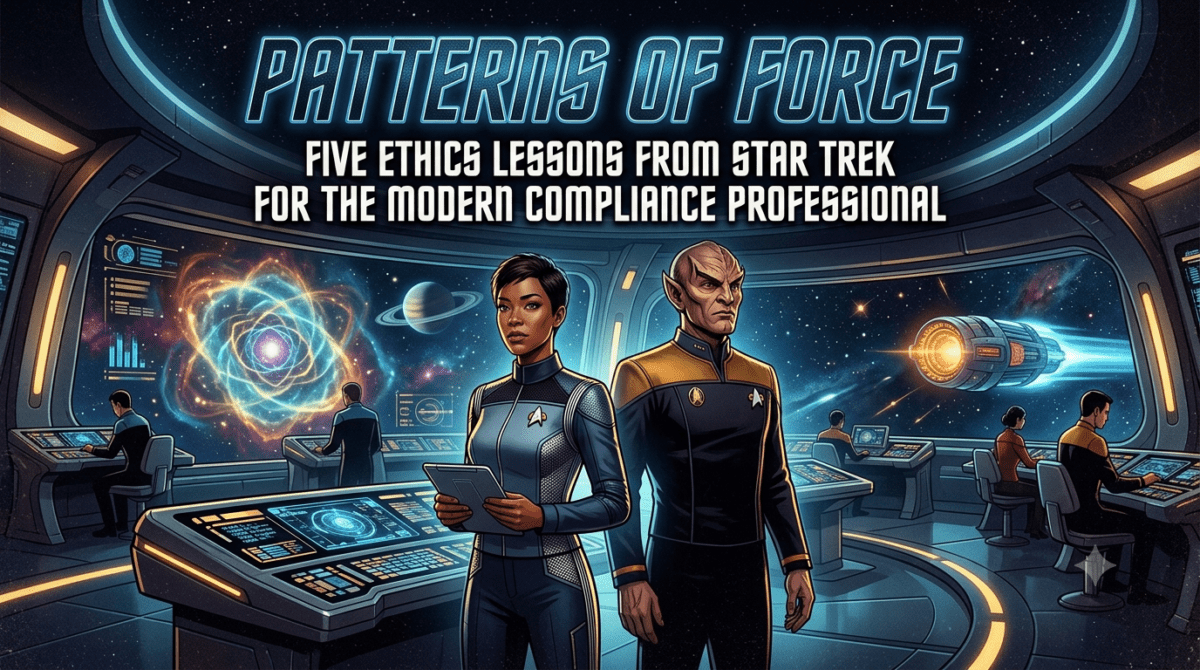
“Patterns of Force”: Five Ethics Lessons from Star Trek for the Modern Compliance Professional

One of the defining strengths of Star Trek: The Original Series (TOS) is its willingness to confront the thorniest questions of morality, leadership, and power. Few episodes tackle these issues as directly or as provocatively as “Patterns of Force.” In this controversial episode, the crew of the USS Enterprise discovers a planet where a well-intentioned Federation historian has recreated the organizational structure of Nazi Germany, believing its efficiency could bring order and peace. Instead, the society devolves into oppression and brutality, proving once again that the ends can never justify the means when it comes to ethics.

For compliance professionals, “Patterns of Force” offers a cautionary tale about the dangers of compromising ethical principles, even for seemingly pragmatic reasons. The story serves as a powerful reminder that organizations cannot pursue “efficiency” or “success” at the expense of their core values. The lessons are as relevant for today’s boardrooms and C-suites as they are for starships in the 23rd century. Today, we explore five key ethics lessons for the modern compliance professional, drawn straight from the pivotal scenes of “Patterns of Force.”

Lesson 1: The Danger of Ethical Shortcuts—The Ends Never Justify the Means

Illustrated by John Gill, the Federation historian, it justifies the creation of a Nazi-like regime on Ekos by arguing that it is the “most efficient state Earth ever knew.” He believes that by adopting its organizational structure but stripping away its evil, he can bring order and peace to a chaotic planet. The result is a nightmare: the re-emergence of fascism, oppression, and genocide.

Compliance Lesson: One of the oldest ethical traps is believing that good intentions justify unethical means. John Gill’s fatal error is to separate efficiency from morality, imagining that a “system” can be controlled and its inherent evils contained. In the corporate world, this translates to shortcuts: ignoring policies for expediency, rationalizing small acts of fraud for the sake of business survival, or tolerating toxic cultures for the sake of “results.”

Compliance officers must reinforce that ethical lapses, no matter how small or “practical,” are never justified. Once the door is opened to compromising values for perceived efficiency, the consequences can be catastrophic. Gill’s experiment failed because the foundation itself was rotten. Embed ethical decision-making frameworks into your risk assessments and strategic planning. Make it clear that no result, no matter how profitable, can ever excuse unethical conduct.

Lesson 2: Leadership Responsibility—Ethics Must Flow from the Top

Illustrated by: Throughout the episode, the regime’s horror is magnified by the passivity and silence of John Gill, who, under the manipulation of his subordinate Melakon, allows atrocities to proceed. Gill’s abdication of responsibility is a direct contributor to the disaster.

Compliance Lesson: Tone at the top is not a cliché; it is a living, breathing necessity. Leaders who abdicate their ethical responsibilities or look the other way empower bad actors and create environments where misconduct flourishes. Those in charge set the moral climate of any organization. If leadership is disengaged, passive, or silent on ethical matters, the consequences can spiral rapidly, just as on Ekos.

A compliance program must ensure that senior leaders not only model ethical behavior but also actively reinforce it at every opportunity. Passivity in the face of unethical conduct is itself dishonest. Develop ongoing training and communications for leadership, focusing on ethical accountability, the importance of speaking up, and the personal responsibility of setting the right example.

Lesson 3: Unintended Consequences—Control Over Ethical Outcomes is an Illusion

Illustrated by: Gill’s initial plan is to use the Nazi system “without the hate.” But he is quickly manipulated by Melakon, who exploits the machinery of power for his ends. The regime becomes a vehicle for oppression, anti-Semitism, and war—exactly what Gill intended to prevent.

Compliance Lesson: When an organization embraces questionable tactics or overlooks ethical red flags for the sake of “greater good,” it can never fully control where those choices will lead. Rationalizing minor code-of-conduct violations or tolerating small acts of corruption can quickly escalate beyond your ability to contain them. Compliance officers should remember that the ethical “slippery slope” is real, and they rarely control where it leads.

The episode’s warning is clear: systems built on unethical foundations are easily hijacked and can have far-reaching, destructive consequences. Implement regular ethics audits and scenario testing. Encourage employees at all levels to challenge policies or practices that may risk unintended harm, regardless of their good intentions.

Lesson 4: The Importance of Speaking Up—Silence Enables Unethical Behavior

Illustrated by: On Ekos, many citizens and officials are complicit in the regime’s crimes, not through malice but through silence and inaction. Only a handful, like the underground resistance leader Isak, speak out and act against the injustice.

Compliance Lesson: A culture of silence is fertile ground for ethical misconduct. If employees feel they cannot speak up or if whistleblowers are punished or ignored, misconduct becomes normalized. Compliance professionals must cultivate a speak-up culture where ethical concerns can be raised without fear of retribution.

Organizations should provide multiple, easily accessible avenues for employees to report concerns anonymously and without retaliation. Moreover, employees should be trained to recognize that failing to report is itself a form of complicity. Regularly communicate and reinforce the importance of speaking up. Celebrate examples of ethical courage and ensure that every employee knows how to report concerns and is confident they will be heard.

Lesson 5: Vigilance Against Ethical Blind Spots—History Repeats if We Forget

Illustrated by: Kirk and Spock are horrified by the resurgence of Nazi imagery and tactics and work to remind the people of Ekos—and the audience—that history’s darkest chapters must never be repeated. The episode closes with a pointed warning that “the price of liberty is eternal vigilance.”

Compliance Lesson: Ethical blind spots are the hidden risks that can undo organizations, especially when we convince ourselves that “it couldn’t happen here.” “Patterns of Force” reminds us that even the best intentions can lead to disaster if we forget the lessons of the past. Compliance officers must continually review, update, and stress-test ethics and compliance programs to ensure they are relevant, resilient, and responsive to evolving threats.

Never assume your organization is immune to ethical lapses. The most successful compliance cultures are those that actively seek out and address blind spots—before they grow into existential risks. Include historical case studies, both from inside and outside your industry, in compliance training. Use them as springboards for honest discussion about ethical risk and organizational vulnerability.

Final ComplianceLog Reflections

Patterns of Force” remains a chilling, relevant parable for compliance professionals. It warns us that even the noblest intentions can go awry when ethical principles are sacrificed for expedience or efficiency.

As compliance officers, our mission is to ensure that our organizations stay true to their core values, never allowing expediency, pressure, or misguided reasoning to compromise our ethical bearings. In the words of Captain Kirk, “The first duty of every Starfleet officer is to the truth.” For us, the first duty of every compliance professional is to ethics, no matter the circumstances.

In the ongoing journey of compliance, let “Patterns of Force” serve as both a warning and a guidepost. Only by holding fast to our ethical compass can we boldly go where no organization has gone before, successfully, sustainably, and with integrity.

Resources:

Excruciatingly Detailed Plot Summary by Eric W. Weisstein

MissionLogPodcast.com

Memory Alpha