Categories
Blog

Re-Calibrating Risk Assessments: Uncovering FTO and TCO Exposure in Cartel-Driven Economies

This blog continues our series focusing on the upcoming ACI Forum on Cartels, TCOs, and Compliance in Latin America and why it is so timely. It is also why compliance officers need to understand that this is not simply another enforcement trend. It is a structural change in how risk must be assessed, governed, and managed. Today, I want to explore why you need to recalibrate your risk assessment in light of the US’s shift in classifying cartels from criminal organizations to Foreign Terrorist Organizations (FTOs).

For years, many companies treated cartel risk as a regional security issue, a physical safety issue, or a narrow sanctions-screening issue. That approach is no longer sufficient. Cartel-driven economies now create enterprise risk across sales, supply chain, procurement, logistics, human resources, community relations, government affairs, security, and internal controls. The CCO must help the organization move from episodic screening to a dynamic, evidence-based risk assessment model that identifies where the business may be exposed to Foreign Terrorist Organization (FTO) and Transnational Criminal Organization (TCO) risks.

The legal and enforcement environment has shifted. Executive Order 14157 established a process for certain international cartels and other organizations to be designated as FTOs or Specially Designated Global Terrorists, and described those organizations as threats to U.S. national security, foreign policy, and the economy. OFAC later issued an alert identifying eight designated organizations and warning that companies with operations in, or exposure to, high-risk jurisdictions where designated cartels are active should assess their sanctions compliance controls. That is the compliance lesson. This is not simply a legal list update. It is a risk assessment reset.

Cartel-Driven Economies Change the Risk Ranking Model

Traditional compliance risk assessments often rank risk by country, business unit, transaction value, government touchpoints, and third-party type. Those variables still matter. But cartel-driven economies require additional factors: territorial control, coercive influence, infiltration of local business networks, labor pressure, logistics-route control, cash intensity, proximity to ports or borders, public security risks, and the likelihood that a legitimate counterparty may be owned, controlled, taxed, extorted, or otherwise influenced by criminal organizations.

The ranking model should distinguish between three types of exposure. First, direct exposure, where a company deals with a designated party or a party it owns or controls. Second, indirect exposure, where a supplier, distributor, customer, logistics provider, labor broker, or security vendor is connected to cartel-linked actors. Third, environmental exposure, where the company operates in a geography or sector where coercion, extortion, or criminal facilitation is a predictable operating condition.

The DOJ’s Evaluation of Corporate Compliance Programs (ECCP) asks whether third-party management is risk-based, integrated into vendor management, supported by business rationale, tied to appropriate contract terms, and subject to ongoing monitoring. Those questions should now be applied not only to anti-bribery risk, but also to FTO and TCO risk.

Create an Internal FTO Working Group

A company cannot manage this risk through sanctions screening alone. The CCO should establish an internal FTO working group with a clear charter, executive sponsorship, and board reporting. The group should include compliance, legal, sanctions, AML, procurement, sales, finance, logistics, security, HR, government affairs, community relations, internal audit, and enterprise risk management.

Its mandate should be practical: identify exposures, refresh risk rankings, define escalation protocols, review high-risk contracts, approve enhanced due diligence standards, monitor emerging typologies, and track remediation efforts. It should also define when the company will suspend a transaction, reject a counterparty, exit a relationship, seek external counsel, notify insurers, or brief the board. This working group should meet frequently at the outset, then move to a risk-based cadence. Its output should not be a memo that sits on a shelf. It should produce a revised heat map, a prioritized counterparty review list, an action tracker, and control enhancements that can be tested by internal audit.

Leverage Existing Risk Assessments

The most efficient approach is not to create a wholly separate FTO risk assessment. The better approach is to integrate FTO/TCO risk into existing assessments. Your FCPA risk assessment already identifies government touchpoints, customs brokers, permitting issues, gifts and entertainment, charitable donations, intermediaries, consultants, and high-risk payments. Those same data points are highly relevant to cartel exposure because criminal networks often exploit local permitting, customs clearance, transportation, public security, and procurement systems.

The business and human rights assessment also provides critical intelligence. The UN Guiding Principles on Business and Human Rights recognize a corporate responsibility to respect human rights through due diligence that avoids infringing on the rights of others and addresses adverse impacts with which the business is involved. In cartel-affected markets, human rights due diligence can reveal forced labor, threats against workers, community intimidation, unsafe security practices, land-access disputes, migrant exploitation, and labor-broker abuse.

Sanctions, AML, trade compliance, cybersecurity, and fraud risk assessments should also be mined. Look for recurring names, addresses, beneficial owners, banks, payment patterns, shell entities, shared directors, unusual routes, unexplained subcontractors, and counterparties that appear across unrelated business units.

Review Major Contracts and Customers for FTO/TCO Risk

Companies often focus due diligence on suppliers and intermediaries, while under-reviewing major customers. That is a mistake. A customer can create sanctions, money-laundering, books-and-records, reputational, and material-support risks. The company should identify major contracts in high-risk geographies and sectors, then re-rank them based on ownership transparency, payment behavior, sector exposure, government interaction, logistics routes, and local operating conditions. High-risk contracts should include enhanced representations, beneficial ownership update obligations, audit rights, sanctions, and FTO/TCO clauses, payment transparency requirements, subcontractor disclosure, termination rights, and controls over cash, commissions, rebates, donations, sponsorships, and community payments.

A contract should move into enhanced review when the business cannot explain the counterparty’s commercial rationale, when pricing is uneconomic, when payment comes from unrelated parties, when revenue spikes in cartel-affected regions, when the counterparty refuses beneficial ownership disclosure, or when local employees report pressure to use a particular vendor, union, broker, transporter, or security provider.

Detect Commingling of Legitimate and Illegal Activity

The core challenge is commingling. Cartels do not always operate through obviously illicit entities. They use logistics companies, fuel businesses, casinos, real estate, import-export companies, labor brokers, charities, community organizations, and professional service providers.

Recent enforcement actions show the point. Recently, the US Department of the Treasury announced multiple CJNG-linked fuel schemes involving cross-border smuggling, falsified customs documents, and shell companies. OFAC also described cartel-linked casino activity used to launder proceeds and integrate illicit funds into the legitimate financial system. For compliance professionals, these examples reinforce a familiar truth: a company’s legal form is not the same as its risk profile.

Detection requires data and local intelligence. Compare invoices to actual services. Review customs documentation against logistics activity. Test whether vendors have employees, assets, facilities, and capacity. Analyze payment flows for round-dollar amounts, rapid pass-through activity, third-party payments, and mismatches between business size and transaction volume. Monitor hotline reports for references to threats, forced vendors, security payments, labor pressure, and community demands.

Functions That Must Be in Scope

Supply chain must map critical suppliers, second-tier exposure, logistics corridors, warehousing, border crossings, ports, and emergency sourcing decisions. HR must assess labor brokers, recruitment channels, employee intimidation, workplace violence, the risk of retaliation, and escalation pathways for threatened employees. Community relations must review donations, sponsorships, local foundations, land-access payments, and community intermediaries. Union relations must assess whether labor organizations or labor contractors are being used as pressure points. Government affairs must evaluate permitting, customs, inspections, police interaction, and local political exposure. Security must review private security providers, public security coordination, incident response, travel protocols, and extortion procedures. The board should ask one question above all others: where could the company be doing legitimate business through a channel that criminal actors influence, control, or monetize?

Practical Takeaways

CCOs should refresh the risk assessment now, not after a transaction is called into question. Build the FTO working group, integrate existing FCPA and human rights intelligence, re-rank major contracts and customers, and test controls for commingling. The objective is not perfection. The objective is a documented, risk-based, board-visible process that shows the company understands its exposure, updates its controls, and acts when the risk profile changes.

The Cartels, TCOs & Compliance in Latin American conference will feature these topics and many more. For information and registration, click here. For a complete list of the agenda, click here. You can receive a 10% off the price by using the Discount Code D10-999-CPN26.

ACI is the sponsor of today’s blog.

Categories
Blog

Cartels, TCOs, and Compliance in Latin America: Why 2026 Is a Watershed Moment

For compliance professionals, some years mark an evolution. Others mark a turning point. In 2026, corporate compliance in Latin America has reached that turning point. For the past two decades, most companies approached regional risk through a familiar lens: anti-corruption. The focus was on government touchpoints, customs interactions, licensing, permits, state-owned enterprises, and third-party intermediaries. That framework is still important. But it is no longer sufficient.

Today, the risk landscape has expanded dramatically. Cartels, transnational criminal organizations, foreign terrorist organization designations, sanctions, anti-money laundering exposure, and supply chain infiltration have all moved to the center of the compliance conversation. What was once a specialized concern has become a board-level issue.

That is why the upcoming ACI Forum on Cartels, TCOs, and Compliance in Latin America is so timely. It is also why compliance officers need to understand that this is not simply another enforcement trend. It is a structural change in how risk must be assessed, governed, and managed. I recently had the opportunity to visit with Matt Ellis, Member at Miller & Chevalier and co-Chair of the Forum. You can listen to Ellis’ remarks on this episode of the FCPA Compliance Report on the Compliance Podcast Network.

The New Risk Equation

The Trump administration has made clear that cartels, fentanyl trafficking, organized crime, and the influence of China in Latin America are policy priorities. That focus has brought multiple enforcement tools to bear, including sanctions, anti-money laundering authorities, FTO designations, and a broader integration of these issues into the compliance and enforcement landscape.

Ellis said that companies, the old model of regional compliance risk must be rethought. The issue is no longer limited to whether a payment was made to a foreign official. The question now is whether a company’s supply chain, transportation provider, security arrangement, or local commercial partner could create exposure under anti-terrorism, sanctions, or AML frameworks.

Mexico Is the Opening Chapter, Not the Whole Book

Much of the current focus is on Mexico, and for good reason. That is where the enforcement spotlight is currently brightest. But compliance professionals should not make the mistake of thinking this challenge begins and ends there.

The risks extend across Latin America, including Central America, Venezuela, Colombia, Brazil, Panama, and other markets where cartel activity, organized crime influence, sanctions risk, or opaque commercial structures may create significant exposure. Each country carries its own risk profile, but the common lesson is clear. Mexico may be the first chapter, but it will not be the last.

For boards and executive teams, that means regional strategy must be reviewed through a broader lens. Market entry, third-party engagement, logistics routes, security providers, and local partnerships all need to be reassessed.

Why the Supply Chain Has Become a Compliance Flashpoint

One of the most important lessons from this discussion is that cartel risk can be embedded in the supply chain. This is where compliance professionals need to recalibrate their thinking. In the anti-corruption world, companies typically focus on agents, distributors, customs brokers, and other third parties that have direct government interactions. In the cartel and TCO context, risk can be embedded within ordinary business operations. Transportation vendors, warehouse providers, local suppliers, labor relationships, and security services may all present hidden risk if they are controlled by, connected to, or exploited by organized crime.

That changes the role of compliance. Procurement, logistics, operations, and security can no longer be treated as peripheral functions. They are now front-line participants in risk identification and mitigation. This is where the compliance function must show leadership. The CCO must bring these disciplines together and translate legal and enforcement developments into practical operational controls.

Due Diligence Must Move Beyond Check-the-Box

If there is one message compliance professionals should take from Ellis’ podcast, it is this: traditional due diligence is not enough. In anti-corruption compliance, companies have become skilled at identifying common red flags. They know how to screen for politically exposed persons, government connections, unusual payment terms, and opaque ownership structures. Those tools still matter, but they will not always surface cartel-linked risk. Organized crime does not announce itself in a database hit.

Instead, companies need a more nuanced and operationally grounded approach. Are there local security concerns being raised by employees? Are there unusual labor dynamics in a region where those patterns do not make commercial sense? Is there persistent chatter about a vendor, route, or business partner that cannot be ignored? Are operations in a community producing concerns that legal and compliance have not fully explored? These are not traditional diligence questions, but they are increasingly the right ones.

Under the DOJ’s Evaluation of Corporate Compliance Programs (ECCP), regulators continue to ask whether a company’s program is designed, implemented, and tested in a manner that addresses actual risk. This is precisely where program effectiveness will now be measured in high-risk operations in Latin America.

The Importance of Listening to the People on the Ground

One of the most practical insights from the interview was the emphasis on local intelligence. Employees who live and work in these communities often know far more than any desktop diligence report will reveal.

That point should resonate deeply with compliance professionals. A company’s speak-up culture is not simply about hotline metrics or case closure rates. It is about whether employees trust the organization enough to raise concerns that may not yet fit into a neat legal category. It is about whether the company listens when local personnel say that something does not add up. This is where compliance, culture, and internal controls intersect.

If a company has not built mechanisms to capture and escalate local concerns, then it is not simply missing information. It is missing one of the most effective risk detection tools available to it. These are not abstract governance questions. They go directly to program effectiveness, risk ownership, and business sustainability.

A Whole-of-Government Enforcement Model

Another important takeaway is the multidimensional nature of this risk environment. In the FCPA era, companies often focused on the DOJ and the SEC. That framework no longer captures the full picture. Now the compliance professional must think across Treasury, OFAC, FinCEN, Homeland Security, DEA, and other agencies, all of which may be interested in the same underlying conduct. This level of coordination matters because it means the government’s expectations are no longer siloed. Enforcement, intelligence, sanctions, and AML concerns can converge quickly. For compliance officers, this demands a more integrated risk management model. Silos within the company will not work when the government itself operates in a coordinated manner.

Is There More Room for Government Engagement?

One of the more interesting themes from the discussion was whether companies may have more room to engage with the government than they traditionally would in the anti-corruption context. That does not mean every issue should be self-disclosed. It does mean that in high-risk environments, thoughtful engagement may sometimes be part of a sound compliance strategy.

The key is judgment. No company should rush into a conversation with the government without understanding the facts and the implications. But where risks are ambiguous, stakes are high, and the legal regimes overlap, strategic dialogue may help demonstrate good faith, show the absence of criminal intent, and allow a company to explain the reasonable steps it is taking. That is not leniency. That is credibility.

The Bottom Line

This is the next generation of Latin America compliance risk. It does not replace anti-corruption compliance. It expands it, hardens it, and operationalizes it. The lesson for compliance professionals is clear. You cannot address cartel and TCO risk with yesterday’s playbook. You need broader risk assessments, deeper third-party diligence, stronger local reporting channels, tighter cross-functional coordination, and more informed board oversight.

In 2026, the companies that succeed will not be the ones with the longest policy manuals. They will be the ones who can demonstrate a compliance program built for the reality of where they operate. For the CCO, that is the challenge. For the board, that is the oversight mandate. For the business, that is the cost of operating responsibly in a changed enforcement environment. The future of compliance in Latin America is already here. The only question is whether your program is ready for it.

Check out the ACI Forum on Cartels, TCOs, and Compliance in Latin America by clicking here. You can receive a 10% off the price by using the Discount Code D10-999-CPN26.

ACI is the sponsor of today’s blog.

Categories
From the Editor's Desk

From the Editor’s Desk: Aaron Nicodemus on the May and June in Compliance Week

In this episode of ‘From the Editor’s Desk,’ Tom Fox visits with Aaron Nicodemus to discuss highlights from Compliance Week in May, review the National Conference, which concluded in May and take a look at what is coming down the pike in June in Compliance Week.

They report that federal enforcement is not receding but shifting, with heightened risk from Foreign Terrorist Organization (FTO) designations affecting companies operating in Mexico, Latin America, and Brazil; increased and novel use of the False Claims Act, including actions targeting DEI programs, referencing IBM and PayPal settlements; and growing enforcement roles for states, FINRA, and divergent ESG regimes in the UK and Europe. Guidance to compliance leaders is to “stay the course,” strengthen third-party risk management, and document enhanced due diligence around potential FTO ties. They note AI discussions moving from governance frameworks toward scaling practical compliance use cases. June will feature “Inside the Mind of the CCO” survey results, DEI-related findings, and two webcasts. They also recognize former Compliance Week journalist Allie McDevitt’s ASBE national Gold Award for her Lafarge series, which is cited as a roadmap for FTO-related risk, alongside DOJ messaging on self-reporting to seek declination.

Resources:

Aaron Nicodemus on LinkedIn

Compliance Week

Categories
Blog

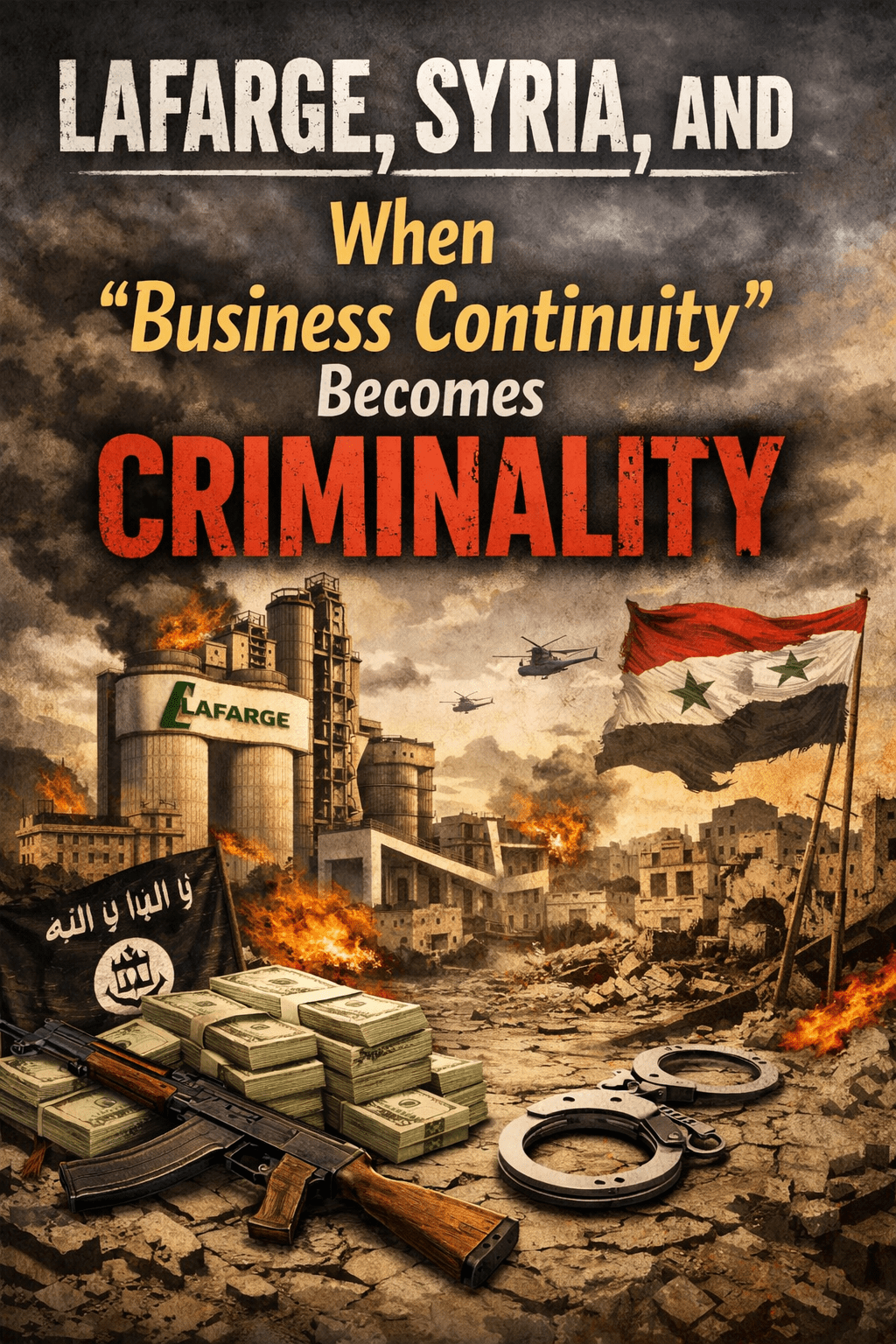
Aly McDevitt Week: Part 3 – Lafarge, Syria, and When “Business Continuity” Becomes Criminality

This week, I want to pay tribute to my former Compliance Week colleague, Aly McDevitt, who announced on LinkedIn that she was retiring from CW to become a full-time mother. I wrote a tribute to Aly, which appeared in CW last week. To prepare to write that piece, I re-read her long-form case studies, which she wrote over the years for CW. They are as compelling today as when she wrote them. This week, I will be paying tribute to Aly by reviewing five of her pieces. The schedule for this week is:

Monday: A Tale of Two Storms

Tuesday: Coming Clean

Wednesday: Inside a Dark Pact

Thursday: Reaching Into the Value Chain

Friday: Ransomware Attack: An immersive case study of a cyber event based on real-life scenarios

In this case study, Aly took a scandal that could easily be reduced to a shocking headline and showed how misconduct often grows incrementally, decision by decision, concession by concession, until a company crosses a line it can no longer explain away. As McDevitt framed it, Lafarge’s collapse into criminal conduct was not sudden. What began as “local concessions” in a war zone ended in terrorist financing, a guilty plea, and a historic compliance disaster.

For the corporate compliance professional, that is where this story starts. Not with ISIS. Not with the guilty plea. Not even with Syria’s descent into civil war. It starts with a corporate mindset that treats business continuity as a value higher than legal and ethical boundaries.

McDevitt lays out the core facts with devastating clarity. Lafarge built a $680 million cement plant in the Jalabiyeh region of Syria in 2010, just as the Arab Spring began to reshape the region. The plant, Lafarge Cement Syria, was strategically important, but it also operated in an increasingly unstable environment. By 2011, political unrest in Syria had become a violent conflict. By 2012, the area around the plant was plagued by kidnappings, hijackings, and the killing of a contractor at a checkpoint. Most companies would view those developments as bright red stop signs. Lafarge saw them as obstacles to manage.

That is the first major lesson of the case study. The most dangerous compliance failures often arise not from ignorance of risk but from a conscious decision to keep operating despite it. McDevitt shows that while other companies pulled out of Syria, Lafarge kept the plant running and shifted management of Syrian operations to Cairo after evacuating European employees. That decision set the stage for the next step: negotiating through intermediaries with armed factions to permit continued operations. By then, the moral and legal slope was already slippery. The question was no longer whether the company faced risk. The question was how much compromise leadership was willing to tolerate to avoid writing off a major investment.

McDevitt’s reporting is especially effective because it captures the gradualism of the wrongdoing. She writes that Lafarge executives did not wake up one day and decide to fund terrorists. It happened slowly, one deal after another, as the company tried to preserve operations in a deteriorating war zone. This is a point every compliance professional should sit with. Catastrophic misconduct often results from the accumulation of rationalized, smaller acts. Each one is framed as temporary, practical, or necessary. Each one moves the line. Eventually, there is no line left.

The Justice Department ultimately found that Lafarge routed about $5.92 million in illicit payments to the al-Nusra Front and ISIS. In 2022, Lafarge pleaded guilty in the United States to providing material support to terrorist organizations, the first case of its kind against a corporation in the U.S. Former Deputy Attorney General Lisa Monaco said the company “paid millions of dollars to both terrorist groups and benefited from their brutality to the tune of $70 million in revenue,” and the company paid $778 million in fines and forfeitures as part of the plea agreement.

That number alone should command the attention of boards and executive teams. Lafarge tried to avoid the business pain of shutting down a troubled asset and ended up paying more than the original investment in penalties, while also suffering deep reputational damage, legal exposure in multiple jurisdictions, and criminal proceedings against former executives. There is a brutal irony in that outcome. The Syrian plant accounted for less than 1% of Lafarge’s total sales at the time of the Holcim merger, yet the consequences of non-compliance proved vastly disproportionate to the asset’s commercial importance. That is the second lesson. The smaller the business rationale, the less defensible the compliance compromise.

McDevitt also explains why the U.S. Department of Justice had jurisdiction. Lafarge used U.S.-based email services to avoid using company email addresses, and some payments linked to terrorist groups were made in U.S. dollars through New York banks. This should resonate with every multinational company. Jurisdiction in modern enforcement is not limited by headquarters location. It is created through systems, currency flows, communications infrastructure, and business touchpoints. In a global company, you can be hauled into a U.S. enforcement action because you used the plumbing of U.S. commerce.

McDevitt’s account also reveals something even more troubling. By September 2013, Lafarge executives were already acknowledging the reality in their own meeting minutes, stating that it was becoming harder and harder to operate without directly or indirectly negotiating with networks designated as terrorists by international organizations and the United States. That line should stop every compliance officer in their tracks. At that moment, the risk was no longer ambiguous. It was known, articulated, and documented. The failure thereafter was not one of detection. It was one of the decision-making processes.

And that brings us to the heart of the compliance lesson. Once a company understands the legal and ethical nature of the risk, the compliance function is not merely to record the issue. The job is to create a decision architecture that can force the right outcome, even when business leadership hates it.

McDevitt reinforces this through the voice of Marcia Narine Weldon, who said, “business continuity can’t be an excuse for abandoning core legal and ethical principles” and even more pointedly, “When you’re dealing with potential terrorism financing, neutrality isn’t an option. You either stop it or you become complicit”. That is exactly right. There are categories of risk where compromise is not prudent; balancing is complicity. Terrorist financing sits squarely in that category.

Another important aspect of McDevitt’s case study is the timeline of internal response. Holcim, after its merger with Lafarge, became aware in 2016 of allegations that Lafarge had negotiated with ISIS and made payments to it. The head of compliance informed the Chief Legal and Compliance Officer that outside counsel had been engaged for legal analysis, and the board’s finance and audit committee directed an investigation. This sequence shows what a post-discovery escalation should look like. But it also highlights a painful truth: escalation after the fact is not the same as prevention. The best board briefing in 2016 could not undo the wrong choices made years earlier.

For compliance leaders, the Lafarge matter is therefore a case study in the limits of retrospective governance. Once the organization has crossed the line into criminal conduct, the role of compliance shifts from prevention to damage containment.

McDevitt weaves this throughout the piece with precision. She does not sensationalize the conduct. She shows how a company operating in a volatile, high-risk environment allowed ethics and compliance to take a back seat to business survival. That is what makes the article so valuable. It reminds us that in high-pressure environments, compliance is not a support function sitting politely on the sidelines. It is the adult in the room. Sometimes that means telling management to shut down an operation. Sometimes it means escalating to the board. Sometimes it means resigning rather than participating in the unambiguously wrong.

In the end, Inside a Dark Pact is one of Aly McDevitt’s strongest cautionary tales because it strips away comforting myths. It tells us that smart people can rationalize the indefensible. It tells us that local concessions can become global crimes. And it tells us that when a company places asset preservation above values, it may preserve neither.

Join us tomorrow when we review Aly’s piece on Flex and its ESG journey. I am a columnist for Compliance Week.

Categories
ACI FCPA Conference 2025

ACI-FCPA Conference Speaker Preview Series – Matt Ellis on FCPA Enforcement in Mexico

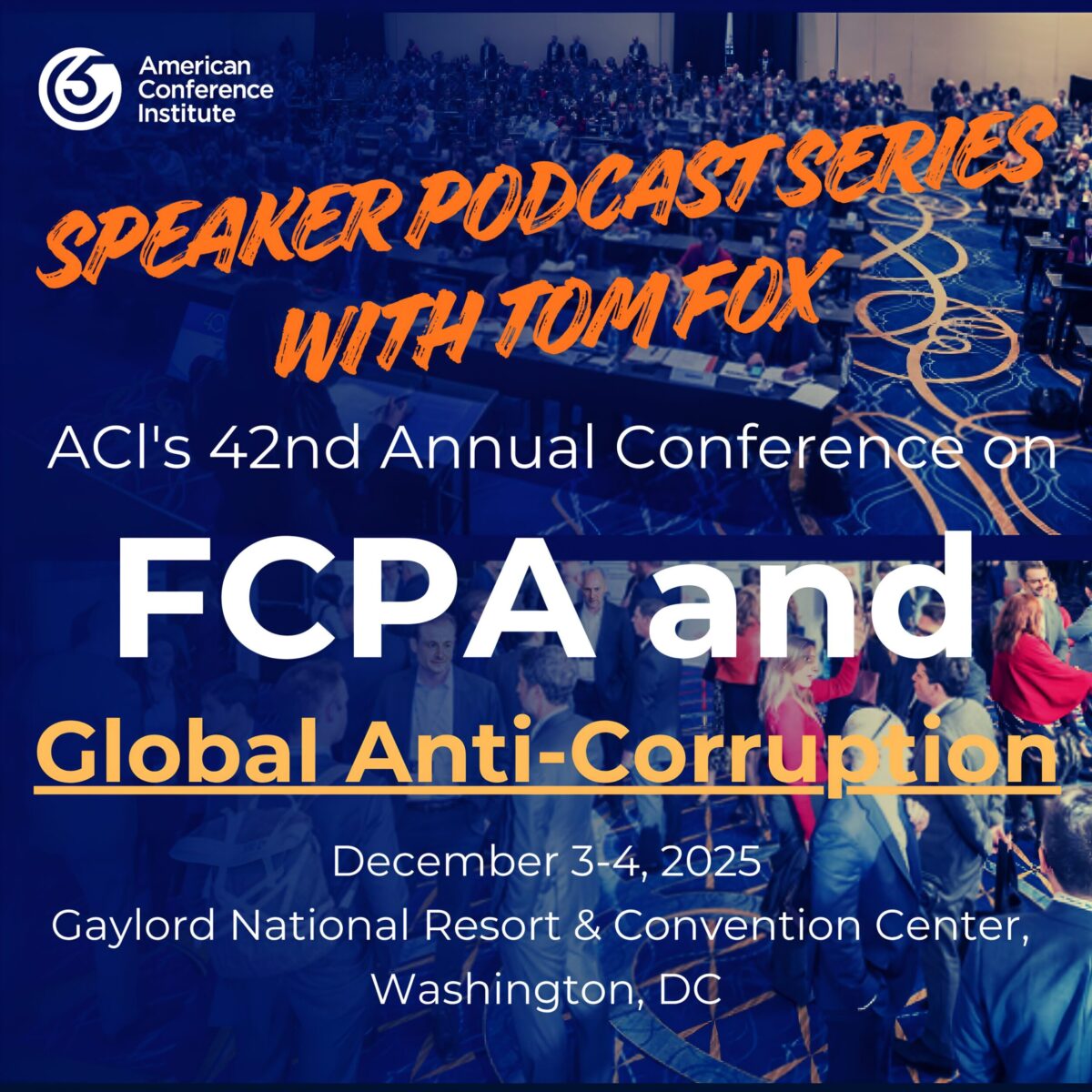
In this episode of the ACI-FCPA and Global Anti-Corruption Conference Speaker Podcasts series, Matt Ellis discusses his panel at the event, “The New FCPA Enforcement Focus in Mexico: A Look at How TCO/FTO Designations Could Impact Prosecutions, Coordination with U.S. Authorities, and the Risk Calculus for Businesses Operating There.”

Some of the issues the panel will discuss are:

  • The evolving enforcement landscape in Mexico.
  • The impact of FTO designations; and
  • Business risks and prosecutorial strategies going forward.

I hope you can join me at the ACI–FCPA Conference. This year’s event will take place on December 3-4 at the Gaylord National Resort & Convention Center in National Harbor, Maryland, near Washington, D.C. The lineup of this year’s event is simply first-rate, featuring some of the top FCPA professionals, white-collar attorneys, and compliance practitioners in the field.

The 2025 program is being completely redesigned to help your organization stay agile, responsive, and ahead of the curve. Expect a dynamic agenda shaped by real-world priorities, practical takeaways, and the most cutting-edge thinking in compliance—led by a faculty of global practitioners with boots on the ground, encountering the very risks that come across your desk.

Please join me at the event. For information on the event, click here. Listeners of this podcast will receive a discount by using the code D10-999-CPN26.

Categories
FCPA Compliance Report

FCPA Compliance Report – Navigating the Complexities of FTO Designations and Compliance in Mexico and Latin America

Welcome to the award-winning FCPA Compliance Report, the longest-running podcast on compliance. In this episode, Tom welcomes Tim O’Toole and Matt Ellis from Miller & Chevalier Chartered to discuss the significant implications of President Trump’s executive order designating Mexican drug cartels as foreign terrorist organizations (FTOs).

Tim and Matt elaborate on the heightened compliance risks and operational challenges now faced by companies operating in these regions. The conversation delves into the legal distinctions between Specially Designated Nationals (SDNs) and FTOs, the broad-ranging impact on industries such as agriculture and logistics, and the urgent need for robust risk assessment strategies to mitigate civil and criminal liabilities under U.S. law. They also explore the broader Latin American context and potential collateral consequences for U.S. and Latin American companies amid anticipations of increased regulatory scrutiny and enforcement actions. The discussion concludes with timely observations on recent U.S. Treasury directives aimed at curbing cartel money laundering activities, showcasing the lengths the administration is willing to go to combat these criminal enterprises.

Key highlights:

  • Executive Order and FTO Designation
  • Heightened Risks for Companies in Mexico
  • Complexities of Cartel Influence in Mexico
  • Risk Management Strategies for Companies
  • Broader Implications for Latin America
  • Potential Weaponization of FTO Designation
  • Corporate Compliance and Human Rights

Resources:

Designation of Cartels as FTOs Creates Heightened Risks for Companies Operating in Latin America

Miller & Chevalier

Tim O’Toole

Matt Ellis

Tom Fox

Instagram

Facebook

YouTube

Twitter

LinkedIn