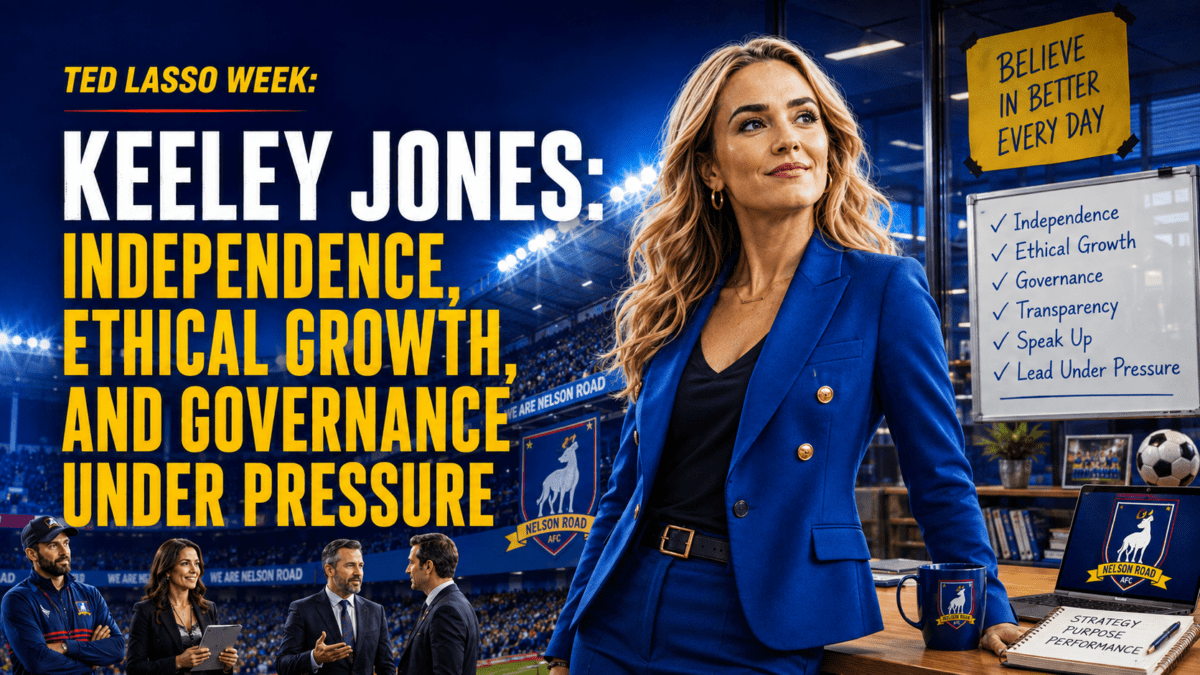
Season 4 of Ted Lasso is out. Matt Kelly reposted a blog he wrote during the original run of the series, and he and I did a deeper dive into the show and its popularity for compliance professionals in an episode of Compliance into the Weeds. I decided to take a deep dive into five characters from the show and use them to explore compliance topics. Over five blog posts, I have considered Manager Ted Lasso, Assistant Manager Nate Shelley, player and later coach Roy Kent, and social media influencer Keeley Jones. Today we conclude with Part 5, where we look at Keeley Jones, who starts as a social media influencer for AFC Richmond but goes on to found her own business. We explore what happens when a talented professional becomes a founder and must build the organization around her.
Keeley has judgment, courage, creativity, and empathy. She can read a room and recognize misconduct before people with greater status are willing to name it. Yet this only reveals that ethical instinct is not the same as governance. As her authority grows, decisions involving friends, investors, employees, personal relationships, privacy, and funding require processes that do not depend solely on the founder making the right call. For compliance professionals, Keeley’s story is about governance keeping pace with growth.
Ethical Leadership Begins Before the Title
Keeley earns influence before she has formal authority. In “The Diamond Dogs” (Season 1, Episode 8), she discovers that Rebecca arranged the paparazzi scheme involving Keeley and Ted. She confronts Rebecca and insists that she tell Ted the truth. The friendship does not excuse the misconduct, and Rebecca’s ownership of Richmond does not silence Keeley.
Keeley acts as Richmond’s missing speak-up system. Her intervention leads to Rebecca’s confession in “All Apologies” (Season 1, Episode 9). The lesson is not that every employee should conduct an investigation alone. It is that organizations need people who will raise difficult issues and systems that protect them when they do. A best-practice compliance program must have reporting and guidance mechanisms employees can use without fear of retaliation. Keeley dares to speak. A mature organization should not make courage the control.
Entrepreneurship Creates Governance Debt
Keeley’s public-relations work for Richmond turns into an opportunity to build her own firm. In “Inverting the Pyramid of Success” (Season 2, Episode 12), investors offer to fund Keeley’s venture, KJPR. Rebecca encourages her to take the opportunity. The funding provides staff, offices, and credibility. It also creates governance debt. Keeley now answers to a board she did not build and depends on a capital provider she does not control. The founder’s personal brand becomes part of the firm’s risk profile.
KJPR should know who approves hiring, client commitments, spending, external statements, workplace relationships, access to sensitive information, and crisis decisions. Growth does not eliminate the need for speed. It prevents speed from becoming uncontrolled discretion.
Hiring a Friend Tests Founder Judgment
In “(I Don’t Want to Go to) Chelsea” (Season 3, Episode 2), Keeley hires her friend Shandy after seeing her demonstrate creative ability during a commercial shoot. Keeley recognizes overlooked talent because she was once overlooked herself. That instinct is admirable. The process is weak. The decision appears to lack a defined role, structured assessment, reference checks, clear reporting line, or behavioral expectations. Shandy later makes unauthorized decisions and publishes an offensive campaign that damages a client relationship. In “Signs” (Season 3, Episode 5), Keeley fires her.
Keeley ultimately protects the firm. She also learns that loyalty cannot substitute for selection controls. A founder who hires a friend should disclose the relationship, use an independent reviewer, document qualifications, define authority, and establish measurable performance expectations. The safeguards protect the company, the team, and the friendship.
DOJ’s Evaluation of Corporate Compliance Programs (ECCP) asks whether organizations use risk-based processes: “Does the company deploy its compliance resources in a risk-based manner, with greater scrutiny applied to greater areas of risk?”; train people for their responsibilities, “targeted training sessions to enable employees to timely identify and raise issues to appropriate compliance, internal audit, or other risk management functions”; and finally apply discipline consistently, “Does the compliance function monitor its investigations and resulting discipline to ensure consistency?” Those questions matter at twenty employees as well as twenty thousand. Informality can be proportionate. It cannot be indistinguishable from favoritism.
Investor Influence Becomes a Conflict
KJPR’s most significant governance failure arises when Keeley begins a romantic relationship with Jack Danvers, the venture capitalist whose firm funds KJPR. Their relationship begins in “Signs” and becomes public inside the office in “The Strings That Bind Us” (Season 3, Episode 7). The central issue is not the relationship itself. It is the power structure around it. Jack influences the capital supporting KJPR and has access to its leadership and board. Keeley’s personal relationship is therefore inseparable from financing, employment stability, reputation, and strategic control.
A functioning conflicts process would require disclosure to disinterested board members, recusal from relevant funding and compensation decisions, independent review, anti-retaliation protections, and a plan for managing the relationship’s end. The organization would also need to consider whether gifts and public displays create obligations or perceptions of influence. KJPR appears to have no independent mechanism for doing any of this. The conflict remains personal until its consequences become corporate.
A Privacy Crisis Reveals Whose Reputation Matters
In “We’ll Never Have Paris” (Season 3, Episode 8), an intimate video Keeley previously sent to Jamie is leaked online. Jack’s lawyers prepare a public statement in which Keeley would apologize for making the video. Keeley refuses. Her refusal is an ethical decision. The statement would shift responsibility from the people who stole and distributed private material to the person whose privacy was violated. It would protect investor reputation by requiring the victim to accept blame.
An effective incident response would center Keeley’s safety and agency while preserving evidence, identifying the source and scope of the breach, assessing legal duties, seeking removal of the material, coordinating communications, and reviewing data security practices. It would also determine what the company knows, who decides, and when the board receives information.
Capital Concentration Threatens Independence
The conflict reaches its predictable conclusion in “International Break” (Season 3, Episode 10). Jack’s board withdraws KJPR’s funding, the office is dismantled, and Keeley learns that the firm will close within two days. She is the founder, but she is the last person meaningfully informed. This is third-party and concentration risk. KJPR depends on one financial sponsor whose governance rights, exit powers, and personal connections could end the business. DOJ’s ECCP asks whether companies understand the business rationale and risks of third-party relationships, use appropriate contractual controls, and monitor those relationships over time.
For a founder, due diligence must run both ways. Before accepting capital, leaders should understand board control, reserved powers, termination rights, communication duties, reputation expectations, data ownership, dispute mechanisms, and contingency funding. A capitalization table is also a control map. Rebecca ultimately offers financing, and Barbara leaves Jack’s organization to rebuild alongside Keeley. The outcome is hopeful, but the governance lesson remains. Replacement capital should not recreate the same dependency under a more trusted name. Friendship does not eliminate conflicts. It makes clear documentation more important.
Independence Does Not Mean Isolation
By “So Long, Farewell” (Season 3, Episode 12), Keeley has rebuilt the firm with Barbara and presents Rebecca with a proposal for an AFC Richmond women’s team. Her final act is not a return to the security of working for someone else. It is the launch of a new strategic opportunity grounded in purpose, partnership, and a broader vision for Richmond. Keeley also refuses to let Roy and Jamie reduce her future to a choice between them. She defines her professional and personal direction herself.
The strongest version of independence is not freedom from investors, colleagues, boards, or controls. It is the ability to make principled decisions within governance that protects the organization from dependency, favoritism, coercion, and the founder’s own blind spots.
Questions for CCOs
Keeley’s journey should prompt five questions:
- Are governance, compliance, and control responsibilities growing as quickly as the business?
- Do hiring and promotion processes manage friendship, affinity, and founder bias?
- Can a genuinely independent decision-maker review conflicts involving investors, directors, or founders?
- Does the incident-response plan protect affected people while addressing legal, technical, and reputational risk?
- Could the loss of one investor, client, platform, or vendor threaten the organization’s survival?
The Richmond Way
Across five character studies, AFC Richmond gives compliance professionals a complete operating model. Ted shows that culture begins with trust and psychological safety. Rebecca shows that power requires independent oversight. Nate shows that promotion can create culture risk. Roy shows that middle managers make standards real. Keeley shows that growth must be matched by governance.
The connecting principle is effectiveness. DOJ, COSO, Caremark, and the Sentencing Guidelines all point to organizations beyond statements of intent. Leaders must design systems, empower people, monitor behavior, respond to warning signs, remediate failures, and test whether improvements work.
Belief can start a culture. Accountability sustains it.