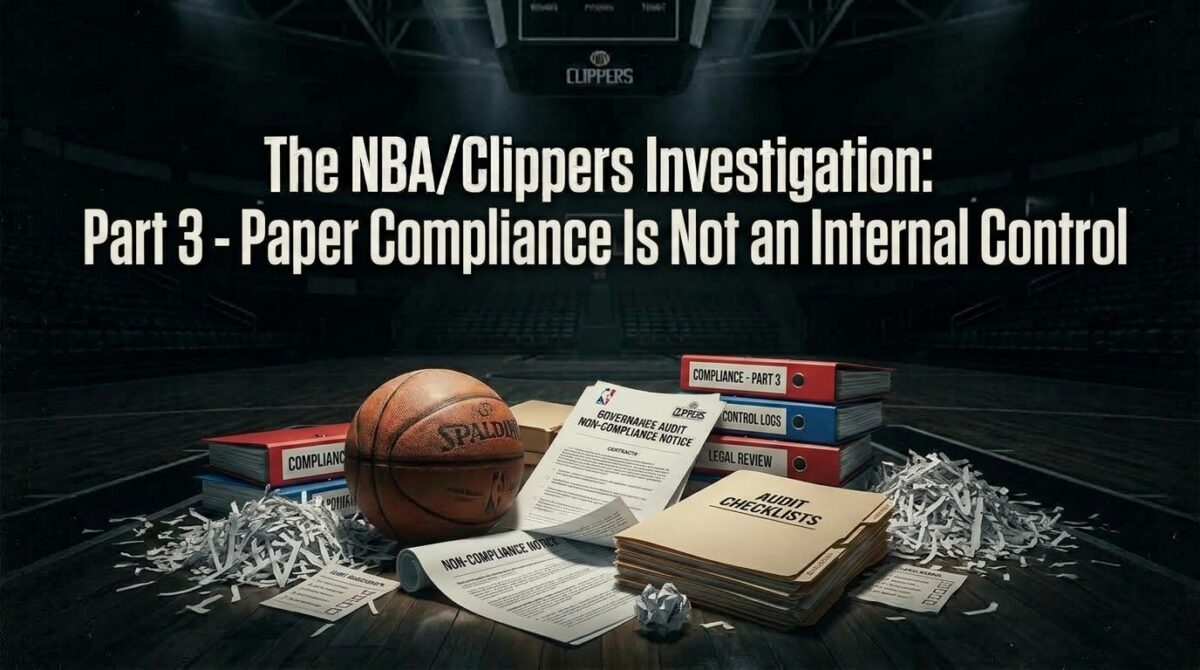
The Clippers investigation shows why contracts, approvals, and carefully drafted emails cannot substitute for controls that test economic reality. In Part 3 of a five-part series, we explore why and how a transaction can have a contract, an approval, an invoice, and an email trail and still pose a serious compliance problem. Documentation proves that a process occurred. It does not prove that the process was legitimate.
That distinction sits at the center of the investigation into the LA Clippers and Kawhi Leonard. The independent investigators’ report (Wachtell Report) concluded that the Clippers initiated and facilitated endorsement arrangements between Leonard and four companies doing business with the team, induced those arrangements by offering business to the companies, paid impermissible personal expenses, and failed to meet improper demands made on Leonard’s behalf.
The alleged conduct crossed organizational boundaries. It touched business operations, basketball operations, procurement, sponsorships, consulting arrangements, accounts payable, expenses, legal review, and executive management. That makes this an internal controls case.
The Difference Between Evidence and Control
One of the report’s most important findings concerned introduction emails sent by Clippers President of Business Operations Gillian Zucker. The emails were written as if Boingo, Daktronics, Lockton, and later Aspiration had requested introductions to Leonard’s representatives. NBA rules permitted a narrow response when a commercial partner initiated such a request. They did not permit the team to create the opportunity for the player. The investigators concluded that the emails did not reflect the true sequence of events and, in Aspiration’s case, were created after deal development was already underway.
This is a classic paper-compliance problem. The communication used the language of the rule without satisfying its substance. A control cannot merely ask whether an introduction email contains the approved wording. It must test who initiated the contact, what discussions preceded the email, who proposed the economics, and whether team personnel remained involved afterward. Checklists confirm the form. Effective controls challenge reality.
Fragmented Transactions Hid a Common Purpose
The Wachtell Report described multiple agreements that could have appeared unrelated in separate systems. Vendors entered consulting or services agreements with the Clippers while also entering endorsement agreements with Leonard. Aspiration had sponsorship, sustainability, investment, forum, and player-endorsement relationships involving overlapping parties.
Investigators connected those transactions through timing, matching amounts, communications, and business leverage. Two companies reportedly received $10 million in consulting payments before entering endorsement agreements with Leonard. A third received a $2 million consulting payment one day after making its first payment to him.
The Forum agreement initially contemplated $7 million in annual business for Aspiration. That figure matched the annual cash component of Leonard’s endorsement agreement. Investigators further reported that the underlying carbon analysis did not generate the $28 million budget. Instead, the consultant said the Clippers supplied that budget.
The control failure was fragmentation. Procurement reviewed one agreement, marketing another, finance a payment, and business leaders the broader relationship. No control appears to have aggregated the transactions and asked whether one funded, induced, or conditioned another.
The DOJ’s Evaluation of Corporate Compliance Programs (ECCP) tells prosecutors to examine how misconduct was funded, including purchase orders and reimbursements (How was the misconduct in question funded (e.g., purchase orders, employee reimbursements, discounts, petty cash?); what controls could have prevented access to those funds (What controls failed?); whether vendor-selection procedures were followed (If vendors were involved in the misconduct, what was the process for vendor selection and did the vendor undergo that process?); and whether contract terms, payment terms, performance, and compensation were appropriate. Those are precisely the questions an organization should ask before enforcement authorities arrive.
Control Environment
The control environment begins with leadership and accountability. According to the report, the most senior business and basketball executives participated in or knew about key parts of the conduct. Investigators concluded that Ballmer failed to create conditions in which the organization followed rules it had previously violated. When senior leaders create the risk, lower-level approvals are unlikely to function as meaningful controls. Employees may view an executive request as authorization to proceed, even when the transaction presents obvious concerns.
Risk Assessment
The Clippers had a prior circumvention violation and were investigated over Leonard’s free-agency negotiations. The NBA had then provided specific training and imposed a mandatory reporting obligation. That history should have produced a targeted risk assessment covering player representatives, sponsor introductions, endorsement arrangements, personal expenses, vendor spend-back programs, and benefits flowing through third parties. Prior misconduct is not simply history. It is risk data.
Here, the ECCP asked some direct questions, including, “Were there prior opportunities to detect the misconduct in question, such as audit reports identifying relevant control failures or allegations, complaints, or investigations?” Additionally, it notes that critical factors in evaluating any program include whether the program is adequately designed to maximize effectiveness in preventing and detecting employee wrongdoing and whether corporate management enforces the program or tacitly encourages or permits employees to engage in misconduct.
Control Activities
The Wachtell Report suggests potential gaps in segregation of duties, conflict review, procurement approval, contract benchmarking, expense reimbursement, and related-transaction analysis. High-risk transactions should require independent approval outside the requesting executive’s chain of command. Controls should compare compensation with deliverables, confirm actual performance, flag advance payments, and identify common counterparties across procurement and non-procurement systems.
Information and Communication
The organization reportedly had information that should have triggered escalation: demands for $10 million in annual off-court income, unusual endorsement economics, concerns from Aspiration executives, internal descriptions of a Forum deal as “shady,” and explicit threats connecting the Forum and Leonard agreements. Indeed, Uncle Dennis’s presence alone was enough of a red flag based on his prior conduct. The issue was not the absence of information. It was the failure to move that information to a function with the independence and authority to act.
Monitoring
Hundreds of personal expenses were reportedly paid without the required deduction or reimbursement. Multiple vendors signed unusual endorsement arrangements, with minimal public activation or performance. These were recurring patterns, not one-time exceptions. Monitoring should identify patterns across time. If a control repeatedly approves exceptions without examining their cumulative effect, it is not monitoring risk. It is normalizing it.
Designing Controls for Substance
An effective control architecture should include three layers. Preventive controls should require documented business rationale, competitive sourcing, conflict disclosures, independent approval, clear deliverables, market benchmarking, and legal and compliance review before committing funds.
Detective controls should compare related transactions, test payment timing, examine overrides, confirm performance, and monitor expense exceptions. They should search for patterns across legal entities and business functions. Responsive controls should define who receives red flags, when compliance can stop payment, when issues reach the audit committee, and how remediation is tracked to completion. The most important design principle is independence. The DOJ asks whether compliance has adequate authority, stature, resources, and direct access to the board. (Where within the company is the compliance function housed (e.g., within the legal department, under a business function, or as an independent function reporting to the CEO and/or board?)
If executives can bypass or overrule the control function without documented challenge, the program is not empowered.
Practical Takeaways
Compliance, audit, and risk leaders should take the following actions:
- Inventory all systems containing vendor, contract, payment, expense, sponsorship, and conflict information.
- Build monitoring systems that identify common parties and beneficiaries across those systems.
- Require proof of services and measurable deliverables before releasing significant payments.
- Review advance payments, matching amounts, compressed timelines, and executive overrides as elevated-risk indicators.
- Treat prior violations and mandatory reporting duties as subjects for recurring control testing.
- Give internal audit authority to examine commercial substance, not merely procedural completion.
- Report control failures involving senior management directly to an independent board committee.
The Clippers salary cap circumvention demonstrates that an audit trail can document a failure as easily as it documents compliance. The question is whether the organization has controls that can interpret what the records mean.
In tomorrow’s blog post, we will turn from detection to accountability and examine how cooperation, credibility, seniority, prior misconduct, and supervisory failure should shape consequence management.