Ed. Note-This month, over on my podcast series Popcorn and Compliance, I am taking a deep dive into the first five Frankenstein movies. Over October I will consider the Frankenstein, the Bride of Frankenstein, Son of Frankenstein, Ghost of Frankenstein and Frankenstein Meets the Wolfman. The blog post is a companion to the podcast series.
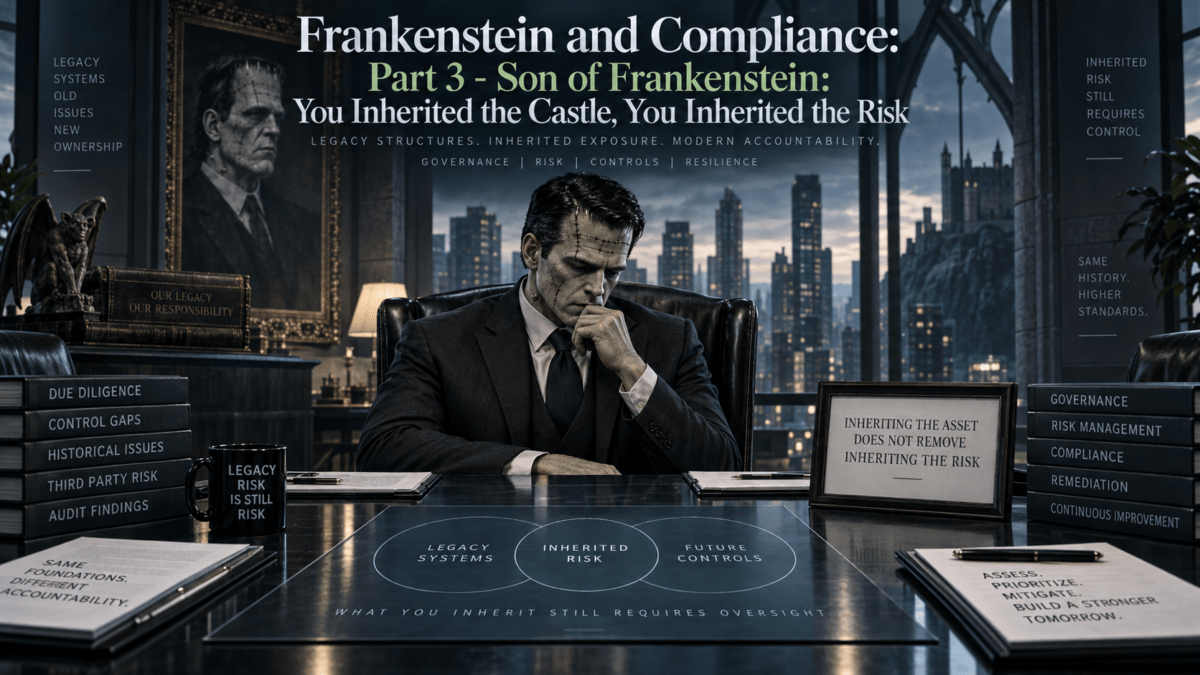
The first two Frankenstein films present two distinct compliance failures. Frankenstein examined innovation without adequate governance. Bride of Frankenstein moved to leadership that understands the risk but allows pressure, ambition, and rationalization to overcome judgment. Son of Frankenstein (1939) presents the next stage: inherited risk, or in the business world risks through aquisition.
Wolf von Frankenstein, played by Basil Rathbone, returns with his family to his ancestral estate hoping to restore the Frankenstein name. Instead, he encounters Ygor, played by Bela Lugosi, and discovers that his father’s Monster is still alive. Wolf had no role in creating the original problem, but his discovery forces him to decide how to address the legacy he has inherited.
That situation should be familiar to companies following acquisitions, leadership transitions, compliance investigations, or changes in the control environment. New management may have had nothing to do with historical misconduct. An acquiring company may not have created the target’s problematic third-party relationships. A new CCO may inherit investigations and remediation projects which were initiated years earlier. Historical responsibility and current responsibility are different questions. The business issue is how management responds once a legacy risk becomes known.
The Castle Is an Acquisition
Think of Wolf’s return to the Frankenstein estate as an acquisition. He receives the property, the assets, the name, and the opportunity to benefit from his father’s scientific legacy. He also assumes the consequences associated with that legacy. Corporate acquisitions work much the same way. Companies acquire revenue, customers, employees, technology, intellectual property, distribution networks, and market access. They may also inherit high-risk third parties, weak internal controls, questionable historical practices, unresolved investigations, government relationships, and cultural problems.
This is why compliance due diligence should focus on how the target actually conducts business rather than simply whether it has the expected compliance infrastructure. A target may have a Code of Conduct, an anti-corruption policy, annual training, and a hotline. Those are relevant data points, but they do not establish program effectiveness.
Compliance needs to understand the target’s business model and risk profile. Consider such questions as Where does the business operate? Who are its customers? Does it interact with government agencies or state-owned entities? Which third parties generate or facilitate business? How are those parties selected and compensated? What does the investigation history reveal? Are there recurring audit or control deficiencies? What does speak-up data indicate? Are significant policy exceptions concentrated in particular markets or business units? The objective is to understand the risk embedded in the business being acquired.
Due Diligence Is the Beginning, Not the End
Even well-designed pre-acquisition due diligence has limitations. Transactions operate under deadlines and time pressures. Access to employees and records may be restricted. (See: Opinion Release 08-02) Data may be incomplete. Privacy requirements may constrain review. Some risks simply do not become visible until the buyer gains access to systems, records, personnel, and financial information after closing. Those limitations make the connection between due diligence and post-acquisition integration critical.
If the buyer cannot complete diligence on a high-risk distributor before closing, that relationship should become a post-closing priority. If investigation records are incomplete, they should be reviewed during integration. If significant controls cannot be tested before the transaction, testing should be incorporated into the integration plan. Compliance should therefore document unresolved diligence issues and carry them forward with assigned owners and deadlines.
This discipline matters because closing creates competing priorities. Management turns quickly toward customers, systems, personnel, financial reporting, cost savings, and expected synergies. Compliance integration can become one workstream among many. An unanswered compliance question does not become less significant because the transaction has closed.
Post-Acquisition Integration Is the Operational Test
An acquiring company can conduct excellent due diligence and still create exposure if it fails to integrate the acquired business effectively. Post-acquisition integration is where the buyer’s compliance expectations become operational. Employees need to understand the acquiring company’s Code of Conduct, policies, reporting mechanisms, investigation procedures, third-party requirements, approval processes, and internal controls. High-risk third parties may require additional diligence. Contracts may need updated compliance provisions. Financial controls may need harmonization. Employees need risk-appropriate training.
Integration should also reflect the acquired company’s actual risk profile. A business operating primarily in lower-risk markets with direct sales may require a different approach from a company dependent on agents and distributors in jurisdictions involving substantial government interaction. The same integration checklist should not be applied mechanically to every acquisition.
The CCO should know which issues require immediate attention, which can be addressed over a reasonable integration period, and who is accountable for each significant action. Without ownership and monitoring, temporary integration gaps can become lasting control weaknesses.
Ygor and the Informal Organization
Ygor provides one of the movie’s most useful compliance lessons. He understands the Frankenstein estate better than Wolf does. He knows its history, its secrets, and how things actually work. Every organization has a formal structure and an informal operating system.The organizational chart describes reporting relationships. Policies describe required processes. Procedures identify approvals. Employees know how business actually gets done.
They know which approvals receive meaningful scrutiny and which are largely administrative. They know which managers routinely approve exceptions. They know which third parties have special relationships with executives. They know which controls become flexible near quarter-end. They know whether raising a concern is welcomed or career-limiting. This is why compliance risk assessment cannot rely exclusively on documents.
Policies lay out how an organization is supposed to operate. Interviews, focus groups, hotline information, investigations, transaction testing, third-party monitoring, audit findings, and employee surveys can show how it operates in practice. That distinction becomes particularly important following an acquisition. The buyer needs to understand not only the target’s compliance architecture but also its operating culture.
Institutional Memory Is a Compliance Control
Inspector Krogh represents the other side of organizational knowledge. He remembers the consequences of the original Frankenstein experiment because he experienced them personally. His perspective is informed by history rather than Wolf’s confidence that the past can be managed differently. Companies need mechanisms for preserving similar institutional knowledge.
Investigations produce knowledge. Internal audits produce knowledge. Regulatory inquiries produce knowledge. Compliance monitoring and remediation projects produce knowledge. That knowledge can disappear surprisingly quickly. Employees retire. CCOs leave. Executives change roles. Board members rotate. Investigations close. Outside counsel completes an engagement. Remediation projects are marked complete.
Years later, new management may propose a business arrangement, third-party relationship, market strategy, or control change similar to one the organization previously determined was problematic. An effective compliance program should prevent important lessons from depending entirely on the memories of individual employees.
Significant investigation findings should inform future risk assessments. Root causes should influence control design. Remediation lessons should affect monitoring. Historical third-party concerns should remain available when relationships are reconsidered. The purpose of an investigation is not simply to resolve an allegation. It should also improve the organization’s understanding of its risks.
New Leadership and the Risk of Exceptionalism
Wolf demonstrates another challenge common to leadership transitions. New leaders often believe they can manage risks that previous leaders could not. Sometimes they can. New leadership may bring stronger systems, better controls, additional resources, and improved judgment. The problem arises when confidence causes management to discount the reasons earlier controls or restrictions were established.
A new sales executive may propose reengaging a distributor previously terminated for compliance concerns. A new CEO may reconsider a market that previous management considered too risky. A new business leader may conclude that an approval requirement imposed after earlier misconduct is unnecessarily restrictive. Any of those decisions may be appropriate. Controls should not remain in place indefinitely simply because they are old. But management should understand the history before changing them.
Before removing a control, determine why it was created. Before reengaging a third party, understand why the relationship ended. Before changing monitoring requirements, identify the risk they were designed to address. Some controls become obsolete. Others represent lessons learned. Good governance distinguishes between the two.
Red Flags and the Governance Response
The central compliance issue arises when Wolf learns the Monster is alive. At that point, the question moves from discovery to response. Corporate compliance systems serve a similar purpose. Internal controls, monitoring, Internal Audit, risk assessments, investigations, hotlines, and management reporting should surface significant information.
The effectiveness of those systems depends upon what happens after the information arrives. The Evaluation of Corporate Compliance Programs (ECCP) suggests such inquiries as: Was the issue investigated? Was it escalated appropriately? Did management assign remediation? Was completion tracked? Was effectiveness tested? Did significant information reach the board or appropriate committee? A sophisticated reporting system provides little protection if material concerns repeatedly reach decision-makers without producing action.
For a CCO, this means escalation protocols matter. The organization should understand which issues remain within normal management processes, which require senior management attention, and which warrant board notification.
Legacy Third Parties Require Fresh Review
Inherited third-party relationships deserve particular attention because longevity can create a false sense of security. The distributor has worked with the business for fifteen years. The consultant is well known locally. The customs broker has always handled government interactions. No significant problems have previously been reported. Those facts provide context. They do not replace risk-based oversight.
Acquisitions and leadership transitions provide an opportunity to reassess significant legacy relationships. Is the third party still necessary? Is the business rationale documented? Is beneficial ownership information current? Has the risk profile changed? Are payment arrangements appropriate? Are contracts current? Has monitoring identified concerns? Longstanding relationships should not automatically be grandfathered into the current compliance program. Some may warrant closer attention precisely because they were established under different controls, different management, and different expectations.
Practical Actions for the CCO
Son of Frankenstein suggests a practical agenda for compliance leadership. Due diligence should examine actual business operations and not simply the existence of policies. Unresolved diligence issues should move directly into the integration plan with defined ownership and deadlines. Integration should be risk-based and should include controls, training, reporting mechanisms, investigations, and third-party oversight.
Significant legacy third parties should be reassessed rather than automatically accepted. Investigation findings and previous control failures should be preserved as institutional knowledge and incorporated into future risk assessments. New leadership should understand why significant controls were established before deciding to eliminate or weaken them. Finally, significant inherited risks should have clear owners. Issues that sit between the transaction team, business leadership, Legal, Compliance, Finance, and Internal Audit can otherwise remain unresolved because everyone assumes someone else is responsible.
The Compliance Lesson
Son of Frankenstein demonstrates the difference between responsibility for creating a problem and responsibility for managing one. Organizations routinely inherit compliance risks through acquisitions, leadership transitions, longstanding business practices, third-party relationships, and unresolved control weaknesses. New management should not be treated as responsible for conduct that occurred before it arrived. Its responsibility begins with the response.
Effective compliance requires the organization to identify inherited risks, prioritize them according to significance, assign ownership, integrate acquired operations, preserve institutional knowledge, and verify that corrective actions occur. That is the business lesson from Wolf von Frankenstein’s return to the family estate. The value of an inheritance cannot be separated from the risks attached to it.
The next stage of the Frankenstein story raises another familiar compliance issue. Organizations can identify problems, investigate them, revise policies, conduct training, complete remediation plans, and close findings. Yet sometimes the same problem returns.
In our next selection we consider The Ghost of Frankenstein. In this movie, the compliance issue is no longer discovery or inheritance. It is program effectiveness. If management says the problem has been remediated, what evidence demonstrates that the remediation actually worked?
For a discussion on these topics and review of the movie, check out Timothy and Fiona in this episode of Popcorn and Compliance.