Categories
Regulatory Ramblings

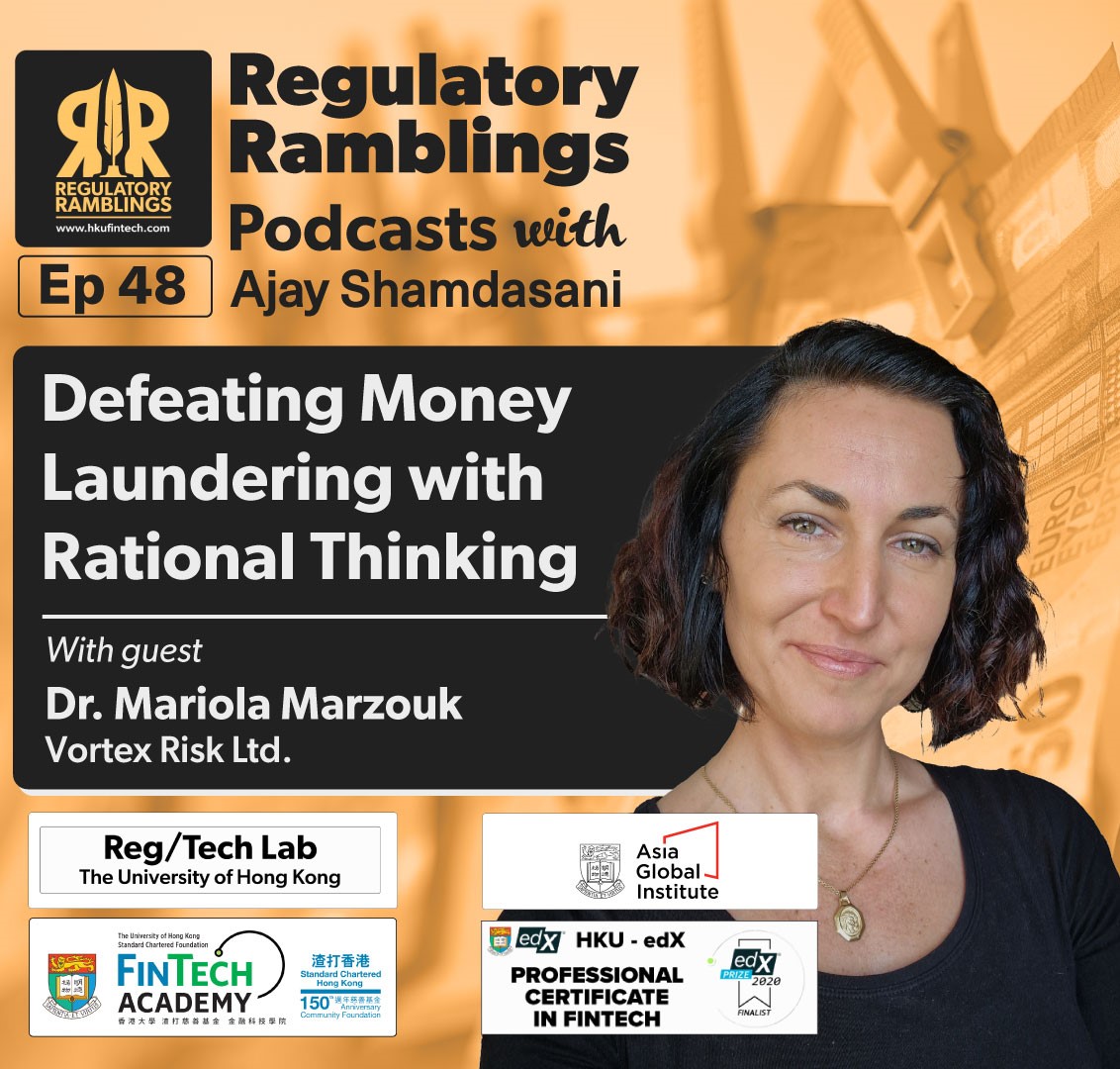
Regulatory Ramblings: Episode 48 – Defeating Money Laundering with Rational Thinking, Not Compliance Red-Flags with Mariola Marzouk (Vortex Risk Ltd.)

Dr. Mariola Marzoukis isan anti-money laundering (AML) professional with extensive experience in regulatory software and consulting across the public and private sectors. Her career has involved working with global banks on how to use technologies to address regulatory compliance demands.

In 2023, after completing her doctorate in criminal justice focused on trade-based money laundering (TBML) and technology, she co-founded Vortex Risk Ltd. with her colleague Dr Nicholas Gilmour (himself a guest on episode #18 of Regulatory Ramblings). The firm provides insights into money laundering practices to individuals and organizations worldwide. Vortex Risk’s approach empowers clients by offering perspectives akin to rational-thinking criminals operating discreetly to evade regulatory suspicion.

Over the course of her career, Mariola has held strategic product management positions at internationally recognized companies such as British Aerospace and Engineering (BAE) Applied Intelligence, EY, NICE Actimize, and Napier AI.

She specializes in financial crime prevention and has demonstrated expertise in detecting money laundering schemes using advanced technologies. Over time, her focus extended to the ever-growing specter of TBML, and her research in this area has garnered recognition within the industry. Mariola’s pilot study on Brexit’s impact on TBML has been published in the Journal of Money Laundering Control, featured on GTR News, and cited by the Institute of Export and International Trade UK.

In this episode of Regulatory Ramblings, she chats with host Ajay Shamdasani, describing her path from Poland to the UK, first as a student and now as a much sought-after financial crime professional in London.

The conversation underscores Mariola’s philosophy: defeating money laundering requires rational thinking and not merely compliance red flags. She eschews the notion of compliance as an exercise in perfunctory box-ticking and form-filing – a perennial lament in the profession.

She shares that her approach towards AML more generally is to precisely deploy RegTech to aid regulated entities in detecting criminality. While acknowledging that data analytics and artificial intelligence (AI) are essential tools in the battle against financial crime, she stresses that technology is not a panacea and works best when used in tandem with the skills, temperament, wisdom, and judgment that experienced professional researchers and investigators have developed over time. AI is no substitute for analysis by a human and good old common sense.

Mariola admits that while she does not have a background in science, technology, engineering, or math (STEM), her experience as a product manager and corporate strategist has afforded her insight into what customers need from technical solutions and a sense of discernment about when to apply which technologies, if at all. While not a techie per se, she has developed an understanding of technological development and how and when it should be deployed to solve specific problems. Ultimately, tools should meet the objectives of problem-solving, she says.

She recounts the various learning curves she experienced from the business side while coping with the more technical aspects of roles throughout her career.

The discussion concludes with Mariola stating her views on the prevailing hypocrisy in AML and sanctions enforcement. The financial world is all too often regulated from Washington, New York, London, and Brussels. Yet, while the US and UK are some of the most aggressive jurisdictions regarding financial crime enforcement actions, their regulatory apparatus is often used to further their geopolitical goals. It is a view outside of the West that Mariola says is not without merit.

Podcast Discussion

3:09 Mariola Marzouk’s Journey into Financial Crime

9:58 Combating Trade-Based Money Laundering: A Personal Pursuit of Restorative Justice

15:25 Disrupting the Norm: Money Laundering and Regulatory Realities

26:43 Unveiling Trade-Based Money Laundering: Beyond Trade Finance Myths

35:03 Technology in Regulatory Compliance: Unfulfilled Promises and Hidden Realities

41:08 The Disconnect and Challenges in Developing Effective RegTech Solutions

50:20 Challenges of Automation and Critical Thinking in Financial Crime Compliance

1:02:52 Assessing the Effectiveness of Sanctions Amidst Strategic Adaptations

1:06:34 Bridging Divides through Education

1:12:57 Gender Dynamics and the Future of Anti-Money Laundering

Connect with RR Podcast at:

LinkedIn: https://hk.linkedin.com/company/hkufintech 
Facebook: https://www.facebook.com/hkufintech.fb/
Instagram: https://www.instagram.com/hkufintech/ 
Twitter: https://twitter.com/HKUFinTech 
Threads: https://www.threads.net/@hkufintech
Website: https://www.hkufintech.com/regulatoryramblings 

Connect with the Compliance Podcast Network at:

LinkedIn: https://www.linkedin.com/company/compliance-podcast-network/
Facebook: https://www.facebook.com/compliancepodcastnetwork/
YouTube: https://www.youtube.com/@CompliancePodcastNetwork
Twitter: https://twitter.com/tfoxlaw
Instagram: https://www.instagram.com/voiceofcompliance/
Website: https://compliancepodcastnetwork.net/
Categories
Trekking Through Compliance

Trekking Through Compliance – Episode 40 – Compliance Lessons from Friday’s Child

In this episode of Trekking Through Compliance, we consider the episode Friday’s Child, which aired on December 1, 1967, Star Date 3497.2.

Kirk attempts to secure a mining agreement for topaline on Capella 4, where Bones had once been stationed.  He warns Kirk that although the Capellans are scrupulously honest, they are war-like. After beaming down, a security guard pulls out a phaser to shoot a Klingon emissary and is instantly killed by a fleet-wielding Capellan.

On the planet, the leader is killed in a coup, and his pregnant wife Eleen is sentenced to death because she carries a royal child. After giving birth, Eleen escapes and runs to give herself up to the Capellans. She claims to have killed the child and the Earthmen as they slept. The Klingon does not believe her and demands that the Capellans, under threat of phaser fire, verify Eleen’s story. Suddenly, Kirk shoots the Klingon with an arrow, and an exchange between the Capellans and Kirk and Spock follows. The Klingon threatens to shoot anyone who raises a weapon against him. This does him no good, however, since Maab exchanges his life for that of Eleen by confronting the Klingon, and Keel uses the opportunity to kill the Klingon. Kirk gains mining rights when Eleen is regent for the child Tierr-to-be, Leonard James Akaar.

Commentary

The narrative showcases key compliance themes, including the importance of due diligence, respect for local customs, avoiding conflicts of interest, clear communication and transparency, and adaptability in conflict resolution. Through the interactions with the Capellans and Klingons, the episode illustrates how a lack of understanding and respect for cultural norms can jeopardize high-stakes negotiations. The discussion also touches upon the complexities of the Prime Directive and its application in interstellar relations.

Key Highlights

  • Episode Overview: Friday’s Child
  • Mining Agreement on Capella IV
  • Conflict with the Klingons
  • Discussion: The Prime Directive
  • Compliance Lessons from Friday’s Child

Resources

Excruciatingly Detailed Plot Summary by Eric W. Weisstein

MissionLogPodcast.com

Memory Alpha

Categories
Blog

The UK Election and Its Implications for Compliance Professionals

Last week saw the greatest wipeout in the recorded history of UK governments, which saw the Tories being swept from power and losing over 400 seats in Parliament. The Labour Party took over with a commanding presence, securing around 450 seats, while the Tories retained only about 120 seats. I recently visited with Jonathan Armstrong, who shared his thoughts on the gravity and history of this election and what it might mean for our compliance contemporaries in the UK, the US, and worldwide, in the most recent episode of the award-winning podcast Life with GDPR.

This election is a refreshing change, irrespective of political leanings. The previous government was seen as limping along like a ship with a hole in its side, and the mood has noticeably improved since the new government took office. The Labour government, led by Sir Keir Starmer, has hit the ground running. Within hours of his appointment by the King, the new cabinet members were assigned their missions and started work immediately. This proactive approach is a sign of the times ahead.

From an enforcement point of view, this government has a firm grasp of compliance and enforcement. With his background as a defense barrister and tenure as the Director of Public Prosecutions, Sir Keir Starmer brings a wealth of experience. His leadership at the Crown Prosecution Service saw the first prosecutions under the Bribery Act, and his understanding of the criminal justice system bodes well for robust enforcement.

The now-entrenched SFO director, whom we previously called the “new” director, has taken significant steps in bribery enforcement, including the first dawn raids in years. I asked Jonathan if he saw a healthy interaction between the current SFO director and the new government. He responded that he does so.

Sir Keir Starmer and the current SFO director are on the same page regarding enforcement. The new administration has already announced a focus on investigating the PPE scandal, which involves around £7.2 billion worth of potentially corrupt contracts from Boris Johnson’s era. This will likely be a priority, and the new Covid Corruption Commissioner will work closely with the SFO, leveraging its powers to conduct dawn raids and demand documents. This indicates a continued and possibly intensified focus on bribery enforcement.

In addition to bribery and corruption, trade controls, customs, and economic sanctions are critical areas of concern. This includes sanctions involving Russian individuals and measures like the Uyghur Forced Labor Prevention Act in the United States. Here, Jonathan sees a stricter approach by Labour than the prior administration.

He believes that there was a perception that some Russian-connected individuals were overlooked in the sanctions list due to their connections with the Conservative Party. The new administration, less entangled with such interests, is likely to expand the sanctions list to align more closely with the US. Regarding Uyghur measures, the new second-in-command at the Treasury, Darren Jones MP, has a background in investigating supply chain issues and forced labor. Armstrong believes we can expect legislation similar to the US approach, emphasizing greater scrutiny and enforcement against forced labor in supply chains.

How about AI governance and enforcement, particularly with the significant tech companies dominating this space? Once again, Armstrong believes the previous administration was perceived as lenient on AI regulation, possibly due to future career aspirations. The new Labour government, however, is likely to take a stricter stance. This will involve a new centralized office to oversee AI usage, educating existing regulators on utilizing their powers, and possibly introducing new AI laws. These measures will likely mirror the EU AI Act, demonstrating the UK’s commitment to aligning with EU standards and fostering a closer relationship with the EU.

The new government views antitrust and competition law similarly to the EU. The CMA has already shown signs of cooperating with EU counterparts, conducting simultaneous dawn raids and sharing concerns about AI monopolies. The new administration is expected to continue this trend, addressing the concentration of GenAI in the hands of a few large US-based tech corporations. This collaboration with the EU will likely result in a more unified enforcement agenda across the channel.

What changes can we expect in traditional topics like GDPR and data privacy under the new UK government? The previous administration attempted to roll back some GDPR provisions, but the new government will likely take a more balanced approach. Changes will focus on areas like research while maintaining compliance with EU adequacy decisions to ensure seamless data transfers. The Labour government will prioritize maintaining a solid relationship with the EU, guaranteeing that any legislative changes do not jeopardize this adequacy decision.

Do you see the new government moving towards greater protections for workers in the era of remote and hybrid work models? Labour’s traditional ties to trade unions suggest a shift towards more pro-worker legislation. This could include regulations on maximum working hours and the right to disconnect, addressing the perceived always-on culture, particularly in US corporations. While hard and fast laws may not be imminent, there will be an emphasis on consulting employees about work-life balance and ensuring fair treatment.

This historic election marks a significant shift in the UK’s political landscape, with profound implications for compliance professionals. The new Labour government, focusing on enforcement, trade controls, AI governance, data privacy, and worker protections, promises a more robust and aligned approach with EU standards. Compliance officers must stay vigilant and adapt to these changes, ensuring their programs remain effective and compliant with evolving regulations. This new UK administration brings a fresh perspective and a more proactive approach to governance. Compliance professionals should be prepared for increased enforcement and regulatory scrutiny. By staying informed and adaptable, they can navigate these changes effectively and continue to uphold the highest compliance standards.

Categories
Compliance Tip of the Day

Compliance Tip of the Day: The Humble Reference Check

Welcome to “Compliance Tip of the Day,” the podcast where we bring you daily insights and practical advice on navigating the ever-evolving landscape of compliance and regulatory requirements.

Whether you’re a seasoned compliance professional or just starting your journey, our aim is to provide you with bite-sized, actionable tips to help you stay on top of your compliance game.

Join us as we explore the latest industry trends, share best practices, and demystify complex compliance issues to keep your organization on the right side of the law.

Tune in daily for your dose of compliance wisdom, and let’s make compliance a little less daunting, one tip at a time.

In today’s episode, we learn how and why the humble reference check can be a key tool in your hiring, evaluation, and due diligence processes.

For more information on the Ethico ROI Calculator and a free White Paper on the ROI of Compliance, click here.

To check out The Compliance Handbook, 5th edition, click here.

Categories
Life with GDPR

Life With GDPR: What Does The UK Election Mean for Compliance?

Tom Fox and Jonathan Armstrong, a renowned expert in cybersecurity, co-host the award-winning “Life with GDPR.” Jonathan has returned from his hiatus, and in this episode, we examine the UK election results and their potential impact on compliance.

The recent UK election has significant implications for compliance, particularly concerning the dynamics between the UK’s Serious Fraud Office (SFO) and the new government. Jonathan Armstrong, an expert on bribery enforcement, anticipates that the new administration under Keir Starmer will focus on high-profile issues like the PPE scandal while maintaining robust enforcement actions, including dawn raids.

Armstrong and Fox bring deep insights into the potential compliance landscape, shaped by their extensive backgrounds: Armstrong’s expertise in corruption investigations and Fox’s experience with the criminal justice system.

Fox highlights the impact of the new Prime Minister’s legal background in bolstering enforcement efforts and contemplates the future governance of AI under this administration. Both experts foresee a political shift, with Armstrong expecting the Conservative Party to lean rightward yet occupy the political center, and Fox emphasizing the continuity and experience the new government brings to compliance and enforcement issues.


Key Takeaways:

  • Heightened Bribery Enforcement Under New Government
  • Russian Sanctions and Uighur Import Regulations
  • Data Protection Bill Changes Post-UK Election
  • UK’s New Administration Faces Challenges and Changes
  • Center-Ground Positioning in UK Politics

Resources:

Connect with Tom Fox

Connect with Jonathan Armstrong

Categories
FCPA Survival Guide

FCPA Survival Guide – Step 6 – Clawbacks and Holdbacks

How can you survive an FCPA enforcement action? In this special podcast series, Tom Fox and Nick Gallo lay out the Top 10 things you can do to reduce your overall fine and penalty, perhaps down to a full declination. All of the actions you can take come from recent DOJ prosecutions under the FCPA and speeches from DOJ representatives. This podcast, sponsored by Ethico, is the companion series to the book The FCPA Survival Guide: Surviving and Thriving a Foreign Corrupt Practices Act Enforcement Action. Today, we discuss the importance of using clawbacks and holdbacks.

In episode six of the FCPA Survival Guide, Tom Fox and Nick Gallo delve into the relatively new DOJ enforcement strategies: clawbacks and holdbacks. They discuss how these financial disincentives, formalized in the 2023 Monaco memo, aim to promote corporate compliance. The conversation highlights practical examples from companies like SAP and Albemarle, which implemented these strategies and received substantial credits from the DOJ. Nick emphasizes the importance and effectiveness of financial disincentives in driving behavior change and maintaining corporate integrity. The episode explores how these methods can operationalize compliance at all organizational levels.

Key Highlights and Issues

  • Understanding Holdbacks and Clawbacks
  • DOJ’s Pilot Program and Case Studies
  • The Impact of Financial Incentives
  • Corporate Responsibility and Individual Accountability
  • Employee Awareness and Compliance Culture
  • Balancing Positive and Negative Incentives

Resources:

Nick Gallo on LinkedIn

Ethico

The FCPA Survival Guide: Surviving and Thriving a Foreign Corrupt Practices Act Enforcement Action

Tom

Instagram

Facebook

YouTube

Twitter

LinkedIn

Categories
Daily Compliance News

Daily Compliance News: July 11, 2024 – The Fraudulent Accounts Redux Edition

Welcome to the Daily Compliance News. Each day, Tom Fox, the Voice of Compliance, brings you compliance-related stories to start your day. Sit back, enjoy a cup of morning coffee and listen to the Daily Compliance News. All from the Compliance Podcast Network.

Each day, we consider four stories from the business world: compliance, ethics, risk management, leadership, or general interest for the compliance professional.

In today’s edition of Daily Compliance News:

  • Fifth Third Bank and another fraudulent account scandal. (WaPo)
  • BitMEX Pleads Guilty to U.S. Anti-Money-Laundering Charge.(WSJ)
  • How UBS fell out with the Swiss banking establishment. (FT)
  • Archegos founder is guilty. (NYT)


For more information on the Ethico ROI Calculator and a free White Paper on the ROI of Compliance, click here.

Categories
Trekking Through Compliance

Trekking Through Compliance – Episode 39 – Culture Lessons from Journey to Babel

In this episode of Trekking Through Compliance, we consider the episode Journey to Babel, which aired on November 17, 1967, and occurred on Star Date 3842.3.

The Enterprise transports ambassadors to a conference to discuss the admission of Corridon to the Federation. Sarek is the ambassador from Vulcan, accompanied by his wife, Amanda. To Kirk’s surprise, they turn out to be Spock’s parents. Also, to Kirk’s surprise, Sarek is cool towards Spock because Spock has chosen to devote his life to Starfleet instead of Vulcan science.

The Tellerite ambassador is murdered, and Sarek falls under suspicion. Meanwhile, Spock detects titanium emissions from an alien ship’s hull after it transmits a message. Sarek requires an open heart operation, and Spock provides a blood transfusion.

Kirk is attacked and requires medical attention, so Spock assumes command. Under these circumstances, he says he cannot take time off to give the transfusion to Sarek and cannot pass the command on to anyone else because he is the best-qualified person to command the Enterprise. His mother pleads with him, but he refuses.

The Enterprise is attacked by an alien ship while Sarek and Spock are on the operating table, endangering their lives. Kirk fools the alien ship by turning off shields and internal power, luring the enemy ship for the kill. Kirk hits it with phasers and disables it when it begins moving in.

However, they blow themselves up before he can ask them to surrender.
McCoy confines the injured Kirk and the recovering Spock to sickbay, shushing all protests. “Well, what do you know,” he says with a grin, “I finally got the last word.”

Commentary

The story features the Enterprise transporting ambassadors, including Spock’s parents, Sarek and Amanda, to a conference on Babel. Amidst diplomatic challenges, an unidentified transmission and a Tellarite ambassador’s murder put Sarek under suspicion. Despite suffering from a heart condition, Sarek is saved through Spock’s blood transfusion. The episode emphasizes medical technology, diplomatic protocols, conflict management, inclusive cultures, whistleblower protection, crisis preparedness, and cybersecurity—offering valuable lessons for modern compliance programs.

Key Highlights

  • Sarek’s Medical Emergency
  • Uncovering the Spy
  • The Final Confrontation
  • Medical Science in Star Trek
  • Cultural and Compliance Lessons

Resources

Excruciatingly Detailed Plot Summary by Eric W. Weisstein

MissionLogPodcast.com

Memory Alpha

Categories
Blog

Supreme Court Rulings: A Compliance Perspective

Recently, the Supreme Court delivered several rulings that have caught the attention of compliance professionals. This blog post will dissect these rulings and explore their implications for corporate compliance. Matt Kelly and I took a deep dive into this week’s Compliance into the Weeds to see if you prefer the audio format.

  1. Jarkesy Decision: SEC and In-House Tribunals

The Jarkesy decision ruled that the SEC cannot use in-house tribunals for enforcement proceedings, mandating that cases be brought to federal court. This ruling is likely to have a minor impact from a compliance perspective. Here’s why:

Federal Court Preference: For severe charges under the Foreign Corrupt Practices Act (FCPA), the SEC has historically opted to bring cases to U.S. district courts. These cases typically involve criminal charges, and the SEC has not utilized in-house tribunals for FCPA enforcement in over a decade.

Corporate vs. Individual Defendants: The ruling primarily benefits defendants who can now have their cases heard in federal court instead of administrative tribunals. However, for corporate compliance officers, this distinction is largely irrelevant. Corporate cases are typically resolved in federal courts through settlements without the need for protracted legal battles.

  1. Loper Case: Overturning the Chevron Doctrine

The Loper case overturned the Chevron doctrine and is another landmark decision. The Chevron doctrine allowed courts to defer to agency interpretations of ambiguous statutes. Here’s what this means for compliance:

Guidelines vs. Rules: Compliance officers should understand that DOJ guidelines for effective compliance programs are just guidelines, not rules. These guidelines are not subject to Chevron’s deference and are regularly updated to reflect best practices.

Practical Impact: Eliminating Chevron’s deference might make it more challenging for agencies to introduce new rules without facing legal challenges. However, this does not directly impact existing guidelines or enforcement practices related to corporate compliance.

Increased Litigation Risk: Future regulations may face more scrutiny and litigation, potentially leading to increased enforcement of existing rules rather than creating new ones. Compliance professionals should prepare for more rigorous enforcement actions based on current regulations.

  1. Snyder Decision: Federal Anti-Corruption Law

The Snyder decision narrowed the scope of federal anti-corruption law, particularly concerning bribes paid to state and local officials. This ruling has some interesting implications:

Case Background: The case involved the former mayor of Portage, Indiana, who awarded a contract to a specific company and later received a $13,000 consulting fee as a reward. The Supreme Court ruled this as a gratuity rather than a bribe, complicating enforcement under federal anti-corruption laws.

Corporate Compliance Concerns: While this ruling applies to state and local officials, compliance officers must remain vigilant about maintaining clear anti-corruption policies. The ruling doesn’t directly affect the FCPA, which targets foreign officials, but highlights the importance of robust internal controls and transparent record-keeping.

Ethical Implications: Compliance programs should continue emphasizing ethical behavior and avoiding corruption, whether labeled as a gratuity or a bribe. The moral imperative against corruption remains unchanged despite legal nuances.

The recent Supreme Court decisions may not drastically alter corporate compliance programs’ day-to-day operations, but they highlight the evolving legal landscape that compliance professionals must navigate. Here are some key takeaways:

  1. Stay Informed: Regularly update your knowledge of legal developments and understand their potential impact on your compliance program.
  2. Focus on Ethics: Reinforce the ethical foundation of your compliance efforts. Emphasize that any corrupt behavior, whether technically legal or not, is unacceptable.
  3. Prepare for Increased Scrutiny: With the potential for more litigation around new regulations, ensure your compliance program is robust and well-documented. Be ready to demonstrate your commitment to ethical practices and effective compliance.
  4. Engage with Legal Experts: Work closely with legal counsel to interpret these rulings and adjust your compliance strategies accordingly. Legal guidance is crucial in navigating complex regulatory changes.

In conclusion, while the Jarkesy, Loper, and Snyder decisions may seem weighty, their direct impact on corporate compliance programs is limited. However, they serve as a reminder of the dynamic nature of compliance and the need for ongoing vigilance and adaptability. By focusing on ethical behavior and maintaining strong internal controls, compliance professionals can continue to safeguard their organizations against legal and reputational risks.

Categories
Compliance Tip of the Day

Compliance Tip of the Day: Communicating Cultural Expectations

Welcome to “Compliance Tip of the Day,” the podcast where we bring you daily insights and practical advice on navigating the ever-evolving landscape of compliance and regulatory requirements.

Whether you’re a seasoned compliance professional or just starting your journey, our aim is to provide you with bite-sized, actionable tips to help you stay on top of your compliance game.

Join us as we explore the latest industry trends, share best practices, and demystify complex compliance issues to keep your organization on the right side of the law.

Tune in daily for your dose of compliance wisdom, and let’s make compliance a little less daunting, one tip at a time.

In today’s episode, we look at how a NWSL GM communicated cultural expectations in the interview process.

For more information on the Ethico ROI Calculator and a free White Paper on the ROI of Compliance, click here.

To check out The Compliance Handbook, 5th edition, click here.