Categories
All Things Investigations

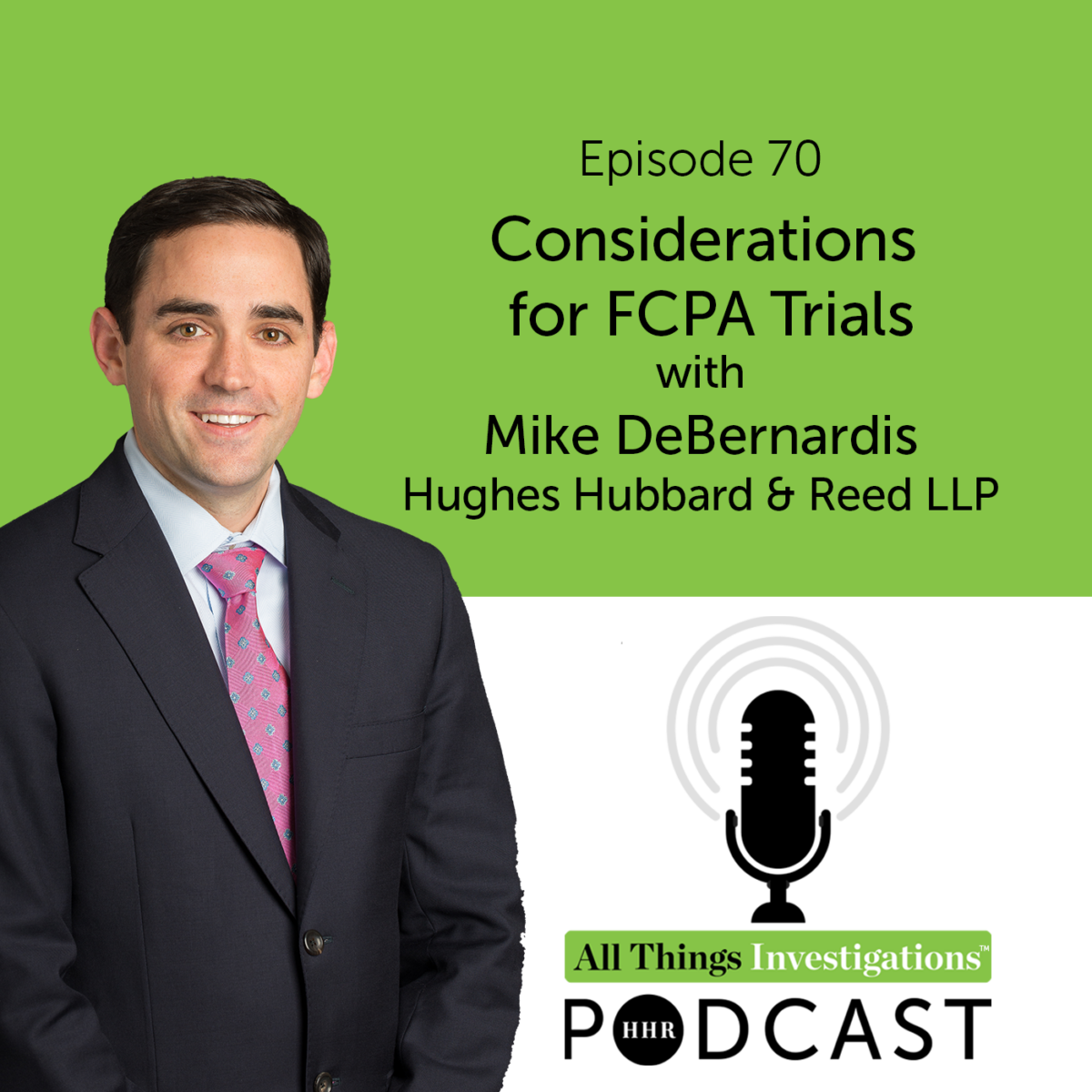
All Things Investigations – Mike DeBernardis on Considerations for FCPA Trials

Welcome to the Hughes Hubbard Anti-Corruption & Internal Investigations Practice Group’s podcast, All Things Investigation. In this podcast, host Tom Fox is joined by HHR partner Mike DeBernardis on the considerations of trying an FCPA case.

Tom and Mike deeply dive into the complexities of preparing for and trying an FCPA case. It includes negotiating with corporate and individual clients involved in criminal cases. It is often easier to convince corporate clients to cooperate with government entities and engage in negotiation processes. Conversely, individual clients, driven by strong convictions of their innocence, can be resistant unless negotiation results in a non-prosecution decision. We highlight the challenging conversations defense counsels must have with individual clients regarding realistic outcomes, including discussing the strengths of the prosecution’s case and potential plea deals. Establishing early discussions about acceptable outcomes and strategies is vital to navigating these difficult negotiations.

Key highlights:

  • Corporate vs. Individual Clients
  • Challenges in Defense Counsel
  • Discussing Plea Deals
  • Importance of Early Negotiation

Resources:

Mike DeBernardis

Hughes Hubbard & Reed Website

Categories
Blog

Compliance Lessons from Sales Incentive Pitfalls

When the scandal broke around Wells Fargo’s sales incentive manipulation, it became clear that incentive structures weren’t just about motivating employees but also fertile ground for ethical missteps and compliance failures. The recent article by Timothy Gardner, Colin Wong, and Rick Butler, entitled How Salespeople Game the System in Harvard Business Review, sheds crucial light on this, offering a timely reminder for compliance professionals about the latent risks embedded in incentive-driven strategies.

Salespeople often exploit incentive programs to maximize their gain through various schemes, damaging company performance and putting the company at legal risk. The authors identify common cheating tactics, including sandbagging, falsifying data, and giving excessive discounts or incentives to close deals quickly. To counter these practices, companies should use data to detect irregularities, revise incentive plans to close loopholes and establish ongoing monitoring. Communication and education about acceptable behaviors are also crucial. Not all gaming tactics need immediate action; however, some may be tolerated if they have a minimal impact on performance and would cause undue disruption to the sales organization. Compliance professionals should adopt a continuous process to identify and mitigate cheating while balancing the need to maintain sales productivity and motivation.

Understanding the Landscape

From Wells Fargo’s notorious misconduct to Vivint Smart Home’s identity theft case, examples abound of sales incentives fostering environments ripe for unethical practices. Sales professionals, driven by quotas and commissions, employ an array of tactics—from sandbagging, where sales are delayed strategically to maximize later bonuses, to outright fraud, such as creating faux customer accounts.

The authors identified eight incentive gaming categories, offering corporate compliance teams a powerful diagnostic tool. These include:

  1. Sandbagging. This technique involves postponing the completion of sales to a later measurement period to optimize incentive earnings. The authors found that “some sales reps at his company would hold as many orders as possible from October through December and submit them in January. The extra sales translated into outstanding sales performance and a very high commission for far exceeding established quotas.”
  2. Partners in profit. This is a particularly dangerous fraud in which the BD folks will “team up with customers to manipulate company processes to secure a better deal for the customer and a higher bonus for themselves.” The authors heard “about personal bankers who coached customers to sign up for accounts to take advantage of promotional deals (earning the bankers a commission) and then close the accounts at the end of the promotion.” This was similar to the Petrobras FCPA bribery scheme.
  3. Squandering sales. This tactic involves misleading customers in ways that benefit the salesperson but not the organization or the customer. The authors cited the following example: “Sales reps would give customers discounts to upsell them to unneeded service levels to earn the higher commission associated with the higher service tier. Though the salespeople came out ahead, the upsell hurt the organization’s bottom line and the customers: The company paid out a higher commission as a result of the upsell, and the customers ended up paying more for unwanted, higher-tier services, possibly resulting in customer dissatisfaction and defection.”
  4. Lost in segmentation. Another FCPA latent risk is where BD folks will “game the system by focusing their efforts on buyer segments that provide greater opportunities for incentive payouts instead of the targeted segments favored by the company. One interviewee told us that this was common among customer service associates (CSAs) who were responsible for both inbound sales-and-service calls and outbound sales-only calls. The CSAs would avoid accepting the incoming calls to maximize the time they could devote to the outbound calls, thereby earning more commissions.”
  5. Carrot and stick. Salespeople may use rewards, promises, threats, or punishments to encourage customer behavior that maximizes incentive payouts. At one airline, “some agents offered to waive baggage fees for customers during check-in if they signed up for the airline’s credit card, thus earning themselves a generous bonus.” This was a Wells Fargo tactic.
  6. Misleading customers. This tactic involves misleading prospective customers or withholding information to move the sales process forward. An example cited by the authors was where sales “reps would falsely tell call-in customers that the transaction couldn’t be completed on the phone and encouraged them to meet with a financial adviser, which yielded them higher bonuses for in-house referrals.”
  7. Falsifying data. Another tactic with criminal overtones. Under this scheme, a “sales management system is fed false information or information is omitted to maximize incentive payouts. In one interview, we heard that sales reps often log in to sales management systems and add their names to deals they did not participate in to increase their bonuses.”
  8. Faux customers. Well Fargo redux. Here, sales folks create “fake customer accounts with the help of friends, relatives, or coworkers.” Simply fabricating accounts is also a common gaming tactic. Some sales reps ask friends to pose as buyers, one interviewer told us. After the rep receives the commission for the “sales,” the phony customers cancel their service.

While varying in severity and potential impact, each of these strategies has the potential to compromise organizational integrity and compliance standards. Therefore, compliance leaders must remain vigilant in recognizing these behaviors and preemptively addressing the conditions that allow them to flourish.

Anticipating Incentive Program Vulnerabilities

Compliance teams can learn from these sales incentive pitfalls by proactively thinking like unethical sales professionals—an approach Gardner, Wong, and Butler dub cultivating an “immoral imagination.” Such foresight enables compliance leaders to anticipate and identify incentive plan vulnerabilities before they manifest into actual misconduct.

For instance, organizations should routinely engage trusted leaders and experienced sales professionals to evaluate incentive plans critically. Using the typology as a checklist can spur proactive identification of potential loopholes and gaming opportunities, informing targeted policy enhancements and strengthened monitoring protocols.

Data-Driven Monitoring and Audits

A robust compliance monitoring infrastructure is central to preventing sales incentive exploitation. Auditing systems for irregularities is critical. This includes tracking sales timing, examining customer account patterns, and monitoring behavior like customer misdirection or misinformation. Companies that successfully curtail gaming implement sophisticated tracking and analysis systems capable of flagging suspicious activities for further investigation.

The authors highlighted instances where systematic auditing effectively detected fraudulent behaviors. A notable example includes a financial institution auditing deposit account closures to identify employees creating fake accounts to artificially boost commissions. The swift identification and termination of those involved prevented further ethical breaches and preserved organizational integrity.

Refining Incentive Plans with Clear Guidelines

Beyond monitoring, refining incentive plans to eliminate ambiguities and clearly articulate acceptable behaviors is imperative. Policies must explicitly outline ethical boundaries and the consequences of transgressions, including incentive clawbacks, disciplinary actions, and potential termination.

Gardner and his co-authors advise that companies embed explicit language prohibiting unethical behaviors and reinforce these through regular training and communication, emphasizing transparency and accountability. The case they presented, involving airline agents improperly waiving baggage fees in exchange for credit card sign-ups, underscores the importance of clear, enforceable policies and vigilant enforcement.

Strategic Communication and Ethical Culture

Communication is the bedrock of any robust compliance strategy. Sales teams need ongoing messaging about ethical standards and incentive program expectations. Establishing an open dialogue around compliance and ethics, including discussing discovered instances of misconduct, helps embed integrity deeply into organizational culture.

Leaders must foster a culture where ethical conduct is the norm rather than the exception. Regular compliance training, reinforced by real-world case studies like those discussed in the Harvard Business Review article, can significantly enhance sales teams’ ethical vigilance and deter potential gaming behaviors.

The Decision to Act or Tolerate

The authors noted that not all incentive gaming is equally damaging or requires immediate rectification. Some minor gaming activities, such as strategic timing of sales submissions, may present minimal risk or impact, suggesting that addressing these issues aggressively could inadvertently disrupt sales operations or morale. Hence, compliance professionals must judiciously evaluate the potential ramifications of intervention versus strategic tolerance.

Concluding Thoughts for Compliance Leaders

Incentive-driven environments inherently contain risks. The complexities and competitive pressures on sales professionals often create scenarios tempting unethical shortcuts. However, compliance leaders can significantly reduce opportunities for unethical behavior with strategic vigilance—anticipating risks, implementing rigorous monitoring, maintaining clear and enforceable incentive guidelines, and fostering an ethical culture.

The insights from this article offer a timely, instructive framework for compliance professionals tasked with overseeing incentive-driven business units. Understanding how incentive systems can be exploited becomes a powerful asset in our ongoing mission to uphold ethical standards, protect corporate integrity, and ensure sustainable business success as we continually adapt and refine our compliance strategies.


Categories
Sunday Book Review

Sunday Book Review: March 30, 2025, The Information Systems Edition

In the Sunday Book Review, Tom Fox considers books that would interest the compliance professional, the business executive, or anyone who might be curious. These could be books about business, compliance, history, leadership, current events, or anything else that might interest Tom. Today, Tom Fox looks at four 2024/25 books on information systems.

  1. Knowledge Management by Irma Becerra-Fernandez, Rajiv Sabherwal, and Richard Kumi
  2. Management and Information Technology after Digital Transformation, edited by Peter Ekman, Peter Dahlin, and Christina Keller
  3. Managing Information Technology 2nd Edition by Francisco Castillo and Korina Monoso
  4. Business Information Systems by Paul Bocij
Categories
Because That's What Heroes Do

Deep Space 9 – Episode 26: Til Death Do Us Part and Unraveling Complex Relationships in DS9

Get ready for an exciting new season of Because That’s What Heroes Do. This season, they take a deep dive into their favorite episodes of Deep Space 9. In this exploration, Tom and Megan are joined by Star Trek maven Alex Murphy (Murphy) from Montreal. Murphy is a local historian, cinema, and TV fan with a love for weird foreign films, all things horror, and obscure media. He has been watching Trek since he was a tiny punk, and it’s been a lifelong love.

In this episode, the team concludes by exploring the introduction to a new character for DS9’s final season and reviewing the episode Til Death Do US Part. They dive into the intricate relationships and transitional plot points of a particularly romantic yet unsettling episode of DS9. We discuss major developments such as Dukat’s infiltration of DS9, Damar’s new leadership role among the Cardassians, and the complex dynamics between Ezri and Worf following their ill-advised hookup. The conversation touches upon profound moments of character introspection, especially with Kai Wen and her interactions with Dukat. Murphy highlights Quark’s emotional depth and the evolving narrative arcs while exploring the impacts of these character developments within the broader DS9 storyline. Join us to uncover the intertwined fates and emotional struggles that drive this pivotal episode forward.

Key highlights:

  • Romantic Entanglements and Character Dynamics
  • Kai Winn and Dukat: A Controversial Pairing
  • Ezri and Worf: Youthful Mistakes
  • Sisko and Kasidy: Prophecy and Struggle
  • Dukat’s Manipulations and Damar’s Downfall
  • Quark’s Heart and Ferengi Values

Resources

Megan Dougherty

LinkedIn

One Stone Creative

Twitter

Tom

Instagram

Facebook

YouTube

Twitter

LinkedIn

Categories
Kerrville Weekly News Roundup

Kerrville Weekly News Roundup: March 29, 2025

Welcome to the Kerrville Weekly News Roundup. Each week, veteran podcaster Tom Fox and his colleagues Andrew Gay and Gilbert Paiz get together to go over a couple of their favorite stories from the past week from Kerrville and the greater Hill Country. Sit back, enjoy a cup of morning coffee, and listen in to get a wrap-up of the Kerrville Weekly News. We each consider two of our favorite stories and talk about the upcoming weekend’s events, which we will enjoy or participate in this weekend.

In this episode, Tom takes a solo turn to look at some of the stories that caught their attention over the past week.

Stories include:

  • BESS protests in Harper
  • Rain and hail damage in Kerrville
  • Watch out for scammers on roof repair in Kerrville
  • David Jones named to Schreiner University football team staff
  • New AD at KISD and head coach at Tivy

Resources:

Tom Fox on LinkedIn

Gilbert Paiz on LinkedIn

Andrew Gay on LinkedIn

Texas Hill Country Podcast Network

The Lead

Kerrville Daily Times

Categories
10 For 10

10 For 10: Top Compliance Stories For the Week Ending March 29, 2025

Welcome to 10 For 10, the podcast that brings you the week’s Top 10 compliance stories in one podcast each week. Tom Fox, the Voice of Compliance, brings you the compliance professional and the compliance stories you need to know to end your busy week. Sit back, and in 10 minutes, hear the stories every compliance professional should know from the prior week. Every Saturday, 10 For 10 highlights the most important news, insights, and analysis for the compliance professional, all curated by the Voice of Compliance, Tom Fox. Get your weekly filling of compliance stories with 10 for 10, a podcast produced by the Compliance Podcast Network.

  • Will Habba go to trial in the Cognizant Tech execs case?  (NY Post)
  • Boeing was sued for the wrongful death of a whistleblower. (WSJ)
  • Even Bloomberg says to enforce the FCPA. (Bloomberg)
  • The House speaker says Congress can eliminate district courts. (Reuters)
  • What is the fire risk for your business? (NYT)
  • Judge orders Boeing to trial. (WSJ)
  • Mintz’s staff was freed after 2 years in Chinese jail.  (BBC)
  • Blatter and Platini were cleared of corruption charges. (Reuters)
  • Target DEI flip-flop costs. (Bloomberg)
  • Nadine Menendez’s: From Under the Bus to ‘Mon Amor”. (Bloomberg)

You can check out the Daily Compliance News, which features four curated compliance and ethics stories each day here.

Connect with Tom 

Instagram

Facebook

YouTube

Twitter

LinkedIn

Categories
Compliance Tip of the Day

Compliance Tip of the Day – The Whole Greater Than the Sum of its Parts

Welcome to “Compliance Tip of the Day,” the podcast where we bring you daily insights and practical advice on navigating the ever-evolving landscape of compliance and regulatory requirements. Whether you’re a seasoned compliance professional or just starting your journey, we aim to provide bite-sized, actionable tips to help you stay on top of your compliance game. Join us as we explore the latest industry trends, share best practices, and demystify complex compliance issues to keep your organization on the right side of the law. Tune in daily for your dose of compliance wisdom, and let’s make compliance a little less daunting, one tip at a time.

Today, we discuss why Aristotle’s maxim that the whole should be greater than the sum of its parts is particularly true of compliance teams.

Categories
Compliance and AI

Compliance and AI: Harnessing Generative AI for Compliance: An Interview with Eric Sydell

What is the role of Artificial Intelligence in compliance? What about Machine Learning? Are you using ChatGPT? These are but three questions we will explore in this cutting-edge podcast series, Compliance and AI, hosted by Tom Fox, the award-winning Voice of Compliance. In this episode, Tom is joined by Eric Sydell, co-founder and CEO of Vero AI, to discuss the intersection of AI and compliance.

Eric shares his unique journey from industrial psychology to HR technology and ultimately to the realm of compliance through AI. They explore how Vero AI utilizes generative AI to analyze and interpret vast amounts of unstructured data at scale, such as text, video, and imagery. Eric emphasizes that AI provides a scalable solution for compliance processes, reducing manual labor and increasing efficiency.

Eric discusses the importance of AI governance in compliance, particularly in light of emerging standards like ISO 42001 and the EU AI Act. He introduces the Vero AI’s Violet Impact Model, which provides a comprehensive framework for evaluating the impact of algorithms and complex systems. The conversation covers practical applications of Vero AI in corporate procurement and risk management, highlighting how the tool can assist compliance officers in continuously monitoring and improving their compliance programs. Eric concludes by explaining how businesses can reach out to learn more about implementing these advanced AI-driven solutions.

Key highlights:

  • Generative AI and Unstructured Data
  • AI in Compliance and Predictive Models
  • AI Governance and Monitoring
  • The Violet Impact Model
  • Vero AI in Risk Management and Procurement

Resources:

Eric Sydell on Linkedin

Vero AI

Tom Fox

Instagram

Facebook

YouTube

Twitter

LinkedIn

Categories
Daily Compliance News

Daily Compliance News: March 28, 2025, The Cave or Go To Trial Edition

Welcome to the Daily Compliance News. Each day, Tom Fox, the Voice of Compliance, brings you compliance-related stories to start your day. Sit back, enjoy a cup of morning coffee, and listen to the Daily Compliance News—all from the Compliance Podcast Network. Each day, we consider four stories from the business world: compliance, ethics, risk management, leadership, or general interest for the compliance professional.

Top stories include:

  • Rivals pounce on Paul Weiss lawyers. (NYT)
  • Will Habba go to trial in the Cognizant Tech execs case? (NY Post)
  • Boeing was sued for the wrongful death of a whistleblower. (WSJ)
  • Trump is wrecking the US armament business. (FT)
Categories
Blog

Compliance Leadership Week: Building Compliance Teams Greater than the Sum of Their Parts

The sum is greater than the whole of its parts.-Aristotle

We conclude our exploration of leadership in the corporate compliance function by exploring how to build teams that are “greater than the sum of their parts.” We continue to mine the article Go, teams: When teams get healthier, the whole organization benefits by authors Aaron De SmetGemma D’Auria,  Maitham Albaharna, and Anaïs Fifer, all with McKinsey, as a starting point for our exploration.

In corporate compliance, effective team performance transcends individual capabilities. Cultivating teams that operate with a shared purpose and excel collectively rather than individually is essential. This approach ensures adherence to regulatory standards and fosters a culture of ethical excellence across the organization. So, how do compliance leaders create such cohesive and highly effective teams?

Understanding Key Drivers of Team Performance

Concentrating on the critical performance drivers of trust, communication, innovation, and decision-making is vital to achieving better compliance outcomes. When these elements are robust, compliance teams can more adeptly handle complex regulatory landscapes and proactively manage potential risks.

Trust is foundational, facilitating open dialogue, candid reporting, and collective problem-solving. Communication must be clear and consistent to ensure alignment and understanding across all compliance efforts. Innovation empowers teams to identify emerging risks and opportunities for process improvements proactively. Finally, effective decision-making ensures timely responses to compliance issues, reducing risk exposure and strengthening organizational resilience.

Addressing the Perception Gap

A common issue within teams is the perception gap; team members acknowledge the importance of certain behaviors but fail to exhibit them consistently. Recognizing this gap and working to close it for compliance teams can significantly enhance performance. Compliance leaders must encourage transparent self-assessment and discussions about team behaviors, promoting accountability for collective improvement.

Actions to Enhance Compliance Team Effectiveness

Here are four actionable steps compliance leaders can take to build teams greater than the sum of their parts:

1. Conduct Comprehensive Team Diagnostics

Team diagnostics provide compliance teams with essential insights into their strengths and weaknesses. By establishing a baseline of existing behaviors, teams can identify areas needing immediate attention. From there, developing a team charter can clearly outline collective expectations, behaviors to prioritize, and shared objectives. Crucially, compliance team members should commit not only to individual accountability but also to collective team success.

Additionally, individual team members benefit from a deeper understanding of their behaviors and how they influence team dynamics. Tools like 360-degree feedback and personalized coaching sessions can significantly enhance personal self-awareness, ultimately contributing to more effective team interactions.

2. Ensure Lasting Behavioral Changes

Once critical behavioral areas have been identified, compliance teams must commit to specific, actionable changes. Clear commitments, supported by tactical interventions and defined governance processes, are necessary for sustained behavioral shifts. Ensuring these commitments are implemented and not merely stated is critical for real transformation.

Periodic retrospectives can help teams continually evaluate their progress, acknowledge successes, and recalibrate strategies when needed. The journey to improved team effectiveness can be challenging, with inevitable setbacks and regressions. However, regular check-ins and open discussions can embed positive changes into team practices, preventing regression to less productive behaviors.

3. Leaders Must Champion and Support Team Changes

Compliance team leaders play a crucial role in driving effective teamwork. Leaders who struggle to transition from traditional command-and-control methods to more collaborative approaches significantly hamper team progress. Compliance leaders must embody the changes they seek, adopting a leadership style of openness, collaboration, and empowerment.

Investing in leadership coaching can significantly aid leaders who are resistant to change. Effective workshops and targeted interventions can help compliance leaders understand and adopt more collaborative and empowering approaches. Leaders must recognize that their perspective is just one among many. Research shows leaders often have overly optimistic views of team effectiveness, highlighting the importance of gathering comprehensive feedback from all team members to form a complete and accurate picture.

4. Embed Team Effectiveness into Organizational Practices

Achieving widespread and sustained team effectiveness requires embedding these principles into the organizational fabric. Adopting a systematic, scalable approach ensures these strategies benefit all compliance teams, not just select groups. The “train the trainer” model effectively disseminates best practices throughout the organization, empowering internal facilitators to carry forward these crucial initiatives.

For instance, consider the experience of an Asian bank that successfully scaled its team effectiveness initiatives across more than 200 teams. The bank first trained members of its HR team with external expert facilitators. These HR professionals progressively took on facilitation roles, first co-leading and eventually independently managing the team-effectiveness programs. This structured, cascading approach ensured consistency, sustainability, and widespread adoption of best practices throughout the organization.

The Imperative of High-Performance Compliance Teams

For compliance professionals, cultivating teams that are truly greater than the sum of their parts is no longer optional; it is essential. By systematically addressing the key drivers of trust, communication, innovation, and decision-making and embedding lasting behavioral changes into everyday practices, compliance leaders can build teams capable of navigating complex regulatory landscapes with agility and precision.

Effective teamwork in compliance is more than merely beneficial; it is fundamental to ensuring sustained organizational integrity, reducing regulatory risks, and fostering a culture where ethical behavior is the norm. By taking these structured, deliberate steps, compliance teams can become powerful agents of organizational value, consistently achieving collective outcomes that far exceed individual capabilities.