Categories
Innovation in Compliance

Personal Training For Businesses with Kris Reynolds


Kris Reynolds is the CEO of Arrowhead Consulting, a company that guides other organizations on managing their employees, processes, and tools. Tom Fox welcomes him to this week’s show to talk about corporate culture, strategies for post-pandemic productivity, and the future of project management. 
 

</p>

Culture As a Focus
Corporate culture is important and must be aligned to the business’s core values. Your core values also can’t be simple slogans that you have up on walls. They have to be constantly acted on. “If you’re not really living and breathing the core values, you’re not really going to be a culture fit,” Kris tells Tom. 
 
Post-Pandemic Strategies
Kris itemizes three strategies companies should be engaging within the post-pandemic business world: creativity, relationships and connections, and going back to basics. Creativity in advertising and marketing is key, and Kris also suggests pairing creativity with relationships. “I would encourage companies whether you’re small or large, to take the time to do more personal related touchpoints with the people that you’re trying to engage with,” he remarks. Going back to basics as a strategy is looking back at what got you to where you are as a business, and making sure that you’re accentuating those elements in your business. 
 
Making Meetings More Efficient
Tom asks Kris to give some tips to make corporate meetings more efficient. The goal of meetings should be decision-making. Corporate meetings should be about making sure that the knowledge shared is being used to advance the respective initiative. Kris stresses having structured meeting agendas that are time-boxed and having the meetings begin with the most important topics. Having meetings commence like this enforces a sense of urgency and will encourage employees to arrive on time. 
 
The Future of Project Management in Technology
Kris explains that there will be a greater focus on virtual reality training as opposed to Zoom meetings and PowerPoint presentations. This is because training in the future has to be experiential and hands-on. Training has to be engaging. “If we have some training spaces where we have the virtual reality, you could be training with somebody across the other side of the globe and being able to talk and work on projects together and things like that,” Kris tells Tom. 
 
Resources
Kris Reynolds | LinkedIn | Twitter 
Arrowhead Consulting
 

Categories
Daily Compliance News

April 19, 2022 the Cesspool of Corruption Edition


In today’s edition of Daily Compliance News:

  • Ohio a cesspool of GOP corruption. (TheHill)
  • Can SEC require gag orders? (NYT)
  • Loretta Lynch to lead racial audit at Amazon. (Bloomberg)
  • If you remove litigation to arbitration, you must pay the fees. (Reuters)
Categories
Blog

Driving the Digital Transformation of Compliance

The digital transformation of compliance will probably be the biggest change in our profession since the move to operationalizing compliance in the past decade. Legal professionals are generally ill-suited to lead this effort due to the legal focused training we all received, not quantitative training that most business students received. This means that many Chief Compliance Officers (CCOs), compliance professionals and corporate compliance functions struggle to reap the benefits of investments in digital transformation. I was therefore intrigued by a recent Harvard Business Review (HBR) article, by Marco Iansiti and Satya Nadella, Microsoft Chief Executive Officer (CEO), on a five-step approach to digital transformation. The article, Democratizing Transformation, sets out how innovation can be pushed out throughout a company’s workforce. I have adapted it for the compliance professional.
For a true digital transformation, technologists and data scientists alone cannot bring about the kind of wholesale innovation both a compliance function and a business unit need. This means that your organization should pair “data scientists with business [and compliance] employees who had insight into where improvements in efficiency and performance were needed.” Another strategy, which is near and dear to the heart of Carsten Tams, Ethical Business Architect and founder and CEO of Emagence LLC, is to use Design Thinking concepts in designing and implementing a digital innovation of compliance. The authors note, “A growing number of teams adopted agile methods to address all kinds of opportunities. The intensity and impact of transformation thus accelerated rapidly, driving a range of innovation initiatives.” This same strategy can work in sales as well as compliance.
It is this step which “democratize access to data and technology” outside of compliance and can lead to true and permanent innovation. The potential for employee-driven digital innovation cannot be accomplished by small groups of technologists and data scientists walled off in organizational silos. It will require much larger and more-diverse groups of employees – executives, managers, and frontline workers – coming together to rethink how every aspect of the business should operate. Once again this is what Tams has talked about with his articulation of Design Thinking, the engagement of business unit employees can well be a significant driver of compliance.
To achieve the type of engagement which will drive real digital transformation, a CCO must create synergy in three key areas: Capabilities, Technology and Architecture. The authors state, “Digital transformation requires that executives, managers, and frontline employees work together to rethink how every aspect of the business should operate.”

  1. Capabilities. It is axiomatic that successful transformation and innovation efforts in compliance requires “that companies develop digital and data skills in employees outside traditional technology functions. These capabilities alone, however, are not sufficient to deliver the full benefits of transformation; organizations must also invest in developing process agility and, more broadly, a culture that encourages widespread, frequent experimentation.” It is all a long-winded way of saying “Call Carsten Tams” and use his framework for Design Thinking as a starting point for your digital transformation.
  2. Technology. As always, “investment in the right technologies is important, especially in the elements of an AI stack: data platform technology, data engineering, machine-learning algorithms, and algorithm-deployment technology. Companies must ensure that the technology deployed is easy to use and accessible to the many nontechnical employees participating in innovation efforts.” Fortunately, there are more compliance product providers you can provide the right tech to you. See the Rise of ComTech.
  3. . One of the things that many compliance professionals do not often consider is that of architecture. The authors believe the “investment in organizational and technical architecture is necessary to ensure that human capabilities and technology can work in synergy to drive innovation. That requires an architecture—for both technology and the organization—that supports the sharing, integration, and normalization of data (for example, making data definitions and characteristics consistent) across traditionally isolated silos. This is the only real, scalable way to assemble the necessary technological and data assets so that they are available to a distributed workforce.” This is similar to what the Department of Justice (DOJ) intoned in the 2020 Update to the Evaluation of Corporate Compliance Program where they mandated for the first time that both the CCO and corporate compliance function should have access to all corporate data, literally cutting across all siloes.

The authors concluded, “mandate for digital transformation creates a leadership imperative: Embrace transformation, and work to sustain it.” I would add that these words apply even more so to the CCO who is leading the digital transformation of a compliance program. You should put together a clear strategy and sell it to the Board and senior management as well as communicating it “relentlessly” throughout your organization. Work to inaugurate a compliance “architecture to evolve into as you make the myriad daily decisions that define your technology strategy. Deploy a real governance process to track the many technology projects underway, and coordinate and integrate them whenever possible. Champion agility in all business initiatives you touch and influence. And finally, break free of tradition. Train and coach your employees to understand the potential of technology and data, and release the innovators within your workforce.”
Momentum is growing for the digital transformation of compliance; from the regulators to business units to investors. Indeed, it will be the driving strategy for compliance in 2025 and beyond. But we must always remember that it is the human element that will be the critical component to drive the transformation and more importantly use those tools to drive compliance up to the next level of effectiveness and engagement.

Categories
All Things Investigations

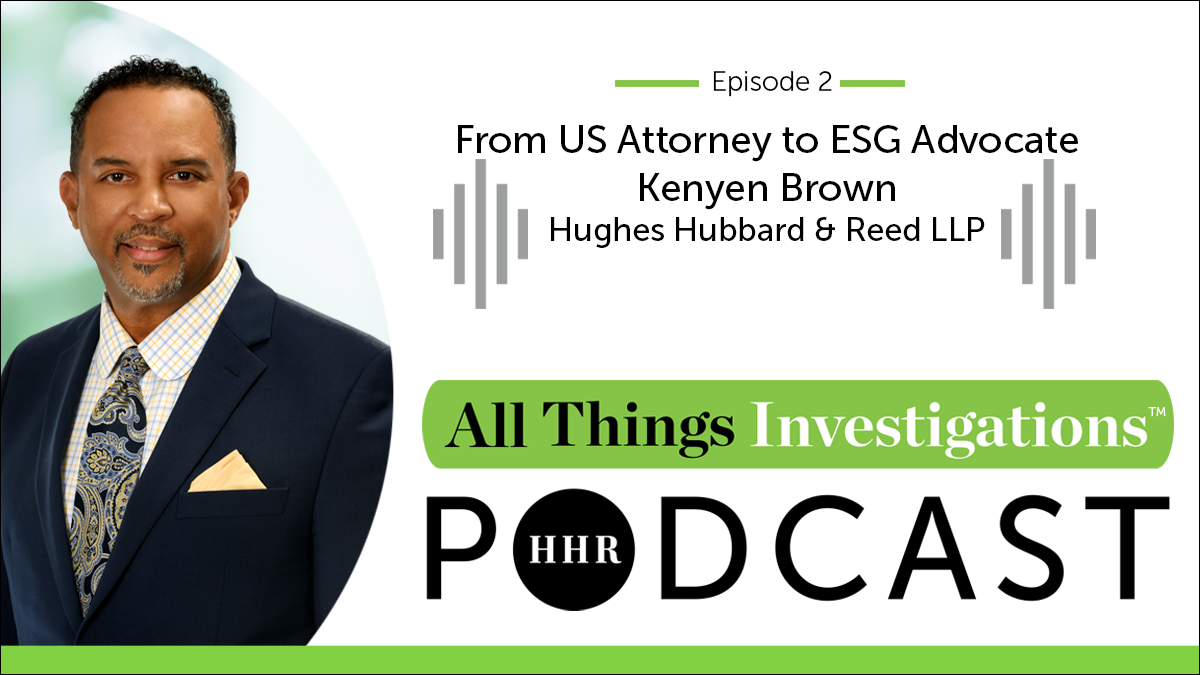
All Things Investigations: Episode 2-From US Attorney to ESG Advocate


Welcome to the Hughes Hubbard Anti-Corruption & Internal Investigations Practice Group’s podcast All Things Investigations. In this podcast, host Tom Fox and members of the Hughes Hubbard Anti-Corruption & Internal Investigations Practice Group will highlight some of the key legal issues involved in white collar and other investigations, both domestically and internationally. In this episode, I visit with Kenyen Brown on his journey from the US Attorney’s office to bring ESG programs and initiatives to clients to improve their businesses.


Kenyen Brown is a partner in the Washington, D.C. office of Hughes Hubbard & Reed in the White Collar & Regulatory Defense and Anti-Corruption & Internal Investigations practices. He is the former US Attorney for the Southern District of Alabama. He also served on the Senate Ethics Committee. Kenyen’s practice focuses primarily on white collar criminal litigation, compliance counseling, including matters involving internal and government investigations. In this area, Kenyen has performed compliance program reviews, audits, and risk assessments.
Key areas we discuss on this podcast are:

  • Role as the US Attorney for the Southern District of Alabama.
  • Role on the Senate Ethics Committee. Key accomplishments.
  • Working with police departments and their communities to identify systemic racial and gender discrimination issues.
  • The ‘S’ in ESG in racial and gender discrimination issues.
  • The important of managing reputational through a robust ESG program.

 
Resources
Hughes Hubbard & Reed website
Kenyen Brown bio
Anti-Corruption and Internal Investigations Practice Group
 

Categories
The ESG Report

Greenwashing or Getting in Trouble While Trying to Do Good with Jonathan Armstrong


Jonathan Armstrong has been looking at ESG from a unique angle for quite some time. In this episode of the ESG Report, he and Tom Fox are taking a look at greenwashing, and how trying to do good can end badly.  


The Issue of Greenwashing 
One area where people can do wrong by trying to do good is combining the energy crisis with ESG. Corporations attempt to get with the ESG program by talking about carbon neutrality or the use of renewable power, but many have gone beyond simply saying ‘We are carbon neutral!’ to sound more like ‘We’re doing what’s best for the planet!’ Making these claims potentially subject your company to fair trading law across Europe, and can lead to fines or even prison in extreme cases, if the statement cannot be backed up. 
 
The Dark Side 
The production of solar panels, wind turbines, and biofuels are associated with a number of issues, including forced labor, armed conflict, corruption, ecosystem destruction, and allegations of fraud and money laundering. Jonathan discusses all of these, making it clear that, “We shouldn’t necessarily assume green is good.”
 
Responses of the EU & UK 
The biggest response has come from the UK parliament, which have had a specific inquiry into supply chains and proposals for new legislation, including a toughening of the UK Modern Slavery Act. Jonathan’s advice is to provide complete due diligence on who is selling the goods, and where they are coming from, to ensure a good ESG program. “A corporation does not have a good ESG program if one of its first acts is being prosecuted for abuses involved in alternative fuel source production,” he tells listeners.
 
RESOURCES 
Tom Fox’s email
Jonathan Armstrong | LinkedIn | Twitter
 

Categories
FCPA Compliance Report

Matt Galvin and Dan Kahn, Part 2-Reflections on the Monaco Speech

This episode of the FCPA Compliance Report begins a special two-part series with two well-known compliance professionals. Matt Galvin, most recently the CCO at AB-InBev and Dan Kahn, former acting Deputy Assistant Attorney General of the Criminal Division, Chief of the Fraud Section, and Chief of the FCPA Unit. Dan is now in private practice at DavisPolk. In this concluding Part 2, we take a deep dive into the Lisa Monaco Speech focusing on how the DOJ might look to access corporate culture, the Speech’s effect on the Benczkowski Memo, using the Monaco Speech and other external information for internal corporate presentations and the DOJ reviewing other corporate misconduct.

Resources

Matt Galvin on LinkedIn

Dan Kahn at Davis Polk

Categories
Daily Compliance News

April 18, 2022 the Bribes in Britain Edition


In today’s edition of Daily Compliance News:

  • Ex-BOA trader admits to spoofing. (WSJ)
  • Exxon fined in Alex Oh litigation sanction. (Reuters)
  • UK Coca-Cola boss admits to taking bribes. (BBC)
  • Former Fresenius GC claims whistleblower retaliation. (WSJ)
Categories
Sunday Book Review

April 17, 2022 the Business Book edition


In today’s edition of Sunday Book Review:

  • The Business of the 21st Century by Robert Kiyosaki
  • The Lean Startup: How Today’s Entrepreneurs Use Continuous Innovation to Create Radically Successful Businesses by Eric Ries
  • Zero to One: Notes on Startups, or How to Build the Future by Peter Theil
  • Sustainability and Supply Chain Management 12th edition Jay Heizer
Categories
Popcorn and Compliance

MCU Series – Black Widow


In this podcast series, two complete MCU fans, Tom Fox, founder of the Compliance Podcast Network, and Megan Dougherty, co-founder of One Stone Creative, indulge in a passion for all things in the Marvel Cinematic Universe by re-watching each movie and then podcasting on every movie in the MCU. If you want to indulge in your love for the MCU with two fans passionate about all things MCU, this is the podcast series for you. For this offering, we consider MCU Series – Black Widow.
Some of the highlights include:
Ø  The story synopsis.
Ø  What are the key plot points?
Ø  What were some of our favorite cookies?
Ø  How does this movie fit into the overall MCU?
Ø  How is this movie an homage to prior non-MCU movies?
**Next up in our series Black Panther**

Categories
Corruption, Crime and Compliance

Episode 230 – Catching Up with DOJ’s Antitrust Division


The Antitrust Division’s Assistant Attorney General Jonathan Kanter promised a new era in antitrust enforcement. He won bipartisan support from both Republicans and Democrats. Across the antitrust field, he promised aggressive merger enforcement, civil enforcement against digital markets, and constraint of market power in numerous industries. AAG Kanter promised a new approach, and he is delivering.
In this episode, Michael Volkov reviews two recent speeches and enforcement efforts by DOJ’s Antitrust Division.