Categories
Compliance Tip of the Day

Compliance Tip of the Day: The Importance of Triage

Welcome to “Compliance Tip of the Day,” the podcast where we bring you daily insights and practical advice on navigating the ever-evolving landscape of compliance and regulatory requirements.

Whether you’re a seasoned compliance professional or just starting your journey, our aim is to provide you with bite-sized, actionable tips to help you stay on top of your compliance game.

Join us as we explore the latest industry trends, share best practices, and demystify complex compliance issues to keep your organization on the right side of the law. Tune in daily for your dose of compliance wisdom, and let’s make compliance a little less daunting, one tip at a time.

In this episode, we look at the importance of triage in your overall investigative protocol.

For more information on the Ethico ROI Calculator and a free White Paper on the ROI of Compliance, click here.

Categories
Everything Compliance

Everything Compliance – Episode 131, The Whistleblower Edition

Welcome to the only roundtable podcast in compliance as we celebrate our second century of shows. In this episode, we have a quintet of commentators; Jonathan Marks, Matt Kelly, Jonathan Armstrong, Jay Rosen, and Special Guest Mary Inman; all hosted by Tom Fox.

1. Matt Kelly bemoans the lack of monitoring in recent FCPA enforcement actions. He shouts out to Ken Buck for his resignation from Congress.

2. Host Tom Fox shouts out to the Ides of March and the Mooring Theater Company’s Production of Shakespeare’s play Julius Caesar,  starring Corin and Vanessa Redgrave.

3. Jonathan Armstrong reviews NIS2 and the changing climate around cybersecurity regulation. He rants about the disaster management failures of the British Crown around Kate Middleton.

4. Jay Rosen looks at the enforcement action involving Gunvor S.A. and the potential Vice-Presidential candidacy of Aaron Rogers and says, “You ain’t no Bill Bradley.”.

5. Special Guest Mary Inman takes a deep dive into the DOJ whistleblower bounty program.  She shouts out to whistleblower John Barnett and rants about the need for mental health resources to be made available to whistleblowers.

6. Jonathan Marks looks at the DOJ’s renewed call for self-disclosure. shouts out a fast-thinking and fast-acting McDonald’s employee who used CPR to save a customer who had a heart attack.

The members of the Everything Compliance are:

Jay Rosen– Jay can be reached at Jay.r.rosen@gmail.com

Karen Woody – One of the top academic experts on the SEC. Woody can be reached at kwoody@wlu.edu

Matt Kelly – Founder and CEO of Radical Compliance. Kelly can be reached at mkelly@radicalcompliance.com

Jonathan Armstrong –is our UK colleague, who is an experienced data privacy/data protection lawyer in London.

Jonathan Marks can be reached at jtmarks@gmail.com.

The host, producer, ranter (and sometimes panelist) of Everything Compliance is Tom Fox, the Voice of Compliance. He can be reached at tfox@tfoxlaw.com. Everything Compliance is a part of the Compliance Podcast Network.

Categories
Blog

Argentieri at ABA White Collar Conference: Corporate Enforcement, Part 1

There were recently two significant speeches by Department of Justice (DOJ) officials at the American Bar Association National Institute on White Collar Crime. The first was by Deputy Attorney General Lisa Monaco. The second was by Acting Assistant Attorney General Nicole Argentieri. They both had important remarks for the compliance professional. Over the next several blog posts, I will review both speeches and what they might indicate for compliance and Foreign Corrupt Practices Act enforcement going forward. Yesterday, I considered the Monaco speech. Today is the speech by Nicole Argentieri.

After reviewing some of the more significant individual prosecutions, Argentieri turned to corporate enforcement, noting, “Corporate accountability is the other side of our white-collar work because companies are the first line of defense against misconduct.” She emphasized the need for “a strong compliance program that is key to preventing corporate crime before it occurs and addressing misconduct when it does occur.” The DOJ’s Corporate Enforcement Policy also encourages “companies to invest in strong compliance functions and to step up and own up when misconduct occurs.” She cited one company that did not have a robust compliance program (or a culture of compliance), Binance, which explicitly communicated its “priorities, telling employees that, when it came to compliance, it was “better to ask for forgiveness than permission.”

In the Foreign Corrupt Practices Act enforcement arena, Argentieri pointed to four cases the DOJ prosecuted over the past 18 months. The companies all entered into corporate resolutions for FCPA violations. This group included Vitol, Glencore, Freepoint, and, most recently, Gunvor. Additionally, the DOJ prosecuted multiple individuals in connection with these cases. She even detailed the multiple bribery schemes involved: “Bribe payments funneled into the pockets of foreign officials through corrupt third-party agents using sham contracts and fake invoices.”

In each organization, there was a decided lack of a culture of compliance. Additionally,  employees exploited gaps in their companies’ internal controls and compliance programs. Personal cell phones and personal email accounts were used, which the organizations seemingly had no access to during the corruption and after the internal investigations. To make payments, internal controls were overridden or ignored to make off-the-books systems not subject to the organization’s standard checks and controls.

Because of the internal control and compliance failures that led to or contributed to the FCPA violations, each of these entities was required to make critical enhancements to their compliance programs to prevent future violations of the FCPA. Argentieri said, “Companies that take forward-leaning steps on compliance will be better-positioned to certify that they have met their compliance obligations at the end of the term of their agreements, as is now required in corporate resolutions with the Criminal Division.”

However, the DOJ’s work done after a settlement with a company is equally important. She clarified that the DOJ will monitor companies after resolution as they make, monitor, and attest to their compliance program and internal controls enhancements. She reported that “twenty-four companies have a market capitalization of more than $1 billion, and 22 are public companies. Over the past decade, hundreds of other companies across a wide range of industries have similarly been subject to compliance obligations in cases brought by the Criminal Division.” This ongoing oversight is not an independent monitorship but to ensure compliance with the resolution documents and to “have a real impact on corporate culture and compliance.”

The DOJ wants good corporate citizens and incentivizes companies to do so in various ways. Beyond enforcement actions are the Evaluation of Corporate Compliance Program (ECCP), the Corporate Enforcement Policy (CEP), the Voluntary Self-Disclosure Program (VSP), and the Compensation Incentives and Clawbacks Pilot Program. Argentieri reported that self-disclosures have increased over the past three years: “In 2023, we received nearly twice as many disclosures as in 2021. We expect this trend to continue as more companies take advantage of the benefits of voluntary self-disclosure and the CEP more generally.”

Argentieri believes that the DOJ has articulated policies that apply transparent criteria for both prosecutors to use and as “guideposts for companies and their counsel to consider when deciding what to do when faced with the prospect of a government investigation. It is a goal of the DOJ “to demonstrate the benefits that await those who voluntarily disclose misconduct.” She concluded this section by stating, “It’s one thing to issue and update policies. It’s another way to change corporate behavior. That is why we track the number of disclosures from companies. I’m proud to announce that early indications are that our policies are bearing fruit.”

Join us tomorrow as we examine how the ECCP, VSD, CEP, and Clawbacks Program have been reflected in recent enforcement actions.

Categories
Compliance Week Conference Podcast

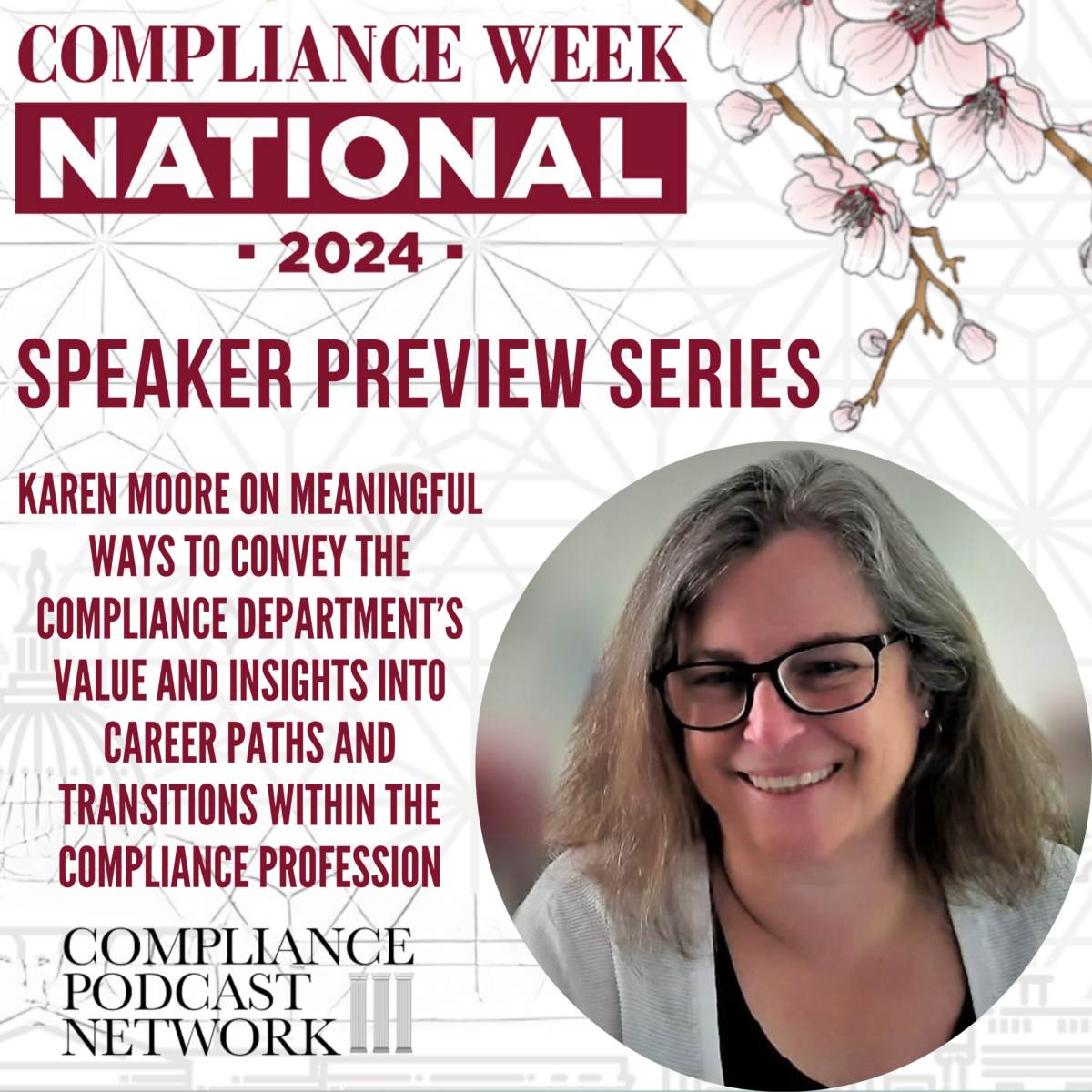
Compliance Week 2024 Speaker Preview Podcasts – Karen Moore on Meaningful Ways to Convey the Compliance Department’s Value

In this episode of the Compliance Week 2024 Speaker Preview Podcasts series, Karen Moore discusses her panel at Compliance Week 2024, “Meaningful Ways to Convey the Compliance Department’s Value.” Some of the issues she will discuss in this podcast and her presentation are:

  • What is the value of your compliance program?
  • ROI of compliance and beyond
  • Seeing old friends and learning about new best practices at Compliance Week 2024

I hope you can join me at Compliance Week 2024. This year’s event will be held April 2-4 at the Westin Washington, DC, Downtown. The line-up is first-rate, with some top ethics and compliance practitioners around.

Gain insights and make connections at the industry’s premier cross-industry national compliance event, offering knowledge-packed, accredited sessions and take-home advice from the most influential leaders in the compliance community. Back for its 19th year, join 500+ compliance, ethics, legal, and audit professionals who gather to benchmark best practices and gain the latest tactics and strategies to enhance their compliance programs. Compliance, ethics, legal, and audit professionals will gather safely face-to-face to benchmark best practices and gain the latest tactics and strategies to enhance their compliance programs, among many others, to:

  • Network with your peers, including C-suite executives, legal professionals, HR leaders, and ethics and compliance visionaries.
  • Hear from 80+ respected cross-industry practitioners, including CEOs, CCOs, regulators, federal officials, and practitioners, to help inform and shape the strategic direction of your enterprise risk management program.
  • Hear directly from panels on leadership, fraud detection, confronting regulatory change, abiding by cross-border rules and regulations, and the always-favorite fireside chats.
  • Bring actionable takeaways from various session types, including cyber, AI, Compliance, Board obligations, data-driven compliance, and many others, to your program for you to listen, learn, and share.
  • Compliance Week aims to arm you with information, strategy, and tactics to transform your organization and career by connecting ethics to business performance through process augmentation and data visualization.

I hope you can join me at the event. For information on the event, click here. As an extra benefit to listeners of this podcast, Compliance Week is offering a $200 discount on the registration price. Enter the discount code TFOX2024 for $200 off.

The Compliance Podcast Network produces the Compliance Week 2024 Preview Podcast series. Compliance Week sponsors this series.

Categories
The ESG Report

The ESG Report: EV Battery Regulation and Compliance in The US & EU-Part 2, Impact of the Inflation Reduction Act

The ESG Report podcast is hosted by Tom Fox. In this special 3-part series, I take a deep dive into EV battery regulation in the US and EU.

In Part 2, we consider the impact of the Inflation Reduction Act on EV battery production and purchase.  Pamela Fierst-Walsh is a prominent voice in critical mineral supply chain issues and a recognized leader in policy development, ESG issues, and international affairs.  From 2017-2021, Pamela drove the reorientation of U.S. diplomacy toward prioritization of minerals supply chains as the U.S. State Department’s Senior Advisor for Critical Minerals.  She coordinated the U.S. Departments of Commerce, Defense, and Energy worked together to support National Security and Economic Council agendas.  In June 2021, she played a key role in shaping the Biden Administration’s 100-day Supply Chain Review on Building Resilient American Supply Chains to improve U.S. competitiveness for clean energy and technological advancement, which set the foundation for greater U.S. clean energy investment under the 2022 Inflation Reduction Act and other acts.  She regularly advises senior U.S. officials, private sector actors, and foreign counterparts.  In 2023, she joined the Board of IMPACT, a non-profit organization focused on empowering communities through greater governance of the natural resources they rely upon.  She is the CEO of PFW Advisory, LLC, and is based in Washington, DC.

Pamela’s perspective on the Inflation Reduction Act, especially on the consumer tax incentives for EV battery purchases, is shaped by her deep understanding of supply chain dynamics, regulatory requirements, and the legislation. She views the Act as an excellent opportunity for consumers to significantly reduce the cost of EV battery purchases, while also stipulating manufacturers track and ensure the traceability of components in their supply chains for compliance with the Act. She underlines the broader implications of the Act, which, beyond consumer incentives, nudge manufacturers to adapt their supply chain practices and consider potential reputational risks associated with non-compliance. Pamela sees the Inflation Reduction Act as a multifaceted initiative that benefits consumers and prompts manufacturers to align their operations with regulatory requirements and evolving business norms.


Key Highlights:

  • EV Battery Discount and Supply Chain Transparency
  • Strategic Resource Control for Domestic Manufacturing
  • Critical Minerals Supply Chain Compliance Standards
  • Due Diligence and Compliance

 Resources:

Pamela Fierst-Walsh on LinkedIn

Tom Fox

Connect with me on the following sites:

Instagram

Facebook

YouTube

Twitter

LinkedIn

Categories
Blog

DAG Monaco at ABA White Collar Conference: Self-Disclosure, Wanted Posters and AI

There were recently two significant speeches by Department of Justice (DOJ) officials at the American Bar Association National Institute on White Collar Crime. The first was by Deputy Attorney General Lisa Monaco. The second was by Acting Assistant Attorney General Nicole Argentieri. They both had important remarks for the compliance professional. Over the next few blog posts, I will look at both speeches and what they might indicate for compliance and enforcing the Foreign Corrupt Practices Act. Today is the speech by DAG Lisa Monaco.

Self-Disclosure Initiatives

Monaco emphasized the importance of timely self-disclosure for companies to receive benefits under the Corporate Enforcement Policy. This tracks speeches made by DOJ officials over the past 18 months and the most significant enforcement actions over the past 15 months, ABB, Albemarle, SAP, and Gunvor. Monaco restated the incentives in place, “ I want to be clear: no matter how good a company’s cooperation, a resolution will always be more favorable with voluntary self-disclosure. We’ve structured our Voluntary Self Disclosure (VSD) programs to encourage companies to take responsibility for misconduct within their organizations. And we’ve conditioned benefits on the company’s willingness to step up and own up—requiring it to disgorge profits, upgrade compliance systems, and cooperate in investigations of culpable employees.”

Monaco also pointed to two separate US Attorney’s Offices, which have initiated their own self-disclosure programs. She stated, “At least two U.S. Attorney’s Offices — led by the Southern District of New York and recently the Northern District of California — are piloting initiatives that are, in essence, voluntary self-disclosure programs for individuals. Both offer non-prosecution agreements to certain categories of at-fault individuals who self-disclose wrongdoing and cooperate against other, more culpable targets. We look forward to evaluating the results of these pilots and determining what’s to come later this year.”

 DOJ Whistleblower Program-Modern Day Wanted Posters

The next area is a new DOJ whistleblower initiative. The money line from her talk was, “Going back to the days of “Wanted” posters across the Old West, law enforcement has long offered rewards to coax tipsters out of the woodwork.” She added, “Today, we’re announcing a program to update how DOJ uses monetary rewards to strengthen our corporate enforcement efforts.” How will the DOJ incentivize this program? The short answer is money.

The DOJ has recognized that paying bounties is a surefire method to attract whistleblowers. She pointed to the examples of Dodd-Frank whistleblower programs at the SEC and the CFTC. She said, “Those agencies have received thousands of tips, paid out many hundreds of millions of dollars, and disgorged billions in ill-gotten gains from corporate bad actors.” There are other similar programs at different agencies and departments, such as the IRS and FinCen, as well as through qui tam actions. “These programs have proven indispensable — but they resemble a patchwork quilt that doesn’t cover the whole bed. They don’t address the full range of corporate and financial misconduct that the Department prosecutes.”

The DOJ will offer payments under four parameters:

  • Only after all victims have been properly compensated;
  • Only to those who submit truthful information not already known to the government;
  • Only to those not involved in the criminal activity itself and
  • Only in cases without an existing financial disclosure incentive — including qui tam or another federal whistleblower program.

Monaco also offered the types of areas the DOJ wants to focus its whistleblower initiative around:

  • Criminal abuses of the U.S. financial system;
  • Foreign corruption cases outside the jurisdiction of the SEC, including FCPA violations by non-issuers and violations of the recently enacted Foreign Extortion Prevention Act,
  • Domestic corruption cases, especially involving illegal corporate payments to government officials.

The DOJ will engage in a 90-day “Policy Sprint” to develop and implement a pilot program, with a formal start date later this year. But the premise should be simple: ” If an individual helps DOJ discover significant corporate or financial misconduct—otherwise unknown to us—then the individual could qualify to receive a portion of the resulting forfeiture.”

Monaco ended with a message for whistleblowers and corporations: “With these announcements, our message to whistleblowers is clear: the Department of Justice wants to hear from you. And to those considering voluntary self-disclosure, our message is equally clear: knock on our door before we knock on yours. “

Justice AI

Recognizing that “all new technologies are a double-edged sword—but AI may be the sharpest blade yet,” Monaco announced that the DOJ would seek sentencing enhancements to increase penalties for criminals whose conduct uses or includes AI. She stated, “Where AI is deliberately misused to make a white-collar crime significantly more serious, our prosecutors will seek stiffer sentences—for individual and corporate defendants alike.”

She went on to add that “compliance officers should take note. When our prosecutors assess a company’s compliance program — as they do in all corporate resolutions — they consider how well the program mitigates its most significant risks. And for a growing number of businesses, that now includes the risk of misusing AI.” To assist compliance professionals with this new area of responsibility, she said that “assessment of disruptive technology risks — including risks associated with AI — into its guidance on Evaluation of Corporate Compliance Programs.”

Cliff Notes

For those old enough to know what Cliff Notes were, Monaco ended with the following:

First, we’re continuing to execute our core strategy: invest the most significant resources in the most serious cases, hold individuals accountable, and pursue tough penalties for repeat offenders.

Second, we’re using carrots and sticks to encourage companies to step up, own up, and report misconduct to the government. With a first-in-the-door strategy, we’re making it clear that neither companies nor individuals can afford to sit on evidence of wrongdoing.

Third, we’re designing our whistleblower rewards program as part of our broader effort to fill gaps and innovate in this space. Stay tuned.

And finally, we’re applying DOJ tools to new, disruptive technologies — like addressing the rise of AI through our existing sentencing guidelines and corporate enforcement programs.

Join me tomorrow as I look at Nicole Argentieri’s speech.

Categories
Principled Podcast

S11E3: Evolving E&C Programs in the UK: Navigating Complex Risks and Global Best Practices

What you’ll learn on this podcast episode

In this episode of the Principled Podcast, Gaby Gray, Head of Legal at Alliance Pharma, joins host Frances Ibekwe, LRN’s Senior E&C Advisor and Barrister, to discuss insights from LRN’s 2024 Ethics & Compliance Program Effectiveness Report with a focus on the UK region. As organizations worldwide face escalating risks, the report underscores the pivotal role of values-based E&C programs in mitigating these challenges. Drawing from global data and insights from over 1,400 E&C professionals, they discuss the effectiveness of such programs in risk reduction and driving positive business outcomes. Tune in as they delve into the evolving landscape of E&C programs in the UK, examining practical best practices for implementation and offering valuable insights for navigating ethical challenges and achieving compliance excellence locally and globally.

Get a copy of the UK edition of LRN’s 2024 Ethics & Compliance Program Effectiveness Report.

Guest: Gaby Gray

Principled Podcast - Gaby Gray - Alliance Pharmaceuticals

Gaby Gray is Head of Legal for Alliance Pharma, a global consumer healthcare company. Starting her legal career in private practice at a UK magic circle firm, Gaby has worked in the industry for 18 years as an in-house lawyer at FTSE 100 and 250 global corporations. Her interests include yoga, books, British country houses, and Greek mythology

Host: Frances Ibekwe

Frances Ibekwe - Grayscale

Frances Ibekwe is a barrister and Senior Ethics & Compliance Advisor at LRN. She is a subject-matter expert in advising, managing, monitoring, and training on ethics, compliance, risk, and legal matters. Frances helps companies implement effective ethics and compliance programs through our advisory services, which include evaluating programs, reinventing/simplifying codes of conduct, and training/communication strategies. Before joining LRN, Frances was a litigator in government practice for the Serious Fraud Office and an in-house compliance lawyer for companies including Cushman & Wakefield, Christie’s, and TikTok. Frances received her law degree from King’s College London with an Erasmus year spent at KU Leuven, Belgium, her Master’s degree in international law from University College London, and the Bar Vocational Course from City, University of London. She also has an Award in Management and Leadership from the Chartered Management Institute. Her hobbies include sports, dance, and languages.

Categories
Great Women in Compliance

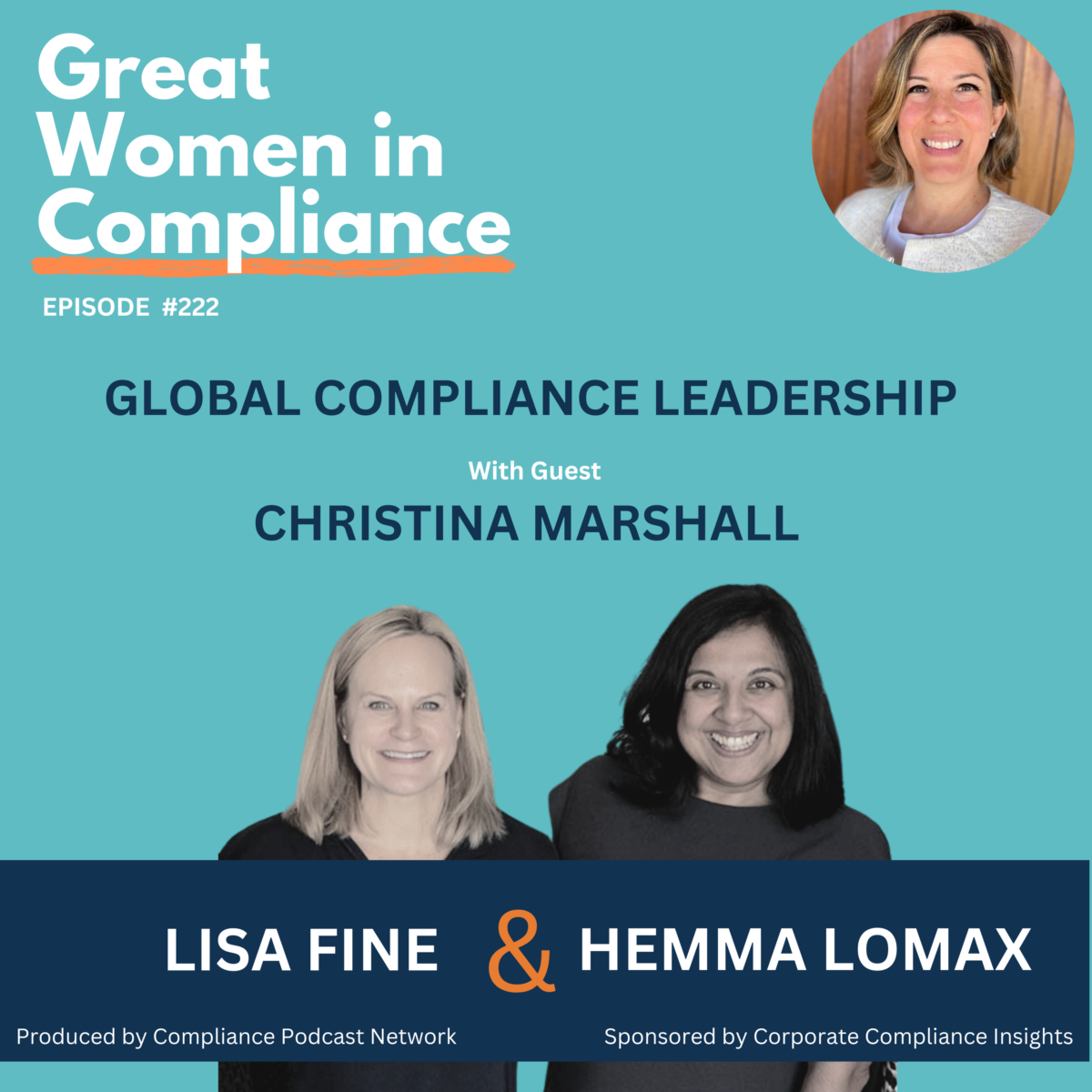
Great Women in Compliance – Christina Marshall on Global Compliance Leadership

Welcome to the Great Women in Compliance Podcast. In this episode, we visit Christina Marshall, an experienced ethics and compliance leader with extensive experience working with US and foreign regulators. Her expertise is in fraud and corruption investigations, risk assessments, and operationalizing compliance in complex global organizations. She currently leads the Oracle EMEA Compliance team, which is responsible for driving compliance through Europe, the Middle East, and Africa. She is a US-trained litigator with a Juris Doctor from Fordham University School of Law.

Christina has worked in private practice as well as as a senior counsel within the Division of Enforcement at the Securities Exchange Commission, which is responsible for investigating violations of the FCPA. Her extensive experience also includes teaching as a professor of Securities Regulation, White Collar Crime, Corporations and American Law. Based on her extensive experience, Christina is highly skilled in investigating procurement fraud, money laundering, and corruption, leading risk assessments, and creating preventative compliance practices.

Christina’s perspective on compliance best practices is that it should function as a partnership with the business, focusing significantly on transparency and support for business leaders, rather than acting as the ‘police’. Her knowledge in this area has been shaped by her prior experience at the US Securities and Exchange Commission’s Division of Enforcement and her extensive engagement with regulators worldwide. Additionally, her time spent teaching law in Russia has enriched her global perspective. She emphasizes the necessity of involving business partners in risk mitigation, with an emphasis on fostering trust and respect, particularly during challenging investigations.

Key Highlights:

  • Collaborative Approach to Achieving Compliance Goals
  • Efficient Risk Management Through Practical Prioritization
  • Fostering Trust Through Investigative Transparency
  • Encouraging Curiosity and Open Communication Culture
  • Global Compliance Strategies in Multinational Operations
  • Tailoring Compliance Programs for Regional Teams
  • Enhancing Compliance Practices Through Root Cause Analysis
  • Enhancing Efficiency Through Clear Communication

Resources:

Join the Great Women in Compliance community on LinkedIn here.

Categories
Charged Up Studio Podcast

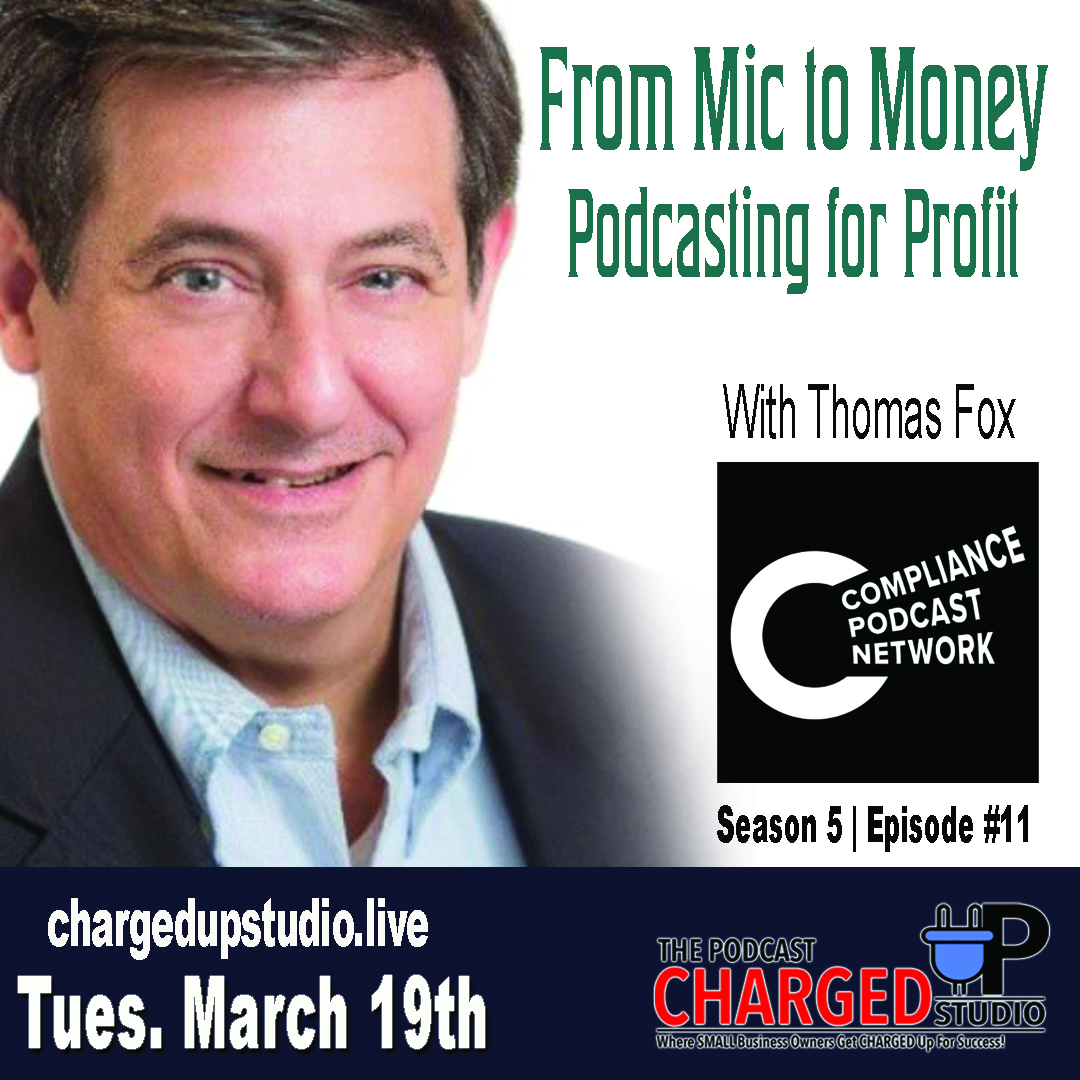
From Mic to Money! Podcasting for Profit

Welcome to Charged Up Studio’s latest podcast episode, where we explore innovation and elevation in product development. This month, we continue focusing on taking the Digital Leap: Navigating the Future of Business Transformation.

Tom Fox, CEO and host of the Compliance Podcast Network joined Danna Olivo, host of the Charged Up Studio Podcast, for this episode. Tom Fox is a trailblazer in the podcasting realm, particularly in the niche of compliance and ethics. Through his innovative approach, he has provided a platform for thought leaders to share their expertise and paved the way for monetization within the podcasting landscape.

Stay tuned in to find out some of the lessons learned and tips Tom has to offer on launching and growing a podcast network. Here’s what you can expect to learn:

  • The Power of Podcasting | Why has it emerged as one of the most powerful mediums for communication and engagement in the digital age?
  • Navigating the Compliance Podcast Network | The inception and evolution of this pioneering platform that caters to professionals in compliance, ethics, and corporate governance.
  • Monetizing Your Podcast | Learn the strategies and tactics for monetizing your podcast effectively.
  • Building a Sustainable Podcasting Business | What are the essential ingredients for a sustainable podcasting business model?
  • Future Trends and Opportunities | Gain foresight into the future trends and emerging opportunities within the podcasting industry.

Whether you are a seasoned podcaster looking to enhance your monetization strategies or a newcomer eager to unlock the full potential of podcasting for profit, this episode is a must-listen. Join us as we embark on a journey of discovery and empowerment in podcasting with Tom Fox at Charged Up Studio.

For inquiries or to connect with Tom, reach out through the links below.

linkedin.com/in/thomasfox13
compliancepodcastnetwork.net 
tfox@tfoxlaw.com
832-744-0264

Categories
Daily Compliance News

Daily Compliance News: March 20, 2024 – The There Were Tapes Edition

Welcome to the Daily Compliance News. Each day, Tom Fox, the Voice of Compliance, brings you compliance-related stories to start your day.

Sit back, enjoy a cup of morning coffee and listen to the Daily Compliance News. All from the Compliance Podcast Network.

Each day, we consider four stories from the business world: compliance, ethics, risk management, leadership, or general interest for the compliance professional.

In today’s edition of Daily Compliance News:

  • Vitol Trading corruption agents were caught on videotape discussing their bribery and corruption. (Bloomberg)
  • SEC settles first AI washing enforcement. (WSJ)
  • Bernie’s not the first. (WaPo)
  • Adani Green says there is no DOJ investigation notice.  (Bloomberg)

For more information on the Ethico ROI Calculator and a free White Paper on the ROI of Compliance, click here.