Categories
The Hill Country Podcast

The Hill Country Podcast – Loren Steffy on the 88th Texas Legislative Session

Welcome to award-winning The Hill Country Podcast. The Texas Hill Country is one of the most beautiful places on earth. In this podcast, Hill Country resident Tom Fox visits with the people and organizations that make this the most unique areas of Texas. Join Tom as he explores the people, places and their activities of the Texas Hill Country.

The 88th Texas Legislature recently concluded its biennial session and two special sessions, focusing on property tax relief, water infrastructure, and the electricity grid. The proposed property tax relief was a welcome move, and Patrick was on the right track with his proposal to ensure homeowners don’t lose their homes due to high tax rates. The legislature ultimately came up with a dual approach, which is a compromise, and homeowners will be glad to see some relief from the property taxes.

Sadly, the impeachment of Ken Paxton took the air out of all other legislative work. Paxton has been under indictment for a long time, and nobody on the Republican side seemed to care until he asked for state funds to pay for his legal settlement. It took a long time for state leaders to take action, and it shouldn’t have taken this much effort. The impeachment trial will be held in the Senate later this summer.

Tom Fox and Loren Steffy discussed the importance of access to education and public services in remote areas. Tom Fox’s junior high school history teacher posited that the American high school created the American middle class. The founding fathers of America wanted to get away from the class system and believed that with access to education, anyone can be anything. The founding fathers of the Republic of Texas, Mirabeau Lamar and Anson Jones, set aside land in every township for K-12 education. The disagreement between the governor and lieutenant governor of Texas was over how to reform property taxes or give people a break. The governor wanted to subsidize school property taxes, while the lieutenant governor wanted to raise the homestead exemption. The governor also wanted to take public funds to fund private education, but he did not get what he wanted.

The transfer of wealth from taxpayers to private companies running schools with less accountability than public schools was a major concern. Rural Republican and urban Democratic voters united in opposition to school vouchers. There was an argument that private schools would take away access to best athletes for rural football teams. There was also an analogy to rural hospitals closing due to lack of cost effectiveness. There was a potential for the education system to become exclusive and elite, and it would also lead to the draining of healthcare facilities in rural areas.

Tom Fox and Loren Steffy also discussed Tom’s book, The Big Empty. Steffy is starting a series called Podcasts in Print. The first Podcasts in Print will be the discussion between Tom and Loren about The Big Empty. It will be released in early August, and Loren is looking forward to its release.

This episode provided an insightful look into the issues facing Texas and the importance of access to education and public services in remote areas. The legislature’s efforts to provide property tax relief and the impeachment of Ken Paxton are two major issues that will have an impact on the state. Podcasts in Print series will be a great way to explore these topics further.

 Key Highlights

·       Assessment of the 88th Legislature

·       Property Tax relief

·      School Vouchers

·      Rural Texas

·      Ken Paxton impeachment by Texas House

 Resources

Loren Steffy

Stoney Creek Publishing

Tom Fox

Instagram

Facebook

YouTube

Twitter

LinkedIn

Categories
31 Days to More Effective Compliance Programs

One Month to a More Effective Compliance Program: Day 21 – Ten Compliance Questions To Pose To HR

As we end this month on the intersection of HR and compliance, I have developed a series of goals and objectives which you might want to use as a starting point for operationalizing your compliance initiatives through your corporate HR function.

  1. How are compliance goals cascaded down to individual workers?
  2. Does anyone complain that your compliance targets are too complex?
  3. How do you deal with repeated compliance failures in a specific business segment or compliance program area?
  4. How does your company show that attracting and developing talent who will engage in ethical business conduct is a top priority?
  5. How long is compliance underperforming tolerated?
  6. What makes it distinctive to work at your company?
  7. How do compliance programs that are not working typically get exposed and remediated?
  8. What key compliance indicators do you use for compliance tracking?
  9. For a given compliance problem, how do you identify the root cause?
  10. What are you doing to retain your top employees from the compliance perspective?

Compliance practitioners continually face the challenge of keeping up with the ever-evolving compliance best practices with little or no budget increase. By asking yourself and of your compliance program these questions you may create a road map to more fully operationalize your compliance regime.

Three key takeaways:

  1. What are the unique compliance targets you have set and how interconnected are they to your business unit goals?
  2. Use a root cause analysis to determine why compliance initiatives are not successful.
  3. Retraining employees in compliance is an under-utilized tool.

For more information, check out The Compliance Handbook, 4th edition, here.

Categories
Blog

3M in China-Where Secret Travel = FCPA Violations

You know that when the Securities Exchange Commission (SEC) uses the word ‘secretly’ when discussing a corporate program, it is a seriously not good look. That is certainly the case in the recently announced Foreign Corrupt Practices Act (FCPA) enforcement action involving 3M’s Chinese business unit. In an Order, outlining the facts and FCPA violations it stated, “During the Relevant Period, a former 3M-China marketing manager (the “Marketing Manager”) colluded with two China-based travel agencies (the “China Travel Agencies”) to secretly provide Tourism Activities for Chinese Government Officials during Educational Events. The Marketing Manager was aided in the scheme by several employees in 3M-China’s sales, marketing and professional services departments.” [emphasis supplied] For its ‘secret’ scheme without admitting or denying the SEC’s findings, 3M agreed to pay $4.5 million in prejudgment interest and disgorgement and a civil penalty of $2 million or a total of $6.5 million.

Background

The Order recited that certain 3M-China Employees targeted influential officials of Chinese state-owned enterprises and Chinese Government Officials for attendance at overseas Educational Events and, in collusion with the China Travel Agencies. To facilitate this scheme, 3M-China Employees would create a travel itinerary that included various legitimate business, training and marketing activities for submission to 3M-China’s compliance personnel for approval. However there were “alternate itineraries (the “Alternate Itineraries”)” planned which consisted of various Tourism Activities at or near the location of the Educational Events. There were free travel and lodging provided which “were designed to improperly induce the Officials to purchase 3M products, and violated company policy.”

Interestingly, the 3M-China Employees circulated the Alternate Itineraries through hand delivery or personal WeChat accounts or ephemeral messaging. The 3M-China Employees asked the participants to keep the agenda hidden, and falsified internal compliance documents so that the Tourism Activities were not shown to be planned as part of the overseas trip.

There were several indicia which demonstrated the travel was not for business purposes but for recreational purposes. From the Order it stated

(a) Tourism Activities were scheduled at the same time as the Educational Event activities;

(b) the ostensibly Educational Events were in English, and the trips included Chinese Government Officials who neither understood English nor had adequate translation services;

(c) at times Chinese Government Officials missed whole days of the Educational Event or simply never attended at all; and

(d) Certain Chinese Government Officials also requested Tourism Activities as part of the overseas trip.

To fund these illegal activities, 3M-China Employees would at times work with the collusive China Travel Agencies to inflate their billing invoices for ostensibly legitimate expenses such as  travel costs. In other instances, the 3M-China Employees submitted unpermitted invoices directly to the China Travel Agencies for reimbursement rather than to 3M China. Finally, the China Travel Agencies, with the support of the 3M-China Employees, at times directed that 3M-China’s distributors pay for portions of the non-reimbursable expenses. Rather stupidly from a legal and compliance perspective, 3M China employees measured the impact that this corruption had on sales. They tracked the effect of providing overseas travel on 3M-China’s sales to SOE Customers. One 3M-China Employee tracked post-trip sales “to ensure they were consistent with 3M-China’s sales goals. Most amazingly “3M-China management asked for the “return on investment” from an Educational Event (i.e. the effect of providing health care officials with overseas travel on sales to the SOE Customer) by comparing sales figures before and after an Educational Event.”

Finally, “from at least 2014 through 2017, 3M-China paid nearly $1 million to fund at least 24 trips for Chinese Government Officials that included Tourism Activities. The costs of these trips were improperly recorded in 3M’s books and records as legitimate business expenses, without any indication that they included Tourism Activities. As a result of the above conduct, 3M improperly benefited by at least $3.5 million from increased sales.”

Discussion

There are several key lessons to be garnered from this FCPA enforcement action. One key lesson from this case is that if your organization is paying for attendance at educational events, the value of rigorous post-event documentation, such as sign-in sheets and attendance verification is critical. By ensuring that officials were present at the events they are paid for, transparency is enhanced, and corruption can be prevented as your employee base will know that compliance is providing oversight and monitoring. This approach draws from the pharmaceutical sector, which has implemented stringent event monitoring practices.

The importance of post-event documentation and monitoring extends beyond coruption prevention. It also plays a crucial role in compliance efforts. By thoroughly documenting events and activities, companies can demonstrate their commitment to ethical business practices and compliance with regulations. This documentation serves as evidence of due diligence and can be invaluable in audits and investigations.

However, compliance professionals must strike a balance between the level of control and the resources required for documentation. While it is essential to have robust controls in place, excessive bureaucracy can hinder efficiency and productivity. Finding the right balance is crucial to ensure compliance without impeding business operations.

Another challenge lies in the use of ephemeral messaging, as seen in the Three M China case. Ephemeral messaging platforms, which automatically delete messages after a certain period, can raise concerns about transparency and compliance. While these platforms may have legitimate uses in private communications, their use in a corporate setting can be seen as a less than transparent attempt to conduct business ethically. Compliance professionals should carefully consider the implications of using such platforms and evaluate whether they align with their organization’s compliance objectives.

Data analytics also play a significant role in post-event documentation and monitoring. By leveraging advanced analytics tools, companies can detect patterns and anomalies that may indicate fraudulent activities. For example, multiple payments to the same vendor by different entities within the extended enterprise can be a red flag worth investigating. Implementing robust data analytics capabilities can enhance the effectiveness of post-event monitoring and help identify potential compliance risks.

In conclusion, the 3M China FCPA enforcement action underscores the importance of post-event documentation and monitoring in fraud prevention and compliance efforts. Rigorous documentation practices, inspired by the pharmaceutical sector’s approach, can enhance transparency and prevent corruption. However, finding the right balance between control and efficiency, addressing challenges associated with ephemeral messaging, and leveraging data analytics are crucial for effective post-event documentation and monitoring. By prioritizing these factors, companies can strengthen their compliance programs and mitigate the risks associated with fraudulent activities.


Categories
Innovation in Compliance

Innovation in Compliance – Oshri Cohen on the Role of a CTO in Compliance

The role of a Chief Technology Officer (CTO) in compliance and data governance is explored in this podcast episode between Tom Fox and Oshri Cohen. They discuss the varying responsibilities of a CTO based on company size, with larger organizations focusing on strategic planning while smaller organizations have the CTO as the head engineer. The importance of the CTO in managing risks, particularly in industries like healthcare and finance, is emphasized, along with the role of the board in providing oversight. The conversation also delves into the significance of data strategy, compliance, and data governance, emphasizing the need for collaboration between the CTO and the Chief Compliance Officer (CCO). Technical due diligence and the establishment of a data commission within organizations are suggested as strategies for effective data governance. Overall, the conversation highlights the crucial role of the CTO in ensuring compliance and protecting sensitive information.

  • The Role of a CTO in Compliance
  • Data Strategy and Compliance
  • Data Governance Challenges
  • Data Governance and Startups
  • Risks in System Audits

 Resources:

Oshri Cohen on LinkedIn

Tom Fox

Instagram

Facebook

YouTube

Twitter

LinkedIn

Categories
Daily Compliance News

Daily Compliance News: August 29, 2023 – The $6bn Edition

Welcome to the Daily Compliance News. Each day, Tom Fox, the Voice of Compliance brings to you compliance related stories to start your day. Sit back, enjoy a cup of morning coffee and listen in to the Daily Compliance News. All, from the Compliance Podcast Network. Each day we consider four stories from the business world, compliance, ethics, risk management, leadership or general interest for the compliance professional.

·       3M to pay $6bn in ear plug settlement.  (WSJ)

·       US does not want to ‘de-couple’ from China.  (NYT)

·       Regional Spanish soccer chiefs demand Rubiales resignation. (ESPN)

·       Non-lessons learned from cyber war in Ukraine. (FT)

Categories
All Things Investigations

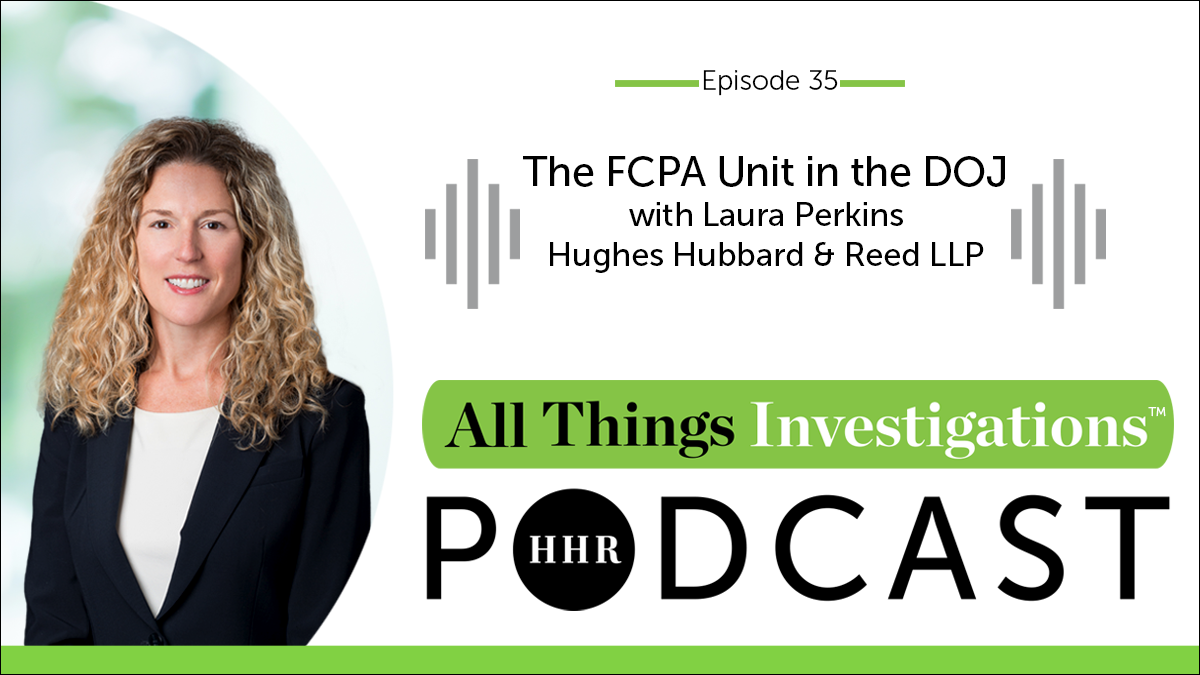
All Things Investigations: The FCPA Unit in the DOJ with Laura Perkins

In this episode of All Things Investigations, Tom Fox and Laura Perkins delve into the workings of the FCPA unit within the fraud section of the Department of Justice. This unit, pivotal in investigating and prosecuting Foreign Corrupt Practices Act violations, operates within a robust hierarchy and collaborates extensively with other agencies.

Laura Perkins is a Hughes Hubbard partner whose practice focuses on representing clients in Foreign Corrupt Practices Act and white collar criminal investigations. She also advises clients on issues related to the FCPA, the federal securities laws, the False Claims Act, and other federal statutes. 


You’ll hear Tom and Laura discuss:

  • There was a recent transition in leadership within the DOJ’s FCPA unit, with an acting head taking the reins. Such changes can potentially shift the direction or focus of the unit.
  • The FCPA unit maintains a collaborative approach, liaising closely with other agencies such as the IRS, FBI, and the Department of State, ensuring a holistic investigative process.
  • Despite being two distinct units, the DOJ’s FCPA and the SEC’s FCPA work closely during parallel investigations. However, certain limitations arise from grand jury issues, preventing complete sharing.
  • Operating within the fraud section, this unit plays an instrumental role in evaluating corporate compliance programs, selecting compliance monitors, and contributing to policy developments and department-wide initiatives.
  • The Corporate Enforcement, Compliance, and Policy Unit has the task of handling FOIA requests, underscoring its role in promoting transparency and information access.
  • The relationship between the chief of the FCPA unit and the head of the fraud section is important as their interactions can potentially influence the direction and outcome of cases.
  • The fraud section provides weekly case summaries to the Deputy Assistant Attorney General’s office. This demonstrates the department’s diligent and ongoing monitoring and reporting system.
  • The FCPA unit doesn’t operate in isolation; it partakes in international collaborations on bribery issues, highlighting its commitment to global anti-corruption efforts.


KEY QUOTES

“[In] the FCPA unit, prosecutors and supervisors handle investigations and cases involving Foreign Corrupt Practices Act or potential Foreign Corrupt Practices Act violations.” – Laura Perkins


“[The DOJ and SEC have] a very close relationship, and often cases are worked in parallel, not necessarily jointly, because there are potential discovery issues that can be created if it’s a joint investigation.” – Laura Perkins


“The [Corporate Enforcement, Compliance and Policy Unit] has a major role in assisting prosecutors in evaluating corporate compliance programs as well as overseeing any compliance monitors that are put in place.” – Laura Perkins


Resources

Hughes Hubbard & Reed website 

Laura Perkins on LinkedIn

Categories
Daily Compliance News

Daily Compliance News: August 28, 2023 – The Spanish Kiss Edition

Welcome to the Daily Compliance News. Each day, Tom Fox, the Voice of Compliance brings to you compliance-related stories to start your day. Sit back, enjoy a cup of morning coffee, and listen in to the Daily Compliance News. All, from the Compliance Podcast Network. Each day we consider four stories from the business world, compliance, ethics, risk management, leadership, or general interest for the compliance professional.

  • 3M settles FCPA action? (WSJ)
  • Imprisoned Kazakh tycoon may be released. (RFE/RL)
  • Do you really need incentives to operate safely? (Reuters)
  • FIFA suspends head of Spanish football. (FT)
Categories
31 Days to More Effective Compliance Programs

One Month to a More Effective Compliance Program: Day 20 – Gap Analysis for HR

Join Tom Fox in this episode of the 31 Days to a More Effective Compliance Program podcast to delve deeper into the significant role of HR in implementing compliance programs. Hopefully you now understand that many of the traditional functions of Human Resources (HR) can be seen as compliance internal controls. At every touchpoint in the lifecycle of the employment relationship there is a HR touchpoint. Fulfilling those touchpoints can be controls for compliance. If you think of multiple HR functions as compliance internal controls, one of the questions becomes how can you determine if HR is meeting the standards of a best practices compliance program? One place to start is with a gap analysis to determine what HR has in place that can facilitate your company’s compliance program.

The role of HR in implementing compliance programs is a critical aspect of maintaining best practices within an organization. Traditional HR functions can serve as compliance internal controls, and that every touch point in the employment relationship can serve as a control for compliance. Fox’s insights are derived from his extensive experience and deep understanding of the compliance and HR environment. He emphasizes the importance of conducting a comprehensive gap analysis and fostering collaboration between HR and business units to enhance the compliance program.

Finally, work with HR to create a consolidated Human Resources Compliance Audit Checklist that can be used to audit (and document) the company’s HR Compliance Program. The key to compliance, in my opinion, is having the proper structure to identify the issues, implement policies and procedures to address the issues, audit for compliance and “Document, Document, and Document”.

 Three key takeaways:

  1. A gap analysis is a key component in the risk assessment process.
  2. The ultimate responsibility should lie with the business units and functional discipline to fully operationalize compliance.
  3. The role of the compliance department is to oversee, provide subject matter expertise and coordinate.


For more information, check out The Compliance Handbook, 4th edition, here.

Categories
Adventures in Compliance

Adventures in Compliance – Leadership Lessons from The Adventure of the Engineer’s Thumb

Welcome to a review of all the Sherlock Holmes stories which are collected in the work, “The Adventures of Sherlock Holmes.” The appeared in the Strand Magazine from July 1891 to June 1892. Over 12 episodes, I will be reviewing each story and mine them for leadership, compliance and ethical lessons.  In this episode, I consider story of “The Adventure of the Engineer’s Thumb” which was originally published in the Strand Magazine in March 1892 and is a part of the collection ‘The Adventures of Sherlock Holmes’.

Summary

Hatherley visits Holmes with a peculiar tale. He recounts his recent experience where he was hired by a man named Colonel Lysander Stark to repair a hydraulic press at his country house. However, things take an alarming turn when Hatherley discovers that the press is not being used for its intended purpose but rather to manufacture counterfeit coins.

Realizing the danger he is in, Hatherley attempts to escape, but he is caught by Stark and his accomplice. In a struggle, Hatherley manages to free himself, but not before his thumb is severed by Stark with a cleaver. Bleeding and desperate, Hatherley seeks assistance from Holmes to bring the criminals to justice and recover his thumb.

Holmes and his trusted associate Dr. John Watson investigate the matter. They discover that Stark is a member of a criminal gang involved in counterfeiting coins. With Holmes’ guidance, Hatherley’s thumb is reattached, and the detectives devise a plan to expose Stark and his operation.

Disguised as potential investors, Holmes and Watson visit Stark’s house. They gather evidence, unravel the gang’s secrets, and narrowly escape a dangerous confrontation. In the end, the authorities apprehend Stark and his gang members, putting an end to their counterfeiting activities.

“The Adventure of the Engineer’s Thumb” showcases Holmes’ deductive reasoning and quick thinking as he helps Victor Hatherley navigate a dangerous situation. The story highlights the detective’s ability to solve complex cases and bring criminals to justice while also emphasizing the importance of the thumb as a key piece of evidence in unraveling the mystery.

Leadership Lessons

1.         Attention to detail: Sherlock Holmes is known for his attention to detail, and this is evident in “The Adventure of the Engineer’s Thumb.” He is able to solve the mystery by paying close attention to small details that others have overlooked. Compliance professionals can learn from this by focusing on the details and not overlooking anything that could be important.

2.         Problem-solving skills: Holmes is a master of problem-solving, and this is demonstrated in the story as he unravels the mystery of the engineer’s thumb. Compliance professionals can learn from this by developing their problem-solving skills and approaching challenges with a creative and analytical mindset.

3.         Teamwork: Although Holmes is the main detective in the story, he works with others, including Dr. John Watson, to solve the case. Leaders in business can learn from this by recognizing the importance of teamwork and building strong relationships with their colleagues.

4.         Adaptability: Throughout the story, Holmes demonstrates his ability to adapt to changing circumstances and adjust his approach as needed. Compliance professionals can learn from this by being flexible and open-minded, and by recognizing that there may be multiple solutions to a problem.

5.         Communication skills: Throughout the story, Holmes effectively communicates with others to gather information and solve the case. Compliance professionals can learn from this by developing their communication skills and being clear and concise in their interactions with others.

6.         Risk management: in the story, the engineer’s thumb is a result of a failed business deal. Compliance professionals can learn from this by recognizing the importance of risk management and by taking steps to minimize potential risks in their operations.

Resource

The New Annotated Sherlock Holmes

Categories
FCPA Compliance Report

FCPA Compliance Report – Jason Patel on Leveraging and Protecting Data

Welcome to the award-winning FCPA Compliance Report, the longest running podcast in compliance. In this episode, Tom Fox welcomes Jason Patel as they delve into the critical aspects of go-to-market security, market intelligence security, and customer privacy enforcement in today’s digital world.

 They discuss the importance of protecting businesses and customers’ experiences, leveraging data for security and marketing strategies, and ensuring compliance with privacy legislation like GDPR and CCPA. They highlight the services offered by Cheq.ai, a company specializing in go-to-market security, and stress the need for real-time compliance and a transparent approach involving various stakeholders. The conversation also explores the risks of relying solely on vendors for compliance and the impact of opt-in and opt-out strategies in data privacy. Looking ahead, they predict data privacy to be a leading issue, emphasizing the need for clear and explicit internet regulations to protect businesses and consumers.

 Key Highlights

·      Check: Go-to-Market Security and Customer Privacy Enforcement

·      Designing GDPR-compliant controls

·      Real-time compliance in data tracking

·      The Impact of Opt-In vs Opt-Out Strategies

·      The Future of Internet Regulations

Resources

Cheq.ai

Tom Fox

Instagram

Facebook

YouTube

Twitter

LinkedIn