Categories
31 Days to More Effective Compliance Programs

One Month to More Effective HR in Compliance: Day 5 – Role of HR in Incentivizing Compliance

Welcome to the August edition of One Month to a More Effective Compliance Program. In the month of August, 2023 we will consider the role of Human Resources in a best practices compliance program.

In this episode, Tom Fox explores the role of HR in implementing effective compliance programs within companies. The episode focuses on the importance of incentivizing compliance and ethical behavior through both financial and non-financial incentives. The Department of Justice’s guidance emphasizes the need for positive incentives, such as personal evaluations, promotions, and rewards for ethics and compliance leadership. The podcast discusses various avenues for implementing incentives, including cash bonuses and non-compensation rewards like t-shirts or ethical awards. It emphasizes the role of HR in driving the right behavior through incentive structures and warns against solely promoting based on financial targets. Overall, the podcast highlights the significance of HR in creating a fully operationalized compliance program that fosters an ethical work environment.

 Three key takeaways:

  1. The DOJ 2023 ECCP specifically calls out incentives for doing business ethically and in compliance.
  2. HR can lead the efforts around incentives.
  3. Incentives go beyond financial rewards.

For more information, check out The Compliance Handbook, 4th edition, available on LexisNexis.com.

Categories
Daily Compliance News

Daily Compliance News: August 7, 2023 – The Face, The Music Edition

Welcome to the Daily Compliance News. Each day, Tom Fox, the Voice of Compliance brings to you compliance-related stories to start your day. Sit back, enjoy a cup of morning coffee, and listen in to the Daily Compliance News. All, from the Compliance Podcast Network. Each day we consider four stories from the business world, compliance, ethics, risk management, leadership, or general interest for the compliance professional.

  • Albemarle makes FCPA settlement reserve. (WSJ)
  • Catching pandemic fraudsters. (NYT)
  • Wells, SocGen to settle messaging app violations. (WSJ)
  • Ex-Allianz manager to face $7bn criminal fraud claim. (Reuters)
Categories
Adventures in Compliance

Adventures in Compliance – Compliance Lessons from The Man with the Twisted Lip

Welcome to a review of all the Sherlock Holmes stories which are collected in the work, “The Adventures of Sherlock Holmes.” The appeared in the Strand Magazine from July 1891 to June 1892. Over 12 episodes, I will be reviewing each story and mine them for leadership, compliance and ethical lessons. In this episode, we consider “The Man with the Twisted Lip” which was originally published by the Strand Magazine in December 1891.  

Summary

The story begins when Watson, called out by a friend Mrs. St. Clair, finds himself in an opium den in the East End of London. While attempting to extract his friend, he encounters Sherlock Holmes in disguise. Holmes is there on a different case involving Neville St. Clair, Mrs. St. Clair’s husband, who was reported missing under mysterious circumstances.

Mrs. St. Clair had seen her husband at a second story window of the opium den, distressed and quickly pulled away from the window. When she rushed to find him, the only people in the room were the landlord and a dirty, disfigured beggar known as Hugh Boone. Despite Boone’s rough exterior, he is known for his eloquence and wit.

Despite no evidence of foul play or indication of St. Clair being there, Mrs. St. Clair insists her husband was in the room. Holmes takes up the case and starts investigating, finding St. Clair’s clothes in the room, but no sign of the man himself.

Boone is arrested and put in a cell, where Holmes observes him closely. Eventually, Holmes discovers that Boone and Neville St. Clair are the same person. St. Clair, a respectable man with a previously high-paying job, had been leading a double life as the beggar Boone. He discovered that he could earn more money begging while disguised as the disfigured Boone, so he maintained this deception to support his family’s comfortable lifestyle.

St. Clair is extremely relieved to be found out, as he was tired of the lie but didn’t know how to get out of it without damaging his family’s reputation. In the end, it is decided that Boone’s ‘disappearance’ would be maintained to protect the family, and St. Clair vows to abandon his alter ego for good.

Compliance Lessons

1.     Honesty and Transparency: The character Neville St. Clair disguises himself and leads a dual life, which eventually leads to misunderstandings and a temporary downfall. In leadership, being open, transparent, and honest is crucial. Leaders who hide important facts or issues from their teams can create mistrust and a lack of confidence.

2.     Understand Different Perspectives: As a beggar, Neville St. Clair was able to understand a different section of society that he normally would not interact with. A good leader must strive to understand the different perspectives within their team, the broader organization, and the external market. This enhances decision-making and ensures that everyone feels heard and valued.

3.     Adaptability: Despite his odd choice, St. Clair displayed a high degree of adaptability by successfully leading a double life. In leadership, circumstances often change rapidly, and the ability to adapt quickly and effectively is vital. Good leaders can handle uncertainty, make necessary adjustments, and guide their teams through changes.

4.     The Importance of Brand: St. Clair manipulated his appearance to fit into different roles. While this is not advisable ethically, it does underscore the impact of a leader’s image on their followers. Leaders need to be mindful of how their behavior, attitude, and professionalism influence others.

5.     Resilience: Despite the hardships he encountered in his double life, St. Clair demonstrated resilience. Leaders often face challenges and obstacles. The ability to bounce back, remain positive, and continue moving forward is a key leadership trait.

6.     Integrity: The absence of integrity in St. Clair’s actions highlights the importance of this trait in leadership. Leaders must maintain high ethical standards and act in a way that is consistent with their words.

Resource

The New Annotated Sherlock Holmes

Categories
All Things Investigations

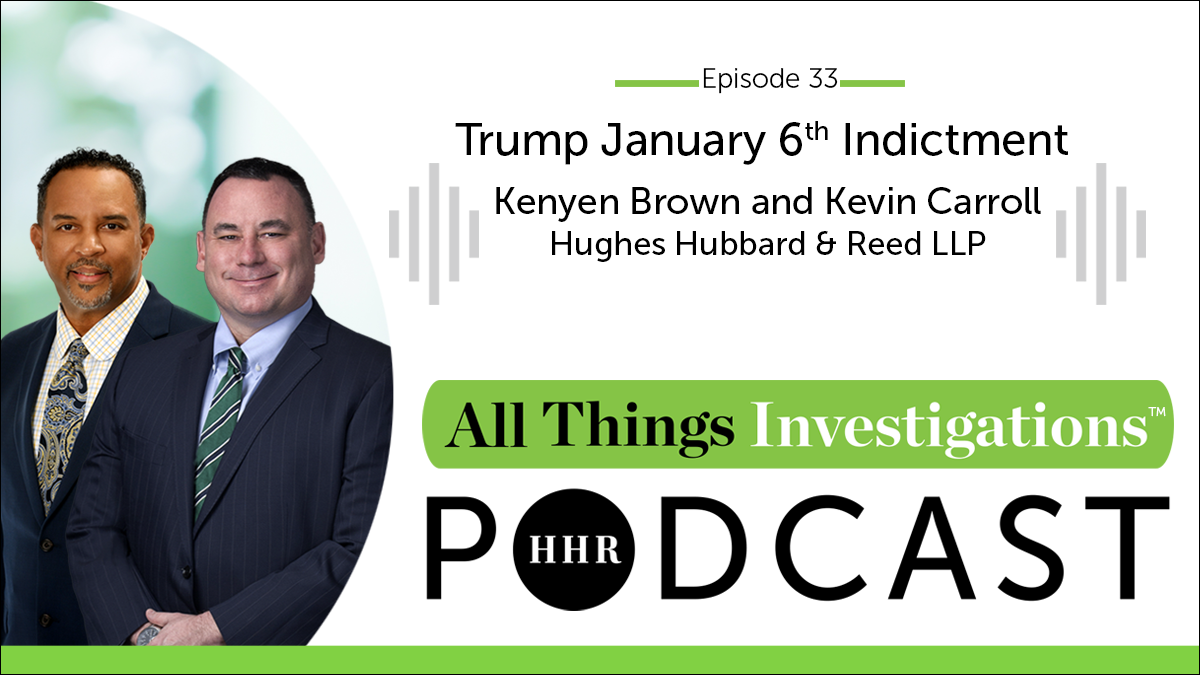
All Things Investigations: Episode 33 – Trump January 6th Indictment with Kenyen Brown and Kevin Carroll

In this episode of All Things Investigations, host Tom Fox discusses the legal intricacies surrounding the Donald Trump indictments with legal experts Kenyen Brown and Kevin Carroll. Tearing apart the indictment against the former President, the conversation illuminates the reality of a country grappling with the unprecedented indictment of its former Commander-in-Chief. They dive deep into the evidence, the potential repercussions, and the broader implications for the legal profession and democracy itself.

Kevin Carroll and Kenyen Brown are partners at Hughes Hubbard & Reed. Kevin is a partner in the Washington, D.C. and New York offices of Hughes Hubbard & Reed in the White Collar & Regulatory Defense and Anti-Corruption & Internal Investigations practice groups. Former U.S. Attorney Kenyen Brown is a partner in the Washington, D.C. office of Hughes Hubbard & Reed in the White Collar & Regulatory Defense and Anti-Corruption & Internal Investigations practices.


You’ll hear Tom, Kenyen and Kevin discuss:

  • The indictment against Donald Trump centers around “prolific lies” used to defraud the United States citizens and election officials, aiming to overturn the 2020 election results. This has legal implications far beyond insurrection.
  • The evidence collected against Trump is expansive, including public statements, internal campaign emails, attorney-client privilege documents, voicemails, and audio recordings.
  • There’s potential for more evidence that can prove the charges brought against Trump, as the indictment itself was written in plain English, suggesting transparency and inclusivity for all concerned citizens.
  • The indictments were carefully formulated to avoid charges of sedition or insurrection, focusing instead on a set of charges that come with very serious sentences.
  • Some of the unindicted conspirators may potentially flip on Trump and provide crucial testimony against the former president. However, the roles of distinguished members of the legal profession in the alleged coup d’etat raise concerns about ethics training and professional discipline at the bar.
  • The likely trial date for this case is expected to be around six to ten months in the future, depending on the course of pretrial motion practice and the scope of the issues being relitigated.
  • The upcoming trial could potentially be the most important in American history, hence all counsel should be given adequate time to prepare.
  • Kevin explains that the oath to the Constitution, not to the Commander-in-Chief, holds deep importance for him and his peers. This oath suggests that the co-equal branches of the government, including the federal judiciary and Congress, deserve equal loyalty.
  • The troubling presence of veterans and a small number of active-duty personnel at the January 6 riot, was deeply disappointing to Kevin. 
  • Kenyen says, as a prosecutor, it is a great honor to represent the United States of America. He emphasizes the weight of the responsibility and the seriousness with which he took his duties of candor and good stewardship of information.
  • The fact that the National Guard was not deployed to aid the Capitol police during the riot, given that only the president can order their deployment in the District of Columbia, suggests that this decision was part of an attempt to pressure Congress and Vice President Mike Pence. President Trump may find it difficult to convince the public of the legitimacy of his actions.


Resources

Hughes Hubbard & Reed website

Kevin Carroll on LinkedIn

Kenyen Brown on LinkedIn

Categories
Corruption, Crime and Compliance

How to Build a Compliance Compensation System

The DOJ is advocating for increased consequences for individuals who engage in misconduct or fail to exercise proper oversight, via the implementation of compliance compensation programs that include financial penalties. Companies need to develop incentives and penalties in a balanced manner to maintain ethical performance, while ensuring the potential for accountability. A crucial aspect of enforcing these policies is the execution of robust clawback provisions as part of the executive’s contract and bonus terms. These clawbacks can act as a deterrent for misconduct, and their enforceability largely depends on the clarity of their language, among other things. In this episode of Corruption, Crime and Compliance, Michael Volkov explores compliance compensation systems and their role in corporate governance in detail. 

You’ll hear Michael talk about:

  • Clawback provisions are important rules that determine how executives’ contracts and bonus terms can be enforced. Companies have a responsibility to execute robust clawback provisions to ensure accountability and deter misconduct.
  • Compliance programs are becoming increasingly vital to global companies as they grapple with complex legal and economic risks. These programs are crucial in reinforcing compliant behavior and promoting positive corporate citizenship.
  • The DOJ has emphasized the importance of compensation systems and consequence management in corporate compliance programs. Not being proactive in reviewing these systems is considered a serious mistake that requires urgent attention and correction.
  • DOJ’s focus has expanded towards consequence management, seeking to escalate penalties for those involved in misconduct. Companies are required to implement compliance compensation programs focusing primarily on clawbacks.
  • Clawback policies, often limited to senior executives and specific conduct, need to be broadened in their scope and applicability. Notably, the Dodd-Frank Act mandates listed companies to have a written clawback policy for financial restatements resulting from accounting misconduct.
  • Compliance rewards act as a significant incentive for ethical behavior and compliance. Executives and managers who fulfill specific compliance requirements may become eligible for performance-related rewards.
  • Compliance compensation systems must be designed to hold individuals accountable for misconduct. Penalties, including retroactive discipline and financial penalties like clawbacks or deferred compensation systems, can be potent deterrents.
  • A comprehensive compliance compensation system requires careful crafting to minimize litigation and defense possibilities. It involves identifying the executives and managers to be included in the penalty system and determining the corresponding percentage penalties.
  • A company must balance its incentive structure, considering factors like large contingent payouts to executives and ethical performance requirements. Clarity in written policies and employment agreements fortify clawback provisions.
  • Collaboration between business, finance, legal, and HR is pivotal in the design and implementation of effective compliance reward and penalty systems.


KEY QUOTES:

“The DOJ wants to add to their risk calculation, and that’s requiring companies to implement compliance compensation programs that include financial penalties against those actors who engage in misconduct, or supervisors that fail to rein in their underlings or conduct proper oversight to ensure compliance.” – Michael Volkov


“Companies have to isolate and weigh incentives and bonus structures to make sure that they can still target accountability penalties commensurate with the risk posed by the executive if he or she engages in misconduct.”  – Michael Volkov


“The key determinant of clawback enforceability is whether the company has insisted on execution of robust clawback provisions as part of the executive’s contract and bonus terms.” – Michael Volkov


Resources:

Michael Volkov on LinkedIn | Twitter

The Volkov Law Group

Categories
Sunday Book Review

Sunday Book Review: August 6, 2023 – The Summer Business Books Edition

In the Sunday Book Review, I consider books that would interest the compliance professional, the business executive or anyone who might be curious. It could be books about business, compliance, history, leadership, current events or anything else that might interest me. In today’s edition of the Sunday Book Review, I continue my summer exploration of books on crime. Today, the summer’s top business books as curated by FT Columnist Andrew Hill.

  • How Big Things Get Done by Bent Flyvbjerg and Dan Gardner 
  • Risky Business by Amy Finkelstein, Liran Einav and Ray Fisman
  • Wonder Boy by Angel Au-Yeung and David Jeans
  • The Case for Good Jobs by Zeynep Ton
  • The Four Workarounds by Paulo Savaget

Resource

Andrew Hill: Best Summer Books: Business in FT

Categories
Kerrville Weekly News Roundup

Kerrville Weekly News Roundup: August 5, 2023

Welcome to the Kerrville Weekly News Roundup. Each week, veteran podcaster Tom Fox and his colleagues Andrew Gay and Gilbert Paiz get together to go over a couple of their favorite stories from the past week from Kerrville and the greater Hill Country. Sit back, enjoy a cup of morning coffee and listen in to get a wrap up of the Kerrville Weekly News. We each consider two of our favorite stories and talk about the upcoming weekend’s events which will enjoy or participate in this weekend.

In this episode, Tom, Gilbert and Andrew discuss the following stories which caught their attention over the past week.

  • Tom discusses the Level 2 water rationing that Kerrville and Kerr County is now under and the Free Splash day at Kerrville-Schreiner Park on Saturday August 5. He invites listeners to drop by the Kerrville Rotary Club booth at the Kerrville Business Expo on Saturday August 5.
  • Andrew take a deep dive into the Kerrville Business Expo on Saturday August 5, why should attend and who will be there, including the Texas Hill Country Advisors.

Resources

Tom Fox on LinkedIn

Gilbert Paiz on LinkedIn

Andrew Gay on LinkedIn

Texas Hill Country Podcast Network

Categories
10 For 10

10 For 10: Top Compliance Stories For the Week Ending August 5, 2023

Welcome to 10 For 10, the podcast which brings you the week’s Top 10 compliance stories in one podcast each week. Tom Fox, the Voice of Compliance brings to you, the compliance professional, the compliance stories you need to be aware of to end your busy week. Sit back, and in 10 minutes hear about the stories every compliance professional should be aware of from the prior week. Every Saturday, 10 For 10 highlights the most important news, insights, and analysis for the compliance professional, all curated by the Voice of Compliance, Tom Fox. Get your weekly filling of compliance stories with 10 for 10, a podcast produced by the Compliance Podcast Network.

  • Albemarle settles FCPA action. (WSJ)
  • The biggest attorney/client privilege case in years. (FT)
  • SEC tells some Wall Street brokers to get their AML controls in order. (WSJ)
  • CCPA to look at connected cars. (WaPo)
  • Audit firms fight expansion of anti-fraud role. (FT)
  • Former AG Lynch to review NU hazing allegations. (Reuters)
  • Altice co-founder denies corruption.(Reuters)
  • US consultancies struggle in China after raids. (FT)
  • Binance founder draws scrutiny from German regulator. (WSJ)
  • Lead FBI agent talks about Householder case. (Columbus Dispatch)

You can check out the Daily Compliance News for four curated compliance and ethics related stories each day, here.

Connect with Tom 

Instagram

Facebook

YouTube

Twitter

LinkedIn

Categories
Blog

E-com Surveillance: A Proactive Approach

In today’s rapidly expanding digital realm, keeping up with regulatory requirements in E-com surveillance is more than just a necessity—it’s a game-changer. As the world grapples with the challenges brought by the COVID-19 pandemic, efforts in ensuring compliance have dramatically shifted, impacting both personal and professional spaces. This, friends, has become a defining factor in not just maintaining, but enhancing compliance and risk management. Let’s delve into how we can proactively monitor communications, adapt to evolving channels, and leverage technology for our advantage while ensuring data security in cloud-based platforms. Here are some key steps:

  • Establishing a Robust Compliance Program
  • Proactively Monitoring Communications in E-Com Surveillance
  • Adapting to Evolving Communication Channels
  • Deploying AI in Compliance Monitoring

1. Establishing a Robust Compliance Program

With the increasing reliance on e-commerce due to the ongoing global health crisis, keeping up with regulatory compliance has become more of a challenge than ever before. Enhanced surveillance within the e-commerce spectrum has emerged as a critical aspect of any robust compliance program. Companies must diligently monitor all communication transactions to identify any potential misconduct early on. With technology continuously evolving, companies are faced with more diverse sources of data and communication channels than before.

To counteract this, advancements in technology have enabled compliance professionals to monitor these various sources more efficiently and focus on high-risk areas.   With the proliferation of novel communication platforms, regulatory requirements have become more stringent, but also more complex to adhere to. AI has been instrumental in empowering compliance officers, allowing them to better concentrate their efforts. With its ability to filter and prioritize alerts based on risk levels, AI functionality is highly effective in optimizing the e-com surveillance process. Compliance functions must keep pace with the constant changes in the communication landscape, meaning that they need to be adaptable in capturing and recording all essential communications.   Organizations must understand the cruciality of establishing a strong compliance program that aligns with their communication platforms and e-commerce operations. By leveraging high-tech solutions, like AI and machine learning, companies can better monitor and manage risks from a proactive stance, while simultaneously obeying regulatory requirements.

 2. Proactively Monitoring Communications 

In the ever-expanding universe of e-commerce, staying ahead of illicit activities such as fraud, theft, and other misconduct is vital. Key to this is the implementation of effective e-commerce surveillance in every organization, large or small. This involves the proactive monitoring and analyzing of all company communications, from emails to chat messages, for any signs of inappropriate behavior. With the ongoing proliferation of communication channels — each one another avenue for potential exploitation — it’s a gargantuan task that might seem overwhelming. However, thanks to the wonder of technology, we now have the means to keep pace with this turbulent environment. Modern advancements have made it possible to capture a vast array of data sources, despite the varying nature and extent of these channels.

 3. Adapting to Evolving Communication Channels

The digital era has seen an explosion in communication channels. From emails, social media, chat platforms to video conferencing, employees now have myriad ways to communicate, both internally and externally. Consequently, e-com surveillance to monitor such communication pipelines and pin down potential misconduct becomes increasingly complex, yet more essential. Adapting to these evolving channels plays a key role in ensuring significant compliance and risk management.   There are unique challenges that emerge with this diversity of communication channels. First instance, coded language by employees and capturing diverse data sources are some of the hurdles organizations face.

However, technology solutions are evolving as fast as the communication landscape. Key amongst these solutions is the use of AI and machine learning models, which cut through the noise to help compliance officers focus on high-risk areas. Regulators such as the SEC in the US and the FCA in the UK expect companies capture, monitor, and record all communication channels. This means your business must keep up with people’s communication methods and ensure every dialogue is recorded.  Why is this adaptation important? In a nutshell, the vastness and ever-evolving nature of digital communication channels pose a risk. The risk lies in the prospect of misconduct going unnoticed, regulatory guidelines being flouted, and ultimately, organizations facing severe consequences.

Moreover, every new communication platform is an additional data source. Managing this increasing data effectively is crucial for any organization in the current digital age. Adapting to evolving communication channels is not just about managing current risks; it is also about equipping organizations with the necessary technological tools to capture, monitor, and manage potential risks that could emerge with future communication spheres. The progression ensures that there is no lag in surveillance and that organizations are always a step ahead in their risk management.

  1. Deploying AI

Artificial intelligence (AI) and machine learning are critical technological advancements enabling companies to monitor the manifold data sources efficiently. These technologies and perhaps others down the road, are a game-changers, empowering compliance officers to focus on high-risk areas and alerts, moving compliance process from a detect mode to prevent mode. By deploying these advanced methods may lead to more comprehensive data capture and monitoring, thereby promoting a seamless, integrated, and effective e-com surveillance mechanism. This is why the implementation of such a step is a necessity more than an option as we move forward in this data-driven age.

Why is this effective approach to e-com surveillance so crucial? Well, we live in an age of digital ecommerce and remote work after COVID-19, where communication channels have diversified and expanded beyond limits. To stay compliant with regulatory requirements, it is not enough just to keep an eye on traditional messaging. You must embrace these changes and adapt by efficiently monitoring all these channels. With the technology such as AI and machine learning, you can create defensible and explainable models that can precisely show why specific alerts were raised, and others weren’t. This approach is the key to adapting to this ever-evolving world and meeting regulatory expectations, thereby enhancing your compliance protocols in the long run.

The importance of maintaining compliance with regulatory requirements in e-commerce surveillance, especially during this ongoing pandemic, cannot be overstated. As compliance authorities, you have the power to make a significant impact on your organization’s risk management. Today, we’ve delved into the necessity of a strong compliance program, the significance of proactively monitoring communications, the need to adapt to new communication mediums, the benefits of utilizing AI in compliance monitoring, and the importance of securing data on cloud platforms. Each of these steps is instrumental in achieving the desired state of compliance. Let this motivate you to continue striving for excellence in all your compliance efforts. After all, your dedication to strengthening these practices is not just about meeting regulations – it’s about fostering trust and reliability in your organization.


Categories
Report from IMPACT 2023

Report from IMPACT 2023: Sally Yates, David Ogden and Andrew Weissmann – Former DOJ Heads Talk Compliance

ECI’s IMPACT 2023 was one of the leading compliance events in 2023. At this conference, Tom Fox, the Voice of Compliance, was able to visit with several of the speakers, exhibitors, participants and one group of ethically minded Girl Scout Troop. In this limited podcast series, Report from IMPACT 2023, Tom explores many of the most cutting-edge topics in ethics and compliance through short podcast episodes. Check out the full series of interviews. You will be enlightened, informed and come away with a fuller and more thorough understanding of the most cutting-edge topics in ethics and compliance. In this episode, Tom visits with former Deputy Attorney Generals Sally Yates and David Ogden and former head of the Fraud Section Andrew Weissmann on the evolution of DOJ thinking on compliance.

This podcast episode covers the importance of compliance with the Foreign Corrupt Practices Act (FCPA) and how the Department of Justice (DOJ) is working to ensure corporate America is held accountable. Through voluntary disclosure incentives and open dialogue with the Defense Bar, agencies, and prosecutors, the DOJ has implemented measures to ensure that companies are adhering to the FCPA. The expertise of Main Justice prosecutors is highly valued, and the Fraud Section of the DOJ can provide invaluable insight into corporate policy. By fostering an open dialogue between the DOJ and industry, both parties can benefit from effective implementation of policies and an understanding of the benefits of compliance.

 Highlights include 

·      Yates Memo

·      Compliance Programs

·      Sticks and Carrots