Categories
Daily Compliance News

Daily Compliance News for August 4, 2023 – The Follow Your Passion Edition

Welcome to the Daily Compliance News. Each day, Tom Fox, the Voice of Compliance brings to you compliance-related stories to start your day. Sit back, enjoy a cup of morning coffee, and listen in to the Daily Compliance News. All, from the Compliance Podcast Network. Each day we consider four stories from the business world, compliance, ethics, risk management, leadership, or general interest for the compliance professional.

·       Altice France suspends director. (Bloomberg)

·       The biggest attorney/client privilege case in years.  (FT)

·       SEC tells some Wall Street brokers to get their AML controls in order. (WSJ)

·       Following your passion.  (NYT)

Categories
31 Days to More Effective Compliance Programs

One Month to More Effective HR in Compliance: Day 4 – The Reference Check

Hiring the right people for your team is critical to the success of any organization. Unfortunately, it can also be a costly endeavor if the wrong hire is made. According to a survey of 2500 companies, one bad hire can cost an organization more than $25,000 in lost productivity, low morale, and other associated costs. In some cases, the cost can be even higher, with one energy service company estimating the cost of a bad hire at $400,000.

With these staggering costs in mind, it’s clear that companies need to invest in the hiring process to ensure they get the right people. Reference checks are an important part of this process, yet they are often overlooked. This was discussed in a recent episode of One Month More Effective Compliance Program. The episode featured Kevin Ryan, who believes that reference checks are an underutilized part of the hiring process and a key internal control for human resources.

Reference checks are the only way to learn things about prospective employees that can’t be found on a resume. Unfortunately, companies often can’t or won’t give out much more information than confirming dates of employment. To get a more robust appraisal, one should dig up people who will speak candidly about the candidate. Search firms are particularly good at this, and companies should emulate this practice. Asking direct questions to acquaintances can provide direct responses 75% of the time.

The Department of Justice has recognized hiring as a best practice for compliance programs since 2004. According to Kevin Ryan, companies should take the time to get to know the candidate and ask questions that will reveal their values, beliefs, and motivations, as well as their ability to work with others, take direction, and think critically. He recommends that companies take three steps in the hiring process: resume review, in person interview, and reference checks. While the resume is good for establishing the basic qualifications for the job, it doesn’t provide much else.

The hiring process is the first step in operationalizing a compliance program. Reference checks are an important part of this process, as they can help to ensure that the candidate is a good fit for the company. Investing in the hiring process is essential to ensure that the right people are brought on board and to avoid costly mistakes. The Department of Justice has recognized hiring as a best practice for compliance programs since 2004, and reference checks are an underutilized part of the hiring process and a key internal control for human resources.

Three key takeaways:

  1. The hiring process is the first step in operationalizing your compliance program.
  2. The DOJ spoke to hiring as part of a best practices compliance program as far back as 2004.
  3. Reference checks are an underutilized part of the hiring process and a key internal HR control.

For more information, check out The Compliance Handbook, 4th edition, available on LexisNexis.com.

Categories
Greetings and Felicitations

Greetings and Felicitations: The Future of Healthcare…Is Now: Part 5 – Down the Road

What is the future of healthcare and when will it arrive? To explore these and similar questions I visited with Dr. Ben Locwin and Scott Endicott in a five-episode podcast series. Over this series we have explored why the future of healthcare is now; gene and cell therapy, the use and misuse of statistics, Hippocrates and modern healthcare and where healthcare will be headed down the road. In this concluding Part 5, we look down the road at the future of healthcare.

The rapid advancement of technology has changed the way we live and work, and it’s also changing the way we receive healthcare. From smaller and smaller silicon wafer chips to quantum computers and micro dosing insulin pumps, technology is becoming more and more prevalent in healthcare.

At the same time, however, this technology poses several potential risks and ethical implications. Data privacy is a major concern, as there have been cases of lost or de-anonymized patient data from electronic health records getting out into the public sphere. AI and machine learning are also being used to collect and predict data, which could lead to further data privacy issues.

Ben and Scott recently discussed the potential risks and benefits of technology and the need for appropriate regulation and oversight to control the future of medical decision making. They also discussed the importance of patient advocacy and self-advocacy, as well as understanding and controlling how data is used.

Taking a counterfactual approach to contemplate the future of healthcare, it’s clear that technology advancements are here to stay. Software as a medical device is an open access point for hackers to get into highly critical medical devices. According to an IBM report, 550 organizations had a data breach between 2022 and 2023, and healthcare organizations had the highest average cost of data breaches at $11 million, up 8% from last year and 50% from a couple of years ago. With malware and ransomware looking to steal data due to the potential financial gain, the loss and risk to patient data from electronic medical and health records is a major concern.

Moore’s Law applies to both good and negative aspects of technology growth. Within 10-20 years, medications will be administered trans-dermally instead of through a bottle, and micronization of diagnostic capabilities will be available. Healthcare services, decisions, and other roles will be available through Amazon-like delivery. AI and ML are becoming more of a buzzword challenge, with many references being made to them in conversations. AI is currently being applied to chat and other spaces but is still five years away from being able to be transformational in medical applications. Genomics data is now accessible for criminal investigations, creating a downside risk. Technology is shrinking and getting faster, with microprocessors being built on five nanometer dies. Computers are beginning to take over for human decision making, with the widespread use of AI being seen in the future.

To ensure that these advancements are used responsibly, appropriate regulation and oversight is key. Ben believes that the human race has a tenacity to revert back if things become too extreme. Scott believes that patient advocacy and self-advocacy will be key to the change that needs to happen. Understanding and controlling how data is used is essential, as well as having more ethicists involved in the industry.

We hope that this blog post has provided you with some practical advice and data-driven insights to help you navigate the world of healthcare technology.

Key Highlights

·      Medical Technology Risks

·      AI in Healthcare

·      Moore’s Law and Medicine

·      Data Privacy and Telemedicine

Resources

Dr. Ben Locwin on LinkedIn

Scott Endicott on LinkedIn

Tom Fox on LinkedIn

Categories
2 Gurus Talk Compliance

2 Gurus Talk Compliance – Episode 10 – Ethical Remote Workers Edition

What happens when two top compliance commentators get together? They talk compliance of course. Join Tom Fox and Kristy Grant-Hart in 2 Gurus Talk Compliance as they discuss the latest compliance issues in this week’s episode!

Tom and Kristy consider the possibility of an international anti-bribery court, challenges in enforcing judgments against countries without strong anti-corruption laws, and the United States’ unlikely participation. The European Commission issued an adequacy decision regarding data transfers between the US and EU, resolving a long-standing issue, but privacy advocate Max Schrems plans to challenge its validity. The importance of on-site due diligence, and the value of on-site audits and cybersecurity disclosure were also explored. The benefits of remote work, global anti-corruption efforts, AI safeguards, and the dangers of zero tolerance policies were covered as well. The conversation provided insights into various compliance-related topics.

Highlights Include

·      World ABC Court

·      No DOJ control on Cognizant investigation.

·      SEC adopts Cyber disclosure rules.

·      Fight against corruption in Ukraine.

·      Goldilocks Compliance.

·      Data Privacy Framework Program Launches New Website Enabling U.S. Companies to Participate in Cross-Border Data Transfers

·      Site Visits: Sometimes the Best Due Diligence is Done on Foot

·      New Data Reveals that Remote Workers are Likely More Ethical than their Office Counterparts.

·      White House Says Amazon, Google, Meta, Microsoft Agree to AI Safeguards

·      Man Steals Vehicle, Crashes it into Building during Search for WiFi Connection

 Resources 

  1. WSJ Risk and Compliance Journal
  2. FCPA Blog
  3. Radical Compliance
  4. Dept. Of Commerce Press Release
  5. WSJ
  6. Conflicts of Interest Blog
  7. GAB
  8. Fast Company
  9. Fox 35 Orlando

Connect with Kristy Grant-Hart on LinkedIn

Spark Consulting

Tom 

Instagram

Facebook

YouTube

Twitter

LinkedIn

Categories
Sustainability

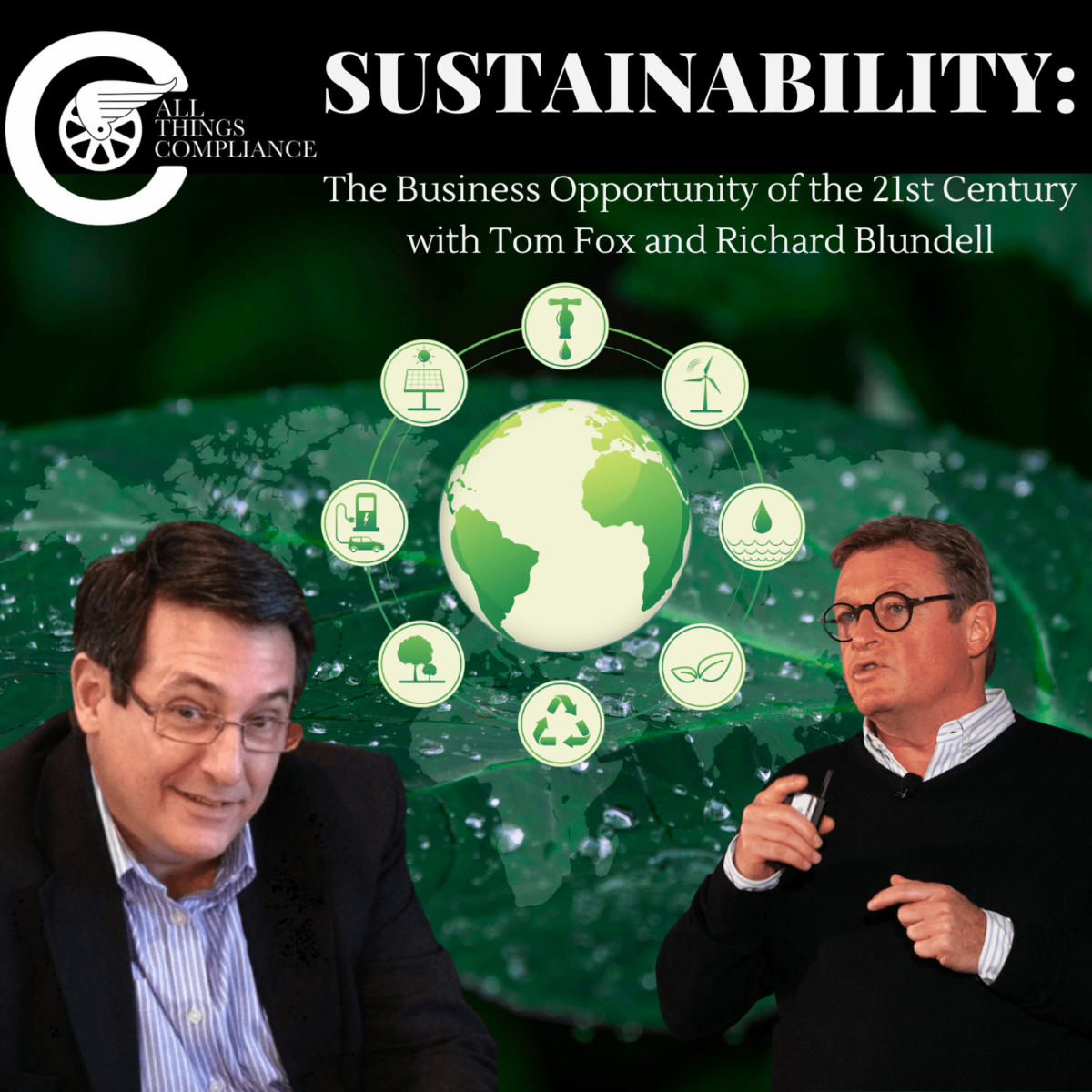
Sustainability: The Business Opportunity of the 21st Century: Sustainability Leadership

Are you ready to take on the business opportunity of the 21st century? We are at a moment of enormous global change and even greater business opportunity. Climate change is the single, biggest commercial opportunity of our time. In this podcast Tom Fox and Sustainability guru Richard Blundell explore the opportunities open to businesses which embrace sustainability from the business perspective. Find out why sustainability is the greatest opportunity of the 21st century and you can prepare your business to take advantage of the unprecedented global opportunity.

This podcast episode dives deep into the concepts of sustainability leadership, transformation, communication, and materiality analysis – all of which are essential to creating a more sustainable future. We explore the importance of viewing sustainability as an opportunity and committing to action to leave the business in better shape than when it arrived. Additionally, we touch on the need for a shift in mindset and the importance of communicating a message about sustainability to an audience. Finally, it delves into materiality analysis, a process that helps companies to prioritize sustainability activities and understand the impact of their decisions. This episode provides valuable insight into the principles of sustainability and how to best approach it in practice.

 Key Highlights

·      Sustainability Leadership

·      Sustainable Transformation

·      Sustainability Communication

·      Materiality Analysis

Listen to the full episode to gain insights and practical tips for incorporating sustainability into business practices. Richard’s enthusiasm and practicality will leave you inspired to explore sustainability as a business opportunity.

Resources

Richard Blundell

Tom Fox

Instagram

Facebook

YouTube

Twitter

LinkedIn

Categories
Blog

Implementing AI Technology for Data Driven Compliance

In the age of information, data is the lifeblood of any organization and now every compliance function. The integrity, accessibility, and security of this data are crucial for the effective functioning of businesses, making its compliance a top priority. As digital landscapes continue to evolve, maintaining compliance becomes increasingly complex. Enter AI technology. With the ability to streamline processes and make sense of unstructured data, AI technology is fast becoming the go-to solution for data compliance in organizations. This blog post will delve into how you can implement AI technology for data compliance within your organization, enhancing your compliance monitoring and proactively detecting potential risks.

Here are the key steps:

  • Understand Your Data Landscape: Get familiar with the types of data your organization handles – structured, semi-structured, and unstructured. Identify the sources of these data, like emails, documents, or messages.
  • Identify the Risks: Be aware of the potential risks associated with each type of data. These could include the disclosure of sensitive information, potential misconduct, or hidden threats, especially within unstructured data.
  • Implement AI Technology: Choose a technology partner that can assist in implementing AI capabilities for data compliance. The AI tools can help with data cleansing, reducing false positives and supporting the detection and even the prevention of compliance violations.
  • Establish Prevention Measures: Create a culture where prevention is given priority over detection.

 1. Understand Your Data Landscape

Stepping into the complexities of your data landscape is a pivotal component of maintaining an ironclad compliance program. As the pivotal backbone of any organization, data comes in all shapes and sizes –structured, semi-structured, and unstructured and from various sources such as emails, Word documents and text messages. This varying landscape can often be a figurative minefield, teeming with potential hazards. This makes it crucial to sift through this landscape, charting out the contours of your information trove, identifying relevant data and understanding how it interacts with your needs and obligations.

This first step sets the foundation for implementing a more efficient and effective compliance monitoring system within your organization.  Integrating AI technology, as emphasized, is a game-changing strategy for tackling the challenges presented by the data landscape. There is even a greater amount of data that compliance professionals must grapple with due to remote work and newer communication platforms. With AI-powered data cleansing, this unstructured data can be whittled down to pertinent, human-generated content, thus increasing efficiency and reducing instances of false positives.

By customizing models and policies to align with your organization’s risks, and by utilizing AI to review irrelevant content and target potential misconduct, organizations not only detect but also prevent instances of non-compliance.  The importance of understanding your data organization’s landscape extends beyond the detect prong of a best practices compliance program; it helps to predict where potential hazards might arise and informs the preventative measures you need to take. Implementing an AI-powered solution that is tailored to your unique organizational landscape means improved efficiency, minimizing the risk of non-compliance, and the potential for a more predictive and preventative approach to compliance management.

  1. Identify the Risks

Understanding unstructured data is not merely necessary for everyday operations but forms the backbone of compliance monitoring system. Recognizing that sifting through vast volumes of data can be onerous, the advent of AI-powered data cleansing capabilities will significantly streamline this process. It does this by eliminating duplicative content, junk, and non-human generated content from communications. This helps to focus on content that is risky and relevant for compliance teams, thereby minimizing the number of false positives.

Indeed this is the very foundation upon which a corporate compliance function can build out its strategy for risk mitigation. Once these risks are identified, compliance teams can take action to address them promptly, thereby creating a healthy culture of compliance within the organization. This kind of proactive approach serves as a deterrent to potential threats that could affect your company’s culture of doing business ethically and in compliance. Moreover, it sets clear expectations about the kinds of behaviors that are tolerated within the organization and those which are not through effective monitoring. All of this means that as a compliance professional you must work to address the challenges of unstructured data and identifying risks as an integral part of compliance monitoring going forward.

  1. Implementing the Tech

Navigating the massive waves of unstructured data within any organization can be a challenging task. With the advent of remote working conditions and a persistent reliance on diverse communication platforms, this data influx has exponentially grown, making the effective data management vital for a functioning compliance monitoring system. The collected data can involve communication records, report alerts, investigations, and training data.

As a recovering lawyer I can attest that the assimilation and interpretation of such fragmented information can be taxing on the compliance officers, primarily if they a traditional legal training. Not only is access to every corporate data silo mandated by the Department of Justice in the Evaluation of Corporate Compliance Programs, but the extraction of relevant insights from such a vast data pool can indeed be an uphill task.

  1. Establish Prevention Measures

When faced with unanticipated challenges like investigations, litigations, privacy compliance, and stringent government requests, compliance professionals must be equipped with a robust data analytics system. Your data solution or tool should provide an AI-powered data cleansing capability that eradicates duplicative content, junk, and non-human generated data. The key is for your solution to swiftly categorizes risky information which is then processed and referred to the compliance wing. But even more significantly,  a swift detection of misconduct and remediation process, will help to demonstrate a robust corporate culture can be promoted where accountability is the cornerstone.

Unarguably, the essence of navigating unstructured data demands exclusive attention. What might come across as a mere pile of unwarranted information might be a minefield of hidden risks and prominent disclosure threats that have the potential to jeopardize the whole organization. Our exclusive focus on the prevention of such risks is the precursor of a strong foundation where necessary expectations and behavioral norms are set. While some may argue about the necessity of such elaborate processes, their significance can only be understood by the way they shape our ability to identify hidden threats. These alone could potentially be the building blocks for a more secure, responsible, and ethically functioning organization.

As compliance officers, the journey towards mastering the realm of unstructured data and successfully implementing AI technology for data compliance can be a game-changer. This task, though complex, is pivotal in ensuring the integrity of your organization in today’s competitive and highly regulated business environment. The steps shared in this blog post are a roadmap to success, guiding you through understanding your data, identifying potential risks, and harnessing the power of AI. These measures will undoubtedly empower you to establish a culture of prevention in your organization. So, take a leap of faith, embrace AI technology, and watch how it revolutionizes your compliance monitoring and risk detection efforts.


Categories
Popcorn and Compliance

Popcorn and Compliance: The Mandalorian, Season 3 – Episode 1, The Apostate

Tom Fox and Jay Rosen are back with a special summer season of Popcorn and Compliance. In this special series, Tom and Jay will review the Mandalorian, Season 3. Get ready for a ton of fun, insights and all things Grogu and Mandalorian.

Tom and Jay begin by discussing the long gap between seasons and the main character’s journey after losing his Mandalorian status. The hosts praise John Favreau’s stewardship of the series, which strikes a balance between nostalgia and innovation within the Star Wars universe. They appreciate Favreau’s ability to create different adventures and storylines while paying homage to the franchise’s roots. The conversation also touches on the artwork in each episode, suggesting the idea of a coffee table book featuring stills and drawings. The use of archetypes in Western films is explored, highlighting their importance in storytelling and their presence in “The Mandalorian.” The hosts express admiration for Favreau’s work and discuss plot developments in the series.

Key Highlights

1. The Long-Awaited Return.  For fans eagerly anticipating the third season, the long gap between seasons two and three may have left us feeling a bit puzzled. However, as we delve into the first episode, it becomes clear that the wait was well worth it. The story sets up a thrilling journey for the main character, who must regain his status as a Mandalorian.

2. The Anthology Nature of “Star Wars”. Drawing parallels to the anthology nature of “Star Wars,” Jay compares the episode to a series based on “Planet of the Apes.” This approach allows for fresh perspectives and diverse storylines within the Star Wars universe, capturing the essence of what makes this franchise so captivating.

3. Impressive Fight Scenes and Mandalorian Culture. One of the standout moments in the episode is the breathtaking fight scene with a reptilian creature. The Mandalorians showcase their remarkable weapons and skills, instantly captivating viewers. The armorer’s introduction of the phrase “this is the way” has even made its way into the Fox household, a testament to the show’s memorable impact.

4. Controversy and Exceptional Acting. The conversation takes a turn as the removal of actress Gina Carano from the show is discussed. Both Jay and Tom hosts acknowledge Carano’s commendable performance. Furthermore, they delve into the remarkable acting skills of a former MMA star, who brings a unique level of authenticity to her character.

5. Archetypes and Constructive Storytelling. Tom and Jay explore the use of archetypes in movies, citing John Ford westerns and Sergio Leone’s spaghetti westerns as examples. They discuss how these constructs and characters benefit the audience’s understanding and provide a sense of familiarity. The conversation also touches upon the humorous transition from IG 11 to IG 12.

6. Jon Favreau’s Stewardship and Marvel Connections. The hosts commend Jon Favreau’s remarkable work on “The Mandalorian” and his ability to create a new universe within the Star Wars franchise. Drawing comparisons to Kevin Smith’s involvement, they discuss Favreau’s portrayal of Happy in the Marvel Cinematic Universe, highlighting the differences between the character and Favreau’s real-life persona.

7. The Artistic Marvel of “The Mandalorian”. The stunning artwork at the end of each episode is a visual feast for fans. Tom and Jay express their desire for it to be released as a book, even suggesting self-publishing on platforms like Amazon. They also praise the storyboard artists for their contribution to the fantastical universe created in the series.

8. The Growing Republic and Bo Katan’s Significance. The conversation delves into the structure of the new republic and the growing pains experienced by Navarro. The introduction of the high magistrate, played by Carl Weathers, adds depth to the storyline. Bo Katan’s role as a significant player in the series, born into the royal family of Mandalore, becomes increasingly prominent as the series progresses.

9. Favreau’s Budget and Spectacular Fights. Favreau’s seemingly unlimited budget for special effects and fight scenes is evident in the series. The hosts describe the last two fights as exhilarating blowouts, leaving us on the edge of our seats. They also touch upon the use of blue screens for filming, highlighting the freedom Favreau has to create different adventures for the main character.

“The Mandalorian” continues to captivate audiences with its compelling storytelling, memorable characters, and breathtaking visuals. Jon Favreau’s stewardship of the series strikes a perfect balance between nostalgia and innovation, leaving fans eagerly anticipating each new episode. As we eagerly await the next installment, titled “The Mines of Mandalore,” let’s celebrate the remarkable journey this show has taken us on so far.

 This is The Way!

Categories
31 Days to More Effective Compliance Programs

One Month to More Effective HR in Compliance: Day 3 – The Hiring Process

When it comes to hiring, it’s important to consider compliance, especially when it comes to family members of foreign government officials or employees of state-owned enterprises. In this podcast episode, Tom Fox discussed the importance of using the skill, will and fit approach to interviewing to try to weed out those persons who might not fit with the organization on an ethical and cultural basis.

The skill, will and fit approach to interviewing involves asking open-ended questions to determine whether the employee takes ownership of their work and has the hunger and creativity to succeed. For example, questions like “What’s the biggest impact you had at your past organization?” and “What do you want to do in five years?” can help to assess whether an employee might have a propensity to engage in bribery and corruption.

Tom also discussed the importance of having a frank discussion with prospective hires about what is expected of them in terms of engaging with the community. He used the example of the Houston Dash, a professional women’s soccer team, who are active in the local community and encourage their players to adopt local charities and become involved. This puts the importance of interacting with the public into their interview process.

There are three questions to analyze the hiring of a family member of a foreign government official or employee of a state-owned enterprise:

1. Does the candidate meet your hiring requirements?

2. Does the foreign official whose family member you are considering for hire demand or suggest that the company hire this prospective candidate?

3. Has the foreign official made or will make a decision which will benefit your company?

He also emphasized the importance of documenting any decisions made in order to avoid violating the Foreign Corrupt Practices Act (FCPA). Additionally, he encouraged organizations to operationalize their compliance programs and to have a second set of eyes in the hiring process to provide another level of oversight.

When it comes to hiring, HR has a dual role with both a traditional hiring and a compliance function. Introducing the topic of compliance at the pre-employment stage may encourage potential employees with a propensity to engage in bribery and corruption to take their skills elsewhere. By using the skill, will and fit approach to interviewing, organizations can assess whether an employee might have a propensity to engage in bribery and corruption, and operationalize their compliance programs to ensure that all hiring decisions are documented and have a second set of eyes for oversight.

Three key takeaways:

  1. Use the interview process to determine who will be an ethical and compliance fit for your organization.
  2. Consider the skill, will and fit approach.
  3. Ask open-ended questions.

For more information, check out The Compliance Handbook, 4th edition, available on LexisNexis.com.

Categories
Pawtastic Friends - The Paw Talk

Pawtastic Friends – The Paw Talk – Athena, Sable, Otis

Welcome to Pawtastic Friends-The Paw Talk. In this podcast, host Tom Fox will visit with Michael and Melissa Novelli, co-founders of Pawtastic Friends as well as those who work with them at Pawtastic Friends. Michael and Melissa are dedicated to helping shelter and rescue dogs in the Las Vegas area become more adaptable, through enrichment training and activities such as yoga and aquatics training, as well as obedience and agility. This podcast is sure to tug on your heart strings, just listen to how sweet this one dog is! Tune in now to hear more from Michael and Melissa Novelli as they discuss their passion for helping pups in need. Get ready for an exciting episode of Pawtastic Friends – The Paw Talk!

In this episode, we explored the importance of being a responsible pet owner and the impact that the media has had on the perception of pit bulls. Tom and Michael and Melissa discussed how to find the right home for senior dogs, how to prevent heat stroke, and the importance of enrichment training at home. They shared the story of Otis, a small dog that was adopted after weeks of training and patience, as an example of the rewards of responsible pet parenting. Overall, this episode highlights the need to provide our furry friends with the best care and environment to ensure their quality of life.

This episode of “Pawtastic Friends-The Paw Talk” is a must-listen for anyone who loves dogs and believes in providing them with a happy and healthy life. You’ll be moved by the stories of these amazing pups and inspired by Mike and Melissa’s dedication to finding them their perfect home. Don’t miss out on the opportunity to make a difference in the life of a dog in need. Tune in now!

Dogs Featured 

·      Athena

·      Sable

·      Otis

Quotes

“It’s like having a kid. If you teach a kid and you ignore them and you teach them bad, they do bad, they become a product of their environment.”

“But once again, the center did what it was supposed to do.”

“Shout out to the ones that believe in the underdog.”

“You don’t have to spend a ton of money on things. You can create your own. Use things around the house.”

Resources

Pawtastic Friends

Categories
Greetings and Felicitations

Greetings and Felicitations: The Future of Healthcare…Is Now: Part 4 – Exploring Healthcare Trends: QALYs, CRACO and Hippocrates

What is the future of healthcare and when will it arrive? To explore these and similar questions I visited with Dr. Ben Locwin and Scott Endicott in a five-episode podcast series. Over this series we will explore why the future of healthcare is now; gene and cell therapy, the use and misuse of statistics, Hippocrates and modern healthcare and where healthcare will be headed down the road. In this Part 4, we look at some current trends in health care including QALYs, CRACO, and more.

This episode of the podcast explored the emerging health care trends that will impact patients and family caregivers, such as Quality Adjusted Life Years (QALYs), which is a metric used to measure the quality of life; and Clinical Research as a Care Option (CRACO), which is an emergent option for cancer treatment, combining traditional standard of care drugs with cutting-edge therapies. Tom, Ben, and Scott discussed the potential benefits and risks of virtual healthcare, including the ability to access care remotely and the potential for nefarious actors to access sensitive information. They also discussed the importance of advanced directives and the need to consider quality of life versus end of life when making decisions.

They also discussed the potential benefits and risks of virtual healthcare, including the ability to access care remotely and the potential for nefarious actors to access sensitive information. They also discussed the importance of advanced directives and the need to consider quality of life versus end of life when making decisions.

Having an appropriate document in place and giving the decision-making power you want to make that designation is important. Quality of life versus end of life is an important consideration when making decisions. Immunotherapies can extend life, but it is important to consider the quality of life that the individual is seeking. Prostate cancer is a condition that affects many males as they age, and advanced directives are a crucial piece to the end-of-life equation, as they help bring a thread of logic to the sequence of events.

Personalized medicine and healthcare have changed drastically in the last five to seven years. Telemedicine and decentralization of healthcare have made tremendous advancements, particularly in rural areas where access to healthcare is often limited. Telemedicine eliminates the need to physically go to a clinic, reducing the risk of exposure to infectious diseases. However, there is a risk of overprescribing medications due to the ease of telemedicine visits, and there is ambiguity in the data regarding the effectiveness of telemedicine. There is also a risk of data breaches due to the use of telemedicine, which could include personal information and medical histories. Technology is advancing, which could help to overcome some of the barriers of telemedicine.

Making end of life decisions is a difficult process, but it is important to consider the quality of life versus end of life when making decisions. Quality Adjusted Life Years and Clinical Research as a Care Option are emerging health care trends that can help to make these decisions easier. With the advancements in telemedicine, more people have access to healthcare, and it is possible to get a better understanding of the quality of life that an individual is seeking.

Key Highlights

·      Digital Health Benefits and Risks

·      Clinical Research as Care

·      Telemedicine Benefits

·      End of Life Decisions

 Resources

Dr. Ben Locwin on LinkedIn

Scott Endicott on LinkedIn

Tom Fox on LinkedIn