Categories
Everything Compliance - Shout Outs and Rants

Everything Compliance – Episode 120, Shout Outs and Rants

Welcome to the only roundtable podcast in compliance. In this episode, we have the gang of Jonathan Marks, Matt Kelly, Jonathan Armstrong, Tom Fox, and Jay Rosen.

1. Matt Kelly shouts out the new Spiderman movie, Spiderman Across the Spider-verse.

2. Jonathan Marks shouts out to Kody Clemens for getting a walk-off hit while his father is in the stands.

3. Tom Fox shouts out to the 9th Circuit Court of Appeals to allow a lawsuit to move forward, which alleges rock n roll lyrics can cause emotional distress.

4. Jay Rosen shouts out to June for having the best sports month each year.

5. Jonathan Armstrong shouts out to all those helicopter pilots hovering outside the London courtroom where Prince Harry is giving testimony in his libel suit.

 The members of Everything Compliance are:

•       Jay Rosen– Jay is Vice President, Business Development Corporate Monitoring at Affiliated Monitors. Rosen can be reached at JRosen@affiliatedmonitors.com

•       Karen Woody – One of the top academic experts on the SEC. Woody can be reached at kwoody@wlu.edu

•       Matt Kelly – Founder and CEO of Radical Compliance. Kelly can be reached at mkelly@radicalcompliance.com

•       Jonathan Armstrong –is our UK colleague, who is an experienced data privacy/data protection lawyer with Cordery in London. Armstrong can be reached at jonathan.armstrong@corderycompliance.com

•       Jonathan Marks is Partner, Firm Practice Leader – Global Forensic, Compliance & Integrity Services at Baker Tilly. Marks can be reached at jonathan.marks@bakertilly.com

The host and producer, ranter (and sometime panelist) of Everything Compliance is Tom Fox the Voice of Compliance. He can be reached at tfox@tfoxlaw.com. Everything Compliance is a part of the Compliance Podcast Network.

Categories
Data Driven Compliance

Data Driven Compliance: Dave Crozier – Everything Lies Within the Data

Are you struggling to keep up with the ever-changing compliance programs in your business? Look no further than the award-winning Data Driven Compliance podcast hosted by Tom Fox. This podcast features an in-depth conversation about the uses of data and data analytics in compliance programs.

The Data Driven Compliance features an insightful discussion between host Tom Fox and guest Dave Crozier from Certa. Dave explains how Certa’s workflow automation platform eliminates swivel chairs, data silos, and process blind spots to make the due diligence process more efficient and trustworthy. They discuss the importance of validating and fact-checking data using validation techniques and exception-based triggers. The conversation also touches on supply chain risk management and the advantages of data-driven controls. Dave emphasizes the need to tailor solutions to an organization’s requirements and resources and benchmark against industry standards. This podcast is a must-listen for compliance officers, board members, and anyone interested in improving their risk management framework. So, tune in to the Data Driven Compliance and learn from industry experts like Tom Fox and Dave Crozier!

 Key Highlights:

·      Digital Transformation and Workflow Automation for Risk Mitigation

·      Importance of Validating Information

·      Supply chain risk management and automation

·      Customized Risk Management Strategies

·      Automation and Transparency for Efficient Compliance

·      Continuous Learning and Workflow Automation in Organizations

 KEY QUOTES:

“I can tell you that, you know, from my own personal experience and our clients’ experiences, that not all data coming from all places is created equal.”

“Having different techniques that could be deployed along the way that don’t add friction to the process. It’s a breadcrumb trailer of authentications that happen for all of these data sources along the way to make sure that, you know, you’re going in the right direction.”

“Think of validating the tax ID that is valid and authentic in the eyes of the registry directly.”

“To be able to capture content and serve it, you know, fit for purpose wise to the user is a critical aspect from our perspective.”

Resources:

Dave Crozier on LinkedIn 

Certa

 Tom Fox 

Connect with me on the following sites:

Instagram

Facebook

YouTube

Twitter

LinkedIn

Categories
SBR - Authors' Podcast

SBR Authors Podcast – Hal Hershfield, Your Future Self – Part 2

Welcome to the Sunday Book Review, the Authors Podcast! On this episode, Tom is joined by colleague Earnie Broughton for Part 2 of their interview with Hal Hershfield, author of Your Future Self, on Sunday Book Review-Author’s Edition. Join Tom and Earnie as they discuss cutting-edge ethical decision-making and behavior management solutions with Hershfield. The hosts delve into using aging apps and age progression algorithms to bring a vivid picture of one’s future self, ultimately leading to positive actions. But that’s not all. They introduce deep visualization exercises and the ancient tradition of idealism, which can help individuals make better choices and reduce anxiety. Hershfield shares his project about a chatbot that allows people to talk to their future selves, paving the way for groundbreaking research in long-term decision-making. Discover ethical commitment devices and other strategies in this captivating episode.

Tune in to the SBR-Authors Podcast and gain insight into how behavioral science can transform your life.

Key Highlights Include:

  • The Power of Age Progression Algorithms
  • Connecting with Future Self
  • Using Commitment Devices to Achieve Goals
  • Finding Balance with Commitment Devices
  • Multiple Selves and Technological Aids
  • Technology for Long-Term Decision Making

Notable Quotes:

“If we can work with someone on really deeply visualizing their future selves and seeing that person and feeling their feelings, that’s the type of thing that I think can hopefully change behavior.”

“Commitment device is one of my favorite behavioral science topics to explore. The basic idea here is that this version of me wants to eat healthy right now. What a commitment device does is it commits me to act a certain way. It puts constraints on my future behavior.

“The basic idea is I read a letter to my future self, and then I tried to write one back from that person. Fascinating exercise because it forces you to step into the shoes of your future self and see the world through their eyes.”

“When people were asked to do this send and reply exercise, it did cause them to take a step back, and it almost calms the feelings of the situation at hand. And that helped them see the big picture and ultimately feel better now.”

Resources

Hal Hershfield

Hal Hershfield at UCLA

Your Future Self

Tom Fox

Instagram

Facebook

YouTube

Twitter

LinkedIn

Categories
Trekking Through Compliance

Trekking Through Compliance – Episode 12 – The Menagerie (Part Two)

In this episode of Trekking Through Compliance, we consider the episode The Menagerie (Part Two), which aired on November 24, 1966, Star Date 3012.4.

This was the original pilot episode presented to NBC. Spock’s trial continues, and the transmitted scene resumes with Pike in 2254 in a cell with a transparent wall. The Talosians begin their “experiment,” which consists of several illusory situations involving Pike and Vina. The Talosians hope that Pike and Vina will mate and find a race of slaves who will reclaim the war-damaged surface of the planet.

That night, Pike can capture the Keeper as he attempts to confiscate the weapons. The captured crew proceeds to the surface. Number One sets her phaser on overload, preferring to die rather than be enslaved. The aliens have found that humans’ “unique hatred of captivity” makes them unsuitable for the Talosians’ plans, which must be abandoned. The crew beams back to the Enterprise.

Back in 2267, the transmission ends as the Enterprise arrives at Talos IV. The court-martial was a ploy to buy time to bring Pike back to Talos IV, where, if willing, he could enjoy the illusion of everyday life. Pike is transported to the planet and rejuvenated Pike.

Compliance Takeaways:

  1. What happens with your counterparty refuses to comply with FCPA requirements?
  2. When the time comes, will you, as a CCO, speak truth to power?
  3. Sometimes failure and being left behind are options.

 Resources
Excruciatingly Detailed Plot Summary by Eric W. Weisstein for The Menagerie (Part Two)
MissionLogPodcast.com-The Menagerie (Parts 1 & 2)

Categories
31 Days to More Effective Compliance Programs

One Month to a More Effective Compliance Program with Boards – The Board as an Internal Control

James Doty, former Commissioner of the Public Company Accounting Oversight Board (PCAOB) was once asked if the Board or its sub-committee which handles audits was a part of a company’s internal financial controls. He answered that yes, he believed that was one of the roles of an Audit Committee or full Board. I had never thought of the Board as an internal control but the more I thought about it, the more I realized it was an important insight for any Chief Compliance Officer or compliance practitioner as it also applies to compliance internal control.
In the FCPA Resource Guide, 2nd edition, in the Hallmarks of an Effective Compliance Program, there are two specific references to the obligations of a Board. The first is in Hallmark No. 1, which states, “Within a business organization, compliance begins with the board of directors and senior executives setting the proper tone for the rest of the company.” The second is found under Hallmark No. 3, entitled “Oversight, Autonomy and Resources”, where it discusses that the CCO should have “direct access to an organization’s governing authority, such as the board of directors and committees of the board of directors (e.g., the audit committee).” Further, under the US Sentencing Guidelines, the Board must exercise reasonable oversight of the effectiveness of a company’s compliance program. The Department of Justice’s (DOJ) Prosecution Standards posed the following queries: (1) Do the Directors exercise independent review of a company’s compliance program? and (2) Are Directors provided information sufficient to enable the exercise of independent judgment? Doty’s remarks drove home to me the absolute requirement for Board participation in any best practices or even effective anti-corruption compliance program.

A Board’s oversight is part of effective compliance controls, then the failure to do so may result in something far worse than bad governance. Such inattention could directly lead to a FCPA violation and could even form the basis of an independent SOX violation as to the Board.
Three Key Takeaways

  1. A Board must engage in active oversight.
  2. A Board should review the design of internal controls on a regular basis.
  3. Failure to do so could form the basis for an independent legal violation under SOX.
Categories
Corruption, Crime and Compliance

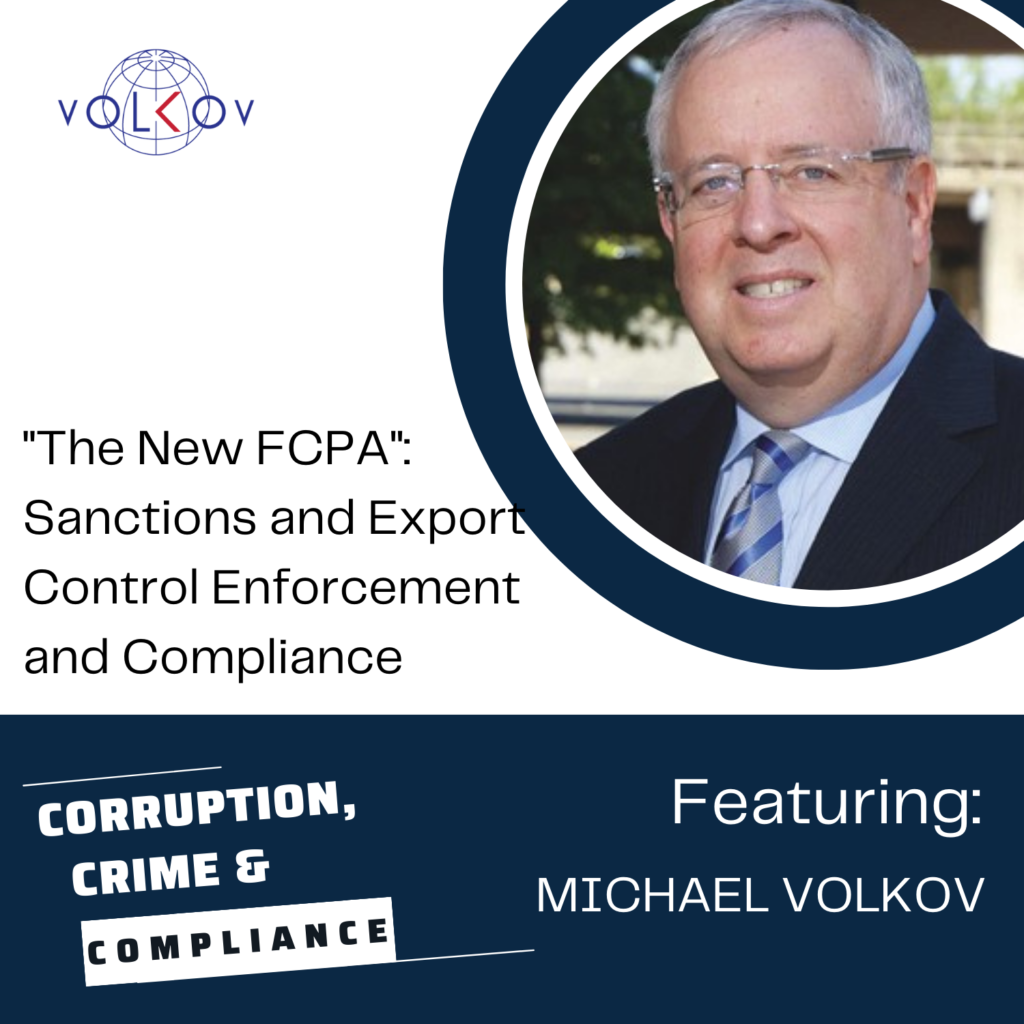
“The New FCPA”: Sanctions and Export Control Enforcement and Compliance

Unprecedented changes in sanctions and export control enforcement are imminent as the U.S. government amplifies its focus on national security and corporate compliance. In this episode of Corruption, Crime, and Compliance, Michael Volkov discusses the potential consequences of these developments. He dissects the “new FCPA,” the Department of Justice’s (DOJ) strategic approach, the critical role of sanctions and export control enforcement, and the intricacies of voluntary disclosure programs.

You’ll hear Michael talk about:

  • A significant shift is occurring in the DOJ’s enforcement focus, with 75% of criminal cases against corporations now related to national security matters, including sanctions enforcement, money laundering, and terrorism.
  • The DOJ will similarly collaborate with OFAC and BIS on the relationship between the DOJ and the SEC during FCPA enforcement.
  • Corporate resolutions are set to increase drastically, with steep penalties, deferred prosecution agreements, guilty pleas, and a surge in individual prosecutions. Heightened compliance expectations around export controls and sanctions compliance will necessitate a ramp-up of relevant compliance programs.
  • The enforcement actions will serve as guidance, similar to the initial stages of FCPA enforcement, providing cues about the DOJ’s view on compliance and their expectations from compliance programs.
  • The DOJ plans to ramp up enforcement against global banks, investing heavily in the Bank Integrity Unit, which is part of the anti-money laundering operations for global banks and sanctions enforcement.
  • The DOJ has forewarned corporations about the enforcement emphasis on sanctions and export controls. DOJ has ongoing investigations in various sectors, including transportation, fintech, banking, defense, and agriculture.
  • Voluntary disclosure programs, such as those from OFAC and the National Security Division, significantly mitigate enforcement actions. However, choosing between OFAC and DOJ disclosure can present a nuanced dilemma for corporations, hinging on whether a violation is willful. The number of voluntary disclosures involving both is expected to increase as corporate enforcement actions rise.
  • The case against British American Tobacco by DOJ and OFAC for illegal sales of cigarettes to North Korea resulted in a combined penalty of $629M. This is a significant instance of enforcement action against a non-financial institution.
  • The Bureau of Industry and Security (BIS) and the Department of Commerce brought a case against Seagate Technology, resulting in a $300 million settlement. DUE TO SEAGATE’S BLATANT VIOLATIONS, the DOJ seems to investigate this matter further.
  • A case against Murad, a cosmetics company, was brought by OFAC for Iran sanctions violations worth approximately $11 million. Murad ended up paying a $3.3M fine. Murad’s actions highlight the importance of sanctions compliance guidance and the significance of due diligence, especially during acquisition processes.
  • OFAC’s enforcement action against Murad also emphasized the importance of having a local compliance structure when a foreign parent company is involved.
  • OFAC also stressed the importance of pre-and post-acquisition due diligence and audits when acquiring companies. The failure to perform such activities may lead to unidentified sanctions issues, as illustrated in the Murad-Unilever case.
  • We may see larger fines against non-financial institutions in the near future, surpassing the current record of $508 million, indicating an uptick in enforcement actions.

KEY QUOTES:

“The number of voluntary disclosures involving both [DOJ and OFAC] is going to increase as we have more corporations that are subject to enforcement actions.” – Michael Volkov

“OFAC announced a separate civil settlement for $508M, the largest fine against a non-financial institution in OFAC’s history. And that’s what we’re going to be seeing. Largest fines against the non-financial institution will eclipse $508M probably in the next couple of years.” – Michael Volkov

“An important message: if you work at a company with a foreign parent, and you are a US subsidiary, you must have local boots on the ground. One other point that OFAC made a big point about is that pre-acquisition due diligence and post-acquisition integration and audits have to be part of this mix when you acquire companies, and companies have to oversee their new business to identify potential sanctions issues closely.” – Michael Volkov

Resources:

Michael Volkov on LinkedIn | Twitter

The Volkov Law Group

Categories
Trekking Through Compliance

Trekking Through Compliance – Episode 11 – The Menagerie (Part One)

In this episode of Trekking Through Compliance, we consider the episode The Menagerie (Part One), which aired on November 17, 1966, Star Date 3012.4.

This was the original pilot episode presented to NBC. Set in 2267, and the Enterprise arrives at Starbase 11 in response to a subspace call Spock reported receiving from the former captain of the Enterprise, Christopher Pike, under whom Spock had served. Pike cannot move or communicate other than answering yes/no questions with a device operated by his brainwaves. Pike refuses to communicate with anyone except Spock.

Spock, meanwhile, commandeers the Enterprise by means of falsified recordings of Kirk’s voice and orders the ship to depart under the computer’s control. After several hours, upon learning from the computer that the shuttlecraft does not have enough fuel to return to the starbase, Spock brings them aboard and then gives himself up, confessing to mutiny. Mendez convenes a hearing, at which Spock requests immediate court-martial, which requires three command officers. The tribunal begins, and Spock offers as his testimony what seems to be video footage of the Enterprise’s earlier visit to Talos IV in 2254.

In 2267, the scene is interrupted by a message from Starfleet Command, which reveals that the images they have been viewing are transmitted from Talos IV. Mendez is placed in command of the Enterprise, but Spock begs Kirk to see the rest of the transmission.

Compliance Takeaways:

  1. Leaders must take care of themselves as well as their crew.
  2. What does it mean if a deal is too good to be true?
  3. Trust but verify.

 Resources
Excruciatingly Detailed Plot Summary by Eric W. Weisstein for The Menagerie (Part One)
MissionLogPodcast.com-The Menagerie (Parts 1 & 2)

Categories
FCPA Compliance Report

FCPA Compliance Report – Scott Solomon on Managing Cash Risk Through Compliance

Welcome to the award-winning FCPA Compliance Report, the longest-running podcast in compliance. Join Tom Fox on the FCPA Compliance Report as he discusses with Scott Solomon, the CEO of Operational Security Solutions (OSS), how they manage compliance and ethical considerations around cash management, particularly for high-risk customers.

In this episode, they talk about the importance of compliance in the financial industry and how OSS helps financial institutions manage their portfolio through best practices. The podcast also touches on the challenges faced by legal cannabis businesses and the gaming industry regarding compliance and cash operations. Listeners will get insights into boutique cash and transit providers’ role in navigating licensing and permitting requirements for cannabis-related cash operations. This informative podcast concludes with contact information and an eagerness to continue the conversation. Don’t miss out on the insights shared in this episode. Tune in now to FCPA Compliance Report with Tom Fox and Scott Solomon.

 Key Highlights:

  • Challenges of Compliance in Handling Cash Transactions
  • Challenges of Compliance in Regulated Industries
  • Cash delivery in the legal cannabis industry
  • Risk Management for Financial Businesses

Notable Quotes

“Our primary customer or partner is a financial institution. So when you look at secure cash management and logistics, it boils down to our specialty is moving cash, and we have the ability in the compliance background to help financial institutions support their high-risk customers.”

“OSS was founded around compliance. A group of former law enforcement personnel, special military operators, and federal regulators got together and saw an opportunity to initially start by consulting.”

“We work with the customer. It doesn’t help us, and it doesn’t help the bank if the customer goes off the rails and becomes non-compliant. So, we want to educate them.”

“I come out of the anti-corruption compliance space; we’ve always looked to the casino world as one of the leaders around AML work simply because it was in their business interest to do.”

Resources

Scott Solomon on LinkedIn

Operational Security Solutions

Tom Fox

Instagram

Facebook

YouTube

Twitter

LinkedIn

Categories
31 Days to More Effective Compliance Programs

One Month to a More Effective Compliance Program with Boards – Boards Inquiring Up and Down

Where does “tone at the top” start? It is with public and most private U.S. companies at the Board of Directors. But what is the role of a company’s Board in compliance? First, a Board should not engage in management but oversee a CEO and senior management. The Board asks hard questions, risk assessment, and identification.

These factors can be easily adapted to compliance and ethics risk management oversight. Initially, it must be necessary that the Board receive direct access to such information on a company’s policies on this issue. The Board must have quarterly or semi-annual reports from a company’s CCO to either the Audit Committee or the Compliance Committee. Every Board should create a Compliance Committee to deal with compliance issues, as an Audit Committee may more appropriately deal with financial audit issues. A Board Compliance Committee can devote itself exclusively to non-financial compliance. The Board’s oversight role should be to receive regular reports on the company’s compliance program’s structure, actions, and self-evaluations. From this information, the Board can oversee any modifications to managing FCPA risk that should be implemented.

Three key takeaways:

  1. A Board Compliance Committee should provide oversight, not management.
  2. A CCO should use multiple reports to communicate with the Board Compliance Committee.
  3. Board Compliance Committee oversight makes companies more efficient and profitable.
Categories
Daily Compliance News

Daily Compliance News: June 12, 2023 – The Nicola Sturgeon Arrested Edition

Welcome to the Daily Compliance News. Each day, Tom Fox, the Voice of Compliance, brings you compliance-related stories to start your day. Sit back, enjoy a cup of morning coffee, and listen to the Daily Compliance News. All from the Compliance Podcast Network. Each day we consider four stories from the business world, compliance, ethics, risk management, leadership, or general interest for the compliance professional.

Stories we are following in today’s edition:

  • Kentucky company sanctioned for Chinese ties. (WSJ)
  • UK PM wants to be the leader in AI. (Bloomberg)
  • Nicola Sturgeon was arrested in a corruption probe. (Euronews)
  • Law firms are kicking the can on hiring. (Reuters)