Categories
SBR - Authors' Podcast

SBR Authors Podcast – Hal Hershfield, Your Future Self – Part 1

Welcome to the Sunday Book Review, the Authors Podcast! In this episode, Tom is joined by colleague Earnie Broughton. Join Tom and Earnie as they interview Hal Hershfield, author of Your Future Self, on Sunday Book Review-Author’s Edition. Delve into the psychology of decision-making and the importance of understanding present and future selves. Listen in as they discuss how organizational identity influences risk and ethical decisions and how the concept of multiple selves relates to integrity and making ethical decisions. Discover the neuroscience behind thoughts about one’s future self and how forgiveness and self-forgiveness can overcome procrastination. Learn how a connection to one’s future self can affect ethical behavior in an organizational context and find practical ways to bring ethics and compliance into workplace programs. Make sure to catch the release date of Hershfield’s upcoming book and where to find his research. Tune in now for an engaging and thought-provoking conversation!

Key Highlights Include:

·      Inaccurate Self-Prediction in Organizations

·      Collective Identity and Ethical Decision Making

·      Challenges of Future Self Concept

·      Importance of Future Self in Decision Making

·      Visualization, Procrastination, and Forgiveness

·      Connection to Future Self and Ethical Behavior

·      Ethical Behavior and Personal Values

 Notable Quotes:

“People who have a stronger sense of connection to their future selves end up doing more of the stuff that they say they want to do, saving more, for instance, reporting higher levels of subjective health.”

“If an organization has a strong collective identity and sees itself almost as a person would over time, then you might imagine if the employee is there and the decision makers there, I buy into that identity, and they feel strongly about where the organization will go in the future, then I could imagine that level of connection will be an important input into these risk decisions, ethical decisions.”

“The essential self. The one that is continuous over time that others see as these moral traits that you’re talking about…I think that relates to the ethics topic of integrity integration and bringing those disparate parts in the resonance.”

“Our future selves evoke similar activity patterns as thoughts about others. In the brain, our future selves look like other people.

Resources

Hal Hershfield

Hal Hershfield at UCLA

Your Future Self

Tom Fox

Instagram

Facebook

YouTube

Twitter

LinkedIn

Categories
Daily Compliance News

Daily Compliance News: June 6, 2023 – The Filthy Ritual Edition

Welcome to the Daily Compliance News. Each day, Tom Fox, the Voice of Compliance, brings you compliance-related stories to start your day. Sit back, enjoy a cup of morning coffee, and listen to the Daily Compliance News. All from the Compliance Podcast Network. Each day we consider four stories from the business world, compliance, ethics, risk management, leadership, or general interest for the compliance professional.

  • How to prepare for increased ESG reporting requirements. (WSJ)
  • New great podcast on fraudsters. (Filthy Ritual Podcast)
  • Circuits split on Forum Selection clauses for shareholder actions. (Reuters)
  • The Pope warns of corruption risk in missionary fundraising. (AP)
Categories
Data Driven Compliance

Data Driven Compliance: Mollie Nichols on Law and Data

Are you struggling to keep up with the ever-changing compliance programs in your business? Look no further than the award-winning Data Driven Compliance podcast, hosted by Tom Fox, featuring an in-depth conversation around the uses of data and data analytics in compliance programs.

In this episode, Tom welcomes the Co-Founder, CEO of Redgrave Data, Mollie Nichols, for an insightful discussion on the importance of data in legal matters and the use of AI in legal representation. Mollie shares her extensive experience in digital evidence, e-discovery, privacy, and client data and her time as an assistant US attorney in Texas. Redgrave Data’s clients are mainly tech companies facing complex big data legal issues and specialize in providing high-quality services. Mollie discusses how Redgrave Data automates data processes for clients, saving them thousands of dollars a day. They also examine the importance of data governance in corporate governance and analytics tools’ critical role, particularly in the legal industry. To learn more about Redgrave Data’s services, head to their website. Don’t miss this engaging and informative episode of Data Driven Compliance.

Key Highlights

· Preserving Data Compliance

· The Power of Technology in Law

· Data visualizations for legal strategy development

· Redgrave’s Data Governance Services and ESG

· The Importance of Data and Corporate Governance

· Data Governance and Analytics in the Cloud

 KEY QUOTES

“It’s really important to understand what data is in play, what data is relevant to a particular matter so that you can take reasonable steps to preserve it.”

“Most of our clients at this point are tech companies that expect from their legal representation that their lawyers will be dealing with their issues using the same type of technology that they would expect to use in their business.”

“I had a team of developers that would quickly put together some sort of utility… And we had tools that we built that we saved clients millions of dollars in a very short fashion.”

“It’s taking that type of information and being able to present it meaningfully. But we do that through using these tools.”

Resources:

Mollie Nichols on LinkedIn 

Redgrave Data

 Tom Fox 

Connect with me on the following sites:

Instagram

Facebook

YouTube

Twitter

LinkedIn

Categories
31 Days to More Effective Compliance Programs

One Month to a More Effective Compliance Program with Boards – Legal Requirements of the Board Regarding Compliance

As to the specific role of best practices in general compliance and ethics, one can look to Delaware corporate law for guidance. The case of In Re Caremark International Inc., 698 A.2d 959 (Del. S. Ct. 1996) was the first case to hold that a Board’s obligation “includes a duty to attempt in good faith to assure that a corporate information and reporting system, which the board concludes is adequate, exists, and that failure to do so under some circumstances may, in theory at least, render a director liable for losses caused by non-compliance with applicable legal standards.”

In the case of Stone v. Ritter, the Supreme Court of Delaware expanded on the Caremark decision by establishing two important principles. First, the Court held that the Caremark standard is the appropriate standard for director duties concerning corporate compliance issues. Second, the Court found that no duty of good faith forms a basis for director liability, independent of the duties of care and loyalty. Rather, Stone v. Ritter 911 A.2d 362 (‎Del. S. Ct. 2006) holds that the question of director liability turns on whether there is a “sustained or systematic failure of the board to exercise oversight—such as an utter failure to attempt to assure a reasonable information and reporting system exists.”

The Board has the role of monitoring the performance of the compliance function, including monitoring the performance of it using standard economic metrics and overseeing compliance with applicable laws and regulations. While the Board is not responsible for auditing or ferreting out compliance problems, it is responsible for determining that the company has an appropriate system of internal controls. The Board should also monitor company policies and practices that address compliance and matters affecting the public perception and reputation of the company. Every company should ensure that it conducts appropriate compliance training for employees and conducts regular compliance assessments. Finally, the Board must take appropriate action if and when it becomes aware of a material problem it believes management is not properly handling. The Delaware Supreme Court has expanded this obligation in the cases of Marchand v. Barnhill (the “Blue Bell” case),  Clovis Oncology, Hughes, and Boeing.

From the Delaware cases, a Board must have a corporate compliance program in place and actively oversee that function. Further, if a company’s business plan includes a high-risk proposition, additional oversight should exist. In other words, there is an affirmative duty to ask tough questions. However, there has been a significant expansion of the Board’s Caremark obligation.  Delaware courts will be much more scrutinizing of Caremark claims going forward. The evolution of decisions from Marchand to Boeing shows that a company must have robust compliance and risk management oversight but, more importantly, engage in oversight for the company’s signature risk(s). Boards must do so aggressively, not passively.

As Mike Volkov has noted, “At the bottom, the Chancery Court is raising the stakes on board member accountability.”

 Three key takeaways:

  1. The Delaware courts have led the way with the Caremark and Stone v. Ritter decisions.
  2. Boards must have compliance expertise and exercise it.
  3. In a series of recent decisions, the Delaware courts are expanding the Caremark obligations, most recently.

For more information check out The Compliance Handbook, 3rd edition, available from LexisNexis here.

Categories
Principled Podcast

Principled Podcast – S9 E16 – What Does Responsible AI and Machine Learning Look Like for Business Leaders?

What you’ll learn on this podcast episode

Generative AI is on the agenda of almost every company right now. Business leaders are grappling with how to use it in products, services, and in workflows. Managers and their teams are wondering if artificial intelligence is coming for their jobs. Regulators are trying to wrap their arms around it as its potential for misuse is high. If you’re concerned about corporate ethics, culture, and compliance, what is your role in the responsible development and deployment of AI-oriented business initiatives? On the Principled Podcast, host Jen Üner talks about responsible AI with Dr. Seth Dobrin, Ph.D. and President of the Responsible AI Institute. Listen in as the two unpack what “responsible AI” means and how business leaders can move forward in this rapidly changing landscape that is sure as monumental a shift as the invention of the Internet. 

 Guest: Seth Dobrin, Ph.D.

Seth Dobrin – Grayscale

Dr. Seth Dobrin is a leading expert in artificial intelligence (AI) and its application to business. He is the president of the Responsible AI Institute. Previously, he was IBM’s global chief AI officer, where he led the company’s AI strategy. He has also held senior positions at other Fortune 500 companies where he used data and AI to create billions of dollars of top and bottom-line value.

Dr. Dobrin is a sought-after speaker and advisor on AI. He has been featured in major publications such as The Wall Street Journal, Forbes, The New York Times, and major broadcast networks such as the BBC, PBS, and NPR. He has also spoken at numerous conferences and events around the world head-lining top-tier events such as IAA Global 2022, AI Week Rmini, TNW Conference 2022, Reuters Momentum 2023, AIMed Global 2023, Total Retail Tech 2023, and many others.

Dr. Dobrin is a passionate advocate for the responsible use of AI. He believes that AI has the potential to solve some of the world’s most pressing problems, but that it is essential to ensure that AI is used in a way that benefits all of humanity.  Dr. Dobrin holds a Ph.D. Molecular and Statistical Genetics from Arizona State University. 

Here are some of his most notable achievements: 

  • DataIQ 100 USA 2024 
  • Corinium’s Top 100 Leaders in Data & Analytics 2022. 
  • AI Innovator of the Year by AIconics in 2021. 
  • “100 Most Influential People in AI” by Onalytica. 
  • “100 Most Influential People in Big Data” by DataQuest. 
  • “Top 50 AI Influencers” by Analytics India Magazine. 
  • “Top 100 AI Thought Leaders” by AI Business Review. 
  • “Top 100 AI Influencers in Europe” by Datanami. 

Dr. Dobrin is a visionary leader who is shaping the future of AI. He is a passionate advocate for the responsible use of AI, and he is committed to using AI to solve some of the world’s most pressing problems. Dr. Dobrin is a true pioneer in the field of AI. He is using his expertise and passion to make a positive impact on the world. 

Host: Jen Üner

Episode_Card_Jen_Uner_2

Jen Üner is the Strategic Communications Director for LRN, where she captains programs for both internal and external audiences. She has an insatiable curiosity and an overdeveloped sense of right and wrong which she challenges each day through her study of ethics, compliance, and the value of values-based behavior in corporate governance. Prior to joining LRN, Jen led marketing communications for innovative technology companies operating in Europe and the US, and for media and marketplaces in California. She has won recognition for her work in brand development and experiential design, earned placements in leading news publications, and hosted a closing bell ceremony of the NASDAQ in honor of the California fashion industry as a founder of the LA Fashion Awards. Jen holds a B.A. degree from Claremont McKenna College.


Categories
All Things Investigations

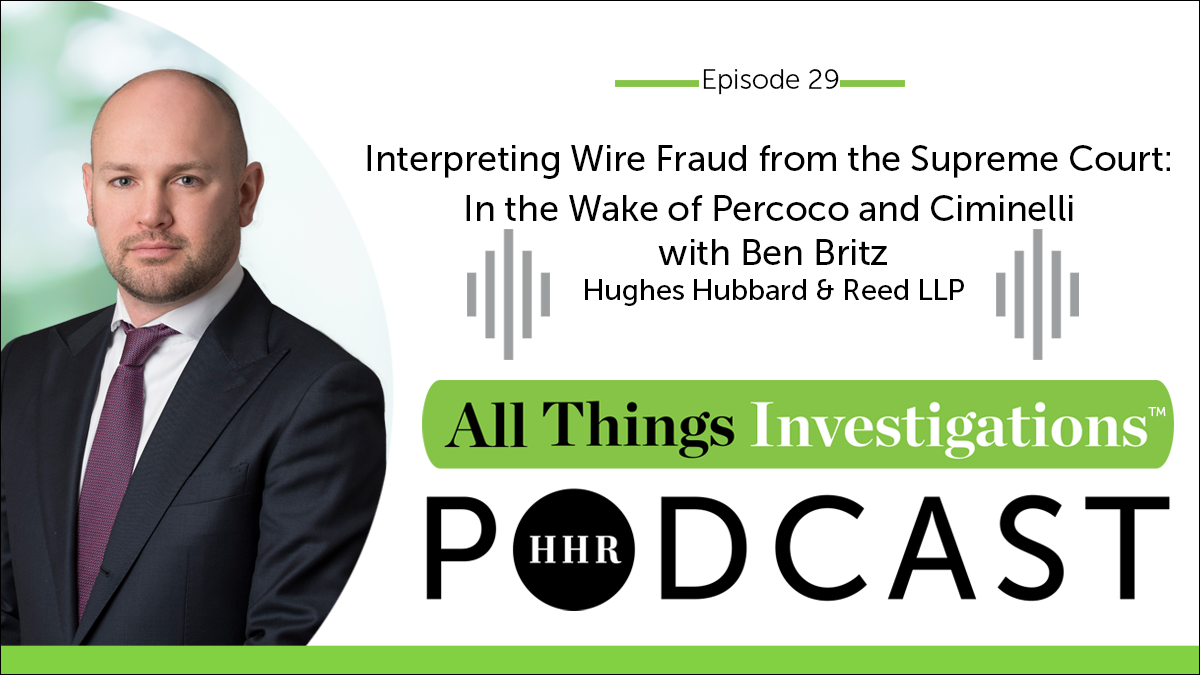
All Things Investigations: Episode 29 – Interpreting Wire Fraud in the Wake of Percoco and Ciminelli Cases with Benjamin Britz

In this award-winning All Things Investigations episode, Tom Fox hosts Benjamin Britz to unpack two high-profile wire fraud cases reshaping how fraud convictions are viewed. Their conversation explores the Cuomo administration cases – Percoco and Ciminelli – providing in-depth analysis of the unanimous Supreme Court decisions and highlighting their broader implications on applying the wire fraud statute.

Ben Britz is a partner at Hughes Hubbard & Reed and an expert in the legal complexities regarding financial fraud. His analysis helps shape a clearer understanding of legal precedents, providing invaluable context to legal practitioners and interested observers.

You’ll hear Tom and Ben discuss:

  • Ben recently wrote a “client alert” article, Hanging by a Thread: Unanimous Supreme Court Snips Back Two Wire Fraud Convictions. The article discusses two high-profile wire fraud cases related to the Cuomo administration in New York, the Percoco and Ciminelli cases.
  • These cases examine the legality of influence exerted in government and the implications of bid rigging.
  • In the Percoco case, Joseph Percoco, a senior advisor to Governor Cuomo from 2011 to 2018, was charged with honest services fraud after he was paid $35,000 to lobby an arm of the New York state government on a labor dispute related to a real estate holding. The case raises questions about the legality of such actions when the individual is technically not in government service.
  • The Ciminelli case involves bid rigging, where Ciminelli and a third party manipulated the qualifications for a project’s bidding process so that only Ciminelli’s company could win. The case raises questions about the “right to control” theory and whether withholding information influencing decision-making amounts to fraud.
  • The Supreme Court has demonstrated a trend of a strict interpretation of wire fraud statutes, often reigning in attempts to expand the application of these laws. Tom and Ben discuss two Supreme Court decisions that pushed back on the expansion of wire fraud statutes, emphasizing a focus on the statutory language.
  • The Department of Justice’s positions in the Percoco and Ciminelli cases were unusual, as they only partially defended the charges.
  • The DOJ admitted that the right-to-control theory was misapplied in the Ciminelli case and agreed that the jury instructions in the Percoco case were based on outdated law.
  • The Supreme Court rulings in these cases put a greater onus on prosecutors to charge cases correctly according to the specific wording of the statute. This includes ensuring the facts align with the charge and not pursuing novel interpretations of the wire fraud statute.
  • The ramifications of these rulings may impact future cases and how prosecutors and defense attorneys approach wire fraud charges.
  • Understanding where the legal boundary lies is crucial, especially for those engaged in political activities, lobbying, and public bidding processes.

KEY QUOTES:

“But I think it’s also these are two weird cases in that in both of them, the DOJ takes a very odd position where it only sort of half defends its case.” – Benjamin Britz

“The Court is getting fairly tired of it, and they want these statutes to be read and interpreted as they’re written and charged in that way.” – Benjamin Britz

“Isn’t it possible that someone can be not in government but still have enough control over what the government is doing that bribing them is illegal?” – Benjamin Britz

Resources:

Hughes Hubbard & Reed website

Benjamin Britz on LinkedIn

Hanging by a Thread

Categories
Corruption, Crime and Compliance

The Murad OFAC Settlement and Sanctions Compliance Lessons Learned

“This [Murad OFAC] enforcement action reflects the fact that OFAC, in recognition of the increasing seriousness of sanctions enforcement, is taking more time to provide guidance through some of their enforcement actions,” Michael Volkov tells listeners. In this episode of Corruption, Crime and Compliance, Michael unpacks the recent enforcement action by OFAC against California-based cosmetics company, Murad. He offers detailed insight into the case, going beyond the headlines and examining the underlying issues that led to the violations, and drawing out key compliance lessons.

You’ll hear Michael talk about:

  • The Murad enforcement action is significant because it highlights OFAC’s increasing focus on sanctions enforcement and the need for global sanctions compliance organizations to have strong local oversight.
  • Over an eight-year period, Murad illegally exported goods and services to Iran in 62 transactions worth approximately $11 million. The company and a former senior executive were penalized, paying $3.3 million and $175,000 respectively.
  • OFAC acknowledged Murad’s voluntary disclosure of the conduct but still categorized the violations as egregious.
  • The conspiracy involved an exclusive agreement to sell Murad’s products in the Middle East, including Iran, and continued even after Murad’s acquisition by Unilever.
  • The key compliance deficiencies cited by OFAC: These include absence of a specific sanctions compliance program, participation of high-level executives in illegal conduct, and lack of understanding of OFAC sanctions by staff based in the United Kingdom.
  • OFAC emphasizes the need for senior management to commit to a culture of compliance and advises against placing a U.S. entity under the compliance structure of a non-U.S. entity that may lack familiarity with U.S. sanctions.
  • Unilever’s failure to uncover Murad’s ongoing contracts with Iran demonstrates the need for robust due diligence and integration processes during acquisitions.


KEY QUOTES:

“OFAC specifically cited that, ‘In some circumstances, placement of a US entity under the compliance structure of a non-US entity that may lack familiarity with US sanctions could prevent prompt identification of and response to potentially prohibited conduct’. In other words, you have to have local boots on the ground, you have to have sanctions expertise in your US operations even though you’re owned by a foreign global company.” – Michael Volkov


“It’s important to have people dedicated to the OFAC sanctions compliance process and to make sure that expertise is available to the business within the United States.” – Michael Volkov


“To this end, OFAC stated that senior executives with managerial responsibilities should take particular care to ensure awareness of applicable prohibitions and refrain themselves from engaging in sanctions violations. ” – Michael Volkov


Resources:

Michael Volkov on LinkedIn | Twitter

The Volkov Law Group

Categories
FCPA Compliance Report

FCPA Compliance Report – GWIC Ladies Reflect

Welcome to the award-winning FCPA Compliance Report, the longest-running podcast in compliance. This episode features a special episode with guests Lisa Fine and Mary Shirley of the Great Women in Compliance podcast. Great Women in Compliance is coming up on its 200th-anniversary show and will move to GWIC 2.0. I asked the women if they would reflect on where they have been and where GWIC may be going.

In this podcast, Mary and Lisa reflect on their podcast journey, discussing their impact on their audience and themselves. They talk about their interview style, attempts to get Dolly Parton’s permission to use her song, and upcoming episodes, including adding a co-host. The podcast highlights the importance of diverse voices and perspectives and aims to make guests comfortable while maintaining a professional yet relaxed tone. Join these dynamic hosts as they share memories and tease new ideas, including a book release and round table discussions with women. Take advantage of this engaging and authentic conversation about success, imposter syndrome, and making a difference!

Key Highlights:

  • Great Women in Compliance: 200th Episode Reflections
  • Evolution of a Passion Podcast
  • Overcoming Impostor Syndrome on Podcasts
  • Opportunities and Authenticity in Podcasting
  • Approach to podcasting and favorite moments
  • Podcast Length and Dolly Parton’s Theme Song
  • Building Successful Business Relationships as Co-Hosts
  • Thanking Listeners for Ideas and Growth

Notable Quotes:

“As a true supporter of women, you looked at us and said, ‘Why don’t you do it?’ And suddenly, right away, it went from this thing we talked about into something bigger than both of us and turned into a book where the people interested in this shared their stories.”

“The podcast started as a hobby but has become an intricate part of our lives, not only as individuals but at least as in my life as cohosts and friends.”

“And what I think was an honor for Lisa and myself as people who aren’t necessarily on the speaking circuit, that we wanted to get the diversity of thought and new voices on the show.”

“Everybody is a thought leader. I’m talking to you because I think you’re a thought leader, and I think you’re bringing something to the table that, again, in a way, which not to make somebody feel pressured into doing it But I also think that’s how I connect with people. Whether they like it or not, this is the conversation. And this is who I am.”

Resources

Mary Shirley

Lisa Fine

Great Women in Compliance

Tom Fox

Instagram

Facebook

YouTube

Twitter

LinkedIn

Categories
Daily Compliance News

Daily Compliance News: June 5, 2023 – The Dylan Tokar Edition

Welcome to the Daily Compliance News. Each day, Tom Fox, the Voice of Compliance, brings you compliance-related stories to start your day. Sit back, enjoy a cup of morning coffee, and listen to the Daily Compliance News. All from the Compliance Podcast Network. Each day we consider four stories from the business world, compliance, ethics, risk management, leadership, or general interest for the compliance professional.

Stories we are following in today’s edition:

  • US firms raise corruption concerns in Ukraine grain deal. (WSJ)
  • Two whistleblowers appeal the Ericsson $279MM whistleblower award. (WSJ)
  • AG files suit to end Civil Rights laws. (Reuters)
  • Dylan Tokar celebrates 4 years a the WSJ Risk and Compliance Journal.
Categories
Trekking Through Compliance

Trekking Through Compliance Episode 3 – Compliance Lessons from Where No Man Has Gone Before

In this episode of Trekking Through Compliance, we consider Where No Man Had Gone Before, which aired on September 22, 1966, Star Date 1312.4. The first Star Trek episode was made (not counting the pilot episode, The Cage), although not the first aired. It differs from subsequent episodes in that there is no “Space, the final frontier” voice-over during the theme song at the beginning.

Story

The Enterprise discovers a 200-year-old ship recorder from the SS Valiant near the galaxy’s edge. Shortly after, the Enterprise passes through an unknown phenomenon that causes major damage and knocks out navigators Gary Mitchell and Dr. Elizabeth Dehner (both of whom have high ESP ratings). When Gary recovers, he begins to acquire telepathic and telekinetic powers. Kirk alarmed at the prospect of having his ship taken over by an increasingly powerful and tyrannical Mitchell, is convinced by Spock to maroon Mitchell at the lithium cracking plant of Delta Vega. Dr. Piper has no explanation for what is happening. Gary kills Lee Kelso and escapes from his imprisonment. Kirk follows him and can destroy him with the help of Dr. Dehner, who is also beginning to acquire the power but kills herself in the process.

Commentary

We take a deep dive into into compliance lessons drawn from the episode’s plot, emphasizing the importance of root cause analysis, risk management, adaptability, ethical leadership, monitoring and controls, balancing innovation with safety, effective team communication, and understanding human behavior in the context of compliance. These lessons are crucial for building and maintaining effective compliance programs in any organization.

Key Highlights

·       Plot Summary of Where No Man Has Gone Before

·       Key Compliance Takeaways

Resources

Excruciatingly Detailed Plot Summary by Eric W. Weisstein

MissionLogPodcast.com

Memory Alpha