Categories
31 Days to More Effective Compliance Programs

One Month to a More Effective Compliance Program for 3rd Parties – Distributor Compensation

One of the issues in any compliance program is the compensation paid to a third party, as FCPA exposure arises when companies pay money, either directly or indirectly, to fund bribe payments. Another area that leads to exposure from third parties is with distributors. In a distributor relationship, the distributor purchases a product, taking the risk of loss and title, at a discount from a manufacturer. The distributor resells at an uplift, and that spread between the purchase price and sales price is the distributor’s income. If a product is purchased at an inflated discounted rate and sold, the difference between the purchase price and resale value could be used for corrupt purposes. Commission payments and excessive distributor discounts can be channeled to pay bribes.

The FCPA Resource Guide, 2nd edition, noted that common red flags associated with third parties include “unreasonably large discounts to third-party distributors.” When companies grant distributors uncommonly steep discounts, bribes can result either: 1) because the company instructs the distributor to use the excess amounts to fund corrupt payments; or 2) because the distributor pays bribes on its own, without the express direction or implicit suggestion from the company, to gain some business advantage.

Three key takeaways:

  1. Creating a well-thought-out process that operationalizes your compliance program around distributor compensation in a manner that documents your decision-making calculus is key.
  2. Require multiple levels of approval for an out-of-range distributor discount.
  3. Tracking distributor discounts globally make your company more efficient.
Categories
Innovation in Compliance

AI – a Horizontal Approach to Business Process with Brian Sathianathan

AI is a horizontal force that can be applied to every department and industry, from retail to banking, legal to HR. The market size for AI is projected to be over $680 billion by 2030, making it one of the most significant technological advances in modern history. Brian Sathianathan, Chief Digital Officer and Co-Founder of Iterate.ai joins host Tom Fox on this episode of Innovation In Compliance to discuss the transformative power of low-code software and AI for enterprise transformation. 

Brian Sathianathan is the Chief Digital Officer and co-founder of Iterate.ai, a company that helps large enterprises innovate faster through low-code software and AI. Sathianathan began his career as a technologist at Apple, working on their secret products and later starting his own video streaming startup. He then transitioned to venture capital work before founding Iterate.ai with his co-founder John Nordmark.


You’ll hear Tom and Brian discuss these ideas:

  • AI is a horizontal force that can be applied to every department and industry.
  • Low code software, such as Iterate.ai’s drag-and-drop software, can help large enterprises innovate faster by building AI and IoT applications 17x faster than traditional methods.
  • AI can be used to scale up a business by improving personalization, image recognition, and even employee hiring and termination.
  • AI can also be applied to supply chain optimization, route optimization, and storage optimization.
  • The AI market is projected to be over $680 billion by 2030, making it one of the most significant technological advances in modern history.
  • Business process automation is becoming more popular as it allows for the removal of repetitive tasks, freeing up time for more creative work.
  • Low code automation started with BPO/BPA processes and eventually expanded to other areas like enterprise applications, consumer ads, and industrial solutions.
  • AI is applicable in BPO processes, particularly within banks, insurance, and finance institutions, where there is a lot of data and conversion from digital data into data that can actually be understood.
  • AI is being used in combination with rule-based or workflow systems, and there will be more code generation and workflow generation happening in the future.
  • Iterate.ai advises boards on use cases and business models to transform the business and eventually work with the senior leaders to get it going.


KEY QUOTES:

“Innovation is going to be everywhere and we wanted to have a company that helps large companies innovate a lot faster. …We realized that for large companies to innovate more aggressively and more effectively, they need software that actually is connected to all these ecosystems.” – Brian Sathianathan


“The beautiful thing about AI is that it’s what I call a horizontal force. When you have technologies, there are vertical forces that can be only applied in one area of the business or you have horizontal forces which can be applied across the entire area of the business.” – Brian Sathianathan


“Using a platform like us, you can build Lego blocks and build a workflow very gracefully and you can apply AI at every point of the decision-making.” – Brian Sathianathan


Resources:

Brian Sathianathan on LinkedIn | Twitter | Email

Iterate.ai

Categories
Daily Compliance News

April 25, 2023 – The Conflict of Interest Edition

Welcome to the Daily Compliance News. Each day, Tom Fox, the Voice of Compliance, brings you compliance-related stories to start your day. Sit back, enjoy a cup of morning coffee, and listen to the Daily Compliance News. All from the Compliance Podcast Network. Each day we consider four stories from the business world, compliance, ethics, risk management, leadership, or general interest for the compliance professional.

Stories we are following in today’s edition:

  • Bullying-no threshold needed. (FT)
  • Does Davis Solomon do business with Goldman? (NYT)
  • The first NFT insider trading case kicks off. (Reuters)
  • Conflicts of interest at the Supreme Court. (Bloomberg)
Categories
The ESG Report

The ESG Report – Trysha Daskam on the Rise of ESG Strategies in Investing

Tom Fox hosts the ESG Report podcast. Welcome to The ESG Report! In this episode, host Tom Fox welcomes Trysha Daskam, Managing Director and Head of ESG Strategy at Silver Regulatory Associates, to discuss how fund managers can implement effective ESG strategies. Trysha stresses the importance of having a defensible and consistent ESG program to attract investments from institutional investors. They discuss the consequences of inaccurate reporting and the need for standardization in ESG reporting across different funds. Trysha expresses her expectations for increased allocation of assets to ESG strategies and more regulation to ensure responsible investment. With regulatory guardrails increasing globally, this episode is a must-listen for any investor who cares about sustainable and responsible investments. Don’t miss this fascinating conversation between Tom Fox and Trysha Daskam. Tune in now to The ESG Report!

Key Highlights:

·       Importance of ESG in Investments

·       Challenges of ESG Conversations with Institutional Investors

·       The Importance of Accurate ESG Reporting

·       Establishing ESG reporting standards

·       Data Privacy Regulations in Global Markets

Notable Quotes:

“And so we’re a team or firm, or a company doesn’t have a perspective on how these factors impact their investments, work, operations, etc. It is seen as an oversight and a meaningful oversight of that company manager management team.”

“If you are a manager that hasn’t gone through fundraising in a period of time and you haven’t seen the request list from a placement agent or from entities looking to diligence you, and you’re not aware of the extensive questions that ESG present with respect to those investigations.”

“If I could drive anything home from this conversation would be around encouraging managers to look at their ESG program, to test it, to ask the question, is every line in here defensible? It is outdated if you still need to update your ESG policy since 20 21. The space has grown. The standards have changed. The questions investors are asking have changed. Priorities have shifted.”

“You must do what you say you are doing, and if you cannot do what you say you’re doing, then you must qualify it, and you must qualify it appropriately.”

Resources

Trysha Daskam on LinkedIn

Silver Regulatory Associates

Tom Fox 

Connect with me on the following sites:

Instagram

Facebook

YouTube

Twitter

LinkedIn

Categories
Data Driven Compliance

Data Driven Compliance – Evgeny Likhoded – Using Data to Make Compliance Programs Dynamic

Are you struggling to keep up with the ever-changing compliance programs in your business? Look no further than the Data Driven Compliance podcast, hosted by Tom Fox. It is a podcast featuring in-depth conversations around the uses of data and data analytics in compliance programs. In this episode, host Tom Fox visits Evgeny Likhoded, the CEO of Clausematch, to discuss their platform for real-time collaboration on content related to governance risk and compliance.

With a focus on financial services, insurance, and Fintech companies, Clausematch ensures compliance with regulations by managing policies and procedures and tracking changes. Likhoded explains how adopting this platform contributes to increased business efficiency and compliance, highlighting its value during times of crisis. Plus, listeners can expect to learn about upcoming trends in compliance technology, including those mandated in areas such as data privacy, ESG, and cybersecurity. Take advantage of innovative ideas to elevate your approach to compliance – subscribe to the Data Driven Compliance podcast today!

Key Highlights:

· The Importance of Dynamic Compliance Programs
· Real-time Governance and Compliance Reporting
· Clausematch Platform and Dynamic Compliance Programs
· Smart and Connected Compliance Strategy
· Compliance Technology and Emerging Regulatory Frameworks

Notable Quotes:

“It’s not enough anymore to have a compliance manual sitting on the shelf; it needs to be distributed. It needs to have engagement. It needs to be communicated.”

“Our goal was to enable collaboration on content that needs a strict and strong governance process.”

“Our platform is used for managing policies and procedures in a way that enables companies to track every single change every time a policy changes to prove that this change complies with the regulations.”

“We have seen an increased number of RFPs requests for proposals specifically in compliance and policy management in large organizations, not just financial services.”

 Resources

Evgeny Likhoded on LinkedIn

Clausematch

 Tom Fox 

Connect with me on the following sites:

Instagram

Facebook

YouTube

Twitter

LinkedIn

Categories
Compliance Week Conference Podcast

Kim Yapchai on Operationalizing Compliance and Leadership Trends

In this episode of the Compliance Week 2023 Speaker Preview Podcasts series, Kim Yapchai discusses some of her presentations at Compliance Week 2023,  “How to Operationalize “Company Culture” Through Compliance” and “Leadership: Current Focus Areas and Future Trends.”

Some of the issues she will discuss in her presentations are:

  1. The meaning of Company Culture and the critical role Compliance can (and must) play in creating, protecting, and operationalizing it;
  2. How the elements of Company Culture intersect with key Compliance mandates;
  3. Strategies that establish Compliance as a “Culture Partner” in an organization;
  4. Emerging topics top of mind for compliance leaders, including CCO certifications, increased liability and;
  5. What steps can compliance professionals take collectively to protect and advance the profession moving forward?

I hope you can join me at Compliance Week 2023. This year’s event will be May 15-17 at the JW Marriott in Washington, DC. The line-up of this year’s event is simply first-rate, with some of the top ethics and compliance practitioners around.

Gain insights and make connections at the industry’s premier cross-industry national compliance event offering knowledge-packed, accredited sessions and take-home advice from the most influential leaders in the compliance community. Back for its 18th year, compliance, ethics, legal, and audit professionals will gather safely face-to-face to benchmark best practices and gain the latest tactics and strategies to enhance their compliance programs. And many others to:

  • Network with your peers, including C-suite executives, legal professionals, HR leaders, and ethics and compliance visionaries.
  • Hear from 75+ respected cross-industry practitioners who are CEOs, CCOs, regulators, federal officials, and practitioners to help inform and shape the strategic direction of your enterprise risk management program.
  • Hear directly from the two SEC Commissioners, gain insights into the agency’s enforcement areas, and walk away with guidance on remaining compliant within emerging areas such as ESG disclosure, third-party risk management, cybersecurity, cryptocurrency, and more.
  • Bring actionable takeaways from your program from various session types, including ESG, Human Trafficking, Board obligations, and many others, for you to listen, learn and share.
  • Compliance Week aims to arm you with information, strategy, and tactics to transform your organization and career by connecting ethics to business performance through process augmentation and data visualization.

I hope you can join me at the event. For information on the event, click here. Listeners of this podcast will receive a discount of $200 by using code TF200 on the link here.

Categories
31 Days to More Effective Compliance Programs

One Month to a More Effective Compliance Program for 3rd Parties-Terminating 3rd Parties

At some point, you will be required to terminate a third party and there will be multiple legal, compliance and business issues to navigate through. If you are stuck doing it in the middle of a FCPA or U.K. Bribery Act investigation, there may well be some tension to do so and do so quickly. If you have not thought through this issue and created a process to follow before a crisis occurs, you may well be in for a very tough road. Yet the 2023 ECCP specifically asked that question in the section entitled, Real Actions and Consequences, when it posed the query: Has a similar third party been suspended, terminated, or audited as a result of compliance issues?

The key theme in termination is planning. The Office of Comptroller of the Currency (OCC), OCC Bulletin 2013-29, said that regarding third-party termination, a bank should develop a “contingency plan to ensure that the bank can transition the activities to another third party, bring the activities in-house, or discontinue the activities when a contract expires, the terms of the contract have been satisfied, in response to contract default, or in response to changes to the bank’s or third party’s business strategy.”

Although rarely considered, the termination of a third-party relationship can be as important a step as any other in the management of the third-party lifecycle. While having the contractual right to terminate is a good starting point, it is only the starting point. You not only need to have a compliance and legal plan in place but a business plan as well. If you do not, the cost in both monetary and potential business reputation can be quite high.

 Three key takeaways:

1. Termination of third parties is an oft-neglected part of the third-party risk management process.

2. Make certain you have the contractual right to terminate third parties written into your compliance terms and conditions.

3. Have a strategy in place for termination before a crisis arises.

Categories
Corruption, Crime and Compliance

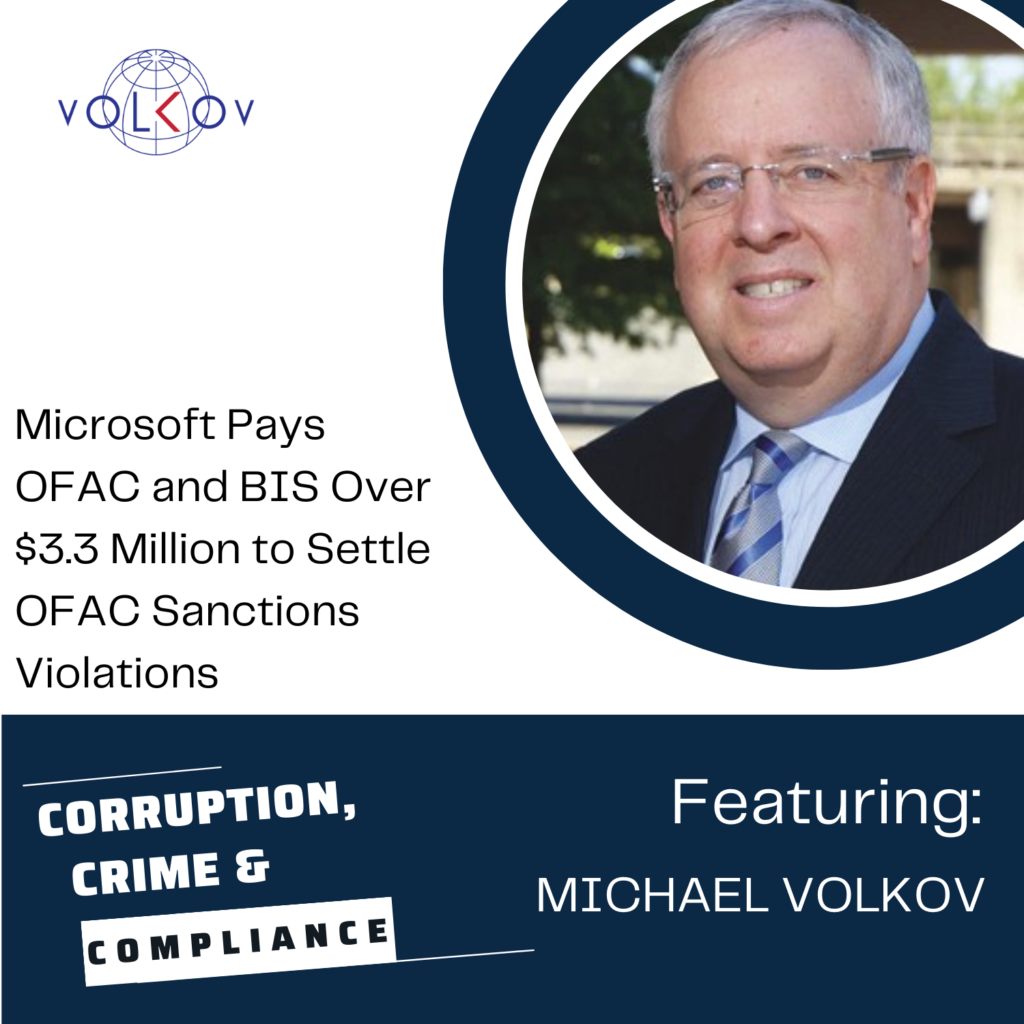
Microsoft Pays OFAC and BIS Over $3.3 Million to Settle OFAC Sanctions Violations

Microsoft recently paid over $3 million for multiple sanctions violations involving illegal exports of services and software to sanctioned jurisdictions. The violations spanned seven years and involved prohibited Russian entities or persons located in the Crimea region of Ukraine. However, what makes this case particularly intriguing is the remedial actions taken by Microsoft, which offer best practices and insights into what can be done when resources are available. In this week’s episode of Corruption, Crime, and Compliance, Michael Volkov takes a deep dive into the Microsoft OFAC enforcement action.

He discusses these ideas:

  • Microsoft committed 1339 transactions in violation of multiple sanctions programs over seven years, totaling over $12 million worth of sales and services.
  • Violations included the sale of software licenses and the provision of related services from servers and systems located in the US and Ireland to SDNs, blocked persons, and other end users located in Cuba, Iran, Syria, Russia, and the Crimea region of Ukraine.
  • The violations were due to Microsoft’s failure to obtain complete or accurate information on the identities of end customers and shortcomings in its restricted party screening. At times, Microsoft Russia employees intentionally circumvented Microsoft screening controls to prevent other Microsoft affiliates from knowing the identity of the ultimate end customers.
  • Microsoft’s significant remedial measures included enhancing its trade compliance program, improving its governance structure and screening resources, adopting a new three lines of defense model, and conducting a holistic risk assessment to identify and remediate instances of prohibited engagements.
  • Microsoft deployed a multidisciplinary internal investigation team proficient in 16 foreign languages, modified its procedures to respond to matches, and expanded the scope and volume of data screened.
  • “Companies with sophisticated technology operations and a global customer base should ensure that their sanctions compliance controls remain commensurate with risk.” 
  • Companies should consider conducting a holistic risk assessment to identify and remediate prohibited engagements and ensure that employees adhere to the sanctions compliance program.
  • OFAC emphasized that companies conducting business through foreign-based subsidiaries, distributors, and resellers should have sufficient visibility into their end-users, including through the provision of services after an initial sale.


KEY QUOTES:

“Now, when Microsoft supported these third party sales to prohibited parties, they provided prohibited software and services to SDNs and end customers in sanctioned jurisdictions and the violations occurred. The root cause really was because Microsoft did not have complete or accurate information on the identities of the end customers for Microsoft’s products.” – Michael Volkov


“Companies with sophisticated technology operations and a global customer base should ensure that their sanctions compliance controls remain commensurate with that risk and leverage in appropriate technological compliance solutions.” – Michael Volkov


“Testing or auditing, whether conducted on a specific element of a compliance program or enterprise wide level, are important tools to ensure that the program is working as designed and weaknesses are promptly remediated.” – Michael Volkov


Resources:

Michael Volkov on LinkedIn | Twitter

The Volkov Law Group


Categories
All Things Investigations

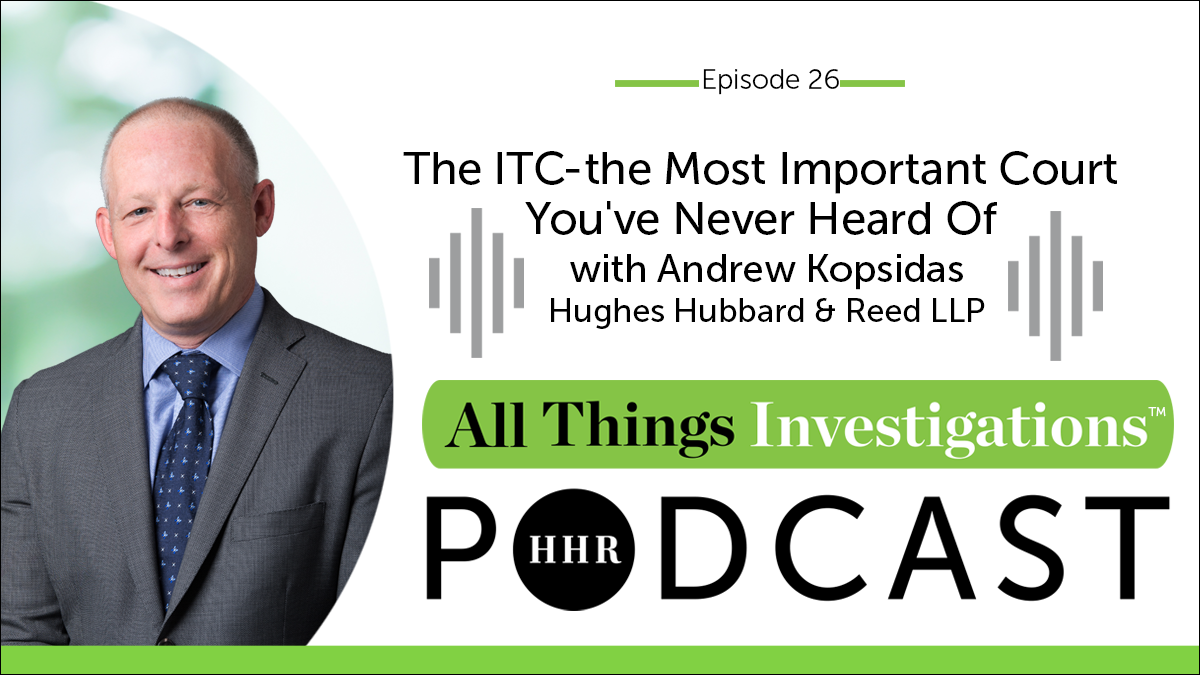
All Things Investigations: Episode 26 – The ITC – The Most Important Court You’ve Never Heard Of with Andrew Kopsidas

Did you know about a powerful court that handles investigations of products imported into the US? On this episode of All Things Investigations, host Tom Fox sits down with Andrew Kopsidas to discuss the International Trade Commission (ITC). Andrew walks Tom through the ins and outs of the ITC, including its broad definition of unfair trade practices, the plaintiff and defendant roles, and the power of the agency to bar products from entering the US. He also shares insights on the speed of ITC cases, the role of administrative law judges, and the importance of having good ITC counsel.

Andrew Kopsidas is a litigation and strategic consulting expert with over 20 years of experience in intellectual property (IP) matters. He graduated from George Washington University Law School in 1999, after earning a degree in aerospace engineering from the University of Maryland. Kopsidas is a partner at Hughes Hubbard & Reed, where he advises clients on litigation and strategic counseling matters related to IP.


You’ll hear Tom and Andrew discuss these ideas:

  • The ITC is a federal agency that investigates unfair trade practices related to international trade, with the power to bar products from entering the US.
  • Any company that has a domestic industry in the US and is facing imports of products made in a foreign country using unfair trade practices can file a complaint with the ITC.
  • Unfair trade practices can include patent and trademark infringement, trade secret misappropriation, false advertising, and more.
  • ITC cases move quickly, with only 30 days to prepare for discovery and respond to requests, making it crucial for in-house counsel to act fast and get management buy-in.
  • Administrative law judges are the fact-finders in ITC cases, and their credibility determinations can be influenced by the reputation of the lawyers involved.
  • ITC lawyers must have knowledge of the nuances of ITC practice and be able to work with the Office of Unfair Import Investigations and persuade them that their side of the case is right.
  • Andrew emphasizes early assessment of cases. He recommends organizing a scrub session with the outside litigation team and employees to go through the merits of the case. He points out that it’s important to consider the client’s objectives to find the best solution for their business.
  • The ITC litigation process is strictly one way, with no counterclaims, and the respondent is always on the receiving end.
  • The government attorneys at the ITC are neutral and trained to represent the public interest. They participate in discovery and give their opinion right before the trial.
  • Going on the offensive is an essential strategy for a defendant in an ITC case. For example, a defendant can file their ITC action as a counteraction, file district court actions, or refuse to stay the district court case.
  • Trials in the ITC can be a lot like a district court, but without a jury. The rules of evidence are not as stringent as in district court.
  • Companies should take ITC cases seriously and avoid hiring inexperienced counsel as there is a lot of nuance to ITC practice.


KEY QUOTES

“I’ve seen a lot of good lawyers stumble in the ITC because they just weren’t familiar with the nuance of practice.” – Andrew Kopsidas


“If a company isn’t taking things seriously, the case can be lost before it’s practically even begun.” – Andrew Kopsidas


“The first question I like to ask clients is, What’s your business objective here? We as litigators a lot of times want to think that what we do is the be all and end all. Really we’re just a tool for these companies that have broader business objectives and we need to keep that in perspective.” – Andrew Kopsidas


Resources:

Hughes Hubbard & Reed website

Andrew Kopsidas on LinkedIn

ITC Spotlight

You’ve Been Sued – Part 1

You’ve Been Sued – Part 2

Categories
FCPA Compliance Report

Executives at Risk Winter: 2022/2023

Welcome to the award-winning FCPA Compliance Report, the longest-running podcast in compliance. In the latest episode of the FCPA Compliance Report, host Tom Fox welcomes Katherine Pappas, Lauren Briggerman, and Ian Herbert, government experts and internal investigations at the Miller & Chevalier law firm. The group discusses changes to the Corporate Enforcement Policy and the challenges companies face with extraordinary cooperation and clawbacks. They also dive into the Biden administration’s antitrust policies, particularly in labor markets and the recent trend of the DOJ losing no-poach cases to juries. The conversation then shifts to the FTC’s proposed rule on non-compete agreements and recent FCPA individual prosecutions related to bribery allegations. Finally, the hosts discuss potential changes to the duty of oversight requirements for company directors and officers and potential changes to US sentencing guidelines. Take advantage of this informative and engaging episode!


Key Highlights:

  • Updates on DOJ’s Corporate Enforcement Policy
  • Challenges and Failures in Antitrust Prosecutions
  • No-poach and non-compete agreements in the energy industry
  • FTC Rulemaking and Non-Compete Agreements
  • Cryptocurrency and High-Profile Nondisclosure Cases
  • Oversight and Sentencing Guidelines in Companies

Resources:

Miller & Chevalier

Executives At Risk Winter: 2022/2023

Lauren Briggerman

Katherine Pappas

Ian Herbert


Tom Fox

Instagram

Facebook

YouTube

Twitter

LinkedIn