In today’s edition of Daily Compliance News:
- 3 Charged in Ecuadorian Bribery and ML Scheme. (DOJ Press Release)
- South Africa asks UAE to extradite Guptas. (US News and World Reports)
- Banks moving to ComTech. (WSJ)
- WWE to restate results. (Reuters)



In today’s edition of Daily Compliance News:
Today we conclude our series on a Federal Anti-Kickback enforcement action which was announced last week, involving the Oregon based medical device manufacturer Biotronik Inc. (Biotronik). Today, I want to consider the corruption schemes and the lessons learned for the compliance professional. As stated in the Settlement Agreement, Biotronik “knowingly caused the submission of false claims for payment to federal healthcare programs by providing remuneration to physicians to induce them to use Biotronik’s CRM devices in violation of the Anti-Kickback Statute, 42 U.S.C. § 1320a-7b(b).”
I. The Bribery Schemes
a. Abuse of Training Programs
The Settlement Agreement alleges “Biotronik knowingly paid excessive payments to physicians with a purpose of inducing and rewarding their use of Biotronik’s pacemakers, defibrillators, and other cardiac devices. One of ways the company did so was through “its new employee training program (“Training Program”) by knowingly paying some of its physician customers (“Training Physicians”) to provide excessive employee trainings.” Under this scheme, the Training Physicians were to be paid a fixed fee of approximately $400.00 each time a Biotronik employee trainee received training during one of the Training Physician’s CRM implant procedures. For instance, under the Training Program implant procedure, the “Training Physician was supposed to educate the employee trainee on Biotronik’s devices and teach how to assist a physician during an implant procedure.”
However, it was the sales team which set up these training programs. Biotronik’s compliance and training functions warned that “Biotronik’s salespeople had too much influence in the selection of Training Physicians, that the Training program and resulting payments were being over- utilized, and that the goal of educating Biotronik employees could be achieved without paying Training Physicians.” However, “Biotronik permitted trainees to attend an excessive number of training procedures for which Training Physicians received payment from Biotronik without first conducting an adequate assessment of the trainee’s need for additional training.”
To further line the pockets of the Training Physicians, “salespeople, including managers, intentionally prevented otherwise qualified trainees from successfully completing the Training Program, not because they needed additional training, but rather as a means of ensuring that the trainee could attend more trainings, thereby purportedly justifying additional payments to Training Physicians.” Biotronik also knowingly paid Training Physicians for some trainings that either never occurred or was of little or no value to trainees. This included paying one “Training Physician for certain trainings for which there was no trainee physically present to observe the implant procedure.”
b. Lavish Entertainment
The Settlement Agreement also alleged that “Biotronik knowingly paid for lavish meals, entertainment, and travel for certain physicians who are known to Biotronik and the United States (hereinafter the “Subject Physicians”) with a purpose of inducing and rewarding their use of Biotronik’s pacemakers, defibrillators, and other cardiac devices.” The company “did not require sign in sheets for lavish meals with physicians and did not use adequate methods to verify the number or identity of attendees or to confirm whether the meals were for a legitimate business purpose.”
This led to some Biotronik employees falsifying “receipts and participant lists, making it possible to exceed the company’s compliance spending limit per attendee.” These meals and outings often included little or no legitimate business discussion. There was also the amount of the entertainment expense, which included “winery tours, annual office holiday parties, and lavish meals with certain Subject Physicians and their guests at high-end restaurants.” Yet another example of spending far too much on entertainment was “one Subject Physician’s international business class airfare and honoraria in the thousands of dollars for a short, 30-minute talk at an international conference.”
II. Biotronik Remediation
No doubt one of the reasons Biotronik did receive the settlement amount was that, at some point, it recognized the issues and instituted remediation. With the training programs “beginning in 2017, Biotronik added new compliance measures and oversight of the Training Program, limited the number of Training Program events, and reduced payments made in connection with such Training Program events.” In April 2021, Biotronik hired a new Vice President of Compliance and was able to get the lavish entertainment under control by adding “new compliance measures related to the provision of meals and travel to healthcare providers which provided additional employee training, imposed new restrictions, and improved oversight to identify and prevent meal and travel policy violations.”
III. Lessons Learned
There are multiple lessons here for the compliance professional outside the laws under which Biotronik ran afoul. Perhaps the clearest and foremost is that compliance not only needs visibility into areas of risk about also some modicum of control. In the area of Physician Training, the Settlement Agreement specifically noted that the Biotronik compliance function “warned that Biotronik’s salespeople had too much influence in the selection of Training Physicians, that the Training program and resulting payments were being over-utilized, and that the goal of educating Biotronik employees could be achieved without paying Training Physicians.” Here a control should have been put in place which required compliance approval before payments and reimbursements were made for the training. This is similar to a compliance oversight and control of expenses paid or reimbursed to foreign government officials in a Foreign Corrupt Practices Act (FCPA) compliance program.
Interestingly, the Department of Justice (DOJ) also discussed a more nuanced approach to determining if the Physician’s Training is both initially warranted and then continues to be warranted. This is ongoing monitoring. Obviously for Biotronik, one of their risks was when the company paid for training provided by doctors who could also prescribe the company’s products and services. The risk to the company is similar to the risk of an internationally focused company doing business with foreign governments or state-owned enterprises, under the FCPA. If you are paying out monies for training and that puts you in a high-risk category, you need to make sure those receiving the training are required to receive it or even need it.
Under the lavish spending on entertainment and travel, the same type of analysis can apply. The key is both “reasonable spending and business purpose.” The amount spent must be reasonable for the time, locale and participants. There should also be an articulated business purpose for the dinner or other event.
Under the FCPA, there is no threshold that a Company can establish a value for business entertainment. However, I believe there are clear guidelines which should be incorporated into your business expenditure policy, which should include the following:
The incorporation of these concepts into a compliance policy is a good first step towards preventing potential violations from arising, but it must be emphasized that they are only a first step. There must be procedures to implement these policies. At a minimum, you must require a business justification from the business representative requesting to provide the gift or business entertainment. Next it should be reviewed and approved by a front-line compliance professional. Then, depending on the amount and nature of the request, it may need Chief Compliance Officer (CCO) approval. Finally, if there is a Compliance Committee it should go to that Committee for a final check to make sure everything is in order.
These guidelines must be coupled with active training of all personnel, not only on a company’s compliance policy, but also on the corporate and individual consequences for violation of the policy. Lastly, it is imperative that all such business entertainment be properly recorded, as required by the books and records component of the FCPA.
And, as always, do not forget the gut check test.
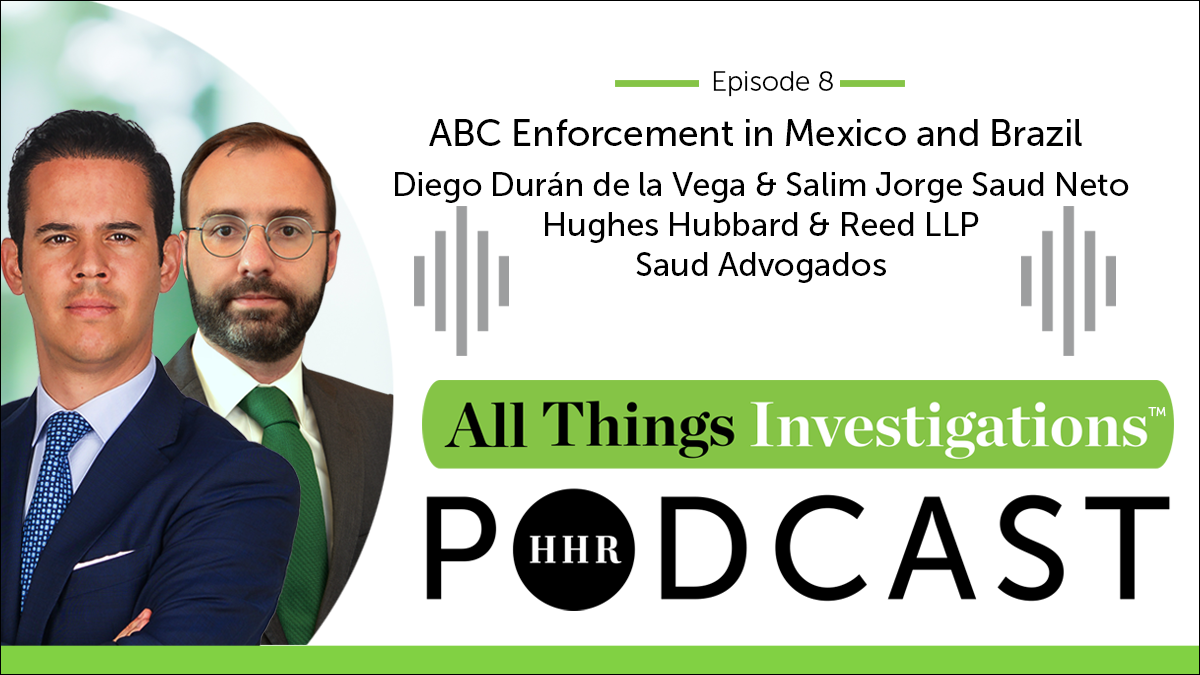
Welcome to the Hughes Hubbard Anti-Corruption and Internal Investigations Practice Group’s Podcast, All Things Investigations. In this podcast, host Tom Fox and Diego Duran and Salim Saud of the Hughes Hubbard Anti-Corruption & Internal Investigations Practice Group highlight some of the key legal issues involved in white collar and other investigations, both domestically and internationally.
Diego Duran is a Hughes Hubbard partner and criminal defense attorney licensed to practice in some parts of the US and Mexico, where he spent several years working for one of its top boutique law firms. Salim Saud is an attorney and partner based in Rio de Janeiro, Brazil, at Saud Advogados, in association with Hughes Hubbard. He specializes in anti-corruption and is also the coordinator of the Anti-Corruption Compliance practice at FGV.
Key areas we discuss on this podcast are:
Resources
Hughes Hubbard & Reed website
Diego Duran on LinkedIn
Salim Saud on LinkedIn

Tom Fox welcomes Raj Arora to the ESG Report. Raj is the CEO of Jensen Hughes, deemed the global leader in safety, security, risk-based engineering, technology, and consulting. It is primarily known for its innovative work in fire protection and engineering. In this week’s show, Raj and Tom discuss the firm, his professional background, and how it relates to ESG.
Risk-Based Engineering
Tom asks Raj to define risk-based engineering. “Risk-based engineering and consulting are all the facets of trying to assess the risk, to ensure that the probabilities and the consequences are limited for our clients,” Raj responds. They help clients prepare for emergencies, mitigate losses and respond and recover from those accidents quickly. They assess emergency management situations through risk frameworks and use the popular method of probabilistic risk assessment.
Principles + Purpose with Jensen Hughes
Tom asks Raj to explain how Jensen Hughes put their Principle + Purpose strategy into practice. “Our purpose is to make our world safe, secure, and resilient,” Raj remarks, “and we have principles that we lead the company by and live by every day and that is our clients, our industry, and our performance.” A successful business needs to have a purpose and a drive for what you’re doing and who you’re doing it for. Your main priority should be being “good partners and understanding your clients objective.” You must also be performance-oriented and focused on business growth “which helps advance the purpose of the firm.”
ESG and the Engineering Industry
Tom asks Raj what role an engineering firm like Jensen Hughes plays in ESG. He responds that Jensen Hughes believes that they must help achieve their ESG goals, as their mission is “making the world safe, secure, and resilient”. Most engineering firms are all about focusing on the environmental aspect of ESG, by reducing their carbon footprint, decarbonization, and environmental stewardship. Jensen Hughes also helps their clients follow ESG regulations by “helping manage wildfires, risk-based engineering, new energy storage solutions and safely advancing carbon-free energy.”
Resources
Raj Arora | LinkedIn | Twitter
Jensen Hughes | Website | LinkedIn
In this episode of the FCPA Compliance Report, I am joined by Keith Williamson and Henry Chambers, Managing Directors at Alvarez and Marsal. We look at the firm’s Threatscape Report. Highlights of this podcast include:
A. Threat 1-ABC Threats
B. Threat 2-Fraud and Digital Asset Fraud Threats
C. Threat 3-Data Privacy and Data Protection
Resources
We have not had a This Day in History opening for the FCPA Compliance and Ethics Blog for some time. So not only is one long overdue but a shipwreck which occurred some 66 years ago makes a great opening for today’s start of a multi-part blog post series on a Federal Anti-Kickback enforcement action which was announced last week, involving the Oregon based medical device manufacturer Biotronik Inc. (Biotronik).
The shipwreck of course was the catastrophe involving the Italian passenger liner the Andrea Doria and the Swedish passenger liner, the Stockholm off the coast of New York on this date in 1956. According to This Day in History, at approximately, 10:45 pm, the Stockholm showed up on the Andrea Doria’s radar screens, at a distance of about 17 nautical miles. Next Andrea Doria showed up on the Stockholm’s radar, at 12 miles away. The Andrea Doria Captain then “exacerbated a dangerous situation by making a turn to port for an unconventional starboard-to-starboard passing, which he wrongly thought the other ship was attempting.” Third Officer Johan-Ernst Bogislaus Carstens, commanding the bridge of the Stockholm, then made a conventional turn to starboard. Andrea Doria Captain Calami realized he was on a collision course with the Stockholm and turned hard to the left, hoping to race past the bow of the Swedish ship but it was too late. Five were killed on the Stockholm and 46 persons on the Andrea Doria died but over 1,600 were rescued. It was one of the final great nautical disasters involving the collision of passenger ships.
According to the Department of Justice (DOJ) Press Release, “the Federal Anti-Kickback Statute prohibits offering or paying anything of value to induce referrals of items or services covered by Medicare and other federally funded programs. The statute is intended to ensure that medical providers’ judgments are not compromised by improper financial incentives.” Principal Deputy Assistant Attorney General Brian M. Boynton, head of the Justice Department’s Civil Division, said, “Paying kickbacks to doctors to influence their selection of medical devices undermines the integrity of federal healthcare programs. When medical devices are used in surgical procedures, patients deserve to know that their device was selected based on quality of care considerations and not on improper payments from manufacturers.”
Biotronik is a company which manufactures and sells cardiac rhythm management (CRM) devices, including pacemakers, defibrillators, and cardiac resynchronization therapy (CRT) devices throughout the United States. The company engaged in bribery and corruption inside the US rather than outside of the US as we see in cases involving the Foreign Corrupt Practices Act (FCPA). The Press Release claims that the company engaged in a “kickback scheme to pay certain favored physicians to induce and reward their use of Biotronik’s pacemakers, defibrillators and other cardiac devices. In particular, Biotronik allegedly abused a new employee training program by paying physicians for an excessive number of trainings and, in some cases, for training events that either never occurred or were of little or no value to trainees.”
Biotronik was on actual knowledge that these payments were illegal as the corporate compliance function “warned that salespeople had too much influence in selecting physicians to conduct new employee training and that the training payments were being over-utilized.” The Press Release also noted, “the settlement also resolves allegations that Biotronik violated the Anti-Kickback Statute when it paid for physicians’ holiday parties, winery tours, lavish meals with no legitimate business purpose and international business class airfare and honoraria in exchange for making brief appearances at international conferences.”
Interestingly, this matter involved two whistleblowers. The civil settlement included the resolution of claims brought under the qui tam or whistleblower provisions of the False Claims Act (FCA), which, under those provisions, a private party can file an action on behalf of the United States and receive a portion of any recovery. The whistleblowers were Jeffrey Bell and Andrew Schmid, both of whom had been employed as independent sales representatives for Biotronik. They brought suit against the company, alleging, as stated in the Settlement Agreement, that Biotronik “knowingly caused the submission of false claims for payment to federal healthcare programs by providing remuneration to physicians to induce them to use Biotronik’s CRM devices in violation of the Anti-Kickback Statute, 42 U.S.C. § 1320a-7b(b). The United States intervened in the Civil Action on June 21, 2021.” Bell and Schmid received approximately $2.1 million as their share of the recovery in this case.
Biotronik agreed to pay $12.95 million to resolve these allegations “by causing the submission of false claims to Medicare and Medicaid by paying kickbacks to physicians to induce their use of Biotronik’s implantable cardiac devices, such as pacemakers and defibrillators.” There were multiple US enforcement authorities involved in this case. The Press Release noted, “the resolution obtained in this matter was the result of a coordinated effort between the Justice Department’s Civil Division, Commercial Litigation Branch, Fraud Section and the U.S. Attorney’s Office for the Central District of California. HHS-OIG assisted in the investigation.”
Join us tomorrow when we consider the bribery schemes allegedly used by Biotronik and the lessons learned for the compliance professional.
In today’s edition of Sunday Book Review:
Resource
In Texas, Women Crime Authors Have Finally Escaped the Shadow of ‘Gone Girl’ by Amy Gentry in Texas Monthly.
In today’s edition of Daily Compliance News:
· The US blacklists former Paraguayan President. (Al-Jazeera)
· An Arab Spring for South Africa? (Bloomberg)
· SEC says crypto is unregulated securities. (WaPo)
· Hyundai used child labor in Alabama. (Reuters)
Where does creativity fit into compliance? In more places than you think. Problem-solving, accountability, communication, and connection – all take creativity. Join Tom Fox and Ronnie Feldman on Creativity and Compliance, part of the award-winning Compliance Podcast Network. In this episode, Tom and Ronnie continue their short series of provocative statements on compliance training and communications, followed by a discussion. In this episode, Ronnie pitches today’s question to Tom on is ethics and compliance training is required? Highlights include:
· Is E&C training required by law?
· Why doesn’t E&C training work?
· Why not spend your time doing things that help?
· How E&C training can promote speak-up culture.
· Why E&C training provides tools and resources.
· How E&C training gets leadership involved.
Resources:
Ronnie Feldman (LinkedIn)
Learnings & Entertainments (LinkedIn)
Ronnie Feldman (Twitter)
Learnings & Entertainments (Website)
60-Second Communication & Awareness Shorts – A variety of short, customizable, quick-hitter “commercials” including songs & jingles, video shorts, newsletter graphics & Gifs, and more. Promote integrity, compliance, the Code, the helpline and the E&C team as helpful advisors and coaches.
Workplace Tonight Show! Micro-learning – a library of 1-10-minute training and communications wrapped in the style of a late-night variety show that explains corporate risk topics and why employees should care.
Custom Live & Digital Programing – We’ll develop programming that fits your culture and balances the seriousness of the subject matter with more engaging delivery.
Tales from the Hotline – check out some samples.