Categories
Innovation in Compliance

Innovation in Compliance – From Engineer to Business Coach: Insights on Leadership and Growth with Brad Farris

Innovation comes in many forms, and compliance professionals need to be ready for it and embrace it. Join Tom Fox, the Voice of Compliance, as he visits with top innovative minds, thinkers, and creators in the award-winning Innovation in Compliance podcast. In this episode, host Tom Fox visits Brad Farris to delve into his multifaceted role as a business coach, advisor, and personal growth director.

Brad shares his journey from engineering to coaching, emphasizing the shift business owners need from service delivery to managerial roles as their companies grow. The discussion covers the complexities of leadership evolution, the impact of AI on professional services, and strategies for scaling and potentially selling a business. Brad provides practical advice on managing client relationships, mentoring emerging leaders, and navigating the intricacies of corporate transitions. Tune in to gain valuable insights on personal and business growth, whether you are an entrepreneur or a compliance professional.

Key highlights:

  • Challenges in Leadership Transition
  • Dealing with Client Expectations
  • Mentorship and Leadership Development
  • Mastermind Groups Explained
  • Preparing for Business Acquisition

Resources:

Brad Farris on LinkedIn

Anchor Advisors

Tom Fox

Instagram

Facebook

YouTube

Twitter

LinkedIn

Categories
All Things Investigations

All Things Investigations: FCPA Alert Week – Jiaxing Hao on Understanding the Role of Multilateral Development Banks in Anti-Corruption

Welcome to the Hughes Hubbard Anti-Corruption & Internal Investigations Practice Group’s podcast, All Things Investigation. This week, we will feature five lawyers from HHR to introduce the firm’s always popular and annual FCPA and Anti-Bribery Alert. In this second podcast of the 5-part series, host Tom Fox is joined by Jiaxing Hao on the significance and enforcement actions of Multilateral Development Banks (MDBs) like the World Bank and Inter-American Development Banks in combating corruption.

They examine key trends from 2024, including a renewed focus on complex corruption cases. Jiaxing emphasizes the importance of compliance, particularly in accurately documenting and reporting all transactions, as MDBs consider even internships, employment contracts, and additional personnel as potential bribery risks. The conversation highlights the MDBs’ lower burden of proof, making it critical for compliance professionals to be vigilant in their anti-corruption efforts.

Key highlights:

  • Understanding Multilateral Development Banks
  • Key Trends in MDB Enforcement Actions
  • Compliance Lessons for Corporations
  • Fraudulent Practices in Bid Documents
  • Burden of Proof in MDB Investigations

Resources:

Hughes Hubbard & Reed website

2024 Fall FCPA and Anti-Bribery Alert

Jiaxing Hao

Categories
Daily Compliance News

Daily Compliance News: December 10, 2024 – The Cost of Corruption Edition

Welcome to the Daily Compliance News. Each day, Tom Fox, the Voice of Compliance, brings you compliance-related stories to start your day. Sit back, enjoy a cup of morning coffee, and listen in to the Daily Compliance News—all from the Compliance Podcast Network. Each day, we consider four stories from the business world: compliance, ethics, risk management, leadership, or general interest for the compliance professional.

  • Trafigura used high-risk middlemen. (FT)
  • Inside a four-day workweek experiment. (NYT)
  • Did Boohoo illegally surveille employees? (BBC)
  • South African government is not working with McKinsey for the G-20.  (Bloomberg)

For more information on the Ethico Toolkit for Middle Managers, available at no charge, click here.

Check out the entire 3-book series, The Compliance Kids, on Amazon.com.

Categories
Blog

AI in Compliance: Part 2, Leveraging AI for Third-Party Risk Management

We continue our week-long look at the use of AI in compliance. Today, we consider third parties. Third-party relationships remain one of the most significant areas of risk for corporate compliance programs. From supply chain partners to distributors and everything in between, third parties act as the face of your organization in many jurisdictions, making their actions, and any misconduct, your problem. To mitigate these risks, companies traditionally relied on periodic due diligence and reactive responses. But in today’s fast-moving and increasingly interconnected world, such approaches fall short.

This is where artificial intelligence (AI) can revolutionize third-party risk management. With AI tools, compliance teams can shift from static, checklist-driven processes to dynamic, continuous monitoring systems. In this post, we’ll explore how AI enhances third-party risk management by screening, monitoring, and evaluating third parties in real time and how it helps meet the DOJ’s 2024 Evaluation of Corporate Compliance Programs (2024 ECCP) expectations for robust, data-driven compliance practices.

The DOJ’s 2024 ECCP places a strong emphasis on using data analytics and continuous monitoring to strengthen compliance programs. These expectations are included with the requirements of a proactive risk management and data-driven compliance. AI allows compliance teams to manage a large volume of third-party relationships efficiently and effectively. To fully align with DOJ expectations, companies should document their use of AI tools, including how they support risk assessments and monitoring activities. Regular audits of AI systems can ensure they remain effective and compliant with legal standards.

AI: The Compliance Professional’s New Ally

The compliance risks tied to third parties are well-documented:  bribery and corruption, reputational damage, and legal and regulatory violations. AI excels at handling exactly the complexity of third-party management entails. It can process vast amounts of data from multiple sources, identify patterns, and provide actionable insights in real-time. Let’s break down how AI can be used at each stage of the third-party lifecycle.

  • Initial Screening.

Traditional screening processes rely on questionnaires and public database checks—important but limited in scope. AI-powered tools enhance this step in a variety of ways. By aggregating diverse data sources, AI systems can pull information from public records, news outlets, litigation databases, social media platforms, and proprietary sources. Through the use of natural language processing (NLP) algorithms, you can detect hidden risks through the analysis of news articles, blogs, or social media posts to uncover potential red flags, such as allegations of fraud, regulatory violations, or ethical misconduct. Finally, with scored risk profiles, AI models assess the likelihood of misconduct based on factors such as geographic risk, industry norms, and historical behavior. This risk scoring allows compliance teams to prioritize their efforts.

  • Onboarding Due Diligence

The onboarding phase is critical for setting the tone of the relationship and understanding the potential risks. AI can assist you in a variety of ways. With automated document review, AI tools can process contracts, certifications, and policies submitted by third parties, flagging inconsistencies or missing information. One area that continues to bedevil due diligence is the identification of Beneficial Ownership. By cross-referencing corporate records, AI can reveal ultimate beneficial owners, including individuals who might otherwise remain hidden. Machine learning (ML) models trained on historical compliance data can predict the likelihood of future misconduct, enabling proactive risk mitigation strategies through predictive insights. The bottom line is that by ensuring a thorough onboarding process, AI helps organizations comply with DOJ guidance, which emphasizes the importance of understanding third-party relationships.

  • Continuous Monitoring

A one-time due diligence exercise is no longer sufficient. The 2024 ECCP made clear the need for ongoing monitoring to ensure that third-party relationships remain compliant. AI facilitates this mandate by offering real-time alerts, where AI-driven systems can monitor news feeds, regulatory databases, and other sources 24/7, sending alerts when a third party is implicated in a legal issue, sanctions violation, or reputational scandal. One of the more challenging areas for compliance professionals has in around transaction monitoring. Here, AI can analyze financial transactions involving third parties, flagging anomalies that might indicate fraud or corruption. Finally, in the area of behavioral analytics, AI tools can track changes in a third party’s behavior, such as a sudden increase in high-risk transactions or shifts in geographic focus. These patterns often signal emerging risks. The bottom line is that with continuous monitoring, companies can address potential problems before they escalate into full-blown compliance failures.

  • Periodic Risk Re-Evaluation

AI ensures that risk assessments are dynamic, reflecting changes in the external environment and the third party’s circumstances. As far back as 2020, the DOJ told compliance professionals that risk assessments should be performed with your organization’s risk change, so a periodic risk re-evaluation directly aligns with the DOJ’s expectations. Key AI capabilities in this area include geopolitical risk analysis, using AI to evaluate the impact of geopolitical events, such as sanctions, trade disputes, or political instability, on third-party relationships. Your industry trends are something the DOJ has been talking about for at least 10 years, and AI systems can monitor regulatory developments and industry trends, helping organizations anticipate new compliance risks. Perhaps most excitedly are the customizable risk models you can create with AI. This would allow compliance teams to adjust risk assessment models based on evolving business needs, ensuring that evaluations remain relevant and actionable.

Overcoming Challenges in AI Implementation

While the benefits of AI are clear, implementing these tools effectively requires careful planning and preparation in several areas. First is your data quality. The old adage of GIGO (Garbage In, Garbage Out) has been replaced by BIBO (Best Input, Best Output). Here, AI is only as effective as the data it analyzes. Organizations must invest in robust data governance practices to ensure accuracy, completeness, and consistency.

Transparency is a key issue for compliance in using AI, and it was directly addressed in the 2024 ECCP. The black-box nature of AI decision-making can be a concern. Compliance teams should work with internal teams and vendors to ensure algorithms are interpretable and results are explainable. AI tools must integrate seamlessly with existing compliance systems to avoid creating silos or inefficiencies. While the US is far behind the rest of the world in data privacy laws, GDPR and others still apply to any internationally facing organization. This means companies must deploy AI responsibly, respecting privacy laws and ensuring that monitoring does not cross ethical boundaries.

The Future of Third-Party Compliance

AI is transforming third-party risk management from a reactive, one-size-fits-all process into a dynamic, data-driven discipline. By leveraging AI tools for screening, onboarding, monitoring, and reassessment, compliance professionals can manage third-party risks with unprecedented precision and agility. However, as with any powerful tool, AI must be used thoughtfully. By focusing on data quality, transparency, and ethical considerations, organizations can harness the full potential of AI while maintaining trust and accountability.  At the end of the day, a best practices compliance program is not simply about checking the box; rather, it is about creating a system that evolves with the risks it manages. AI is that system’s next evolution.


Categories
Punter Southall Law Head to Head

Head to Head: Judge Seo Yoon Lee on AI & Human Rights

In this edition of Punter Southall Law, Head to Head Jonathan Armstrong talks to Judge Seo Yoon Lee of the District Court of Korea.

Judge Lee has been a judge in Korea since 2012. She is a member of the Korean courts’ AI group. She was educated in Korea and Canada and spent some time at the International Criminal Court in The Hague.

Judge Lee’s research mainly focuses on the interaction of AI & human rights. In this film, Jonathan and Judge Lee talk about:

  • the issues with training data
  • the implications for privacy
  • the role of the gig economy in training AI
  • the increasing digital divide
  • ESG & AI
  • the environmental aspects of AI
  • the use of chatbots for bad purposes

Judge Lee discusses regulatory investigations in Korea involving ChatGPT and Iruda.

You can read Punter Southall Law’s take on the EU AI Act here: https://puntersouthall.law/insights/the-eu-artificial-intelligence-act/. You can also find out more about Punter Southall Law here: https://puntersouthall.law/about-us/.

We’re grateful to Hyun Suk Choi of Choi & Park, LLC, for the initial introduction to Judge Lee.

Categories
Regulatory Ramblings

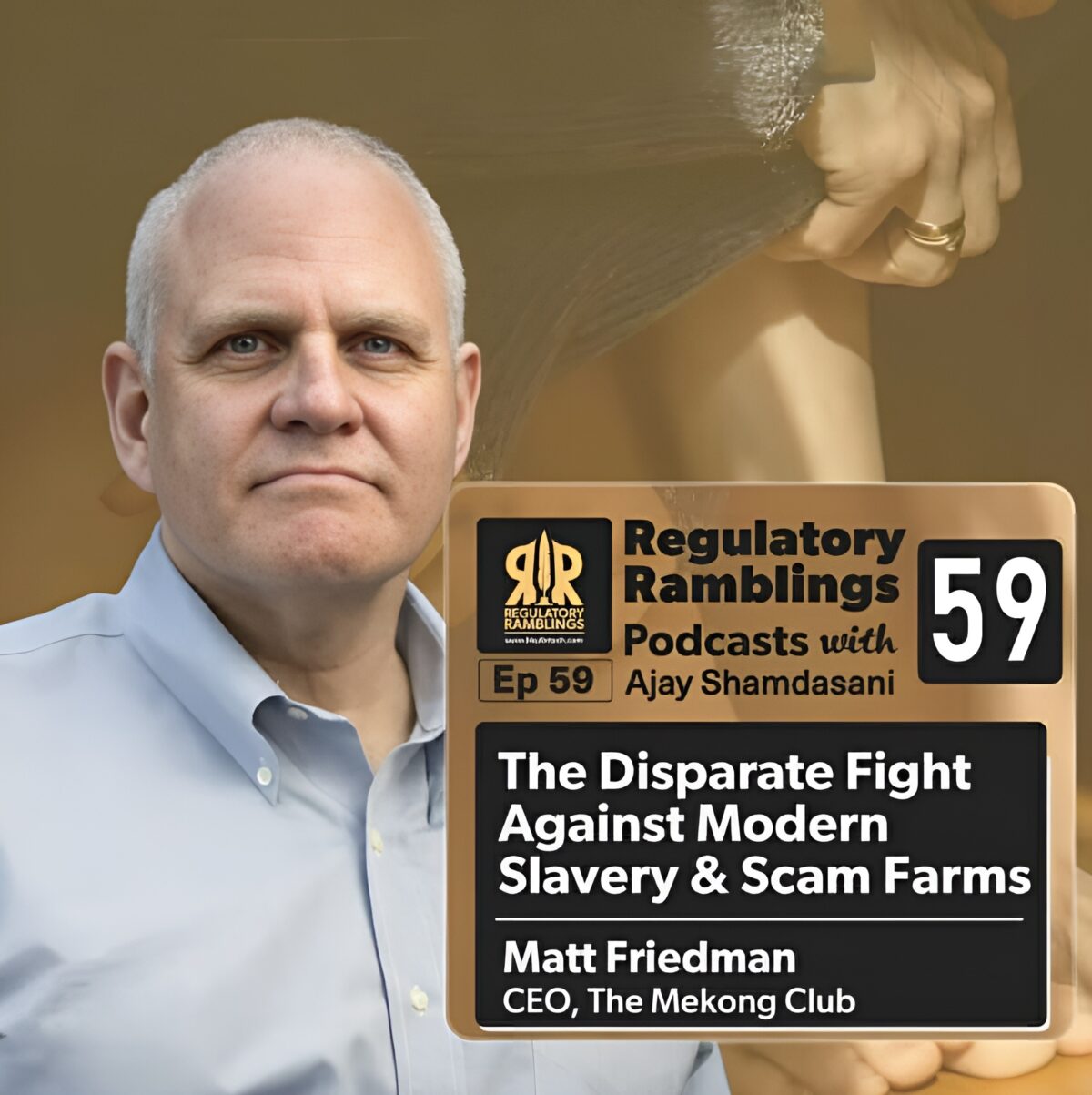
Regulatory Ramblings: Episode 59 – Four Decades Fighting Human Trafficking and Modern Slavery – A Diplomat Reflects with Matt Friedman

As a former US and United Nations diplomat, Matthew Friedman has been a true warrior on the frontlines against modern slavery and sex trafficking for over four decades. He is an international human trafficking expert and the CEO of The Mekong Club, a non-governmental organization comprised of Hong Kong’s leading businesses that have joined forces to help end all forms of modern slavery.

The Mekong Club is very active in the ESG space and is well-versed in identifying red flags and appropriate metrics to gauge anti-human trafficking compliance.

Previously, he worked for the United States Agency for International Development and the UN in over 40 countries. Matt offers technical advice to numerous governments, banks, and corporations working to eliminate all forms of modern slavery and authorizes fifteen books. In 2017, he won Asia’s prestigious “Communicator of the Year” Gold Award.

His postings have taken him all over Asia, from Nepal to Bangladesh and Thailand. The Mekong Club works with private sector banks, manufacturers, retailers, and the hospitality sectors to do what they need to do in the fight against human trafficking and slavery.

The topic of modern slavery – more colloquially referred to as human trafficking – is a bleak one. In this episode of Regulatory Ramblings, Matt chats with host Ajay Shamdasani about what the global banking and financial institutions and multinational corporations can do about the matter.

The problem indirectly affects us all: estimates are that 50 million people in the world are currently in some form of slavery. Twenty-seven million of them are engaged in forced labor, of which 82% of this figure is associated with supply chains.

Though many survivors of human slavery put on a brave face and try to go about their lives as best they can, it is debatable whether or not they can truly ever be made whole.

The conversation begins with Matt sharing his background and what drew him to the cause of modern slavery. He also stresses that despite the Mekong Club being an NGO, it works with the private sector, perhaps more so than with other NGOs or state bodies. As he notes, there is a greater impetus to take action to effect change in the private sector than in the public sector.

Working with the private sector is an approach that has served Matt and the Club well because, as he puts it: “The private sector has a sense of urgency, unlike the public sector. If a company does an audit on human trafficking and there is a problem, within fifteen minutes, they will call a meeting of all the relevant stakeholders and work to remediate it. The private sector does more than traditional NGOs because they are closer to the action,” he said. He added that NGOs tended to intellectualize matters, often reducing them to purely academic or legal concerns.

Reflecting on his four decades in the field, Matt also recounts what has changed about human trafficking and what has remained the same. As he points out, the evolution of human trafficking is interesting, going from forced manual labor to compelling enslaved persons to undertake more elaborate crimes such as scam farms and ‘pig butchering’ schemes.
​​
The discussion concludes with Matt sharing his views on how the financial sector can protect themselves from becoming unwitting participants in human trafficking and the sex trade. There is an intersection between money laundering, financial crime, and human trafficking, he says, and it is something the UN Counter-Trafficking program was created to combat.

The Regulatory Ramblings podcasts are brought to you by the University of Hong Kong—Reg/Tech Lab, HKU-SCF Fintech Academy, Asia Global Institute, and HKU-edX Professional Certificate in Fintech, with support from the HKU Faculty of Law.

Useful links in this episode:

You might also be interested in:

Connect with RR Podcast at:

LinkedIn: https://hk.linkedin.com/company/hkufintech 
Facebook: https://www.facebook.com/hkufintech.fb/
Instagram: https://www.instagram.com/hkufintech/ 
Twitter: https://twitter.com/HKUFinTech 
Threads: https://www.threads.net/@hkufintech
Website: https://www.hkufintech.com/regulatoryramblings 

Connect with the Compliance Podcast Network at:

LinkedIn: https://www.linkedin.com/company/compliance-podcast-network/
Facebook: https://www.facebook.com/compliancepodcastnetwork/
YouTube: https://www.youtube.com/@CompliancePodcastNetwork
Twitter: https://twitter.com/tfoxlaw
Instagram: https://www.instagram.com/voiceofcompliance/
Website: https://compliancepodcastnetwork.net

Categories
All Things Investigations

All Things Investigations: FCPA Alert Week – Mike DeBernardis on the FCPA & Anti-Bribery 2024 Alert

Welcome to the Hughes Hubbard & Reed Anti-Corruption & Internal Investigations Practice Group’s podcast, All Things Investigation. This week, we will feature five lawyers from HHR to introduce the firm’s always popular and annual FCPA and Anti-Bribery Alert. In this first podcast of the 5-part series, host Tom Fox joined Mike DeBernardis to introduce the Alert and some key themes and highlights from the FCPA and anti-bribery in 2024.

In the inaugural episode celebrating the Hughes Hubbard & Reed FALL 2024 FCPA and Anti-Bribery Alert, Tom is joined by Mike DeBernardis. They delve into the significance of Hughes Hubbard & Reed being the first major firm to release their FCPA alert each year and discuss the creative introduction themed around 1999 movies, including a quote from ‘The Matrix.’ The Alert is segmented into four comprehensive chapters covering analysis, policy developments, corporate resolutions, international focus, and updates from multilateral development banks. Key trends such as treating past misconduct and encouraging whistleblowing are highlighted, along with an ongoing issue of gifts and hospitality in corporate resolutions. The audience is encouraged to access the report on the firm’s website for more detailed insights.

Key highlights:

  • Overview of the FCPA and Anti-Bribery Alert
  • The Matrix Quote and Its Relevance
  • Detailed Breakdown of the 2024 Alert
  • Key Highlights and Trends
  • Focus on Gifts and Hospitality

Resources:

Hughes Hubbard & Reed website

2024 Fall FCPA and Anti-Bribery Alert

Mike DeBernardis

Categories
Compliance Tip of the Day

Compliance Tip of the Day – AI in Compliance – The Next Frontier is Here

Welcome to “Compliance Tip of the Day,” the podcast where we bring you daily insights and practical advice on navigating the ever-evolving landscape of compliance and regulatory requirements. Whether you’re a seasoned compliance professional or just starting your journey, we aim to provide bite-sized, actionable tips to help you stay on top of your compliance game. Join us as we explore the latest industry trends, share best practices, and demystify complex compliance issues to keep your organization on the right side of the law. Tune in daily for your dose of compliance wisdom, and let’s make compliance a little less daunting, one tip at a time.

Over this week, we will take a deep dive into the use of AI in compliance programs. Today, we will introduce the use of AI in compliance.

For more information on the Ethico Toolkit for Middle Managers, available at no charge, click here.

Check out the entire 3-book series, The Compliance Kids, on Amazon.com.

Categories
Corruption, Crime and Compliance

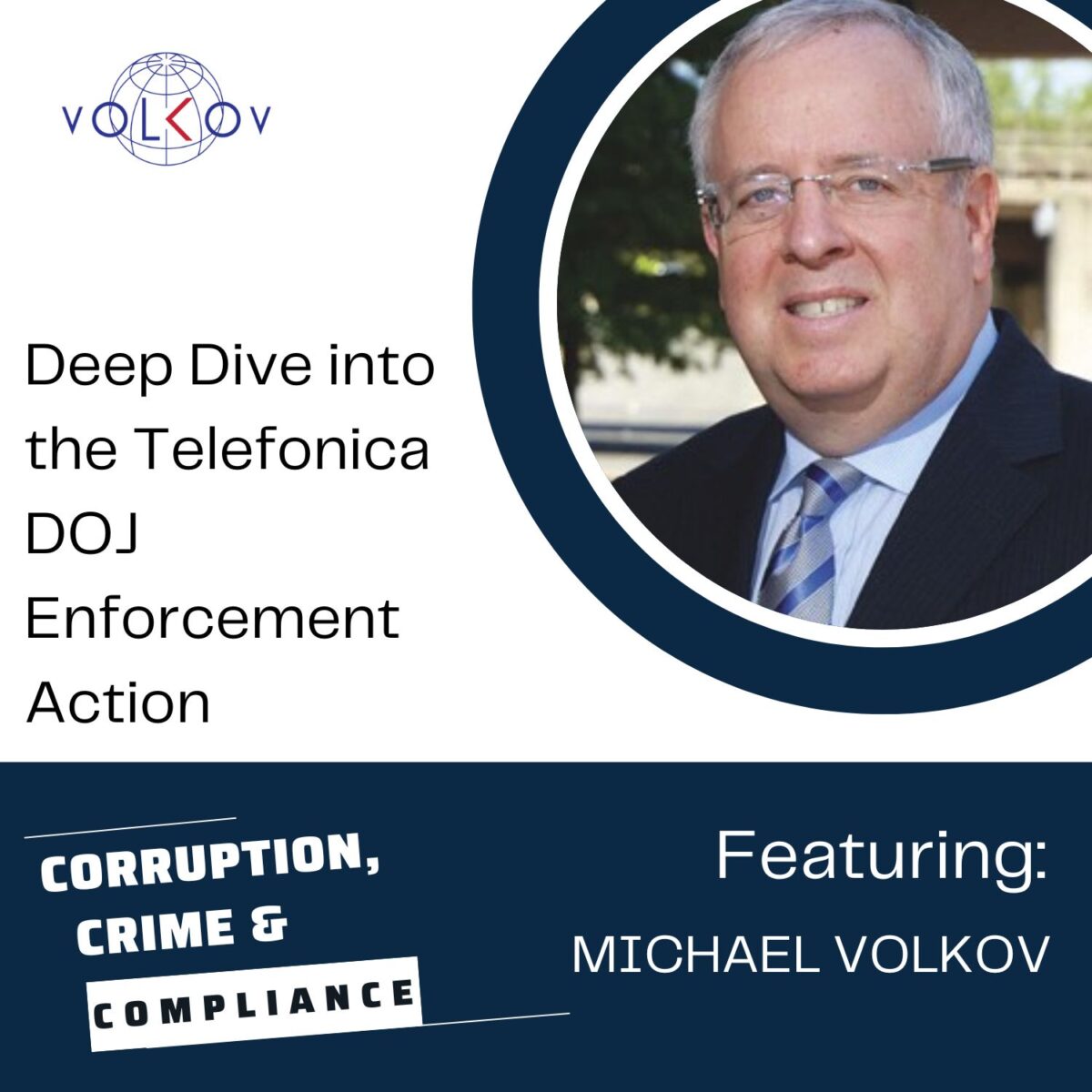
Deep Dive into the Telefonica DOJ Enforcement Action

What does it take for a global telecom giant to get caught up in a bribery scheme involving over $85 million—and what can we learn from their mistakes? How do companies like Telefónica Venezolana conceal millions in bribes through inflated contracts and shell companies, and why do these schemes so often fly under the radar?

This episode examines Telefónica Venezolana’s $85.2 million settlement with the DOJ for bribery violations under the FCPA. Michael Volkov explains how the Venezuelan subsidiary exploited a government-controlled currency auction system, paid nearly $29 million in bribes, and concealed the payments through inflated equipment purchases. The case reveals systemic flaws and offers essential lessons on preventing corporate misconduct.

You’ll hear him discuss:

  • How Telefónica Venezuela used inflated supplier contracts to fund $28.9 million in bribes
  • The role of shell companies and intermediaries in concealing bribery schemes
  • How bribery enabled access to $110 million in undervalued U.S. currency
  • DOJ’s assessment of cooperation, compliance efforts, and penalty reductions
  • Telefónica’s failure to address red flags in its financial controls and due diligence processes
  • The importance of vetting third parties and managing high-risk transactions
  • How Telefónica implemented compliance reforms, including anti-corruption measures and internal audits
  • Lessons for compliance professionals on detecting and preventing similar schemes

Resources:

Michael Volkov on LinkedIn | Twitter

The Volkov Law Group

Categories
Daily Compliance News

Daily Compliance News: December 9, 2024 – The TikTok for Sale Edition

Welcome to the Daily Compliance News. Each day, Tom Fox, the Voice of Compliance, brings you compliance-related stories to start your day. Sit back, enjoy a cup of morning coffee, and listen in to the Daily Compliance News—all from the Compliance Podcast Network. Each day, we consider four stories from the business world: compliance, ethics, risk management, leadership, or general interest for the compliance professional.

  • How to make your culture as toxic as possible. (FT)
  • Appeals Court upholds law requiring the sale of TikTok. (Reuters)
  • Methode discloses FCPA investigation. (MSN)
  • AI and the Human in the Loop.  (WSJ)

For more information on the Ethico Toolkit for Middle Managers, available at no charge, click here.

Check out the entire 3-book series, The Compliance Kids, on Amazon.com.