Categories
Adventures in Compliance

Adventures in Compliance: The Novels – The Hound of the Baskervilles: Uncovering M&A Compliance Lessons

In this new season of Adventures in Compliance, host Tom Fox takes a deep dive into the Sherlock Holmes novels. Over the course of this season, Tom Fox will take a deep dive into each novel in a four-part series. The four novels we will consider from the ethics and compliance perspective are A Study in Scarlet, The Sign of Four, The Hound of the Baskervilles, and The Valley of Fear. For the month of July, we are considering lessons from The Hound of the Baskervilles. Today, Timothy and Fiona are back to consider the pre- and post-acquisition M&A lessons from the novel.

This episode explores the fascinating parallels between Sir Arthur Conan Doyle’s ‘The Hound of the Baskervilles‘ and modern corporate compliance. By examining Sherlock Holmes’ meticulous investigative methods, we gain critical insights into due diligence, compliance integration, and forensic investigations. Discover how to apply Sherlockian principles to proactively prevent corruption, foster an ethical corporate environment, and transform potential liabilities into assets. We break down these ideas into three stages: pre-acquisition due diligence, post-acquisition training and integration, and the handling of forensic investigations when issues arise.

Highlights include:

  • Pre-Acquisition Due Diligence: The Sherlockian Approach
  • Post-Acquisition Integration: Building a Baskerville Hall of Compliance
  • Forensic Investigations: Swift and Evidence-Based Responses
  • Conclusion: Applying Sherlockian Insights to Modern Compliance

Resources:

The New Annotated Sherlock Holmes

Sherlock Holmes FAQ by Dave Thompson

Sherlock Holmes, The Novels with an introduction by Michael Dirda

Connect with Tom Fox

Instagram

Facebook

YouTube

Twitter

LinkedIn

Categories
All Things Investigations

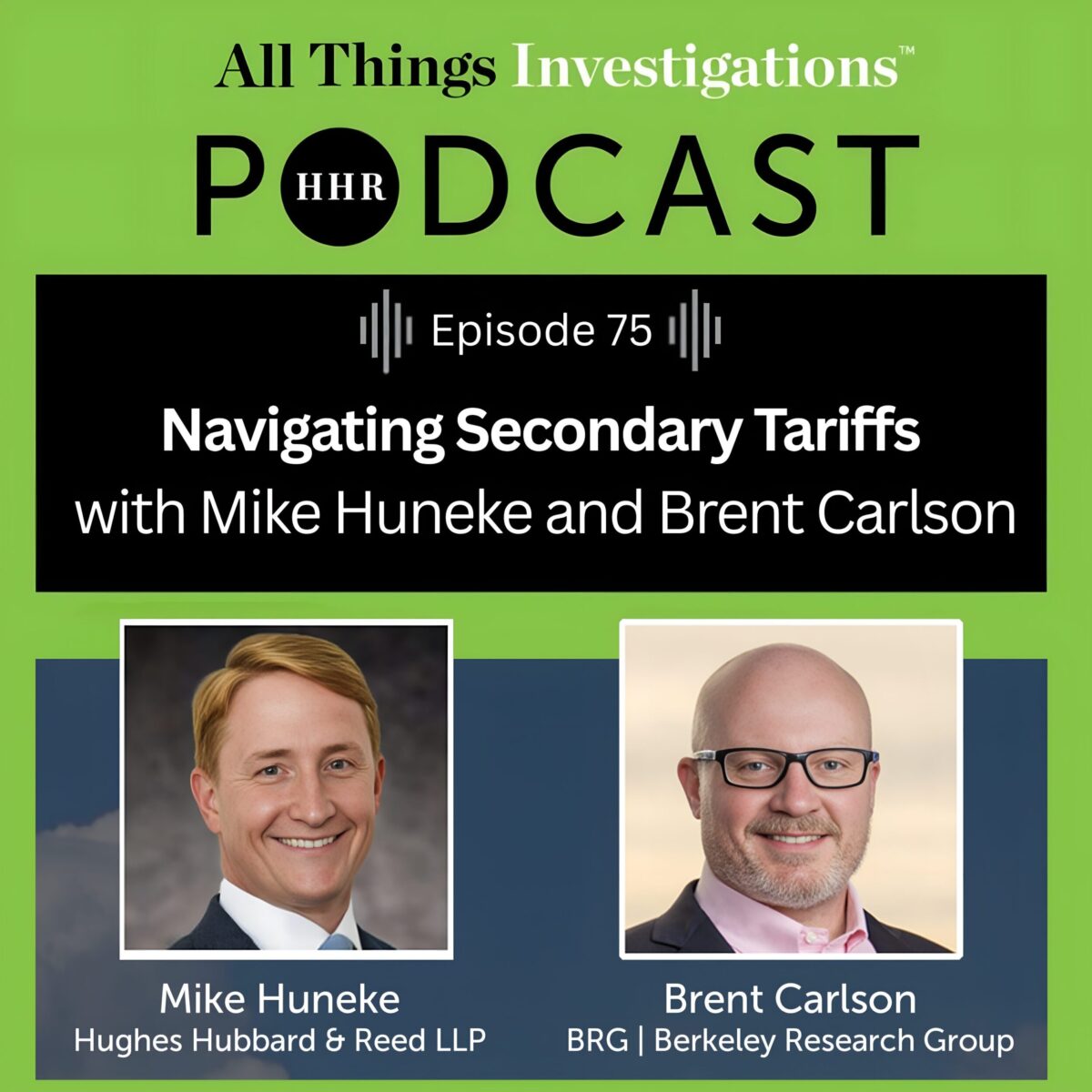
All Things Investigations – Navigating Secondary Tariffs with Mike Huneke and Brent Carlson

Welcome to the Hughes Hubbard Anti-Corruption & Internal Investigations Practice Group’s podcast, All Things Investigation. In this podcast, host Tom Fox is joined by HHR partner Mike Huneke and BRG Director Brent Carlson to discuss secondary tariffs.

Mike Huneke and Brent Carlson are leading experts in trade compliance, with a particular focus on the intricacies and impacts of tariffs and secondary tariffs within the global economic landscape. Huneke emphasizes the existential threats tariffs pose to businesses, stressing the importance of understanding their effects on countries with significant economic ties to Russia, such as China, and advising companies to reassess trade relationships with nations like China, Brazil, Russia, and Iran. Carlson emphasizes the need for trade compliance officers to adapt to the rapidly evolving geopolitical landscape, advising companies to assess their suppliers and consider potential indirect transactions through transshipment countries to navigate imposed tariffs effectively. Both experts emphasize the importance of businesses adopting a dynamic, risk-based approach to compliance, anticipating challenges, and making informed decisions to mitigate financial impacts and maintain shareholder value amid shifting trade patterns and geopolitical tensions.

Key highlights:

  • Geopolitical Impact of Secondary Tariffs
  • Global Trade Dynamics Amid Geopolitical Shifts
  • Trade Compliance Risks: False Claims & Tariff Evasion
  • Resilient Supply Chain Strategy Amid Global Trade Dynamics
  • Negotiating Tactics in Geopolitical Tariff Strategy

Resources:

Mike Huneke

Hughes Hubbard & Reed Website

Brent Carlson

BRG Website

Categories
Daily Compliance News

Daily Compliance News: July 28, 2025, The Where is Grasshopper When You Need Him Edition

Welcome to the Daily Compliance News. Each day, Tom Fox, the Voice of Compliance, brings you compliance-related stories to start your day. Sit back, enjoy a cup of morning coffee, and listen in to the Daily Compliance News. All, from the Compliance Podcast Network. Each day, we consider four stories from the business world, including those related to compliance, ethics, risk management, leadership, or general interest, that are relevant to the compliance professional.

Top stories include:

  • Meta to end Political Ads in the EU. (NYT)
  • The EU cuts aid to Ukraine due to corruption issues. (NYT)
  • Was bribery involved in the Skydance-Paramount deal? (Deadline)
  • The head of the Shaolin Temple in China is in hot water over corruption allegations. (FT)

You can donate to flood relief for victims of the Kerr County flooding by going to the Hill Country Flood Relief here.

Categories
FCPA Compliance Report

FCPA Compliance Report – 10 Core Principles for Effective Internal Investigations with Michelle Peirce

Welcome to the award-winning FCPA Compliance Report, the longest-running podcast in compliance. In this episode, Tom Fox welcomes Michelle Peirce from Hinckley Allen, where she co-chairs the White Collar and Government Enforcement Group.

They take a deep dive into Michelle’s article on the 10 Core Principles Common to Internal Investigations, discussing topics such as the importance of understanding the investigation’s purpose, maintaining privilege, the role of an engagement letter, deciding between written reports and verbal summaries, and the significance of billing and internal communications. Michelle also shares her insights from her professional background, including her experience as a special assistant district attorney, and touches on current pressures on compliance tied to self-disclosure to the DOJ. The conversation offers a comprehensive guide for organizations on conducting successful internal investigations.

Key highlights:

  • Role and Challenges in Internal Investigations
  • Core Principles of Internal Investigations
  • Importance of Privilege and Engagement Letters
  • Written vs. Verbal Reports
  • Order and Structure of Investigations
  • Professionalism and Billing in Investigations

Resources:

Michelle Peirce on LinkedIn

Michelle Peirce at Hinckley Allen

10 Core Principles Common to Internal Investigations

Tom Fox

Instagram

Facebook

YouTube

Twitter

LinkedIn

For more information on the use of AI in compliance programs, my new book is Upping Your Game. You can purchase a copy of the book on Amazon.com.

Categories
Blog

Lost Among the Stars: Leadership & Tone from the Top Lessons from Star Trek’s “The Paradise Syndrome”

Few Star Trek episodes put Captain Kirk in as vulnerable or as revealing a position as “The Paradise Syndrome.” What begins as a routine mission to deflect an asteroid from a primitive planet spirals down into an exploration of leadership, identity, and the power of influence from the very top. For corporate compliance professionals, this story is a masterclass in how tone from the top and authentic leadership can either protect or imperil an entire organization.

In “The Paradise Syndrome,” the Enterprise crew is faced not only with a ticking clock but also with the absence of their leader. As Kirk loses his memory and is separated from his command, Spock, McCoy, and the rest must navigate the crisis without the guiding presence that usually sets the tone. What unfolds is a powerful lesson in why leadership and the values it projects matter more than any written policy or technology.

With Kirk’s leadership removed at the most critical moment, we see the cascading impact on the crew, on the planet, and on Kirk himself. This scenario, while fantastical, is a perfect metaphor for what happens in organizations when the tone from the top is unclear, inconsistent, or simply absent.

Join me as we step through the wormhole and extract five vital leadership lessons for the modern compliance officer, each illustrated by scenes from this unforgettable episode.

Leadership Presence Is the First Line of Defense

Illustrated By: As soon as Kirk disappears, Spock and McCoy sense something is amiss. The crew is uneasy, decision-making becomes muddled, and a lack of clear command amplifies the mission’s urgency.

Compliance Lesson: The tone set by leadership isn’t just about lofty statements or annual memos. It’s a daily, lived presence. When leadership is visible, engaged, and available, the organization operates with clarity and confidence. When it is absent, even for a short time, uncertainty fills the vacuum, and risk increases.

What should I do? For compliance professionals, this means that leadership must be front and center, not just when things go wrong, but in the rhythms of daily business. Leaders should participate in training, be present in investigations, and visibly support the compliance function. A leader’s consistent presence sends the strongest possible message: compliance matters here.

Values Must Be Internalized, Not Just Announced

Illustrated By: Stripped of his memory, Kirk (as “Kirok”) is taken in by the planet’s people. Despite not knowing who he is, his instincts for fairness, curiosity, and protection shine through. He becomes a leader not by decree, but by action.

Compliance Lesson: True leadership is more than titles and speeches; it’s about internalized values that guide decisions, even under stress or uncertainty. Kirk’s ethical compass survives amnesia because it’s part of who he is.

What should I do? Corporate values, particularly those related to ethics and compliance, must be deeply ingrained in the organization. Training and messaging must move beyond checklists to foster genuine understanding and belief. When faced with unexpected challenges or moral dilemmas, employees should be able to act based on these internalized values, even if the “playbook” is missing. Compliance professionals should focus on culture-building, rather than just disseminating policies.

Crisis Reveals the True Tone from the Top

Illustrated By: Spock, now in command, faces a daunting technical challenge with limited time and resources. He makes tough, sometimes unpopular decisions, including pushing the engines to dangerous limits. McCoy protests, but Spock remains steadfast, demonstrating calm under pressure.

Compliance Lesson: In a crisis, all eyes turn to leadership. How leaders act or fail to act under stress defines the tone from the top far more than any code of conduct. Spock’s resolve and willingness to make hard choices keep the crew focused on their mission, even as doubt and tension rise.

What should I do? Compliance leaders should prepare for the inevitable crisis by building trust, communicating transparently, and showing willingness to take responsibility. When employees see leadership confronting difficulties head-on, they are more likely to follow suit. Tabletop exercises and crisis simulations should always include a tone-from-the-top component. How will leadership communicate? How will they reinforce values under pressure?

Empathy and Communication Sustain Compliance

Illustrated By: While among the villagers, Kirk forms relationships based on empathy and service. He marries Miramanee, helps heal a sick child, and supports his new community. Even without his identity, he inspires trust because of the way he listens and responds to those around him.

Compliance Lesson: Leadership is not just about command; it is about connection. In compliance, the ability to listen, understand, and respond to concerns is just as important as issuing directives. Empathy fosters credibility and promotes a culture of speaking up, particularly during times of change.

What should I do? Compliance officers should foster open-door environments where employees feel comfortable sharing concerns and asking questions. Leaders should model humility and emotional intelligence, admitting when they don’t have all the answers. In the modern workplace, psychological safety is an essential component of tone from the top.

Sustainable Culture Requires Both Structure and Spirit

Illustrated By: When Kirk finally regains his memory and identity, he is torn between his love for Miramanee and his duty to the Enterprise. The heartbreak of leaving behind his new life underscores that authentic leadership often requires personal sacrifice for the greater good.

Compliance Lesson: Tone from the top is sustained not just by systems and controls, but by the personal commitment of leaders to do what’s right, even when it’s difficult. The spirit of compliance must be aligned with the structure of compliance; one without the other is incomplete.

What should I do? Senior leaders and compliance professionals must demonstrate their commitment through both words and deeds. This may involve making tough decisions, investing resources, or prioritizing compliance over short-term gains. By modeling this balance, leadership sets the foundation for a culture that endures, regardless of who is at the helm.

Final ComplianceLog Reflections

“The Paradise Syndrome” is a cautionary tale and an inspiration. When leadership vanishes, even temporarily, an organization’s values, direction, and resilience are put to the test. Kirk’s journey reminds us that leadership is not just about the title on the door but about daily actions, internalized values, and the ability to connect authentically with those you lead. By embracing these lessons, compliance officers and business leaders alike can build organizations that thrive not just in paradise but in any storm the universe throws their way.

Resources:

⁠⁠Excruciatingly Detailed Plot Summary by Eric W. Weisstein⁠⁠

⁠⁠MissionLogPodcast.com⁠⁠

⁠⁠Memory Alpha

Categories
Blog

Setting the Tone: Why Top-Level Commitment Is the Heart of Fraud Prevention

In today’s rapidly evolving compliance landscape, one principle has become abundantly clear: effective fraud prevention starts at the top. The Economic Crime and Corporate Transparency Act 2023, with its new offense of failure to prevent fraud, has elevated the expectations for senior leadership and boards across large organizations. Fortunately, the UK government has put out a document entitled “Economic Crime and Corporate Transparency Act 2023: Guidance to organizations on the offense of failure to prevent fraud” (The Guidance). Section 3.1 of the official guidance, titled “Top Level Commitment,” should be required reading for every compliance professional seeking to build a credible, defensible, and sustainable anti-fraud culture. Today, we take a deep dive into what a top-level commitment is.

The Imperative: Leadership’s Role in Preventing Fraud

Section 3.1 places the responsibility for preventing and detecting fraud squarely on those charged with governance, including the Board of Directors, partners, and senior management. This is not simply a perfunctory statement. The Guidance makes it clear: without authentic buy-in and leadership from the very top, even the best-written policies and controls will falter.

A culture of zero tolerance for fraud must be more than a slogan. The board and senior management must actively foster an environment where fraud is not only discouraged but also considered unthinkable, where profit derived from or assisted by fraud is unequivocally rejected.

Visible Commitment: Not Just Words, But Deeds

What does genuine top-level commitment look like? The Guidance offers a clear framework. It is about visible, consistent action that resonates throughout the organization. This includes:

  • Publicly rejecting fraud, even at the cost of lost business opportunities. Boards and executives must demonstrate that they will walk away from deals if the price compromises their integrity and values.
  • Explaining the business benefits of a strong anti-fraud posture. Protecting the company’s reputation, building trust with customers and business partners, and ensuring long-term sustainability are tangible, valuable outcomes.
  • Backing policies and codes of conduct with consequences. There must be clarity about what happens if someone breaches anti-fraud policies—up to and including contractual and disciplinary action.
  • Acknowledging and endorsing collective anti-fraud efforts. Participation in industry initiatives or trade body actions against fraud demonstrates seriousness of intent.

A leadership statement is only credible if real accountability, named roles, and continuous communication back it.

Governance: Structuring Responsibility for Real Results

Clear governance is the backbone of any fraud prevention framework. Section 3.1 stresses that organizations should define, document, and communicate who is responsible for every aspect of fraud prevention, from risk assessment to whistleblowing, and from detection to disciplinary actions.

Best practice governance includes:

  • Designated responsibility for horizon scanning, risk assessment, policy development, disciplinary action, whistleblowing, investigation, and ongoing review.
  • Direct access for compliance leadership to the board or CEO, even if day-to-day reporting is elsewhere. This ensures critical issues don’t get buried in middle management.
  • Documentation of decisions and actions. Board minutes should capture key compliance decisions, risk reviews, and follow-up actions.
  • Succession planning for compliance leadership. Governance should account for staff turnover and ensure continuity in anti-fraud efforts, even when key personnel are absent or leave the organization.

In some organizations, the board or senior executives will be personally involved in designing fraud prevention measures; in others, they will delegate this responsibility to the Head of Ethics and Compliance while retaining ultimate accountability. The key is active engagement and oversight.

Commitment to Resources: Funding and Training

Fraud prevention is not a costless endeavor. The guidance is explicit: senior management must allocate a reasonable and proportionate budget for compliance leadership, fraud prevention staff, training, and technology, including due diligence tools and platforms. This budget commitment must be sustained for the long term, not just as a one-off initiative.

Training is equally crucial. Senior management must champion not only initial training but also ongoing refreshers and updates, ensuring that all staff, especially those in high-risk roles, are equipped to identify and prevent fraud. Resilience is key: anti-fraud practices must be maintained even when staff are on vacation or sick leave or when there is turnover.

Leading by Example: The Tone at the Top

The “tone at the top” is more than a catchphrase; it is the bedrock of ethical culture. Senior managers must embody the standards they expect from the rest of the organization. This means:

  • Openly challenging rationalizations for fraud. Whether it’s “everyone does it,” “it’s not material,” or “it’s for the good of the business,” these are dangerous myths that must be confronted.
  • Encouraging early reporting of concerns. Leadership should foster an open culture where staff feel empowered to speak up, no matter how minor the issue may seem. The earlier a problem is raised, the less likely it will snowball into a major scandal.
  • Making ethics a daily practice, not a quarterly campaign. Whether through regular reminders, integration into performance evaluations, or simply modeling the right behaviors, leaders set the ethical weather for the company.

Communication: Reinforcing the Anti-Fraud Message

Top-level commitment must be consistently and credibly communicated to all key audiences, including employees, contractors, agents, suppliers, and business partners. The guidance recommends tailoring the message for different stakeholders; what resonates with employees may differ from what is relevant for contractors or vendors.

Effective anti-fraud communication should:

  • Highlight the organization’s commitment to integrity over short-term gains.
  • Reinforce the real-world consequences of violating anti-fraud policies.
  • Regularly spotlight examples of ethical leadership, transparency, and collective action against fraud.

The Importance of Whistleblowing

Section 3.1 places significant emphasis on whistleblowing—not only establishing clear channels but also creating a culture where speaking up is encouraged and protected. Senior management should ensure:

  • There are safe, independent channels for reporting concerns.
  • Whistleblowers are protected from retaliation.
  • Reports are acted on quickly and transparently.

A strong whistleblowing culture indicates that leadership is committed to identifying and addressing problems before they become systemic.

The “Why” Behind Top-Level Commitment

Why is all of this so critical? Because fraud is adaptive. It thrives in ambiguity, and it flourishes when leadership is distracted, disinterested, or inconsistent. The Economic Crime and Corporate Transparency Act 2023 raises the stakes: organizations now face not just reputational and commercial damage but also criminal liability if they cannot show that their prevention procedures were reasonable and implemented with real top-level commitment.

The regulators and prosecutors will look for evidence of this commitment. Are senior managers personally invested? Do they walk the talk? Can they demonstrate, with documentation, that anti-fraud policies are embedded in the organization’s DNA?

Practical Steps for Compliance Professionals

What should compliance professionals do today?

  1. Engage with your board and C-suite. Make sure they understand their personal and collective responsibilities under the Act.
  2. Audit your current governance structures. Identify gaps in accountability, communication, or resource allocation.
  3. Refresh your anti-fraud messaging and training. Ensure it is regular, targeted, and endorsed by top management.
  4. Enhance your whistleblowing framework. Benchmark it against best practices and ensure visible support from leadership.
  5. Document everything. If it’s not written down, it didn’t happen. Ensure that minutes, decisions, and compliance actions are accurately recorded.

Conclusion: Leadership Sets the Standard

Section 3.1 is clear: fraud prevention is not just the job of compliance or internal audit. It is the duty of those at the top. Authentic leadership means investing in people, systems, and culture; communicating a vision of integrity; and never wavering, even when the pressure to bend the rules is immense.

For the modern compliance professional, this is both a challenge and an opportunity. With exemplary leadership, organizations can move beyond reactive compliance and build an enduring culture where ethical conduct is the norm and fraud has no place to hide.

Join us tomorrow, where we will consider a fraud risk assessment.

Categories
Sunday Book Review

Sunday Book Review: July 27, 2025, The Best Books on Economics Edition

In the Sunday Book Review, Tom Fox considers books that interest compliance professionals, business executives, or anyone curious about the subject. It could be books about business, compliance, history, leadership, current events, or any other topic that might interest Tom. For the month of July, we looked at the FT’s recommendation for top books in the summer of 2025. In this episode, Tom reviews the FT’s list of the top books on Economics from 2025.

  1. The Measure of Progress: Counting What Really Matters by Diane Coyle
  2. Capitalism and Its Critics: A History: From the Industrial Revolution to AI by John Cassidy
  3. Uncertainty and Enterprise: Venturing Beyond the Known by Amar Bhidé
  4. Stellar: A World Beyond Limits, and How to Get There by James Arbib and Tony Seba


The Sunday Book Review was recently honored as one of the Top 100 Book Podcasts.

Resources:

FT’s Best Books of Summer for 2025: Economics by Martin Wolf.

Categories
Trekking Through Compliance

Trekking Through Compliance: Episode 56 – Rewiring the Enterprise: What Spock’s Brain Teaches Us About Compliance Training

Few episodes of Star Trek: The Original Series are as infamous or as misunderstood as “Spock’s Brain.” Dismissed by many as campy science fiction, the episode nevertheless offers a wealth of practical insights for today’s compliance professionals, especially those responsible for developing, maintaining, and delivering effective compliance training programs.

Let’s boldly go where few compliance trainers have gone before and extract five key compliance training lessons from the Enterprise’s wild quest to retrieve Spock’s missing brain. Along the way, we will see that even the quirkiest stories can teach us how to build smarter, more resilient compliance cultures.

1. When the Unimaginable Strikes, Training Must Enable Action, Not Panic

Illustrated By: The crew awakens to chaos. Spock is incapacitated. The bridge officers, stunned and confused, look to Kirk for leadership.

Compliance Lesson: The actual test of a compliance training program is not how well it’s received during routine times, but how effectively it empowers employees to act decisively under pressure.

2. You Can’t Train for Every Event, But You Can Teach Problem-Solving

Illustrated By: There is no manual for “what to do when someone steals your first officer’s brain.”

Compliance Lesson: No training program can anticipate every possible scenario. What you can train, however, is a culture of problem-solving, adaptability, and continuous learning.

3. Communication Bridges the Knowledge Gap

Illustrated By: The landing party discovers a society split in two: the technologically advanced women who control the planet’s systems, and the men, who live in primitive conditions below.

Compliance Lesson: The episode’s iconic “teaching helmet” is a comical take on knowledge transfer, but it highlights a real challenge: bridging the gap between compliance expertise and employee understanding.

4. Just-in-Time Training—When You Need It Most

Illustrated By: Faced with the daunting task of reattaching Spock’s brain, Dr. McCoy uses the teaching helmet to acquire the necessary surgical skills.

Compliance Lesson: The best compliance programs recognize this and provide “just-in-time” resources, such as quick-reference guides, FAQs, and on-demand training, for when employees need to act.

5. Teamwork and Psychological Safety Are the Real Secret Sauce

Illustrated By: With Spock’s brain reconnected, he awakens mid-surgery and begins to talk McCoy through the final steps.

Compliance Lesson: Effective compliance training fosters a similar sense of psychological safety.

Final ComplianceLog Reflections

Spock’s Brain” may not win any awards for scientific realism or dramatic subtlety, but its outlandish premise serves as a powerful allegory for the daily realities of corporate compliance training. Unexpected risks will arise. Knowledge will lapse. Sometimes, you will need to act with incomplete information and under enormous pressure.

The crew of the Enterprise prevails not because they followed a script, but because they were trained, through experience, teamwork, and relentless problem-solving, to adapt and respond to the unknown. The same should be true of your compliance training program.

A training program inspired by the lessons of “Spock’s Brain” will not only teach the rules but empower employees to act ethically and effectively when it matters most. And that, ultimately, is how we boldly go forward together.

Resources:

⁠⁠Excruciatingly Detailed Plot Summary by Eric W. Weisstein⁠⁠

⁠⁠MissionLogPodcast.com⁠⁠

⁠⁠Memory Alpha

Categories
Blog

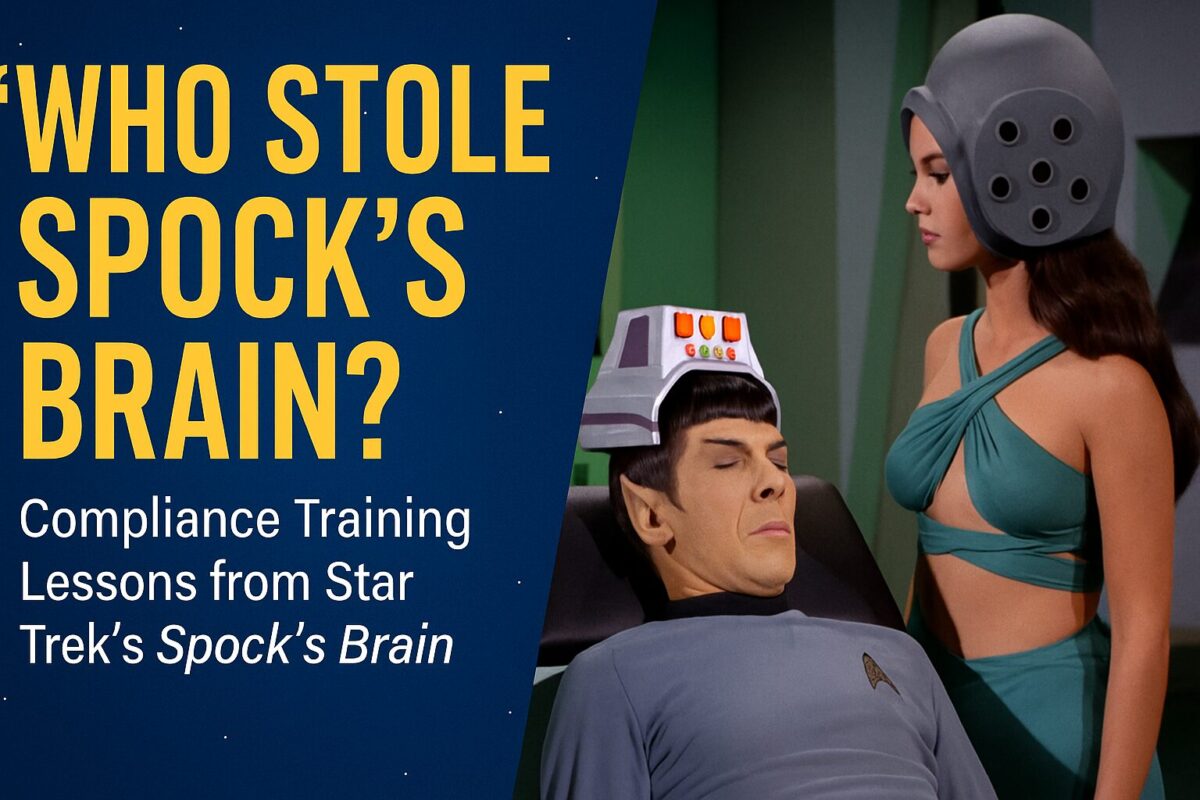
“Who Stole Spock’s Brain?” – Compliance Training Lessons from Star Trek’s Spock’s Brain

Few episodes of Star Trek: The Original Series are as infamous or as misunderstood as “Spock’s Brain.” Dismissed by many as campy science fiction, the episode nevertheless offers a wealth of practical insights for today’s compliance professionals, especially those responsible for developing, maintaining, and delivering effective compliance training programs.

Let’s boldly go where few compliance trainers have gone before and extract some valuable lessons from the Enterprise’s wild quest to retrieve Spock’s missing brain. Along the way, we will see that even the quirkiest stories can teach us how to build smarter, more resilient compliance cultures.

Setting the Stage: When the Unthinkable Happens

For those who have not watched or have not watched recently, “Spock’s Brain” begins with an incident straight out of the compliance professional’s nightmare file: an inexplicable event with catastrophic implications. An unknown intruder boards the Enterprise, incapacitates the crew, and removes Spock’s brain, leaving his body alive but inert.

Captain Kirk, Dr. McCoy, and the rest of the crew must race against time, using every available tool and resource to recover Spock’s brain before it’s too late. What unfolds is a bizarre odyssey that is part rescue mission, part leadership crucible, and, as we’ll see, a perfect metaphor for the compliance training journey.

Today, we consider five key compliance training lessons, each illustrated by a memorable scene from “Spock’s Brain.”

1. When the Unimaginable Strikes, Training Must Enable Action, Not Panic

Illustrated By: The crew awakens to chaos. Spock is incapacitated. The bridge officers, stunned and confused, look to Kirk for leadership.

Compliance Lesson: The unexpected will happen in business. Whether it’s a major regulatory change, a data breach, or a sudden ethics scandal, the initial reaction is often confusion and panic. The true test of a compliance training program is not how well it’s received during routine times, but how effectively it empowers employees to act decisively under pressure.

What should you do? Compliance training must move beyond rote memorization or check-the-box exercises. Instead, it should equip employees with the critical thinking, ethical reasoning, and procedural knowledge they need to respond effectively when the “unimaginable” occurs. Scenario-based training, simulations, and live drills can help build this kind of resilience. In short, training is about readiness, not just awareness.

2. You Can’t Train for Every Event, But You Can Teach Problem-Solving

Illustrated By: Lacking any clear leads, Kirk, McCoy, and Scotty piece together clues using technology, logic, and their collective expertise. There is no manual for “what to do when someone steals your first officer’s brain.”

Compliance Lesson: No training program can anticipate every possible scenario. Regulatory changes, market disruptions, and new types of misconduct are always around the corner. What you can train, however, is a culture of problem-solving, adaptability, and continuous learning.

What should you do? Modern compliance training should focus on building core competencies: How do we spot red flags? How do we escalate issues? Who do we call for help? By emphasizing principles over prescriptive checklists, you empower employees to adapt and innovate—even when they find themselves, metaphorically, searching for a missing piece of the puzzle.

3. Communication Bridges the Knowledge Gap

Illustrated By: The landing party discovers a society split in two: the technologically advanced women who control the planet’s systems, and the men, who live in primitive conditions below. The women possess “the knowledge,” delivered via a helmet-like teaching device, which bestows instant expertise but only temporarily.

Compliance Lesson: The episode’s iconic “teaching helmet” is a comical take on knowledge transfer, but it highlights a real challenge: bridging the gap between compliance expertise and employee understanding. Compliance training can’t simply “download” knowledge into employees’ minds; it requires communication, repetition, and reinforcement.

What should you do? Effective compliance programs use plain language, relatable stories, and multi-modal training (videos, workshops, microlearning) to make complex requirements understandable. And like the helmet, real-world learning is most powerful when it’s immediately relevant to employees’ jobs; just-in-time training, delivered at the point of need, can bridge gaps more effectively than annual courses.

4. Just-in-Time Training—When You Need It Most

Illustrated By: Faced with the daunting task of reattaching Spock’s brain, Dr. McCoy uses the teaching helmet to acquire the necessary surgical skills. He gains instant, but fleeting, expertise enough to attempt the operation, but not enough to complete it without help.

Compliance Lesson: Compliance knowledge, like McCoy’s surgical skills, is often perishable. Employees may learn something in training but forget it when months have passed or when stress levels are high. The best compliance programs recognize this and provide “just-in-time” resources, such as quick-reference guides, FAQs, and on-demand training, for when employees need to take action.

What should you do? Consider building a compliance “knowledge base” accessible to all employees, with short, targeted modules or “how-to” videos for high-risk tasks. Reinforce training with periodic reminders and prompts. And don’t be afraid to re-train in the moment; support employees when they’re “in the operating room,” not just once a year.

5. Teamwork and Psychological Safety Are the Real Secret Sauce

Illustrated By: With Spock’s brain reconnected, he awakens mid-surgery and begins to talk McCoy through the final steps. Kirk, McCoy, and Spock work together seamlessly, overcoming their limitations by relying on each other’s strengths.

Compliance Lesson: The ultimate success of the mission does not rest on the brilliance of any one individual. It is the product of a team that trusts each other, communicates openly, and isn’t afraid to admit when they’re out of their depth. Effective compliance training fosters a similar sense of psychological safety.

What should you do? Employees should feel safe asking questions, raising concerns, and admitting knowledge gaps. Training should encourage discussion and feedback, rather than relying solely on one-way lectures. When compliance becomes a shared journey, employees support each other, fill in knowledge gaps, and ultimately make better decisions, especially when the stakes are high.

Final ComplianceLog Reflections

Spock’s Brain” may not win any awards for scientific realism or dramatic subtlety, but its outlandish premise serves as a powerful allegory for the daily realities of corporate compliance training. Unexpected risks will arise. Knowledge will lapse. Sometimes, you will need to act with incomplete information and under enormous pressure.

The crew of the Enterprise prevails not because they followed a script, but because they were trained, through experience, teamwork, and relentless problem-solving, to adapt and respond to the unknown. The same should be true of your compliance training program.

The world of compliance, like the universe of Star Trek, is full of strange new worlds and unexpected dangers. As compliance professionals, we can learn much from Kirk, McCoy, and Spock, not just about courage and leadership, but about how to prepare our crews for whatever lies ahead.

A training program inspired by the lessons of “Spock’s Brain” will not only teach the rules but empower employees to act ethically and effectively when it matters most. And that, ultimately, is how we boldly go forward together.

Resources:

⁠⁠Excruciatingly Detailed Plot Summary by Eric W. Weisstein⁠⁠

⁠⁠MissionLogPodcast.com⁠⁠

⁠⁠Memory Alpha

Categories
Blog

Mission Critical: What Star Trek’s Gary Seven and Assignment Earth Teach Us About Due Diligence

If there is one constant in the universe, it is that business, regulations, and politics never stand still. Each new venture, partnership, or acquisition brings a fresh set of risks, obligations, and opportunities. Yet too often, organizations approach due diligence as a box-checking exercise when, in truth, it is the essential safeguard that ensures they are not letting an unknown variable derail their mission. Nowhere is this more cleverly dramatized than in the Star Trek TOS episode “Assignment: Earth,” where the Enterprise crew finds themselves conducting the ultimate form of due diligence, investigating the mysterious Gary Seven and the true risks he poses to Earth’s future.

With its spy-fi trappings, high-stakes secrets, and moral ambiguity, “Assignment: Earth” is a goldmine for compliance professionals seeking fresh insights into what robust due diligence truly requires. Today, we beam down and explore five timeless lessons from this episode, each rooted in a scene that every compliance leader should remember the next time a critical business decision looms.

Lesson 1: Verify Identity—Trust, But Always Confirm

Illustrated By: When Gary Seven appears on the Enterprise, he claims to be a human agent from the future, sent to prevent Earth’s destruction. His credentials, demeanor, and even physiology confound the crew. Spock’s scans confirm some aspects, but other elements remain mysterious. Kirk is forced to weigh trust against hard evidence, deciding that until Seven’s story is verified, he must remain under close observation.

Compliance Lesson: In every business deal, knowing exactly who you are dealing with is non-negotiable. Vendors, acquisition targets, third-party agents, and partners all come with their backgrounds and histories. “Assignment: Earth” illustrates the risks of acting on assumptions or charm; as the Enterprise crew learns, even the most convincing story requires verification. For compliance teams, this means robust onboarding processes, identity verification, and background checks not only at the outset but throughout the relationship. Trust is good; verification is better.

What should you do? Deploy enhanced due diligence for high-risk or high-impact relationships. Use independent sources, cross-check credentials, and don’t hesitate to pause the process if any red flags arise.

Lesson 2: Investigate the Full Scope—Understand Intent, Capability, and History

Illustrated By: The crew’s investigation into Gary Seven doesn’t stop with his identity. They probe his capabilities, his advanced technology, his mysterious “servo,” and the highly sophisticated computer at his headquarters. Spock and Kirk ask probing questions about Seven’s mission, intent, and track record.

Compliance Lesson: Surface-level information often fails to reveal the entire story. In business, a potential partner’s capabilities and intent matter as much as their identity. Due diligence is not just about who someone is, but also what they are capable of and what they plan to do with that capability. A company’s operational strengths, compliance record, and ethical history all inform future risk. Teams must go beyond public filings and financials. Look for operational gaps, management weaknesses, and track records of regulatory engagement. Just as Kirk and Spock dig into Gary Seven’s motives and methods, compliance officers should investigate all relevant dimensions.

What should you do? Expand your checklist: evaluate litigation history, regulatory fines, press coverage, key executive backgrounds, and past compliance breaches. Interview multiple stakeholders to triangulate intent.

Lesson 3: Control Information—Monitor and Secure Sensitive Data

Illustrated By: Much of “Assignment: Earth” revolves around the management of sensitive information. Seven’s computer contains data that could alter the fate of the planet. Both Seven and the Enterprise crew are vigilant about access, using encryption, voice authentication, and physical security to ensure information is only available to those with a legitimate need.

Compliance Lesson: Whether you are acquiring a company or onboarding a supplier, data security is central to modern due diligence. The risks of data leaks, cyberattacks, or inadvertent disclosure can be devastating, especially if sensitive deal information falls into the wrong hands. Therefore, it is crucial to monitor who has access to key data during the diligence phase. Implement robust information barriers and control access to confidential material. Make cybersecurity a core part of your diligence process.

What should you do? Require non-disclosure agreements from all parties. Use secure data rooms and audit access logs. Include cybersecurity posture and data protection history in every due diligence report.

Lesson 4: Expect the Unexpected—Adapt When New Risks Emerge

Illustrated By: Kirk and Spock’s plan to detain Gary Seven is upended when he escapes and races to sabotage a nuclear missile test that could ignite World War III. The crew must adapt instantly, utilizing every tool and resource at their disposal to prevent disaster, even as their understanding of the mission’s stakes evolves in real-time.

Compliance Lesson: Due diligence is not a static process. The best-laid plans are often disrupted by new information, sudden market fluctuations, or the revelation of previously unknown risks. Teams must be nimble, ready to reassess, escalate, and change course as new facts emerge. Establish protocols for escalating concerns and adjusting timelines when red flags appear. Build flexibility into your diligence process; sometimes, a deal should slow down or even pause while serious concerns are addressed.

What should you do? Schedule interim reviews, not just final sign-offs. Empower team members to call for additional investigation when new risks emerge, and document all changes to scope and focus.

Lesson 5: Assess Impact and Alignment—Consider the Broader Consequences

Illustrated By: As the story unfolds, the crew realizes that Gary Seven’s actions, though seemingly dangerous, are intended to prevent an even greater catastrophe. Kirk must weigh the consequences of intervening or not, understanding that the impact goes beyond the immediate crisis and could shape the entire future of humanity.

Compliance Lesson: Effective due diligence requires looking beyond the transaction itself. Will this deal, partnership, or acquisition align with your company’s mission, values, and long-term strategy? What are the potential downstream consequences? Does the opportunity support or threaten your compliance culture? Kirk’s willingness to consider the broader impact rather than just “following the rules” mirrors the best compliance thinking. Evaluate not just the legal and financial implications, but the reputational, cultural, and strategic impacts as well.

What should you do? Be sure to include cultural fit, values alignment, and long-term strategy in your final diligence reports. Consult with leadership about potential impacts, positive and negative, before greenlighting a deal.

Final ComplianceLog Reflections

Assignment: Earth” might masquerade as a playful, spy-themed episode, but at its heart, it is a meditation on trust, investigation, and the unpredictable nature of risk. For compliance professionals, its lessons ring true across the decades. Due diligence is not a one-time task, nor is it a matter of simply collecting signatures and ticking boxes. It is an ongoing, multi-dimensional practice rooted in skepticism, curiosity, and a willingness to adapt.

In today’s business environment, the threats and opportunities you face are more complex than ever. The partners, acquisitions, and investments you pursue all come with hidden variables. Like Kirk and his crew, your mission is to look deeper, ask more challenging questions, protect sensitive information, and never lose sight of the broader impact your decisions have on the world.

The next time your organization faces a pivotal deal or partnership, remember the spirit of “Assignment: Earth” and conduct your due diligence with the rigor, flexibility, and ethical perspective that the future demands.

Resources:

Excruciatingly Detailed Plot Summary by Eric W. Weisstein

MissionLogPodcast.com

Memory Alpha