Categories
Blog

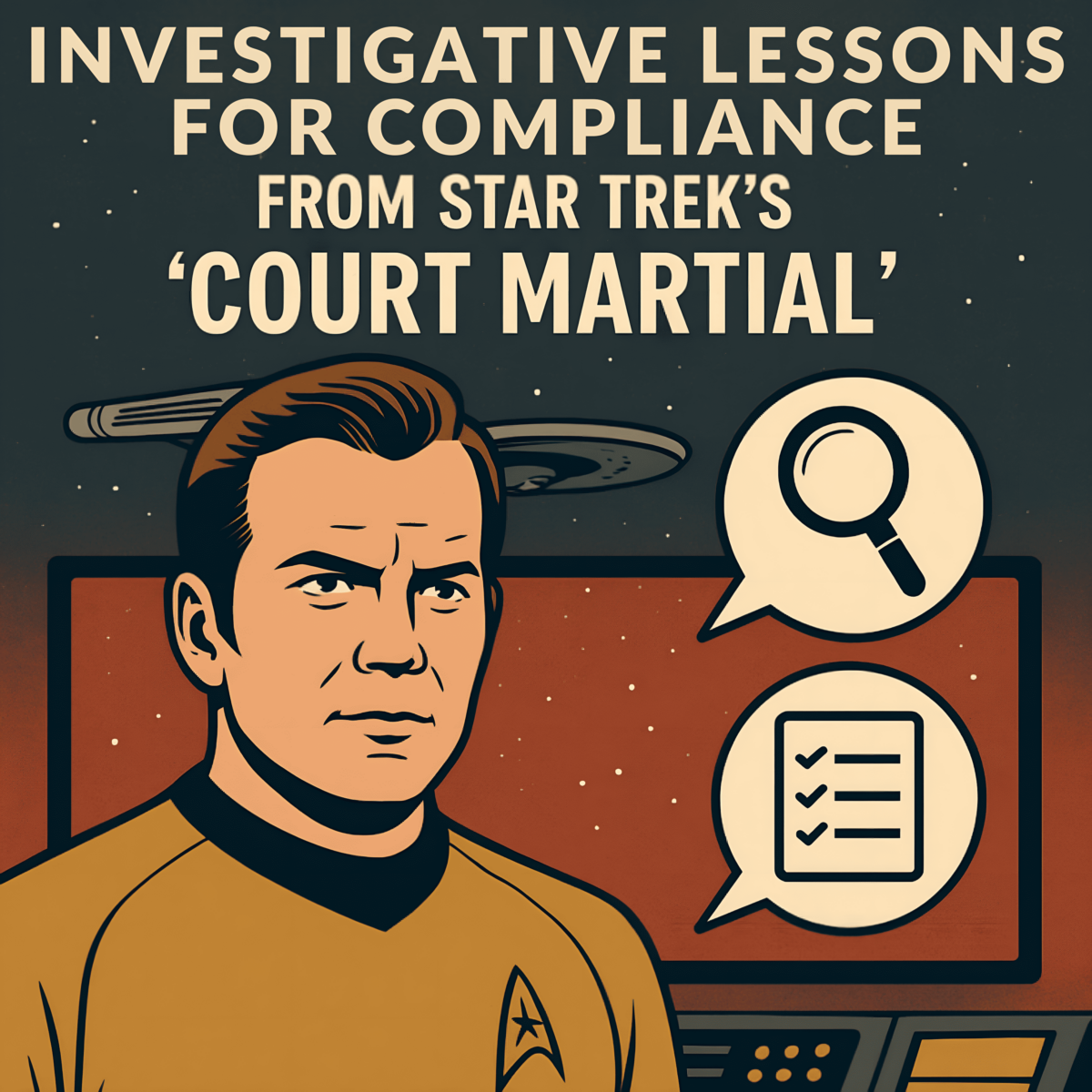
Investigative Lessons from Court Martial

Star Trek: The Original Series often illustrates complex ethical and procedural dilemmas that resonate deeply within the realm of corporate compliance. The episode “Court Martial,” in particular, offers compelling insights into effective investigative techniques and the challenges they present. In this narrative, Captain James T. Kirk faces accusations of negligent homicide, leading to a rigorous and revealing investigation. The drama unfolding aboard the USS Enterprise presents significant lessons for compliance professionals tasked with conducting internal investigations.

Today, we explore several critical investigative lessons from “Court Martial,” starting with a vivid scene from the episode, followed by the practical compliance takeaway.

1. Maintain Objectivity to Ensure Credibility

Illustrated By: Captain Kirk is accused of prematurely ejecting a research pod containing crewman Ben Finney during an ion storm. Initial computer records indicate Kirk’s guilt, prompting immediate suspicion.

Compliance investigations must always maintain objectivity. When allegations surface, compliance officers must approach each situation without preconceived notions or bias. Kirk’s investigators initially rely solely on computer data, presuming its infallibility. In corporate compliance, similarly, relying exclusively on initial reports or unverified data risks compromised investigations. Objectivity requires considering all available evidence impartially, interviewing multiple witnesses, and rigorously verifying the accuracy of data before drawing a conclusion. Objectivity protects the credibility of the compliance function and ensures fair treatment for all involved.

2. Validate Data Integrity and Authenticity

Illustrated by: Lieutenant Commander Spock meticulously tests the Enterprise’s computer system, uncovering evidence of intentional data tampering. He discovers discrepancies indicating the falsification of records used against Kirk.

Spock’s rigorous testing of the Enterprise’s data integrity underscores a fundamental investigative principle: always verify the authenticity of data. Compliance professionals cannot rely solely on digital records or untested evidence. Ensuring the integrity of investigative data involves thorough audits, cybersecurity verifications, and analytical validations. Investigations should routinely include data integrity checks and forensic audits to confirm that no manipulation or corruption has occurred. Integrity validations protect the investigation’s accuracy and reinforce trust in compliance processes.

3: Thoroughly Interview Witnesses and Stakeholders

Illustrated By: During Kirk’s trial, multiple crew members testify about Kirk’s character and actions. The varying perspectives initially add complexity but ultimately provide clarity about the underlying truth.

Effective compliance investigations require comprehensive witness interviews to build a complete understanding. Witnesses provide invaluable context, nuances, and insights beyond documentary evidence alone. Interviewing diverse stakeholders allows compliance professionals to develop a multidimensional perspective of events. Interviews should be carefully planned, meticulously documented, and designed to uncover not just factual information but also cultural dynamics, underlying motivations, and potential inconsistencies. Robust witness interviews help paint a complete investigative picture, greatly enhancing accuracy and reliability.

4. Beware of Confirmation Bias

Illustrated By: Initially, Starfleet Command investigators quickly embrace apparent computer evidence against Kirk, displaying confirmation bias driven by the expectation that the computer system’s reliability is absolute.

Compliance officers must guard against confirmation bias, the human tendency to seek or interpret evidence in a way that confirms preexisting beliefs or assumptions. Confirmation bias compromises investigative accuracy, potentially leading to unjust outcomes. To mitigate this, compliance investigators must consciously seek information that challenges initial assumptions, consider alternative explanations, and remain vigilant for indicators that contradict their preliminary conclusions. Compliance programs should incorporate systematic safeguards—such as peer reviews or independent validation—to reduce bias, thereby fostering robust and impartial investigations.

5. Documentation and Transparency Enhance Investigation Integrity

Illustrated By: Throughout Kirk’s trial, Starfleet meticulously documents each proceeding, transparently demonstrating adherence to investigative protocols and ensuring accountability.

Thorough documentation and transparency are critical in corporate investigations. Complete, accurate, and contemporaneous documentation enhances the credibility of investigations, protects against allegations of unfairness or misconduct, and strengthens the defensibility of compliance. Investigative processes should be transparently documented, recording every significant step, the rationale behind decisions, and the evidence gathered. Such meticulous transparency ensures that compliance teams can confidently explain their methods and conclusions, reinforcing trust among employees, regulators, and other stakeholders.

6. Ethical Leadership Reinforces Compliance Integrity

Illustrated By: Despite significant personal and professional risk, Captain Kirk consistently demonstrates ethical integrity, willingly submitting to the investigative and judicial processes without interference or evasion.

Ethical leadership profoundly influences compliance investigations. Leaders who openly embrace investigative processes, even when personally inconvenient or challenging, set powerful examples that foster organizational trust and ethical standards. Compliance officers must similarly lead investigations transparently and ethically, demonstrating an unwavering commitment to integrity. When leadership visibly upholds investigative processes without attempting to undermine or influence outcomes, organizations cultivate a deeper culture of compliance, emphasizing that ethical adherence takes precedence over personal convenience or hierarchical influence.

7. Accountability Builds Trust and Organizational Integrity

Illustrated By: The resolution of the investigation leads to accountability, restoring Kirk’s reputation and revealing the true culprit, Ben Finney, who had staged his apparent death and manipulated evidence out of personal grievance.

Compliance investigations must result in clear accountability to maintain organizational trust and integrity. Investigations lacking follow-through on identified misconduct undermine the credibility of compliance efforts. Conversely, holding responsible parties genuinely accountable, regardless of their position or seniority, significantly enhances an organization’s commitment to ethical standards. Compliance teams must ensure the consistent and impartial enforcement of corrective actions, sanctions, or procedural adjustments arising from investigations. Genuine accountability reinforces compliance programs, fortifies organizational trust, and deters future misconduct.

Final ComplianceLog Reflections

“Court Martial” compellingly illustrates key principles of critical compliance investigations: maintaining objectivity, validating data integrity, conducting thorough witness interviews, avoiding confirmation bias, ensuring transparent documentation, exemplifying ethical leadership, and reinforcing accountability. Each investigative lesson from Captain Kirk’s dramatic ordeal directly translates into best practices for compliance professionals navigating complex corporate scenarios.

Ultimately, effective compliance investigations hinge upon fairness, rigor, and transparency. Compliance professionals can profoundly strengthen investigative integrity by applying these timeless Star Trek lessons, creating robust frameworks that earn stakeholder confidence, protect the organization’s reputation, and affirm a commitment to uncompromising ethical standards.

Let us integrate these investigative lessons boldly into our compliance programs, ensuring that we consistently uphold and exemplify the highest investigative standards. By doing so, compliance professionals truly become organizational champions and guardians of integrity, transparency, and trust.

Resources:

Excruciatingly Detailed Plot Summary by Eric W. Weisstein

MissionLogPodcast.com

Memory Alpha

Categories
Daily Compliance News

Daily Compliance News: June 20, 2025, The Death of the Business Card Edition

Welcome to the Daily Compliance News. Each day, Tom Fox, the Voice of Compliance, brings you compliance-related stories to start your day. Sit back, enjoy a cup of morning coffee, and listen in to the Daily Compliance News. All from the Compliance Podcast Network. Each day, we consider four stories from the business world: compliance, ethics, risk management, leadership, and general interest, all of which are relevant to the compliance professional.

Top stories include:

  • EU Advisor backs $4.7bn Google fine. (WSJ)
  • An Interpol official has been arrested for corruption related to Red Notices. (NYT)
  • Who mourns the death of the business card? (FT)
  • The ex-Janus analyst was found guilty of insider trading in the WFH scheme. (Reuters)
Categories
FCPA Compliance Report

#Risk New York Speaker Series – Inside Behavioral Insights: Tom Hardin on Compliance at #RiskNYC

Join Tom Fox and hundreds of other GRC professionals in the city that never sleeps, New York City, on July 9 & 10 for one of the top conferences around, #Risk New York. The current US landscape, shaped by evolving policies, rapid advancements in AI, and shifting global dynamics, demands adaptive strategies and cross-functional collaboration.

At #RISK New York, you will master the New Regulatory Reality by getting ahead of US regulatory shifts and their impact. Conquer AI and Tech Risk by Safeguarding Your Organization in an AI-Driven World and Understanding the Implications of Major Tech Investments. Navigate Financial and Crypto Volatility by Protecting Your Assets and Exploring Solutions in a Dynamic Market. Strengthen Your GRC Framework by Leveraging Governance, Risk, and Compliance for Strategic Advantage. Protect Digital Trust by addressing challenges in cybersecurity and data privacy, and combating misinformation. All while meeting with the country’s top #Risk management professionals.

In this episode, Tom Fox is joined by Tom Hardin, a former hedge fund analyst known as Tipper X, who shares his unique journey from insider trading informant to a global speaker on compliance and risk. Hardin previews his upcoming panel on applying behavioral science to design effective GRC programs at the #RiskNYC conference. He discusses topics such as cognitive biases, social norms, and rationalizations in decision-making, emphasizing the enduring nature of human behavior despite technological advancements. The episode highlights Hardin’s goal of fostering deeper connections between psychology, technology, and regulation to build more proactive and resilient risk cultures.

Resources:

#Risk Conference Series

#RiskNYC—Tickets and Information

Tom Hardin on LinkedIn

Visit Tipper X Website

Categories
Trekking Through Compliance

Trekking Through Compliance: Investigative Lessons from Court Martial

Show Summary

The episode “Court Martial,” in particular, offers compelling insights into effective investigative techniques and the challenges they present. In this narrative, Captain James T. Kirk faces accusations of negligent homicide, leading to a rigorous and revealing investigation. Today, we explore several critical investigative lessons from “Court Martial,” starting with a vivid scene from the episode, followed by the practical compliance takeaway.

Lesson 1: Maintain Objectivity to Ensure Credibility

Illustrated By: Captain Kirk is accused of prematurely ejecting a research pod containing crewman Ben Finney during an ion storm. Initial computer records indicate Kirk’s guilt, prompting immediate suspicion.

Compliance investigations must always maintain objectivity, which requires considering all available evidence impartially, interviewing multiple witnesses, and rigorously verifying the accuracy of data before concluding.

Lesson 2: Validate Data Integrity and Authenticity

Illustrated by: Lieutenant Commander Spock meticulously tests the Enterprise’s computer system, uncovering evidence of intentional data tampering. He discovers discrepancies indicating the falsification of records used against Kirk.

Spock’s rigorous testing of the Enterprise’s data integrity underscores a fundamental investigative principle: always verify the authenticity of data.

Lesson 3: Thoroughly Interview Witnesses and Stakeholders

Illustrated By: During Kirk’s trial, multiple crew members testify about Kirk’s character and actions.

Effective compliance investigations require comprehensive witness interviews to build a complete understanding.

Lesson 4: Beware of Confirmation Bias

Illustrated By: Initially, Starfleet Command investigators quickly embrace apparent computer evidence against Kirk, displaying confirmation bias driven by the expectation that the computer system’s reliability is absolute.

Compliance officers must guard against confirmation bias, the human tendency to seek or interpret evidence in a way that confirms preexisting beliefs or assumptions.

Lesson 5: Documentation and Transparency Enhance Investigation Integrity

Illustrated By: Throughout Kirk’s trial, Starfleet meticulously documents each proceeding, transparently demonstrating adherence to investigative protocols and ensuring accountability.

Meticulous transparency ensures compliance teams can confidently explain their methods and conclusions, reinforcing trust among employees, regulators, and other stakeholders.

Lesson 6: Ethical Leadership Reinforces Compliance Integrity

Illustrated By: Despite significant personal and professional risk, Captain Kirk consistently demonstrates ethical integrity, willingly submitting to the investigative and judicial processes without interference or evasion.

Compliance officers must lead investigations transparently and ethically, demonstrating an unwavering commitment to integrity and transparency.

Lesson 7: Accountability Builds Trust and Organizational Integrity

Illustrated By: The resolution of the investigation leads to accountability, restoring Kirk’s reputation and revealing the true culprit, Ben Finney, who had staged his apparent death and manipulated evidence out of personal grievance.

Compliance teams must ensure the consistent and impartial enforcement of corrective actions, sanctions, or procedural adjustments arising from investigations.

Final ComplianceLog Reflections

Ultimately, effective compliance investigations hinge upon fairness, rigor, and transparency. Compliance professionals can profoundly strengthen investigative integrity by applying these timeless Star Trek lessons, creating robust frameworks that earn stakeholder confidence, protect the organization’s reputation, and affirm a commitment to uncompromising ethical standards.

Let us integrate these investigative lessons boldly into our compliance programs, ensuring that we consistently uphold and exemplify the highest investigative standards. By doing so, compliance professionals truly become organizational champions and guardians of integrity, transparency, and trust.

Resources:
Excruciatingly Detailed Plot Summary by Eric W. Weisstein

MissionLogPodcast.com

Memory Alpha

Categories
Blog

Navigating Global Travel Risks: Essential Strategies for U.S. Employers

International business travel has always presented its own unique set of logistical hurdles; however, today’s volatile geopolitical landscape significantly elevates these challenges. Rebecca Knight’s recent Harvard Business Review article, “An International Travel Checklist for U.S. Employers,” highlights the need for organizations to reassess their international travel strategies comprehensively. Given how poorly the Trump Administration is treating all other countries, friend and foe alike, it might be a good time for every compliance professional to assess their company’s travel risks and risk management strategies.

Knight emphasizes the duty of care obligation inherent in corporate travel management. This fiduciary responsibility compels companies to ensure employee safety, comply with federal requirements, and maintain thorough preparedness for travel contingencies. The article highlights the complexity introduced by recent political shifts, notably the Trump administration’s expansive travel bans affecting numerous nations.

For U.S. employers, clarity regarding employees’ travel authorization statuses is critical. Companies must maintain precise records of sponsored visas and short-term work statuses, tracking renewal deadlines meticulously. (IE. Document Document Document) Additionally, proactive communication is key. Organizations must inform foreign nationals about potential entry issues that may arise from previous legal issues or political activities, equipping them with comprehensive information about their rights and the likely entry challenges they may face.

Knight advises establishing a clear framework to evaluate the necessity of each business trip. Travel decisions must consider whether in-person engagement directly impacts crucial business outcomes, such as securing contracts or fostering client relationships, or if remote meetings could suffice. This framework should also ensure the equitable treatment of employees with varying passport privileges, thereby promoting fairness and equal opportunity across all international travel decisions.

Preparation includes briefing employees thoroughly about the entry requirements. Proper documentation, such as valid visas or an Electronic System for Travel Authorization (ESTA), is mandatory. Organizations should clearly outline protocols for dealing with potential border issues, including denials of entry or additional scrutiny, and identify internal support structures, such as HR and legal resources, to assist employees in navigating these challenges.

Knight further suggests developing robust contingency plans for unexpected shifts in travel policy. Companies must be agile, ready to relocate meetings or conferences, and implement alternative travel routes or pre-clearance strategies to mitigate disruptions. For example, directing employees through U.S. pre-clearance immigration locations such as Dublin can effectively manage potential border complications proactively.

Lastly, Knight emphasizes the importance of striking a balance between cautious awareness and practical decision-making. While it’s prudent to acknowledge and prepare for risks associated with international travel, organizations should avoid excessive conservatism. Effective leaders strive to maintain operational fluidity and business continuity, avoiding fear-induced paralysis.

5 Key Takeaways for Compliance Professionals:

  1. Maintain Comprehensive Employee Travel Records: Regularly update and monitor visa statuses and authorization documents to ensure compliance and readiness for policy changes. Implement robust tracking systems and databases to flag potential issues well ahead of travel dates. Proactive management of travel documentation reduces risk, enhances operational efficiency, and ensures employees can travel without interruption. Ensure that all personnel responsible for travel oversight are adequately trained to recognize and promptly address documentation discrepancies, thereby minimizing organizational vulnerability and potential legal challenges.
  2. Communicate Proactively with Foreign Nationals: Inform employees of potential risks associated with their specific circumstances, preparing them adequately for border entry scenarios. Proactive dialogue helps employees understand their rights and obligations, significantly reducing anxiety and improving compliance. Develop clear guidelines outlining possible entry complications, offer legal resources, and maintain open channels for employees to raise concerns or seek clarification. Effective communication strategies foster trust, enhance morale, and ensure smoother international travel operations.
  3. Evaluate Trip Necessity and Fairness: Implement frameworks to systematically assess the critical nature of international travel, striking a balance between business needs and equity among employees. Decisions should transparently weigh the value of in-person engagements against virtual alternatives. Explicit criteria help organizations prioritize critical business trips and provide a clear rationale for travel approvals or denials. Such frameworks should also emphasize equitable treatment of employees with differing passport privileges, ensuring that travel decisions do not inadvertently disadvantage or discriminate against certain groups.
  4. Develop Robust Contingency Plans: Anticipate and prepare for sudden policy changes or entry issues by establishing alternative meeting locations, travel routes, and comprehensive pre-clearance procedures. Robust contingency planning includes identifying alternative arrangements for meetings and conferences, pre-clearing employees at international immigration checkpoints, and routing travel through strategic hubs. Organizations should regularly rehearse contingency plans, adapting them based on evolving geopolitical contexts and operational realities. This proactive approach ensures continuity in critical business functions despite unpredictable changes in travel policy.
  5. Balance Caution with Practicality: Aim for informed, thoughtful decision-making that prioritizes employee safety and compliance without unnecessarily hindering essential business activities. Companies must navigate a careful balance between prudence and operational necessity, ensuring neither excessive caution nor reckless disregard for potential risks. Leaders should foster a culture of informed vigilance, where risks are acknowledged, prepared for, and managed effectively without overly constraining business agility. Establish clear, evidence-based decision-making protocols that empower leaders to make judicious choices, safeguarding employee welfare while sustaining organizational productivity and competitiveness.

In conclusion, navigating international travel risks demands a strategic blend of meticulous preparation, clear communication, and agile responsiveness. As geopolitical landscapes continue to shift unpredictably, compliance professionals must proactively manage employee documentation, maintain open and transparent communications, and regularly evaluate the necessity and fairness of travel decisions. Robust contingency planning, complemented by balanced and pragmatic decision-making, is crucial for mitigating potential disruptions and maintaining organizational resilience. By embracing these comprehensive strategies, companies not only ensure regulatory compliance and employee safety but also position themselves effectively to adapt and thrive in the face of ongoing global uncertainties.

Categories
Red Flags Rising

Red Flags Rising: S01 E16 – The Israel-Iran Conflict’s Implications for U.S. Export Controls

Mike and Brent follow up on Mike’s being quoted in the Dow Jones Risk Journal regarding the unexpected export control consequences of the Israel-Iran conflict. They discuss the geopolitical context (00:39), the article by Richard Vanderford and Mengqi Sun (01:22), the risk that Iran tries to evade U.S. export controls (and sanctions) by procuring replacement parts and equipment through third-party intermediaries (02:12), the cautionary tale of an Alabama resident sentenced to five years in U.S. federal prison for diverting items to Iran (03:29), the need to be cognizant of “catch-all” U.S. export controls related to ballistic missiles and WMD programs (including nuclear) and those controls reliance on the full definition of “knowledge” to include “an awareness of a high probability” (04:42), increased tracking and investigative activity by the U.S. government (06:19), how companies need to think about responding to “red flags” (06:45), the likely impact of forensic review of battlefield recoveries on requests by Israel and NGOs to companies for assistance in tracing item or component flows to Iran (07:44), and the likelihood of increased, rather than decreased, activity by U.S. agencies as a result of the conflict (09:52). They conclude with another segment of Brent Carlson’s “Managing Up” (12:26).

Resources:

The Dow Jones Risk Journal article (June 13, 2025) (subscription req.)

The Wall Street Journal Morning Risk Report (June 16, 2025)

Brent LinkedIn

Mike LinkedIn

Mike & Brent’s “Fresh Looks” Series

Categories
Blog

What Gets Measured AI Will Automate: Compliance Lessons in the Age of AI

“What gets measured gets managed” is a long-standing business adage attributed to management guru Peter Drucker. Today, in the age of artificial intelligence (AI), we can adapt this adage into a new compliance paradigm: “What gets measured gets automated.” Compliance professionals must grasp this shift, anticipate its impacts, and leverage AI strategically to enhance their compliance programs.

Automation is no longer confined to repetitive, mundane tasks. As highlighted by Christian Catalini, Jane Wu, and Kevin Zhang in their recent HBR article, What Gets Measured, AI Will Automate, AI’s capabilities now encompass complex cognitive tasks such as analysis, design, and even creative writing. This transformation is facilitated by powerful models that can rapidly absorb, analyze, and act upon extensive data sets. For compliance professionals, this signifies that areas heavily reliant on data, such as financial analysis, audits, regulatory monitoring, and reporting, are prime candidates for automation.

Understanding AI’s Automation Potential in Compliance

To effectively leverage AI, compliance professionals must first understand the scope of its potential. The article underscores that any task definable by data, a measurable outcome, and sufficient computational power is ripe for AI-driven automation. Compliance activities, such as monitoring transaction data for suspicious activities, continuously tracking regulatory updates, and managing compliance audits, fit neatly into this framework.

Consider transaction monitoring under anti-money laundering (AML) regulations. AI systems, once trained on vast historical transaction data, can instantly identify anomalies far beyond human capability, significantly enhancing detection accuracy and reducing false positives. Similarly, AI tools can autonomously track regulatory changes across jurisdictions, interpret updates, and swiftly integrate them into compliance frameworks, ensuring continuous alignment with legal mandates.

Embracing the Automation Imperative

Catalini, Wu, and Zhang note the increasing trend toward automation, citing statistics from AI firm Anthropic, which indicate that 43% of interactions with AI involve automated tasks rather than human-augmented activities. This trend underscores the need for compliance departments to adopt automation proactively.

Organizations must actively identify and prioritize measurable compliance processes for automation, thereby reallocating human resources to areas that require complex judgment and strategic decision-making. Automation in compliance does not imply reducing the significance of the workforce; instead, it empowers compliance professionals to focus on higher-order tasks that require nuanced understanding and contextual judgment.

Navigating the Human-AI Collaboration

A crucial takeaway from the authors is the delineation between tasks suited for automation and those demanding inherent human judgment, such as ethical decision-making, nuanced risk assessments, and novel compliance strategies. Tasks involving uncertainty or requiring a human touch, like ethical deliberations and whistleblower investigations, remain less suited for full automation.

Incorporating AI, therefore, should not be an all-or-nothing strategy. Compliance professionals must strive for a harmonious partnership between humans and AI, leveraging the strengths of each. For instance, AI can efficiently manage regulatory changes while compliance teams interpret these insights and apply them strategically within their organizational context.

Strategic Implementation of AI in Compliance

The authors advocate for a strategic approach that identifies tasks that AI can readily automate based on three foundational components: data availability, measurable objectives, and computational feasibility. Compliance teams should systematically catalog compliance processes against these criteria to identify opportunities for automation and optimization.

For example, continuous monitoring systems can integrate AI to streamline monitoring and enhance predictive capabilities, proactively flagging emerging compliance risks before they manifest. AI-driven platforms can analyze extensive datasets from past compliance breaches to identify patterns and predict potential future risks, thereby enabling compliance teams to act preemptively.

Leveraging AI for Continuous Improvement

One significant advantage emphasized by the authors is AI’s ability to improve through iterative learning cycles continually. Compliance automation, supported by machine learning algorithms, continuously refines itself, becoming increasingly accurate and responsive. This capability is particularly critical in compliance, where the risk landscape constantly evolves.

By integrating AI-driven continuous improvement into their compliance monitoring systems, companies can achieve significant efficiency gains. For instance, iterative improvements in anomaly detection algorithms reduce false positives over time, enabling more precise resource allocation in compliance investigations.

Confronting Challenges and Risks

Despite AI’s potential, compliance professionals must remain vigilant regarding inherent challenges and risks, such as algorithmic bias, data privacy concerns, and model transparency. Effective governance structures must oversee the implementation of AI, ensuring its ethical deployment is aligned with regulatory expectations and organizational values.

Transparency and explainability of AI-driven compliance decisions will increasingly become regulatory imperatives, underscoring the need for models that clearly articulate their decision-making processes. Compliance professionals must advocate for model interpretability, working closely with data scientists to develop explainable AI solutions that withstand regulatory scrutiny.

Preparing for the Future

The authors emphasize a clear message: in the future landscape of compliance, tasks amenable to measurement and automation will swiftly transition into the AI domain. Compliance leaders must proactively identify these tasks, implementing robust automation strategies while simultaneously focusing human effort on navigating uncertainty, making strategic decisions, and addressing ethical considerations.

Compliance professionals can draw inspiration from innovators like Amar Bose, mentioned by the authors, who succeeded by prioritizing qualitative human experiences over quantitative metrics alone. Similarly, compliance programs must strike a balance between measurable automation efficiencies and qualitative human judgment, thereby fostering resilience and adaptability.

The future of compliance lies not in resisting automation but in embracing it strategically. Compliance professionals equipped to leverage AI’s capabilities proactively will find themselves better positioned to manage evolving risks effectively. By automating measurable tasks, compliance teams can reallocate resources to address complex uncertainties, enhancing their strategic impact and ultimately strengthening organizational integrity.

In the age of AI, compliance professionals who effectively combine automated precision with nuanced human judgment will set new benchmarks in compliance excellence.

Categories
Compliance Tip of the Day

Compliance Tip of the Day – AI, Behavioral Analytics and Cyber Security

Welcome to “Compliance Tip of the Day,” the podcast that brings you daily insights and practical advice on navigating the ever-evolving landscape of compliance and regulatory requirements. Whether you’re a seasoned compliance professional or just starting your journey, our goal is to provide you with bite-sized, actionable tips to help you stay ahead in your compliance efforts. Join us as we explore the latest industry trends, share best practices, and demystify complex compliance issues to keep your organization on the right side of the law. Tune in daily for your dose of compliance wisdom, and let’s make compliance a little less daunting, one tip at a time.

Today, we explore how pairing AI with behavioral analytics can enhance your cybersecurity.

For more information on this topic, refer to The Compliance Handbook: A Guide to Operationalizing Your Compliance Program, 6th edition, recently released by LexisNexis. It is available here.

Categories
Daily Compliance News

Daily Compliance News: June 19, 2025, The Corruption in Spain Edition

Welcome to the Daily Compliance News. Each day, Tom Fox, the Voice of Compliance, brings you compliance-related stories to start your day. Sit back, enjoy a cup of morning coffee, and listen in to the Daily Compliance News. All from the Compliance Podcast Network. Each day, we consider four stories from the business world: compliance, ethics, risk management, leadership, and general interest, all of which are relevant to the compliance professional.

Top compliance stories.

  • Will the corruption scandal bring down Spain’s government? (Politico)
  • How the Culture War Is Remaking Advertising. (FT)
  • Who will run US Steel? (WSJ)
  • Families of Boeing victims file formal objections. (Reuters)
Categories
Hill Country Hustlers

Hill Country Hustlers – Real Estate Journeys with David and Jayden Hughes

In this episode of the Hill Country Hustlers Podcast, host Zachary Green speaks with guests David and Jayden Hughes about their extensive experience in the real estate industry. The Hughes discuss their journey from animal capturing to pioneering website development in their region and eventually to their thriving real estate business, specializing in ranch properties and probate real estate. They emphasize the importance of empathy in their dealings, the impact of technological advancements, such as AI and drones, on their work, and the value of effective mentorship. They share their strategies for success, including time management and continual learning, and reflect on the unique beauty and relationships that their line of work affords them.

Key highlights:

  • David and Jayden Hughes’s Journey into Real Estate
  • Challenges and Changes in the Real Estate Market
  • Community Impact and Specialization in Probate Real Estate
  • Technological Advancements in Real Estate
  • Advice for Aspiring Real Estate Agents

Resources:

Zachary Green

Tom Fox on LinkedIn

Andrew Gay on LinkedIn

Texas Hill Country Podcast Network

Broken Arrow Realty Group