Categories
Compliance Into the Weeds

Compliance into the Weeds: The Reality of AI Adoption in Corporate Compliance

The award-winning Compliance into the Weeds is the only weekly podcast that takes a deep dive into a compliance-related topic, literally going into the weeds to explore it more fully. Looking for some hard-hitting insights on compliance? Look no further than Compliance into the Weeds! In this episode of Compliance into the Weeds, Tom Fox and Matt Kelly examine three recent surveys that examine the real-world impact of AI adoption in corporate environments.

Recording from Alexandria, Virginia, where Matt is attending a conference on ethical governance of AI, Matt and Tom discuss the differing perceptions of AI’s benefits between senior executives and other employees. They explore findings from PWC, Section, and Workday surveys, uncovering a significant gap in AI’s perceived value. The discussion highlights the challenges of integrating AI, the significant rework required by employees, and the struggle to build trust in AI tools. They also debate whether enterprise-scale AI deployment or incremental, point-specific adoption is the best path forward.

Key highlights:

  • Conference on Ethical AI Governance
  • Reality Checks on AI Adoption
  • AI Rework and Employee Training Concerns
  • Trust Issues with AI

Resources:

Matt in Radical Compliance

Tom

Instagram

Facebook

YouTube

Twitter

LinkedIn

A multi-award-winning podcast, Compliance into the Weeds was most recently honored as one of the Top 25 Regulatory Compliance Podcasts, a Top 10 Business Law Podcast, and a Top 12 Risk Management Podcast. Compliance into the Weeds has been conferred a Davey, a Communicator Award, and a W3 Award, all for podcast excellence.

Categories
Great Women in Compliance

GWIC 300 – The GWICies

Today is a milestone.  It is episode 300, and marks 100 episodes since Hemma joined Lisa as a co-host and Ellen and Sarah made us what we call “Team GWIC.”  To recognize this, we go together to recognize some of the individuals and values that define our profession.

We highlight some of the amazing people who have supported us and the profession, including culture carriers, change agents, mentors, Great Gentlemen in Compliance, and collaborators and supporters.

We also wanted to recognize some true MVPs – those who have stood up at personal and professional risk to strengthen integrity, support whistleblowers, and push the profession forward. It also shines a light on the often-unspoken challenges of ethical decision-making and the consequences that may come from speaking out, including well-being and professional isolation.  Their work and stories reaffirm the reasons we do what we do and why we are committed to the mission.

We should have an award for the entire GWIC community for your support and for sticking with us.  We are excited for what comes next, including new branding, materials, and exciting content.

Categories
Blog

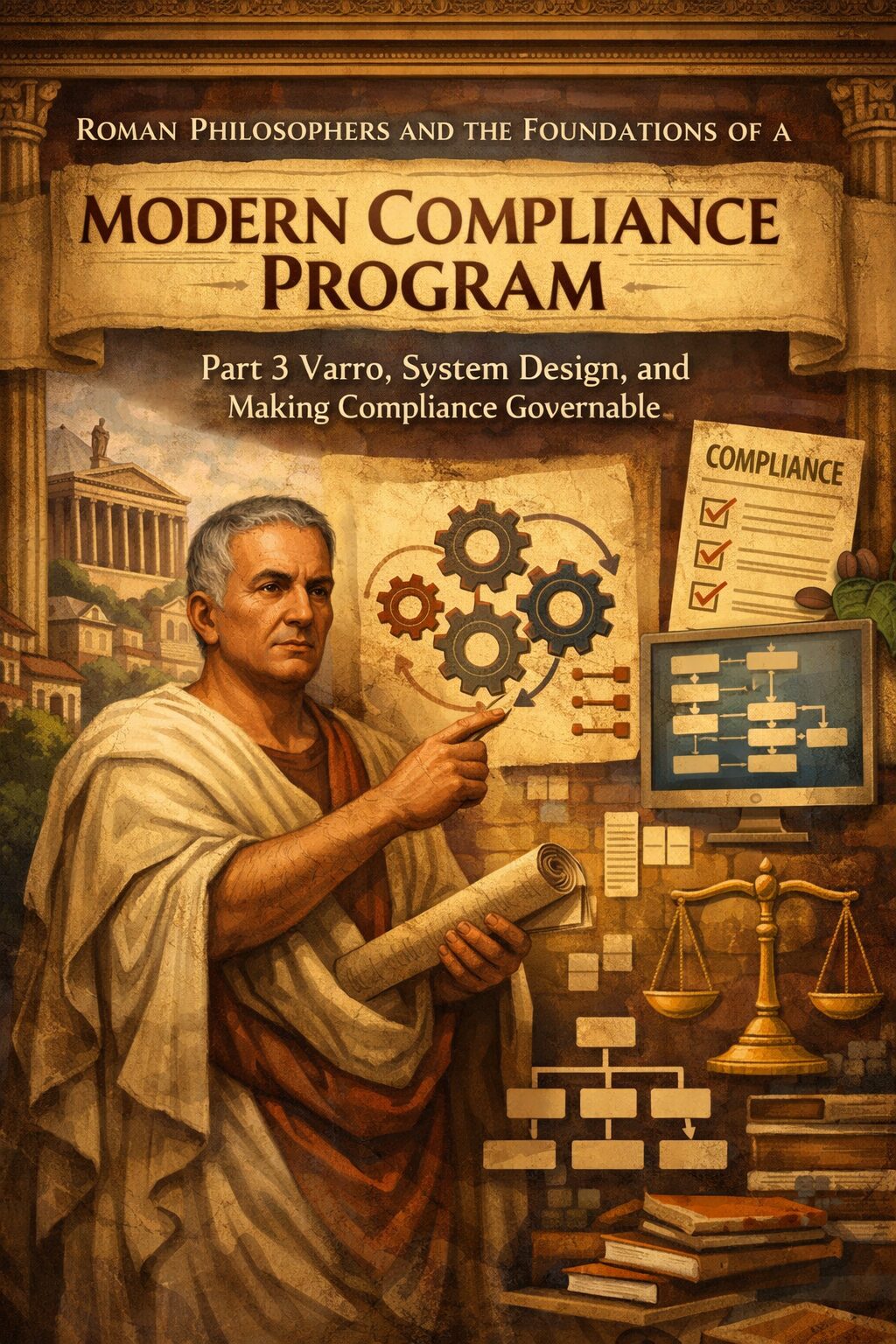
Roman Philosophers and the Foundations of a Modern Compliance Program: Part 3 Varro, System Design, and Making Compliance Governable

I recently wrote a series on the direct link between ancient Greek Philosophers and modern corporate compliance programs and compliance professionals. It was so much fun and so well-received that I decided to follow up with a similar series on notable Roman Philosophers. This week, we will continue our exploration of the philosophical underpinnings of modern corporate compliance programs and compliance professionals by looking at five philosophers from Rome, both from the Roman Republic and the Roman Empire.

We have considered Cicero and the duty, law, and the moral limits of business; and Seneca and power, pressure, and ethical decision-making under stress. Today, we consider Varro and corporate governance; upcoming blog posts include Marcus Aurelius and ethical leadership and tone at the top, and we will conclude with Lucretius to explore rationality, fear, and risk perception. Today, we continue our discussion of Varro and compliance governance structures.

I. Varro in Context: Order as Institutional Survival

Marcus Terentius Varro was not a moralist in the way Cicero was, nor a psychological observer like Seneca. He was Rome’s great systematizer. Varro cataloged language, religion, agriculture, history, and civic life with a single objective: to make complex institutions intelligible and durable. He believed that civilizations fail not first from immorality, but from disorder. Although very little of his writings survives, Plutarch described him as “Rome’s Third Great Light” behind Virgil and Cicero.

Varro lived through the collapse of the Roman Republic. He watched institutions grow so complex, fragmented, and inconsistent that they could no longer govern themselves. His response was not exhortation or outrage, but classification. By defining categories, standardizing language, and organizing knowledge, Varro sought to preserve Rome’s ability to function even as political pressures mounted.

For modern compliance professionals, Varro is essential precisely because he does not begin with ethics. He starts with structure. He understood that values cannot operate within incoherent systems. Before leadership can model ethics and before culture can reinforce integrity, the institution must be governable.

II. The Compliance Problem Varro Illuminates: Program Sprawl and Structural Entropy

Modern compliance programs rarely fail because they lack policies or commitment. They fail because they become structurally unmanageable.

Over time, compliance programs accumulate:

  • Policies written for different risks, jurisdictions, and moments in time
  • Risk assessments that do not align with controls
  • Training modules disconnected from decision-making
  • Escalation paths that vary by function or geography
  • Metrics that track activity but do not integrate

This is compliance sprawl. No one intentionally designs it. It emerges gradually as organizations respond to enforcement actions, audits, mergers, new regulations, and internal incidents. Eventually, the program exists everywhere and nowhere at once. Varro would recognize this immediately. He believed that when systems grow faster than understanding, governance becomes ceremonial. Rules exist, but they do not guide behavior. Oversight exists, but it cannot see clearly.

The DOJ Evaluation of Corporate Compliance Programs (ECCP) reflects Varro’s concern by asking whether a program is well-designed, consistently applied, and understood by employees. These are not ethical questions. They are structural ones.

III. Modern Corporate Application: Varro, DOJ Expectations, and Compliance Architecture

Applying Varro to modern compliance highlights the importance of architecture over accumulation.

First, compliance programs must classify risk consistently. Varro believed that naming and categorizing were a form of control. In compliance terms, this means standardized risk taxonomies, consistent issue classifications, and shared definitions across legal, compliance, audit, and HR. Without this, trend analysis and root cause assessment become unreliable.

Second, integration must replace layering. Varro linked systems rather than allowing them to multiply independently. Modern compliance programs should map risks to controls, controls to training, training to behavior, and behavior to metrics. The DOJ increasingly expects compliance to be embedded in business operations rather than treated as a parallel system.

Third, ownership must be explicit. Varro rejected ambiguity about responsibility. In compliance programs, unclear ownership of controls, investigations, and remediation creates delay and finger-pointing. A governable program clearly and visibly assigns responsibility.

Fourth, institutional memory must be preserved. Varro understood that institutions that forget repeat mistakes. Compliance programs must retain investigation outcomes, remediation decisions, and lessons learned to inform future risk assessments and controls. DOJ guidance increasingly focuses on learning and continuous improvement, which cannot occur without memory.

Finally, language discipline matters. Varro studied language because confused language produces confused action. In compliance, inconsistent terminology across policies, reports, and board materials undermines oversight. Precision is not pedantry. It is governance.

IV. Key Takeaways for Compliance Professionals

  1. Compliance Governance. Compliance professionals should view Varro as the architect of governable compliance. Varro teaches that ethics cannot function without a structure that allows oversight, consistency, and understanding. A compliance program that cannot be clearly explained cannot be effectively governed. Governable compliance is the prerequisite for ethical leadership, accountability, and continuous improvement.
  2. Well Designed. Compliance should prioritize coherence over accumulation. Adding more policies, controls, and tools does not strengthen a compliance program if they do not align with one another. Varro would warn that unchecked accumulation creates confusion rather than protection. Coherence ensures that each element of the program reinforces the others instead of competing for attention.
  3. Risk Measurement. Compliance should standardize risk classification and language across functions. Varro understood that shared language is essential for coordinated action. When legal, compliance, audit, and business teams describe the same risk differently, oversight becomes fragmented. Standardized terminology allows trends to be identified, lessons to be learned, and governance to function effectively.
  4. Written Program. Your compliance should integrate policies, controls, training, and metrics into a single operating model. Varro rejected isolated systems in favor of interconnected ones. A compliance program works only when policies inform controls, controls shape training, and training influences measurable behavior. Integration transforms compliance from a collection of activities into an operational system.
  5. Remember. Compliance should preserve institutional memory to prevent repeat failures. Varro believed institutions must remember their own history to avoid repeating mistakes. Compliance programs fail when lessons learned from investigations or audits are lost with personnel changes or reorganizations. Preserving institutional memory enables trend analysis, informed risk assessments, and durable remediation.
  6. Enabler. Compliance should treat structure as an ethical enabler, not a bureaucratic burden. Structure is often misunderstood as red tape rather than support. Varro shows that clear structure empowers ethical action by reducing ambiguity and inconsistency. Well-designed systems make it easier for individuals and leaders to do the right thing.
  7. Simplicity. Finally, Varro reminds us that ethical intent cannot survive inside incoherent systems. Compliance programs do not fail only because people act under pressure. They fail because the system itself becomes too complex to operate. Ethical breakdown is often preceded by structural breakdown. When compliance systems become fragmented, opaque, or unmanageable, even well-intentioned actors struggle to act responsibly. Varro’s lesson is that simplicity, clarity, and integration are not administrative preferences but governance necessities.

V. Conclusion

Varro’s enduring contribution to modern compliance is his insistence that ethics cannot function in systems that cannot be understood, managed, or governed. He reminds compliance professionals that before culture can shape behavior and before leadership can model integrity, the program itself must be coherent, integrated, and durable. In an era where compliance programs risk collapsing under their own complexity, Varro offers a sobering but practical lesson: clarity is not a luxury, simplicity is not weakness, and structure is not bureaucracy. They are the conditions that allow ethical intent to survive pressure, scale, and time.

Varro stabilizes the compliance program by making it governable. But structure alone does not produce integrity. A well-organized system can still fail if those who lead it do not model ethical restraint. This is where Varro yields to Marcus Aurelius. If Varro ensures that the compliance program holds together, Marcus Aurelius determines how it behaves. The transition from Varro to Marcus Aurelius mirrors the shift from system design to ethical leadership, from architecture to example. Compliance becomes durable only when principled leaders animate coherent systems.

Join us tomorrow in Part 4 for a look at Marcus Aurelius, stoicism, and leadership.

Categories
AI Today in 5

AI Today in 5: February 3, 2026, The AI Undergrad Degree Edition

Welcome to AI Today in 5, the newest addition to the Compliance Podcast Network. Each day, Tom Fox will bring you 5 stories about AI to start your day. Sit back, enjoy a cup of morning coffee, and listen in to the AI Today In 5. All, from the Compliance Podcast Network. Each day, we consider five stories from the business world, compliance, ethics, risk management, leadership, or general interest about AI.

Top AI stories include:

  1. UW-Whitewater offers an undergraduate degree in AI. (Channel3000)
  2. The race to build an operating system for investment advisors. (InvestmentNews)
  3. Cramer says AI changing companies fortunes. (YahooFinanceSingapore)
  4. Is your business’s speed a risk? (FinTechGlobal)
  5. Where is AI taking us? 8 thinkers report. (NYT)

For more information on the use of AI in Compliance programs, my new book, Upping Your Game, is available. You can purchase a copy of the book on Amazon.com.

Categories
Daily Compliance News

Daily Compliance News: February 3, 2026, The Pizza Hut and Compliance Edition

Welcome to the Daily Compliance News. Each day, Tom Fox, the Voice of Compliance, brings you compliance-related stories to start your day. Sit back, enjoy a cup of morning coffee, and listen in to the Daily Compliance News. All, from the Compliance Podcast Network. Each day, we consider four stories from the business world, compliance, ethics, risk management, leadership, or general interest for the compliance professional.

Top stories include:

  • NATO officials were arrested on corruption charges. (MILITARNYI)
  • How to bury a mandated whistleblower report. (WSJ)
  • A Pizza Hut resurgence and compliance. (Slate)
  • Former FBI compliance head slides over to EY. (GTSC)
Categories
Innovation in Compliance

Innovation in Compliance – Insights on FCPA and Anti-Corruption Enforcement Trends with Anik Shah

Innovation touches every part of the modern enterprise, and compliance professionals must be prepared not only to respond to change but to lead through it. Join Tom Fox, the Voice of Compliance, as he visits with top innovative minds, thinkers, and creators on the award-winning Innovation in Compliance podcast. In this episode, host Tom Fox welcomes Anik Shah, Global Director of Anti-Bribery and Anti-Corruption Compliance at Sandisk, for an insightful discussion on the pivotal shifts in FCPA enforcement during 2025 and what they signal for 2026.

Shah outlines his extensive professional background, including his prior roles at the SEC and DOJ. The conversation explores key developments from 2025, including the Executive Order pausing certain FCPA investigations, the Blanche Memo’s four criteria for opening FCPA cases, and the implications of revisions to the Corporate Enforcement Policy. He also analyzes the Communications Cellular enforcement action to highlight practical compliance lessons, focusing on strengthening AML controls, managing third-party risk, and deploying proactive compliance measures amid renewed anti-corruption scrutiny.

The episode concludes with a forward-looking discussion of emerging anti-corruption risks associated with advanced AI technologies, large AI construction projects, and related permitting activities, both in the United States and globally. Shah offers strategic recommendations for compliance professionals seeking to anticipate and manage these evolving risks.

Key highlights:

• 2025 as a Pivotal Year in FCPA Enforcement

• The Blanche Memo and Corporate Enforcement Policy Revisions

• Anti-Money Laundering and Third-Party Risk Management

• Large AI Construction Projects and Permitting Risks

• Global Anti-Corruption Laws and Compliance

• Key Takeaways for 2026

Resources:

Anik Shah on LinkedIn 

Sandisk

Innovation in Compliance was recently honored as the Number 4 podcast in Risk Management by 1,000,000 Podcasts.

Categories
Red Flags Rising

Red Flags Rising: S01 E36: How to Prepare for 2026 – The Fraud Diamond Framework (SM) Applied

Mike Huneke and Brent Carlson return for the new year with a refresher on The Fraud Diamond Framework (SM) introduced in Episode 34 and an explanation of how it would apply in practice as trade compliance professionals try to expect the unexpected in 2026. They discuss the importance of designing and implementing “compliance backstops” as geopolitical guardrails (01:47), how Stoic philosophy and the good work of Mo Bunnell (CEO and Founder of Bunnell Idea Group, author of Give to Grow) help build resiliency (03:40), review The Fraud Diamond Framework(SM) (05:57), describe how the framework can help trade compliance personnel to make and defend triage decisions (10:59), the implications of many trade compliance programs reaching a point in their evolution where they need to be able to demonstrate true integrity and effectiveness (13:45), the new 25% tariffs on certain semiconductors (14:38), and notable economic sanctions enforcement decisions related to lawyers’ advice or lawyers themselves (15:56). They conclude with Brent’s first Managing Up of 2026 (21:04).

Resources:

Brent’s email: brent@redflagsrising.com

Mike’s email: michael.huneke@morganlewis.com

Categories
The PfBCon Podcast

The PfBCon Podcast: Unlocking the Secrets to Successful Podcasting with Insider Tips and Tools with Chris Krimitsos

In this inaugural episode of The PfBCon Podcast, Chris Krimitsos, the founder and driving force behind Podfest Multimedia Expo—one of the world’s most influential podcasting and creator community events—delves into valuable tips and tools for creating an exceptional podcast or video podcast.

Chris highlights the North American pod tour, thanks key sponsors and contributors, and discusses essential resources such as Google Trends, Answer the Public, VidIQ, and more to generate content ideas and increase audience engagement. Discover powerful AI tools such as Adobe Enhanced Speech, Cast Magic, Descript, and others to streamline your podcast production and explore creative ways to enhance your podcast’s reach and monetization strategies with PodMatch, Canva, and Headliner. Listen for insights on overcoming industry-specific challenges and leveraging AI to stay ahead in the podcasting world.

Key highlights:

  • The Pod Tour
  • Highlighting Key Figures in Podcasting
  • Tips for Creating an Amazing Podcast
  • Essential Tools for Podcasters
  • AI Tools and Their Benefits
  • Case Study: The Produce Industry Podcast

Resources:

Follow Chris on his:

Website

Facebook

Podfest Multimedia Expo

Categories
Blog

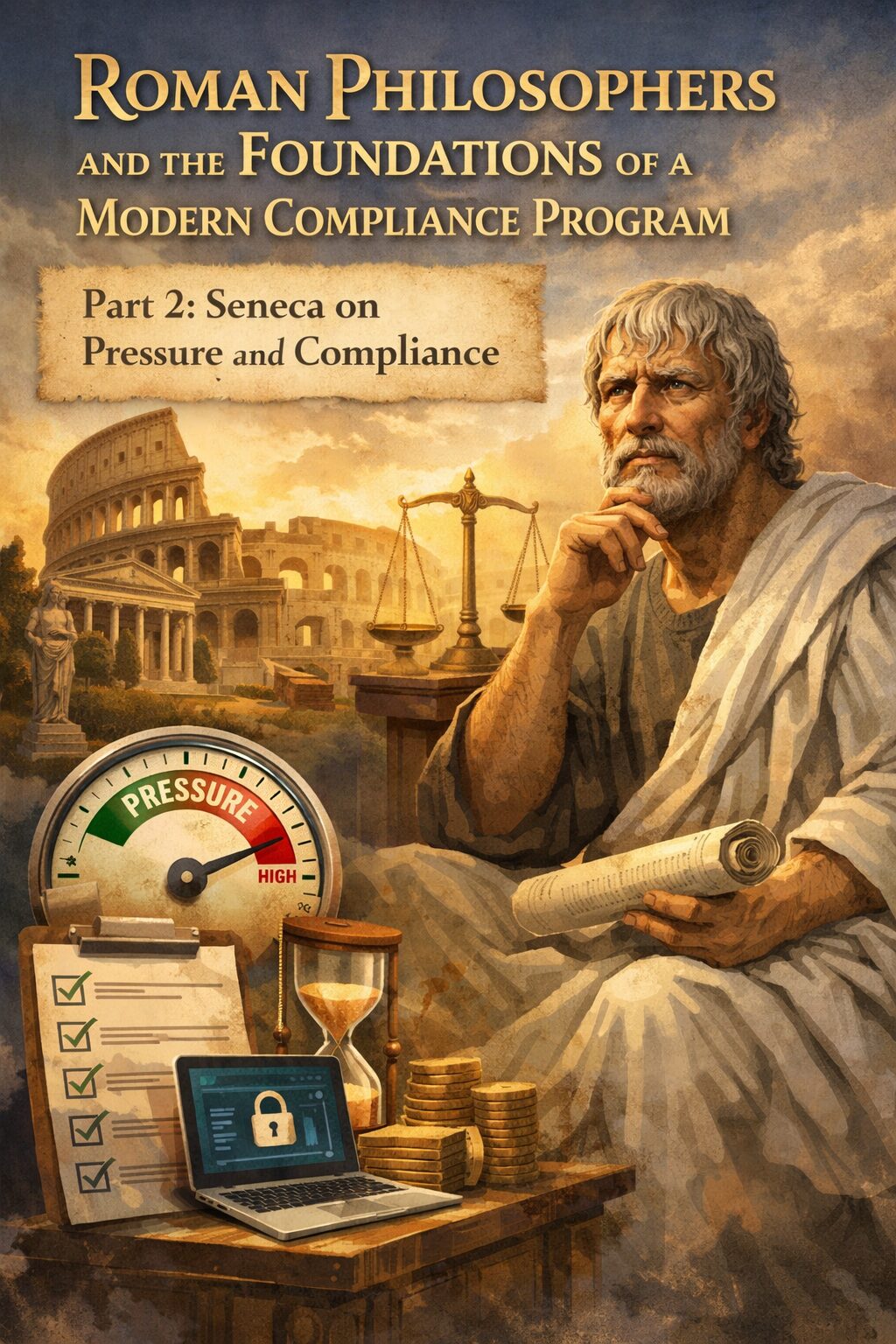
Roman Philosophers and the Foundations of a Modern Compliance Program: Part 2 Seneca on Pressure and Compliance

I recently wrote a series on the direct link between ancient Greek Philosophers and modern corporate compliance programs and compliance professionals. It was so much fun and so well-received that I decided to follow up with a similar series on notable Roman Philosophers. This week, we will continue our exploration of the philosophical underpinnings of modern corporate compliance programs and compliance professionals by looking at five philosophers from Rome, both from the Roman Republic and the Roman Empire.

Yesterday, we considered Cicero and the duty, law, and the moral limits of business; today, we will look at Seneca and power, pressure, and ethical decision-making under stress; upcoming blog posts include Marcus Aurelius and ethical leadership and tone at the top; Varro and corporate governance; and Lucretius to explore rationality, fear, and risk perception. Today, we continue with Seneca on pressure and when compliance matters the most.

I. Seneca in Context: Ethics from Inside Power

Lucius Annaeus Seneca did not write philosophy from a safe distance. He lived at the center of Roman power, wealth, and danger. As tutor and later advisor to Emperor Nero, Seneca understood how quickly ethical intentions could be compromised by fear, ambition, loyalty, and survival. He also understood how people justify those compromises to themselves.

Seneca’s writings, particularly Letters from a Stoic and On Anger, are not abstract moral treatises. They are practical examinations of how human beings behave when placed under stress. He was deeply concerned with emotional excess, not because emotions were immoral, but because unchecked emotion distorts judgment. Anger, fear, greed, and the desire for approval all lead otherwise rational people to make decisions they later defend as necessary.

For Seneca, ethical failure was rarely sudden. It was incremental. People crossed lines not because they intended to be corrupt, but because they convinced themselves that circumstances demanded flexibility. This insight makes Seneca indispensable to the modern compliance professional, whose greatest challenge is not policy design, but behavior under pressure.

II. The Compliance Problem Seneca Illuminates: Rationalization Under Stress

Most compliance programs are designed around rules, controls, and reporting structures. Far fewer are designed with human psychology in mind. Seneca would argue that this is a critical oversight. Modern compliance failures often occur in high-pressure environments: aggressive sales targets, looming deadlines, competitive markets, political instability, or financial distress. In these moments, individuals do not typically reject ethical norms outright. Instead, they rationalize deviations as temporary, necessary, or harmless.

Common rationalizations include:

  • “This is how business is done here.”
  • “We will fix it later.”
  • “No one is really harmed.”
  • “Leadership expects results.”
  • (and my personal favorite) “We’ve always done it this way.”

Seneca warned that these internal narratives are more dangerous than ignorance. Once people justify unethical conduct to themselves, external controls become less effective. A policy cannot compete with a story someone tells themselves to preserve status, income, or safety. The DOJ, particularly in its various iterations of the Evaluation of Corporate Compliance Programs (ECCP), has increasingly focused on this dynamic. In recent enforcement actions, regulators have emphasized root-cause analysis, asking not only what rule was broken but also why individuals felt compelled to break it. Pressure, incentives, and cultural signals consistently appear as contributing factors.

Seneca teaches that compliance programs must anticipate rationalization. It is not enough to say “do not do this.” Organizations must understand when and why people will convince themselves that doing it is acceptable.

III. Modern Corporate Application: Seneca, DOJ Expectations and Behavioral Compliance

The ECCP explicitly asks whether a company’s risk assessment and controls account for “the types of misconduct most likely to occur” and whether the company has “addressed the root causes of misconduct.” These questions align directly with Seneca’s insights. Consider major enforcement actions involving systemic bribery, fraud, or manipulation of controls. In cases such as the Wells Fargo fraudulent accounts scandal or the Volkswagen emissions testing scandal, both of which involved employees operating under intense performance pressure. While not all wrongdoing can be excused by culture, regulators repeatedly noted environments where employees felt trapped between expectations and ethics.

A Seneca-informed compliance program would focus on several practical measures.

First, risk assessments should explicitly identify pressure points. Compliance should map where incentives, deadlines, or market conditions increase the likelihood of rationalization. This includes sales functions, third-party relationships, emerging markets, and crises.

Second, training should move beyond rules into scenario-based discussions. Seneca believed self-awareness was an ethical discipline. Modern compliance training should confront common rationalizations directly, helping employees recognize them before they take hold. DOJ guidance increasingly favors practical, tailored training over generic training.

Third, escalation pathways must be realistic under stress. A hotline that exists only on paper will not be used when fear of retaliation or failure dominates. Seneca understood that fear silences conscience. Effective compliance programs must demonstrate that speaking up under pressure is protected, valued, and acted upon.

Fourth, leadership messaging matters most during crises. Seneca warned that leaders set moral boundaries through behavior, not speeches. The DOJ has emphasized that how management responds to misconduct is a key indicator of program effectiveness. When leaders excuse results achieved through questionable means, rationalization spreads quickly.

Finally, compliance must be present before the crisis, not introduced afterward. Seneca would view reactive compliance as inherently weak. Ethical resilience must be built in advance, when judgment is clear, and stakes are lower.

Key Takeaways for Compliance Professionals

1. Behavioral Risk. Compliance professionals should view Seneca as a guide to behavioral risk, not philosophical pessimism. Seneca focuses on how real people behave under pressure rather than on abstract ethical ideals. He recognizes that stress, fear, ambition, and loyalty distort judgment long before formal rules are broken. For compliance professionals, Seneca provides a framework for understanding why misconduct occurs even in organizations with well-designed programs.

2. Pressure Points. Compliance should identify and manage pressure points where rationalization thrives. High-performance targets, crises, and competitive markets create environments where ethical shortcuts are easily justified. Seneca teaches that rationalization flourishes when people feel trapped between expectations and consequences. Compliance programs must proactively map and mitigate these pressure points rather than react after misconduct occurs.

3. Training Design. Compliance should design training that addresses how people actually make decisions under stress. Traditional rule-based training assumes calm, rational decision-making, which rarely occurs in real-world situations. Seneca reminds us that ethical failure often occurs in moments of emotional intensity rather than in deliberation. Effective compliance training should use scenarios and realistic dilemmas that reflect pressure, ambiguity, and competing incentives.

Compliance should ensure escalation mechanisms work when fear and incentives collide. A hotline or reporting channel is ineffective if employees do not trust it during high-risk moments. Seneca understood that fear silences conscience and discourages disclosure. Compliance programs must test whether escalation pathways function when the personal cost of speaking up feels high.

4. Leadership Engagement. Compliance should engage leadership on how their responses to pressure shape ethical behavior. Leaders signal ethical boundaries most clearly when responding to setbacks, failures, or missed targets. Seneca warned that inconsistent or emotionally driven leadership responses accelerate ethical decay. Compliance professionals must ensure leaders understand that their reactions under pressure become cultural instruction.

  • Compliance should focus on prevention through awareness, not punishment after failure. Seneca emphasized self-awareness as the first defense against moral error. Compliance messaging that only appears after misconduct reinforces fear rather than learning. Ongoing communication about pressure, rationalization, and ethical expectations strengthens resilience before problems arise.
  • Finally, Seneca instructs us that ethical systems fail not because people abandon values, but because they convince themselves that those values can wait. A compliance program that ignores pressure is a program designed to fail when it matters most. Rationalization is the quiet mechanism through which ethical erosion occurs. Seneca shows that delay, exception-making, and “temporary” compromises accumulate into systemic failure. Compliance programs that do not confront rationalization directly leave themselves exposed at their most vulnerable moments.

Conclusion

Seneca exposes the internal dynamics that cause compliance programs to fail under pressure. He shows us how fear, ambition, and rationalization erode ethical judgment, even when rules are clear and controls are in place. But Seneca largely examines the problem from the inside out, focusing on how individuals respond to external forces. That analysis leads directly to the next question in the compliance lifecycle: what responsibility does the individual retain when pressure is real, and authority is unequal? This is where Seneca gives way to Epictetus.

Join us tomorrow as we explore Varro and corporate governance for your compliance regime.

Categories
Career Can D0

Success Without Burnout with Elle Ballard

When did everything start feeling so loud? The goals, the pressure, the constant push to keep going. This episode of Career Can Do slows things down in the best possible way.

Mary Ann is joined by Elle Ballard, founder of Women of the World Network, for a conversation that feels more like a deep exhale than a career lecture. Elle shares how her journey from the corporate world to community building led her to create a global space where women can connect, share their stories, and grow with intention.

They talk about how the idea of success changes over time. For Elle, it’s no longer about chasing external milestones at the expense of everything else. Real success, she explains, has to include inner fulfillment, energy, and alignment across all areas of life. When those pieces are out of sync, something always feels off.

Elle also opens up about the new direction she’s taking with her work, bringing in more mind-body practices inspired by her own transformation through movement. It’s about reconnecting with yourself, restoring vitality, and finding your spark again – especially if you’re feeling burned out or stuck.

When Mary Ann asks what one small shift could help someone move forward, Elle keeps it simple. Pause. Get quiet. Ask better questions. As she says, “I think it’s important to take time to pause, actually, and just go back to your voice.” Making space to check in with yourself can be more powerful than any big plan.

Resources

Elle Ballard on the Web | LinkedIn | Women of the World Network

Mary Ann Faremouth on the Web | X (Twitter)