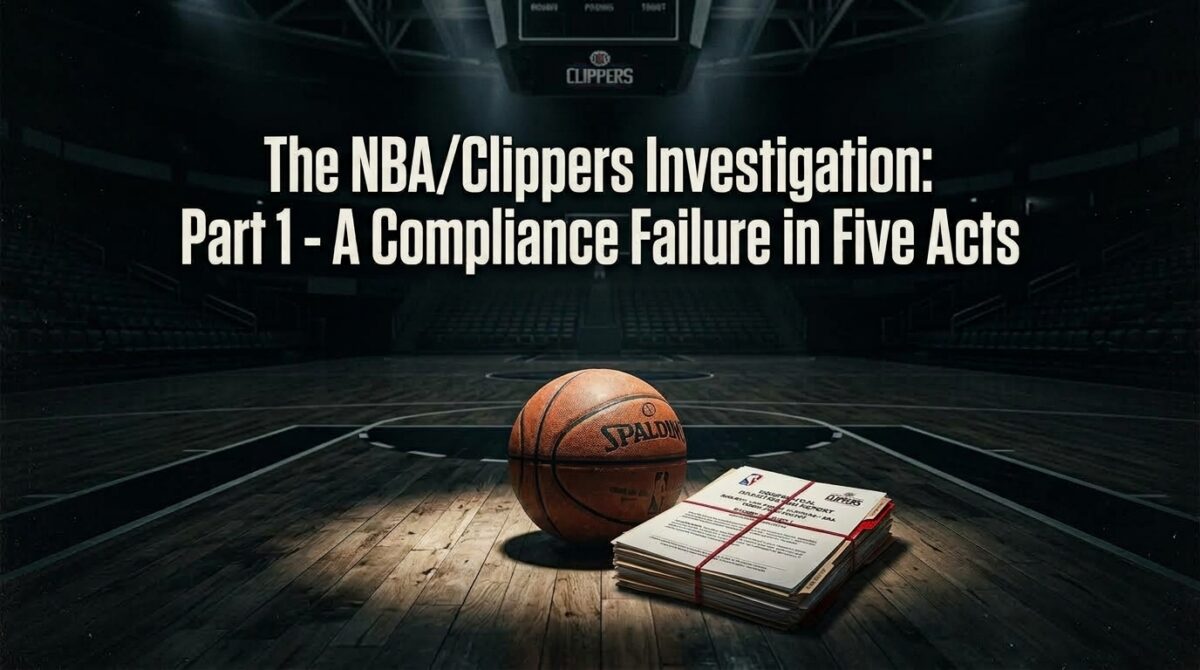
Over the next five blog posts, we will consider how commercial pressure, weak controls, and leadership decisions turned a salary-cap rule into an enterprise-wide governance failure. Today in Part 1, we summarize those compliance failures.
The most dangerous compliance failure is not ignorance of the rules. It is knowing the rules, receiving targeted training, having a history of prior violations, and then creating a process that appears compliant while delivering a prohibited result. That is the central compliance lesson from the investigation into the LA Clippers and Kawhi Leonard.
The independent investigators’ report, prepared by the law firm Wachtell, Lipton, Rosen & Katz, concluded that the Clippers violated the NBA’s salary-cap circumvention rules through a pattern of transactions involving Leonard, his representatives, team executives, and four companies doing business with the organization. This is a sports story, but it is also much more. It is a case study in executive accountability, third-party risk, conflicts of interest, internal controls, reporting failures, organizational culture, and board oversight.
The Investigation
The matter began after the September 2025 podcast Pablo Torre Finds Out reported allegations involving a four-year endorsement agreement between Leonard and Aspiration Partners, a sustainability services company that later entered bankruptcy. Torre won a Pulitzer Prize for his podcast reporting. Thereafter, the NBA retained Wachtell Lipton to investigate. The inquiry eventually expanded beyond Aspiration to include endorsement agreements involving Boingo Wireless, Daktronics, and Lockton Insurance.
Investigators conducted 73 interviews of 60 people and reviewed more than 200,000 pages of documents. They interviewed Clippers owner Steve Ballmer; President of Business Operations Gillian Zucker; President of Basketball Operations Lawrence Frank; Leonard; and Leonard’s uncle and then-business manager, Dennis Robertson (Uncle Dennis). Third-party cooperation varied. Aspiration’s bankruptcy trustee and Daktronics provided substantial assistance, while other parties reportedly limited or refused cooperation.
The resulting 36-page report is a summary, not a complete presentation of the evidence. Nevertheless, the investigators concluded that the record was sufficient to establish multiple violations. The misconduct unfolded in five acts.
Act One: A Known Rule and a Known Risk
The NBA’s circumvention rules broadly prohibit teams from providing players with compensation, business opportunities, or anything else of value outside their authorized player contracts. The rules also prohibit attempts, solicitations, inducements, and informal understandings intended to produce such benefits. The rule has a simple underlying principle: to prevent salary cap circumvention.
The NBA provided teams with practical examples. A team representative could not recommend a player to a sponsor for an endorsement arrangement or initiate and facilitate that relationship. If a sponsor independently asked about a player, the team’s permissible response was generally limited to supplying the player’s or agent’s contact information.
The Clippers were not operating in unfamiliar territory. In 2015, the NBA fined the team $250,000 for conduct involving a potential endorsement opportunity for DeAndre Jordan. In 2019, the NBA investigated demands reportedly made by Uncle Dennis during Leonard’s free agency. The League subsequently required teams to report improper solicitations for benefits, even when the team rejected the request.
In December 2019, the NBA provided circumvention training to the Clippers’ senior leadership, including Ballmer, Zucker, and Frank. Investigators reported that all three understood the rule. This is the first compliance lesson: knowledge is not a control. Training can establish awareness, but only governance, monitoring, escalation, and accountability can translate awareness into compliant conduct.
Act Two: Pressure From a Powerful Stakeholder
According to the report, Uncle Dennis pressed the Clippers to help Leonard obtain approximately $10 million per year in off-court income. He communicated his demands to Frank, Ballmer, and Zucker. The report found no evidence that these demands were reported to the NBA, even though the reporting rule had been created in response to earlier concerns involving Robertson. Investigators also found no evidence that senior leaders clearly instructed him to stop making the requests.
Instead, contemporaneous notes reflected assurances that Clippers’ personnel would help Leonard achieve his financial goals. Uncle Dennis requested a plan, a pipeline of potential companies, and more frequent communication. This was a decisive moment. The organization had received a red flag from the highest-risk source, involving one of its most commercially valuable stakeholders. The control that mattered was not another training presentation. It was the ability to say no, document the response, escalate the demand, and make the required report.
Act Three: The Commercial Ecosystem Becomes the Delivery Mechanism
During six days in June 2020, Zucker sent introduction emails connecting Uncle Dennis with Boingo, Daktronics, and Lockton. Each email was written as if the company had requested the introduction. Investigators did not credit that explanation. They concluded that the Clippers initiated the introductions in response to Uncle Dennis’ demands.
Leonard subsequently entered into endorsement agreements with all three companies. The agreements provided for $18 million in total compensation, all of which was paid by August 2021. Investigators identified several unusual characteristics: the agreements were negotiated rapidly during the COVID-19 shutdown, imposed minimal performance obligations, were not publicly announced, and produced little evidence of meaningful activation.
At the same time, each company was pursuing lucrative business with the Clippers or the team’s arena. The report described consulting agreements, substantial advance payments, and perceived links between vendor business and payments to Leonard. The investigators found the Daktronics arrangement particularly direct. They concluded that Clippers personnel proposed using an endorsement agreement with Leonard as part of a “spend back” arrangement connected to Daktronics’ pursuit of the Intuit Dome scoreboard contract.
Here, third-party risk and procurement risk converged. The vendors were not merely outside parties. They allegedly became the mechanism through which the prohibited benefit was delivered.
Act Four: Aspiration and the Appearance of Legitimacy
Aspiration’s relationship with the Clippers was substantial. It included a long-term sponsorship agreement, sustainability services for the Intuit Dome, and a $50 million personal investment by Ballmer. The report concluded that Zucker raised the possibility of an Aspiration endorsement agreement with Leonard, recruited a business agent to help structure it, communicated proposed financial terms, provided input on the term sheet, and remained involved after the formal introduction.
The final agreement called for $48 million in cash and equity over four years. Investigators described the compensation as extraordinarily high in relation to Leonard’s obligations and endorsement profile. The most significant issue involved a separate agreement under which the Clippers would purchase sustainability services for the Forum. Early documents contemplated $7 million in annual business for Aspiration, matching the annual cash component of Leonard’s endorsement agreement. When Aspiration’s co-founder threatened to abandon the Leonard agreement unless the Forum transaction was completed, internal Clippers’ communications reportedly reflected awareness of that linkage. Ballmer nevertheless approved the Forum agreement.
The compliance lesson is substance over form. A formal contract, documented introduction, consultant analysis, or stated business purpose does not end the inquiry. Compliance must ask who initiated the transaction, who benefits, whether the economics make sense, and whether supposedly independent agreements are actually connected.
Act Five: Expenses, Reporting, and the Control Environment
Investigators also identified hundreds of instances in which the Clippers paid personal travel, accommodations, gifts, and ticket expenses for Leonard, his family, or Uncle Dennis without making the deductions required by NBA rules. Frank authorized the payments.
The report further concluded that Ballmer, Zucker, and Frank failed to report Uncle Dennis’ improper solicitations. These findings move the case beyond isolated dealmaking. They suggest failures in expense management, accounts payable, executive approvals, legal review, reporting, and compliance escalation. Under the COSO Internal Control–Integrated Framework, internal controls support operational, reporting, and compliance objectives. They must operate across the enterprise, particularly where multiple transactions point toward the same underlying risk.
The Compliance Program Test
The DOJ’s Evaluation of Corporate Compliance Programs organizes its analysis around three fundamental questions:
- Is the compliance program well designed?
- Is it adequately resourced and empowered to function effectively?
- Does it work in practice?
The Clippers matter raises all three. The DOJ Organizational Sentencing Guidelines similarly require risk assessment, appropriate authority for compliance personnel, monitoring and auditing, confidential reporting mechanisms, consistent enforcement, and remediation. Prior misconduct must inform future risk assessment and control design.
The Caremark Doctrine provides the board-level perspective. The Delaware Supreme Court’s decision in Marchand v. Barnhill emphasizes that directors must make a good-faith effort to establish and monitor reporting systems addressing mission-critical compliance risks. The relevant point here is not that Caremark liability has been established. It is that known, central risks require reliable information to reach governing authorities, followed by documented oversight and action.
The Consequences
Following the report, the NBA imposed significant penalties. According to The Athletic the penalties are:
- The forfeiture of five first-round picks by the Clippers;
- A $30 million team fine for the Clippers;
- A one-year suspension for Clippers owner Steve Ballmer
- Suspensions without pay for two of the top Clippers executives, Gillian Zucker (president of business operations; one year) and Lawrence Frank (president of basketball operations; six months);
- Placement in the NBA-controlled compliance and monitoring program for five years;
- Leonard was required to forfeit $700,000; and
- Uncle Dennis was banned and is prohibited from conducting business with NBA teams for five years.
These penalties demonstrate that governance failures can create consequences far beyond the value of the underlying transactions.
These penalties demonstrate that governance failures can create consequences far beyond the value of the underlying transactions.
Compliance Takeaways
Compliance professionals should take five immediate lessons from this matter:
- Treat prior violations as mandates for verified remediation, not completed training exercises.
- Map interconnected relationships among vendors, executives, customers, agents, and other powerful stakeholders.
- Require independent review when multiple agreements may benefit the same individual.
- Test the economic substance of transactions, including pricing, deliverables, advance payments, and ultimate beneficiaries.
- Give compliance the authority to escalate and stop transactions involving senior executives or strategically important individuals.
The question is not whether an organization has rules. The question is whether its compliance system can withstand pressure from the people the business most wants to satisfy. In Part 2 (after Labor Day), we will examine the conflicts of interest embedded in the Clippers’ commercial ecosystem and consider how organizations should govern transactions where sponsors, vendors, executives, personal relationships, and individual benefits intersect.