
Categories
Blog

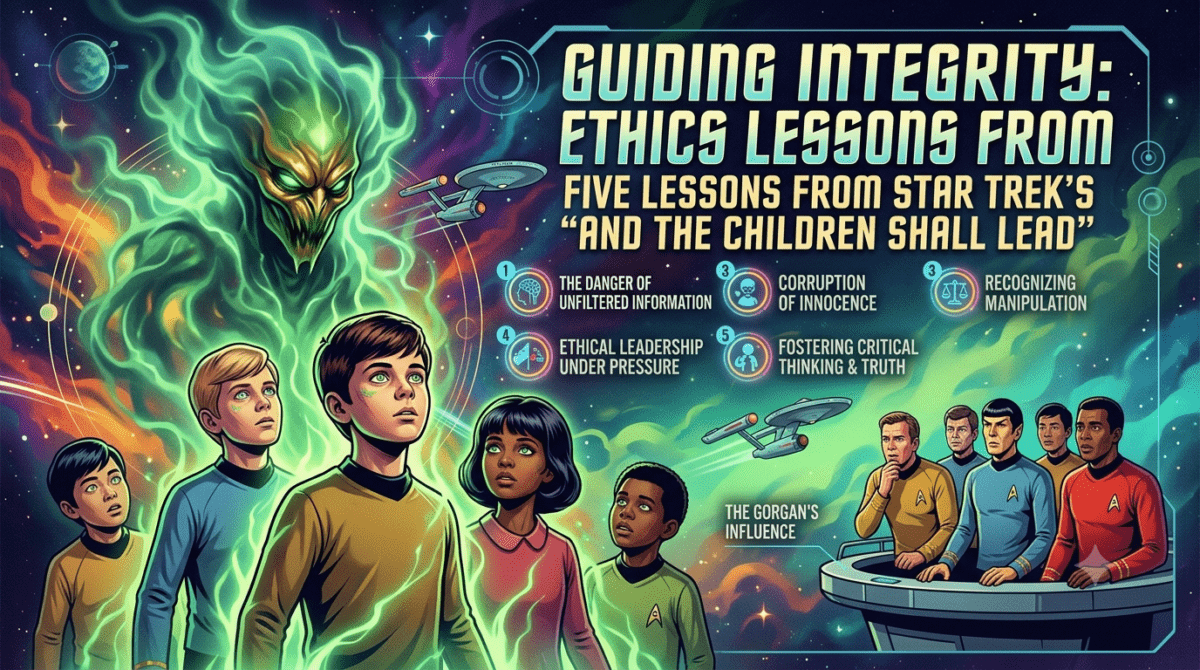
Guiding Integrity: Ethics Lessons from Star Trek’s ‘And The Children Shall Lead’

My winner for the worst of Star Trek: The Original Series is the episode “And the Children Shall Lead.” Yet there are clear ethical lessons, as the episode itself stands out for its disturbing exploration of power, manipulation, and ethical responsibility. Compliance professionals tasked with safeguarding their organizations from ethical lapses can draw powerful insights from this intriguing narrative. Today, we explore five key ethical lessons every compliance leader should internalize from this episode.

Lesson 1: Influence and Ethical Leadership

Illustrated by: The children aboard the Enterprise, manipulated by an alien entity known as Gorgan, exercise dangerous control over the crew, compelling them to abandon rational judgment.

Compliance Lesson: Leadership wields tremendous influence. Ethical leaders must recognize their power and consciously deploy it to uphold ethical standards rather than undermine them. A misuse of influence can erode trust and corrupt organizational culture. Ethical leadership requires self-awareness and a steadfast commitment to organizational values. Leaders who misuse their influence often set negative precedents, creating an environment where unethical behavior becomes normalized. Conversely, leaders who consistently demonstrate ethical decision-making inspire similar behavior in their teams, fostering a culture of integrity.

What can you do now? Ensure your leaders understand the impact of their actions. Implement regular leadership training focused on ethical decision-making and on raising awareness of how leaders’ actions affect company behavior and culture.

Lesson 2: Recognizing and Addressing Manipulation

Illustrated by: Kirk and Spock realize that the children’s unnatural behavior stems from external manipulation by Gorgan, who exploits their innocence and vulnerability for his gain.

Compliance Lesson: Organizations must be vigilant against manipulative practices. Ethical compliance involves recognizing manipulation, whether internal or external, and actively counteracting it to protect the organization’s integrity. Manipulation can manifest subtly through coercion, exploitation of vulnerabilities, or abuse of power dynamics. Compliance leaders must educate employees on the nuances of manipulation and how it undermines ethical practices, ultimately compromising organizational integrity. Early detection and proactive intervention are key to safeguarding the organization.

What can you do now? Develop training programs designed to empower employees to recognize and report manipulative behavior. Establish clear communication channels for safely and anonymously raising ethical concerns.

Lesson 3: Ethical Courage in Speaking Truth to Power

Illustrated by: Nurse Chapel and Captain Kirk courageously confront the children with the harsh truths about their manipulated behavior and its devastating consequences.

Compliance Lesson: Speaking truth to power, especially in ethical matters, requires considerable courage. Compliance leaders must foster environments where employees feel empowered to speak openly, even against popular opinion or powerful interests. It is crucial to establish a corporate culture that not only permits but actively encourages transparency and honesty. Compliance officers play a pivotal role in creating platforms where ethical concerns can be voiced without fear of retaliation. The ability to challenge unethical practices openly is essential for maintaining organizational integrity.

What can you do now? Create a robust whistleblower program that emphasizes protection and support for those who courageously voice ethical concerns. Celebrate instances where employees have demonstrated bravery in upholding ethical standards.

Lesson 4: Awareness of Ethical Blind Spots

Illustrated by: Initially, the Enterprise crew underestimates the threat posed by the children, blinded by assumptions of innocence and vulnerability.

Compliance Lesson: Ethical blind spots often emerge from assumptions and biases. Organizations must cultivate awareness and self-reflection, understanding that ethical risks can arise unexpectedly from overlooked or underestimated sources. Blind spots can be particularly dangerous because they often remain invisible until significant damage occurs. Compliance teams must foster an environment of continuous vigilance, in which assumptions are routinely challenged, and biases are openly discussed and addressed. Training programs should incorporate scenario-based exercises to reveal hidden ethical vulnerabilities.

What can you do now? Conduct regular ethics risk assessments to uncover hidden vulnerabilities. Encourage ongoing discussions and training sessions about implicit biases, assumptions, and overlooked ethical threats within the organization.

Lesson 5: Responsibility and Accountability in Ethics

Illustrated by: After breaking Gorgan’s hold, Kirk ensures that the children confront and understand the severity of their actions, instilling a crucial sense of accountability.

Compliance Lesson: Ethical accountability must permeate all organizational levels. Leaders and employees alike should clearly understand their responsibilities and the consequences of unethical behavior. Accountability ensures that ethical standards are consistently upheld and that violations are promptly and appropriately addressed. Leaders must make it clear that ethical breaches will have real and proportionate consequences, reinforcing the importance of personal and organizational integrity. Accountability measures help maintain trust within and outside the organization.

What can you do now? Establish transparent accountability systems that reinforce individual and collective responsibility for ethical behavior. Regularly communicate the importance of ethical accountability and the organizational commitment to enforce ethical standards uniformly.

You Must Lead With Ethics

“And The Children Shall Lead” reminds compliance professionals that ethical vigilance and leadership are essential for organizational health. Through ethical influence, courageous confrontation of manipulation, awareness of blind spots, and unwavering accountability, organizations can protect their integrity and thrive.

Compliance professionals must continually embody these lessons, creating robust ethical cultures that are resilient against manipulation, corruption, and ethical lapses. Let the lessons of the Enterprise crew guide us, fostering environments where integrity leads, and compliance thrives.

Resources:

⁠⁠Excruciatingly Detailed Plot Summary by Eric W. Weisstein⁠⁠

⁠⁠MissionLogPodcast.com⁠⁠

⁠⁠Memory Alpha

Categories
Blog

Connected Compliance: Part 3 – Why Every Investigation Is a Culture Opportunity for Your Organization

An effective compliance program is not a collection of disconnected policies, training modules, hotline reports, and investigation files. It is an operating system. Culture determines whether employees will use it. Risk assessment tells the organization where it must adapt. Investigations test whether the system responds credibly. Whistleblower programs reveal whether employees trust it enough to speak. In Blog 1, we examined communication as a compliance control. In Blog Post 2, we showed how those communications and other operational signals create a dynamic risk radar. Today in Blog Post 3, we ask what happens when a signal becomes an allegation as an introduction to how and why every investigation can be an opportunity to both pressure-test and build out your culture.

A hotline report, audit exception, control override, manager escalation, or unusual transaction may begin as just another compliance signal; once the company decides it requires investigation, the stakes change. The organization must establish what happened, protect people and evidence, make defensible decisions, and strengthen the program.

That makes an investigation more than a fact-finding exercise. It is a visible test of governance. Employees watch who is interviewed, how leaders behave, whether the process appears fair, whether high performers receive special treatment, and whether the company acts when misconduct is substantiated. Details should remain confidential, but the organization cannot erase the cultural impact. Every investigation sends a message.

Credibility Is Built Before the First Interview

The strongest investigations begin with disciplined triage. Before scheduling interviews or collecting data, the company should first identify the immediate risks that require action. Is anyone’s health or safety at risk? Could misconduct be continuing? Is evidence vulnerable? Does the allegation implicate financial reporting, government contracting, sanctions, corruption, product integrity, cybersecurity, privacy, or another obligation requiring prompt escalation?

Containment is not a conclusion. Suspending access, preserving records, pausing a payment, separating employees, or protecting a reporter may be necessary while the facts remain unresolved. The decision should be proportionate, documented, and revisited as evidence develops.

Triage should identify the functions that need to participate without turning the matter into a committee project. One person should own the process, one decision-maker should approve material scope changes, and communication lines should be defined at the outset.

What the DOJ Is Really Asking

The Department of Justice (DOJ) places investigations squarely inside its test of program effectiveness. The 2024 Evaluation of Corporate Compliance Programs (ECCP) asks, “How does the company ensure that investigations are properly scoped?” It then asks what steps the company takes to ensure investigations are “independent, objective, appropriately conducted, and properly documented,” as well as how the company determines who should conduct an investigation.

Those words provide a practical quality standard. Proper scope means the investigation addresses the allegation and reasonably connected issues without drifting into an unlimited inquiry. Independence means the investigator is free from conflicts and improper business pressure. Objectivity requires a search for facts that may confirm or disprove the allegation. Appropriate conduct includes lawful evidence collection, fair treatment of witnesses, and proportionate methods. Proper documentation allows the company to explain what it did, why it did it, and how it reached its conclusions.

DOJ also asks whether the company applies timing metrics, monitors outcomes, and ensures accountability for findings and recommendations. Later, the ECCP describes a working program as having an “appropriately funded mechanism for the timely and thorough investigations” of allegations or suspicions of misconduct. The point is not speed at any cost. It is disciplined responsiveness supported by adequate resources.

Scope the Question, Not the Desired Answer

A written investigation plan should define the allegation, relevant policy or legal issues, time period, business units, people, data sources, immediate risks, and proposed work. It should identify the standard used to reach findings and the expected form of the report. It should also record what remains outside scope.

The plan must be flexible. Evidence may reveal additional conduct, another geography, a control failure, or management involvement. The investigator should document the new information, assess its materiality, identify any additional resources or conflicts, and obtain appropriate approval for expansion.

This discipline prevents a scope narrowed to contain the issue and investigation drift that delays a conclusion. A credible process follows the evidence while preserving a clear line of sight to the original allegation.

Choose the Investigator for the Risk

Not every matter requires outside counsel, and not every matter should remain inside the company. The choice should turn on credibility and capability, not habit. Internal investigators may understand the business and manage routine matters efficiently. External counsel or specialists may be appropriate when allegations involve senior leadership, significant legal exposure, government reporting, material financial impact, technical evidence, cross-border restrictions, litigation, or concerns about internal independence.

The company should establish decision criteria before a crisis. Who determines whether compliance, legal, human resources, internal audit, security, or outside counsel will lead? What conflicts require recusal? When does the audit committee or another independent authority oversee the matter? Which technical experts may be needed, and how will their work be directed? An outside law firm’s letterhead does not create independence. It comes from clear authority, freedom from interference, sufficient resources, access to evidence, and an escalation route when investigators encounter resistance.

Protect the Privilege with Precision

The attorney-client privilege can protect confidential communications seeking or providing legal advice, but an investigation is not privileged simply because a lawyer attends. Privilege rules are jurisdiction-specific, and careless circulation, unclear roles, or unnecessary third-party involvement can create risk.

At the beginning, counsel should define the legal purpose, identify the client and team, establish communication and documentation protocols, and explain confidentiality expectations. Team members should know which communications seek legal advice, where documents will be stored, and who may receive them. Over-labeling every document as privileged does not create stronger protection. It can undermine discipline and complicate later disclosure decisions. The better approach is to use privilege deliberately, involve counsel where legal advice is genuinely required, and preserve a reliable factual record that supports the company’s decisions.

Treat Witnesses as People, Not Evidence Containers

Witness interviews often determine whether employees experience the investigation as fair. The investigator should explain the purpose of the interview, the investigator’s role, expectations for truthful cooperation, applicable confidentiality limits, and the company’s prohibition against retaliation. The interviewer should not promise complete secrecy, prejudge the allegation, coach testimony, or imply that raising concerns created the problem.

Respect improves evidence quality. Employees are more likely to provide complete information when questions are neutral, and the interviewer listens before challenging inconsistencies. Cultural, language, disability, and power dynamics may affect participation and should be addressed thoughtfully.

Anti-retaliation protection requires more than an opening statement. Compliance and human resources should identify foreseeable risks of retaliation, monitor employment actions and workplace behavior, provide a safe escalation channel, and respond quickly to concerns. Retaliation may be subtle: exclusion, schedule changes, lost opportunities, hostile supervision, or reputational harm. A technically sound investigation can still damage culture if the reporter or witnesses pay a price for participating.

Preserve Evidence and Measure the Right Clock

Evidence management must begin early. Relevant emails, collaboration messages, mobile communications, transaction records, system logs, personnel documents, and physical evidence all require preservation. Collection should follow applicable law, privacy requirements, company policy, and forensic protocols. The team should document sources, custodians, dates, gaps, and chain of custody where necessary. Always remember the first question the DOJ will ask after you self-disclose is, “Do you have the documents tied down? ”

Timeliness should be measured, but the metric must support quality. Useful measures include time from intake to triage, time to investigator assignment, aging by risk category, days awaiting business action, time from finding to remediation, and overdue reporter updates. A single average completion target can create pressure to close simple matters quickly or rush complex ones. Status reviews should ask what is delaying the matter, whether scope remains appropriate, whether interim protections still work, and whether new risks require escalation. The objective is a process that explains delay, removes bottlenecks, and prioritizes higher-consequence matters.

Move Beyond the Bad Actor

An investigation that identifies who violated a policy but not why the system allowed it has completed only half the work. DOJ asks whether investigations identify “root causes, system vulnerabilities, and accountability lapses,” including those involving supervisors and senior executives.

Root-cause analysis should examine incentives, performance pressure, control design, access rights, training, supervision, third-party oversight, data availability, prior warnings, and the consistency of discipline. Did the policy prohibit the conduct but the workflow reward it? Did a manager ignore a red flag? Did an exception process become the normal process? Did earlier reports reveal the same weakness?

The answer should drive remediation, including discipline, control redesign, policy revision, monitoring, training, leadership changes, third-party action, disclosure, or resource reallocation. Each action needs an owner, deadline, evidence, and testing. Otherwise, the investigation becomes a historical record rather than a compliance control.

Close the Case and the Cultural Loop

A reasoned closure record should state the allegation, scope, steps taken, evidence considered, credibility analysis, findings, and approved response. Discipline should be consistent across ranks and levels of commercial importance, with deviations documented. Investigation data should then feed the risk assessment, training plan, control testing, and management reporting.

The reporting party also matters. Without disclosing confidential personnel information, the company can acknowledge that the review is complete, thank the person for speaking up, restate anti-retaliation protections, and provide a contact for further concerns. Silence after intake encourages employees to conclude that nothing happened.

This is the connection across the series. Communication brings information into the program. Dynamic risk assessment helps the company recognize its significance. Investigation converts allegations into facts, accountability, and learning. Therefore, join us for Part 4 tomorrow, as we will demonstrate the front door to that process: how an effective whistleblower program gives employees safe, accessible ways to report and confidence that speaking up will lead to credible follow-through.

Bonus Questions for Compliance Professionals

  1. Who has authority to triage an allegation and order immediate containment or preservation measures?
  2. What written criteria determine who should lead an investigation and when independent oversight or outside counsel is required?
  3. Can the company show that recent investigations were properly scoped, independent, objective, timely, and documented?
  4. Which stages of the investigation create the greatest delays, and are those delays risk-based or simply unmanaged?
  5. How does the organization monitor subtle retaliation against reporters and witnesses?
  6. Do investigation reports identify control failures, incentives, supervisory accountability, and root causes in addition to individual misconduct?
  7. What evidence shows that completed investigations changed controls, training, discipline, resources, or risk assessment?
  8. How does the company communicate appropriate closure to reporters without compromising confidentiality?
Categories
Innovation in Compliance

Innovation in Compliance: Compliance Evangelists Fighting Modern Slavery Together with Matt Friedman

Innovation comes in many areas, and compliance professionals need to not only be ready for it but also embrace it. Join Tom Fox, the Voice of Compliance, as he visits with top innovative minds, thinkers, and creators in the award-winning Innovation in Compliance podcast. In this episode, host Tom Fox visits with Matt Friedman, who provides a 2026 update to the fight against the international scourge of human trafficking and modern slavery and discusses his latest book, Awakening the Advocate.

Friedman is a leading voice in the fight against human trafficking and modern slavery, known for founding and leading the Mekong Club and for more than 35 years of advocacy, policy work, and corporate engagement. He views modern slavery as a vast, still underaddressed crisis, where tens of millions remain trapped while the number of survivors helped and criminals convicted remains far too small to match the scale of the problem. Friedman believes the biggest barrier is not compassion but awareness and that educating employees inside companies can “wake up” lawyers, bankers, marketers, and other professionals who already have the instincts to help. From his perspective, ESG and compliance efforts can protect the business while also driving meaningful anti-slavery action, making corporate compliance a practical engine for both risk reduction and social change.

Key highlights:

  • Compliance Evangelists Fighting Modern Slavery Together
  • Leadership Briefings and Procurement Risk Assessments
  • Board-Level Awareness Protects Reputation and Brand Value
  • AI sifting data to uncover scam-center patterns
  • Modern Slavery Risks Make ESG’s Future Uncertain

Resources:

Matt Friedman on LinkedIn

The Mekong Club

Awakening the Advocate on Amazon.com

Innovation in Compliance was recently honored as the Number 4 podcast in Risk Management by 1,000,000 Podcasts.

Categories
Daily Compliance News

Daily Compliance News: July 28, 2026, The Chirayu Rana Amps It Up Edition

Welcome to the Daily Compliance News. Each day, Tom Fox, the Voice of Compliance, brings you compliance-related stories to start your day. Sit back, enjoy a cup of morning coffee, and listen in to the Daily Compliance News. All from the Compliance Podcast Network. Each day, we consider four stories from the business world, compliance, ethics, risk management, leadership, or general interest for the compliance professional.

Top stories include:

  • Philippine President to address corruption scandal. (ABC News)
  • The secret deal for Meta’s mega-data center in LA. (NYT)
  • Chirayu Rana amps it up against JPMorgan. (WSJ)
  • Trump learns yet again that only Congress has the power to tax. (Reuters)

To learn about the intersection of Sherlock Holmes and the modern compliance professional, check out Tom’s latest book, The Game is Afoot-What Sherlock Holmes Teaches About Risk, Ethics and Investigations on Amazon.com.

Categories
Trekking Through Compliance

Trekking Through Compliance: Episode 58 – Leadership & Tone from the Top Lessons from “The Paradise Syndrome”

Few Star Trek episodes put Captain Kirk in as vulnerable or as revealing a position as “The Paradise Syndrome.” What begins as a routine mission to deflect an asteroid from a primitive planet spirals down into an exploration of leadership, identity, and the power of influence from the very top. For corporate compliance professionals, this story is a masterclass in how tone from the top and authentic leadership can either protect or imperil an entire organization.

Join me as we step through the wormhole and extract five vital leadership lessons for the modern compliance officer, each illustrated by scenes from this unforgettable episode.

Lesson 1: Leadership Presence Is the First Line of Defense

Illustrated by: As soon as Kirk disappears, Spock and McCoy sense something is amiss. The crew is uneasy, decision-making becomes muddled, and a lack of clear command amplifies the mission’s urgency.

Compliance Lesson: The tone set by leadership isn’t just about lofty statements or annual memos. It’s a daily, lived presence.

Lesson 2: Values Must Be Internalized, Not Just Announced

Illustrated by: Despite not knowing who he is, Kirk’s instincts for fairness, curiosity, and protection shine through. He becomes a leader not by decree, but by action.

Compliance Lesson: True leadership is more than titles and speeches; it’s about internalized values that guide decisions, even under stress or uncertainty. Kirk’s ethical compass survives amnesia because it’s part of who he is.

Lesson 3: Crisis Reveals the True Tone from the Top

Illustrated by: Spock makes tough, sometimes unpopular decisions, including pushing the engines to dangerous limits.

Compliance Lesson: In a crisis, all eyes turn to leadership. How leaders act or fail to act under stress defines the tone from the top far more than any code of conduct. Spock’s resolve and willingness to make hard choices keep the crew focused on their mission, even as doubt and tension rise.

Lesson 4: Empathy and Communication Sustain Compliance

Illustrated by: While among the villagers, Kirk forms relationships based on empathy and service.

Compliance Lesson: Leadership is not just about command; it is about connection. In compliance, the ability to listen, understand, and respond to concerns is just as important as issuing directives. Empathy builds credibility and encourages a culture of speaking up, especially during times of change.

Lesson 5: Sustainable Culture Requires Both Structure and Spirit

Illustrated by: When Kirk finally regains his memory and identity, he is torn between his love for Miramanee and his duty to the Enterprise.

Compliance Lesson: Tone from the top is sustained not just by systems and controls but by the personal commitment of leaders to do what’s right, even when it’s difficult. The spirit of compliance must be aligned with the structure of compliance; one without the other is incomplete.

Final ComplianceLog Reflections

“The Paradise Syndrome” is a cautionary tale and an inspiration. When leadership vanishes, even temporarily, an organization’s values, direction, and resilience are put to the test. Kirk’s journey reminds us that leadership is not just about the title on the door but about daily actions, internalized values, and the ability to connect authentically with those you lead.

Resources:

⁠⁠Excruciatingly Detailed Plot Summary by Eric W. Weisstein⁠⁠

⁠⁠MissionLogPodcast.com⁠⁠

⁠⁠Memory Alpha

Fiona is an AI-generated voice

Categories
AI Today in 5

AI Today in 5: July 28, 2026, The Cheaper Way Edition

Welcome to AI Today in 5, the newest addition to the Compliance Podcast Network. Each day, Tom Fox will bring you 5 stories about AI to start your day. Sit back, enjoy a cup of morning coffee, and listen in to AI Today in 5. All from the Compliance Podcast Network. Each day, we consider five stories from the business world, compliance, ethics, risk management, leadership, or general interest about AI.

Top AI stories include:

  1. Microsoft unveils new cybersecurity tools. (NYT)
  2. Using traditional legal frameworks to regulate AI. (Reuters)
  3. AI to help in chronic disease research. (HealthcareITNews)
  4. HSBC opens AI center of excellence. (FinTechGlobal)
  5. A cheaper way to use AI in Main Street banks. (WSJ)

For more information on the use of AI in compliance programs, Tom Fox’s new book, Upping Your Game, is available. You can purchase a copy of the book on ⁠Amazon.com⁠.

To learn about the intersection of Sherlock Holmes and the modern compliance professional, check out Tom’s latest book, The Game is Afoot-What Sherlock Holmes Teaches About Risk, Ethics and Investigations on ⁠Amazon.com⁠.

Categories
Blog

Lost Among the Stars: Leadership & Tone from the Top Lessons from Star Trek’s “The Paradise Syndrome”

Few Star Trek episodes put Captain Kirk in as vulnerable or as revealing a position as “The Paradise Syndrome.” What begins as a routine mission to deflect an asteroid from a primitive planet spirals down into an exploration of leadership, identity, and the power of influence from the very top. For corporate compliance professionals, this story is a masterclass in how tone from the top and authentic leadership can either protect or imperil an entire organization.

In “The Paradise Syndrome,” the Enterprise crew is faced not only with a ticking clock but also with the absence of their leader. As Kirk loses his memory and is separated from his command, Spock, McCoy, and the rest must navigate the crisis without the guiding presence that usually sets the tone. What unfolds is a powerful lesson in why leadership and the values it projects matter more than any written policy or technology.

With Kirk’s leadership removed at the most critical moment, we see the cascading impact on the crew, on the planet, and on Kirk himself. This scenario, while fantastical, is a perfect metaphor for what happens in organizations when the tone from the top is unclear, inconsistent, or simply absent.

Join me as we step through the wormhole and extract five vital leadership lessons for the modern compliance officer, each illustrated by scenes from this unforgettable episode.

Lesson 1: Leadership Presence Is the First Line of Defense

Illustrated by: As soon as Kirk disappears, Spock and McCoy sense something is amiss. The crew is uneasy, decision-making becomes muddled, and a lack of clear command amplifies the mission’s urgency.

Compliance Lesson: The tone set by leadership isn’t just about lofty statements or annual memos. It’s a daily, lived presence. When leadership is visible, engaged, and available, the organization operates with clarity and confidence. When it is absent, even for a short time, uncertainty fills the vacuum, and risk increases.

What should I do? For compliance professionals, this means that leadership must be front and center, not just when things go wrong, but in the rhythms of daily business. Leaders should participate in training, be present in investigations, and visibly support the compliance function. A leader’s consistent presence sends the strongest possible message: compliance matters here.

Lesson 2: Values Must Be Internalized, Not Just Announced

Illustrated by: Stripped of his memory, Kirk (as “Kirok”) is taken in by the planet’s people. Despite not knowing who he is, his instincts for fairness, curiosity, and protection shine through. He becomes a leader not by decree, but by action.

Compliance Lesson: True leadership is more than titles and speeches; it’s about internalized values that guide decisions, even under stress or uncertainty. Kirk’s ethical compass survives amnesia because it’s part of who he is.

What should I do? Corporate values, particularly those related to ethics and compliance, must be deeply ingrained in the organization. Training and messaging must move beyond checklists to foster genuine understanding and belief. When faced with unexpected challenges or moral dilemmas, employees should be able to act based on these internalized values, even if the “playbook” is missing. Compliance professionals should focus on culture-building, rather than just disseminating policies.

Lesson 3: Crisis Reveals the True Tone from the Top

Illustrated by: Spock, now in command, faces a daunting technical challenge with limited time and resources. He makes tough, sometimes unpopular decisions, including pushing the engines to dangerous limits. McCoy protests, but Spock remains steadfast, demonstrating calm under pressure.

Compliance Lesson: In a crisis, all eyes turn to leadership. How leaders act or fail to act under stress defines the tone from the top far more than any code of conduct. Spock’s resolve and willingness to make hard choices keep the crew focused on their mission, even as doubt and tension rise.

What should I do? Compliance leaders should prepare for the inevitable crisis by building trust, communicating transparently, and showing willingness to take responsibility. When employees see leadership confronting difficulties head-on, they are more likely to follow suit. Tabletop exercises and crisis simulations should always include a tone-from-the-top component. How will leadership communicate? How will they reinforce values under pressure?

Lesson 4: Empathy and Communication Sustain Compliance

Illustrated by: While among the villagers, Kirk forms relationships based on empathy and service. He marries Miramanee, helps heal a sick child, and supports his new community. Even without his identity, he inspires trust through the way he listens to and responds to those around him.

Compliance Lesson: Leadership is not just about command; it is about connection. In compliance, the ability to listen, understand, and respond to concerns is just as important as issuing directives. Empathy fosters credibility and promotes a culture of speaking up, particularly during times of change.

What should I do? Compliance officers should foster open-door environments where employees feel comfortable sharing concerns and asking questions. Leaders should model humility and emotional intelligence, admitting when they don’t have all the answers. In the modern workplace, psychological safety is an essential component of tone from the top.

Lesson 5: Sustainable Culture Requires Both Structure and Spirit

Illustrated by: When Kirk finally regains his memory and identity, he is torn between his love for Miramanee and his duty to the Enterprise. The heartbreak of leaving behind his new life underscores that authentic leadership often requires personal sacrifice for the greater good.

Compliance Lesson: Tone from the top is sustained not just by systems and controls but by the personal commitment of leaders to do what’s right, even when it’s difficult. The spirit of compliance must be aligned with the structure of compliance; one without the other is incomplete.

What should I do? Senior leaders and compliance professionals must demonstrate their commitment through both words and deeds. This may involve making tough decisions, investing resources, or prioritizing compliance over short-term gains. By modeling this balance, leadership sets the foundation for a culture that endures, regardless of who is at the helm.

Final ComplianceLog Reflections

“The Paradise Syndrome” is a cautionary tale and an inspiration. When leadership vanishes, even temporarily, an organization’s values, direction, and resilience are put to the test. Kirk’s journey reminds us that leadership is not just about the title on the door but about daily actions, internalized values, and the ability to connect authentically with those you lead. By embracing these lessons, compliance officers and business leaders alike can build organizations that thrive not just in paradise but in any storm the universe throws their way.

Resources:

⁠⁠Excruciatingly Detailed Plot Summary by Eric W. Weisstein⁠⁠

⁠⁠MissionLogPodcast.com⁠⁠

⁠⁠Memory Alpha

Categories
Blog

Connected Compliance: Part 2 – From Risk Register to Risk Radar

An effective compliance program is not a collection of disconnected policies, training modules, hotline reports, and investigation files. It is an operating system. Culture determines whether employees will use it. Risk assessment tells the organization where it must adapt. Investigations test whether the system responds credibly. Whistleblower programs reveal whether employees trust it enough to speak. Blog 1 examined communication as the control that connects those elements. In this Part 2, we examine what compliance must do with the intelligence that communication produces.

The traditional risk assessment was built for a world that moved more slowly. Compliance gathered a group of leaders, reviewed enforcement trends, scored familiar risks, produced a heat map, and returned to the exercise the following year. That process still has value, but it is no longer enough.

Today, a new market restriction, customer demand, artificial intelligence deployment, supply-chain disruption, sanctions measure, or data rule can alter the company’s risk profile before the annual plan is approved. The central question is therefore not whether the organization has a risk register. It is whether compliance has a risk radar that can detect change, decide what matters, assign ownership, and translate the signal into action.

Every Compliance Risk Has a Political Dimension

Compliance obligations do not develop in a vacuum. They reflect choices made by governments about national security, trade, technology, labor, privacy, corruption, competition, and corporate accountability. For a multinational company, those choices may conflict, overlap, or change with little notice. Particularly in this political age, the single most-used byword is volatility.

That makes geopolitical awareness a compliance capability. It does not require the CCO to become a foreign-policy analyst. It requires the compliance function to understand how political priorities can become legal obligations, enforcement pressure, customer expectations, or operational constraints. Export controls can reshape product access. Sanctions can alter payment and counterparty risk. Forced-labor requirements can reach deep into a supply chain. AI rules can change how a business collects data, develops products, and makes decisions.

The practical lesson is that legal change is often the last stage in a longer policy development process. Compliance should monitor the earlier signals: legislative proposals, agency speeches, enforcement patterns, trade measures, customer questions, supplier difficulties, and operational workarounds. These indicators do not all demand a program change, but they should enter a disciplined triage process.

What the DOJ Is Really Asking

The Department of Justice has made dynamic risk assessment part of the effectiveness inquiry. The 2024 Evaluation of Corporate Compliance Programs (ECCP) directs prosecutors to consider “emerging risks as internal and external circumstances impacting the company’s risk profile evolve.” This risk profile can change due to factors outside a company’s control or its own business decisions. Moreover, the ECCP language moves risk assessment beyond a scheduled document and into continuous management.

DOJ then asks: “Is the company’s approach to risk management proactive or reactive?” The distinction is critical. A reactive program updates controls after a failure, enforcement action, or audit finding. A proactive program uses operational information across functions to identify change before misconduct occurs. The ECCP also asks whether periodic review is merely a point-in-time exercise or draws on continuing access to operational data, and whether the results lead to updates in policies, procedures, and controls.

The enforcement question is not whether the company predicted every development. No program can. The question is whether the company had a reasonable process for identifying material changes, directing resources to higher-risk areas, documenting its decisions, and revising the program over time.

Build the Risk Radar From Multiple Signals

A dynamic risk process begins with a wider field of vision. Regulatory alerts and outside counsel updates are useful, but they show only part of the environment. Some of the earliest warnings come from inside the business. Sales may see unusual customer demands in a new market. Procurement may find suppliers unable to provide origin information. Finance may identify payment routes that no longer fit the expected transaction. Information security may discover employees using unapproved AI tools. Human resources may raise concerns about retaliation or pressure related to performance targets. Audit may identify recurring exceptions. Hotline reports and investigations may reveal a pattern that a heat map missed.

Compliance should bring these signals together through a repeatable cadence. A quarterly cross-functional review can examine changes in the business model, geography, products, third parties, technology, enforcement, and employee concerns. High-velocity risks may require monthly or event-driven review. The objective is not to create another committee. It is to establish a reliable place where weak signals are compared, challenged, and assigned.

Or simply look at the changes wrought by the Trump Administration in 2026 alone. Venezuela is now open for business. How about the Democratic Republic of Congo? See here and here. Of course there is Iran, but you have to ask what week it is and are we doing business with Iran or are we at war with Iran.

Give One Person the Clock

Emerging risks often fall between organizational boxes. Legal understands the rule. Compliance sees the control issue. Operations owns the process. Procurement controls the supplier relationship. Technology owns the system. To use a well-worn maxim, if everyone is in charge, no one is in charge. In the corporate world, when everyone is generally responsible, no one is specifically accountable. This is both why and where compliance needs to step up its game.

Every material risk needs a named owner with the authority to convene the necessary functions, set deadlines, escalate disagreements, and report on the disposition. That person does not perform every task. The owner keeps the clock, maintains the decision record, and ensures that the issue does not disappear between meetings.

Governance should also define escalation triggers. A credible framework identifies which developments require immediate executive attention, which can be handled through a working group, and which should remain under observation. Without thresholds, organizations either under-escalate material risk or flood leadership with undeveloped issues.

Use a Two-Speed Assessment

Not every signal requires an enterprise-wide risk assessment. Compliance needs two speeds. The first is rapid triage. A small group of subject-matter experts identifies the potential legal obligation, affected operations, time horizon, severity, available data, current controls, and immediate containment needs. This is where AI can play a key role in compliance, essentially superforecasting risks to enable quick, efficient risk management strategies when volatility hits. Additionally, such an approach may lead to a decision to monitor, take interim action, or launch a deeper review.

The second is formal assessment. Complex or high-impact risks may require structured interviews, data analysis, control testing, external counsel, forensic support, or scenario planning. The deeper process should be proportionate to the exposure, not triggered simply because the issue is new. This two-speed model protects agility without sacrificing rigor. It also creates evidence that the company made a reasoned decision. A short written triage record can show what information was considered, who participated, why the company chose its response, and when the issue will be reviewed again.

Convert Assessment Into Real Controls

The most common failure is not the inability to identify risk. It is the failure to convert assessment into a viable risk management strategy and then to implement, monitor, and improve your business operations. A new questionnaire, certification, or policy may create documentation, but documentation alone does not mitigate the underlying exposure.

Consider third-party risk. A supplier questionnaire can identify missing information, but the control lies in what happens next: enhanced diligence, contractual protection, source verification, payment restrictions, audit rights, monitoring, remediation, or a decision not to proceed. The same principle applies to AI. An AI-use policy matters, but effective governance also requires an inventory of use cases, approval gates, data controls, human oversight, testing, monitoring, and accountability.

Each response should identify the control objective, owner, implementation date, evidence, and testing method. Compliance should also ask what existing control can be adapted before building a separate program. Strong governance, escalation, training, data access, and investigation processes are reusable infrastructure across risk domains.

Resource allocation is part of that conversion. If a changing risk profile calls for deeper third-party monitoring, faster export review, or additional AI oversight, the organization must decide what people, technology, and budget will support the response. Compliance cannot claim to be risk-based when yesterday’s priorities continue to dictate today’s resources. The allocation decision, including any accepted constraint, should be visible and documented.

Treat Change Management as a Control

A technically correct response can still fail if employees do not understand it or the business cannot implement it. New requirements frequently collide with established incentives, systems, customer commitments, and local practice. Change management should therefore be part of the control design. Explain why the risk changed. Identify which decisions and workflows are affected. Train the employees and gatekeepers who must act differently. Provide a practical escalation route. Test understanding. Gather feedback. Then revise the process when implementation exposes friction or unintended consequences. For a full discussion of change management as a compliance control, listen to the podcast Ronnie Feldman and I did with Caveni Wong on this episode of Creativity and Compliance.

This is where blog post 1’s communication discipline comes into play. Compliance cannot adapt to risk through broadcast messages alone. It needs a two-way channel that tells employees what changed and tells compliance whether the response works in practice.

Measure Adaptation, Not Activity

The number of risk meetings or completed assessments says little about effectiveness. Better measures test whether the organization moves from signal to decision and from decision to control. Useful indicators include the time required to triage a material development, percentage of actions with named owners and deadlines, overdue remediation, control implementation and testing results, repeat exceptions, unresolved ownership disputes, and lessons incorporated from investigations.

Compliance should also examine whether resources shifted when risk shifted. A program that identifies a higher risk but leaves staffing, monitoring, and controls unchanged has produced analysis without management. The result should be a closed loop: detect, assess, assign, mitigate, test, and learn. That loop turns risk assessment from an annual artifact into a management process.

That transition is where program credibility is tested. Join us tomorrow as we consider how organizations scope investigations, preserve independence, establish consistency, document decisions, and convert findings into remediation. A dynamic risk process helps the company see the signal. A credible investigation determines what happened and what the organization must do next.

Bonus Questions for Compliance Professionals

  1. Which internal and external signals can change the company’s risk profile between formal assessments?
  2. Who has specific ownership for emerging risks that cross legal, compliance, operations, procurement, finance, and technology?
  3. What criteria determine whether an issue is monitored, triaged, escalated, or formally assessed?
  4. Can the company show how a recent risk assessment changed a policy, control, resource allocation, or business decision?
  5. Do substantive mitigation and ongoing monitoring support questionnaires and certifications?
  6. How quickly can the organization move from a weak signal to a documented decision?
  7. What recent investigation finding should change the current risk assessment?
Categories
FCPA Compliance Report

FCPA Compliance Report: The Business Case for Going Back into Venezuela with Loren Steffy

Welcome to the award-winning FCPA Compliance Report, the longest-running podcast in compliance. In this episode, Tom welcomes back former Houston Chronicle business columnist Loren Steffy to discuss the business aspects of returning to Venezuela.

Loren Steffy has spent much of his career analyzing the energy industry and the challenges of oil and gas development. On Venezuela, he argues that Trump administration moves are unlikely to produce meaningful gains in oil output and are more likely to deepen market uncertainty, especially in West Texas. Steffy says Venezuela’s oil sector is effectively too risky and too unstable for major foreign investment because its infrastructure has deteriorated, its legal and political environment remains unclear, and rebuilding production would require major capital, advanced technology, and years of work. Even if some companies were willing to take a chance, he believes the combination of insecurity, weak rules, and Trump-era policy uncertainty makes a broad investment revival in Venezuela highly unlikely.

Resources:

Loren Steffy on LinkedIn

Stoney Creek Publishing

Tom Fox

Instagram

Facebook

YouTube

Twitter

LinkedIn

The FCPA Compliance Report was recently named the world’s Best Business Ethics Podcast by FeedSpot.

Categories
Blog

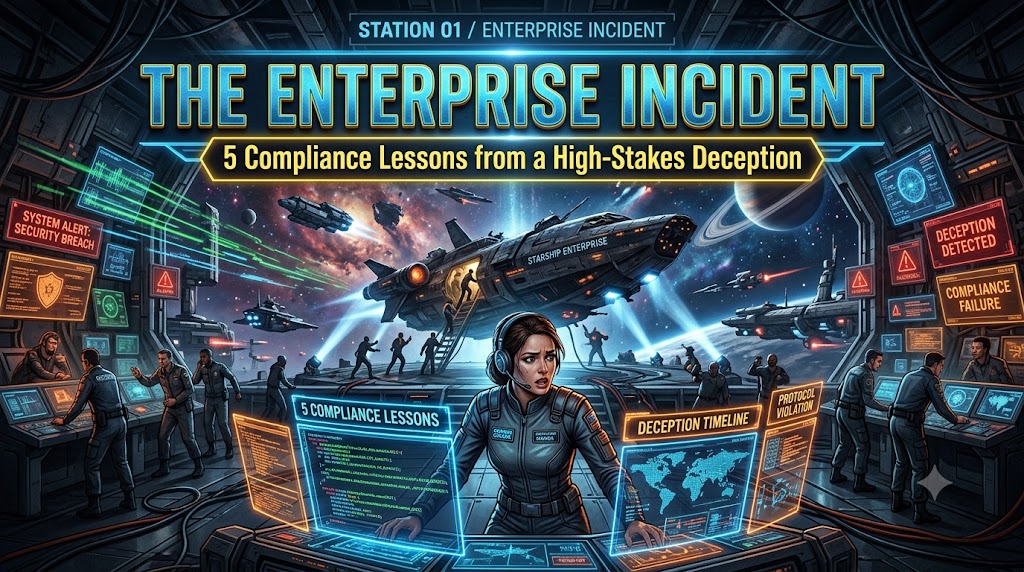
The Enterprise Incident: 5 Compliance Lessons from a High-Stakes Deception

In The Enterprise Incident, Captain Kirk appears to suffer a breakdown. He orders the USS Enterprise across the Neutral Zone and into Romulan territory, where three Romulan vessels immediately surround the ship. Kirk claims that a navigational error caused the incursion. Spock refuses to support that explanation. Instead, he testifies that Kirk has become irrational and is no longer fit for command. Dr. McCoy confirms the diagnosis. Kirk then appears to die after attacking Spock. Of course, none of this is what it seems.

Kirk, Spock, and McCoy are executing a classified Federation operation to steal a Romulan cloaking device. Kirk’s breakdown is staged. Spock’s betrayal is part of the plan. The supposed Vulcan death grip is a fiction. Kirk is surgically disguised as a Romulan, returns to the enemy vessel, steals the device, and escapes with the Enterprise.

The mission succeeds. Yet operational success does not necessarily establish that the underlying decisions were ethical, properly governed, or worth the risk. That tension makes The Enterprise Incident an outstanding study in compliance leadership. It presents five lessons for compliance professionals operating in high-pressure environments.

Lesson 1: Ethical Decision-Making Requires More Than Authorization

Kirk’s mission was not an impulsive act. He was operating under Federation orders. Nevertheless, the operation required deception, an illegal border crossing, theft of sensitive technology, and conduct that could have triggered an interstellar conflict. Authorization matters, but authorization alone does not resolve the ethical question.

Corporate misconduct is often defended with some variation of “senior management approved it” or “the business required it.” Those statements do not transform improper conduct into ethical conduct. They may instead reveal weaknesses in governance, escalation, and executive accountability.

Compliance leaders must ask whether a proposed course of action is consistent with the organization’s legal obligations, stated values, risk appetite, and long-term interests. They must also consider whether the action could withstand scrutiny from regulators, shareholders, employees, and the board. Under pressure, the temptation is to focus exclusively on the desired outcome. The stronger approach is to examine both the objective and the means used to achieve it.

A successful mission can still represent a governance failure. Compliance must help the organization distinguish between what it can do, what it should do, and what it must never do.

Lesson 2: Confidentiality Must Not Eliminate Accountability

The Enterprise crew succeeds because Kirk, Spock, McCoy, and Scotty understand their roles and trust one another. Within that small group, the plan is carefully coordinated. Outside the group, almost everyone is intentionally misled. This is a classic need-to-know operation. It also demonstrates the risk created when secrecy becomes a substitute for accountability.

Organizations sometimes need to restrict information. Internal investigations, acquisition discussions, government inquiries, cybersecurity incidents, and sensitive personnel matters all require confidentiality. The mistake is assuming that confidentiality means normal controls no longer apply. Even the most sensitive matter should have an accountable owner, defined decision rights, appropriate legal oversight, protected documentation, and a process for reporting to the board when necessary. Information may be limited, but accountability should remain clear.

This lesson is particularly important in internal investigations. An investigation may require discretion, but the organization must still preserve evidence, manage conflicts, document decisions, protect against retaliation, and identify who receives the findings. The key distinction is between controlled confidentiality and organizational opacity. Controlled confidentiality protects the integrity of the process. Opacity protects decision-makers from scrutiny. Trust among a small team is valuable. It is not a replacement for governance.

Lesson 3: Sensitive Technology Demands Controls Across Its Entire Lifecycle

The Romulan cloaking device is more than a valuable piece of equipment. It is strategically significant technology capable of changing the balance of power. The Enterprise crew focuses first on acquiring the device. Scotty must then integrate an unfamiliar piece of Romulan technology into the ship’s systems while the Enterprise is under attack. There is little time for testing, security review, or compatibility analysis.

Modern organizations face similar issues with artificial intelligence, source code, proprietary algorithms, customer data, trade secrets, surveillance tools, and cybersecurity capabilities. The risk does not begin or end with acquisition. It extends across the technology’s entire lifecycle. The cloaking device also raises a broader question: Just because technology can create a strategic advantage, should the organization deploy it immediately?

That question is central to AI governance. A new AI system may promise speed, efficiency, and competitive advantage. It may also create risks related to privacy, discrimination, intellectual property, cybersecurity, and regulatory compliance. The organization needs more than an enthusiastic business sponsor. It needs governance, testing, documentation, human oversight, and clear accountability. Innovation without controls creates unmanaged exposure. Controls without an understanding of the technology create false assurance.

Lesson 4: Regulatory and Geopolitical Risk Must Be Built into Strategy

The Neutral Zone is not simply a line on a star chart. It represents a legal, diplomatic, and military boundary. Crossing it creates consequences that extend far beyond the Enterprise. International businesses operate across their own versions of the Neutral Zone. These include anti-bribery laws, sanctions, export controls, data localization requirements, competition rules, human rights expectations, and restrictions on technology transfers.

A decision that appears commercially attractive in one jurisdiction may create serious exposure in another. A third party that looks essential to market access may present corruption or sanction risks. A technology transfer may implicate national security restrictions. A routine payment may become evidence of an improper inducement. Compliance cannot be brought in after the business has crossed the border.

The compliance function should participate in market-entry decisions, transactions, major technology transfers, and relationships involving government touchpoints. This requires more than maintaining a regulatory inventory. It requires understanding how legal, political, cultural, and enforcement risks affect business strategy. The Enterprise had only one hour to respond to the Romulan demand for surrender. Corporate leaders often face similar pressure, although usually without disruptor beams. The time to establish decision protocols is before the crisis begins.

Lesson 5: Compliance Should Enable Calculated Risk, Not Eliminate It

Stealing the cloaking device was extraordinarily risky. It also offered a significant strategic benefit. Starfleet decided that the potential value justified the exposure. Every organization takes risks. The purpose of compliance is not to eliminate risk or prevent innovation. It is to help the organization understand risk, evaluate it intelligently, establish limits, and make accountable decisions.

A calculated risk is not simply a dangerous decision that happens to succeed. It is a decision supported by reliable information, appropriate expertise, documented assumptions, mitigation measures, clear ownership, and contingency planning. The Enterprise mission depended on several assumptions. The Romulans had to accept Kirk’s apparent instability. The commander had to believe Spock’s betrayal. Kirk’s disguise had to work. Scotty had to integrate the cloaking.

Compliance adds value when it helps the business take better risks. That requires early engagement, commercial understanding, credible challenge, and a willingness to say no when the proposed conduct crosses a legal or ethical boundary.

Final Thoughts

The Enterprise Incident ends with the Enterprise escaping Romulan space under the protection of the stolen cloaking device. The operation succeeds because of extraordinary coordination, technical skill, and trust. Yet the episode leaves compliance professionals with a harder question: Was the mission properly governed, or was it simply successful?

That distinction matters. Results do not validate weak processes. Senior approval does not cure unethical conduct. Confidentiality does not remove accountability. Innovation does not override controls. Strategic pressure does not suspend legal obligations. The compliance professional’s role is to help the organization navigate those tensions before it enters the Neutral Zone.

The final compliance lesson from The Enterprise Incident is straightforward: Bold leadership may take the organization into uncertain territory, but effective compliance ensures that it does not cross the line without understanding what lies on the other side.

Resources:

Excruciatingly Detailed Plot Summary by Eric W. Weisstein
MissionLogPodcast.com

Memory Alpha