Categories
Blog

The NBA Betting Scandal: Part 2 – Prop Bets, Data Analytics, and Conflicted Interests

In Part 2 of our exploration of the NBA betting scandal, we consider one of the culprits: Prop Bets. However, we also consider the roles of the NBA’s sports betting partners in detecting suspicious activity that may flag the illegal release of information, and then explore whether the NBA’s financial ties to betting companies create an ethical conflict of interest eerily familiar to corporate compliance professionals.

Prop bets that began as an innovation to boost fan engagement have become a Trojan horse for corruption. Prop bets are wagers on specific player outcomes, like points scored or minutes played. Unfortunately, they have introduced a new form of insider trading into sports. And as the NBA, DraftKings, FanDuel, and ESPN Bet have learned the hard way, you cannot mix integrity and profit without a serious compliance framework in between.

The Prop Bet Problem

Traditional sports betting was straightforward: who wins, who loses, and by how much. But in today’s digital betting ecosystem, gamblers can place hundreds of micro-wagers per game;  on rebounds, turnovers, three-pointers, or even whether a player checks out early with an injury.

These “prop bets” (short for proposition bets) have become a massive driver of revenue. According to Silver Bulletin’s Nate Silver, player-specific prop bets now represent as much as 10–30% of total sportsbook activity, and they carry higher margins than traditional wagers because they’re marketed to casual fans, not professionals.

But with that innovation came a compliance nightmare. When Terry Rozier allegedly told a friend he’d fake an injury early in a March 2023 game, enabling insiders to bet the “under” on his scoring stats, he was not required to throw the entire game, and he arguably did not even affect the score. He only had to manipulate one statistic. That’s what makes prop bets so insidious: They make partial corruption profitable.

From a compliance perspective, this is micro-fraud. It is where individual actors exploit subcomponents of a larger system for localized gain. It’s the same logic behind an employee falsifying a single line item on an expense report or a trader front-running small transactions to avoid detection. As The New York Times’ David French warned, “Prop bets give the player absolute control over the outcome for many gamblers. Players can enrich themselves and their confederates — at least until they’re caught”. The result is a system in which the game’s integrity can be compromised without altering its final score.

How Sportsbooks Detect Suspicious Betting Patterns

To their credit, major sportsbooks like FanDuel, DraftKings, and BetMGM have built sophisticated monitoring systems to detect anomalies. These are the compliance analytics engines of the betting world.

Here is how they work and how they discovered the NBA scandal in the first place:

1. Data Aggregation and Pattern Recognition

Licensed sportsbooks collect vast amounts of betting data, literally down to timestamps, geolocations, and bet types. When dozens of bets suddenly target a specific player’s “under” statistics within minutes of tipoff, that’s a red flag. Nate Silver notes that these regulated sportsbooks have a “Know Your Customer” framework akin to AML rules. They know exactly who is betting and how much. This allows them to flag sudden spikes in specific markets or betting clusters linked by shared IP addresses or payment methods.

2. Odds Movement Analysis

Sophisticated betting algorithms continuously monitor line shifts. If insider information leaks,  such as a player’s plan to sit out, odds will move dramatically before official announcements. Sportsbooks cross-reference those shifts against bet timing to determine whether someone is acting on non-public information.

3. Regulator and League Reporting

When patterns suggest insider activity, sportsbooks are legally obligated to report suspicious behavior to state gaming commissions and, in this case, to the NBA’s integrity unit. That is exactly how the Rozier bets and before them, Jontay Porter’s suspicious unders, were first flagged.

Much like a financial institution’s Suspicious Activity Report (SAR) to the SEC or FinCEN, these alerts become the foundation for investigations. In both cases, data-driven compliance exposes behavior long before public whistleblowing ever could. But detection only works when the watchers are independent. And that’s where the NBA’s problem deepens.

The Conflict of Interest: When Integrity Is Also a Business Partner

The modern NBA is financially entangled with the very entities tasked with reporting its integrity breaches. FanDuel, DraftKings, and BetMGM are not simply sportsbooks. More importantly, they are official league partners. ESPN, now operating its own sportsbook, is simultaneously a rights holder and an integrity stakeholder.

That creates a textbook compliance conflict of interest.

  • The NBA profits directly from the volume of bets placed, even on the prop bets that compromise its credibility.
  • Sportsbooks rely on NBA data feeds and licensing deals worth millions, giving them a vested interest in maintaining the appearance of a “clean” market.
  • Broadcasters like ESPN and Turner promote betting lines in real time, normalizing gambling within the game narrative itself.

This convergence of profit and policing mirrors the very risks that Sarbanes-Oxley sought to eliminate in corporate America, when auditors and clients had overlapping interests, objectivity vanished. The same principle applies here; you cannot be both the regulator and the revenue partner. As The Athletic’s Eric Koreen observed, “The league is inextricably tied to the alleged behavior, tied as it is to its gambling partners”. And as compliance professionals know, perception of independence matters as much as actual independence. If the NBA’s integrity unit relies on the cooperation and financial goodwill of its betting partners, how impartial can its investigations truly be?

The Compliance Parallel: When Oversight Becomes Complicity

Corporate compliance officers will find this moment uncomfortably familiar. The NBA’s integrity dilemma is not unique. It is the same trap that financial institutions, energy conglomerates, and tech giants fall into when they mistake profitability for legitimacy. When the people tasked with monitoring the game for integrity are also profiting from it, compliance becomes theater.

For the NBA, the only way forward is to disentangle integrity from income. For corporate leaders, the lesson is the same: your monitoring function can’t share the same incentives as your money-makers. Whether it’s a boardroom or a basketball court, the rule never changes: you cannot bet on integrity if you are already gambling with it.

Join us tomorrow as we consider the history of basketball’s betting scandals and a few compliance lessons.

Categories
The Ethics Experts

Episode 233 – Michele Lee

In this episode of The Ethics Experts, Nick Gallo welcomes Michele Lee.

Michele C. Lee is a prominent figure in technology law, specializing in the intersection of online behavior and continually changing legal frameworks. Her expertise encompasses youth safety, privacy, artificial intelligence, and the evolving regulatory landscape governing online platforms.

Lee’s contributions have garnered significant recognition. She was distinguished as one of the “2023 Most Influential Women in Bay Area Business” by the San Francisco Business Times, honored as the “2020 Woman Leader in Tech Law” by The Recorder, and recognized as a “2021 Thought Leader” by Corporate Counsel’s Women, Influence, and Power in Law.

Connect with Michele on LinkedIn

Categories
FCPA Compliance Report

FCPA Compliance Report – The Importance of Outside Counsel in False Claims Act Investigations

In this episode, Tom Fox welcomes Arthur Gollwitzer from the law firm of Jackson Walker to discuss the merits of involving outside counsel in handling False Claims Act cases and the nuances of legal compliance. Arthur shares his experiences in avoiding and defending False Claims Act allegations, the significance of hiring specialized investigative counsel early, and the integrity and credibility required in investigative processes. He also offers insights on the implications of AI regulations in Texas, his time as an Assistant US Attorney in the Southern District of New York, and the honor of representing the United States in court.

Key highlights:

  • Discussing False Claims Act
  • Importance of Independent Investigations
  • Credibility in Legal Investigations
  • AI and Legal Implications
  • Experience in the Southern District of New York

Resources:

JacksonWalker

Arthur Gollwitzer on LinkedIn

Texas 89th Legislature: Key Artificial Intelligence Legislation

Tom Fox

Instagram

Facebook

YouTube

Twitter

LinkedIn

For more information on the use of AI in Compliance programs, my new book is Upping Your Game. You can purchase a copy of the book on Amazon.com.

Categories
AI Today in 5

AI Today in 5: October 27, 2025, The Trusting Your Eyes Edition

Welcome to AI Today in 5, the newest edition to the Compliance Podcast Network. Each day, Tom Fox will bring you 5 stories about AI to start your day. Sit back, enjoy a cup of morning coffee, and listen in to the AI Today In 5. All, from the Compliance Podcast Network. Each day, we consider four stories from the business world, compliance, ethics, risk management, leadership, or general interest about AI.

Top AI stories include:

  1. Can you trust your eyes? (FT)
  2. AI at the crossroads. (Cooley)
  3. AI hallucinations highlight the role of compliance. (CW)
  4. Businesses are now facing a plethora of AI laws. (Bloomberg Law)
  5. AI and your patent strategy. (Bloomberg Law)

For more information on the use of AI in Compliance programs, my new book, Upping Your Game, is available. You can purchase a copy of the book on Amazon.com.

Categories
Daily Compliance News

Daily Compliance News: October 27, 2025, The All FT Edition

Welcome to the Daily Compliance News. Each day, Tom Fox, the Voice of Compliance, brings you compliance-related stories to start your day. Sit back, enjoy a cup of morning coffee, and listen in to the Daily Compliance News. All, from the Compliance Podcast Network. Each day, we consider four stories from the business world, compliance, ethics, risk management, leadership, or general interest for the compliance professional.

Top stories include:

  • Uber, Veon whistleblower speaks. (FT)
  • Can you trust your eyes? (FT)
  • No more work emails with “!”. (FT)
  • CVC tax fraud rocks Spain’s PE sector. (FT)

The Daily Compliance News has been honored as the No. 2 in the Best Regulatory Compliance Podcasts category.

Categories
Compliance Tip of the Day

Compliance Tip of the Day – A Clash of Cultures

Welcome to “Compliance Tip of the Day,” the podcast that brings you daily insights and practical advice for navigating the ever-evolving landscape of compliance and regulatory requirements. Whether you’re a seasoned compliance professional or just starting your journey, we aim to provide you with bite-sized, actionable tips to help you stay on top of your compliance game. Join us as we explore the latest industry trends, share best practices, and demystify complex compliance issues to keep your organization on the right side of the law. Tune in daily for your dose of compliance wisdom, and let’s make compliance a little less daunting, one tip at a time.

This week, we consider communications in compliance. Today, we look at the merging of cultures as a merger or acquisition.

For more on this topic, check out The Compliance Handbook: A Guide to Operationalizing your Compliance Program, 6th edition, which LexisNexis recently released. It is available here.

Categories
Blog

The NBA Betting Scandal: Integrity Under Fire: Part 1 – Introduction

In the world of professional basketball, few things cut deeper than a betrayal of trust. Fans expect grit, competition, and authenticity, not a rigged game. Yet last week, the U.S. Department of Justice (DOJ) unsealed an Indictment that shook the National Basketball Association (NBA) to its core. Current and former NBA players, along with several associates, stand accused of running an insider-betting ring built on confidential medical and lineup information.

For compliance professionals, this is more than a sports story. It is a real-time case study in integrity risk, insider information abuse, and governance failure. It also demonstrates how arrogance, blindness, and even incompetence can blindside any organization. Over the next several blog posts, I will take a deep dive into not only who was involved and what they did, but also how the same ethical breakdowns that can corrupt a corporate organization found their way into America’s most celebrated sports league. (I am not sure how many posts I will have on this series.) Today, in Part 1, we introduce the players and allegations.

The Conspiracy

The indictment, unsealed in the Eastern District of New York, reads like the playbook of a financial fraud operation dressed up in jerseys. The six defendants. They include Eric Earnest, Marves Fairley, Shane Hennen, Damon Jones, Deniro Laster, and Terry Rozier, who are all charged with wire fraud conspiracy and money laundering conspiracy.

The scheme allegedly unfolded between December 2022 and March 2024, when the group exploited non-public NBA injury and lineup information to place fraudulent bets worth hundreds of thousands of dollars. They allegedly received insider tips directly from players and coaches, including Rozier and Jones, and then laundered the illicit profits through a web of intermediaries.

U.S. Attorney Joseph Nocella Jr. stated in the DOJ Press Release on the Indictment, “As alleged, the defendants turned professional basketball into a criminal betting operation, using private locker rooms and medical information to enrich themselves and cheat legitimate sportsbooks. This was a sophisticated conspiracy involving athletes, coaches, and intermediaries who exploited confidential information for profit.  Insider betting schemes erode the integrity of American sports, and this Office will continue in its strong tradition of holding accountable anyone who seeks to corrupt sports through illegal means.”

The Defendants — and Their Roles

Terry Rozier — “Scary Terry” Turns Scandalous

Known for his explosive play as a guard for the Charlotte Hornets, Rozier allegedly tipped off longtime friend Deniro Laster that he would exit a March 23, 2023, game early due to a “purported injury.” According to the indictment, Rozier gave this information specifically so that Laster could place bets on Rozier’s under” stats, predicting he would underperform.

Laster, Fairley, and others allegedly bet over $200,000 on the game using this insider knowledge. When Rozier exited after only nine minutes, the bets paid off handsomely. Laster then drove through the night to Rozier’s house, where they reportedly counted the profits together.

Damon Jones — From Coach to Co-Conspirator

Once a respected NBA player and later coach, Damon “D Jones” Jones allegedly became a hub for insider information. Prosecutors claim that on several occasions, Jones shared or sold confidential lineup and medical details, particularly concerning the Los Angeles Lakers,  to his co-conspirators. Two key examples cited occurred on February 9, 2023, and January 15, 2024, when Jones allegedly provided early medical information about Lakers star players, allowing others to place lucrative wagers before the news became public. For a league that prides itself on data transparency and player health disclosures, this allegation strikes at the heart of data governance,  an issue that corporate compliance officers know all too well.

Eric Earnest — The Middleman with a Coach’s Ear

At 53, Eric “Spook” Earnest was no athlete, but he allegedly wielded powerful connections. In one cited incident, Earnest received insider information from a friend, an NBA coach, who alerted him that several Portland Trail Blazers starters would sit out a March 24, 2023, matchup against the Chicago Bulls. Before that information went public, Fairley and his associates wagered over $100,000 against the Blazers. When the lineup was confirmed, the betting lines shifted dramatically, and the conspirators’ early bets cashed in.

Marves Fairley — The Fixer

Operating under nicknames like “Vezino” and “Vezino Locks,” Marves Fairley allegedly acted as both a bettor and a connector. He is accused of placing bets using information from multiple inside sources, including players with the Orlando Magic and the Toronto Raptors. On April 6, 2023, Fairley allegedly used information from an Orlando Magic player to learn that several top teammates would sit out a game against the Cleveland Cavaliers. Fairley bet approximately $11,000 on the Cavaliers to cover the spread, and when the Cavs won by 24, he pocketed the winnings.

Deniro Laster — The Courier

At age 30, Deniro “Niro” Laster allegedly served as a courier, moving cash, distributing tips, and laundering proceeds. He was reportedly Rozier’s point of contact in the infamous March 23 Hornets game and allegedly helped convert illicit betting profits into cash payments.

Shane Hennen — The Straw Bettor

Finally, Shane “Sugar” Hennen allegedly helped conceal the betting activity by using a network of straw bettors, placing wagers under different names to evade sportsbook compliance checks. He reportedly received inside information not only from Rozier and Jones, but also via secondary intermediaries, including Long Phi Pham, a previously convicted co-conspirator tied to former Raptors player Jontay Porter.

The Porter Connection: A Prequel to the Scandal

While not a named defendant in this indictment, Jontay Porter, formerly of the Toronto Raptors, looms large in the background. Porter had already pleaded guilty earlier in 2025 for his role in a similar insider-betting scheme, one that the DOJ now says was part of the same web of corruption. Porter allegedly told co-conspirators that he would intentionally leave games early due to “injuries,” allowing others to place bets on his underperformance. Those fraudulent bets paid out when he exited games on January 26 and March 20, 2024.

For compliance professionals, Porter’s earlier conviction was the canary in the coal mine, a warning that insider collusion in sports betting wasn’t a one-off anomaly. It was systemic risk spreading through the ecosystem.

Final Thoughts

As FBI Director Kash Patel noted in the DOJ Press Release, “Using private information and positions of power to rig sports gambling outcomes is not only illegal, but destroys the integrity of the game.” His words echo across industries: wherever inside access can be monetized, the temptation exists, and so does the compliance risk.

For the NBA, this scandal demands a hard reset. It is not enough to suspend players or ban bettors. The league must now confront questions about compliance governance, data ethics, and the duty of care owed by players and coaches as fiduciaries of the sport’s reputation.

For now, the facts are clear: between 2022 and 2024, a small group of insiders treated NBA injury reports as market-moving data. They manipulated outcomes, corrupted competition, and, in doing so, jeopardized the public’s faith in one of America’s most beloved institutions.

The DOJ’s prosecution is not just about punishing individuals. It is about protecting integrity as a public asset. For compliance professionals, that principle transcends industries. Whether you work in finance, healthcare, energy, or sports, the message is the same:

Integrity is the game. And if you cheat it, you lose.

Join us tomorrow as we consider how insider betting parallels insider trading.

Categories
Sunday Book Review

Sunday Book Review: October 26, 2025, The Risk Management Edition

In the Sunday Book Review, Tom Fox considers books that would interest compliance professionals, business executives, or anyone curious. It could be books about business, compliance, history, leadership, current events, or anything else that might interest Tom. Today, we review four top books on risk management.

  • How to be a Chief Risk Officer by Jennifer Geary
  • Fundamentals of Risk Management by Kate Boothroyd and Clive Thompson
  • The Failure of Risk Management by Douglas Hubbard
  • The Risk Management Handbook by David Hillson
Categories
10 For 10

10 For 10: Top Compliance Stories For the Week Ending, October 25, 2025

Welcome to 10 For 10, the podcast that brings you the week’s Top 10 compliance stories in one podcast each week. Tom Fox, the Voice of Compliance, brings you the compliance stories you need to know to end your busy week. Sit back, and in 10 minutes, hear about the stories every compliance professional should be aware of from the prior week. Every Saturday, 10 For 10 highlights the most important news, insights, and analysis for the compliance professional, all curated by the Voice of Compliance, Tom Fox. Get your weekly filling of compliance stories with 10 for 10, a podcast produced by the Compliance Podcast Network.

Top stories this week:

  • Need a pardon, invest with Trump. (CNBC)
  • Former Citibank official jailed for AML charges in Singapore. (FT)
  • Gambling arrests rock the NBA. (ESPN)
  • Musk pleads for $1tn pay package. (Bloomberg)
  • More on BCG protocols. (WSJ)
  • The market spanked BNP Paribas. (WSJ)
  • How China took over rare earths. (WSJ)
  • Green shipping plan delayed. (WSJ)
  • BCG appoints new chief risk officer. (FT)
  • How CFPB scraps Citibank Consent Order. (Reuters)

You can check out the Daily Compliance News for four curated compliance and ethics-related stories each day, here.

Connect with Tom 

Instagram

Facebook

YouTube

Twitter

LinkedIn

You can purchase a copy of my new book, Upping Your Game, on Amazon.com

Categories
2 Gurus Talk Compliance

2 Gurus Talk Compliance – Episode 62 – The What’s on Your Menu Edition

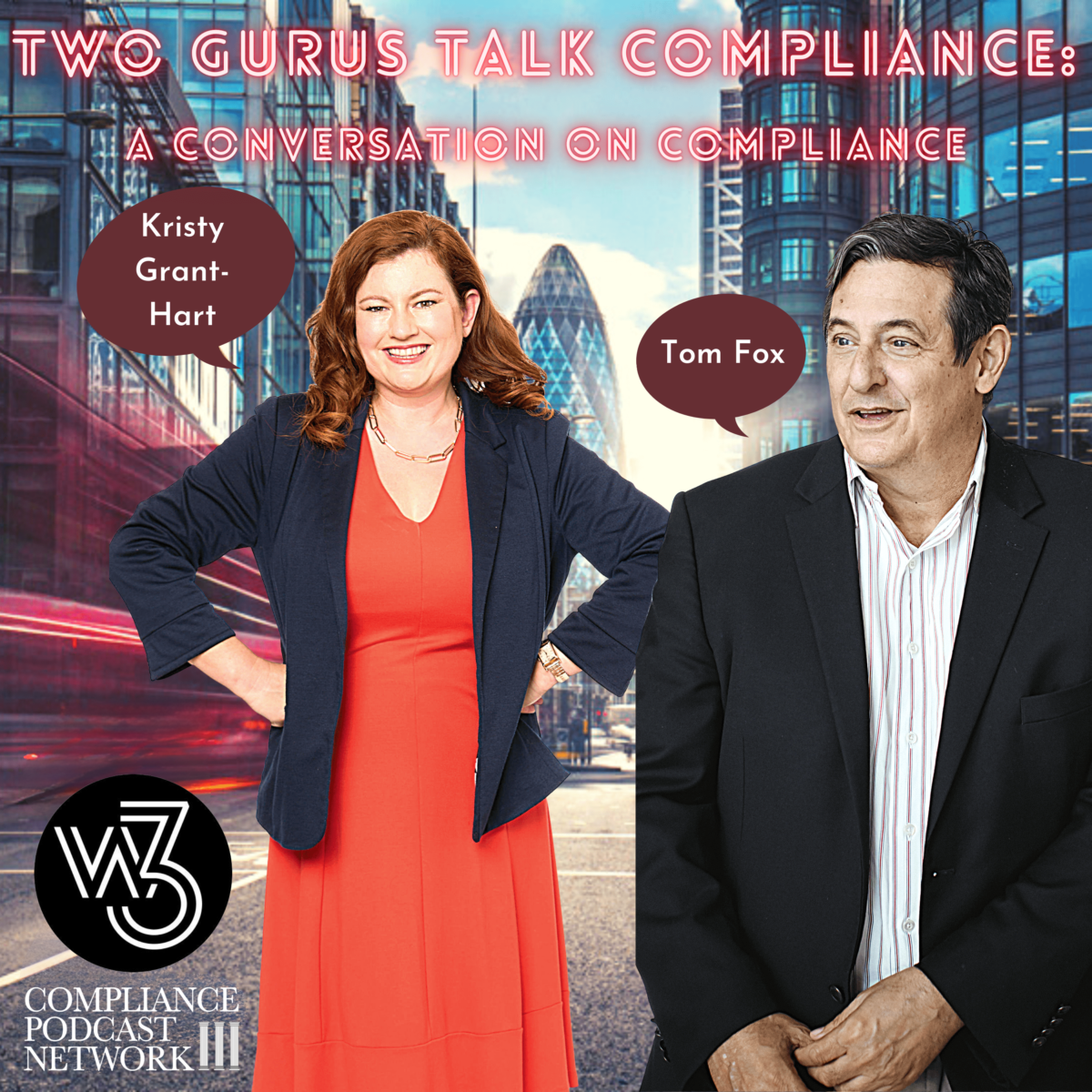
What happens when two top compliance commentators get together? They talk compliance, of course. Join Tom Fox and Kristy Grant-Hart in 2 Gurus Talk Compliance as they discuss the latest compliance issues in this week’s episode!

 Stories this week include:

  • What CFOs need to know about AI for compliance. (PYMNTS)
  • A sucker is born every minute, water edition. (WSJ)
  • Is OpenAI now too big to fail? (WSJ)
  • The history and future of securities litigation defense. (The D&O Diary)
  • AI chatbots are replacing Indian call centers. (Reuters)
  • Amazon Outage Forces Hundreds of Websites Offline for Hours – NYT
  • An Intriguing Whistleblower Award Case – Radical Compliance
  • Yes, You Can Fire an Employee for a Problematic Post, but Should You? – Corporate Compliance Insights
  • Smucker vs. Trader Joe’s, Lululemon vs. Costco: Fight Over Brands Goes to Court – WSJ
  • Florida Man Repeatedly Calls 911 on Restaurant’s ‘Extremely So Small’ Clams – Vice.com

Connect with the hosts:

Resources:

Kristy Grant-Hart on LinkedIn

Prove Your Worth

Tom

Instagram

Facebook

YouTube

Twitter

LinkedIn