Categories
Blog

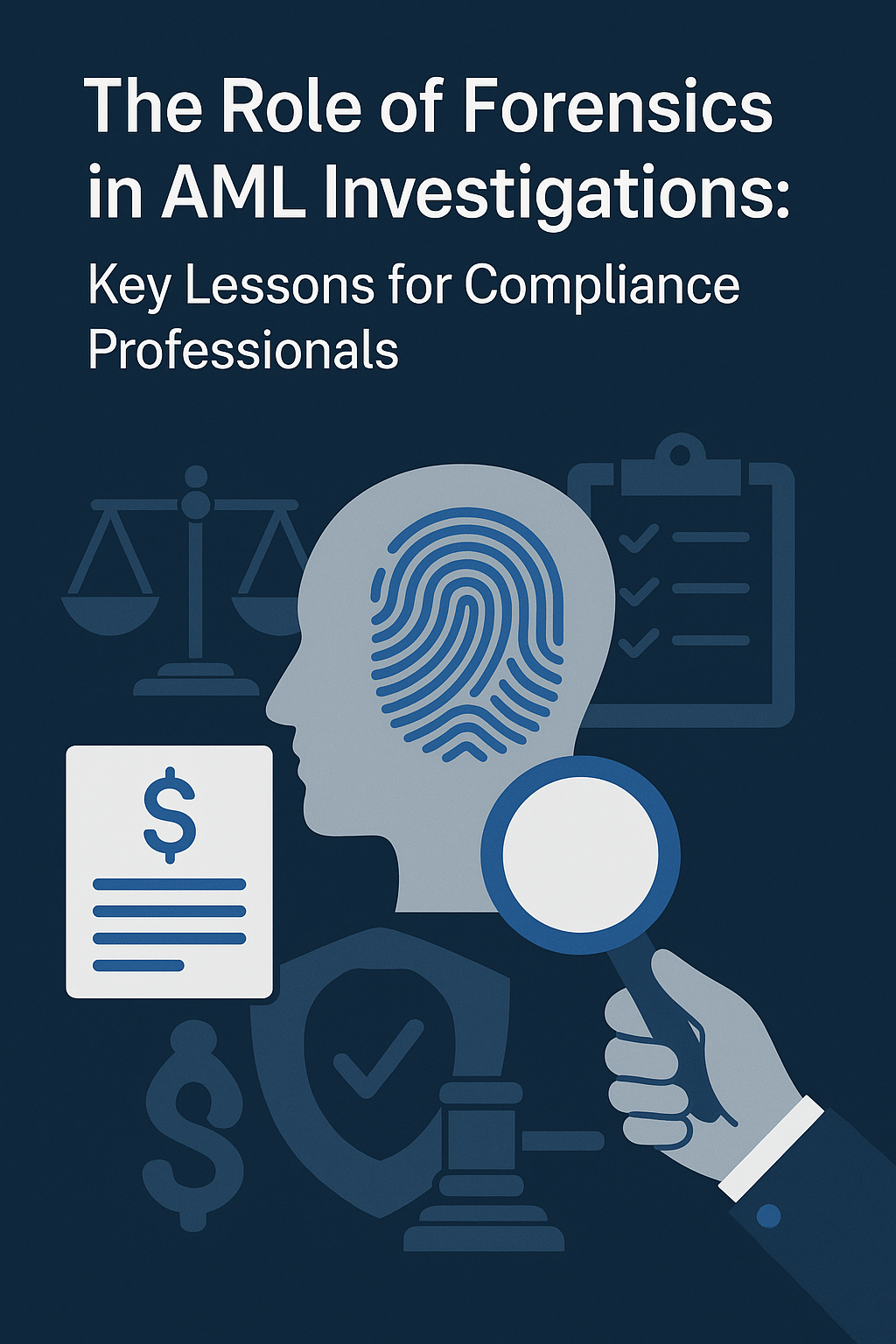
The Role of Forensics in AML Investigations: Key Lessons for Compliance Professionals

Effective anti-money laundering (AML) strategies rely heavily on forensic methodologies, which combine investigative expertise, advanced analytical technologies, and meticulous procedural rigor. Elaine Wood and Niall Murphy, from Charles River Associates, recently wrote an article that appeared in GIR, an extract from the third edition of The Guide to Anti-Money Laundering. Drawing insights from recent enforcement cases and best practices, their article outlined the five top lessons learned for compliance professionals regarding the role of forensic analysis in AML investigations. I have adapted it for the compliance professional.

1. The Power of Advanced Technology

Artificial intelligence (AI) and machine learning (ML) technologies have significantly enhanced the effectiveness of forensic analysis in anti-money laundering (AML) investigations. Leveraging these advanced technologies allows investigators to identify suspicious activities swiftly and accurately by recognizing anomalous behaviors through outlier detection and natural language processing. For instance, the U.S. Department of the Treasury’s successful recovery of over $1 billion from check fraud in fiscal year 2024 was primarily achieved through AI-driven solutions, representing a substantial increase compared to previous recoveries.

Compliance professionals should embrace AI and ML tools to strengthen their AML programs. Implementing these technologies can significantly enhance detection capabilities, streamline investigative processes, and mitigate risks more effectively.

2. Comprehensive Forensic Reviews

A comprehensive forensic review is critical when a company faces allegations of involvement in money laundering schemes. These forensic audits meticulously analyze transactional data across jurisdictions, mapping complex networks and pinpointing irregular activities. The case involving TD Bank, which resulted in a $3 billion penalty for AML failures, highlights the importance of thorough forensic reviews in uncovering long-term deficiencies and systemic lapses.

Compliance professionals must prioritize comprehensive forensic audits and continuously review their AML policies and controls. Robust and proactive forensic analyses help prevent substantial financial losses, severe penalties, and considerable reputational damage.

3. Rigorous Documentation and Record-Keeping

Proper documentation and record-keeping are essential in AML forensic investigations. These practices facilitate accurate transaction mapping, precise identification of irregular activities, and effective remediation strategies. During forensic examinations, each transaction alert, including how it was triggered, reviewed, escalated, and resolved or reported, must be meticulously recorded, along with assessments of existing AML controls.

In recent enforcement actions against financial institutions, regulatory agencies have highlighted deficiencies in documentation and record-keeping as contributing factors to compliance failures. Thus, compliance professionals must ensure that robust documentation protocols are in place and consistently adhered to, safeguarding against lapses and ensuring readiness for regulatory scrutiny.

4. Asset Tracing and Recovery Techniques

Forensic analysis extends beyond identifying irregular activities to include asset tracing and recovery, a crucial component of anti-money laundering (AML) investigations. Skilled forensic accountants and investigators track illicit funds across multiple jurisdictions and through various entities. An example of successful asset tracing is illustrated in the investigation of Central and South American drug cartels, where forensic techniques traced funds used to purchase illegally mined gold, highlighting complex laundering schemes involving international trade.

Compliance professionals should be adept at or closely collaborate with experts skilled in asset tracing and recovery. Understanding how to effectively track the flow of illicit funds through financial statements, transaction records, and ownership details significantly enhances the ability to reclaim assets and mitigate organizational exposure.

5. Calculating Economic Impact and Loss

Forensic specialists also play a pivotal role in determining the economic impact of money laundering, a complex task involving meticulous financial forensics. Calculating losses consists of assessing both the impact of the predicate crime and the economic damage resulting from subsequent laundering activities. Financial forensic analyses provide essential data for criminal forfeitures, civil judgments, and administrative penalties, offering precise quantifications of losses incurred.

In the Brink’s Global Services case, for instance, the assessment involved evaluating the company’s failure to adhere to AML regulations, resulting in a significant settlement. Compliance professionals must understand the methodologies and implications of calculating economic losses, as these calculations significantly impact legal outcomes and regulatory penalties.

Conclusion

Effective AML compliance demands integrating advanced forensic methodologies, technologies, and expertise into organizational frameworks. By learning from prominent cases and incorporating the above lessons, leveraging AI technology, conducting thorough forensic audits, maintaining rigorous documentation, mastering asset tracing techniques, and understanding economic impact calculations, compliance professionals can significantly enhance their AML capabilities.

A proactive and informed approach to forensic analysis not only aids in identifying and mitigating AML risks but also safeguards organizations from severe financial and reputational consequences. Compliance professionals equipped with robust forensic tools and methodologies are uniquely positioned to ensure organizational integrity, regulatory compliance, and resilience in the increasingly complex financial landscape.
Categories
Trekking Through Compliance

Trekking Through Compliance – Episode 8 – Miri

In this episode of Trekking Through Compliance, we consider the episode Miri, which aired on October 27, 1966, Star Date 2713.5. In this episode of Trekking Through Compliance, we explore one of the eeriest and most profound cautionary tales in the Star Trek canon: “Miri.” When the crew responds to a distress signal from a planet that’s an exact duplicate of Earth, they find a society ravaged by a failed experiment in human longevity. Only children remain, while the adults, the “grups,” have all died from a virulent disease.

This haunting story is not simply science fiction. It is a case study of what happens when risk management is treated as an afterthought. We draw parallels between the biohazard breakdowns on the planet and the kinds of failures that modern compliance officers must guard against, whether in public health readiness, supply chain risk, or workforce welfare.

Episode Summary

A disfigured man attacks a landing party, who die after Kirk strikes him. They discover a preadolescent, Miri, who ran away from them because “grups” kill and maim children before dying. She and her friends are “onlies,” the only ones left. The distress call is traced to an automated signal. The landing party, except for Spock, notices purple lesions on their bodies; Miri tells them that these are the first signs of the disease, and they will soon develop into the same condition as the other adults. When the disease begins, its victims have seven days to live. Although Spock is immune, he considers himself a carrier who could infect the Enterprise if he returns.

Back on the Enterprise, after vaccinating everyone and leaving the children in the care of a medical team, Kirk sends for teachers and advisers to help the children improve their lives.

Key highlights:

1. Disaster Preparedness—A Cure Without a Contingency Plan

🖖Illustrated by: The civilization’s experiment to extend life, which instead wipes out all adults.

This central failure underscores the risks associated with scientific advancement that lacks proper risk assessment. The developers had no fallback, no regulatory oversight, and no crisis management framework in place. For compliance professionals, this serves as a reminder that innovation must be paired with effective scenario planning and disaster recovery protocols.

2. Environmental and Public Health Compliance—Invisible Risks Become Existential Threats

🖖Illustrated by: The crew’s infection with the disease upon beaming down, with lesions appearing days later.

This serves as a metaphor for health and safety non-compliance. Enterprises must be vigilant about how workplace conditions, unseen hazards, and biological risks can impact staff and operations. Proactive monitoring and rapid-response mechanisms are essential components of any risk management strategy.

3. Data Governance and Early Warning Systems—Responding Too Late

🖖Illustrated by: The automated distress signal continued even though no adult survivors remained.

The signal was still active, but no one was listening until it was far too late. In modern organizations, this is equivalent to ignoring audit logs, internal control alerts, or whistleblower reports that go unread. A culture of attentiveness to data and signals is crucial to catching issues before they cascade.

4. Supply Chain Risk—Critical Resource Shortages in the Field

🖖Illustrated by: The crew’s struggle to develop a cure with limited time, no labs, and deteriorating conditions.

Kirk and McCoy were caught without adequate resources. This scenario mirrors the real-world risks companies face when they lack redundancy in their supply chains, fail to conduct thorough vendor audits, or fail to plan for logistical disruptions. A robust compliance framework includes stress-testing the supply chain for resilience under duress.

Employee Welfare and Isolation—Psychological and Ethical Concerns in Hazard Zones

🖖Illustrated by: Spock’s decision not to return to the Enterprise due to the risk of contamination.

Spock’s sacrifice is a model of ethical risk containment. In any risk environment, whether it is a pandemic, data breach, or financial misconduct, companies must empower employees to make ethically sound decisions while providing mental health support for those isolated by crisis response roles.

Final Starlog Reflections

Miri is a chilling illustration of what happens when ambition outpaces ethics and planning. The children left behind are the victims of a society that prioritizes progress over protection. For compliance professionals, this episode serves as a vivid reminder that a well-crafted compliance program is not just about preventing misconduct—it’s about preparing for the unknown.

Resources

Excruciatingly Detailed Plot Summary by Eric W. Weisstein

MissionLogPodcast.com

Memory Alpha

Categories
Sunday Book Review

Sunday Book Review: June 8, 2025, The Books on AI Governance Edition

In the Sunday Book Review, Tom Fox considers books that would interest compliance professionals, business executives, or anyone curious about the subject. It could be books about business, compliance, history, leadership, current events, or any other topic that might interest Tom. Today, Tom Fox looks at four prominent books that address AI governance.

  1. AI Governance: Applying AI Policy and Ethics through Principles and Assessments by Dr. Darryl Carlton
  2. The Oxford Handbook of AI Governance, edited by Justin B. Bullock
  3. Human Compatible: Artificial Intelligence and the Problem of Control by Stuart Russell
  4. Life 3.0: Being Human in the Age of Artificial Intelligence by Max Tegmark

The Sunday Book Review was recently honored as one of the Top 100 Book Podcasts.

Categories
10 For 10

10 For 10: Top Compliance Stories For the Week Ending June 7, 2025

Welcome to 10 For 10, the podcast that brings you the week’s Top 10 compliance stories in one podcast each week. Tom Fox, the Voice of Compliance, brings you the compliance stories that compliance professionals need to be aware of to end your busy week. Sit back, and in 10 minutes, hear about the stories every compliance professional should be mindful of from the prior week. Every Saturday, 10 For 10 highlights the most important news, insights, and analysis for the compliance professional, all curated by Tom Fox, the Voice of Compliance. Get your weekly filling of compliance stories with 10 for 10, a podcast produced by the Compliance Podcast Network.

  • Why the Wells Fargo asset cap was a good punishment.  (Bloomberg)
  • Wells Fargo has an asset cap lifted. (WSJ)
  • More millennials and Gen Zers as middle managers. (BusinessInsider)
  • Swiss banking reforms for UBS are announced. (FT)
  • More spying and corruption at EcoPetrol.  (Bloomberg)
  • Goldman’s letter sways Leissner’s sentencing judge.  (Bloomberg)
  • Google to invest $500 million in compliance. (Reuters)
  • Tesla tells employees that poor culture is their responsibility. (WSJ)
  • More spy claims in HR SaaS battle. (FT)
  • AI and Thought Leadership. (FT)

You can check out the Daily Compliance News for four curated compliance- and ethics-related stories each day here.

Connect with Tom 

Instagram

Facebook

YouTube

Twitter

LinkedIn

You can purchase a copy of my new book, Upping Your Game, on Amazon.com

Categories
Because That's What Heroes Do

Deep Space 9 – Episode 33: Reflecting on the Finale – A Deep Dive into DS9’s Last Episode, What You Leave Behind

All good things…No, that is Star Trek TNG. We are at the end of our exploration of Deep Space Nine. In this episode, the team concludes with an exploration of DS9’s final episode. Today, they review the series finale, What You Leave Behind.

In this episode, the hosts share their detailed thoughts and mixed feelings about the finale of ‘Star Trek: Deep Space Nine.’ They discuss the storyline’s rapid pace, the character arcs, and significant scenes, including the evolution of Garak, the bromance of Chief O’Brien and Bashir, and the ultimate fates of key characters. The panelists expressed their reservations and highs, particularly the conclusion of the Dominion War, Sisko’s transformation into a prophet, and other poignant moments. They also explore broader themes, such as the portrayal of post-war life and the human essence depicted through an alien-rich narrative. As they wrap up, the hosts reflect on their deep appreciation for DS9, its storytelling, and its lasting impact on the Star Trek universe.

Key highlights:

  • Mixed Feelings on the Episode
  • The Shapeshifters and Their Fate
  • Character Dynamics and Bromance
  • The Final Battle and Its Aftermath
  • The Prophets and Cisco’s Transformation
  • Odo and the Founder’s Redemption
  • Life Goes On After the War
  • Final Thoughts and Farewell to DS9

Resources:

Megan Dougherty

LinkedIn

One Stone Creative

Twitter

Tom

Instagram

Facebook

YouTube

Twitter

LinkedIn

Categories
Kerrville Weekly News Roundup

Kerrville Weekly News Roundup: June 7, 2025

Welcome to the Kerrville Weekly News Roundup. Each week, veteran podcaster Tom Fox and his colleagues, Andrew Gay and Gilbert Paiz, get together to go over a couple of their favorite stories from the past week from Kerrville and the greater Hill Country. Sit back, enjoy a cup of morning coffee, and listen in to get a wrap-up of the Kerrville Weekly News. We each consider two of our favorite stories and discuss the upcoming weekend’s events that we will enjoy or participate in.

In this episode, Tom takes a solo turn to examine some of the stories that caught their attention over the past week.

Stories include:

  • Watch out for utility scams
  • City denies County request for sign variance
  • Last weekend of the Kerrville Folk Festival
  • More County Meetings over County Animal Shelter

Resources:

Tom Fox on LinkedIn

Gilbert Paiz on LinkedIn

Andrew Gay on LinkedIn

Texas Hill Country Podcast Network

The Lead

Kerrville Daily Times

Fredericksburg Standard

Categories
Blog

The Enemy Within: Duality, Decision-Making, and the Ethics of Power

Show Summary

Today, we examine one of the most psychologically compelling Star Trek episodes to date: The Enemy Within. A transporter malfunction splits Captain Kirk into two versions of himself: one good and one evil. Each represents different aspects of leadership, impulse, and integrity. As the crew struggles to respond to the fractured captain, we’re given a front-row seat to the ethical breakdowns and Me Too-era lessons still resonant today. I explore five key compliance takeaways from this tale of divided identity, linking them directly to scenes aboard the Enterprise that show what happens when power is unmoored from principle and when control systems, both technical and ethical, fail.

Key Highlights and Star Trek Case Studies

1. The Dangers of Unchecked Power—When ‘Authority’ Becomes Assault

Illustrated by: Evil Kirk attacking Yeoman Janice Rand in her quarters.

One of the most disturbing moments in early Trek canon, this assault serves as a stark warning about the abuse of power. Evil Kirk resembles the captain and carries his authority, but lacks a conscience. It’s a Me Too moment that reveals the need for every organization to install guardrails, even around its most powerful figures. Compliance must include mechanisms to protect the vulnerable from those who misuse rank or influence.

2. Ethical Decision-Making Requires Wholeness—The Fragmented Leader Can’t Lead 

Illustrated by: Good Kirk losing decisiveness, compassion becoming indecision.

As “good” Kirk weakens, Spock and McCoy realize that without the aggressive, assertive part of his personality, the captain cannot lead. This reinforces the idea that ethical leadership is not about being soft; it is rather about striking a balance. Compliance leaders need the courage to act and the heart to guide. Ethical strength is integrative, not binary.

3. Crisis Response and Chain of Command—When Leadership Wavers, Chaos Breeds

Illustrated by: Evil Kirk taking the bridge and ordering the ship away from orbit.

With no one certain which Kirk is in control, the crew becomes vulnerable to manipulation. This episode serves as a cautionary tale about the importance of clarity in the chain of command and protocols for handling leadership incapacitation. In corporate compliance, crisis scenarios must anticipate rogue actors with access to decision-making tools.

4. Investigating Allegations—Belief, Process, and Support Matter

Illustrated by: Spock and McCoy interviewing Rand after her assault.

Their interview is subtle but painful. The tension in believing victims, navigating hierarchical power, and confronting uncomfortable truths is deeply relevant today. A strong compliance program ensures that all allegations are taken seriously, investigated professionally, and addressed with empathy and integrity.

5. Reintegration and Remediation—Restoring What Was Broken

Illustrated by: The merging of good and evil Kirk through a restored transporter.

Rebuilding trust and a unified identity requires technology, trust, and time. Just as Kirk must reabsorb the parts of himself to lead again, organizations recovering from misconduct must integrate the lessons learned into their culture, policies, and leadership. The ultimate goal is not punishment alone but rather to restore the organization’s ethical function.

Final Compliance Log Thoughts

The Enemy Within is more than a science fiction tale. It’s a mirror to every compliance program, showing us how quickly things unravel when power is unrestrained, when voices are ignored, and when organizations fail to integrate strength with morality. It is also a hopeful reminder that even fractured systems can be repaired if we face the truth with clarity and courage.

Resources:

Excruciatingly Detailed Plot Summary by Eric W. Weisstein

MissionLogPodcast.com

Memory Alpha

Categories
Compliance Tip of the Day

Compliance Tip of the Day – Internal Controls for Third Parties

Welcome to “Compliance Tip of the Day,” the podcast that brings you daily insights and practical advice on navigating the ever-evolving landscape of compliance and regulatory requirements. Whether you’re a seasoned compliance professional or just starting your journey, our goal is to provide you with bite-sized, actionable tips to help you stay ahead in your compliance efforts. Join us as we explore the latest industry trends, share best practices, and demystify complex compliance issues to keep your organization on the right side of the law. Tune in daily for your dose of compliance wisdom, and let’s make compliance a little less daunting, one tip at a time.

How to make specific internal controls for 3rd parties.

For more information on this topic, refer to The Compliance Handbook: A Guide to Operationalizing Your Compliance Program, 6th edition, recently released by LexisNexis. It is available here.

Categories
Daily Compliance News

Daily Compliance News: June 6, 2025, The Good Punishment Edition

Welcome to the Daily Compliance News. Each day, Tom Fox, the Voice of Compliance, brings you compliance-related stories to start your day. Sit back, enjoy a cup of morning coffee, and listen in to the Daily Compliance News. All from the Compliance Podcast Network. Each day, we consider four stories from the business world: compliance, ethics, risk management, leadership, or general interest, all relevant to the compliance professional.

Top stories include:

  • Mongolian PM ousted over corruption. (Aljazeera)
  • No ditherers, please. (FT)
  • Will there be a one-commissioner CFTC? (Bloomberg Law)
  • Why the Wells Fargo asset cap was a good punishment.  (Bloomberg)
Categories
2 Gurus Talk Compliance

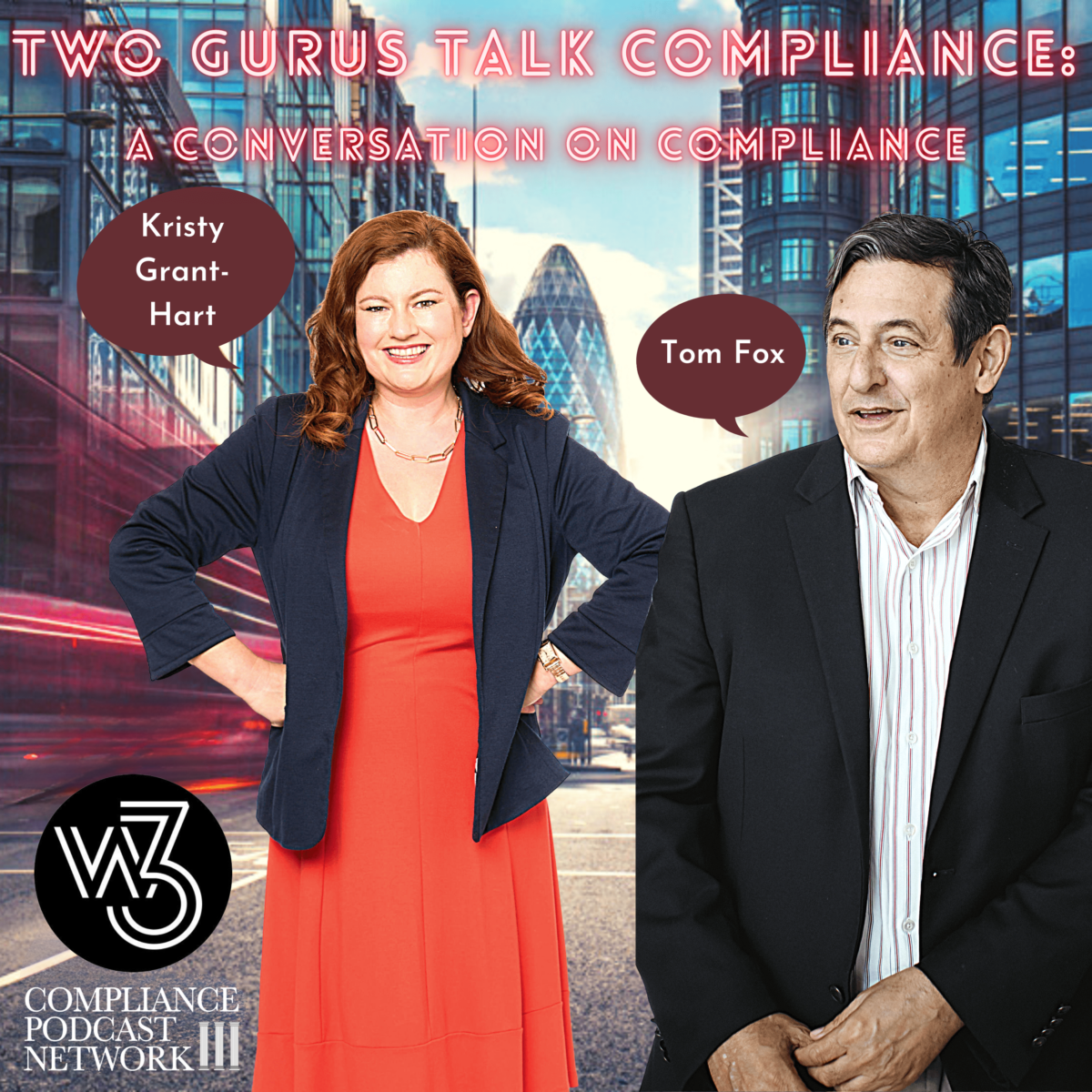
2 Gurus Talk Compliance: Episode 53 – The AI as a Whistleblower Edition

What happens when two top compliance commentators get together? They talk compliance, of course. Join Tom Fox and Kristy Grant-Hart in 2 Gurus Talk Compliance as they discuss the latest compliance issues in this week’s episode!

Stories this week include:

  • EY is negligent in missing $3bn fraud, court told. (Reuters)
  • Don’t tell the truth on your employee satisfaction survey. (Business Insider)
  • Trump pardons VA. Sheriff convicted of bribery.   (Bloomberg)
  • Tim Leissner sentenced.(Bloomberg)
  • Uyghurs are being moved around China. (NYT)
  • Boeing’s Internal Safety Plan: Make Problems Easier to Report – WSJ – HERE
  • Uh-Oh: AI’s New Whistleblower Impulses – Radical Compliance –HERE
  • Caught Between Conscience and Career: An E&C Leader’s Confession – Corporate Compliance Insights – HERE
  • How Is Remote Work Fueling Migration Trends? – Mortgage Point –HERE
  • You spray painted the wrong damn car’: Deputies mock teen who vandalized the wrong vehicle while trying to exact revenge on her ex – The Independent – HERE

 Resources:

Kristy Grant-Hart on LinkedIn

Prove Your Worth

Tom

Instagram

Facebook

YouTube

Twitter

LinkedIn