Categories
Blog

Stepping Up and Stepping Forward: The Future of Compliance in an Age of AI and Deregulation

The world of compliance took a surprising turn this February with the Executive Order issued by the President suspending FCPA investigation and enforcement. This was followed in short order by the dismissal, after six years of prosecution, of the two ex-Cognizant Technology executives charged with paying or authorizing the payment of bribes in that case. It now appears that both the Department of Justice (DOJ) and Securities and Exchange Commission (SEC) FCPA units will be eviscerated and even shut down by the Administration. These significant legal rollbacks have ignited a series of conversations about the very essence and future of the compliance profession. As compliance professionals, many of us are left pondering, where exactly does compliance go from here?

I recently discussed this topic on the Compliance into the Weeds podcast with Matt Kelly, reflecting on his insights from a compliance event held in Boston he wrote about in a blog post in Radical Compliance. Matt highlighted a prevalent unease among compliance officers, underpinned by two primary concerns: the potential redundancy of compliance roles due to relaxed regulatory scrutiny and the impact of advancing technology, particularly AI, on compliance functions.

First, tackle the issue of regulatory rollback. The Trump administration has shown a clear inclination toward scaling back certain regulatory requirements, warranted or not. But there is a critical takeaway. It is not 2010, at the modern beginnings of compliance; it is 2025, and compliance is fundamentally different from what it was 15 years ago. Compliance practices and ethics programs have become deeply integrated into business operations, creating intrinsic value that transcends mere regulatory requirements. These practices have proven essential not only for managing regulatory risk but also for effectively managing broader business risks, operational efficiency, and corporate reputation.

Yet, despite the embedded nature of compliance in modern corporations, there’s a troubling scenario Matt outlined based on a keen observation from Kristy Grant-Hart. Could compliance functions gradually be absorbed by other departments? Could compliance tasks like hotline management drift toward HR, regulatory compliance fall into the hands of the legal department, and privacy compliance become the responsibility of IT security? Unfortunately, this scenario is not entirely implausible. Some short-sighted organizations might indeed take this fragmented route, viewing it as an opportunity to reduce headcount and costs.

Both Matt and I agree this is a dangerous and ultimately costly path. Fragmenting compliance capabilities across departments risks creating silos, precisely what compliance professionals have spent years fighting against. Silos impede effective communication and cloud transparency and hinder the swift, coordinated responses necessary to manage risk in today’s complex business environments. In short, this fragmentation threatens operational integrity, compliance effectiveness, and, ultimately, corporate profitability.

Instead of retrenching, compliance professionals must seize this uncertain moment as an opportunity. This is a time to demonstrate conclusively how compliance adds tangible business value beyond regulatory mandates. Hui Chen beautifully articulated this sentiment in her insightful blog post, urging compliance leaders to elevate their roles proactively. Chen recommends re-evaluating and broadening our compliance messaging, enhancing engagement with leadership, and demonstrating the clear business value compliance delivers to the organization.

Now, when we look at technology, particularly AI, there is palpable excitement and understandable anxiety within our compliance community. AI presents both extraordinary potential and a perceived threat. The crux of the concern is straightforward: could AI replace human compliance professionals?

AI undoubtedly enhances compliance capabilities significantly; it empowers us to manage larger, more complex data sets, swiftly identifies risks, automates repetitive compliance tasks, and enriches our analytical capabilities. But here’s the fundamental truth: AI requires a “human in the loop.” Human oversight, nuanced judgment, ethical considerations, and strategic thinking cannot, and should not, be outsourced entirely to algorithms.

Moreover, AI is not a threat but a tool that amplifies the effectiveness of compliance officers. Compliance professionals should proactively harness AI to enhance third-party risk management, improve whistleblower and speak-up programs, conduct more nuanced behavioral analytics, and streamline compliance training and communication. AI is here to augment, not eliminate, the vital role of the compliance officer.

Short-sighted individuals will always view AI as a cost-cutting opportunity. These individuals might attempt to unravel compliance functions, dispersing responsibilities across various departments supported by AI, thereby undermining the coherent strategic value a centralized compliance function provides.

Our response as compliance professionals should be unequivocal; robust compliance management and risk assessment capabilities are more critical now than ever. Compliance functions must remain centralized and strategic, leveraging technology to enhance rather than dilute their impact. We must clearly demonstrate to senior management how a strong, unified compliance function, bolstered by advanced technologies like AI, not only ensures regulatory compliance but actively strengthens operational resilience, business efficiency, and profitability.

In closing, Matt and I both agree these are indeed challenging and uncertain times for the compliance profession. However, they also represent a profound opportunity for growth and innovation and demonstrate the indispensable value compliance brings to businesses. Compliance professionals must rise to this challenge, proactively shaping the future rather than passively waiting for it to unfold.

As Matt aptly concluded, and I echo wholeheartedly, “I would bet on the durability of the ethics and compliance profession every day of the week.” I would only add that now is unquestionably the moment for compliance to step forward confidently, embracing innovation and clearly demonstrating its value as a strategic partner in business success.
Categories
Everything Compliance

Everything Compliance: Episode 152, The Season Opener Edition

Welcome to this edition of the award-winning Everything Compliance. In this episode, Matt Kelly, Jonathan Armstrong, Karen Moore, and Tom Fox, the Compliance Evangelist, will appear as panelists.

1. Karen Moore examines EU changes in reporting on ESG and CCCD and rants about the anxiety caused by the Trump Administration.

2. Matt Kelly reviews the off-channel messaging scandal. He rants about the Trevor Milton pardon.

3. Jonathan Armstrong takes a deep dive into Agentic AI and its implications for compliance. He shouts out to Russell Brand for unmasking British actor Penelope Keith as JFK’s assassin.

4. Tom Fox examines the world’s response to Trump’s suspension of FCPA enforcement. He shouts out to Opening Day of the 2025 MLB season and highlights his hometown heroes, the Houston Astros.

The members of Everything Compliance are:

The host and producer, rantor (and sometime panelist) of Everything Compliance is Tom Fox, the Voice of Compliance. He can be reached at tfox@tfoxlaw.com. Everything Compliance is a part of the award-winning Compliance Podcast Network.

Categories
Daily Compliance News

Daily Compliance News: April 3, 2025, The Tribute to Ice Edition

Welcome to the Daily Compliance News. Each day, Tom Fox, the Voice of Compliance, brings you compliance-related stories to start your day. Sit back, enjoy a cup of morning coffee, and listen to the Daily Compliance News—all from the Compliance Podcast Network. Each day, we consider four stories from the business world: compliance, ethics, risk management, leadership, or general interest for the compliance professional.

Top stories include:

  • End of SEC FCPA bribery unit. (Reuters)
  • Ex-Shell boss tasked with cleaning up Nigerian National Petroleum Company (NNPC).  (BBC)
  • The judge dismisses Adams’s case with prejudice. (NYT)
  • DOJ moves to dismiss FCPA trial of former Cognizant execs. (Law360) sub req’d
Categories
Red Flags Rising

Red Flags Rising: S01 E04 – FRESH LOOKS: Export Controls Penalties

In Episode 4, Mike and Brent revisit another of their prior “Fresh Looks” posts on the NYU Law School’s Program on Corporate Compliance & Enforcement (“PCCE”) blog. This one concerns export control penalties and what to make of recent statements attributed to Commerce Secretary Howard Lutnick and Undersecretary Jeffrey Kessler. Mike and Brent discuss the context for the original November 14, 2023, post (00:30), how historical FCPA penalties compared to U.S. export controls penalties prior to the April 2023 Seagate resolution (01:26), what current official statements and enforcement trends mean for c-suites and boards (02:59), a recent Export Compliance Daily article regarding internal BIS discussions about enforcement priorities (04:57), how to prepare (07:23) for high probability-based enforcement (08:52), the role of the DOJ’s National Security Division (11:01), and conclude with Brent Carlson’s “Managing Up” segment (12:30).

Resources:

Brent LinkedIn

Mike LinkedIn

Mike & Brent’s “Fresh Looks” Series

Categories
Blog

Gerry Zack Reports on from the OECD

Gerry Zack recently attended the OECD 2025 Global Anti-Corruption and Integrity Forum Conference in Paris. I was able to catch up with Gerry about his reflections on the conference. The full interview is found on this episode of the FCPA Compliance Report. This event has long been a cornerstone in the global compliance calendar, and this year’s gathering confirmed what many in the compliance profession already suspected: the expectations for corporate compliance programs are not only rising, but they are expanding in scope, depth, and accountability.

Over several days of panel discussions, roundtables, hallway conversations, and formal presentations, Zack heard from government regulators, corporate leaders, NGO advocates, academics, and frontline compliance professionals. Each brought their perspectives, but the collective message was clear: compliance has matured. It’s no longer a reactive function that kicks into gear when things go wrong. It is a proactive, dynamic, and essential business function that must be embedded throughout the organization, from the boardroom to the back office. Here are Zack’s key takeaways from the conference.

1. Compliance Has Gone Global—And So Have the Regulators

The global nature of risk is not new. However, what is new is the increasing level of coordination and information-sharing among regulators. This year’s Forum showcased how cross-border enforcement is now the norm, not the exception.

Representatives from Brazil, Germany, South Africa, and Indonesia all spoke candidly about their partnerships with international bodies like the OECD Working Group on Bribery, the United Nations Office on Drugs and Crime (UNODC), and national law enforcement agencies including the U.S. Department of Justice and the UK Serious Fraud Office.

Couple this with the task force recently created by the UK, France, and Switzerland, and it creates an undeniable takeaway for the corporate world: Enforcement is no longer local. It is global, coordinated, and deeply interconnected.

This means that compliance teams must have scalable internal controls, third-party risk processes, and applicable investigation protocols across jurisdictions. A weak compliance program in a high-risk country is no longer just a local problem; it is a potential global liability.

2. The Definition of “Compliance Risk” Is Expanding Rapidly

You’re missing the bigger picture if your organization still structures your compliance risk assessment around bribery, fraud, and financial misconduct alone. One of the most notable shifts at this year’s conference was the broadening of the integrity lens.

Some of the key areas compliance professionals are being asked to tackle:

  • Human rights violations in supply chains;
  • Climate-related disclosure risks;
  • Workplace harassment and DEI failures;
  • Misinformation and data ethics risks; and
  • AI governance and algorithmic bias.

As one panelist from the European Commission aptly said, “Integrity today includes not just what’s illegal but what’s unethical, unsustainable, or irresponsible.”

This evolution presents a golden opportunity for compliance professionals to step into broader leadership roles, working cross-functionally with ESG teams, legal departments, HR, procurement, and IT. However, it also means that risk ownership needs to be clarified. If your risk universe is expanding, your governance model should evolve with it.

3. Real-Time Monitoring and Data-Driven Compliance Are the New Norm

Several sessions at the Forum focused on the power of data analytics and automation in transforming compliance programs. Gone are the days when manual, quarterly sample testing was enough. Today’s compliance function must be continuous, predictive, and digital. Here are some of the key advancements discussed:

  • AI-driven due diligence tools that adapt based on geopolitical risk signals;
  • Transaction monitoring platforms that flag anomalies in near real-time;
  • Natural language processing (NLP) is used to screen internal communications for misconduct indicators and
  • Dashboarding that visualizes cultural metrics, training gaps, and hotline responsiveness

One global bank compliance leader shared how their monitoring system identified an uptick in vendor payments in a particular region, triggering a review that uncovered a corruption scheme in its early stages.

The message was clear: if regulators are using data to investigate you, you should be using data to stay ahead of them.

Of course, technology is not a silver bullet; it requires investment, integration, and governance. But the future of compliance will be won by those who use data not just for reporting, but for anticipating risk and enabling the business to act decisively.

4. Culture is No Longer a “Soft” Metric—It’s a Leading Indicator

One of the most powerful sessions I attended focused on measuring and monitoring organizational culture. For years, compliance professionals have been saying, “Culture eats policy for breakfast.” Now, regulators are saying it, too, and they are acting on it.

Several enforcement agencies, including the U.S. DOJ and French AFA have signaled that they now interview employees at various levels during investigations to assess whether a company’s compliance program is truly operational or just a paper tiger. As a compliance professional, you need to move from showing what policies you have in place and procedures to implement them to whether your employees believe in them.

In practice, this means you should use such tools as

  • Pulse surveys should become a regular part of your compliance toolkit.
  • Behavioral metrics, such as speaking-up rates, bystander intervention, and trust in investigations, matter more than ever.
  • Leadership modeling and how your senior managers demonstrate (or fail to demonstrate) ethical conduct will be scrutinized.

In short, culture has become a measurable compliance risk factor. And you need to be able to show not just that you have a positive culture but that you’re tracking it, nurturing it, and improving it.

5. Community Is Compliance’s Secret Weapon

One of the most energizing aspects of the OECD Forum is not just the content; it is the people. Zack walked away from the conference, reminded that compliance professionals do not have to go it alone. Whether you are a seasoned CCO at a multinational or a solo compliance officer at a mid-market company, the challenges we face are surprisingly similar. The OECD Forum reminded me just how powerful our community can be when we share resources, ask hard questions, and commit to learning from each other.

If there is one thing we have all learned over our collective years in the compliance field, it is that the best compliance programs are not built in isolation. They are informed by the wisdom of others, through conferences, working groups, webinars, and yes, even podcasts.

Keep the Conversation Going

After the final session of the OECD Forum, an attendee asked a simple question: “How do we keep this conversation alive after we go back to our companies? ”

The answer is the same one I will leave you with: reach out. Keep the dialogue going. Ask questions. Share what is and perhaps what is not working for you. Stay engaged and connected.

Categories
The Hill Country Podcast

The Hill Country Podcast – Cycling for a Cause: The MS 150 Journey with Alan Peterson

Welcome to the award-winning The Hill Country Podcast. The Texas Hill Country is one of the most beautiful places on earth. In this podcast, Hill Country resident Tom Fox visits with the people and organizations that make this the most unique area of Texas. This week, Tom welcomes Dr. Alan Peterson back to discuss their mutual passion for the MS 150 bike ride, a major National Multiple Sclerosis Society fundraiser.

Alan shares the historical context of the event, which began in Minneapolis in 1980 and is now most prominent in Texas. The ride has raised over $1.3 billion for MS research. Alan reveals his motivation for participating in the event, rooted in his mother’s battle with the disease. He emphasizes the significant advancements in MS treatments funded through these initiatives and touches on the unique experiences of the ride, including the camaraderie at La Grange and the multiple routes participants can choose from. Alan and Tom also reminisce about their past participation and the importance of individual and corporate sponsorships in making the event successful.

Key highlights:

  • Overview of the MS 150
  • Details of the MS 150 Trek
  • The La Grange Experience
  • Fundraising Efforts and Impact

Resources:

Alan Peterson Facebook Page

Nancy Huffman Fine Art

Other Hill Country Focused Podcasts

Hill Country Authors Podcast

Hill Country Artists Podcast

Texas Hill Country Podcast Network

Alan Peterson QR Code for Donation

Open photo


Categories
Compliance Into the Weeds

Compliance into the Weeds: The Role of Compliance Going Forward

The award-winning Compliance into the Weeds is the only weekly podcast that takes a deep dive into a compliance-related topic, literally going into the weeds to explore a subject more fully. Are you looking for some hard-hitting insights on compliance? Look no further than Compliance into the Weeds! In this episode of Compliance into the Weeds, Tom Fox and Matt Kelly take a deep dive into the intricate future of corporate compliance amidst changes brought by the presidential executive order suspending FCPA investigation and enforcement.

Matt shares insights from a recent Compliance Week event in Boston, highlighting concerns among compliance professionals about the potential obsolescence of their roles. The discussion covers two primary scenarios: regulatory relaxation, making dedicated compliance roles redundant, and technological advancements, particularly AI, potentially replacing human compliance officers. However, both agree on the enduring importance of robust compliance functions integrated within corporate structures, emphasizing the strategic value of compliance in risk management and business operations.

They explore the dual excitement and anxiety surrounding AI’s role in compliance. Matt and Tom caution against shortsighted management decisions to decentralize compliance functions and highlight how AI can be harnessed to enhance rather than replace human oversight. They argue for proactive measures from compliance officers to demonstrate their value and leverage AI to improve compliance programs. As Matt eloquently puts it, this is a challenging yet opportune time for compliance professionals to up their game and secure their vital role in ensuring corporate integrity and efficiency.

Key highlights:

  • The Future of Compliance Post-Executive Order
  • The Role of Technology in Compliance
  • AI’s Impact on Compliance Officers
  • Strategic Imperatives for Compliance

Resources:

Matt in Radical Compliance

Tom in the FCPA Compliance and Ethics Blog

Hui Chen A Pause in FCPA Enforcement: Crisis or Opportunity

Tom

Instagram

Facebook

YouTube

Twitter

LinkedIn

Compliance into the Weeds was recently honored as one of a Top 25 Regulatory Compliance Podcast

Categories
Great Women in Compliance

Great Women in Compliance – Roundtable on The Future of Financial Crime Prevention

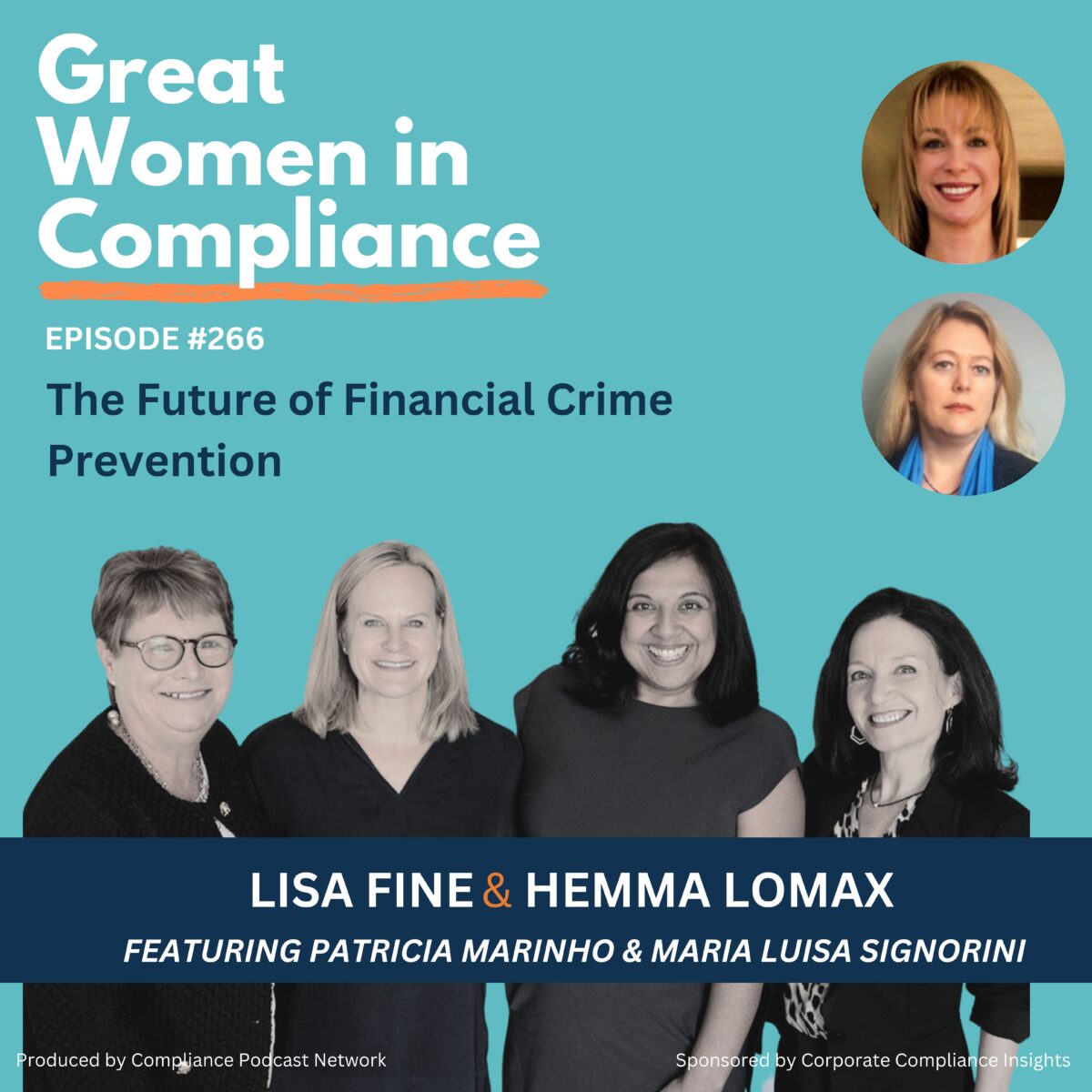
In this episode of Great Women in Compliance, hosts Dr. Hemma Lomax and Lisa Fine bring together Patricia Marinho and Maria Luisa Signorini to discuss the future of financial crime prevention. The conversation delves into their extensive backgrounds in financial compliance, the role of technology and AI in anti-money laundering (AML) controls, and the challenges and advancements in the field. They also reflect on the importance of human oversight in AI-driven systems and share their visions for the future of AML technology.

Highlights include:

  • A tour of the guest’s deep experience in financial regulation and risk management
  • Key challenges in financial crime detection and prevention
  • The role of innovation and emerging technology in compliance
  • Trust and the expectation of regulators when it comes to AI in financial services
  • Advice for compliance professionals leveraging community and mentorship


Biographies

Patricia Marinho is a highly accomplished Executive Global Head of Compliance, legal professional, and senior compliance strategist with over 25 years of experience in regulatory affairs, risk management, and corporate governance across the United States, Latin America, and global markets. She specializes in developing and leading high-impact compliance programs, aligning financial institutions with international regulatory frameworks, and advising executive leadership on governance and risk oversight.

As Executive Global Head of Compliance at Hamilton Reserve Bank (HRB), Patricia is responsible for shaping and implementing the bank’s global compliance strategy to support global growth and ensure adherence to international financial regulations. She is pivotal in positioning HRB for long-term regulatory success and global expansion, working closely with executive leadership to strengthen governance, mitigate risks, and enhance operational resilience.

Maria Luisa Signorini is the Vice President of Global Financial Crimes for Bank of America in Brazil. She has over 30 years of experience as a Legal professional in Litigation, Banking, Asset Management, and Financial Services, having worked for leading players in Brazil’s law firms, banking, and the financial services industry. She started her career as a civil litigator in major Law Firms in São Paulo – Brazil, and afterward transitioned to Compliance, Anti Money Laundering (AML)/Counter-Terrorism Financing (CTF), fraud, corruption, and bribery Areas. She has extensive knowledge of Brazil’s legal, compliance, and regulatory matters through senior positions in major global financial institutions located in Brazil, such as HSBC, UBS, Western Union, and now Bank of America.

Maria Luisa’s extensive expertise includes supporting the business by defining strategic compliance and reputational risks, having a deep understanding of Brazil’s regulatory environment, having experience working with local regulators, and having strong project coordination and management skills.

🎧 Listen now on your favorite platforms, the Compliance Podcast Network and Corporate Compliance Insights

♥️ Thanks as always to our wonderful #GWIC community for your support. Have an idea or suggestion? Drop a note to Lisa Fine or Hemma Lomax.

Categories
Daily Compliance News

Daily Compliance News: April 2, 2025, The All WSJ Edition

Welcome to the Daily Compliance News. Each day, Tom Fox, the Voice of Compliance, brings you compliance-related stories to start your day. Sit back, enjoy a cup of morning coffee, and listen to the Daily Compliance News—all from the Compliance Podcast Network. Each day, we consider four stories from the business world: compliance, ethics, risk management, leadership, or general interest for the compliance professional.

Top stories include:

  • What is the true cost of corruption-lost lives? (WSJ)
  • Agentic AI and ‘a moment of truth.’ (WSJ)
  • Head of EU Competition heads to US for Liberation Day. (WSJ)
  • The eyes of Dr. T. J. Eckleburg. (WSJ)
Categories
Career Can D0

The Truth About Hiring Right (And Why It’s Hard) with Craig Sullivan

What if the secret to a thriving company wasn’t just about hiring the right skills but the right character? That’s the core idea Craig Sullivan, President of Heat Transfer Tubular Products (HTT Products), shares in this episode of Career Can Do. Craig sat down with Mary Ann Faremouth to dive into the key to building a successful company—hiring for character and creating a culture that keeps people around for the long haul.

Craig believes hiring isn’t just about finding people with the right technical skills. It’s about character—integrity, problem-solving, and the ability to adapt. For him, the best employees can think critically and align with the company’s values. It’s not just about a resume; it’s about the person behind it.

But character isn’t the only thing that sets HTT apart. Craig also stresses the importance of culture. He’s a big fan of Simon Sinek’s Start With Why and uses the book’s principles to create an environment where employees feel like they’re part of something bigger than themselves. It’s not just about the work—they’re invested in the mission and personal growth. And that’s how you keep people around.

Speaking of keeping people around, HTT has a pretty impressive track record regarding employee retention. Craig says that many employees stick around for over 10 years and that longevity directly results from mentorship, career growth opportunities, and a culture that encourages engagement. But it’s not just about the work; Craig also understands that each generation has different expectations, and he’s all about making sure his workplace adapts to meet those needs.

So, if you’re a leader looking to build a strong company culture or find ways to keep your team happy and engaged, this episode is for you. Craig’s insights on hiring, leadership, and employee satisfaction offer a fresh perspective on what it takes to create a company that people don’t just work for but want to work for.

Resources:

Craig Sullivan on HTT Products | LinkedIn

Mary Ann Faremouth on the Web | X (Twitter)