Categories
Career Can D0

Unlocking Career Success with Mindset Shift and Skill Development with Sonja Price

Sonja “Dynamo” Price is a top career strategist, salary advisor, and leadership coach whose mission is to support professionals to have greater meaning, better work life balance, and significantly higher pay. She has worked with Tony Robbins, trained with Al Gore, and won an award from the Women’s Economic Forum. Sonja helps clients with career branding, job search and networking, and offer negotiation, to help them find clarity in their career, and ensure they are focused on the right roles and projects. Sonja is also the co-author of two books, The Pivot Point System and The Infinite Leader, which detail her process for helping individuals make transformative changes in their lives, careers, health, and wealth. 

It’s important to evaluate your coach to make sure they have the skills, qualifications, and experience necessary to help you reach your goals, Sonja tells listeners. Mary Ann highlights the need for individuals to gain more digital skills to stay competitive in the post-COVID job market and she suggests taking online courses or going back to school to gain such skills. Sonja recommends looking for a coach who offers a ROI guarantee.

When you want to transition careers you should marry your past work experience with the direction that you are heading in the future and to look for creative ways to work around any prerequisites or qualifications that may be listed in a job description. Mary Ann adds that it is important to adjust your mindset, as a negative attitude is likely to make interviews shorter. Sonja provides coaching services to help people adjust their mindset and identify the right fit opportunities in their next career chapter. She helps them build confidence and break down their fears for the future. 

Resources

Sonja Price on LinkedIn
Faremouth.com

Categories
Compliance Into the Weeds

ChatGPT for the Compliance Professional

The award winning, Compliance into the Weeds is the only weekly podcast which takes a deep dive into a compliance related topic, literally going into the weeds to more fully explore a subject. In this episode, Matt and I take a deep dive into ChatGPT, a natural language processing tool that works by indexing every piece of written content on the Internet. We discuss the impact of the Biden administration’s proposals for AI and discusses NIST’s voluntary AI framework and  the utility of chat GPT in the workplace. What should your organization consider about incorporating AI into both their shipping decisions and mission-critical processes. If you’re interested in efficient and advanced AI technology, you don’t want to miss this episode.

Key Highlights Include

  • Impact of Chat GPT on Jobs -The Quality of Chat CPG for non-English Speakers
  • The Biden Administration’s Nonbinding Guidelines for Artificial Intelligence.
  • The Benefits of Adopting a Voluntary AI Framework by NIST for Defense Contractors
  • The Impact of Artificial Intelligence on Shipping and Work Processes

 Notable Quotes

  1. “Chat GPT can answer pretty much anything. It won’t necessarily tell you where it is getting this information. It will just give you information pretty much like the way Tom, I am answering your question right now. Just imagine text-based bot answering those questions in the same way. That’s what it is.”
  2. “Will it make your job easier? Probably for a lot of people who struggle to come up with written content. Yes, it could. But specifically then for compliance officers and let’s bring it back to what matters for our audience. We’ll chat GPT as used by others make my job harder. Compliance officers. Now I think, actually, you have a lot to worry about there, and we could get into that.”
  3. “But I just view this as a huge boom to anyone who is interested in research, anyone who is interested in learning, can’t replace the weekly and business journalist, Matt. So you’re good to go at Radical Compliance.”
  4. “But you have identified really, I think, the heart of the problem that compliance officers need to think about now. Because to me, it’s just 1 more tool.”
Categories
Daily Compliance News

February 15, 2023 – The Ghost of Hoffa Edition

Welcome to the Daily Compliance News. Each day, Tom Fox, the Voice of Compliance, brings you compliance-related stories to start your day. Sit back, enjoy a cup of morning coffee, and listen to the Daily Compliance News. All from the Compliance Podcast Network. Each day we consider four stories from the business world, compliance, ethics, risk management, leadership, or general interest for the compliance professional.

Stories we are following in today’s edition of Daily Compliance News:

  • Speak up within teams. (FT)
  • Does visiting a museum = an ethical issue? (NYT)
  • Hoffa corruption still haunts organized labor. (The Globe and Mail)
  • Qatar Emir to make a case to Marcon. (Politico)
Categories
31 Days to More Effective Compliance Programs

One Month to More Effective Internal Controls – Internal Controls for Gifts, Travel and Entertainment

While many compliance practitioners believe that employee expense reports are a sufficient internal control of gifts because there are other ways in which a gift can be presented, other controls must be considered. Once your company policy on gifts has been finalized, the internal controls over expense reports fall into three primary areas:

  1. The expense report format, including what information it requires.
  2. Controls over the submitting employee and the preparation of the expense report.
  3. Controls to ensure the approvers do their review process properly.

Internal controls around gifts can be used in various ways in your best practices compliance program. They can certainly be used to detect an issue and perhaps even prevent an issue from becoming a full-blown FCPA violation; however, by using some of the techniques that Howell has suggested, you can move your compliance program to a proscriptive phase where you not only stop an issue from becoming a violation but through identification, you can move towards remediation as a part of your ongoing compliance efforts. The bottom line is that good internal controls make for good business processes; if you can move your compliance program’s internal controls forward, you can help make them a part of your financial controls and, thereby, have a better-run company. 

Three Key Takeaways:

  1. GTE compliance internal controls are low-hanging fruit. Pick them.
  2. Compliance with internal controls can be both detected and prevented controls.
  3. Good compliance with internal controls is good for business.

For more information on how to build out a best practices compliance program, including internal controls, check out The Compliance Handbook, 3rd edition.

Categories
Innovation in Compliance

Entrepreneurship and Risk Management with Adrienne Bellehumeur

Tom Fox’s guest in this episode of Innovation In compliance is Adrienne Bellehumeur. They discuss the significance of gap analysis in the design of internal controls, and why having a thorough understanding of design is critical to the success of gap analysis. They emphasize the importance of continuous improvement and avoiding a “pass-fail” approach to internal control programs. Adrienne also shares her five principles for creating high-value compliance programs.

Adrienne Bellehumeur is the Director and Co-owner of Risk Oversight, a firm specializing in internal controls, internal audit, and compliance programs. She has written a book called The 24-Hour Rule and Other Secrets for Smarter Organizations: Including the 6 Steps of Dynamic Documentation, which is set to be published on March 7th and is geared towards managers who are seeking solutions through documentation. This book aims to provide a fun and foundational approach to documentation for the modern knowledge workforce and is the first mass-market book on documentation best practices.


Some of the key points discussed during the show include:

  • Adrienne’s background and current role at her company, Risk Oversight, which specializes in delivering services to mid-sized oil and gas companies in the engineering sectors.
  • The purpose of gap analysis is to identify areas for improvement in processes and controls to support operational effectiveness.
  • Adrienne’s belief that internal controls should focus on good habits, accountability, and continuous improvement rather than just ticking boxes.
  • How Risk Oversight helps companies fulfill their obligation of oversight by providing entity-level control review and understanding best practices in governance.
  • The two best practices for board minutes, the “Goldilocks principle” and the “business judgment rule.”
  • The Caremark doctrine in Delaware and the importance of documentation of major risk management decisions.
  • Adrienne’s book The 24-Hour Rule, which is a mass-market book on documentation aimed at managers looking to solve problems through documentation and is applicable to various industries.


KEY QUOTATION:

“Risk management is about action.” – Adrienne Bellehumeur 


Resources 

Adrienne Bellehumeur | LinkedIn | Twitter 

Risk OversightThe 24-Hour Rule and Other Secrets for Smarter Organizations: Including the 6 Steps of Dynamic Documentation

Categories
Daily Compliance News

February 14, 2023 – The Happy Valentine’s Day Edition

Welcome to the Daily Compliance News. Each day, Tom Fox, the Voice of Compliance, brings you compliance-related stories to start your day. Sit back, enjoy a cup of morning coffee, and listen to the Daily Compliance News. All from the Compliance Podcast Network. Each day we consider four stories from the business world, compliance, ethics, risk management, leadership, or general interest for the compliance professional.

Stories we are following in today’s edition of Daily Compliance News:

  • White fragility is a race-based farce. (Reuters)
  • TX AG pays $3.3MM to settle whistleblower lawsuits. (NYT)
  • NMSU cancels BB season due to hazing allegations. (ESPN)
  • SEC to crack down on insider trading loopholes. (WSJ)
Categories
31 Days to More Effective Compliance Programs

One Month to More Effective Internal Controls – Internal Controls for Third Parties

Bribery built into the fabric of Chinese healthcare system”, reporters Jamil Anderlini and Tom Mitchell wrote about the ‘nuts and bolts of how bribery occurs in the healthcare industry in China. The authors quoted Shaun Rein, a Shanghai-based consultant and author of “The End of Cheap China,” for the following “This is a systemic problem, and foreign pharmaceutical companies are in a conundrum. If they want to grow in China, they must give bribes. It’s not a choice because officials in the health ministry, hospital administrators, and doctors demand it.”

It would be reasonable to expect that internal controls over gifts would be designed to ensure that all gifts satisfy the required criteria, as defined and interpreted in Company policies. It should fall to a Compliance Officer to finalize and approve a definition of permissible and non-permissible gifts, travel, and entertainment, and internal controls will follow from such definition or criteria set by the company. These criteria would include the amount of the spend, localized down into increased risk, such as the higher risk recognized in China. Within this context, there are four general internal controls to consider. 

Three Key Takeaways:

  1. GSK in China continues to be an example of the lack of internal controls for an effective compliance program.
  2. General areas of review for internal compliance controls.
  3. Third parties are still at the highest risk of corruption-related issues.

For more information on how to build out a best practices compliance program, including internal controls, check out The Compliance Handbook, 3rd edition.

Categories
The Ethics Experts

Episode 143 – David Tate & Marianne Pantalon


In this episode of The Ethics Experts, Nick welcomes David Tate & Marianne Pantalon. David is a licensed clinical psychologist, executive coach, and organizational consultant. He is a Co-Founder and CEO at Conscious Growth Partners , a consultancy that promotes organizational thriving through better leadership, teamwork, and culture. Marianne is a clinical and consulting psychologist and executive coach. She is Co-founder and Chief Strategy Officer at Conscious Growth Partners, a mission focused consulting firm dedicated to helping organizations improve both their results and relationships through improved awareness, intentionality, and skill development.
https://www.linkedin.com/in/david-c-tate-780683/
https://www.linkedin.com/in/mariannepantalon

Categories
The ESG Report

ESG Stewardship with Ben Colton

In this episode of the ESG Report, Tom Fox discusses ESG sustainability and stewardship. Guest Ben Colton explains how his company State Street Global is contributing to a better understanding and implementation of sustainability and stewardship practices for ESG.

Ben Colton is the Global Head of Asset Stewardship at State Street Global. The company is a steward of their clients’ investments, and as such, he oversees proxy, voting, and engagement activities.


  • Sustainability provides opportunity. The low carbon economy will allow companies to refine their business models as they transition. They can then see sustainability as a differentiator, and see a shift in consumer behavior. Ben stresses however, that the discussion about brown vs green energy should not become polarized. How companies change in response to a low carbon economy will not be linear. 
  • Not having diversity is a business risk, especially at the board level. This speaks to flaws within your nomination processes. Ben stresses that it is important to ensure that members are widening their nomination pool, and allowing for a diverse set of candidates. 
  • It’s time to start setting baseline expectations for carbon emissions and holding companies accountable for meeting them, Ben stresses. Companies need to be part of the solution. “Large oil and gas companies can be part of the solution. We can’t polarize this discussion in brown versus green and just expect high emitting companies to just spin off all their assets to the private equity sector because that’s what we’re seeing and that’s what we’re really concerned about,” he says. 
  • Diversity is a part of human capital management, and related to corporate culture. Diverse work environments encourage innovation, create a welcoming work environment, and encourage employee engagement.
  • Human capital management will be more important in the coming years and companies are going to be thinking about how they’re integrating their employees’ voices and feedback. 


KEY QUOTE

“Having progressive diversity and inclusion practices will promote employee satisfaction.” – Ben Colton 


Resources

Ben Colton on LinkedIn

State Street Global Advisors

Categories
Corruption, Crime and Compliance

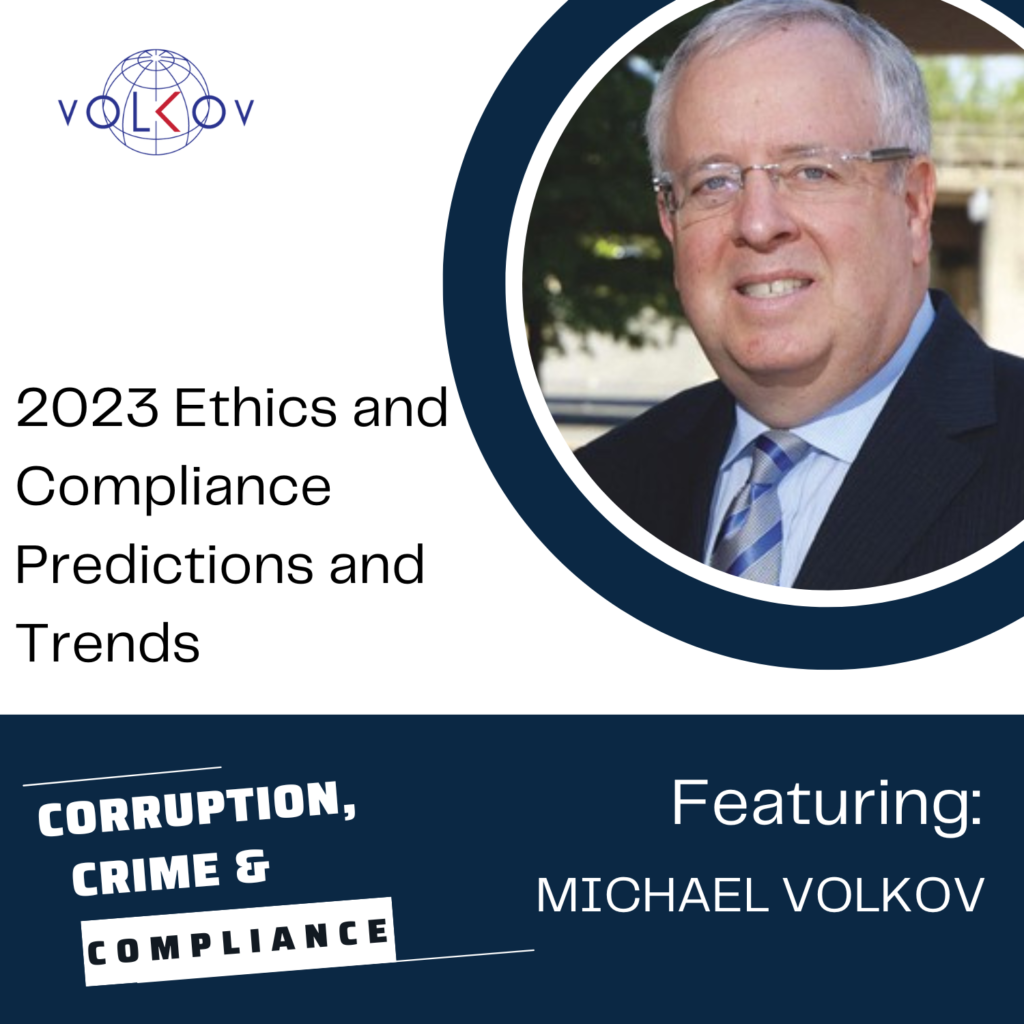
2023 Ethics and Compliance Predictions and Trends


In this episode of the Crime, Corruption, and Compliance podcast, Michael Volkov forecasts the compliance and ethics trends that will be significant in 2023. He emphasizes the crucial role ethics and compliance play in the corporate governance landscape, the increasing relevance of ESG, and highlights the need for robust ethics and compliance programs even in the C suite. 

Key ideas in this episode:

  • The need for robust ethics and compliance programs with adequate resources.
  • Boards and CEOs who fail to understand the importance of these programs are “doomed”.
  • Culture and ethics will be top priority in 2023.
  • The importance of C suite risk assessments and third-party risk management. “CCOs need to reach out to internal audit and their CFOs to enlist their support for a simple proposition, and that is that we need to design and implement financial controls applicable to the C Suite that are tailored to the relevant risks,” Michael says.
  • The evolution of third-party risk management to become a more holistic concept. “The ability to address, monitor and collect data on your third parties also with the evolving risk landscape led to this transformation,” Michael points out. “The fast pace of this transformation is going to continue.” 
  • CCOs and compliance officers need to ask questions surrounding internal controls and accounting controls.
  • Compliance professionals will participate more deeply in financial control review and responsibility. 


KEY QUOTES:

“CCOs need to reach out to internal audit and their CFOs to enlist their support for a simple proposition, and that is that we need to design and implement financial controls applicable to the C Suite that are tailored to the relevant risks.” – Michael Volkov


Resources:

Michael Volkov on LinkedIn | Twitter

The Volkov Law Group