Categories
Blog

AI in Compliance: Part 1, Use in a Best Practices Compliance Program

Leveraging advanced technologies like artificial intelligence (AI) is no longer a luxury; it is quickly becoming necessary. For compliance professionals, AI offers a transformative tool to enhance program efficiency, improve risk detection, and create a more resilient corporate compliance framework. Over the course of this week, we will explore how AI can elevate a compliance program to meet the DOJ’s 2024 Evaluation of Corporate Compliance Programs (2024 ECCP) standards and provide actionable insights for compliance professionals to consider.

Why AI Matters for Compliance 

AI’s value proposition lies in its ability to process vast amounts of data at scale, identify patterns that may be imperceptible to human analysis, and deliver predictive insights that help companies stay ahead of potential issues. In compliance, these capabilities translate into multiple enhancements and improvements for your compliance program.

  • Enhanced Risk Assessment and Management

AI-driven tools can analyze diverse datasets, transaction records, third-party due diligence files, and communications logs to identify high-risk behaviors or potential red flags. Machine learning models can adapt to new data inputs, refining their predictive accuracy.

  • Improved Monitoring and Auditing

Real-time monitoring systems powered by AI can flag anomalies as they occur, significantly reducing the time between risk emergence and remediation. For instance, detecting a pattern of irregular vendor payments could preempt a Foreign Corrupt Practices Act (FCPA) violation.

  • Streamlined Processes

Automating repetitive compliance tasks such as document review, policy distribution, or training reminders frees compliance professionals to focus on more strategic, high-value activities.

  • Data-Driven Decision-Making

AI tools offer dashboards and visualizations that present compliance data in an actionable format, enabling leadership to make informed decisions based on trends and insights rather than intuition.

AI Applications in a Best Practices Compliance Program

There are several areas where AI can drive value in compliance programs. (We will examine each application in depth over the rest of this week.)

  • Third-Party Risk Management

Third-party relationships are the perennial area of compliance risk. AI tools can screen and monitor third parties in real time by aggregating data from public records, news outlets, social media, and proprietary databases. Advanced models can assess the likelihood of misconduct based on historical behavior or regional risk factors, ensuring continuous evaluation rather than a one-time due diligence exercise.

  • Employee Behavior Analytics

AI can analyze employee communications for indicators of unethical behavior, such as conflicts of interest, fraud, or harassment. Natural language processing (NLP) models can identify sentiment and tone in emails or chats, flagging potentially concerning exchanges for further review. For instance, an uptick in discussions about side deals or special arrangements might warrant investigating contract negotiations or sales processes. Notably, such tools must be deployed with privacy considerations in mind to avoid overreach.

  • Policy and Training Effectiveness

AI can evaluate the effectiveness of compliance training programs by analyzing completion rates, quiz results, and behavioral data. For example, if employees who completed anti-bribery training still show compliance gaps, AI can recommend targeted remedial training or adjustments to the curriculum. AI-powered chatbots can serve as on-demand compliance advisors, providing employees instant guidance on policies or reporting mechanisms.

  • Predictive Analytics for Emerging Risks

Emerging risks, such as those tied to geopolitical shifts, new regulations, or technological advancements, can be challenging to anticipate. AI models trained on global datasets can identify trends that signal new risk areas. Analyzing changes in supply chain patterns might reveal vulnerabilities to sanctions or trade compliance issues.

  • Continuous Monitoring and Reporting

AI enables continuous monitoring of financial transactions, procurement processes, and operational activities. By setting customized thresholds, companies can use AI to flag activities outside acceptable parameters, triggering alerts for potential violations.

For reporting, AI can automate the generation of compliance dashboards tailored to various stakeholders, whether it be a Board of Directors, regulators, internal auditors, shareholders, or the growing number of other stakeholders for every corporation. All of these offer transparency and accountability across the organization.

Addressing Challenges and Limitations 

While AI offers significant potential, it is not a panacea. Compliance professionals must consider several challenges when implementing AI in their programs. Moreover, always remember the human in the loop part of every AI equation.

  • Data Quality (GIGO)

AI is only as good as the data it processes. Inaccurate, incomplete, or biased data can lead to flawed outcomes. Organizations should invest in data governance frameworks to ensure the integrity and reliability of input data. GIGO (Garbage In, Garbage Out) is just as relevant in 2024 as when I took my first computer course in college.

  • Ethical Concerns

AI tools must be deployed to respect employee privacy and adhere to applicable data protection laws. Overzealous surveillance could erode trust in the compliance function and run afoul of regulations like the GDPR or CCPA. GIGO also touches on ethical concerns: If you input biased data, the output will be equally biased.

  • Black-Box Decision-Making

AI models often operate as “black boxes,” making decisions based on complex algorithms that are difficult to explain. Compliance teams should prioritize transparency by using interpretable AI models and documenting decision-making processes. Regulators are moving to this position; every compliance professional should be moving toward this.

  • Integration with Existing Systems

Integrating AI with legacy systems can be a technical and logistical challenge. A phased approach, starting with pilot programs, can help organizations assess feasibility and scalability before full deployment. Start small and test, then move on and up.

Ensuring Alignment with DOJ Expectations 

The 2024 ECCP emphasizes the importance of continuous improvement, data-driven risk assessment, and a culture of accountability. AI aligns well with these priorities by enabling dynamic, responsive, transparent compliance processes. Compliance teams should use a variety of tactics to meet DOJ expectations while leveraging AI. The first is almost a compliance by-word: Document Document Document. You should maintain detailed records of how AI tools are used in the compliance program, including the rationale for their implementation and the results achieved.

Ongoing monitoring and reviews are critical to determine the effectiveness of AI-driven tools to ensure they align with compliance goals and adapt to evolving risks. As noted above, the Human in the Loop must always be considered as AI should augment, not replace, human judgment. Compliance officers should use AI insights as a starting point for investigation and decision-making rather than as the final word. Finally, all corporate stakeholders should be engaged through collaboration with IT, legal, and data privacy teams to ensure AI implementation adheres to corporate policies and legal requirements.

Building the Compliance Program of Tomorrow

AI represents a powerful opportunity to elevate compliance programs to new heights. By integrating AI thoughtfully and strategically, companies can not only meet regulatory expectations but also create a proactive, agile compliance function that is well-equipped for future challenges.

As compliance professionals, our role is to guide this transition responsibly. By combining the strengths of human expertise with AI’s analytical capabilities, we can build programs that are reactive, predictive, efficient, and transformative. The bottom line is that compliance is a business process, and AI is the next frontier in making that process both effective and sustainable. Compliance professionals should embrace this frontier with the diligence, creativity, and ethical commitment that define our profession.

Categories
Great Women in Compliance

Great Women in Compliance – Neta Meidav on Bridging the Trust Gap

In this week’s episode, Hemma visits Neta Meidav to discuss bridging the trust gap with innovative technology and the power of women entrepreneurs in the ethics and compliance space. Neta is a visionary entrepreneur and CEO co-founder of Vault Platform, an impact-driven company disrupting outdated workplace misconduct reporting and resolution models.

Highlights include: 

  • Bridging the trust gap by focusing on the employee experience
  • Building impact and values into the DNA of a product
  • How to proactively prevent and detect misconduct using AI and disruptive technologies
  • The role of women founders and entrepreneurs in ethics and compliance
  • The release of #ethicschat by Vault – revolutionizing compliance knowledge management 

Biography:

Neta is the Founder and CEO of Vault Platform. She founded Vault to modernize ethics and compliance and create more equitable, safe, and ethical workplaces worldwide. Neta was recently named one of Inc. Magazine’s Female Founders 200.

Before founding Vault, Neta worked for over a decade in the UK Government as a climate change negotiator and participated in the Paris Climate Agreement. Alongside leading Vault, Neta is on a mission to promote female founders in tech and spends time coaching and helping her fellow female founders who are earlier on their journey.

Resources:

www.vaultplatform.com

Press Release on the launch of #ethicschat by Vault 

Thanks to our sponsor, Corporate Compliance Insights, and the wonderful #GWIC community.  You can join the Great Women in Compliance community on LinkedIn here.

Categories
Compliance and AI

Compliance and AI: Demystifying AI Integration in Compliance: Insights from the DOJ

What is the role of Artificial Intelligence in compliance? What about Machine Learning? Are you using ChatGPT? These questions are but three of the many we will explore in this cutting-edge podcast series, Compliance and AI, hosted by Tom Fox, the award-winning Voice of Compliance. In this episode, Tom reflects on recent DOJ speeches on AI and the 2024 ECCP revisions concerning AI and compliance.

Tom discusses Deputy Assistant Attorney General Nicole Argentieri’s September speech and the 2024 Evaluation of Corporate Compliance Programs (ECCP). He also unpacks how compliance professionals are expected to manage AI-related risks rigorously. He offers actionable steps, such as conducting comprehensive risk assessments, implementing robust compliance controls, and ensuring ongoing monitoring and employee training. This episode is essential listening for compliance professionals aiming to stay ahead of AI-related challenges and align with the DOJ’s latest expectations.

Key highlights:

  • DOJ’s New Approach to AI in Compliance
  • Steps to Align Compliance Programs with DOJ Expectations
  • 2024 ECCP: Key Questions for Compliance Professionals
  • Proactive Strategies for Managing AI Risks

Resources:

For additional information check out the FCPA Compliance and Ethics Blog.

Tom Fox

Instagram

Facebook

YouTube

Twitter

LinkedIn

Categories
Regulatory Ramblings

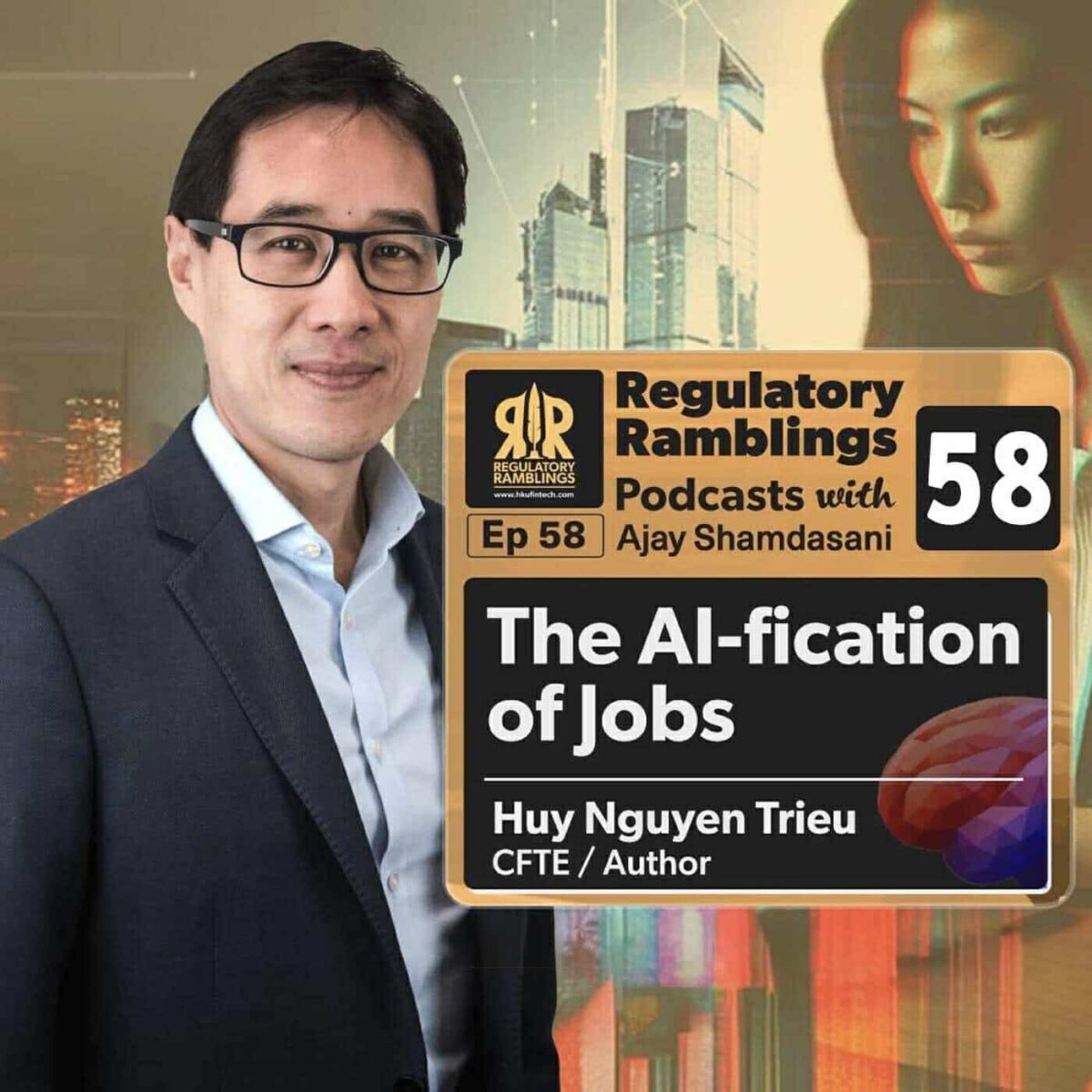
Regulatory Ramblings: Episode 58 – The AI-fication of Jobs with Huy Nguyen Trieu

Huy Nguyen Trieu is the author of the new book The AI-fication of Jobs. He is the co-founder and Ms. Tram Anh Nguyen of the London-headquartered Centre for Finance, Technology and Entrepreneurship (CFTE). As a global FinTech knowledge platform, CFTE opened its Abu Dhabi office earlier this year and its Singapore office.

A leading voice in the world of AI, Huy’s book is the product of 10 months of effort and debuted at the recent Singapore FinTech Festival in early November 2024. It explores how AI reshapes the workforce and moves beyond the common question of “Will AI take my job?”

Huy shares with Regulatory Ramblings host Ajay Shamdasani how his book provides a structured framework for understanding AI’s impact from displacement to augmentation and how such changes and trends can be leveraged for future success and insights. It is an accessible, future-focused guide and a must-read for anyone interested in AI’s role in shaping careers, industries, and society.

As Huy puts it: “AI is a complex, personal topic – 85 percent of workers believe it will significantly impact their jobs. But understanding what that means is often confusing.”

Huy goes on to describe his professional background: He is an engineer by training and an entrepreneur by nature. As a “big picture” person, he’s interested in the revolution in technology that is transforming finance—what he calls Disruptive Finance.

To quote Huy: “Put simply, we are facing a Napster moment: technology is set to revolutionize finance, which will massively impact the global economy, business, and society.”

His passion, he says, is building and growing businesses—especially in changing environments. This passion led him from being a tech CEO in New York to managing director at an investment bank in London to founding partner at a Hong Kong-based accelerator and now co-founder of the CFTE.

As a managing director at Citi, Huy grew a business that helped Europe’s largest insurance companies, major pension funds, and international banks adapt to an increasingly complex environment.

He also adores teaching at scale, having co-created some of the largest FinTech courses in the world at Oxford University’s Said Business School, the University of Hong Kong University, Imperial College, and now CFTE.

As CEO of The Disruptive Group, he’s developing a firm that builds innovative finance businesses that leverage technology and advises CEOs of large organizations. One of TDG’s projects is the CFTE, which is dear to Huy’s heart as he explains the impetus for the body’s creation.

“CFTE is the answer to a very simple question: as a professional in financial services, how do I acquire the skills to be future-proof? The question is simple, but the solution is hard because there is much knowledge to acquire, the industry is changing all the time, and professionals do not have time to learn,” Huy says.  “Together with hundreds of experts [from heads of innovations in banks to CEOs of challenger banks and CEOs of FinTech venture capital firms], we have created a platform that helps the industry acquire this knowledge quickly, from FinTech to artificial intelligence to open banking,” he concluded.

A key observation of the book is that AI and its massive impact on careers portends a shift that will give rise to a class of “supercharged professionals” – those who combine their skills with tech to thrive like never before. And then there are the “creative disruptors,” a select few poised to build entirely new industries from scratch. Huy urges us all to embrace this future, not just for ourselves, but to ensure the potential benefits of AI for everyone.

“On average, we are all about average most of the time. Yet, the results that can be gained through AI are now consistently above average,” he warns while acknowledging there are no easy answers to how the workforce can ‘raise their game’ to avoid redundancy.

In addition to London, the CFTE is also based in Singapore and Hong Kong and earlier this year opened an office in Abu Dhabi, given the deep need in the Middle East and, in particular, the GCC nations for education in the technologies that will shape the future of work. The CFTE works with most Tier 1 financial institutions, governments, and central banks.

The Regulatory Ramblings podcasts are brought to you by the University of Hong Kong—Reg/Tech Lab, HKU-SCF Fintech Academy, Asia Global Institute, and HKU-edX Professional Certificate in Fintech, with support from the HKU Faculty of Law.

Useful links in this episode:

  • Follow Huy Nguyen Trieu on LinkedIn

  • “The AI-fication of Jobs” on: Amazon

  • CFTE book page: Webpage

You might also be interested in:

Connect with RR Podcast at:

LinkedIn: https://hk.linkedin.com/company/hkufintech 
Facebook: https://www.facebook.com/hkufintech.fb/
Instagram: https://www.instagram.com/hkufintech/ 
Twitter: https://twitter.com/HKUFinTech 
Threads: https://www.threads.net/@hkufintech
Website: https://www.hkufintech.com/regulatoryramblings 

Connect with the Compliance Podcast Network at:

LinkedIn: https://www.linkedin.com/company/compliance-podcast-network/
Facebook: https://www.facebook.com/compliancepodcastnetwork/
YouTube: https://www.youtube.com/@CompliancePodcastNetwork
Twitter: https://twitter.com/tfoxlaw
Instagram: https://www.instagram.com/voiceofcompliance/
Website: https://compliancepodcastnetwork.net

Categories
Compliance and AI

Compliance and AI: John Sun on Enhancing Compliance Processes with AI Technology

What is the role of Artificial Intelligence in compliance? What about Machine Learning? Are you using ChatGPT? These are but three questions we will explore in this cutting-edge podcast series, Compliance and AI, hosted by Tom Fox, the award-winning Voice of Compliance. In this episode, Tom visits with John Sun, the founder and CEO of Spring Labs.

Spring Labs is a pioneering advocate for viewing compliance processes as crucial drivers of business efficiency rather than mere regulatory obligations. With his extensive experience in financial institutions, John understands the profound impact of well-managed compliance on decision-making and resource allocation. He argues that leveraging AI and data analytics in compliance enhances precision and effectiveness and transforms customer feedback into actionable insights that can lead to product innovation and operational improvements. At Spring Labs, John leads the charge by developing cutting-edge AI tools that empower compliance teams, demonstrating that a proactive approach to compliance can significantly boost an organization’s ROI and drive long-term growth.

Key highlights:

  • Insights from Complaints: Enhancing Business Operations
  • Compliance Processes as Business Efficiency Enhancers
  • Enhancing Compliance Processes with AI Technology
  • Enhancing Business Efficiency through AI Analysis
  • Enhancing Compliance Operations with AI Technology

Resources:

John Sun on LinkedIn

Spring Labs

Tom Fox

Instagram

Facebook

YouTube

Twitter

LinkedIn

Categories
Innovation in Compliance

Innovation in Compliance: Revolutionizing Compliance: AI’s Role in Shaping The Future of Compliance Financial Institutions

Innovation comes in many areas and compliance professionals need to not only be ready for it but embrace it. Join Tom Fox, the Voice of Compliance, as he visits with top innovative minds, thinkers, and creators in the award-winning Innovation in Compliance podcast.

In this episode, Tom Fox has an enlightening discussion with John Sun, CEO of Spring Labs, sponsor of this podcast, as they delve into the transformative impact of AI on compliance in the financial sector.

John shares his journey from a Chief Risk Officer at Avant to leading Spring Labs, an AI company focused on creating innovative compliance tools for financial institutions. The episode explores the significant gap in existing compliance tools and the company’s contributions to making compliance processes more efficient and adoptable. They cover the challenges faced by compliance professionals in communicating the value of these tools to quantitative-oriented stakeholders and highlight how AI-powered solutions like Zanko ComplianceAssist, Agent Assist, and Customer Assist are enhancing efficiency and accuracy.

Additionally, the conversation touches on how AI is being used to convert unstructured conversational data into actionable insights, leading to better business decisions and process improvements. This episode offers valuable insights for financial institutions aiming to use customer feedback as a strategic resource and emphasizes the growing importance of AI in compliance and data management.

Key Highlights:

  • The Genesis of Spring Labs
  • Strategic Value of Compliance Management
  • Leveraging AI in Compliance
  • Streamlining Customer Service with AI
  • Leveraging Data for Business Efficiency
  • AI’s Role in Structuring Data
  • Future of AI in Compliance

Resources:

John Sun on LinkedIn

Spring Labs

Tom Fox

Instagram

Facebook

YouTube

Twitter

LinkedIn

Categories
Daily Compliance News

Daily Compliance News: October 25, 2024 – The 80 Hour Work Week Edition

Welcome to the Daily Compliance News. Each day, Tom Fox, the Voice of Compliance, brings you compliance-related stories to start your day. Sit back, enjoy a cup of morning coffee, and listen to the Daily Compliance News. All from the Compliance Podcast Network.

Each day, we consider four stories from the business world: compliance, ethics, risk management, leadership, or general interest for the compliance professional.

In today’s edition of Daily Compliance News:

  • The 80-hour workweek circuit breaker. (FT)
  • Why didn’t Boeing answer the Lion Air question on the safety of 737MAX. (NYT)
  • FInCEN fines CA Casino over AML violations. (WSJ)
  • Will AI make employee burnout worse? (BBC)

Categories
Compliance and AI

Compliance and AI: Navigating AI Compliance: The EC Gang Reviews The 2024 ECCP

What is the role of Artificial Intelligence in compliance? What about Machine Learning? Are you using ChatGPT? These questions are but three of the many questions we will explore in this cutting-edge podcast series, Compliance and AI, hosted by Tom Fox, the award-winning Voice of Compliance.

In this episode, Matt Kelly leads the Everything Compliance quartet of Susan Divers, Jonathan Marks, Karen Moore and Tom Fox through a look at Compliance and AI from the prism of the 2024 Evaluation of Corporate Compliance Programs (ECCP).

Kelly examines the complexities of integrating artificial intelligence into corporate compliance frameworks, highlighting the DOJ’s recent guidance on managing AI risks as laid out in the 2024 ECCP. In Deputy Attorney General Nicole Argentieri’s SCCE speech, she noted the overlooked AI risks and compliance requirements and emphasized the need for businesses to assess both internal AI applications and external threats from malicious uses by scammers or fraudsters.

The gang then delved into the dual aspect of AI risk—its creation and reception—and underlining the importance of comprehensive risk assessment and control measures in AI deployment, such as developing bug bounty programs and ensuring anti-fraud mechanisms are robust. We explored the role of compliance officers in AI oversight, focusing on the challenges in governing AI-generated decisions compared to human actions. With various insights on the legal and operational aspects of AI compliance, the discussion urges companies to evaluate the implications of AI use, both in risk management and ethical execution.

Key Highlights:

  • Understanding AI Risks
  • Compliance Guidelines for AI
  • AI in Fraud Prevention
  • Challenges in AI Oversight
  • Compliance Officers and AI
  • Model Validation and AI

Resources:

Tom Fox

Instagram

Facebook

YouTube

Twitter

LinkedIn

Categories
Compliance and AI

Compliance and AI: Navigating Compliance with AI – Sage Franch and Scott McCleskey on RuleBook AI

What is the role of Artificial Intelligence in compliance? What about Machine Learning? Are you using ChatGPT? These questions are but three of the many questions we will explore in this cutting-edge podcast series, Compliance and AI, hosted by Tom Fox, the award-winning Voice of Compliance.

In this episode, Tom visits with Sage Franch, CEO and co-founder of Rulebook, and Scott McCleskey, a member of Rulebook’s board of advisors, who discuss their innovative AI-driven solutions for regulatory compliance.

Franch describes his extensive background in AI, emphasizing its transformative impact on driving business growth and organizational resilience. McCleskey, with over 30 years in compliance, highlights the challenges of navigating complex regulatory environments and the siloed nature of compliance functions. The conversation explores Rulebook’s AI tools like Regufy and PolicyProtect, which enhance compliance professionals’ abilities by processing vast amounts of regulatory information quickly, thus aiding in proactive and informed decision-making. Moreover, the discussion challenges misconceptions about AI, suggesting that it should augment rather than replace human capabilities, offering support in managing compliance risk proactively and efficiently. The episode concludes with insights into the potential future evolution of compliance tools and the role of AI in wider regulatory contexts.

Key Highlights:

  • Challenges in Regulatory Compliance
  • AI’s Role in Compliance
  • Misconceptions About AI
  • AI Supporting Compliance Professionals
  • Rulebook AI’s Human-in-the-Loop Approach
  • Future of AI in Compliance

Resources:

Sage Franch on LinkedIn

Scott McCleskey on LinkedIn

RuleBook AI

Regufy AI

Policy Protect AI

Tom Fox

Instagram

Facebook

YouTube

Twitter

LinkedIn

Categories
FCPA Compliance Report

FCPA Compliance Report: Jag Lamba on Integrating AI with Existing Compliance Systems

Welcome to the award-winning FCPA Compliance Report, the longest running podcast in compliance. In this edition of the FCPA Compliance Report, Tom Fox welcomes back Jag Lamba from Certa AI, the sponsor of this podcast, to consider the integration of AI into your overall compliance framework.

Our discussion emphasizes the importance of using great software to effectively integrate AI into existing processes, systems, and teams. For successful implementation, the software should be both flexible and scalable to suit different organizational needs and volumes. Moreover, the incorporation of guardrails is crucial in areas like third-party compliance due to AI being a relatively new technology. These guardrails function as a framework to prevent excessive autonomy, similar to the limitations set on a new coworker. It is fascinating to look at the cutting-edge use of AI in compliance.


Highlights in this Episode:

  • Integrating AI with Existing Systems
  • The Human in the Loop
  • Flexibility and Scalability in Software
  • Key Elements: Guardrails in AI

Resources:

Jag Lamba on LinkedIn

Certa.AI

Tom Fox

Instagram

Facebook

YouTube

Twitter

LinkedIn