Categories
AI Today in 5

AI Today in 5: January 22, 2026, The AI Compliance Blindspot Edition

Welcome to AI Today in 5, the newest addition to the Compliance Podcast Network. Each day, Tom Fox will bring you 5 stories about AI to start your day. Sit back, enjoy a cup of morning coffee, and listen in to the AI Today In 5. All, from the Compliance Podcast Network. Each day, we consider five stories from the business world, compliance, ethics, risk management, leadership, or general interest about AI.

Top AI stories include:

  1. CEOs say AI is working; employees are not so sure. (WSJ)
  2. The AI Compliance Blindspot. (UCToday)
  3. Bots are now making college acceptance decisions. (Bloomberg)
  4. AI is helping mid-market banks meet compliance obligations. (NLR)
  5. Apple is developing a wearable pin. (TheInformation)

For more information on the use of AI in Compliance programs, my new book, Upping Your Game, is available. You can purchase a copy of the book on Amazon.com.

Categories
AI Today in 5

AI Today in 5: January 21, 2026, The 9 AI Risks Edition

Welcome to AI Today in 5, the newest addition to the Compliance Podcast Network. Each day, Tom Fox will bring you 5 stories about AI to start your day. Sit back, enjoy a cup of morning coffee, and listen in to the AI Today In 5. All, from the Compliance Podcast Network. Each day, we consider five stories from the business world, compliance, ethics, risk management, leadership, or general interest about AI.

Top AI stories include:

  1. 9 AI risks you should be aware of. (The News Tribune)
  2. The US is a global FinTech hub. (FinTech Global)
  3. The memory crunch is real. (Bloomberg)
  4. Clio was hit with a countersuit. (Reuters)
  5. Healthcare, AI, and pharma. (CNBC)

For more information on the use of AI in Compliance programs, my new book, Upping Your Game, is available. You can purchase a copy of the book on Amazon.com.

Categories
AI Today in 5

AI Today in 5: January 20, 2026, The Extortion Edition

Welcome to AI Today in 5, the newest addition to the Compliance Podcast Network. Each day, Tom Fox will bring you 5 stories about AI to start your day. Sit back, enjoy a cup of morning coffee, and listen in to the AI Today In 5. All, from the Compliance Podcast Network. Each day, we consider five stories from the business world, compliance, ethics, risk management, leadership, or general interest about AI.

Top AI stories include:

  1. Moving from testing to implementation, in compliance. (CPI)
  2. An enterprise-grade Agentic AI. (IBM)
  3. Keep global AI compliance in mind. (FastCompany)
  4. Enterprise AI’s biggest risk. (TechCrunch)
  5. Will energy be the limiting factor for AI? (Green Matters)

For more information on the use of AI in Compliance programs, my new book, Upping Your Game, is available. You can purchase a copy of the book on Amazon.com.

Categories
Innovation in Compliance

Innovation in Compliance: Transforming from Hierarchy to High Performance: Governance and AI in 2026

Innovation occurs across many areas, and compliance professionals need not only to be ready for it but also to embrace it. Join Tom Fox, the Voice of Compliance, as he visits with top innovative minds, thinkers, and creators in the award-winning Innovation in Compliance podcast. In this episode,  host Tom Fox welcomes guests Bill Sanders, Olivia Storelli, and Andrew Stevens to explore the theme ‘From Hierarchy to High Performance’ in the context of AI and corporate governance.

They take a deep dive into the critical role of AI governance, highlighting its importance for accountability and competitive advantage, and stress the need for decentralized, automated governance to ensure fair and unbiased outcomes. The discussion also covers the interplay between leadership, accountability, and culture in achieving AI success, and outlines the three primary functions of AI: customer relationships, operations, and business models. The episode emphasizes the need for execution over ambition for AI value creation and addresses how legal and compliance professionals can keep pace with the rapidly changing business environment through AI.

Key highlights:

  • The Importance of AI Governance
  • Distributed Governance and Compliance
  • AI’s Impact on Business Models and Operations
  • Decentralization and High Performance

Resources:

Download the AI Executive Whitepaper:

Text the word PLAYBOOK to 415.960.1161. 

or

Visit https://whitepaper.download/

  • Websites

https://roeblingstrauss.com/

https://www.sakurasky.com/

• LinkedIn 

LinkedIn: Bill Sanders

LinkedIn: Olivia Storelli

LinkedIn: Andrew Stevens

Books:

Innovation in Compliance was recently ranked 4th among Risk Management podcasts by 1,000,000 Podcasts.

Categories
FCPA Compliance Report

FCPA Compliance Report – Navigating Corporate Ethics and Compliance Trends in 2026 with Mike Volkov, Part 2

Welcome to the award-winning FCPA Compliance Report, the longest-running podcast in compliance. In this inaugural episode of 2026, Tom Fox welcomes back his good friend and colleague, Mike Volkov, to reflect on the tumultuous year of 2025 and discuss the new trends for the upcoming year. This is Part 2 of a two-part series.

This episode delves into the significance of the False Claims Act (FCA) as a critical tool for government enforcement, discussing its constitutionality and potential outcomes before the Supreme Court. The conversation expands to discuss how FCA applies across various areas, such as trade enforcement and tariffs, and how it encourages corporate whistleblowing. Additionally, the discussion highlights the growing role of technology, AI, and ChatGPT in compliance, as well as the risks associated with their use. Other focal points include the importance of conflict-of-interest programs and the impact of ethical conduct on marketplace dynamics. The episode underlines the growing scrutiny from financial institutions and private equity over compliance practices, as well as the long-term trend towards a more ethics-driven corporate culture.

Key highlights:

  • Supreme Court and Constitutionality Issues on the FCA
  • Corporate Whistleblowers and DOJ’s Stance
  • Technology, AI, and Compliance Risks
  • Conflict of Interest and Ethical Culture
  • Marketplace Accountability and Corporate Reputation
  • Financial Institutions and Due Diligence

Resources:

Mike Volkov on LinkedIn

Volkov Law Group

Tom Fox

Instagram

Facebook

YouTube

Twitter

LinkedIn

Categories
AI Today in 5

AI Today in 5: January 16, 2026, The More Chatbots in Recruiting Edition

Welcome to AI Today in 5, the newest addition to the Compliance Podcast Network. Each day, Tom Fox will bring you 5 stories about AI to start your day. Sit back, enjoy a cup of morning coffee, and listen in to the AI Today In 5. All, from the Compliance Podcast Network. Each day, we consider five stories from the business world, compliance, ethics, risk management, leadership, or general interest about AI.

Top AI stories include:

  1. Shadow AI is a compliance problem. (PYMNTS)
  2. Sovereign Core SW to scale AI. (Intellectia)
  3. Scaling AI-driven compliance. (FinTechGlobal)
  4. AI has arrived in Gmail. What you need to know. (NYT)
  5. McKinsey is moving to chatbots for recruiting. (Bloomberg)

For more information on the use of AI in Compliance programs, my new book, Upping Your Game, is available. You can purchase a copy of the book on Amazon.com.

Categories
Compliance and AI

Compliance and AI – Transforming Cloud Investments: The Role of AI Governance

What is the intersection of AI and compliance? What about Machine Learning? Are you using ChatGPT? These questions are just three of the many we will explore in this cutting-edge podcast series, Compliance and AI, hosted by Tom Fox, the award-winning Voice of Compliance. Today, Tom looks at AI and governance with 3 guests, Bill Sanders, Olivia Storelli, and Andrew Stevens.

Bill Sanders, Olivia Storelli, and Andrew Stevens are leading voices in the discourse on AI governance and guardrails, each bringing a unique perspective. Bill, a leader in brand management and consulting, views AI governance as essential for leveraging AI’s potential, emphasizing the need for decentralized decision-making and strategic oversight to ensure safety and strategic foresight. Olivia, CEO of Sakura Sky, underscores the importance of aligning strategy with practical technology execution, advocating for governance as a means to achieve rapid value while maintaining safety and innovation. Andrew, an expert in cloud technology, highlights the need for governance to manage AI’s risks and liabilities, calling for executive leadership to define permissible data use and decision-making to foster a robust, accountable AI implementation. Together, they stress the importance of clear guidelines, organizational readiness, and leadership involvement in navigating the complexities of AI adoption and ensuring its safe and effective integration into business operations.

Key highlights:

  • AI governance is crucial for safe and efficient deployment of artificial intelligence systems in organizations.
  • Collaboration and a mindset shift towards compliance professionals as enablers are essential for safe AI adoption.
  • AI compliance impacts trust, fairness, and security within organizations.
  • Leadership, accountability, and culture are key to success in AI projects.
  • A phased approach with executive sponsorship is crucial for implementing the AI roadmap.

Resources:

Download the AI Executive Whitepaper:

Text the word PLAYBOOK to 415.960.1161. 

or

Visit https://whitepaper.download/

  • Websites

https://roeblingstrauss.com/

https://www.sakurasky.com/

LinkedIn 

LinkedIn: Bill Sanders

LinkedIn: Olivia Storelli

LinkedIn: Andrew Stevens

Books

Tom Fox

Instagram

Facebook

YouTube

Twitter

LinkedIn

Categories
FCPA Compliance Report

FCPA Compliance Report: The Role of AI and Data Analytics in Compliance: Preview of The Leading Edge with Roxanne Bras Petraeus and Andrew McBride

Today, we have a special edition of the FCPA Compliance Report, previewing speakers and presentations at the upcoming Compliance Week event, The Leading Edge: Applying AI and Data Analytics in E&C, to be held at The Westin Fort Lauderdale on January 28 and 29. In this episode, Tom Fox is joined by Roxanne Bras Petraeus, CEO of Ethena, and Andrew McBride, Founder & CEO of Integrity Bridge LLC, to discuss their presentation, “Seeing is Believing: Live AI Demos for Ethics and Compliance Leaders.

Roxanne emphasizes the practical integration of AI within Ethena’s services and its utility for compliance leaders, while Andrew shares insights from his extensive experience in risk and compliance consulting. They highlight their upcoming presentation at The Leading Edge conference, where they will demonstrate 10 AI tools and discuss real-life use cases, opportunities, and limitations of AI in compliance. They also reflect on the evolving role of AI in data analytics and the need for transparency and data validation. Both guests express their eagerness to engage with compliance professionals and share practical insights to enhance the industry’s AI adoption.

Key highlights:

  • Preview of the Compliance Week Presentation
  • The Importance of Effective Training
  • AI’s Impact on Data Analytics in Compliance
  • Expectations for the Conference

Resources:

Compliance Week

The Leading Edge: Applying AI and Data Analytics in E&C conference, click here. Compliance Week is offering a 20% discount to the event for listeners of this podcast. Use the discount code TFOX at registration.

 Guests

Roxanne Bras Petraeus on LinkedIn

Ethena

Andrew McBride on LinkedIn

Integrity Bridge

Host

Tom Fox

Instagram

Facebook

YouTube

Twitter

LinkedIn

Categories
AI Today in 5

AI Today in 5: January 15, 2026, The AI for IA Edition

Welcome to AI Today in 5, the newest addition to the Compliance Podcast Network. Each day, Tom Fox will bring you 5 stories about AI to start your day. Sit back, enjoy a cup of morning coffee, and listen in to the AI Today In 5. All, from the Compliance Podcast Network. Each day, we consider five stories from the business world, compliance, ethics, risk management, leadership, or general interest about AI.

Top AI stories include:

  1. AI for internal audit. (DataSnipper)
  2. The CISO’s guide to cyber AI. (Darktrace)
  3. Building the business case for legal-driven AI. (Harvey)
  4. The human-in-the-loop for financial crime risk assessments. (FinTechGlobal)
  5. Warren Buffett compares AI risk to the risk of nuclear war. (Yahoo!Finance)

For more information on the use of AI in Compliance programs, my new book, Upping Your Game, is available. You can purchase a copy of the book on Amazon.com.

Categories
Blog

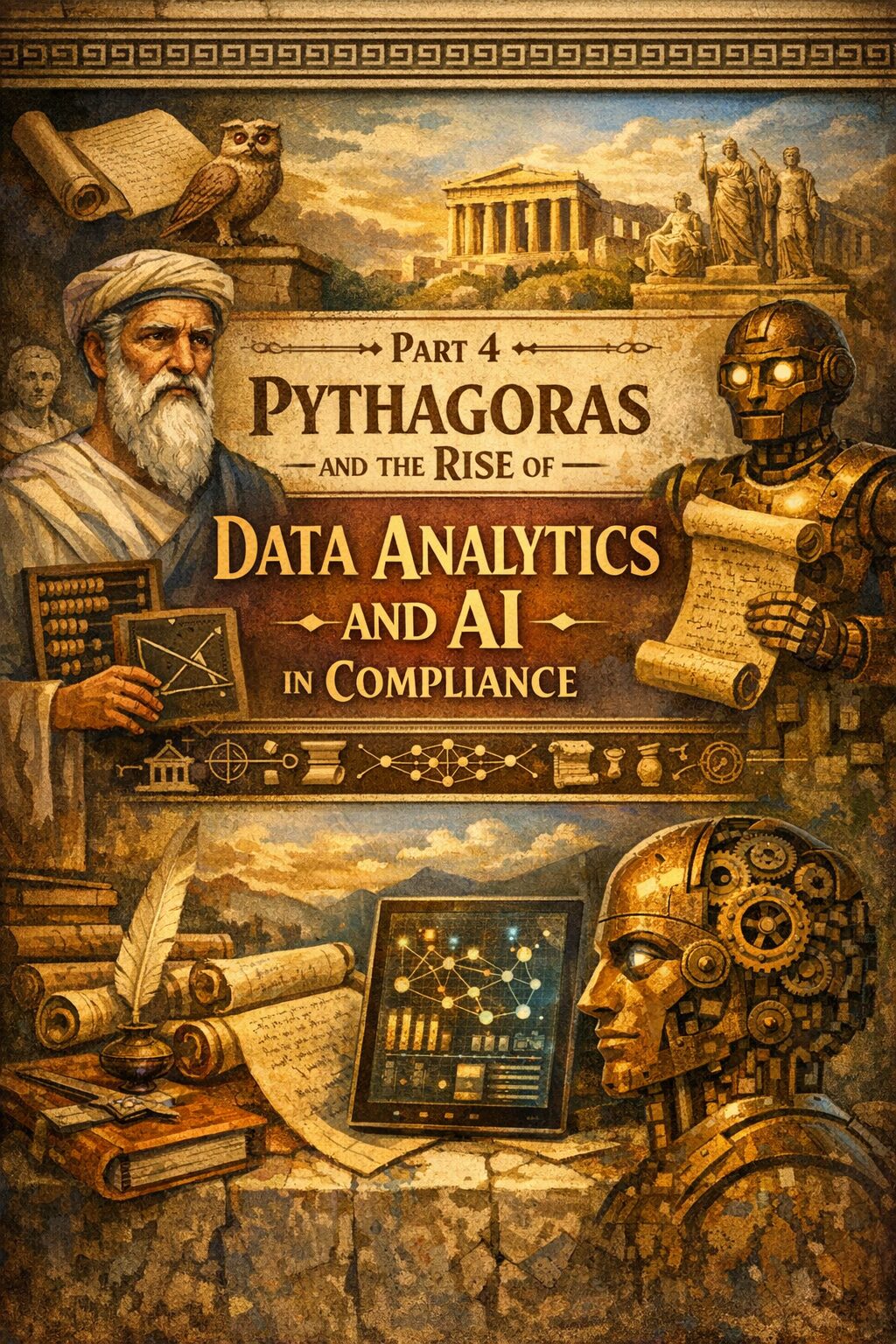
Greek Philosophers Week: Part 4 – Pythagoras and the Rise of Data Analytics and AI in Compliance

We continue our exploration of the origins of the modern corporate compliance organization in Part 4, looking at Pythagoras. Aristotle teaches compliance professionals how ethics are lived through judgment, habit, and daily decision-making. But modern organizations operate at a scale Aristotle could never have imagined. Thousands of transactions, third parties, employees, and decisions occur simultaneously across jurisdictions. At that scale, judgment alone is not enough. Measurement becomes essential. That is where Pythagoras enters the compliance conversation.

Pythagoras believed that reality could be understood through number, proportion, and harmony. He did not see numbers as cold abstractions but as tools to reveal the underlying truth. That belief sits squarely at the heart of modern compliance analytics, continuous monitoring, and artificial intelligence. The DOJ Evaluation of Corporate Compliance Programs (ECCP) increasingly reflects this Pythagorean turn, asking not only whether programs exist, but whether companies use data to test effectiveness, identify patterns, and evolve.

If Aristotle teaches us how people should behave, Pythagoras teaches us how to observe whether they actually do. Or as Vince Walden might say, it’s always about the numbers.

“All Is Number” and the Measurement of Compliance Effectiveness

Pythagoras’ famous assertion that “all is number” resonates strongly in today’s compliance environment. Modern programs rely on metrics to understand risk exposure, detect anomalies, and allocate resources. Hotline data, transaction monitoring, third-party risk scores, training completion rates, and investigation timelines are all numerical expressions of ethical behavior.

The ECCP explicitly asks whether companies track and analyze data to assess program effectiveness and, equally important, whether the compliance function has access to this data. The ECCP states, “Do compliance and control personnel have sufficient direct or indirect access to relevant sources of data to allow for timely and effective monitoring and/or testing of policies, controls, and transactions? ” This is not a technological preference. It is a governance expectation. Regulators understand that unmanaged data obscures risk, while well-designed analytics reveal it.

In daily operations, compliance professionals must decide what to measure and why. Pythagoras reminds us that numbers should illuminate reality, not replace it. Metrics must be chosen deliberately, tied to risk, and interpreted with care. Counting activity is easy. Measuring insight requires discipline. The ECCP goes on to ask the following questions: Is the company appropriately leveraging data analytics tools to create efficiencies in compliance operations and measure the effectiveness of components of compliance programs?

Proportion and the Danger of Over-Engineered Analytics

Pythagoras placed enormous importance on proportion and balance. Harmony emerged when relationships were mathematically sound. This lesson is critical for compliance programs rushing to adopt advanced analytics and AI. The ECCP expects data-driven compliance, but it does not reward excess, stating, “Is the company appropriately leveraging data analytics tools to create efficiencies in compliance operations and measure the effectiveness of components of compliance programs? ” Overly complex monitoring systems often generate false positives that overwhelm teams and erode trust with the business. Employees begin to see compliance as noise rather than guidance. Investigators drown in alerts rather than insights.

A Pythagorean approach demands proportionality. Analytics should scale to risk. High-risk transactions deserve deeper scrutiny. Low-risk activity should not consume disproportionate resources. AI models must be tuned to business reality, not theoretical perfection. Balance, not volume, produces effectiveness.

Harmony of Systems and Breaking Down Data Silos

Pythagoras believed that harmony arises when individual elements work together according to rational relationships. In compliance, this translates into integration. One of the most common failures in compliance analytics is fragmentation. Compliance data lives in one system. HR data in another. Finance and audit data elsewhere. Each tells a partial story. None reveals the whole picture.

The ECCP increasingly expects companies to connect these dots. Patterns of misconduct often emerge only when data sets are viewed together. For example, high sales pressure combined with weak supervision and delayed training may more accurately predict risk than any single metric. Daily compliance operations should therefore focus on integration. Data governance, cross-functional collaboration, and shared dashboards are not IT luxuries. They are an ethical infrastructure. Pythagoras teaches that truth emerges through harmony, not isolation.

AI in Compliance: Augmentation, Not Abdication

Pythagoras revered numbers, but he did not confuse measurement with wisdom. That distinction is critical as compliance programs adopt AI. Artificial intelligence can identify patterns humans miss. It can process a scale impossible for manual review. But it cannot understand intent, fairness, or ethical nuance. The ECCP implicitly acknowledges this by emphasizing human oversight, explainability, and accountability.

A Pythagorean compliance program treats AI as an instrument, not an authority. Algorithms inform decisions. Humans make them. Compliance professionals must understand how models work, what data they rely on, and where bias may emerge. Black-box systems that cannot be explained to regulators or boards undermine trust and increase risk. The lesson is clear. AI should strengthen judgment, not replace it.

Ethical Design of Metrics and Models

Pythagoras viewed mathematical relationships as expressions of order. In the context of compliance, this means that metrics and models must reflect ethical intent. What a company chooses to measure sends a signal. Measuring speed over quality encourages shortcuts. Measuring volume over impact encourages superficial activity. The ECCP asks whether metrics drive meaningful improvement or merely create the appearance of control, stating, “How is the company measuring the accuracy, precision, or recall of any data analytics models it is using? ”

In daily practice, compliance professionals must evaluate whether dashboards reflect what truly matters. Are metrics aligned with values? Do they incentivize the right behavior? Are they reviewed and refined as risks evolve? Pythagoras teaches that poorly designed numbers distort reality rather than reveal it.

5 Key Takeaways for the Compliance Professional

1. Data is foundational to modern compliance effectiveness.

Pythagoras teaches that numbers reveal truth when used correctly. The ECCP expects compliance programs to use data to assess risk and effectiveness. Daily operations should rely on metrics that illuminate behavior, not merely document activity. Thoughtful measurement enables early detection, targeted remediation, and informed decision-making across the organization.

2. Proportion is critical in analytics and AI deployment.

More data is not better data. Over-engineered systems overwhelm teams and erode credibility. A Pythagorean approach emphasizes balance. Analytics and AI should be scaled to risk and organizational maturity. Proportional systems produce insight without fatigue, supporting both effectiveness and trust.

3. Integrated data reveals systemic risk.

Isolated metrics tell incomplete stories. Pythagoras’ concept of harmony applies directly to compliance data integration. The ECCP increasingly expects cross-functional insight. Compliance professionals should work to connect data across compliance, HR, finance, and audit to identify patterns that go unnoticed in silos.

4. AI must augment, not replace, human judgment.

Numbers do not equal wisdom. AI tools support scale and pattern recognition, but ethical decisions require human oversight. The ECCP emphasizes accountability and explainability. Compliance professionals must understand, govern, and challenge AI outputs rather than defer to them.

5. Metrics are ethical choices.

What gets measured shapes behavior. Poorly designed metrics distort incentives and undermine values. Pythagoras reminds us that numbers carry moral weight. Compliance leaders must ensure metrics align with ethical goals and drive meaningful improvement, not superficial compliance.

From Pythagoras to Euclid: From Measurement to Proof

Pythagoras introduces compliance professionals to the power and peril of numbers. He shows how data, analytics, and AI can reveal patterns, test assumptions, and bring harmony to complex systems. But measurement alone is not enough. At some point, regulators, boards, and stakeholders will ask a harder question. Can you prove your program works?

That is where Euclid completes the journey. If Pythagoras teaches us how to measure compliance, Euclid teaches us how to structure it logically, define it precisely, and demonstrate effectiveness through proof rather than assertion. The Euclid post you have already written stands as the natural capstone to this series, translating philosophical insight into a compliance system that is coherent, defensible, and built to endure.

Pythagoras shows us how to see compliance through numbers. Euclid will show us how to organize those insights into a system that proves its own effectiveness. Join us tomorrow in our concluding blog post to find out how.