Categories
Blog

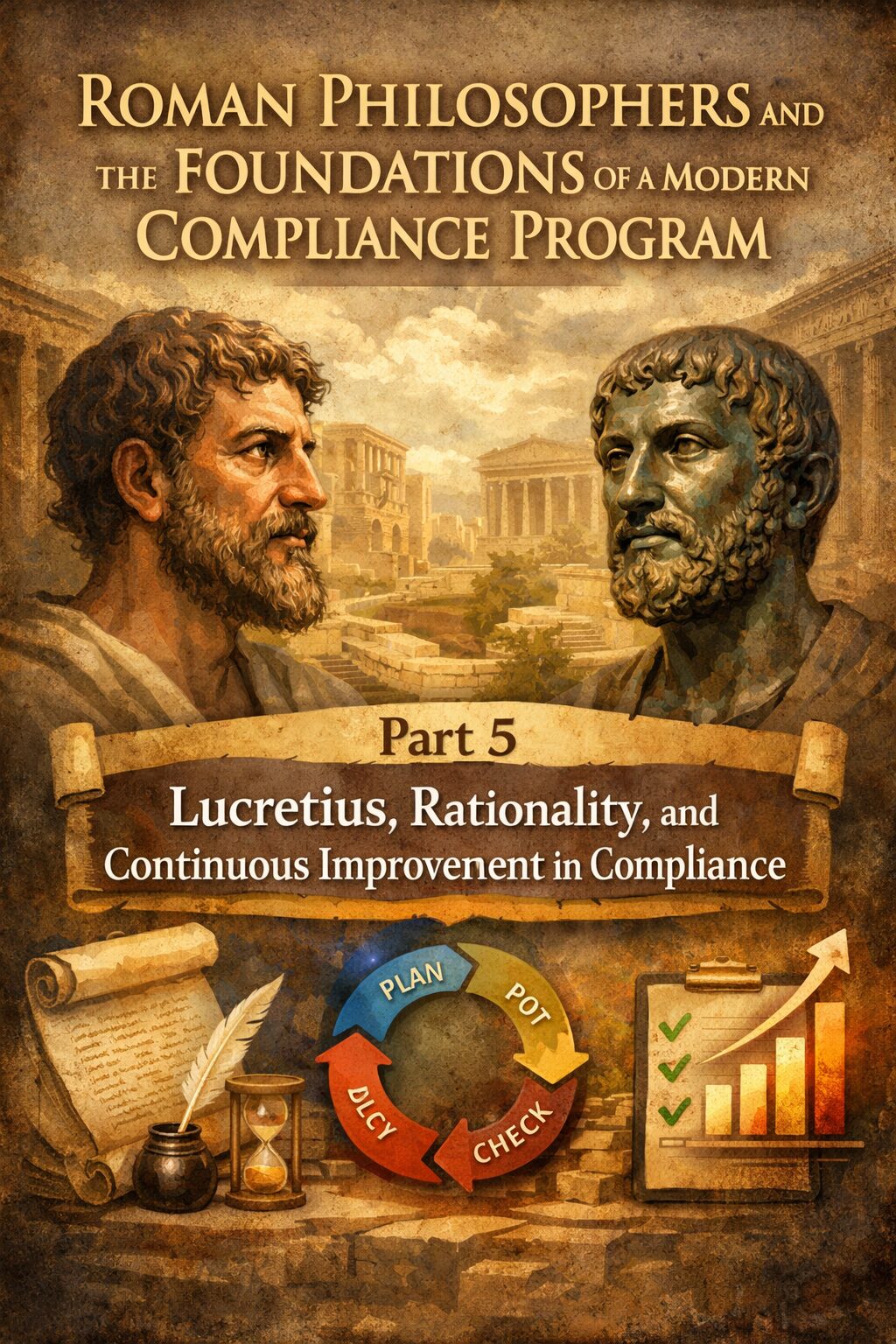
Roman Philosophers and the Foundations of a Modern Compliance Program: Part 5 – Lucretius, Rationality, and Continuous Improvement in Compliance

Welcome to our concluding blog post on notable Roman Philosophers and the philosophical underpinnings of modern corporate compliance programs and compliance professionals, focusing on five philosophers from Rome spanning the end of the Roman Republic to the Roman Empire.

We have considered Cicero and the duty, law, and the moral limits of business; Seneca on power, pressure, and ethical decision-making under stress; Varro on corporate governance; and Marcus Aurelius on ethical leadership and tone at the top. Today, we conclude with Lucretius to explore rationality, fear, and risk perception.

I. Lucretius in Context: Seeing the World Clearly

Titus Lucretius Carus is the outlier in the Roman philosophical tradition, and that is precisely why he matters to compliance professionals. In De Rerum Natura (On the Nature of Things), Lucretius set out to explain the world as it actually is, stripped of superstition, fear, and comforting illusions. He believed that human suffering and bad decision-making were driven less by malice than by misunderstanding.

Lucretius lived in a Roman world gripped by fear of divine punishment, fate, and unseen forces. He argued that when people attribute events to superstition or rumor rather than observation and evidence, they lose the ability to respond rationally. Fear, in his view, was the enemy of clear judgment. Only through disciplined observation and reason could individuals and institutions act wisely.

For modern compliance professionals, Lucretius offers a final and essential lesson. Even the best-designed compliance program, staffed by accountable individuals and supported by ethical leadership, will fail if it cannot see itself clearly. Programs that rely on assumptions, anecdotes, or reputation rather than evidence inevitably drift. Lucretius teaches that rational observation is not merely a scientific virtue. It is an ethical one.

II. The Compliance Problem Lucretius Illuminates: Blind Spots and Compliance Theater

Many compliance programs operate on belief rather than proof. Leaders believe the culture is strong. Boards believe controls are effective. Compliance teams believe training is working. Yet enforcement actions routinely reveal blind spots that persisted for years, unnoticed or unchallenged. This gap between belief and reality is what Lucretius would have called superstition. In compliance, it takes the form of compliance theater: dashboards that look reassuring, certifications that go unquestioned, and metrics that measure activity rather than effectiveness.

The DOJ Evaluation of Corporate Compliance Programs (ECCP) repeatedly asks whether companies test, monitor, and improve their programs. Prosecutors are explicit that assumptions are insufficient. They want evidence that the program detects misconduct, adapts to change, and evolves based on lessons learned. Fear plays a central role here. Organizations fear discovering problems. They fear bad news reaching the board. They fear regulatory scrutiny. Lucretius warned that fear distorts perception. In compliance terms, fear leads to underreporting, superficial audits, and avoidance of uncomfortable data.

A compliance program that cannot tolerate evidence of weakness cannot improve. Lucretius insists that rational systems must prefer truth over comfort.

III. Modern Corporate Application: Lucretius, DOJ Expectations, and Evidence-Based Compliance

Applying Lucretius to modern compliance highlights the central role of monitoring, testing, and continuous improvement.

First, compliance monitoring must focus on effectiveness, not volume. Counting training completions or hotline calls says little about whether the program works. Lucretius would insist on asking harder questions. Are issues detected early? Are repeat risks declining? Are controls changing behavior?

Second, data must be interpreted without fear. DOJ guidance emphasizes learning from misconduct and near misses. Yet many organizations treat incidents as anomalies rather than signals. Lucretius teaches that patterns matter more than isolated events. Compliance teams should analyze trends across regions, functions, and time, even when results are uncomfortable.

Third, programs must adapt to changing risk. Lucretius rejected static explanations of the world. The DOJ similarly asks whether compliance programs evolve as business models, markets, and technologies change. A program designed for yesterday’s risks becomes a liability when conditions shift.

Fourth, monitoring must include culture and behavior, not just transactions. Culture surveys, exit interviews, and speak-up analytics provide insight into employees’ trust in the system. Lucretius would caution against ignoring qualitative data simply because it is harder to measure.

Fifth, continuous improvement must be documented and demonstrable. The DOJ evaluates whether companies close the loop by updating controls, training, and governance in response to findings. Rational compliance requires not only seeing clearly but acting on what is seen.

Finally, compliance leaders must resist narrative-driven assurance. Statements such as “this has never happened before” or “we trust our people” are not evidence. Lucretius reminds us that trust is strengthened, not weakened, by verification.

IV. Key Takeaways for Compliance Professionals

1. Father of CM/CI. Compliance professionals should view Lucretius as the philosophical foundation of monitoring and continuous improvement. Lucretius grounds compliance in disciplined observation rather than comfort or tradition. He reminds compliance professionals that a program cannot improve what it refuses to examine honestly. Monitoring and continuous improvement are not technical exercises but ethical commitments to see the organization as it truly operates.

2. Fact-based. Compliance should privilege evidence over assumption. Assumptions about culture, control effectiveness, or employee behavior create blind spots that persist until a failure forces attention. Lucretius warns that belief without verification is a form of self-deception. An effective compliance program insists on data, testing, and validation rather than reassurance.

3. Measure outcomes, not activity. Compliance should design metrics that measure effectiveness, not activity. Counting trainings delivered or policies acknowledged does not demonstrate that misconduct is being prevented or detected. Lucretius would reject metrics that comfort leadership without revealing reality. Compliance metrics must answer whether controls change behavior and reduce risk, not merely whether processes occurred.

4. Information is data. Compliance should treat incidents and near misses as data, not embarrassment. Organizations often hide or minimize incidents out of fear of reputational harm or internal scrutiny. Lucretius teaches that fear distorts judgment and delays learning. A mature compliance program uses incidents and near misses as signals for improvement rather than reasons for denial.

5. Risks Change. Compliance should evolve as risks, markets, and technologies change. Static compliance programs assume the world remains stable, an assumption Lucretius would view as fundamentally irrational. This is certainly not true in the age of Trump. Business models, geopolitical risks, and technologies shift faster than policy cycles. Continuous adaptation is the only rational response to an environment in constant motion.

6. Embrace Observation. Compliance should embrace rational observation as an ethical obligation. Seeing clearly is not morally neutral; it is a responsibility owed to stakeholders and institutions. Lucretius argued that ignorance sustained by fear causes harm. In compliance, choosing not to look is itself an ethical failure.

7. Evidence-based. Finally, Lucretius teaches that organizations fail not because reality is unknowable, but because they choose not to look. This is the capstone lesson of the compliance lifecycle. Organizations that avoid uncomfortable facts drift into compliance theater and false confidence. Rational, evidence-based compliance treats truth as an asset, even when it reveals weakness.

V. Conclusion: Roman Philosophy and the Compliance Program That Actually Works

Taken together, these five Roman philosophers describe the full lifecycle of a modern compliance program as it exists in the real world, not as it appears in policy manuals. Cicero establishes why compliance must exist at all, grounding the program in duty rather than expediency and reminding organizations that law is only the starting point. Seneca then confronts the reality that ethical commitments are tested under pressure, exposing how fear, ambition, and rationalization undermine even well-designed systems. Epictetus moves the analysis to the individual, insisting that ethical responsibility does not disappear inside hierarchy and that compliance ultimately depends on personal agency. Marcus Aurelius elevates that responsibility to leadership, showing how culture is formed through example and how ethical expectations live or die by the behavior of executives. Finally, Lucretius closes the loop, demanding rational observation, evidence, and continuous improvement so that compliance programs do not drift into assumption, superstition, or complacency.

What makes the Roman philosophers uniquely valuable to compliance professionals is their focus on institutions, power, and human behavior under constraint. The Greeks gave us ethical ideals. The Romans showed us how those ideals survive, or fail, inside complex systems. This mirrors the Department of Justice’s modern approach to compliance, which increasingly evaluates not whether a program exists, but whether it operates, adapts, and functions under real-world conditions.

For the compliance professional, the lesson of this series is both sobering and empowering. No single control, policy, or training module is sufficient. Effective compliance requires ethical foundations, behavioral awareness, individual accountability, principled leadership, and disciplined monitoring working together as an integrated system. Remove any one of these elements, and the program weakens. Align them, and compliance becomes not a defensive function, but a durable governance capability.

In combining these Roman insights with the earlier Greek philosophical foundations, the compliance professional gains more than historical perspective. They gain a framework for building programs that withstand pressure, earn trust, and evolve. In the end, that is the measure of a compliance program that actually works.
Categories
Compliance Tip of the Day

Compliance Tip of the Day – AI, Continuous Monitoring and Compliance

Welcome to “Compliance Tip of the Day,” the podcast where we bring you daily insights and practical advice on navigating the ever-evolving landscape of compliance and regulatory requirements. Whether you’re a seasoned compliance professional or just starting your journey, we aim to provide you with bite-sized, actionable tips to help you stay on top of your compliance game. Join us as we explore the latest industry trends, share best practices, and demystify complex compliance issues to keep your organization on the right side of the law. Tune in daily for your dose of compliance wisdom, and let’s make compliance a little less daunting, one tip at a time.

Today, we consider how AI can give your compliance program continuous monitoring going forward.

For more on this topic, check out The Compliance Handbook, a Guide to Operationalizing your Compliance Program, 6th edition, which LexisNexis recently released. It is available here.

Categories
Compliance Tip of the Day

Compliance Tip of the Day – Citibank and Continuous Monitoring

Welcome to “Compliance Tip of the Day,” the podcast that brings you daily insights and practical advice on navigating the ever-evolving landscape of compliance and regulatory requirements. Whether you’re a seasoned compliance professional or just starting your journey, our goal is to provide you with bite-sized, actionable tips to help you stay ahead in your compliance efforts. Join us as we explore the latest industry trends, share best practices, and demystify complex compliance issues to keep your organization on the right side of the law. Tune in daily for your dose of compliance wisdom, and let’s make compliance a little less daunting, one tip at a time.

Today, we consider how Citibank used continuous monitoring as an AML tool.

For more information on this topic, refer to The Compliance Handbook: A Guide to Operationalizing Your Compliance Program, 6th edition, recently released by LexisNexis. It is available here.

Categories
Compliance Tip of the Day

Compliance Tip of the Day – Using AI for Continuous Monitoring

Welcome to “Compliance Tip of the Day,” the podcast where we bring you daily insights and practical advice on navigating the ever-evolving landscape of compliance and regulatory requirements. Whether you’re a seasoned compliance professional or just starting your journey, we aim to provide bite-sized, actionable tips to help you stay on top of your compliance game. Join us as we explore the latest industry trends, share best practices, and demystify complex compliance issues to keep your organization on the right side of the law. Tune in daily for your dose of compliance wisdom, and let’s make compliance a little less daunting, one tip at a time.

Today, we consider how AI allows compliance to take a proactive, data-driven approach to emerging risk analytics.

For more information on the Ethico Toolkit for Middle Managers, available at no charge, click here.

Check out the entire 3-book series, The Compliance Kids, on Amazon.com.

Categories
Blog

AI in Compliance: Part 5 – Leveraging AI for Continuous Monitoring

In Part 5, we conclude our five-part series on using AI in a compliance program. In today’s concluding blog post, we look at using AI for continuous monitoring. Traditional monitoring and auditing approaches, typically reliant on periodic audits and manual reviews, are simply not sufficient in this post-COVID world of instant Black Swan events. Enter artificial intelligence (AI), a transformative tool that enables continuous monitoring and reporting across financial transactions, procurement processes, and operational activities.

AI allows compliance professionals to set customized thresholds for acceptable behavior, flag anomalies, and generate tailored reports that provide actionable insights to stakeholders. This strengthens the compliance function and aligns with the DOJ’s 2024 Evaluation of Corporate Compliance Programs (2024 ECCP) emphasis on dynamic, data-driven compliance systems. Today, we will explore how AI reshapes continuous monitoring and reporting, its best applications, and how to implement it effectively while addressing deployment challenges.

The Case for Continuous Monitoring with AI 

Continuous monitoring is the backbone of a proactive compliance program. It enables organizations to complete several different compliance tasks, including identifying issues in real time. Instead of waiting for the next audit or whistleblower report, AI-driven monitoring systems can detect anomalies as they occur. This allows you to mitigate risks early, as prompt alerts allow compliance teams to investigate and remediate potential violations before they escalate. Finally, it enhances accountability, as automated monitoring creates an auditable trail of compliance activities, bolstering transparency and trust. AI amplifies these benefits by processing vast amounts of data, identifying patterns, and learning from new information.

Applications of AI in Continuous Monitoring

There are several ways AI can assist the compliance professional. In financial transactions, AI-powered systems can analyze financial transactions to identify irregularities that might signal fraud, corruption, or money laundering. AI can do so by flagging a series of payments under the approval threshold to a vendor in a high-risk jurisdiction. Such notice would allow compliance or internal audit to investigate whether these payments circumvent anti-bribery controls, potentially averting an FCPA violation.

This type of monitoring is the backbone of compliance detection, but now it can be done in real time. AI can detect round-dollar payments, split invoices, or unusual payment patterns. It can also monitor transactions against sanction lists and politically exposed persons (PEP) databases. Finally, AI can analyze historical data to refine thresholds and reduce false positives.

AI is equally proficient in the procurement process, where multiple areas of compliance risk can arise, including bribery, conflicts of interest, and vendor fraud. An example might be when AI detects a pattern where a single employee consistently selects a particular vendor despite higher bids or less favorable terms. The result could be an investigation that reveals a conflict of interest, enabling swift corrective action.

AI is also well suited for monitoring potential conflicts of interest through real-time tasks such as comparing procurement decisions against benchmarks for fairness and competitiveness, identifying relationships between employees and vendors through data mapping, and spotting deviations from approved procurement policies or procedures.

Operational activities are always a challenge for corporate compliance, as they are so dynamic and certainly rife with compliance challenges. AI enables organizations to monitor these areas dynamically. AI can facilitate real-time warning systems, such as sensors in a manufacturing plant feeding data to an AI system, which flags a series of maintenance delays that could violate environmental or safety regulations. This could allow compliance to address the lapses before they result in fines or accidents.

Automating Compliance Reporting with AI

AI does not stop at monitoring; it revolutionizes reporting by automating the generation of tailored compliance dashboards. These dashboards provide stakeholders with the information they need to make informed decisions.

  1. Real-Time Dashboards for Leadership. A Board of Directors and C-suite require high-level overviews of compliance performance. AI-powered dashboards can present such areas as key risk indicators (KRIs) across functions and geographies. It can graph trends in incidents, investigations, and remediation efforts. It can develop heat maps highlighting high-risk areas. By automating these insights, AI saves time and ensures consistency, allowing leadership to focus on strategy rather than data collection.
  2. Regulatory Reporting. AI can streamline submissions to regulators for industries with strict reporting requirements, from industries and verticals as diverse as financial services to healthcare and everything in between. AI can compile and validate data for anti-money laundering (AML) reports in the financial regulatory world, ensuring accuracy and compliance with reporting standards. This can reduce errors, faster submissions, and fewer regulatory penalties.
  3. Internal Audit Support. Internal auditors need detailed, granular data to assess compliance effectiveness. AI enhances their capabilities by generating reports on specific transactions or activities. AI can highlight recurring issues or control gaps. It can Document Document Documents by providing audit trails for all monitoring activities.

Best Practices for Implementing AI in Monitoring and Reporting

Many compliance professionals struggle with implementing AI into their compliance regimes. The key is to start small, test and validate, and then build out and scale. Begin by customizing your thresholds and parameters. AI systems are only as effective as the thresholds and rules you provide them. Customize these settings based on your organization’s risk profile, industry norms, and regulatory requirements. An example might be to set lower thresholds for transactions in high-risk jurisdictions to capture more potential violations.

You should work to prioritize the integration of AI into your compliance program. AI tools must integrate seamlessly with existing compliance systems, including enterprise resource planning (ERP) and financial and procurement platforms. This ensures consistent data flows and minimizes disruptions.

Building out and scaling are critical as you move forward. You can do this by focusing on the explainability of your AI program. AI systems can sometimes act as “black boxes,” making decisions that are difficult to interpret. You should select AI tools that provide clear, explainable outputs to facilitate investigations and meet regulatory expectations.

You must work to address data quality to combat GIGO (Garbage In, Garbage Out) and move to BIBO (Best Input, Best Output)—the effectiveness of AI hinges on the quality of the data it processes. Implement robust data governance practices to ensure accuracy, consistency, and completeness.

As with most any other corporate initiative, you must work to both train and upskill the employee base, with an emphasis on targeted training for key AI team members. You must ensure compliance teams understand how to use AI tools effectively. Provide training on interpreting AI outputs, refining thresholds, and integrating insights into decision-making processes.

Challenges and Aligning AI with DOJ Expectations   

While AI offers transformative potential, you must work to navigate challenges ethically and responsibly. Beware of false positives, as an overly sensitive AI system may generate excessive alerts, leading to “alert fatigue.” Regularly review and adjust thresholds to maintain balance. Data Privacy should also be at the forefront of your concerns. Ensure compliance with data privacy laws, such as GDPR or CCPA, particularly when monitoring employee or vendor activities. Finally, you must make sure there is no bias in algorithms. AI models must be tested for biases that could lead to unfair treatment of certain groups or regions.

The DOJ’s 2024 ECCP emphasizes the need for data-driven, dynamic compliance programs. AI aligns with these expectations by enabling real-time monitoring, providing transparency through automated reporting, creating a clear, auditable trail of compliance activities, and supporting continuous improvement. To demonstrate alignment with DOJ expectations, document how AI tools are used, the insights they generate, and how these insights inform decision-making.

The Future of Compliance Monitoring and Reporting 

AI is revolutionizing compliance by making continuous monitoring and reporting more efficient, effective, and transparent. By harnessing AI, organizations can anticipate and address risks in real-time, provide actionable insights to stakeholders, and build programs that meet the highest regulatory standards. However, AI is not a panacea. Its success depends on thoughtful implementation, ethical use, and a commitment to continuous improvement. The bottom line for a compliance professional is that a compliance program that cannot see around corners simply needs to be better. AI gives us the vision to anticipate risks, act decisively, and build stakeholder trust. Finally, always remember the human in the loop.