Categories
31 Days to More Effective Compliance Programs

31 Days to a More Effective Compliance Program: Day 14 – Internal Controls

What are internal controls? The best definition I have come across is from Jonathan Marks, partner at BDO, who defined internal controls as:

An internal control is an action or process of interlocking activities designed to support the policies and procedures detailing the specific preventative, detective, corrective, directive, and corroborative actions required to achieve the desired process outcomes or objectives. This, along with continuous auditing, continuous monitoring, and training, reasonably assures:

• The achievement of the process objectives linked to the organization’s objectives;

• Operational effectiveness and efficiency;

• Reliable (complete and accurate) books and records (financial reporting);

• Compliance with laws, regulations and policies; and

• The reduction of risk fraud, waste, and abuse, which aids in the decline of process and policy variation, leading to more predictive outcomes.

The bottom line is that internal controls are just good financial controls. The internal controls that detail requirements for third-party representatives in the compliance context will help to detect fraud, which could well lead to bribery and corruption. As an exercise, map your existing internal controls to the Hallmarks of an Effective Compliance Program or some other well-known anti-corruption regime to see where gaps may exist. This will help you determine whether adequate internal compliance controls are present in your company. From there, you can move on to see if they are working in practice.

Three key takeaways:

1. Effective internal controls are required under the FCPA

2. Internal controls are a critical part of any best practices compliance program

3. There are four significant controls for the compliance practitioner to implement initially. (a) Delegation of authority (DOA); (b) Maintenance of the vendor master file; (c) Contracts with third parties; and (d) Movement of cash or currency

Categories
Blog

Internal Controls

What are internal controls? The best definition I have come across is from Jonathan Marks, partner at BDO, who defined internal controls as:

An internal control is an action or process of interlocking activities designed to support the policies and procedures detailing the specific preventative, detective, corrective, directive and corroborative actions required to achieve the desired process outcomes or the objectives(s). This, along with continuous auditing, continuous monitoring and training reasonably assures:

The achievement of the process objectives linked to the organization’s objectives;

Operational effectiveness and efficiency;

Reliable (complete and accurate) books and records (financial reporting);

Compliance with laws, regulations and policies; and

The reduction of risk-fraud, waste and abuse, which, aids in the decline of process and policy variation, leading to more predictive outcomes.

What specifically are internal controls in a compliance program? The starting point is the FCPA itself, which requires issuers to devise and maintain a system of internal controls that can reasonably assure:

1. Transactions are executed in accordance with management’s general or specific authorization;

2. Transactions are recorded as necessary (I) to permit preparation of financial statements in conformity with generally accepted accounting principles or any other criteria applicable to such statements, and (II) to maintain accountability for assets;

3. Access to assets is permitted only in accordance with management’s general or specific authorization; and

4. The recorded accountability for assets is compared with the existing assets at reasonable intervals and appropriate action is taken with respect to any differences.

The DOJ and SEC, in the 2020 FCPA Resource Guide, 2nd edition, stated:

Internal controls over financial reporting are the processes used by companies to provide reasonable assurances regarding the reliability of financial reporting and the preparation of financial statements. They include various components, such as: a control environment that covers the tone set by the organization regarding integrity and ethics; risk assessments; control activities that cover policies and procedures designed to ensure that management directives are carried out (e.g., approvals, authorizations, reconciliations, and segregation of duties); information and communication; and monitoring. … The design of a company’s internal controls must take into account the operational realities and risks attendant to the company’s business, such as: the nature of its products or services; how the products or services get to market; the nature of its work force; the degree of regulation; the extent of its government interaction; and the degree to which it has operations in countries with a high risk of corruption.

This was supplemented in the 2023 ECCP, with a pair of pointed questions: whether a company has made significant investigation into its internal controls and have they been tested, then remediated based upon the testing?

The whole concept of internal controls is that companies need to focus on where the risks—compliance or otherwise—are and then allocate their limited resources to putting controls in place that address those risks. In the compliance world, of course, your two biggest risks are 1) company assets or resources, marketing expenses, petty cash or other sources of funds being used to pay a bribe, and 2) diversion of company assets, such as unauthorized sales discounts or receivables and write offs used to pay a bribe.

There are four significant controls for the compliance practitioner to implement initially. They are:

1. Delegation of authority (DOA);

2. Maintenance of the vendor master file;

3. Contracts with third parties; and

4. Movement of cash/currency.

Your DOA should reflect the impact of compliance risk including both transactions and geographic location so that a higher level of approval for matters involving third parties, for fund transfers and invoice payments to countries outside the US would be required inside your company.

Next is the vendor master file, which can be a powerful preventative control tool largely because payments to fictitious vendors are one of the most common occupational frauds. The vendor master file should be structured so that each vendor can be identified not only by risk level but also by the date on which the vetting was completed and the vendor received final approval. There should be electronic controls in place to block payments to any vendor for which vetting has not been approved. Internal controls are needed over the submission, approval, and input of changes to the vendor master file.

Contracts with third parties can be a very effective internal control that works to prevent nefarious conduct rather than simply as a detect control. For contracts to provide effective internal controls, however, relevant terms of those contracts—including, for instance, the commission rate, reimbursement of business expenses, use of subagents, etc.,—should be made available to those who process and approve vendor invoices.

All situations involving the movement of cash or transfer of monies outside the US—including such methods as computer checks, manual checks, wire transfers, replenishment of petty cash, loans, and advances—should be reviewed from the compliance risk standpoint. This means identifying the ways in which a country manager or a sales manager could cause funds to be transferred to their control and to conceal the true nature of the use of the funds within the accounting system.

To prevent these types of activities, internal controls need to be in place. All wire transfers outside the US should have defined approvals in the DOA. The persons who execute the wire transfers should be required to evidence agreement of the approvals to the DOA, and wire transfer requests going out of the US should always require dual approvals. Lastly, wire transfer requests going outside the US should be required to include a description of proper business purpose.

The bottom line is that internal controls are just good financial controls. The internal controls that detail requirements for third-party representatives in the compliance context will help to detect fraud, which could well lead to bribery and corruption. As an exercise, map your existing internal controls to the Hallmarks of an Effective Compliance Program or some other well-known anti-corruption regime to see where gaps may exist. This will help you to determine whether adequate compliance internal controls are present in your company. From there you can move to see if they are working in practice.

Categories
31 Days to More Effective Compliance Programs

Day 31 to a More Effective Compliance Program: Day 13 – Policies and Procedures

There are numerous reasons to put some serious work into your compliance policies and procedures. They are certainly the first line of defense when the government comes knocking. The 2023 ECCP made clear that “Any well-designed compliance program entails policies and procedures that give both content and effect to ethical norms and that address and aim to reduce risks identified by the company as part of its risk assessment process.” This statement made clear that the regulators will take a strong view against a company that does not have well-thought-out and articulated policies and procedures against bribery and corruption, all of which are systematically reviewed and updated. Moreover, having policies written out and signed by employees provides what some consider the most vital layer of communication and acts as an internal control. Together with a signed acknowledgement, these documents can serve as evidentiary support if a future issue arises. In other words, the “Document, Document, and Document” mantra applies just as strongly to policies and procedures in anti-corruption compliance.

Three key takeaways:

1. Written compliance policies and procedures, together with the Code of Conduct, form the backbone of your compliance program.

2. The DOJ and SEC expect a well-thought-out and articulated set of compliance policies and procedures and that they be adequately communicated throughout your organization.

3. Institutional fairness for the application of policies and procedures demands consistent application of your policies and procedures across the globe.

Categories
Blog

Policies and Procedures

There are numerous reasons to put some serious work into your compliance policies and procedures. They are certainly a first line of defense when the government comes knocking. The 2023 ECCP made clear that “Any well-designed compliance program entails policies and procedures that give both content and effect to ethical norms and that address and aim to reduce risks identified by the company as part of its risk assessment process.” This statement made clear that the regulators will take a strong view against a company that does not have well thought out and articulated policies and procedures against bribery and corruption; all of which are systematically reviewed and updated. Moreover, having policies written out and signed by employees provides what some consider the most vital layer of communication and acts as an internal control. Together with a signed acknowledgement, these documents can serve as evidentiary support if a future issue arises. In other words, the “Document, Document, and Document” mantra applies just as strongly to policies and procedures in anti-corruption compliance.

The specific written policies and procedures required for a best practices compliance program are well known and long established. According to the 2020 FCPA Resource Guide 2nd edition, some of the risks companies should keep in mind include the nature and extent of transactions with foreign governments (including payments to foreign officials); use of third parties; gifts, travel, and entertainment expenses; charitable and political donations; and facilitating and expediting payments. Policies help form the basis of expectations for standards of conduct in your company. Procedures are the documents that implement these standards of conduct.

Compliance policies do not guarantee employees will always make the right decision. However, the effective implementation and enforcement of compliance policies demonstrate to the government that a company is operating professionally and ethically for the benefit of its stakeholders, its employees and the community it serves.

There are five general elements to a compliance policy, which should stake out the following:

  • Identify who the compliance policy applies to;
  • Set out the objective of the compliance policy;
  • Describe why the compliance policy is required;
  • Outline examples of both acceptable and unacceptable behavior under the compliance policy; and
  • Lay out the specific consequences for failure to comply with the compliance policy.

The 2023 ECCP went further by requiring an assessment whether a company has established policies and procedures that incorporate the culture of compliance into its day-to-day operations, through a design which is appropriate to the organization, based upon that organization’s assessed risks.

Design––What is the company’s process for designing and implementing new policies and procedures and updating existing policies and procedures, and has that process changed over time? Who has been involved in the design of policies and procedures? Have business units been consulted prior to rolling them out?

Comprehensiveness––What efforts has the company made to monitor and implement policies and procedures that reflect and deal with the spectrum of risks it faces, including changes to the legal and regulatory landscape?

The 2023 ECCP Evaluation mandated there must be communication of your compliance policies and procedures throughout the workforce and relevant stakeholders such as third parties and business venture partners.

Accessibility––How has the company communicated its policies and procedures to all employees and relevant third parties? If the company has foreign subsidiaries, are there linguistic or other barriers to foreign employees’ access? Have the policies and procedures been published in a searchable format for easy reference? Does the company track access to various policies and procedures to understand what policies are attracting more attention from relevant employees?

Responsibility for Operational Integration––Who has been responsible for integrating policies and procedures? Have they been rolled out in a way that ensures employees’ understanding of the policies? In what specific ways are compliance policies and procedures reinforced through the company’s internal control systems?

Moreover, just as risks evolve, your policies and procedures should evolve. The 2023 ECCP asked the following questions:

  • How often has the company updated its risk assessments and reviewed its compliance policies, procedures, and practices?
  • Has the company undertaken a gap analysis to determine if particular areas of risk are not sufficiently addressed in its policies, controls, or training?
  • What steps has the company taken to determine whether policies/procedures/practices make sense for particular business segments/subsidiaries?
  • Does the company review and adapt its compliance program based upon lessons learned from its own misconduct and/or that of other companies facing similar risks?

The bottom line is that the DOJ expects updates to your policies and procedures needed to be reviewed on a regular basis and updated as your risks evolve.

Finally, the 2020 FCPA Resource Guide, 2nd edition, ends its section on policies with the following, “Regardless of the specific policies and procedures implemented, these standards should apply to personnel at all levels of the company.” It is important that compliance policies and procedures are applied fairly and consistently across the organization. Institutional fairness demands that if compliance policies and procedures are not applied consistently, there is a greater chance that an employee dismissed for breaching a policy could successfully claim he or she was unfairly terminated. Moreover, inconsistent application of your policies and procedures will destroy the credibility of your compliance program. This last point cannot be over-emphasized. If an employee is going to be terminated for fudging their expense accounts in Brazil, you had best make sure that same conduct lands your top producer in the U.S. with the same quality of discipline.


Categories
31 Days to More Effective Compliance Programs

31 Days to a More Effective Compliance Program: Day 12 – Your Code of Conduct

What is the value of having a Code of Conduct? In its early days, a Code of Conduct tended to be lawyer-written and lawyer-driven to wave in a regulator’s face during an enforcement action as proof of ethical overall behavior. Is such a legalistic code effective? Is a Code of Conduct more than simply your company’s internal law? What should be the goal of the creation of your company’s Code of Conduct?

How important is the Code of Conduct? Consider the 2016 SEC enforcement action involving United Airlines, Inc., which turned on a violation of the company’s Code of Conduct. The breach of the Code of Conduct was determined to be an FCPA internal control violation. It involved a clear quid pro quo benefit paid out by United to David Samson, the former Chairman of the Board of Directors of the Port Authority of New York and New Jersey, the public government entity that has authority over, among other things, United’s operations at the company’s huge east coast hub in Newark, NJ.

Three key takeaways:

1. A Code of Conduct is a foundational document in any compliance regime.

2. The substance of your Code of Conduct should be tailored to the company’s culture, to its industry, and to its corporate identity.

3. “Document, Document, and Document” your training and communication efforts regarding your Code of Conduct.

Categories
Blog

Your Code of Conduct

What is the value of having a Code of Conduct? In its early days, a Code of Conduct tended to be lawyer-written and lawyer-driven to wave in regulator’s face during an enforcement action as proof of ethical overall behavior. Is such a legalistic code effective? Is a Code of Conduct more than simply your company’s internal law? What should be the goal in the creation of your company’s Code of Conduct?

How important is the Code of Conduct? Consider the 2016 SEC enforcement action involving United Airlines, Inc., which turned on violation of the company’s Code of Conduct. The breach of the Code of Conduct was determined to be a FCPA internal controls violation. It involved a clear quid pro quo benefit paid out by United to David Samson, the former Chairman of the Board of Directors of the Port Authority of New York and New Jersey, the public government entity which has authority over, among other things, United’s operations at the company’s huge east coast hub at Newark, NJ.

The actions of United’s former CEO, Jeff Smisek, in personally approving the benefit granted to favor Samson violated the company’s internal controls around gifts to government officials by failing to not only follow the United Code of Conduct but also violating it. The $2.4 million civil penalty levied on United was in addition to its 2016 Non-Prosecution Agreement (NPA) settlement with the DOJ, which resulted in a penalty of $2.25 million. The scandal also cost the resignation of Smisek and two high-level executives from United.

In the 2020 FCPA Resource Guide, 2nd edition, the DOJ and SEC stated:

A company’s Code of Conduct is often the foundation upon which an effective compliance program is built. As DOJ has repeatedly noted the most effective codes are clear, concise, and accessible to all employees and to those conducting business on the company’s behalf.

The 2023 ECCP specified “As a threshold matter, prosecutors should examine whether the company has a code of conduct that sets forth, among other things, the company’s commitment to full compliance with relevant Federal laws that is accessible and applicable to all company employees.” The Antitrust Guidance also specified “If the company has a Code of Conduct, are antitrust policies and principles included in the document?”

The 2020 FCPA Resource Guide, 2nd edition, the 2023 ECCP and Antitrust Guidance go on to make it clear that it is difficult to effectively implement a compliance program if it was not available in the local language so that employees in foreign subsidiaries can access and understand it. When assessing a compliance program, DOJ and SEC will review whether the company has taken steps to make certain that the Code of Conduct remains current and effective and whether a company has periodically reviewed and updated its code.

There are several purposes which should be communicated in your Code of Conduct. The overriding goal is for all employees to follow what is required of them under the Code of Conduct. You can do this by communicating those requirements, to providing a process for proper decision-making and then requiring that all persons subject to the Code of Conduct put these standards into everyday business practice. Such actions are some of your best evidence that your company upholds and supports proper compliance.

The substance of your Code of Conduct should be tailored to your company’s culture, and to its industry and corporate identity. It should provide a mechanism by which employees who are trying to do the right thing in the compliance and business ethics arena can do so. The Code of Conduct can be used as a basis for employee review and evaluation. It should certainly be invoked if there is a violation. Your company’s disciplinary procedures must be stated in the Code. These would include all forms of disciplines, up to and including dismissal, for serious violations of the Code. Further, your company’s Code should emphasize it will comply with all applicable laws and regulations, wherever it does business. The code needs to be written in plain English and translated into other languages as necessary so that all applicable persons can understand it.

The three most important things about your compliance program are “Document, Document, and Document.” The same is true in communicating your company’s Code of Conduct. You need to do more than simply put it on your website and tell folks it is there, available and that they should read it. You need to document that all employees, or anyone else that your Code of Conduct is applicable to, has received, read, and understands it. The DOJ expects each company to begin its compliance program with a very publicly announced, very robust Code of Conduct. If your company does not have one, you need to implement one forthwith.

However, your Code of Conduct is not a static document to be put on a shelf and never reviewed again. For just as your compliance program is a living entity; it should be constantly evolving, the same is true for your Code of Conduct. If your company has not reviewed or assessed your Code of Conduct for five years, do so in short order, as much has changed in the compliance world. Some of the questions you should begin with include:

• When was the last time your Code of Conduct was revised?

• Have there been changes to your company’s business model since the last revision to the Code of Conduct?

• Have there been changes to relevant laws relating to a topic covered in your company’s Code of Conduct?

• Are any provisions of the Code of Conduct outdated?

• What is the budget to revise your Code of Conduct?

After revision of your Code of Conduct, you should develop a plan to communicate the revised document. A rollout is always critical because it is important that revisions are communicated in a manner that encourages employees to review and use the Code of Conduct on an ongoing basis. Your company should use the full panoply of tools available to it to publicize the revised Code of Conduct. This can include a multi-media approach or physically handing out a copy to all employees at a designated time. You might consider having a company-wide compliance Code of Conduct roll out meeting where the revised Code is announced with great fanfare out across the company all in one day. Also remember, with all things compliance; the three most important aspects are “Document, Document, and Document”. However, for each delivery of revised Code of Conduct, you must document that each employee received it.

These points are a useful guide to not only thinking through how to determine if your Code of Conduct need updating, but also practical steps on how to tackle the problem. It is far better to review and update your Code of Conduct, than wait for a massive FCPA investigation to go through the process.

Categories
31 Days to More Effective Compliance Programs

31 Days to a More Effective Compliance Program: Day 11 – Moving Compliance Tone Down Through an Organization

The 2023 ECCP made it clear that a company must have more than simply good ‘Tone-at-the-Top’; it must move down through the organization from senior management to middle management and into its lower ranks. It stated, “Beyond compliance structures, policies, and procedures, it is important for a company to create and foster a culture of ethics and compliance with the law at all levels of the company. The effectiveness of a compliance program requires a high-level commitment by company leadership to implement a culture of compliance from the middle and the top.”

Employees often look to their direct supervisor to determine what the tone of an organization is and will be going forward. Many employees of large, multi-national organizations may never have direct contact with the CEO or even senior management. By moving the values of compliance through an organization into the middle, you will be in a much better position to inculcate these values and operationalize compliance with them.

Three key takeaways:

1. Tone at the top—direct supervisors become the most important influence on people in the company

2. Give your middle managers a toolkit around compliance so they can fully operationalize compliance

3. Organizational justice is an additional way to help operationalize compliance

Categories
Blog

Moving Compliance Tone Down Through an Organization

Mike Volkov, in a blog post entitled, Mood in the Middle Versus Tone at the Top, said, “Even when a company does all the right things at the senior management level, the real issue is whether or not that culture has embedded itself in middle and lower management. A company’s culture is reflected in the values and beliefs that exist throughout the company.” To fully operationalize your compliance program, you must articulate the message of ethical values and doing business in compliance and then drive that message from the top down, throughout your organization.

The 2023 ECCP made clear a company must have more than simply good ‘Tone-at-the-Top’; it must move down through the organization from senior management to middle management and into its lower ranks. It stated, “Beyond compliance structures, policies, and procedures, it is important for a company to create and foster a culture of ethics and compliance with the law at all levels of the company. The effectiveness of a compliance program requires a high-level commitment by company leadership to implement a culture of compliance from the middle and the top.”

The 2023 ECCP posed the following questions under the section, Shared CommitmentWhat actions have senior leaders and middle-management stakeholders (e.g., business and operational managers, finance, procurement, legal, human resources) taken to demonstrate their commitment to compliance or compliance personnel, including their remediation efforts? Have they persisted in that commitment in the face of competing interests or business objectives?

This requirement speaks to the greater role of non-compliance functions in a fully operationalized compliance program. Indeed, one sign of a mature compliance and ethics program is the extent to which a company’s other corporate disciplines are involved in implementing and then taking forward a compliance solution. This approach can act as a lynch pin in spreading a company’s commitment to compliance throughout the employee base. It can also be used to ‘connect the dots’ in many divergent elements of a corporate compliance and ethics program.

What should the tone in the middle be? What should middle management’s role be in the company’s compliance program? This role is critical because the majority of company employees work most directly with middle, rather than top management and, consequently, they will take their cues from how middle management responds to a situation. Perhaps most importantly, middle management must listen to the concerns of employees. Even if middle management cannot affect a direct change, it is important that employees have an outlet to express their concerns. Your organization should train middle managers to enhance listening skills in the overall context of providing training for their “Manager’s Toolkit.” This can be particularly true if there is a compliance violation or other incident which requires some form of employee discipline. Most employees think it important that there be organizational justice so that people believe they will be treated fairly. For if there is organizational justice, it engenders perceived procedural fairness which makes it more likely an employee will be willing accept a decision that they may not like or disagree with the end result.

Even with great “tone at the top” and positive “mood in the middle”, you cannot stop. One of the greatest challenges of a compliance practitioner is how to impact the most front-line employees or the “tone at the bottom”. One of the things you can do is assemble a compliance focus group to find out how business is done in the field and if it differs from what your company expects from an ethical and compliance perspective. Begin by assembling a group of employees who are familiar with the challenges of doing business in a compliant manner in certain geographic regions to discuss the challenges of doing business ethically and in compliance. Ask them questions about their understanding of your compliance regime. Then categorize the answers into the theory and practice of compliance in your company.

From this, test what is real in theory and in practice. You can check and see which employees are promoted more regularly; those who do business ethically and in compliance or those who meet their sales quotas every quarter? After you have internally tested, reassemble the original group and have them consider the beliefs that were articulated by them individually in the context of your how your compliance model is subsequently tested. Lead a discussion that attempts to identify what is different in practice and in theory. From there you can move from theory to practice to fully operationalizing your compliance regime. Finally, and in the feedback step, test how more fully operationalized your compliance regime has become. These tests can be accomplished in the regular course of business or through a special project with a special team and separate budget.

By engaging employees at this level, you can find out not only what the employees think about the company compliance program but use their collective experience to help design a better and more effective compliance program. Employees want to do business in an ethical manner. Giving employees the chance to engage in business the right way, as opposed to cheating, will win their hearts and minds almost all the time. By using this protocol, you can not only find out the effect of your compliance program on the employees at the bottom, but you can affect them as well.

Employees often look to their direct supervisor to determine what the tone of an organization is and will be going forward. Many employees of large, multi-national organizations may never have direct contact with the CEO or even senior management. By moving the values of compliance through an organization into the middle, you will be in a much better position to inculcate these values and operationalizing compliance with them.

Categories
31 Days to More Effective Compliance Programs

31 Days to a More Effective Compliance Program: Day 10 – Leadership’s Conduct at The Top

The 2022 Monaco Memo emphasized the basic point that the key to every company is culture. The bottom line is that corporate culture matters, and corporate culture that fails to hold individuals accountable or fails to invest in compliance—or worse, that thumbs its nose at compliance—leads to bad results.

To assist companies in understanding this requirement, the 2023 ECCP sets out inquiries demonstrating that DOJ requirements are more than simply the ubiquitous “tone-at-the-top,” as they focus on the conduct of senior management. The DOJ wants to see a company’s senior leadership actually doing compliance. The DOJ asks if company leadership has, through their words and concrete actions, brought the right message of doing business ethically and in compliance to the organization. How does senior management model its behavior based on a company’s values and finally, how is such conduct monitored in an organization?

Three key takeaways:

1. Senior management must actually do compliance—not simply talk the talk of compliance but also walk the walk.

2. The DOJ is now actively assessing corporate culture during investigations.

3. Your CEO is a Compliance Ambassador.


Categories
Compliance Into the Weeds

Compliance Into The Weeds: FTC and Rite-Aid: Compliance Issues with AI Facial Recognition

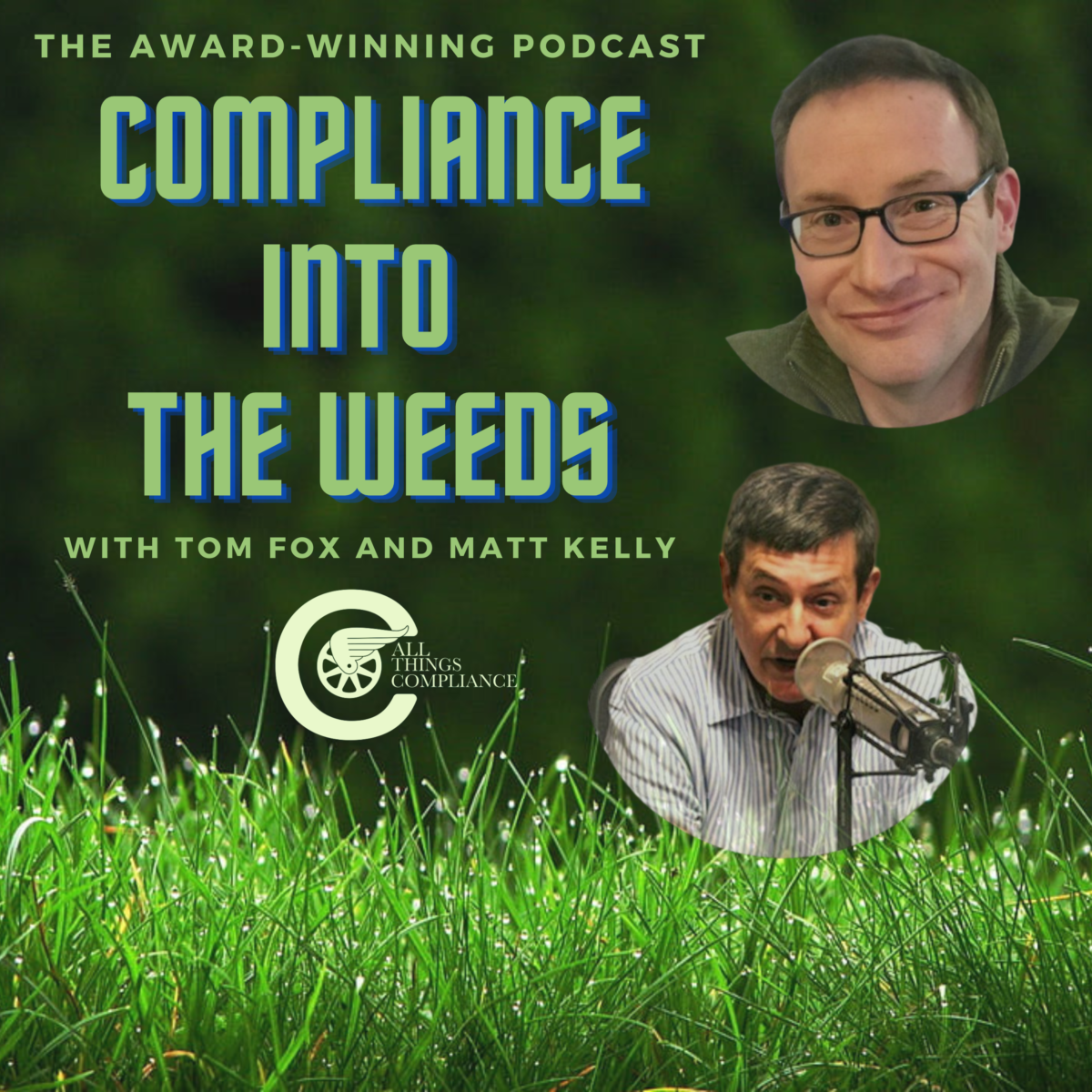
The award-winning Compliance into the Weeds is the only weekly podcast that takes a deep dive into a compliance-related topic, literally going into the weeds to more fully explore a subject. Looking for some hard-hitting insights on sanctions compliance? Look no further than Compliance into the Weeds! In this episode, Tom and Matt take a deep dive into the recent FTC enforcement action involving Rite-Aid and its inappropriate use of AI-generated facial recognition.

The adoption of AI technologies, as demonstrated by the Rite Aid case, underscores the critical need for robust compliance oversight. This case, involving the use of AI-driven facial recognition technology, resulted in compliance risks and a high rate of false positives, highlighting the potential pitfalls of AI technologies when not properly managed. Tom emphasized the importance of a comprehensive process to assess, manage, and monitor the risks associated with new technologies. He believes that collaboration among different stakeholders is key to understanding and mitigating potential risks. Matt stressed the need for careful consideration of how new technologies will impact business processes and the importance of correct governance from both a technical and human perspective. Join Tom Fox and Matt Kelly in this episode of the Compliance into the Weeds podcast as they delve deeper into the importance of robust governance in adopting AI technologies.

Key Highlights:

  • The Impact of AI Facial Recognition Technology
  • Concerns of AI Facial Recognition and Racial Profiling
  • Issues with AI Facial Recognition Training
  • Collaborative Risk Management for AI Implementation

Resources:

Matt Kelly on LinkedIn

Matt on Radical Compliance

 Tom 

Instagram

Facebook

YouTube

Twitter

LinkedIn