Categories
AI Today in 5

AI Today in 5: October 15, 2025, The White House Target Edition

Welcome to AI Today in 5, the newest edition to the Compliance Podcast Network. Each day, Tom Fox will bring you 5 stories about AI, so start your day, sit back, enjoy a cup of morning coffee, and listen in to the AI Today In 5, all from the Compliance Podcast Network. Each day, we consider four stories from the business world, compliance, ethics, risk management, leadership, or general interest related to AI.

Top AI stories include:

  1. AI assistant for loan compliance. (Housing Wire)
  2. AI for customer outreach compliance. (Business Wire)
  3. Streamlining compliance for marketing with AI. (CMS Wire)
  4. Anthropic is a WH target. (Bloomberg)
  5. OpenAI has a 5-year plan to spend $1tn. (FT)

For more information on the use of AI in Compliance programs, my new book, Upping Your Game, is available. You can purchase a copy of the book on Amazon.com.

Categories
Compliance Tip of the Day

Compliance Tip of the Day – Monitoring and Improvement of Internal Controls

Welcome to “Compliance Tip of the Day,” the podcast where we bring you daily insights and practical advice on navigating the ever-evolving landscape of compliance and regulatory requirements. Whether you’re a seasoned compliance professional or just starting your journey, we aim to provide you with bite-sized, actionable tips to help you stay on top of your compliance game. Join us as we explore the latest industry trends, share best practices, and demystify complex compliance issues to keep your organization on the right side of the law. Tune in daily for your dose of compliance wisdom, and let’s make compliance a little less daunting, one tip at a time.

This week, we consider issues around internal controls in a best practices compliance program. Today, we consider how to monitor and improve your internal controls.

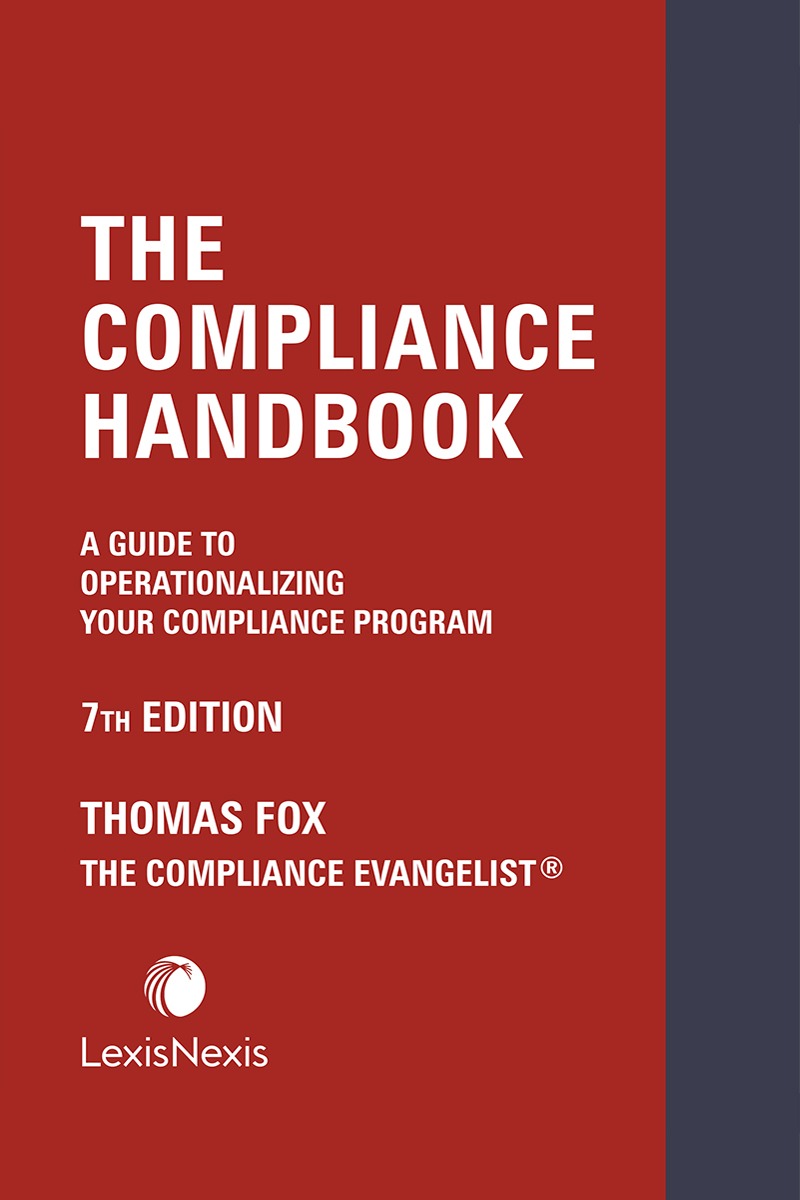
For more on this topic, check out The Compliance Handbook: A Guide to Operationalizing Your Compliance Program, 6th edition, which LexisNexis recently released. It is available here.

Categories
Blog

From a Wake to Global Greatness: Compliance Lessons from the Creation of Les Misérables

The New York Times recently ran an article on the creation of the play Les Misérables. When the show premiered at London’s Barbican Theatre in 1985, the creative team celebrated with champagne and optimism. But by the next morning, that optimism had curdled. Critics savaged the show, The Evening Standard called it a “glum opera,” and The Daily Mail mocked it as “ripples of cheap sentiment.” Yet forty years later, the musical has become a global juggernaut: 15,500 London performances, translations into 22 languages, and productions across 53 countries.

How did a project that began as a critical failure turn into one of the most beloved works of modern theatre? The answer lies in the same principles that define a strong corporate compliance program: resilience, continuous improvement, and purpose-driven leadership. Today, I want to use this most beloved story behind Les Misérables (Les Miz) to explore lessons for compliance professionals seeking to build programs that endure, inspire, and transform.

Act I: Facing the Critics – Resilience in the Face of Failure

Producer Cameron Mackintosh had just 48 hours after opening night to decide whether to fund a West End transfer. With negative reviews piling up, the rational business decision might have been to pull the plug. But Mackintosh did not because he listened to a different source of data: the public. Within days, the Barbican box office was inundated with calls. Demand skyrocketed. Word of mouth triumphed over the headlines. Mackintosh saw that passion and persistence, not panic, should guide his decision-making. (IE., Cool, Calm, and Collected)

For compliance officers, this moment is instructive. Programs often face early resistance: executives skeptical of costs, employees fatigued by training, or media narratives about “bureaucracy over business.” Like Mackintosh, compliance leaders must look beyond the immediate criticism and focus on long-term trust indicators: employee engagement, internal reporting rates, and cultural alignment. As John Caird, one of the show’s co-directors, later recalled, “It was two or three days of worry. Then it became apparent this thing was unstoppable.” That’s what resilient leadership looks like. It is the courage to hold the line until values prove their worth.

Act II: Reinvention and Collaboration – Building Through Continuous Improvement

The original French production of Les Misérables was a creation of Claude-Michel Schönberg and Alain Boublil. It was little more than “a series of tableaux.” To bring it to London, Mackintosh assembled a powerhouse team: Caird, Trevor Nunn, and poet James Fenton. Together, they reshaped the story, studied Victor Hugo’s 1,400-page novel, and discovered a central truth: the conflict between forgiveness and justice.

When the scene of Jean Valjean stealing silver from a bishop was reimagined to include the bishop’s forgiveness, the show found its soul. As Caird put it, “Sewing God into the show was what animated the characters.”  In compliance terms, that’s equivalent to finding your “why.” Many programs begin as checklists: rules, policies, and audits. But the real power comes when compliance discovers its animating purpose: integrity, fairness, and the belief in redemption.

And the Les Misérables team did not stop improving. Even weeks before opening, they were rewriting scenes and composing new music. The haunting ballad “Bring Him Home,” for instance, was added at the eleventh hour to showcase Colm Wilkinson’s voice. A lyric change from “the song of common men” to “the song of angry men” captured the fire of revolution and made the anthem unforgettable. That kind of iterative creativity mirrors modern compliance practice. Programs thrive when they are dynamic. When risk assessments lead to policy refinements, when whistleblower feedback reshapes processes, and when technology brings fresh insight into employee behavior. Continuous monitoring and improvement are not simply boxes to check; instead, they are the lifeblood of sustained success.

Act III: Mission, Meaning, and the Power of Emotion

What ultimately made Les Misérables unstoppable was not just the music or the staging. It was emotion and story. The raw humanity of people struggling against injustice. Audiences from Shanghai to São Paulo connected to Jean Valjean’s redemption, Fantine’s suffering, and the students’ defiance on the barricades. The musical’s emotional resonance even crossed from stage to real life. During the Tiananmen Square protests in 1989, members of the Los Angeles cast watched the news backstage, then went out to sing “Do You Hear the People Sing?” with renewed intensity. “We were singing to empower them,” one actor said.

That is what great art and great compliance can do: inspire people to act on their values. A compliance culture isn’t sustained by fear of enforcement but by belief in purpose. When employees see compliance not as control but as conscience, they become part of something larger. Les Misérables endures because its story is universal. As Caird reflected, “Deep down, so many members of the audience feel the same sense of fate or destiny about their own life journeys.” Compliance, too, speaks to that inner struggle, doing the right thing when no one’s watching, holding fast to integrity under pressure, and believing that redemption is possible even after mistakes.

Act IV: Governance, Adaptation, and Global Legacy

Even as Les Misérables became a global brand, its creative and business stewards never lost sight of governance. The show’s licensing model ensures consistent quality worldwide. Each local production is supported by an extensive oversight network, a framework that any compliance professional would recognize as a control environment.

The show’s adaptability has also been key to its longevity. From Paris to London, from Broadway to Shanghai, the creative team allowed for local variation without losing the show’s ethical and emotional core. For compliance, the essence of risk-based design is adapting policies and procedures to the local context while maintaining global standards.

The duality of consistency and flexibility is the hallmark of resilient compliance systems. Whether you’re dealing with data privacy laws in the EU or anti-bribery rules in emerging markets, the goal is the same: uphold integrity, but adapt intelligently.

Curtain Call: The Compliance Lessons from Les Misérables

Forty years on, Les Misérables remains not just a musical but a movement. Its improbable rise from derision to dominance reflects the same principles that make compliance programs succeed in the long run. Here are three key lessons for today’s compliance professionals:

1. Resilience Over Reputation. Critics will come, whether they are journalists, executives, or employees, and they will be skeptical of compliance initiatives. What matters is endurance. Listen to feedback, adapt when necessary, but stay rooted in purpose. Like Mackintosh, bet on the long-term power of doing what’s right, not what’s popular.

2. Continuous Reinvention Is Compliance Excellence. Les Misérableswas refined until every lyric and note supported the story. Similarly, compliance programs must be living systems. They must constantly be assessed, tested, and evolved. Success comes not from a perfect launch but from perpetual improvement.

3. Emotion and Ethics Drive Engagement. What made Les Misérablesunforgettable was not its spectacle but rather its soul. The same applies to compliance. Rules deter misconduct; stories inspire integrity. Embed humanity into your messaging. Celebrate courage. Encourage second chances. Compliance is not about fear. It is about belief.

Final Encore

From the opening-night “wake” to four decades of standing ovations, Les Misérables proves that greatness often begins in adversity. For compliance professionals, the lesson is clear: Build programs with purpose, persistence, and passion. Like Valjean himself, a great compliance culture does not just survive, it redeems, inspires, and endures.

Categories
Life with GDPR

A Compliance Roadmap for ADS/ADMT – Part 2: Understanding Opt-In and Opt-Out Requirements

Welcome to a special series on Life with GDPR. Over the next five episodes, Tom Fox and Alyssa DeSimone, a legal/compliance & risk management expert, with an extensive background in HR,  will discuss the complex topic of a Compliance Roadmap for ADS/ADMT.

In this second episode, Tom Fox and Alyssa DeSimone review the opt-in and opt-out requirements introduced in the recent updates to the California Consumer Privacy Act (CCPA). They discuss what opting in and out entails, the concept of anti-retaliation in this context, and how disparate impact analysis can help regulators assess compliance. Additionally, they explore the importance of clear communication and training for HR departments on the use of AI in hiring, as well as the role of vendors in ensuring compliance. The episode wraps up with a discussion on the ambiguous term ‘significant decision making’ and its potential for litigation.

Key highlights:

  • Understanding Opt-In and Opt-Out Requirements
  • Anti-Retaliation Measures
  • Disparate Impact Analysis
  • Applicant Rights and Training
  • Vendor Collaboration and Compliance
  • Significant Decision Making

Resources:

Connect with Tom Fox

Connect with Alyssa DeSimone

Life with GDPR was recently honored as a Top Data Security Podcast

Categories
Compliance Tip of the Day

Compliance Tip of the Day – A Failure in Internal Controls

Welcome to “Compliance Tip of the Day,” the podcast where we bring you daily insights and practical advice on navigating the ever-evolving landscape of compliance and regulatory requirements. Whether you’re a seasoned compliance professional or just starting your journey, we aim to provide you with bite-sized, actionable tips to help you stay on top of your compliance game. Join us as we explore the latest industry trends, share best practices, and demystify complex compliance issues to keep your organization on the right side of the law. Tune in daily for your dose of compliance wisdom, and let’s make compliance a little less daunting, one tip at a time.

This week, we consider issues around internal controls in a best practices compliance program. Today, we consider how a single control override led to a catastrophic control failure and an FCPA enforcement action.

For more on this topic, check out The Compliance Handbook: A Guide to Operationalizing Your Compliance Program, 6th edition, which LexisNexis recently released. It is available here.

Categories
Life with GDPR

A Compliance Roadmap for ADS/ADMT – Part 1: Introduction & Jurisdiction

Welcome to a special series on Life with GDPR. Over the next five episodes, Tom Fox and Alyssa DeSimone, a legal/compliance & risk management expert with an extensive background in HR, will discuss the complex topic of a Compliance Roadmap for ADS/ADMT.

In this first episode, we break down the essentials of ADS/ADMT, focusing on who is covered, the nuances of jurisdiction, and the broader business implications of evolving employment laws. ADS is an automated decision system, and ADMT is an automated decision-making technology. Whether you are an HR professional, compliance professional, or legal eagle, this discussion will help you navigate the complexities of compliance in a changing legal landscape.

Key highlights:

  • What is ADS/ADMT?
  • Applies to 5+ employees (including part-time/out-of-state).
  • Coverage limits for out-of-state conduct.
  • Jurisdiction can reach beyond California.
  • Risk mitigation tips for businesses.

Resources:

Connect with Tom Fox

Connect with Alyssa DeSimone

Life with GDPR was recently honored as a Top Data Security Podcast

Categories
Compliance Tip of the Day

Compliance Tip of the Day – Rev Rec, Internal Controls and Compliance

Welcome to “Compliance Tip of the Day,” the podcast that brings you daily insights and practical advice on navigating the ever-evolving landscape of compliance and regulatory requirements. Whether you’re a seasoned compliance professional or just starting your journey, our goal is to provide you with bite-sized, actionable tips to help you stay ahead in your compliance efforts. Join us as we explore the latest industry trends, share best practices, and demystify complex compliance issues to keep your organization on the right side of the law. Tune in daily for your dose of compliance wisdom, and let’s make compliance a little less daunting, one tip at a time.

This week, we consider issues around internal controls in a best practices compliance program. Today, we consider the inter-relationship of revenue recognition, internal controls, and compliance.

For more on this topic, check out The Compliance Handbook: A Guide to Operationalizing Your Compliance Program, 6th edition, which LexisNexis recently released. It is available here.

Categories
Blog

Nights in White Compliance: Lessons from John Lodge and the Moody Blues for Today’s Compliance Professional

1, 2, 3, 4. While that sequence is well known, it is also one of the greatest rock n’ roll count-ins. It opens the John Lodge-written song “Ride My See Saw” by The Moody Blues. We lost John Lodge last week. The Moody Blues are in my top 5 bands of all time and were one of the leading lights of progressive (prog) rock.

According to his New York Times (NYT) obituary, John Lodge and Justin Hayward joined the band in 1966, replacing two founding members, Denny Laine and Clint Warwick. The classic Moody Blues lineup was now in place with Lodge and Hayward, with Mike Pinder on keyboards, Graeme Edge on drums, and Ray Thomas on flute and vocals.

It was their groundbreaking release of the 1967 album, “Days of Future Passed,” that changed rock n’ roll forever. It fused rock and orchestral music, establishing The Moody Blues as pioneers of progressive rock. It was one of the first rock albums to be structured as a concept album, telling a story over a 24-hour cycle. It propelled the band to international success, particularly through the enduring hit single “Nights in White Satin“. It offered elaborate arrangements, lush contributions from the London Festival Orchestra, and the plaintive sound of Mr. Pinder’s Mellotron, an electromechanical keyboard that plays samples of different instruments.

While the Moody Blues had hits for the rest of the century, it was their development of prog rock for which they will always be known. Today, I want to pay tribute to Lodge and explore five timeless lessons compliance professionals can learn from him and from The Moody Blues.

1. Innovation Begins When You Refuse to Accept the Status Quo

When Days of Future Passed was released in 1967, it was unlike anything listeners had ever heard. The Moody Blues combined rock instrumentation with full orchestral arrangements, creating a symphonic concept album that broke every rule of the time. Instead of focusing on singles or radio hits, they presented a continuous musical experience that told a story, a day in the life of ordinary people, elevated to art.

For compliance professionals, the lesson is clear: the most meaningful innovation happens when you refuse to accept “the way it’s always been.” Lodge and his bandmates didn’t abandon structure; they reimagined it. Likewise, modern compliance programs shouldn’t merely follow old templates. Whether it is integrating AI-driven monitoring, developing behavioral analytics, or crafting narrative-based training, progress comes from seeing beyond the checklist and daring to compose something new. In other words, the future of compliance is not mechanical; it is symphonic.

2. Harmony Requires Every Voice

The Moody Blues were more than the sum of their parts. Lodge’s melodic bass anchored Justin Hayward’s soaring vocals, Ray Thomas’s flute added ethereal texture, and Graeme Edge’s drumming provided both rhythm and poetry. Each member contributed a distinct voice, yet they blended perfectly into harmony.

A world-class compliance program operates the same way. No single person or department can carry the tune alone. Compliance requires a cross-functional orchestra; legal, HR, finance, audit, operations all playing from the same score. When departments act in isolation, the result is noise; when they work in harmony, it is music. Lodge’s approach to collaboration reminds us that leadership in compliance is not about conducting with authority but coordinating with empathy. The best Chief Compliance Officers listen as much as they lead.

3. Build Systems That Evolve

Progressive rock, by its very name, implies evolution, the willingness to progress. The Moody Blues constantly evolved their sound: from the baroque experimentation of On the Threshold of a Dream to the electronic textures of Long Distance Voyager. They did not stagnate; they adapted.

Compliance programs, too, must evolve with changing times. Regulations, markets, and technologies shift. What worked in 2015 may be obsolete in 2025. The DOJ’s 2024 Evaluation of Corporate Compliance Programs underscores this need for adaptability, requiring that programs be “dynamic, data-informed, and risk-based.” Lodge’s musical journey embodies that principle. He never let nostalgia stop innovation. Compliance officers should adopt the same mindset, continuously evaluating controls, integrating feedback, and embracing technology to remain relevant. Evolution, not inertia, sustains credibility.

4. Tell a Story That Inspires, Not Just Informs

The Moody Blues were not just musicians; they were storytellers. Songs like Nights in White SatinQuestion, and Isn’t Life Strange resonated because they connected emotionally. They did not lecture; instead, they invited listeners to reflect. Each album was an emotional arc, designed to make people feel, not just think.

That is precisely the challenge and opportunity for compliance communication. Too often, we rely on policies and PowerPoints that inform but fail to inspire. John Lodge understood that engagement requires narrative. Compliance professionals can learn from that: training should tell stories, not recite statutes. Whistleblower programs should humanize courage, not just codify reporting channels. Codes of conduct should speak to values, not just violations. In short, emotion drives ethics. Lodge showed us that communication, when done with authenticity, can change behavior. Compliance leaders should compose their messaging the same way musicians write songs: with heart, structure, and meaning.

5. Legacy Matters More Than Fame

Though The Moody Blues achieved global recognition, they never chased popularity at the expense of integrity. Their albums demanded patience and reflection,  qualities at odds with commercial radio. Yet their influence endures precisely because they valued substance over spectacle. Lodge once said he wanted to “create music that would last.” And it has.

For compliance professionals, this is the ultimate lesson: sustainability over visibility. A compliance program’s success is not measured by awards or press releases but by resilience, the quiet trust employees place in doing the right thing even when no one’s watching. Lodge’s passing reminds us that legacies are built note by note, day by day. In compliance, every investigation handled with fairness, every training delivered with clarity, every policy written with purpose, these are our symphonies. The work may seem routine, but over time, it becomes timeless.

Closing Reflections: From Melodies to Ethics

As we reflect on John Lodge’s contribution to music, we can see the deeper resonance for our own profession. Progressive rock does not simply entertain; it continues to expand what music could be. Likewise, compliance today is no longer a back-office function; rather, it is a driver of culture, innovation, and trust.

Both disciplines, music and compliance, strive for harmony amid complexity. Both require structure balanced with creativity. Both depend on collaboration, communication, and conviction.

So as we say goodbye to John Lodge, perhaps we can also rededicate ourselves to what he and The Moody Blues represented: the belief that art and ethics can elevate humanity. Because in the end, every great compliance program, like every great song, seeks the same outcome: to move people toward something better.

===============================================================

A special thanks to Alison Taylor, who many years ago named me the Rock’ N’ Roll Compliance Blogger. It is my favorite moniker of all time and one I still take seriously. 

Tom’s Top 5 John Lodge Songs (all links from YouTube)

  1. Ride My See Saw – Lodge said of the song, “It started, really, like a lot of my rock ‘n’ roll songs, as a rhythm track building up. “I wanted it to be this chorale, where we’re all singing these harmonies through the song — it’s interesting that way,” he added.
  2. I’m Just a Singer (in a rock n roll band)- Lodge retook the lead for this Top 20 track, the last single of the Moody Blues’ first phase. Lodge’s message was world peace through music, singing that “I’m just a-wandering on the face of this earth/Meeting so many people who are trying to be free…Now we’ve found the key.” The song marked the last time the group used a Mellotron, which was one of its sonic hallmarks, while the saxophone sound came from a Chamberlin keyboard.
  3. (Evening) Time to Get Away – Lodge made his prog rock mark on the group’s thematic masterwork first with “Lunch Break: Peak Hour” but more memorable with the airy “(Evening) Time to Get Away),” part of “The Afternoon” suite that kicked off side two in tandem with Hayward’s “Forever Afternoon (Tuesday?).”
  4. Natural Avenue – Part of the album Lodge and Hayward made together during the Moodys’ hiatus, this kicked off the second side of the album with symphonic bombast. Its theme, established in the title, maintained Lodge’s heartfelt belief in the divine (spiritually more than religiously) power of music.
  5. Gemini Dream – This song emerged from a jam session built from a dance-floor targeted beat, with Lodge’s chugging bass pushing the groove. Lodge’s original title, by the way, was “Touring in the USA,” while Hayward came up with “Backstage Pass;” they settled on “Gemini Dream” as a representation of their dual personalities. It received an ASCAP songwriting award for the track, which reached its No. 12 peak as the Moody’s best for a new song in eight years.

Resources:

Top 10 John Lodge Songs

Categories
FCPA Compliance Report

FCPA Compliance Report – From the Courtroom to Compliance: FCPA Challenges and Strategies with James Koukios

Join Tom Fox as he welcomes back MoFo partner James M. Koukios to discuss the themes and strategies observed in recent FCPA trials and the DOJ’s prosecutorial approach. They explore the importance of making juries care about corruption cases, the themes of abuse of power and financial motive, and the significance of concealment in establishing guilt. The conversation also touches on the future of FCPA trials and the DOJ’s commitment to prosecuting individuals involved in corporate misconduct. And of course, Go Blue!

Key highlights:

  • Making juries care about the impact of corruption is crucial.
  • Abuse of power is a central theme in corruption cases.
  • Concealment of actions indicates consciousness of guilt.
  • Compliance programs must emphasize transparency and documentation.
  • Jurors expect good governance and are sensitive to abuse of power.
  • Financial incentives in corporations should align with compliance.
  • Prosecuting individuals remains a priority for the DOJ.

Resources:

Morrison Foerster

James Koukios

Expect DOJ To Repeat 4 Themes From 2024’s FCPA Trials

Tom Fox

Instagram

Facebook

YouTube

Twitter

LinkedIn

For more information on the use of AI in Compliance programs, my new book, Upping Your Game, is available. You can purchase a copy of the book on Amazon.com.

Categories
AI Today in 5

AI Today in 5: October 10, 2025, The Romantic AI Edition

Welcome to AI Today in 5, the newest edition to the Compliance Podcast Network. Each day, Tom Fox will bring you 5 stories about AI, so start your day, sit back, enjoy a cup of morning coffee, and listen in to the AI Today In 5, all from the Compliance Podcast Network. Each day, we consider four stories from the business world, compliance, ethics, risk management, leadership, or general interest related to AI.

Top AI stories include:

  1. How does AI think? (WSJ)
  2. Can you trust your eyes anymore? (NYT)
  3. 20% of high schoolers have romantic relationships with AI. (NPR)
  4. Saunders says AI will cost 100MM jobs. (Yahoo!News)
  5. Data quality and AI. (Global Newswire)